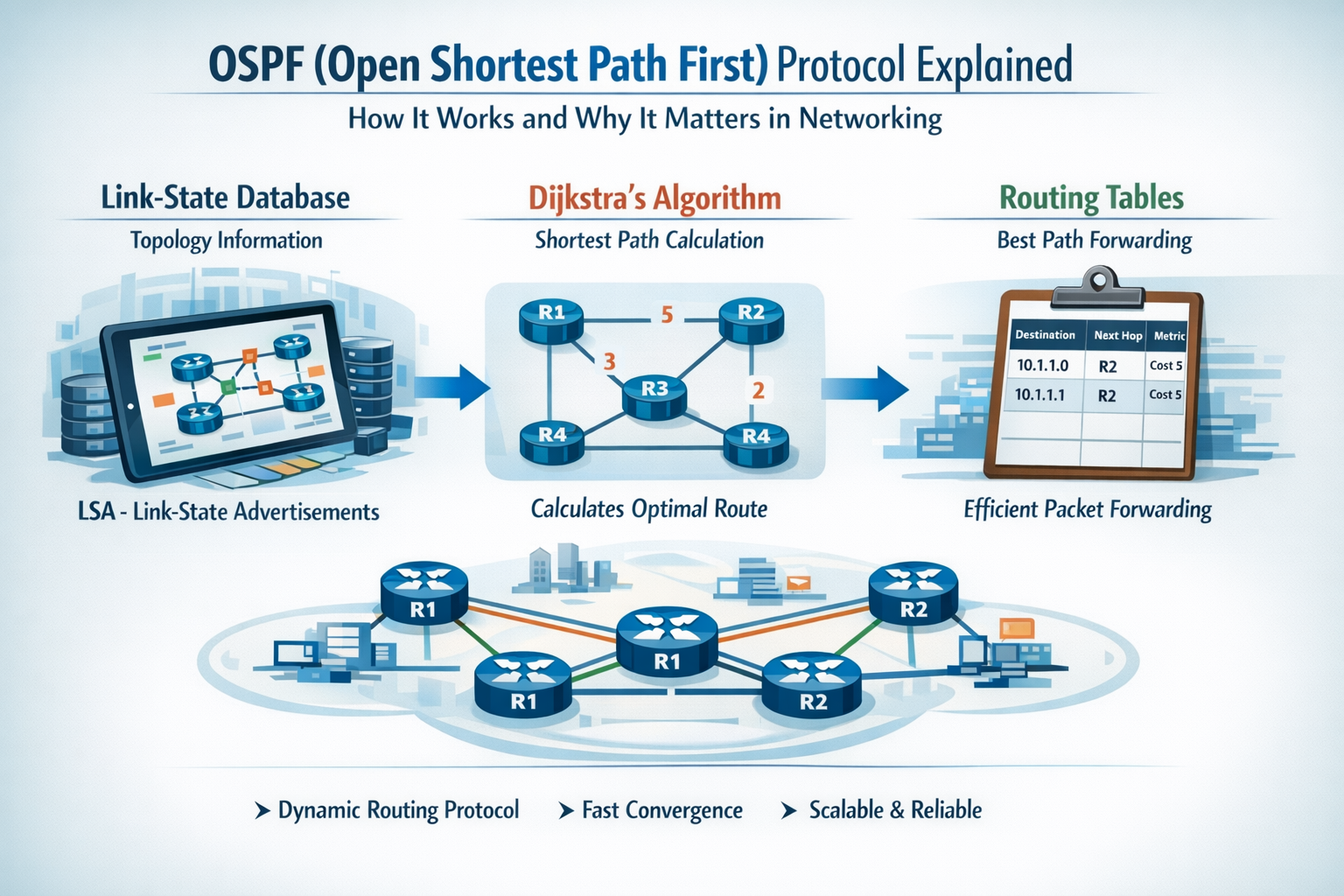
OSPF is one of the most important interior gateway routing protocols used in modern computer networks. It is designed to efficiently manage how data travels between routers within a large and complex network. Unlike simpler routing methods, OSPF is built to adapt quickly to changes, scale smoothly as networks grow, and maintain accurate routing information across all devices. It is widely used in enterprise environments where stability, speed, and reliability are critical for communication.
Fundamental Concept of OSPF
At its core, OSPF is a link-state routing protocol. This means that instead of simply passing routing tables from one router to another, each router shares detailed information about its directly connected links. Every router then uses this shared information to build a complete map of the network. This map is not guessed or partially known; it is a synchronized and consistent view that exists independently on every router.
Once the network map is built, each router calculates the best possible paths to all destinations using a shortest path algorithm. This ensures that data always travels through the most efficient route available at any given moment. The result is reduced latency, improved performance, and better utilization of network resources.
Role of Link-State Advertisements in OSPF
A key mechanism that allows OSPF to function is the use of Link-State Advertisements. These are small packets of information that routers exchange with each other. Each advertisement contains details about the state of a router’s connections, including which networks it is directly connected to and the cost associated with those connections.
When a router receives these advertisements, it stores them in a database that represents the entire network structure. This database is identical across all routers in the same area, ensuring consistency. As changes occur in the network, new advertisements are sent, allowing routers to update their understanding dynamically without needing to rebuild everything from scratch.
Building the Network Topology Database
Every OSPF router maintains a database known as the link-state database. This database acts as a complete representation of the network’s topology. It is not a routing table itself but rather the foundation from which routing tables are built.
The process begins when routers discover their neighbors. Once neighbor relationships are formed, they exchange link-state information. As more data is collected, each router independently constructs an identical map of the network. This synchronized view is one of the key strengths of OSPF, as it eliminates confusion and reduces routing inconsistencies.
Shortest Path First Algorithm in OSPF
After the topology database is built, OSPF uses a mathematical approach known as the Shortest Path First algorithm to determine the best routes. This algorithm evaluates all possible paths from one router to every destination and selects the path with the lowest cost.
Cost in OSPF is typically based on bandwidth. Higher bandwidth links are assigned lower cost values, making them more desirable for routing traffic. This ensures that data is always routed through the most efficient links available rather than just the shortest physical distance.
The algorithm continuously recalculates routes whenever there is a change in the network, ensuring that routing decisions remain accurate and optimized at all times.
Hierarchical Structure and OSPF Areas
One of the most powerful features of OSPF is its ability to divide large networks into smaller sections known as areas. This hierarchical design helps improve efficiency and reduce unnecessary routing overhead.
Each area operates as a smaller independent network within the larger OSPF system. Routers within the same area share detailed topology information, while communication between different areas is more controlled and summarized. This reduces the amount of routing information that needs to be processed and stored, making the network more scalable and easier to manage.
The backbone area plays a central role in connecting all other areas together. It acts as the core through which inter-area traffic is routed, ensuring connectivity across the entire network structure.
Neighbor Discovery Process in OSPF
Before routers can exchange routing information, they must first discover and establish relationships with neighboring routers. This process begins with the exchange of hello packets. These packets are sent periodically to detect nearby routers and maintain active connections.
Once two routers recognize each other and agree on certain parameters, they form what is known as a neighbor relationship. If conditions are fully compatible, this relationship can progress to a more advanced state where full routing information is exchanged. This structured approach ensures that only valid and properly configured routers participate in the network.
DR and BDR Election Mechanism
In networks with multiple routers connected to the same segment, OSPF uses a special mechanism to reduce unnecessary communication. It selects a Designated Router and a Backup Designated Router to manage information exchange on that segment.
The Designated Router acts as a central point for exchanging routing information, reducing the number of direct connections required between routers. The Backup Designated Router takes over if the primary one fails. This system improves efficiency and reduces network traffic, especially in broadcast networks.
Metric Calculation and Route Selection
OSPF uses a cost-based metric system to determine the best path for data transmission. Each link in the network is assigned a cost value, usually based on its bandwidth. Faster links have lower costs, making them more attractive for routing decisions.
When multiple paths exist to the same destination, OSPF compares their total costs and selects the path with the lowest cumulative value. This ensures that traffic is always directed through the most efficient route available.
In cases where multiple paths have equal cost, OSPF can perform load balancing by distributing traffic across those paths, improving overall network performance.
Fast Convergence and Network Adaptability
One of the most important advantages of OSPF is its ability to quickly adapt to network changes. When a link fails or a new route becomes available, OSPF rapidly updates its topology database and recalculates routes.
This fast convergence minimizes downtime and ensures that data continues to flow with minimal interruption. Unlike slower routing protocols that may take longer to respond, OSPF is designed for environments where real-time communication and reliability are essential.
Scalability in Large Networks
OSPF is highly scalable, making it suitable for both small and extremely large networks. Its hierarchical area design ensures that even as the network grows, routing information remains manageable.
By limiting detailed topology sharing to individual areas and summarizing information between them, OSPF reduces processing overhead on routers. This allows large organizations and service providers to maintain efficient network performance without overwhelming their infrastructure.
Efficiency and Resource Optimization
Another important aspect of OSPF is its efficient use of network resources. Since it only updates routing information when changes occur, rather than continuously sending full routing tables, it significantly reduces bandwidth usage.
Additionally, its intelligent path selection ensures that network traffic is distributed in a balanced and optimized way. This helps prevent congestion and improves the overall stability of the network.
Security Considerations in OSPF
OSPF also includes authentication mechanisms to ensure that only authorized routers can participate in the routing process. This helps prevent malicious devices from injecting false routing information into the network.
Authentication can be configured so that routers verify each other before exchanging data. This adds an important layer of security in environments where network integrity is critical.
Importance of OSPF in Modern Networking
OSPF continues to be one of the most widely adopted routing protocols due to its balance of performance, scalability, and reliability. It is particularly valuable in enterprise networks, data centers, and service provider infrastructures where efficient routing is essential.
Its ability to quickly adapt to changes, manage large networks, and optimize routing paths makes it a foundational technology in modern networking systems. Even as newer technologies emerge, OSPF remains a critical protocol for ensuring stable and efficient data communication across complex environments.
OSPF Packet Types and Their Role in Communication
OSPF relies on a set of specialized packet types to manage communication between routers and maintain an updated view of the network. Each packet type has a specific purpose, ensuring that routers can discover neighbors, exchange topology information, and maintain synchronization efficiently. These packets are lightweight but highly structured, allowing OSPF to operate with precision even in large-scale environments.
The main packet types include Hello packets, Database Description packets, Link-State Request packets, Link-State Update packets, and Link-State Acknowledgment packets. Each of these plays a unique role in the lifecycle of routing information exchange.
Hello packets are responsible for discovering and maintaining neighbor relationships. They are sent periodically between routers to confirm that connections are still active. If a router stops receiving Hello packets from a neighbor, it assumes that the neighbor is no longer reachable and updates its topology accordingly.
Database Description packets are used during the initial synchronization process between routers. They provide a summary of the link-state database so that routers can compare their information and determine what updates are needed.
Link-State Request packets are sent when a router identifies missing or outdated information in its database. It uses these packets to request specific details from its neighbors.
Link-State Update packets carry the actual routing information, such as link-state advertisements. These updates ensure that all routers maintain an identical and accurate view of the network.
Link-State Acknowledgment packets confirm the receipt of updates, ensuring reliability in communication and preventing data loss.
OSPF Neighbor States and Formation Process
Before routers can fully exchange routing information, they go through a series of defined states that represent the progress of their relationship. This structured process ensures stability and prevents errors in routing exchanges.
The process begins with the Down state, where no communication has yet been established. When a router sends or receives a Hello packet, it transitions to the Init state, indicating that a neighbor has been detected.
Next is the Two-Way state, where both routers recognize each other and confirm bidirectional communication. In broadcast networks, this is often where routers decide whether to proceed with full adjacency or not.
If routers are selected to exchange full routing information, they move into the ExStart state, where they negotiate master-slave roles for database exchange. This is followed by the Exchange state, where database descriptions are shared.
The Loading state occurs when routers request missing information using Link-State Request packets. Finally, when all databases are synchronized, the routers reach the Full state, indicating complete adjacency and full routing exchange capability.
Types of Link-State Advertisements in OSPF
Link-State Advertisements are the foundation of OSPF’s routing intelligence. There are several types of LSAs, each serving a specific purpose in representing the network topology.
Router LSAs describe the links of a router within a single area. They provide detailed information about directly connected networks and costs associated with those links.
Network LSAs are generated by Designated Routers and represent multi-access networks. They help simplify communication in broadcast segments.
Summary LSAs are used to describe routes between different areas. They help reduce complexity by summarizing detailed information into compact form.
External LSAs represent routes that originate outside the OSPF domain, such as routes redistributed from other routing protocols.
Each LSA type contributes to building a complete and structured view of the network while minimizing unnecessary data exchange.
OSPF Cost Calculation and Path Selection Logic
The concept of cost is central to how OSPF determines the best path for routing data. Cost is typically calculated based on the bandwidth of a link, with higher bandwidth links receiving lower cost values.
The formula used is generally based on a reference bandwidth divided by the interface bandwidth. This ensures that faster links are preferred over slower ones.
When multiple paths exist to a destination, OSPF evaluates the total accumulated cost of each route. The route with the lowest total cost is selected as the best path.
If multiple paths have identical costs, OSPF can perform equal-cost load balancing, distributing traffic across all available routes to optimize performance and reduce congestion.
OSPF Areas and Advanced Hierarchical Design
The division of OSPF networks into areas is one of its most powerful scalability features. Beyond simple segmentation, OSPF areas are designed to optimize routing efficiency and reduce computational overhead.
The backbone area, often referred to as Area 0, serves as the central point for inter-area communication. All other areas must connect to this backbone, either directly or through virtual links.
Internal routers operate entirely within a single area and maintain full knowledge of that area’s topology. Area Border Routers connect multiple areas and manage the exchange of summarized routing information between them.
Autonomous System Boundary Routers connect OSPF networks to external routing domains, allowing integration with other protocols and external networks.
This structured hierarchy ensures that large networks remain manageable and efficient even as they scale significantly.
Route Summarization in OSPF
Route summarization is an important technique used in OSPF to reduce the size of routing tables and improve performance. Instead of advertising every individual route, routers can group multiple routes into a single summary.
This reduces the amount of routing information that must be processed and stored, leading to faster convergence and lower memory usage.
Summarization is typically performed at area boundaries, where Area Border Routers aggregate routes before advertising them to other areas. This helps maintain a clean separation between different sections of the network.
OSPF Virtual Links and Their Purpose
In some network designs, it may not be possible for all areas to directly connect to the backbone area. In such cases, OSPF supports virtual links, which act as logical connections between routers.
A virtual link allows an area to connect to the backbone through another intermediate area. This ensures that the hierarchical structure of OSPF remains intact even in complex or imperfect network topologies.
While virtual links are useful for flexibility, they are generally considered a temporary or design workaround rather than a preferred long-term solution.
OSPF Authentication and Security Mechanisms
Security is an important aspect of OSPF, especially in environments where multiple administrators or networks are involved. OSPF supports authentication to ensure that only trusted routers participate in routing exchanges.
Authentication can be configured in different modes, including simple password authentication and more secure cryptographic methods. When authentication is enabled, routers must verify each other before exchanging routing information.
This helps prevent unauthorized devices from injecting false routes, which could disrupt network traffic or create security vulnerabilities.
OSPF Timers and Network Stability Control
OSPF uses several timers to maintain stability and control the frequency of updates. The Hello interval determines how often Hello packets are sent, while the Dead interval defines how long a router waits before declaring a neighbor unreachable.
These timers must be consistent between neighboring routers to ensure proper communication. If they are mismatched, adjacency formation will fail.
Additional timers control the frequency of retransmissions and database updates, helping balance responsiveness with network efficiency.
OSPF Convergence Behavior and Performance Optimization
Convergence refers to the time it takes for all routers in a network to agree on the current topology after a change occurs. OSPF is designed for fast convergence, meaning it quickly adapts to failures or modifications in the network.
When a link goes down, affected routers immediately generate new link-state advertisements. These updates are flooded throughout the network, and all routers recalculate their routing tables using the updated information.
This rapid response ensures minimal disruption to traffic and maintains network stability even during failures.
Route Redistribution in OSPF Networks
OSPF often operates alongside other routing protocols in real-world networks. Route redistribution allows OSPF to exchange routing information with other protocols.
This process enables seamless communication between different network domains. However, redistribution must be carefully managed to avoid routing loops or inconsistencies.
Metrics and filters are often used to control how external routes are introduced into OSPF, ensuring stability and predictability.
OSPF Advantages in Real-World Deployment
OSPF offers several advantages that make it suitable for modern network environments. Its ability to scale efficiently allows it to support both small enterprise networks and large service provider infrastructures.
Its fast convergence ensures minimal downtime, while its hierarchical design reduces unnecessary routing overhead. The use of cost-based metrics provides intelligent path selection, improving performance and reliability.
Additionally, its support for authentication and flexible design options makes it adaptable to a wide range of network requirements.
Common Challenges in OSPF Implementation
Despite its strengths, OSPF can be complex to configure and maintain. Proper area design is critical, as poor planning can lead to inefficiencies or routing issues.
Mismatched configurations, such as inconsistent timers or authentication settings, can prevent neighbor relationships from forming. Large networks may also require careful tuning to ensure optimal performance.
Understanding the underlying structure and behavior of OSPF is essential for successful deployment and troubleshooting.
OSPF in Modern Network Architectures
Today, OSPF remains a foundational protocol in enterprise and service provider networks. It is often used alongside newer technologies but continues to play a critical role in internal routing.
Its balance of flexibility, efficiency, and reliability ensures that it remains relevant even in evolving network environments. As networks continue to grow in complexity, OSPF’s structured and scalable design makes it a dependable choice for managing routing at scale.
OSPF Design Considerations in Real Networks
Designing an OSPF network is not just about enabling the protocol on routers; it requires careful planning to ensure stability, efficiency, and scalability. A well-designed OSPF deployment considers how areas are structured, how routers are placed, and how traffic flows across the network. Poor design can lead to excessive routing overhead, slow convergence, or even instability in large environments.
One of the most important design principles is keeping the backbone area stable and simple. Since all inter-area traffic depends on it, any issues in the backbone can affect the entire network. Engineers often design the backbone with high-reliability links and redundant paths to avoid single points of failure.
Another key consideration is limiting the size of each area. Smaller areas reduce the amount of link-state information each router must process, which improves performance and reduces memory usage. At the same time, areas should not be too fragmented, as that can complicate routing and increase administrative overhead.
Role of Backbone Area in OSPF Stability
The backbone area, often referred to as Area 0, is the central hub of all OSPF routing activity. Every other area must connect to it directly or indirectly. This design ensures that all inter-area traffic flows through a consistent and controlled path.
The backbone acts as a distribution layer, carrying summarized routing information between different areas. This reduces the complexity of routing tables and ensures that routers outside the backbone do not need to know every detail of the entire network.
Maintaining a stable backbone is critical for network health. Any instability in this area can cause widespread routing recalculations, affecting performance across multiple segments of the network.
OSPF Scalability in Large Enterprise Networks
One of the reasons OSPF is widely used is its ability to scale effectively in large environments. Through its hierarchical structure, it can handle thousands of routers without overwhelming the network with excessive routing information.
As networks grow, OSPF areas help distribute the workload. Instead of every router processing every route in the network, each router only focuses on its local area and summarized external information. This significantly reduces CPU and memory consumption.
Additionally, route summarization at area boundaries further improves scalability by reducing the number of routes advertised across the network. This allows OSPF to remain efficient even as complexity increases.
OSPF in Service Provider Environments
In service provider networks, OSPF is often used as an internal routing protocol to manage infrastructure connectivity. It provides fast convergence and reliable path selection, which are essential for maintaining service quality.
Service providers often combine OSPF with other protocols for external routing, but OSPF remains the backbone of internal communication. Its ability to adapt quickly to link failures ensures minimal service disruption.
Large-scale deployments may involve multiple OSPF areas and carefully engineered backbone structures to ensure high availability and performance across geographically distributed networks.
OSPF Convergence Optimization Techniques
While OSPF is already designed for fast convergence, network engineers often apply additional optimization techniques to improve performance further. These include tuning timers, optimizing area design, and adjusting cost metrics for better traffic distribution.
Reducing unnecessary link-state flooding is another important optimization strategy. By controlling how updates are propagated, networks can reduce overhead and improve stability.
In modern high-speed networks, even small improvements in convergence time can significantly impact user experience, especially in latency-sensitive applications such as voice or video communication.
Impact of OSPF on Network Traffic Engineering
OSPF plays an important role in traffic engineering by influencing how data flows through a network. Since it uses cost-based routing, administrators can manipulate link costs to control path selection.
By adjusting interface costs, network engineers can direct traffic through preferred paths, balance loads across multiple links, or avoid congested routes. This level of control allows for efficient use of available bandwidth.
However, improper cost manipulation can lead to suboptimal routing or unexpected traffic patterns, so careful planning is required when making such adjustments.
OSPF and Redundancy in Network Design
Redundancy is a key principle in modern network design, and OSPF supports it naturally through its dynamic routing capabilities. When multiple paths exist between routers, OSPF can automatically switch to backup routes if the primary path fails.
This redundancy ensures continuous connectivity even during hardware failures or link outages. Equal-cost multi-path routing further enhances redundancy by allowing multiple active paths simultaneously.
By combining redundancy with fast convergence, OSPF helps maintain high availability in critical network environments.
OSPF Virtual Link Usage Scenarios
Although not commonly used in ideal designs, virtual links provide a useful solution in certain scenarios where direct backbone connectivity is not possible. They allow routers in non-backbone areas to logically connect to the backbone through intermediate areas.
This mechanism helps maintain OSPF hierarchy in networks with design limitations or legacy constraints. However, virtual links can introduce complexity and are generally avoided in modern optimized designs.
When used, they must be carefully monitored to ensure stability and prevent routing inconsistencies.
OSPF Database Synchronization Process
The synchronization of link-state databases is a critical part of OSPF operation. When two routers form an adjacency, they must ensure that their databases match exactly.
This process involves exchanging summaries of link-state information, identifying missing entries, and requesting updates where needed. Once synchronization is complete, both routers have identical views of the network.
This consistency is essential for accurate routing decisions and prevents loops or inconsistencies in traffic forwarding.
OSPF Packet Flooding Mechanism
OSPF uses a controlled flooding mechanism to distribute link-state information across the network. When a router receives new information, it forwards it to all its neighbors except the one from which it received it.
This ensures that updates spread quickly and efficiently throughout the network without unnecessary duplication. Each router also keeps track of received information to prevent processing the same update multiple times.
This flooding mechanism is key to maintaining synchronized topology databases across all routers in an OSPF area.
OSPF Troubleshooting Fundamentals
Troubleshooting OSPF requires understanding its neighbor relationships, database synchronization, and routing calculations. One of the most common issues is failure to form neighbor adjacencies, often caused by mismatched configurations such as timers, area IDs, or authentication settings.
Another common issue is missing routes, which can result from improper area design or incorrect summarization. Examining the link-state database and neighbor states helps identify where problems occur.
Effective troubleshooting involves checking each stage of OSPF operation, from neighbor discovery to route installation.
OSPF Performance in High-Density Networks
In high-density networks with many routers and links, OSPF must efficiently manage large amounts of routing information. Its hierarchical design helps distribute this load, but proper planning is still essential.
Too many routers in a single area can lead to excessive flooding of link-state updates, increasing CPU usage. Splitting networks into multiple areas helps mitigate this issue.
Additionally, careful control of route summarization and update frequency ensures that performance remains stable even under heavy load.
OSPF Interaction with Other Routing Protocols
In real-world environments, OSPF often operates alongside other routing protocols. This requires careful coordination to ensure consistent routing behavior across the network.
Route redistribution allows information to flow between OSPF and other protocols, but it must be managed carefully to avoid routing loops or inconsistencies. Metrics and filtering rules are commonly used to control how routes are exchanged.
Proper integration ensures seamless communication between different network domains while maintaining stability.
OSPF Reliability and Fault Tolerance
OSPF is inherently reliable due to its design, which continuously monitors network topology and adapts to changes. If a link fails, the protocol quickly recalculates routes and updates all affected routers.
This fault tolerance ensures that network disruptions are minimized and traffic is rerouted efficiently. Combined with redundancy and fast convergence, OSPF provides a highly resilient routing solution.
Its ability to maintain consistent operation even in unstable environments is one of its most valuable characteristics.
OSPF Functional Overview
OSPF remains one of the most advanced and widely used interior routing protocols due to its combination of scalability, efficiency, and reliability. Its structured design, hierarchical architecture, and intelligent path selection make it suitable for networks of all sizes.
From small enterprise setups to large service provider infrastructures, OSPF continues to provide stable and efficient routing. Its ability to adapt dynamically to network changes while maintaining consistency ensures its ongoing relevance in modern networking environments.
OSPF Advanced Behavior in Real-Time Networks
OSPF is not just a static routing protocol; it behaves dynamically based on real-time network conditions. Every change in the network, whether it is a link failure, a new router addition, or a cost adjustment, triggers a recalculation process across all affected devices. This continuous adaptation ensures that routing decisions always reflect the current state of the network rather than outdated information.
In real environments, this behavior is especially important because networks are rarely stable. Links may go up or down, congestion levels may change, and devices may be added or removed frequently. OSPF handles these changes by rapidly updating its link-state database and propagating new information across the network. This makes it highly suitable for environments where uptime and responsiveness are critical.
OSPF Database Aging and Maintenance Process
To maintain accuracy, OSPF includes mechanisms that regularly refresh and validate routing information. Each link-state advertisement has an aging timer that determines how long the information remains valid. If an update is not refreshed within a certain time, it is considered outdated and removed from the database.
This aging process ensures that stale or incorrect routes do not remain in the system. It also forces routers to continuously confirm the validity of their network information. As a result, the link-state database remains clean, updated, and consistent across all routers in the same area.
OSPF and Network Stability During Failures
One of the most important strengths of OSPF is its behavior during network failures. When a link or router fails, OSPF does not rely on manual intervention. Instead, it automatically detects the failure through missing hello packets or invalid routes.
Once a failure is detected, the affected router immediately generates a new link-state advertisement reflecting the change. This update is flooded throughout the network, and all routers recompute their routing tables. This process ensures minimal downtime and quick recovery, which is essential for critical systems.
The speed of this recovery process is one of the main reasons OSPF is preferred in enterprise and service provider environments where reliability is non-negotiable.
OSPF Load Distribution and Traffic Balancing
OSPF supports intelligent load distribution when multiple equal-cost paths exist between a source and destination. Instead of selecting only one path, it can distribute traffic across several paths simultaneously.
This capability improves bandwidth utilization and prevents congestion on a single link. It also enhances redundancy because traffic can continue flowing even if one of the equal-cost paths fails.
However, load balancing must be carefully designed to avoid uneven traffic distribution or potential packet reordering issues in sensitive applications.
OSPF Interaction with High-Speed Networks
In modern high-speed networks, OSPF must operate efficiently without introducing delays. It achieves this by minimizing unnecessary updates and only sending changes when required. This event-driven behavior reduces bandwidth usage and ensures that routing updates do not interfere with actual data traffic.
Additionally, OSPF is optimized to handle large routing tables efficiently, making it suitable for backbone networks that carry significant amounts of data. Its ability to scale while maintaining performance is one of its defining strengths.
OSPF Design Best Practices in Large Networks
Proper design is essential for achieving optimal OSPF performance. One best practice is ensuring that each area has a clear purpose and is not overloaded with too many routers. Overcrowded areas can lead to excessive link-state flooding and slow convergence.
Another best practice is maintaining consistent configuration across all routers. Differences in timers, authentication, or area settings can prevent adjacency formation and lead to routing issues.
Summarization should also be applied at area boundaries to reduce routing table size and improve efficiency. This ensures that routers only process relevant information instead of the entire network topology.
OSPF Role in Modern Hybrid Networks
Modern networks often use a combination of multiple technologies and protocols. In such environments, OSPF plays a central role in internal routing while working alongside other systems for external communication.
It provides a stable foundation for routing within an organization while allowing integration with other routing methods when needed. This flexibility ensures that OSPF remains relevant even as networking technologies evolve.
Its ability to coexist with other protocols while maintaining internal stability makes it a key component in hybrid network architectures.
OSPF Optimization for High Availability Systems
High availability systems require continuous connectivity with minimal downtime. OSPF supports this requirement through fast convergence, redundancy, and dynamic route recalculation.
By maintaining multiple paths and continuously monitoring network health, OSPF ensures that traffic can be rerouted instantly in case of failures. This makes it ideal for environments such as financial systems, healthcare networks, and large enterprise infrastructures where downtime is unacceptable.
Careful tuning of OSPF parameters further enhances its performance in these environments, ensuring predictable and stable behavior.
OSPF Limitations and Considerations
Despite its advantages, OSPF also has certain limitations. One of the main challenges is its complexity. Proper configuration requires a strong understanding of network design principles, area structure, and routing behavior.
Another limitation is resource usage. In very large networks, OSPF can consume significant CPU and memory resources due to frequent database updates and recalculations. This is why proper area segmentation and summarization are essential.
Additionally, misconfigurations can lead to routing instability or suboptimal paths, making careful planning and monitoring necessary.
Future Relevance of OSPF in Networking
Even with the emergence of newer routing technologies and automation-based networking solutions, OSPF continues to remain highly relevant. Its reliability, predictability, and widespread support make it a long-term solution for many network infrastructures.
While newer protocols may offer additional features or automation capabilities, OSPF’s stability and proven performance ensure that it will continue to be used in critical environments for years to come.
Its adaptability and strong foundation in networking principles make it a timeless protocol in the field of computer networking.
Conclusion
OSPF is a powerful and highly efficient routing protocol designed to manage complex network environments with precision and reliability. Its link-state architecture allows routers to build a complete and consistent view of the network, enabling intelligent and optimal routing decisions.
Through features such as hierarchical area design, fast convergence, cost-based path selection, and robust failure recovery, OSPF ensures stable and efficient communication across both small and large networks. Its ability to adapt dynamically to changes makes it especially valuable in modern, fast-changing environments.
Although it requires careful planning and proper configuration, the benefits of OSPF far outweigh its complexity. It provides scalability, redundancy, and performance optimization that are essential for enterprise and service provider networks.
In conclusion, OSPF remains one of the most reliable and widely adopted interior gateway protocols in networking. Its structured design, operational efficiency, and continuous adaptability ensure that it continues to play a critical role in maintaining seamless communication across modern digital infrastructures.