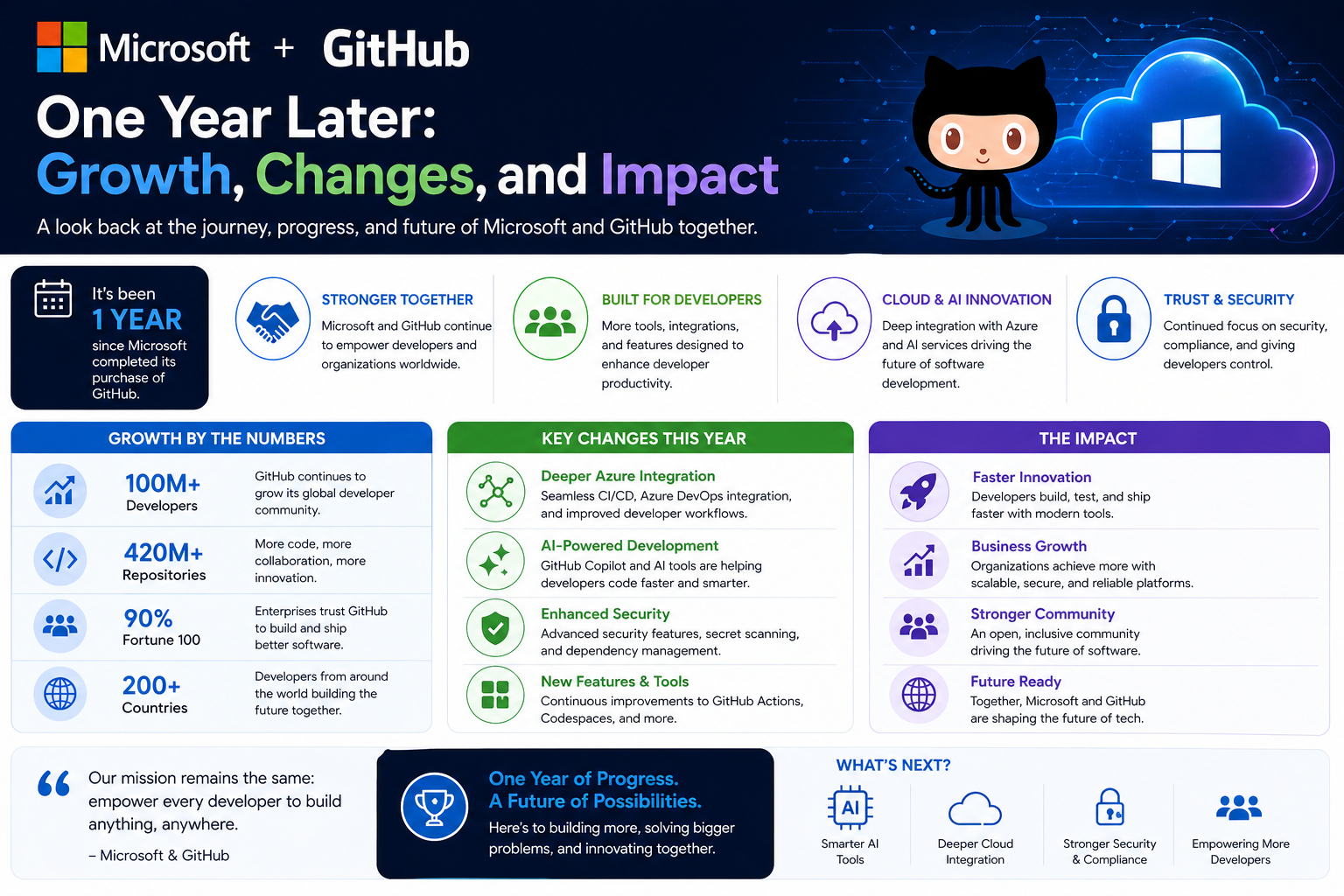
Over the past year, the relationship between Microsoft and GitHub has continued to evolve from a simple corporate acquisition into a deeply interconnected development ecosystem. What initially began as a strategic alignment has now matured into a more unified vision for how modern software is built, deployed, and maintained. The emphasis has shifted toward reducing friction across the entire development lifecycle, ensuring that developers can move smoothly from planning and coding to testing, deployment, and monitoring without switching between disconnected tools or environments.
This evolution has also been driven by a broader industry trend where organizations are no longer satisfied with isolated tools. Instead, they are seeking platforms that integrate intelligence, automation, and collaboration into a single flow. Microsoft and GitHub have increasingly responded to this demand by aligning their services more closely and embedding development intelligence deeper into everyday workflows.
Transformation of Developer Workflows
One of the most significant shifts over the past year has been the transformation of developer workflows. Traditional software development often required developers to juggle multiple tools for version control, code review, issue tracking, and deployment pipelines. The combined ecosystem of Microsoft and GitHub has progressively reduced this fragmentation.
Developers now experience a more continuous workflow where code creation, collaboration, and deployment are interconnected. Pull requests have become more intelligent, automated checks are more deeply integrated, and feedback loops are significantly faster. This has not only improved productivity but has also changed how development teams structure their daily work, with more emphasis on iterative improvement rather than large, delayed release cycles.
At the same time, organizations have begun to standardize their development practices around this ecosystem, using it as a central hub for both internal and external software projects. This shift has encouraged consistency in coding standards, testing practices, and deployment strategies across teams of varying sizes.
Expansion of AI-Assisted Development
Artificial intelligence has become one of the defining forces shaping the evolution of Microsoft and GitHub over the past year. AI-assisted development tools have moved from being experimental features to essential components of modern coding environments. Developers are increasingly relying on intelligent code suggestions, automated refactoring, and contextual assistance during development.
These AI-driven capabilities have changed the way developers approach problem-solving. Instead of focusing heavily on syntax or repetitive coding patterns, they can now concentrate more on architectural decisions, system design, and optimization. The presence of AI has not replaced developers but has instead shifted their role toward higher-level thinking and creative engineering.
Another important change is the way AI has been integrated into collaboration workflows. Code reviews, for instance, are becoming more efficient as AI systems help identify potential bugs, security vulnerabilities, and performance issues before human reviewers even engage with the code. This has reduced review cycles and improved overall code quality.
Deepening Cloud Integration and Scalability
The integration between Microsoft’s cloud infrastructure and GitHub has become more refined and deeply embedded over the past year. Cloud-native development is no longer an optional approach but a standard expectation for many organizations. As a result, the ecosystem has expanded its capabilities to support highly scalable applications, distributed systems, and global deployment strategies.
Developers are now able to connect their repositories directly to cloud environments with greater ease, enabling automated testing and deployment pipelines that reduce manual intervention. This has significantly improved reliability and reduced the risk of human error during deployment processes.
In addition, the scalability of cloud resources has allowed organizations to handle larger and more complex projects without needing to fundamentally change their development approach. This flexibility has made the ecosystem especially attractive to enterprises managing global user bases and high-traffic applications.
Security as a Core Foundation
Security has become a central pillar in the evolution of Microsoft and GitHub over the past year. Rather than being treated as a separate layer added at the end of development, security has increasingly been integrated into every stage of the software lifecycle.
This shift toward “security by design” has led to stronger emphasis on vulnerability detection, dependency management, and automated security scanning. Developers now receive real-time feedback about potential risks within their code, allowing them to address issues early rather than after deployment.
Organizations have also benefited from improved governance controls, which allow them to define and enforce security policies across large development teams. These improvements have been especially important for enterprises operating in regulated industries where compliance and data protection are critical concerns.
The result is a more resilient development ecosystem where security is not an afterthought but an embedded component of everyday workflows.
Impact on Collaboration and Team Dynamics
Collaboration has always been a core strength of GitHub, but over the past year, it has evolved in more sophisticated ways. Teams are now able to collaborate in real time with greater visibility into ongoing work, reducing delays and misunderstandings that often occur in distributed environments.
The introduction of smarter notification systems, improved project tracking, and enhanced discussion tools has made it easier for teams to stay aligned even when working across different time zones and regions. This has been particularly important as remote and hybrid work models continue to dominate the software industry.
Microsoft’s contribution to collaboration tools has also strengthened integration with communication platforms and productivity environments, enabling smoother transitions between discussion, planning, and execution. This has resulted in more cohesive teamwork and faster decision-making processes.
Growth of Open Source Influence
Open source development remains a foundational element of the GitHub ecosystem, and over the past year, its influence has continued to grow. More organizations are actively contributing to open source projects, not only as a form of community engagement but also as a strategic advantage for innovation and transparency.
The platform has made it easier for contributors to participate in projects regardless of their location or organizational affiliation. This inclusivity has led to a more diverse range of contributions, improving the quality and creativity of open source software.
Microsoft’s ongoing involvement in open source communities has also reinforced trust among developers who were once skeptical of large corporate influence in open ecosystems. The continued collaboration between enterprise and community-driven development has created a more balanced and sustainable environment for innovation.
Enterprise Adoption and Digital Transformation
Enterprises have played a major role in shaping the growth of the Microsoft and GitHub ecosystem over the past year. Many organizations have accelerated their digital transformation efforts, adopting cloud-native architectures and modern DevOps practices to remain competitive in rapidly changing markets.
The ability to manage large-scale codebases, automate deployment pipelines, and maintain strong security standards has made the ecosystem highly attractive for enterprise use. As a result, many companies have standardized their development processes around this integrated platform.
This shift has also influenced internal organizational structures, with more emphasis placed on cross-functional teams that combine development, operations, and security responsibilities. The result is a more agile and responsive approach to software delivery.
Performance Optimization and Development Efficiency
Performance improvements across the ecosystem have contributed significantly to its adoption and usability. Faster build times, improved repository performance, and optimized workflow automation have all contributed to a smoother developer experience.
These improvements have reduced bottlenecks in large-scale projects, allowing teams to iterate more quickly and release updates at a faster pace. In competitive industries where speed is critical, these enhancements have provided a meaningful advantage.
Efficiency has also improved through better resource management in cloud environments, where automated scaling and optimization tools help ensure that applications run smoothly without unnecessary cost or overhead.
Educational and Community Impact
Beyond enterprise and professional development, the ecosystem has also had a growing impact on education and learning communities. Students, independent developers, and early-career engineers increasingly rely on these tools to learn modern software development practices.
The availability of collaborative repositories, open source projects, and AI-assisted coding tools has lowered the barrier to entry for new developers. As a result, more individuals are able to participate in meaningful software development earlier in their careers.
This educational impact has contributed to a broader expansion of the global developer community, fostering innovation and knowledge sharing across regions and disciplines.
Long-Term Industry Influence
The combined progress of Microsoft and GitHub over the past year has had a lasting influence on the software industry as a whole. Development practices are becoming more automated, collaborative, and intelligent, with AI playing an increasingly central role.
Organizations are now rethinking traditional software delivery models, moving toward continuous integration and continuous deployment as standard practices rather than advanced techniques. This shift is redefining expectations around speed, quality, and scalability.
The ecosystem has also influenced competitor platforms and tools, pushing the broader industry toward more integrated and intelligent development environments.
Ongoing Transformation
The developments observed over the past year reflect a broader transformation in how software is created and managed. Microsoft and GitHub have moved beyond being separate entities working in partnership to forming a unified development ecosystem that shapes industry standards.
This transformation continues to evolve, driven by advancements in AI, cloud computing, security, and collaboration. As these technologies mature further, the ecosystem is expected to become even more integrated, intelligent, and central to global software development practices.
Evolution of AI-Native Development Environments
Over the past year, one of the most noticeable transformations in the Microsoft and GitHub ecosystem has been the shift toward AI-native development environments. Instead of treating artificial intelligence as an add-on feature, the platform has increasingly designed workflows where AI assistance is embedded into every stage of software creation. This has changed how developers interact with code editors, repositories, and deployment systems.
AI-assisted coding has moved beyond simple autocomplete functionality. It now plays a more contextual role, understanding project structure, coding patterns, and even intent behind development tasks. Developers are able to describe what they want to build in natural language and receive structured code suggestions that align with their existing architecture. This reduces cognitive load and speeds up prototyping significantly.
At the same time, AI is being used to help maintain large codebases. Legacy systems, which often suffer from complexity and outdated documentation, are now easier to understand through AI-generated explanations and summaries. This has been especially valuable for enterprise teams managing systems that have evolved over many years with contributions from multiple developers.
Shift Toward Autonomous Development Assistance
A growing trend within the ecosystem is the movement toward more autonomous development assistance. Rather than simply suggesting code, AI systems are beginning to participate in multi-step tasks such as generating test cases, identifying refactoring opportunities, and proposing performance optimizations.
This has led to a gradual change in developer expectations. Developers are no longer just consumers of code suggestions but are increasingly collaborating with AI systems as part of the development team. This collaboration model has introduced new workflows where developers review and refine AI-generated outputs rather than building everything from scratch.
However, this shift has also raised questions about control and accountability. While AI can accelerate development, organizations are still required to ensure that outputs meet quality, security, and compliance standards. As a result, human oversight remains a critical part of the development process, even as automation increases.
Advancements in DevOps Integration
The integration between development and operations has become even more seamless over the past year. The Microsoft and GitHub ecosystem has continued to refine its DevOps capabilities, enabling smoother transitions from code creation to deployment and monitoring.
Automation pipelines have become more intelligent, with systems capable of adapting to changes in code structure and dependency updates without requiring manual reconfiguration. This has reduced downtime and improved deployment reliability across a wide range of applications.
Another important improvement has been the increased visibility into deployment processes. Developers and operations teams can now track changes more transparently, identify bottlenecks faster, and respond to issues in near real time. This level of visibility has improved collaboration between traditionally separate roles, encouraging a more unified approach to software delivery.
Security as an Embedded Lifecycle Process
Security has continued to evolve from a checkpoint-based model into a continuous lifecycle process. Instead of checking for vulnerabilities at the end of development, the ecosystem now integrates security checks at every stage of the workflow.
Code scanning tools have become more advanced, capable of detecting subtle vulnerabilities that may not be immediately obvious. Dependency management systems now provide deeper insight into potential risks introduced through third-party libraries, which is especially important in modern software development where external dependencies are common.
There has also been a stronger emphasis on supply chain security. As software systems become more interconnected, ensuring the integrity of dependencies and build processes has become a priority. The ecosystem now provides more tools for verifying code provenance and tracking changes across the entire development pipeline.
This shift has helped organizations reduce exposure to security risks while maintaining development speed, which has historically been a challenging balance to achieve.
Expansion of Enterprise Governance Capabilities
As adoption of the platform has grown among large organizations, governance features have become increasingly important. Enterprises require more control over how code is accessed, modified, and deployed, especially when working across multiple teams and regions.
The ecosystem has responded by offering more granular permission systems, policy enforcement tools, and audit capabilities. These features allow organizations to define clear boundaries around who can access specific repositories, what actions can be performed, and how changes are tracked.
Governance has also expanded into compliance management, helping organizations meet industry-specific regulatory requirements. This has been particularly important for sectors such as finance, healthcare, and government services, where strict standards must be maintained.
By strengthening governance capabilities, the ecosystem has made it easier for large organizations to adopt modern development practices without compromising on control or security.
Impact on Software Supply Chain Management
Software supply chain management has become a critical focus area over the past year. As applications increasingly rely on external libraries, frameworks, and services, ensuring the integrity of the entire supply chain has become essential.
The Microsoft and GitHub ecosystem has introduced enhanced tools for tracking dependencies, verifying package authenticity, and identifying potential risks before they reach production environments. This has helped organizations reduce the likelihood of introducing vulnerabilities through third-party components.
In addition, improved transparency across build and deployment pipelines has made it easier to trace issues back to their source. This level of traceability is particularly valuable when responding to security incidents or debugging complex production problems.
The overall result is a more resilient software ecosystem where trust is built into every stage of development rather than assumed at the end.
Growth of Developer Marketplace Ecosystems
Another important area of growth has been the expansion of marketplace ecosystems around development tools and extensions. Developers now have access to a wide range of integrations that enhance productivity, automate repetitive tasks, and extend the functionality of their development environments.
These marketplaces have become essential for customizing workflows to meet specific project needs. Whether it involves integrating testing frameworks, deployment tools, or AI-based assistants, developers can now tailor their environments with minimal effort.
This flexibility has contributed to the ecosystem’s widespread adoption, as it allows organizations to build workflows that align closely with their internal processes rather than forcing them to adapt to rigid tool structures.
Collaboration Across Distributed Teams
The way teams collaborate has continued to evolve significantly. With distributed and hybrid work models becoming the norm, the need for strong asynchronous collaboration tools has increased.
The ecosystem has improved its support for distributed teams by enhancing communication around code changes, improving visibility into project status, and enabling more structured discussions around development decisions. This has reduced delays caused by time zone differences and improved overall team coordination.
In addition, shared development environments and cloud-based workspaces have made it easier for teams to collaborate in real time when needed, without requiring complex local setups. This has been particularly beneficial for onboarding new developers and supporting large-scale collaborative projects.
Performance Scaling for Large Systems
As codebases and applications grow in complexity, performance optimization has become increasingly important. The ecosystem has focused on improving scalability for both repositories and deployment systems to handle large-scale projects more efficiently.
Build systems have been optimized to reduce processing time, while caching mechanisms have been improved to avoid redundant computations. These enhancements have contributed to faster development cycles, even for complex enterprise applications.
In addition, infrastructure scaling in cloud environments has allowed applications to handle increased traffic without requiring significant manual intervention. This has improved reliability and reduced operational overhead for development teams.
Developer Experience and Interface Refinement
Over the past year, continuous improvements have been made to developer interfaces to enhance usability and reduce friction. The focus has been on simplifying complex workflows and making key actions more intuitive.
Navigation within repositories, issue tracking systems, and deployment dashboards has been refined to reduce cognitive overload. Developers can now access relevant information more quickly, allowing them to make decisions with greater efficiency.
These refinements may seem incremental individually, but collectively they contribute to a significantly smoother development experience. This attention to detail has played an important role in improving overall developer satisfaction.
Challenges in Rapid Automation Adoption
Despite the many advancements, the rapid adoption of automation and AI-driven development has introduced certain challenges. One of the main concerns is the risk of over-reliance on automated systems without sufficient human validation.
While AI can significantly improve productivity, it can also introduce subtle errors or assumptions that may not align with project requirements. This makes it essential for developers to maintain strong review practices and not fully depend on automated outputs.
Another challenge is the learning curve associated with new tools and workflows. As the ecosystem evolves quickly, developers and organizations must continuously adapt to new features, which can create temporary disruptions in productivity.
Balancing Innovation with Stability
A key theme over the past year has been the balance between innovation and stability. On one hand, the ecosystem is rapidly introducing new features, particularly in AI and automation. On the other hand, enterprises require stable and predictable systems to support mission-critical applications.
Maintaining this balance has required careful planning and incremental rollout of new capabilities. Rather than introducing disruptive changes all at once, improvements are often phased in gradually to ensure compatibility with existing workflows.
This approach has helped maintain trust among enterprise users while still enabling continuous innovation.
Broader Industry Influence and Competitive Pressure
The progress made within the Microsoft and GitHub ecosystem has also influenced the broader software industry. Competing platforms have been encouraged to adopt similar levels of integration, automation, and AI assistance.
This competitive environment has accelerated innovation across the industry, leading to more advanced development tools becoming widely available. Developers now benefit from a broader selection of platforms that offer increasingly sophisticated capabilities.
At the same time, this competition has raised expectations among developers, who now anticipate faster, smarter, and more integrated tools as standard rather than optional enhancements.
Long-Term Vision of Unified Development Platforms
Looking ahead, the trajectory of the ecosystem suggests a continued movement toward fully unified development platforms. The goal appears to be creating an environment where planning, coding, testing, deployment, and monitoring exist within a single interconnected system.
Such a platform would reduce fragmentation and allow developers to focus entirely on building software rather than managing tools. While this vision is still evolving, the progress made over the past year indicates steady movement in that direction.
AI, automation, and cloud integration will likely continue to play central roles in shaping this future.
Ongoing Transformation of the Software Industry
The developments within Microsoft and GitHub over the past year represent more than just incremental improvements. They reflect a broader transformation in how software is conceived, built, and delivered.
The industry is moving toward systems that are more intelligent, collaborative, and automated. This shift is redefining traditional roles within development teams and changing how organizations approach software engineering as a whole.
As these changes continue to unfold, the influence of integrated ecosystems like Microsoft and GitHub will likely become even more central to the global software landscape.
Shifting Role of Developers in an AI-Driven Era
Over the past year, the role of software developers within the Microsoft and GitHub ecosystem has continued to evolve in a way that reflects broader changes across the technology industry. Developers are no longer viewed solely as manual code writers but increasingly as system designers, reviewers, and supervisors of AI-assisted workflows. This shift has been gradual, but its impact is becoming more visible as AI tools take on a larger share of routine coding tasks.
Instead of spending most of their time writing boilerplate code or debugging repetitive issues, developers are now focusing more on defining requirements, structuring system architecture, and validating outputs generated by automated systems. This has elevated the importance of conceptual thinking and problem decomposition in modern software engineering.
At the same time, this transformation has created a new learning curve for developers. Understanding how to effectively collaborate with AI systems, evaluate generated code, and maintain quality standards has become a critical skill. Developers who adapt quickly to these changes are finding themselves more productive, while those who rely solely on traditional methods may face challenges keeping up with evolving workflows.
Redefinition of Software Engineering Practices
Traditional software engineering practices have also been redefined as a result of these advancements. Waterfall-style development models have largely been replaced by continuous integration and continuous deployment approaches, which are now further enhanced by AI-driven automation.
Development cycles have become shorter and more iterative, with frequent updates replacing large, infrequent releases. This allows organizations to respond more quickly to user feedback and market demands. It also reduces the risk associated with large-scale deployments, as changes are introduced incrementally and can be rolled back more easily if needed.
Testing practices have similarly evolved. Automated test generation, AI-assisted debugging, and predictive error detection have made it possible to identify issues earlier in the development process. This has improved overall software quality and reduced the time spent on manual testing efforts.
Rise of Intelligent Code Collaboration
Collaboration within development teams has become more intelligent and context-aware over the past year. Instead of static code reviews and manual feedback cycles, developers now engage in dynamic collaboration environments where AI systems provide real-time insights and suggestions.
These systems analyze code changes as they are being written and offer recommendations related to performance optimization, security improvements, and stylistic consistency. This has made collaboration more proactive rather than reactive, allowing teams to address potential issues before they become embedded in the codebase.
In addition, shared understanding across teams has improved as AI tools provide consistent documentation and explanations of complex code structures. This reduces misunderstandings and helps new team members integrate more quickly into ongoing projects.
Evolution of Platform Ecosystem Thinking
Another major shift has been the increasing adoption of ecosystem-based thinking rather than tool-based thinking. Instead of viewing development tools as isolated utilities, organizations are now treating them as interconnected components of a larger platform.
The Microsoft and GitHub ecosystem exemplifies this shift by integrating code management, CI/CD pipelines, AI assistance, security scanning, and cloud deployment into a unified environment. This reduces fragmentation and improves overall efficiency.
Organizations that adopt this ecosystem-based approach benefit from smoother workflows, fewer integration issues, and more consistent development practices across teams. It also allows for better scalability as systems grow in complexity.
Impact on Startup and Innovation Culture
The changes within the ecosystem have also had a significant impact on startup culture and innovation. Smaller teams now have access to powerful development tools that were previously only available to large enterprises. This has lowered barriers to entry and enabled faster prototyping and product development.
Startups can now build, test, and deploy applications with minimal infrastructure overhead, allowing them to focus more on innovation rather than operational complexity. AI-assisted development tools further accelerate this process by reducing the time required to turn ideas into functional products.
This democratization of development capabilities has contributed to a more competitive and diverse technology landscape, where innovation is no longer limited by organizational size or resources.
Data-Driven Development Decision Making
Data has become an increasingly important factor in development decision-making processes. The ecosystem now provides more detailed analytics around code performance, user engagement, system reliability, and deployment success rates.
Developers and organizations use this data to make informed decisions about feature prioritization, performance improvements, and architectural changes. This has shifted development from intuition-based decision-making toward more evidence-driven approaches.
AI systems also play a role in analyzing this data and providing actionable insights. For example, they can identify patterns in bug reports, predict potential system failures, or suggest optimizations based on historical performance data.
Increased Emphasis on Ethical AI Usage
As AI becomes more deeply integrated into development workflows, ethical considerations have become increasingly important. Questions around code ownership, bias in AI-generated outputs, and responsible usage of automated systems are now central to discussions within the ecosystem.
Organizations are working to ensure that AI tools are used responsibly and transparently. This includes maintaining clear documentation of AI involvement in code generation, ensuring fairness in automated decision-making processes, and avoiding over-reliance on machine-generated outputs without human oversight.
Ethical AI usage is also becoming part of developer education, with increasing emphasis placed on understanding the limitations and risks associated with automated systems. This ensures that developers remain aware of their responsibility in maintaining the integrity of the software they build.
Transformation of Learning and Skill Development
The way developers learn and develop skills has also changed significantly. Traditional learning methods focused heavily on syntax memorization and manual coding practice. However, with the rise of AI-assisted development, learning is now more focused on problem-solving, system design, and tool utilization.
New developers are encouraged to understand how to work effectively with AI systems from the beginning of their careers. This includes learning how to interpret AI suggestions, validate outputs, and integrate automated tools into their workflows.
Educational platforms and training programs are also adapting to this shift by incorporating AI-driven coding environments and interactive learning systems. This has made learning more dynamic and closely aligned with real-world development practices.
Long-Term Impact on Employment Structures
The integration of AI and automation has also influenced employment structures within the software industry. While demand for software development continues to grow, the nature of roles is changing.
There is increasing demand for roles that focus on system architecture, AI oversight, security analysis, and platform engineering. At the same time, purely manual coding roles are becoming less common as automation handles a larger portion of routine tasks.
This does not necessarily reduce job opportunities but rather shifts the skill requirements for developers. Professionals who adapt to these changes and develop expertise in AI-assisted development environments are likely to remain highly valuable in the evolving job market.
Expansion of Cross-Platform Development Capabilities
Cross-platform development has become more streamlined over the past year. Developers can now build applications that run across multiple environments with less effort, thanks to improved abstraction layers and unified tooling systems.
This has reduced duplication of effort and made it easier to maintain consistent functionality across different platforms. It has also allowed organizations to reach wider audiences without significantly increasing development complexity.
AI tools further enhance this capability by automatically adapting code structures for different environments, reducing the need for manual adjustments and platform-specific optimization.
Increasing Importance of System Reliability
As software systems become more interconnected and complex, system reliability has become a top priority. Downtime or performance issues can have significant consequences, especially for large-scale applications serving global users.
The ecosystem has responded by introducing more advanced monitoring, alerting, and self-healing systems. These tools can detect anomalies in real time and take corrective actions automatically when possible.
This has improved overall system stability and reduced the need for manual intervention during critical incidents. However, it also requires organizations to carefully design fallback mechanisms and ensure that automated responses do not introduce unintended side effects.
Growth of Multi-Cloud and Hybrid Architectures
Another major trend over the past year has been the growth of multi-cloud and hybrid cloud architectures. Organizations are increasingly avoiding reliance on a single infrastructure provider and instead distributing workloads across multiple environments.
The Microsoft and GitHub ecosystem supports this trend by providing tools that enable seamless integration across different cloud platforms. This flexibility allows organizations to optimize cost, performance, and reliability based on their specific needs.
Hybrid architectures, which combine on-premises systems with cloud infrastructure, are also becoming more common. This approach is particularly important for organizations with strict data residency or compliance requirements.
Influence on Global Software Standards
The advancements within the ecosystem have also influenced global software development standards. Practices such as continuous integration, automated testing, and AI-assisted coding are becoming widely adopted across the industry.
This has led to a convergence of development methodologies, where best practices are increasingly standardized across organizations and regions. As a result, software development is becoming more predictable, efficient, and scalable at a global level.
Industry-wide collaboration has also improved as developers share tools, frameworks, and methodologies more openly than before. This has contributed to faster innovation cycles and more consistent software quality.
Future Direction of Integrated Development Systems
Looking ahead, the direction of integrated development systems appears to be moving toward even greater unification and intelligence. Future systems are likely to combine coding, deployment, monitoring, and optimization into fully automated pipelines guided by AI decision-making.
In such environments, developers may primarily focus on defining goals and constraints rather than writing detailed implementation code. AI systems would then handle the execution, optimization, and maintenance of applications within defined parameters.
While this vision is still developing, the progress made over the past year suggests that it is a realistic long-term direction for the industry.
Final Reflection on Industry Transformation
The evolution of Microsoft and GitHub over the past year represents a broader transformation in the software industry. Development is becoming more automated, intelligent, and interconnected, with AI playing an increasingly central role in shaping workflows.
This transformation is not limited to tools or platforms but extends to how developers think, collaborate, and build software. It is reshaping expectations around speed, quality, and scalability while also redefining what it means to be a software engineer.
As this evolution continues, the boundaries between human creativity and machine assistance will likely become even more integrated, leading to new possibilities in how software is designed and delivered.
Conclusion
Over the past year, the Microsoft and GitHub ecosystem has undergone a meaningful transformation that goes far beyond incremental updates. It has steadily moved toward a more unified, intelligent, and automation-driven development environment where AI, cloud infrastructure, and collaborative tools work together as a single system rather than separate components.
Cloud integration and DevOps improvements have further streamlined the software lifecycle, reducing friction between development and operations. Faster deployment cycles, improved scalability, and more reliable automation pipelines have allowed teams to deliver software with greater confidence and consistency.
Another defining aspect has been the rapid rise of AI-assisted development. While still evolving, it has already changed developer workflows significantly, shifting the focus from repetitive coding tasks to higher-level decision-making and system design. This has not only increased productivity but also redefined the skill sets required in modern software engineering.