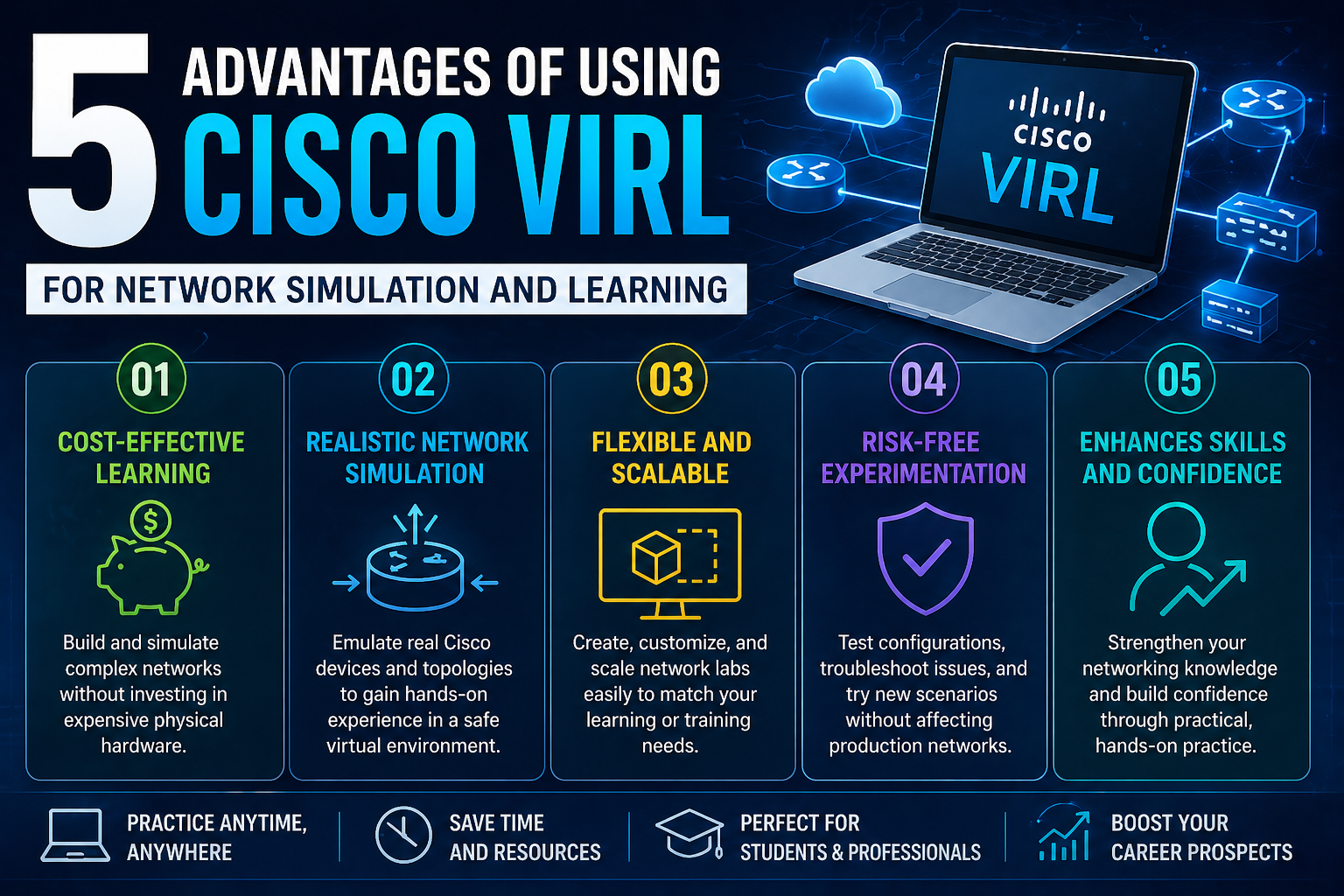
Cisco VIRL provides strong scalability, which allows users to design and simulate both small and extremely large network environments. This is especially important for learners and professionals who want to understand how enterprise-level infrastructures operate. In real organizations, networks are not simple; they often include multiple sites, data centers, branches, and cloud connections. VIRL allows all of these scenarios to be recreated in a virtual environment.
Users can start with a basic topology and gradually expand it by adding more routers, switches, and endpoints. This scalability helps in understanding how networks behave as they grow in size and complexity. It also demonstrates how performance, routing efficiency, and latency change when more devices are added to the system.
Another advantage of scalability is that it helps learners prepare for real-world challenges. In large-scale networks, even small configuration changes can have wide impacts. VIRL allows users to observe these impacts in real time, which improves their ability to plan and manage enterprise networks effectively.
The ability to scale environments without physical limitations makes VIRL an ideal platform for experimenting with different architectural designs. Users can simulate distributed systems, hierarchical network structures, and multi-layered security setups with ease.
Support for Automation and Scripting Practice
Modern networking increasingly relies on automation, and Cisco VIRL provides an excellent environment for practicing these skills. Users can simulate networks where configurations are applied automatically rather than manually, helping them understand the principles of network automation.
This is particularly useful for learning scripting concepts and understanding how automation tools interact with network devices. By working in a simulated environment, users can test automated workflows without risking errors in live systems.
Automation practice in VIRL helps users become familiar with repetitive tasks such as device configuration, updates, and monitoring. These tasks can be automated to save time and reduce human error in real environments.
It also allows learners to experiment with configuration templates and structured deployment methods. This builds a strong foundation for understanding how modern networks are managed in large organizations where manual configuration is not practical.
By practicing automation in a controlled environment, users develop skills that are highly relevant in today’s networking industry, where efficiency and consistency are critical.
Better Understanding of Network Protocol Behavior
Cisco VIRL provides an excellent way to study how different network protocols behave under various conditions. Protocols such as routing, switching, and traffic management can be configured and observed in real time.
This helps learners understand not just how protocols are configured, but also how they function internally. For example, users can observe how routing decisions are made, how data packets travel through the network, and how redundancy mechanisms activate during failures.
This level of visibility is extremely valuable because theoretical knowledge alone is often not enough to fully understand protocol behavior. VIRL allows users to see the direct impact of configuration changes, making learning more practical and intuitive.
It also helps in comparing different protocol types and understanding their advantages and limitations. Users can test multiple scenarios and analyze which protocol performs better in specific network environments.
This deep understanding of protocol behavior is essential for designing efficient and reliable networks in real-world situations.
Efficient Time Management in Learning Process
Cisco VIRL significantly improves time efficiency in network learning. Traditional physical labs require setup time, configuration time, and troubleshooting of hardware issues before actual learning can begin. In contrast, VIRL allows instant access to virtual environments.
Users can quickly create, save, and reset network topologies without wasting time on physical setup. This makes learning more productive and focused on actual concepts rather than equipment management.
The ability to quickly reset environments is especially useful when experimenting with complex configurations. If something goes wrong, users can simply restart the simulation and try again without long delays.
This efficiency allows learners to complete more practice sessions in less time, which accelerates skill development. It also helps professionals test multiple design ideas quickly, improving productivity in both learning and work environments.
Overall, VIRL ensures that time is spent on understanding networking concepts rather than dealing with physical limitations.
Improved Problem-Solving and Analytical Thinking
Working with Cisco VIRL enhances problem-solving and analytical thinking skills by exposing users to real network challenges in a simulated environment. When users configure networks or troubleshoot issues, they must analyze the situation carefully to find solutions.
This process encourages logical thinking and structured analysis. Users learn to break down complex problems into smaller parts, identify root causes, and apply appropriate solutions.
For example, if a network is not functioning correctly, users must check configurations, routing tables, and device status to identify the issue. This systematic approach builds strong analytical skills that are essential in IT careers.
The ability to repeatedly practice problem-solving scenarios helps users become more confident and efficient in handling real-world network issues. Over time, they develop a natural ability to diagnose and resolve problems quickly.
This skill development is one of the most valuable benefits of using a simulation platform like VIRL.
Real-World Enterprise Network Simulation
Cisco VIRL is designed to closely replicate real enterprise network environments, making it a powerful tool for understanding how large organizations manage their infrastructure. Users can simulate multiple departments, remote offices, and data centers within a single virtual setup.
This helps in understanding how different parts of a network interact with each other. It also provides insight into how data flows between different organizational units and how communication is maintained across distributed systems.
Enterprise networks often involve complex routing, security policies, and redundancy mechanisms. VIRL allows users to experiment with these components in a controlled environment, improving their understanding of enterprise-level networking.
By simulating real-world scenarios, users gain practical experience that directly applies to professional roles in IT and networking industries.
Enhanced Collaboration and Learning Opportunities
Cisco VIRL also supports collaborative learning, where multiple users can work on similar network scenarios or share configurations. This encourages teamwork and knowledge sharing among learners and professionals.
Collaboration helps users gain different perspectives on the same problem, leading to better understanding and more efficient solutions. It also allows teams to work together on designing and testing complex network architectures.
In educational environments, instructors can use VIRL to demonstrate concepts to students in a more interactive way. Students can then replicate and modify these examples to strengthen their understanding.
This collaborative approach makes learning more engaging and effective, especially in group training or classroom settings.
Improved Confidence for Real Network Deployment
One of the most important benefits of Cisco VIRL is the confidence it builds before working on real networks. By practicing in a simulated environment, users become familiar with configurations, troubleshooting techniques, and network design principles.
This reduces hesitation and uncertainty when working with actual systems. Users are better prepared to handle real-world tasks because they have already experienced similar scenarios in a virtual environment.
Confidence is especially important in networking, where mistakes can have serious consequences. VIRL helps reduce these risks by providing a safe space for learning and experimentation.
Over time, users develop the assurance needed to manage complex networks independently and effectively.
Integration with Modern Networking Concepts
Cisco VIRL supports learning modern networking concepts such as virtualization, cloud connectivity, and software-defined networking principles. These concepts are increasingly important in today’s IT environments.
By simulating these technologies, users can understand how traditional networking is evolving. They can explore how virtual networks are created, managed, and optimized in modern infrastructures.
This exposure helps learners stay updated with industry trends and prepares them for future technologies. It also ensures that their skills remain relevant as networking continues to evolve.
Understanding modern concepts through practical simulation gives users a strong advantage in both academic and professional settings.
Continuous Skill Development and Practice
Cisco VIRL encourages continuous skill development by allowing users to practice regularly without limitations. Since environments can be created and reset easily, users can keep refining their skills over time.
This continuous practice is essential for mastering networking concepts. The more users interact with different scenarios, the more confident and skilled they become.
It also allows users to track their progress by experimenting with increasingly complex network designs. This gradual learning approach ensures steady improvement in both knowledge and practical ability.
Continuous access to a simulation environment helps maintain and enhance networking skills over the long term.
Advanced Troubleshooting Simulation Capabilities
Cisco VIRL provides an excellent environment for advanced troubleshooting simulations, allowing users to experience real network issues in a controlled setup. In real-world networking, problems rarely appear in simple or predictable forms. Instead, they often involve multiple layers such as routing misconfigurations, interface failures, or protocol mismatches. VIRL allows users to recreate these complex situations and practice resolving them step by step.
This hands-on troubleshooting experience is extremely valuable because it teaches users how to think logically under pressure. Instead of guessing solutions, users learn to follow structured diagnostic methods such as checking connectivity, verifying configurations, and analyzing logs. These methods are essential in professional networking roles where quick and accurate problem resolution is required.
Another important aspect is that VIRL allows users to repeatedly simulate the same issue. This repetition helps in reinforcing troubleshooting patterns and building muscle memory for network diagnostics. Over time, users become faster and more accurate in identifying the root cause of network problems.
It also helps in understanding how different network layers interact when something goes wrong. For example, a simple connectivity issue might actually be caused by routing policies, firewall rules, or incorrect IP configurations. VIRL makes it easier to trace these dependencies visually and logically.
Practical Exposure to Routing Protocols
Cisco VIRL offers deep practical exposure to routing protocols, which are one of the most important components of networking. Users can configure and test protocols such as OSPF, EIGRP, and BGP in a fully simulated environment. This helps in understanding how routers exchange information and build routing tables dynamically.
Unlike theoretical study, VIRL allows users to see how routing decisions are actually made in real time. For example, when a new route is introduced or a link fails, users can observe how the network recalculates paths and maintains connectivity.
This real-time observation helps in understanding key concepts such as convergence, route redistribution, and path selection. These concepts are often difficult to grasp through theory alone but become much clearer when seen in action.
Users can also compare different routing protocols to understand their advantages and limitations. This comparison helps in making informed decisions when designing real networks.
Switching Concepts and VLAN Implementation Practice
Cisco VIRL provides strong support for practicing switching concepts and VLAN configurations. Switching is a fundamental part of networking, and understanding how data flows within local networks is essential for any IT professional.
In VIRL, users can configure switches, create VLANs, and test how devices communicate within and across different network segments. This helps in understanding segmentation, broadcast domains, and traffic isolation.
Users can also simulate trunk links and inter-VLAN routing to see how different VLANs communicate with each other. This practical exposure makes complex switching concepts much easier to understand.
Another advantage is the ability to test misconfigurations. Users can intentionally create VLAN mismatches or trunking issues and observe how they affect network communication. This helps in building strong diagnostic skills for switching environments.
Security Configuration Practice in Virtual Networks
Cisco VIRL also allows users to practice network security configurations in a safe and controlled environment. Security is a critical part of modern networking, and understanding how to protect data and devices is essential.
Users can configure access control lists, firewall rules, and security policies to control network traffic. They can also simulate unauthorized access attempts to see how security configurations respond.
This hands-on experience helps in understanding how security layers protect networks from threats. It also teaches users how to design networks with security in mind from the beginning.
VIRL allows experimentation with different security approaches, helping users identify the most effective strategies for protecting network resources. This practical exposure is far more effective than theoretical learning alone.
Network Performance Testing and Optimization
Cisco VIRL enables users to test network performance under different conditions. This includes analyzing how networks behave under heavy traffic, high latency, or limited bandwidth scenarios.
By simulating these conditions, users can learn how to optimize network performance. They can adjust configurations, redistribute traffic, or modify routing policies to improve efficiency.
This helps in understanding the importance of network design in achieving optimal performance. Poorly designed networks can lead to congestion and delays, while well-designed networks ensure smooth data flow.
Users can also compare different design approaches to see which performs better under stress. This analytical approach helps in developing strong optimization skills that are essential in real-world networking environments.
Understanding Redundancy and Failover Mechanisms
Cisco VIRL provides an effective way to study redundancy and failover mechanisms in networking. In real environments, networks must remain operational even when certain components fail. VIRL allows users to simulate such failures and observe how the network responds.
Users can configure redundant links and devices to ensure continuous connectivity. When a failure is introduced, they can see how backup paths are activated automatically.
This helps in understanding the importance of redundancy in network design. It also teaches how to create fault-tolerant systems that minimize downtime.
By experimenting with failover scenarios, users gain practical knowledge of high availability concepts, which are critical in enterprise networks.
Multi-Site Network Simulation Practice
Cisco VIRL supports the creation of multi-site network environments, which are common in large organizations. Users can simulate branch offices, headquarters, and remote locations within a single virtual setup.
This helps in understanding how data is exchanged between geographically distributed networks. It also provides insight into WAN technologies and inter-site communication methods.
Users can configure routing, security, and performance settings for each site and observe how they interact. This practical experience is important for understanding large-scale network architecture.
Multi-site simulation also helps in identifying potential challenges such as latency, bandwidth limitations, and routing complexity.
Cloud and Virtual Network Integration Concepts
Cisco VIRL allows users to explore basic concepts of cloud and virtual networking integration. Modern networks often connect to cloud platforms and virtual environments, making this knowledge essential.
Users can simulate connections between traditional networks and virtual systems. This helps in understanding how hybrid environments operate.
It also provides insight into how data is managed across different infrastructure types. Users can experiment with connectivity, routing, and security between on-premises and virtual networks.
This exposure helps in preparing for modern IT environments where cloud integration is a standard requirement.
Learning Network Design Best Practices
Cisco VIRL helps users understand and apply network design best practices. Good network design is essential for performance, scalability, and security.
Users can experiment with different topologies and evaluate their efficiency. This helps in understanding concepts such as hierarchical design, modular architecture, and segmentation.
By testing different designs, users learn how to build networks that are both efficient and easy to manage. They also understand the importance of planning before implementation.
This practical experience helps in developing strong design skills that are essential for professional networking roles.
Simulation of Real-Time Network Traffic Flow
Cisco VIRL allows users to simulate real-time traffic flow within networks. This helps in understanding how data moves from one device to another and how different protocols handle traffic.
Users can generate traffic between devices and observe how it is routed through the network. This helps in visualizing data paths and identifying potential bottlenecks.
It also provides insight into how different network configurations affect performance. For example, changing routing paths or switching configurations can significantly impact traffic flow.
This real-time observation helps in building a strong understanding of network behavior under different conditions.
Exposure to Layered Network Architecture
Cisco VIRL helps users understand layered network architecture by allowing them to build and analyze networks based on different layers such as physical, data link, network, and transport.
This layered approach helps in understanding how each layer contributes to overall network communication. Users can configure and test each layer independently and observe how they interact.
This structured understanding is essential for diagnosing issues and designing efficient networks. It also helps in breaking down complex systems into manageable components.
By working with layered architecture in VIRL, users develop a clear mental model of how networks function as a whole system.
Practical Understanding of Network Addressing Schemes
Cisco VIRL provides practical experience with network addressing schemes such as IPv4 and IPv6. Users can configure IP addresses, subnet masks, and routing tables in a virtual environment.
This helps in understanding how addressing works in real networks. Users can experiment with different subnetting strategies and observe how they affect connectivity.
It also helps in learning how to design efficient IP addressing plans for large networks. Proper addressing is essential for scalability and organization in network design.
By practicing addressing schemes in VIRL, users develop strong foundational knowledge that is critical for all networking tasks.
Deep Learning of Network Convergence Behavior
Cisco VIRL allows users to deeply understand network convergence behavior, which is a critical concept in routing and overall network stability. Convergence refers to the time it takes for all network devices to agree on the current network topology after a change such as a failure or new route introduction. In real networks, slow convergence can lead to packet loss, delays, and instability.
With VIRL, users can simulate changes like link failures, router shutdowns, or configuration updates and then observe how quickly the network adapts. This helps in visualizing how routing protocols recalculate paths and update routing tables across multiple devices.
By repeatedly testing convergence scenarios, users develop a clear understanding of which protocols converge faster and under what conditions delays occur. This is especially useful when comparing distance vector and link-state routing approaches.
The ability to visually observe convergence also helps in understanding how network stability is maintained in dynamic environments. Users can experiment with timers, route metrics, and failover mechanisms to see how they affect convergence speed.
Hands-on Experience with Load Balancing Techniques
Cisco VIRL provides a practical environment for exploring load balancing techniques in networking. Load balancing is used to distribute traffic evenly across multiple paths or devices to improve performance and prevent congestion.
Users can configure multiple routes between source and destination devices and observe how traffic is distributed. This helps in understanding equal-cost multi-path routing and other balancing strategies used in enterprise networks.
By simulating different traffic loads, users can see how networks respond under stress and how load balancing improves efficiency. It also helps in identifying potential bottlenecks when load distribution is not properly configured.
This hands-on practice is important because load balancing plays a major role in maintaining network performance in large-scale environments. VIRL allows users to test different configurations and understand which strategies work best in specific scenarios.
Practical Study of Network Latency and Delay Factors
Cisco VIRL allows users to simulate and analyze network latency, which is the delay experienced in data transmission across a network. Understanding latency is important for designing high-performance systems, especially for applications that require real-time communication.
Users can introduce delays in network paths and observe how they affect data transfer. This helps in understanding how distance, congestion, and routing decisions impact overall performance.
By experimenting with different configurations, users can identify the factors that contribute to high latency and learn how to reduce them. This includes optimizing routing paths, reducing hops, and improving bandwidth allocation.
This practical exposure helps in developing strong performance optimization skills that are essential for managing efficient networks in real-world environments.
Understanding Broadcast and Multicast Traffic Behavior
Cisco VIRL provides a clear way to study broadcast and multicast traffic behavior in networks. These types of traffic are essential for many network operations but can also lead to inefficiencies if not properly managed.
Users can simulate broadcast traffic and observe how it propagates through different network segments. This helps in understanding broadcast domains and how switches handle broadcast packets.
Multicast traffic behavior can also be studied to see how data is efficiently delivered to multiple receivers without unnecessary duplication. This is particularly useful in applications like streaming and group communication systems.
By working with these traffic types in VIRL, users gain a deeper understanding of how networks manage data distribution efficiently.
Exploration of Dynamic Network Topology Changes
Cisco VIRL allows users to simulate dynamic changes in network topology, which is common in real-world environments. Networks are not static; devices may be added, removed, or reconfigured at any time.
Users can experiment with adding new routers or switches and observe how the network adapts. They can also simulate device failures or link removals to see how routing protocols respond.
This helps in understanding how networks maintain stability despite constant changes. It also highlights the importance of dynamic routing protocols and adaptive network design.
This experience is crucial for developing the ability to manage real networks that are constantly evolving.
Practice with Quality of Service (QoS) Concepts
Cisco VIRL enables users to explore Quality of Service concepts, which are used to prioritize network traffic based on importance. In real networks, not all data has the same priority; for example, voice and video traffic often require higher priority than regular data transfer.
Users can configure QoS policies and observe how traffic is managed under different conditions. This helps in understanding how bandwidth is allocated and how congestion is controlled.
By simulating high-traffic scenarios, users can see how QoS improves performance for critical applications. It also helps in understanding trade-offs between fairness and prioritization in network design.
This practical exposure is essential for designing networks that support real-time and mission-critical applications.
Insight into Network Virtualization Techniques
Cisco VIRL provides an environment for understanding network virtualization, which is a key concept in modern IT infrastructure. Virtualization allows multiple virtual networks to operate on a single physical infrastructure.
Users can create isolated virtual networks and observe how they function independently. This helps in understanding how resources are shared while maintaining separation between different network segments.
It also provides insight into how virtualization improves flexibility and scalability in modern networks. Users can experiment with different virtual configurations without affecting other systems.
This knowledge is essential for working with cloud-based and software-defined networking environments.
Hands-on Practice with Access Control Mechanisms
Cisco VIRL allows users to practice implementing access control mechanisms that regulate who can access specific network resources. This is an important aspect of network security and management.
Users can configure rules that allow or deny traffic based on IP addresses, protocols, or ports. They can then test these rules by simulating different types of network traffic.
This helps in understanding how access control lists work in real environments. It also shows how proper configuration can protect sensitive data and prevent unauthorized access.
By experimenting with different policies, users learn how to balance security with accessibility in network design.
Understanding Network Monitoring and Diagnostics
Cisco VIRL provides tools and features that help users understand network monitoring and diagnostics. Monitoring is essential for maintaining network health and performance.
Users can observe traffic patterns, device status, and routing information in real time. This helps in identifying potential issues before they become serious problems.
It also allows users to practice diagnostic techniques such as checking interface statistics, analyzing logs, and tracing packet paths.
This experience is important for developing the ability to maintain and troubleshoot real-world networks efficiently.
Exposure to Multi-Protocol Network Environments
Cisco VIRL allows users to work with multiple network protocols simultaneously. In real environments, networks often use a combination of protocols to achieve different objectives.
Users can configure and test interactions between routing, switching, and security protocols within the same environment. This helps in understanding how different protocols coexist and influence each other.
It also provides insight into protocol compatibility and integration challenges that may arise in complex networks.
This multi-protocol exposure is essential for building comprehensive networking knowledge.
Practical Understanding of Bandwidth Utilization
Cisco VIRL enables users to study how bandwidth is utilized in different network configurations. Bandwidth management is critical for ensuring efficient data transfer and preventing congestion.
Users can simulate heavy traffic conditions and observe how bandwidth is distributed across different links. This helps in identifying inefficient configurations and optimizing network performance.
By experimenting with different traffic loads, users gain a clear understanding of how bandwidth limitations affect network behavior.
This knowledge is essential for designing networks that can handle varying levels of traffic efficiently.
Simulation of Network Recovery Processes
Cisco VIRL allows users to simulate network recovery processes after failures. In real-world networks, recovery mechanisms are essential for maintaining uptime and reliability.
Users can introduce failures and observe how quickly the network restores connectivity. This includes rerouting traffic, activating backup systems, and restoring services.
This helps in understanding the importance of redundancy and disaster recovery planning in network design.
By practicing recovery scenarios, users develop the ability to design resilient networks that can handle unexpected failures effectively.
Advanced Network Design Validation Techniques
Cisco VIRL provides a powerful environment for validating advanced network designs before they are implemented in real-world infrastructure. In professional networking, design validation is a critical step because even a small miscalculation can lead to performance issues, security gaps, or system failures. VIRL allows users to test their entire network architecture in a virtual space and ensure that every component works as expected.
Users can build complete enterprise-level topologies and then run simulations to check how data flows under different conditions. This includes testing routing efficiency, redundancy paths, and device interactions. By doing this, users can confirm whether their design meets performance and reliability requirements before deployment.
This validation process helps reduce risks in real environments. Instead of discovering problems after implementation, users can identify and fix them during the design stage. It also helps in refining network architecture to make it more efficient and scalable.
Another advantage is the ability to compare multiple design approaches. Users can create different versions of a network and evaluate which one performs better under load or failure conditions. This analytical approach improves decision-making in network planning.
Realistic Enterprise Troubleshooting Scenarios
Cisco VIRL enables the creation of realistic enterprise troubleshooting scenarios that closely resemble issues faced in professional environments. These scenarios often involve multiple interconnected problems rather than a single fault, making them ideal for advanced learning.
Users can simulate situations such as partial network outages, misconfigured routing, or security conflicts across different departments. They are then required to analyze the network, identify the root cause, and implement a solution.
This process builds strong real-world troubleshooting experience. It teaches users how to handle complex problems systematically instead of relying on guesswork. Each scenario improves their ability to think critically and act efficiently under pressure.
Repeated exposure to such scenarios helps users become more confident and capable in managing live networks. It also prepares them for unexpected challenges in enterprise environments where quick and accurate responses are essential.
Understanding Interoperability Between Network Devices
Cisco VIRL provides a valuable platform for studying interoperability between different network devices and technologies. In real networks, devices from different vendors or with different configurations must work together seamlessly.
Users can simulate mixed environments where routers, switches, and virtual devices interact with each other. This helps in understanding compatibility issues and how they can be resolved through proper configuration.
It also demonstrates how standard protocols enable communication between different systems. Users can observe how data is exchanged across devices and how consistency is maintained throughout the network.
This practical experience is important for working in diverse IT environments where interoperability is a key requirement.
Simulation of Network Upgrade and Migration Processes
Cisco VIRL allows users to simulate network upgrade and migration processes, which are common in enterprise environments. Upgrading a network involves adding new devices, updating configurations, or transitioning to new technologies without disrupting services.
Users can practice upgrading network components and observe how the system adapts. They can also simulate migration from older protocols or architectures to newer ones.
This helps in understanding the challenges involved in maintaining network stability during upgrades. It also highlights the importance of planning and testing before making changes in real systems.
By practicing these scenarios, users develop the ability to manage complex network transitions with minimal disruption.
Hands-on Experience with Network Topology Optimization
Cisco VIRL provides opportunities for optimizing network topologies based on performance, scalability, and efficiency. Users can analyze different network layouts and make adjustments to improve overall performance.
This includes reducing unnecessary hops, balancing traffic paths, and improving redundancy. Users can test how these changes affect network behavior in real time.
Topology optimization is an important skill in networking because poorly designed networks can lead to inefficiencies and increased costs. VIRL helps users identify and correct these issues during the design phase.
Through continuous experimentation, users develop a strong understanding of how to build efficient and scalable network structures.
Practical Learning of Service Deployment in Networks
Cisco VIRL allows users to simulate service deployment within network environments. Services such as file sharing, communication systems, and application hosting can be integrated into virtual networks for testing purposes.
Users can configure service connectivity and observe how network configurations affect service performance. This helps in understanding how network design supports application functionality.
It also provides insight into how services are prioritized and managed within enterprise networks. Users can experiment with different deployment strategies to optimize service delivery.
This practical exposure is important for understanding how networks support business applications in real-world environments.
Simulation of Network Policy Implementation
Cisco VIRL enables users to practice implementing network policies that govern traffic flow, security, and resource access. Network policies are essential for maintaining order and efficiency in complex systems.
Users can create rules that define how data should be handled within the network. They can then test these rules to see how they affect communication between devices.
This helps in understanding how policies are enforced and how they impact overall network behavior. It also teaches users how to balance control with flexibility in network management.
By working with policies in a simulated environment, users gain practical knowledge that is directly applicable to real-world networking.
Exploration of Hybrid Network Environments
Cisco VIRL supports the exploration of hybrid network environments that combine traditional infrastructure with virtual and cloud-based systems. Modern organizations often use hybrid models to improve flexibility and efficiency.
Users can simulate connections between physical-like networks and virtual components. This helps in understanding how different environments interact and share resources.
It also provides insight into how data is managed across hybrid systems. Users can experiment with connectivity, routing, and security across different environments.
This exposure is important for understanding modern IT infrastructure, where hybrid networking is becoming the standard approach.
Development of Strategic Network Planning Skills
Cisco VIRL helps users develop strategic network planning skills by allowing them to design, test, and refine network architectures. Strategic planning is essential for building networks that are efficient, scalable, and reliable.
Users can evaluate different design strategies and choose the most effective one based on performance and requirements. This includes considering factors such as cost, scalability, and security.
The ability to test strategies in a virtual environment improves decision-making and reduces risks in real deployments. It also helps users think long-term when designing network systems.
This strategic approach is highly valuable in professional networking roles where planning plays a critical role in success.
Conclusion
Cisco VIRL stands as a comprehensive and highly advanced network simulation platform that supports nearly every aspect of networking education and professional development. It provides a realistic environment where users can design, test, and optimize complex network systems without the risks associated with physical infrastructure.
Through its ability to simulate enterprise networks, troubleshooting scenarios, routing behaviors, security configurations, and modern hybrid environments, it delivers a complete hands-on learning experience. Users gain not only technical knowledge but also critical thinking, problem-solving, and strategic planning skills.
The platform’s flexibility allows continuous learning and experimentation, making it suitable for beginners as well as advanced professionals. It bridges the gap between theory and real-world application by offering practical exposure to network design, performance analysis, and system optimization.
By enabling safe experimentation, realistic simulation, and detailed analysis, Cisco VIRL plays a significant role in preparing users for real-world networking challenges and advanced IT careers.