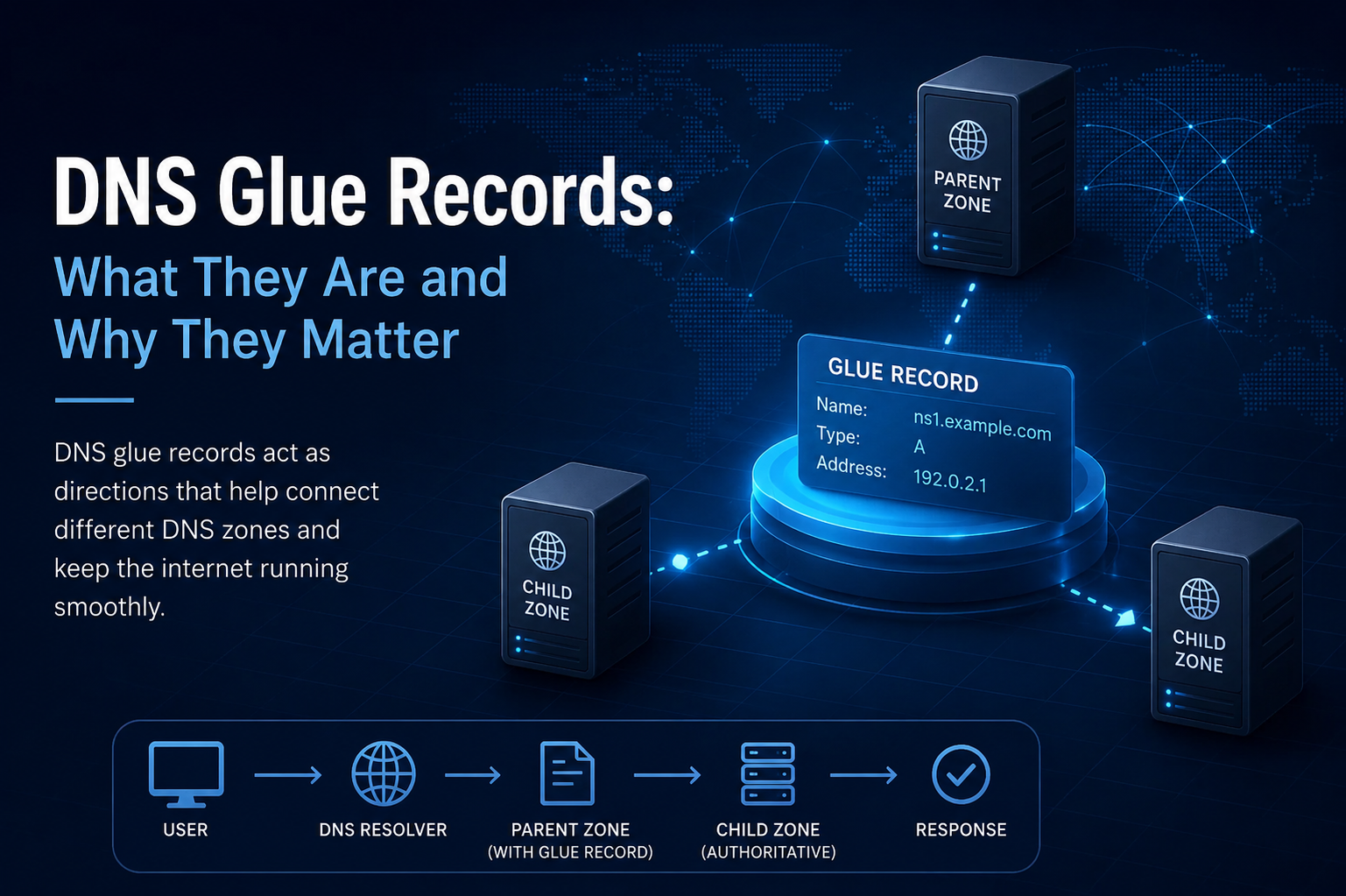
DNS glue records become even more important when we examine the deeper mechanics of how recursive resolution works across distributed systems. Every DNS query typically passes through multiple layers of caching resolvers before reaching an authoritative answer. At each stage, efficiency and accuracy depend on whether the resolver can quickly locate the next hop in the resolution chain.
When glue records are present, they eliminate uncertainty at the delegation point. Instead of requiring an additional lookup to resolve a name server’s address, the resolver receives that information immediately during the referral process. This significantly reduces resolution time and prevents unnecessary dependency loops.
In large-scale networks, even minor inefficiencies in DNS resolution can multiply into noticeable latency. Glue records therefore act as optimization points, ensuring that the transition between delegation and authoritative querying happens without delay or ambiguity.
How Caching Interacts with Glue Records
Caching plays a critical role in DNS performance, and glue records interact closely with this mechanism. Once a resolver obtains the IP address of a name server through a glue record, it stores this information temporarily in its cache. This allows subsequent queries to bypass the initial resolution steps and directly contact the authoritative server.
However, caching also introduces complexity. If a glue record changes at the authoritative level but cached data is not updated promptly, resolvers may continue using outdated information. This can lead to intermittent resolution failures that are difficult to diagnose because they appear inconsistently across different users or regions.
To manage this, DNS systems rely on time-to-live values that control how long glue-related data remains in cache. Proper tuning of these values is essential to balance performance and freshness of data. Too long a cache duration can delay updates, while too short a duration increases query load and reduces efficiency.
Glue Records and Self-Referential DNS Architectures
One of the most important use cases for glue records is in self-referential DNS architectures. These occur when a domain uses name servers that are themselves subdomains of the same domain. In such configurations, the system inherently depends on itself to resolve its own infrastructure.
Without glue records, this creates a paradox where resolution cannot begin because the first step depends on information that is not yet reachable. Glue records resolve this by anchoring the initial lookup process with direct IP information at the parent zone level.
This design allows organizations to maintain full control over their DNS infrastructure while still ensuring global accessibility. It is especially useful for enterprises that prefer to manage their own resolution systems rather than relying entirely on external providers.
The Importance of Glue Records in High Availability Systems
High availability systems depend on redundancy and fault tolerance at every layer, including DNS. Glue records contribute to this by ensuring that name server resolution does not become a single point of failure.
In setups where multiple name servers are used for redundancy, glue records help ensure that each server is independently reachable from the start of the resolution process. This means that even if one server becomes unavailable, others can still be reached without requiring additional resolution steps.
This redundancy is critical for maintaining uptime in mission-critical applications. Even brief DNS failures can cascade into service outages, making glue records a foundational element of resilient infrastructure design.
Glue Records in Distributed and Cloud-Based Environments
Modern cloud-based architectures add another layer of complexity to DNS management. Resources are often distributed across multiple regions, and name servers may be dynamically assigned or scaled based on demand.
In such environments, glue records provide a stable reference point that remains consistent even when underlying infrastructure changes. They act as fixed anchors in an otherwise dynamic system, ensuring that resolution can always begin from a known and reliable state.
This is particularly important in distributed systems where latency and regional routing play significant roles. By ensuring that name server addresses are immediately available, glue records help reduce cross-region lookup delays and improve overall responsiveness.
Security Considerations Related to Glue Records
Although glue records are primarily a functional component of DNS, they also have security implications. Because they provide direct IP addresses at a high level of the resolution process, they can be targeted if not properly managed.
If an attacker were able to manipulate glue records, they could redirect traffic intended for authoritative name servers to malicious destinations. This could lead to interception or disruption of DNS queries.
To mitigate this risk, DNS infrastructure often relies on strict administrative controls and verification processes when updating glue records. Changes are typically made only at the parent zone level and require coordination with domain registrars or authoritative operators.
Additionally, modern security extensions to DNS introduce validation mechanisms that help ensure the integrity of responses, reducing the risk of tampering during resolution.
DNSSEC and Its Relationship with Glue Records
DNS security extensions add cryptographic validation to DNS responses, ensuring that data has not been altered in transit. While glue records themselves are not signed in the same way as standard DNS records, they still play a role in the secure resolution chain.
Because glue records are provided by the parent zone, they are considered part of the delegation process rather than the authoritative data of the domain itself. This means their trust model is based on the integrity of the parent zone.
When combined with secure DNS practices, glue records help maintain a balance between performance and security. They provide the necessary bootstrap information while still allowing cryptographic validation of subsequent queries.
Operational Challenges in Managing Glue Records
Managing glue records at scale can present operational challenges, especially in environments with frequent infrastructure changes. One of the primary difficulties is ensuring consistency between glue records and actual server configurations.
If a name server’s IP address changes but the corresponding glue record is not updated promptly, resolution issues can occur. These issues are often intermittent, depending on cache states across different resolvers.
Another challenge is coordination between different administrative systems. Since glue records are stored at the parent level, changes often require interaction with external management systems. This introduces potential delays and increases the importance of accurate change management processes.
Organizations that operate large-scale DNS infrastructures often implement automated monitoring systems to detect inconsistencies between glue records and active server configurations.
Performance Optimization Through Proper Glue Record Usage
While glue records primarily serve a functional purpose, they also contribute to performance optimization in DNS resolution. By reducing the number of lookup steps required to reach authoritative servers, they decrease overall query latency.
This improvement is particularly noticeable in high-traffic environments where DNS queries occur at a massive scale. Even small reductions in resolution time can lead to significant performance gains when multiplied across millions of requests.
Properly configured glue records ensure that resolvers can bypass unnecessary recursive steps, allowing faster access to authoritative data. This efficiency is one of the reasons glue records are considered essential in modern DNS design.
Troubleshooting Common Glue Record Issues
When DNS resolution problems occur, glue records are often one of the first areas to investigate. Symptoms of glue-related issues include intermittent accessibility, delayed resolution, or complete failure to reach a domain despite correct DNS configuration.
One common issue arises when glue records point to outdated IP addresses. This can happen after infrastructure migrations or server changes if updates are not properly propagated.
Another issue involves mismatches between glue records and authoritative name server data. When inconsistencies exist, resolvers may behave unpredictably depending on which cached data they use.
Effective troubleshooting typically involves verifying consistency across all layers of DNS configuration, including parent zone delegation, authoritative records, and active server status.
Future Relevance of Glue Records in Evolving Internet Systems
As internet infrastructure continues to evolve, the role of glue records remains stable but increasingly important. With the growth of distributed systems, edge computing, and globally dispersed services, DNS resolution complexity continues to increase.
Glue records provide a foundational mechanism that ensures this complexity remains manageable. They allow systems to maintain clear and reliable delegation paths even as underlying architectures become more dynamic.
In future DNS developments, glue records are likely to remain a core component, even as new technologies enhance security, speed, and automation. Their simplicity and effectiveness make them a lasting part of the internet’s design.
Final Conclusion
DNS glue records may appear to be a small technical detail within the larger DNS ecosystem, but they play a crucial role in ensuring the system functions correctly. By resolving circular dependencies and providing immediate access to name server IP addresses, they prevent structural failures that would otherwise disrupt domain resolution.
Their importance extends beyond simple functionality. They contribute to performance optimization, system reliability, infrastructure scalability, and even security integrity when combined with modern DNS protections.
As internet systems become more complex and distributed, glue records continue to serve as essential stabilizing elements. They ensure that despite increasing abstraction and decentralization, the fundamental process of translating domain names into reachable destinations remains consistent, efficient, and dependable.