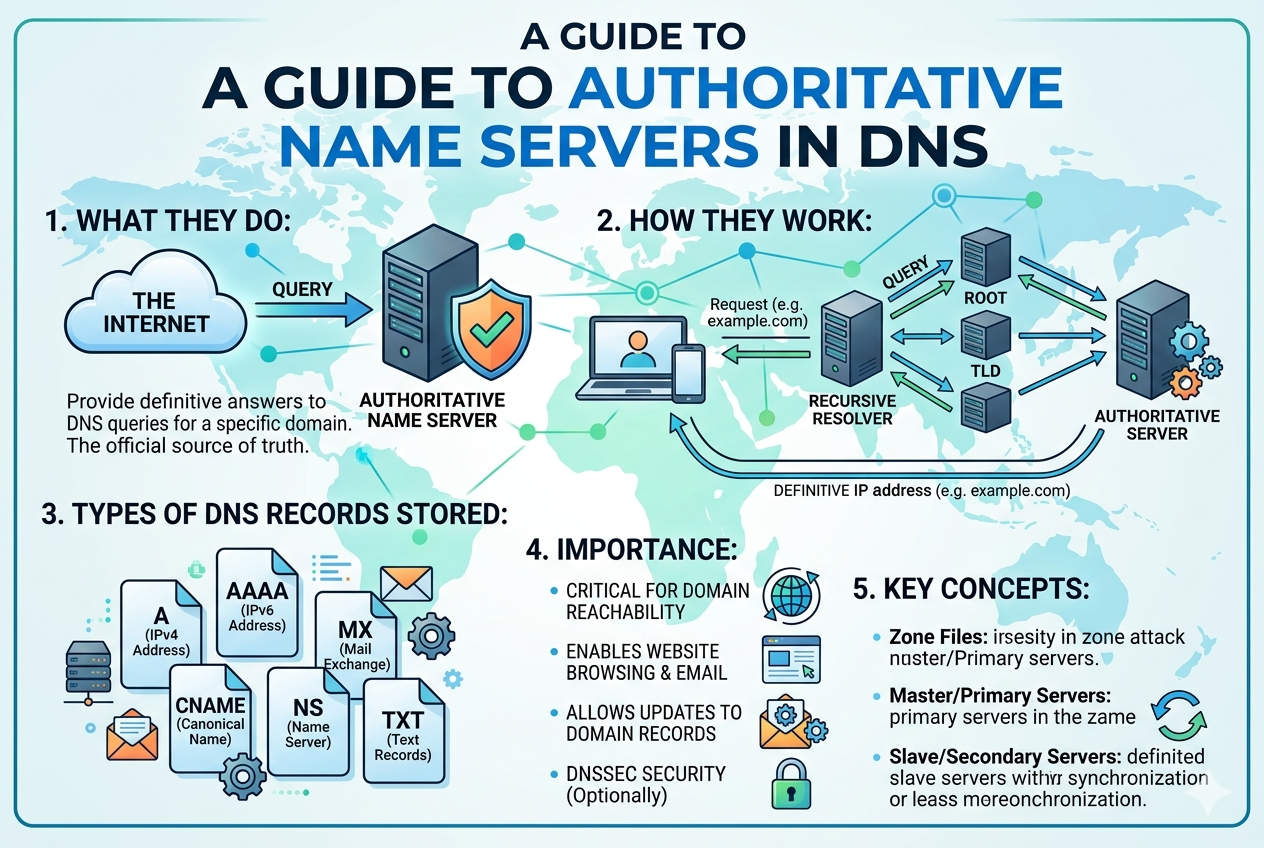
The Domain Name System is one of the most essential and foundational systems that supports the functioning of the modern internet. It works silently in the background, allowing users to access websites, services, applications, and digital platforms using simple and readable names instead of complex numerical identifiers. Without this system, navigating the internet would require memorizing long strings of numbers, making everyday usage extremely difficult and inefficient. At the heart of this system are authoritative name servers, which serve as the final and most reliable source of information for domain-related queries.
Authoritative name servers are responsible for storing and delivering accurate DNS records that define how a domain behaves on the internet. These servers ensure that when a user requests a domain name, the correct destination information is provided without ambiguity. They act as the ultimate decision-makers in the DNS hierarchy, meaning that their responses are final and do not require validation from any other source. This makes them a critical component in maintaining the reliability, speed, and structure of internet communication.
Understanding how authoritative name servers function requires a deeper look into how DNS is structured, how queries flow across the system, and how data is managed and distributed across multiple layers of infrastructure. Their role is not isolated but integrated into a global network of systems that collectively ensure seamless digital communication.
Understanding the Structure of the Domain Name System
The Domain Name System is built as a hierarchical and distributed database system. This design ensures that no single point of failure exists and that the system can scale to accommodate billions of requests every day. At the highest level are root servers, followed by top-level domain servers, and then authoritative servers at the final stage of resolution.
Each level in this hierarchy plays a specific role in guiding a query toward its destination. The root servers provide directions to the appropriate top-level domain servers. These servers then point toward authoritative servers that contain the actual DNS records for a domain. This structured approach ensures that queries are resolved efficiently and accurately.
Authoritative name servers sit at the lowest level of this hierarchy, but they are the most important in terms of data accuracy. While higher-level servers provide guidance, only authoritative servers contain the original and verified DNS information.
The Core Function of Authoritative Name Servers
Authoritative name servers are designed to respond to DNS queries with final answers. They do not perform recursive lookups or rely on external sources to validate information. Instead, they store complete DNS zone files that define how a domain should behave.
When a query reaches an authoritative server, it checks its stored records and returns the relevant response. This response may include IP address mappings, service routing information, or other domain-related data. Because the information comes directly from the source of authority, it is considered fully reliable.
This direct response mechanism is what distinguishes authoritative servers from caching resolvers or recursive servers. While other components in the DNS system assist in finding information, authoritative servers are responsible for providing the definitive answer.
DNS Zones and Their Importance
A DNS zone is a distinct portion of the domain namespace that is managed by an organization or administrator. Authoritative name servers store zone files that contain all DNS records associated with that zone. These files define how a domain should function and how different types of requests should be handled.
Each zone is carefully maintained to ensure accuracy and consistency. Any change in domain configuration, such as updating an IP address or adding a new service record, is made within the zone file. Once updated, these changes are propagated to all authoritative servers associated with the zone.
This structured management system allows administrators to maintain control over domain behavior while ensuring that users worldwide receive consistent responses.
Types of DNS Records Managed by Authoritative Servers
Authoritative name servers store various types of DNS records, each serving a unique purpose in the resolution process. One of the most fundamental record types is the address record, which maps domain names to numerical IP addresses. These records allow browsers and applications to locate the correct servers hosting the requested content.
Another important record type defines mail routing information, ensuring that email messages are delivered to the correct mail servers. There are also records used for aliasing, allowing multiple domain names to point to a single destination. Text-based records are used for verification, configuration, and security purposes.
Each record plays a role in defining how a domain interacts with different systems on the internet. Together, they form a complete configuration that determines how users experience a domain.
Primary and Secondary Authoritative Servers
To ensure reliability and redundancy, authoritative DNS systems are typically composed of primary and secondary servers. The primary server holds the original zone file and is responsible for managing updates and changes. Any modification to DNS records begins on this server.
Secondary servers maintain copies of the zone data and serve as backups. They regularly synchronize with the primary server to ensure that their data remains up to date. This redundancy ensures that even if the primary server becomes unavailable, DNS resolution can continue without disruption.
This distributed approach improves both reliability and performance, as multiple servers can handle queries simultaneously across different geographic locations.
The Process of DNS Resolution Involving Authoritative Servers
When a user enters a domain name into a browser, a complex resolution process begins. The request first goes to a recursive resolver, which is responsible for finding the correct IP address. If the resolver does not already have the information cached, it begins querying the DNS hierarchy.
The resolver first contacts a root server, which directs it to the appropriate top-level domain server. The top-level server then provides the location of the authoritative name server responsible for the domain. Once the authoritative server is reached, it provides the final DNS record.
This record is then returned to the user’s device, allowing the connection to be established. The entire process happens in milliseconds, making it appear instantaneous to the user.
Caching and Its Relationship with Authoritative Servers
Caching plays a significant role in improving DNS performance. Recursive resolvers store previously obtained responses so that future queries can be answered quickly without contacting authoritative servers again. This reduces load on the system and improves response times.
However, cached data is temporary and expires after a certain period defined by time-to-live values. Once expired, the resolver must contact the authoritative server again to obtain fresh information. This ensures that updates made in authoritative records are eventually reflected across the internet.
Despite caching, authoritative servers remain essential because they define the original and updated source of truth.
Security in Authoritative DNS Infrastructure
Security is a critical aspect of authoritative DNS systems. Since these servers provide final answers, they must be protected against unauthorized changes and external attacks. If compromised, they could redirect users to incorrect destinations or disrupt services entirely.
To enhance security, modern DNS systems use cryptographic validation techniques that ensure responses are authentic and have not been tampered with. Access controls are also implemented to restrict who can modify DNS records. These protections help maintain trust in the DNS system.
Threats and Vulnerabilities
Authoritative DNS systems can face several types of threats. One common issue is spoofing, where attackers attempt to impersonate legitimate servers to provide false information. Another threat is cache poisoning, where incorrect data is inserted into caching systems to redirect users.
Denial-of-service attacks can also target DNS infrastructure by overwhelming servers with excessive traffic. To mitigate these risks, redundancy, filtering, and distributed architectures are used.
Maintaining the integrity of authoritative servers is essential for ensuring the safety and reliability of internet communication.
Performance and Global Distribution
Authoritative name servers are often distributed globally to ensure fast response times. By placing servers in multiple geographic locations, DNS queries can be resolved more quickly based on user proximity. This reduces latency and improves overall user experience.
Load balancing techniques are also used to distribute traffic evenly across servers. This ensures that no single server becomes overloaded, maintaining consistent performance even during high traffic periods.
This global distribution model is essential for supporting the scale of the modern internet.
Operational Management and Maintenance
Managing authoritative DNS infrastructure requires continuous monitoring and maintenance. Administrators must ensure that zone files are accurate, synchronized, and updated when necessary. Any misconfiguration can lead to service disruptions or incorrect routing.
Monitoring systems are used to track performance, detect anomalies, and identify potential issues before they escalate. Regular audits and validation processes also help maintain data integrity.
Operational efficiency is critical because DNS is a foundational service that supports nearly all internet activity.
Evolution and Future of Authoritative DNS Systems
As internet usage continues to grow, authoritative DNS systems are evolving to meet new demands. Improvements in automation, security, and distributed architecture are making these systems more resilient and efficient.
New technologies are also enhancing protection against emerging threats while improving response times. The integration of advanced encryption and validation methods is strengthening trust in DNS infrastructure.
The future of authoritative DNS systems will likely involve even greater decentralization and automation, ensuring that the internet remains scalable and secure.
Conclusion
Authoritative name servers are a vital component of the Domain Name System and play a central role in how the internet functions. They provide the final and trusted source of information for domain resolution, ensuring that users are directed accurately and efficiently.
Their structured management of DNS zones, combined with redundancy, security measures, and global distribution, makes them essential for maintaining internet stability. Without authoritative servers, the DNS system would lack a reliable source of truth, leading to confusion and inconsistency in digital communication.
By understanding how these servers operate, it becomes clear how seamlessly the internet is able to connect billions of users to services across the globe. Their importance lies not only in technical functionality but also in enabling the smooth, secure, and reliable experience that defines modern internet usage.