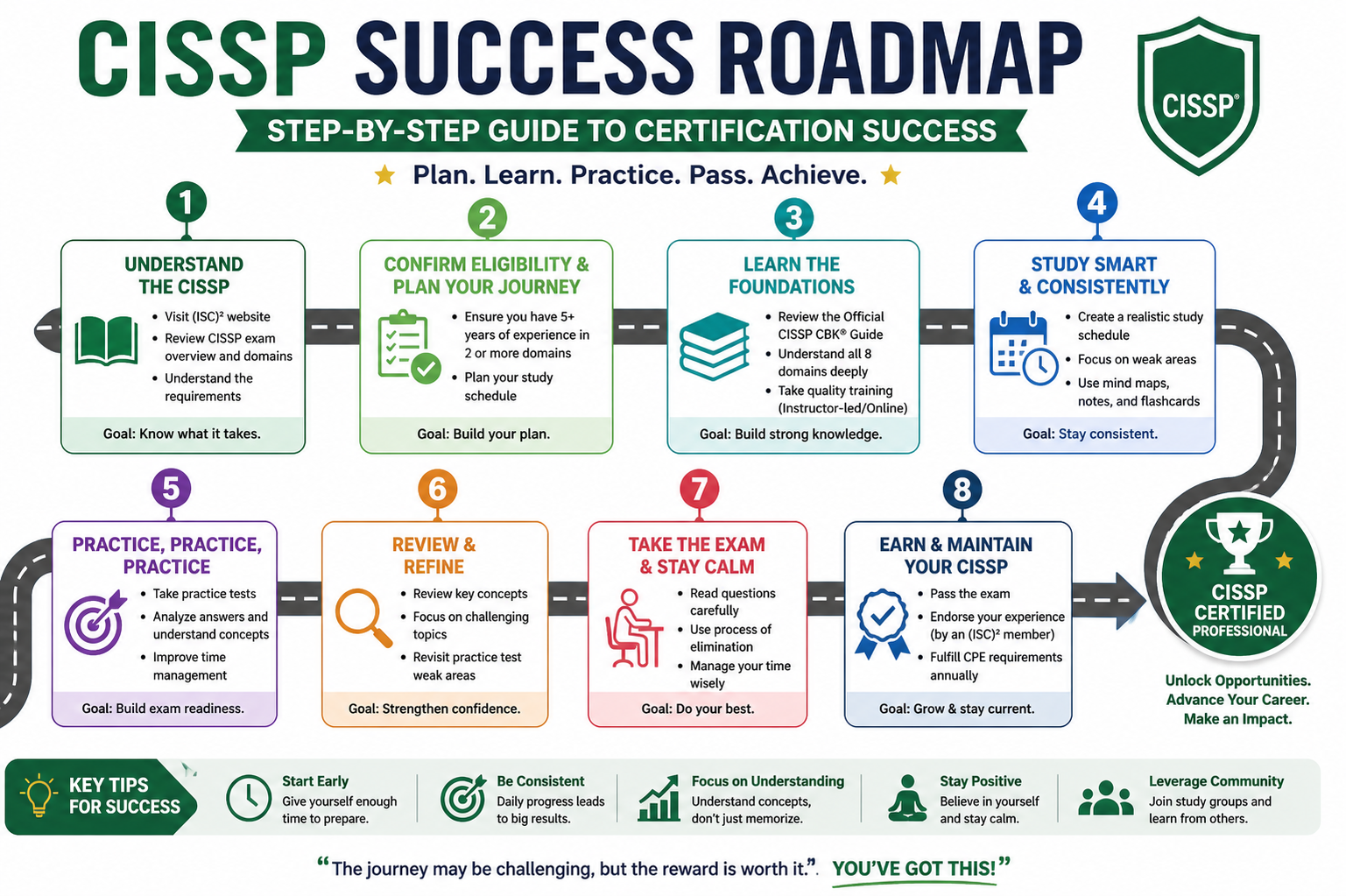
The CISSP certification is widely recognized as a benchmark for advanced cybersecurity knowledge and professional credibility. It is designed for individuals who want to demonstrate their ability to design, implement, and manage a secure business environment. Unlike entry-level certifications, CISSP focuses on a broad and strategic understanding of security principles rather than isolated technical skills. This makes it highly valuable for roles such as security analyst, security architect, IT manager, and cybersecurity consultant.
The certification is also structured to test both knowledge and experience. It is not only about what you know but also about how effectively you can apply that knowledge in real-world scenarios. Because of this, candidates are expected to have a strong background in information security before attempting the exam. Understanding this expectation early helps set a realistic mindset and prepares you for the depth of study required.
Building a Strong Foundation in Cybersecurity Concepts
Before diving into CISSP domains, it is essential to strengthen your understanding of fundamental cybersecurity principles. This includes learning how information security works at a basic level, such as confidentiality, integrity, and availability. These three principles form the backbone of almost every security decision and policy.
You should also become comfortable with basic networking concepts, operating system behavior, and general IT infrastructure. Even though CISSP is not deeply technical in a hands-on coding sense, it assumes you understand how systems interact and how vulnerabilities can arise. Without this foundation, advanced topics can feel overwhelming and disconnected.
Developing this base knowledge allows you to approach CISSP topics with confidence and clarity, making it easier to understand complex scenarios later in your preparation journey.
Understanding the CISSP Domain Structure in Depth
CISSP is organized into multiple domains, each focusing on a specific area of cybersecurity. These domains collectively represent the full scope of information security management. Instead of treating them as separate subjects, it is important to understand how they connect with each other in real environments.
For example, security and risk management principles influence how access control systems are designed. Similarly, communication and network security directly impacts security operations. When you begin to see these relationships, your understanding becomes more practical and exam-focused.
A common mistake candidates make is studying each domain in isolation. A more effective approach is to continuously relate concepts across domains, which improves both memory retention and analytical thinking.
Developing a Structured Study Approach
A disciplined and organized study plan is critical for CISSP success. Without structure, the vast amount of content can feel confusing and difficult to manage. A strong study approach involves dividing your preparation into manageable segments and setting realistic goals for each stage.
Consistency is more important than intensity. Studying regularly for shorter periods is more effective than irregular long sessions. This helps your brain retain information better and reduces burnout. It also allows you to gradually build confidence as you progress through the material.
Tracking your progress is equally important. By regularly reviewing what you have covered, you can identify weak areas and adjust your focus accordingly. This ensures balanced preparation across all domains instead of overemphasizing one area.
Mastering Security and Risk Management Principles
One of the most important areas in CISSP is security and risk management. This domain covers essential topics such as governance, compliance, risk assessment, and ethical practices. Understanding how organizations manage risk is critical for making informed security decisions.
You should focus on learning how policies are created, how risk is evaluated, and how security frameworks are applied in real environments. These concepts are not just theoretical; they directly reflect how organizations operate in the real world.
A strong grasp of this domain also helps in answering scenario-based questions, which are a major part of the CISSP exam. Instead of memorizing definitions, focus on understanding decision-making processes and the reasoning behind them.
Strengthening Identity and Access Management Knowledge
Identity and Access Management is another core area that plays a significant role in CISSP. It focuses on ensuring that only authorized users have access to systems and data. This includes authentication methods, authorization models, and access control mechanisms.
Understanding how identities are created, managed, and secured is essential for protecting organizational resources. You should also study different access control models and how they are applied in various environments.
This domain often appears in practical scenarios where you must determine the most secure way to grant or restrict access. Therefore, focusing on real-world application rather than theory is highly beneficial.
Building Expertise in Security Architecture and Engineering
Security architecture and engineering focus on designing secure systems and infrastructure. This includes understanding how hardware, software, and networks interact to create a secure environment.
You should learn about secure design principles, encryption methods, and system resilience strategies. These concepts help in building systems that can withstand attacks and recover from failures.
A strong understanding of this domain also improves your ability to evaluate system weaknesses and recommend improvements. It requires both analytical thinking and awareness of how different components work together in an IT ecosystem.
Improving Knowledge of Security Operations
Security operations involve the day-to-day management of security processes within an organization. This includes monitoring systems, responding to incidents, and maintaining operational security controls.
You should focus on understanding how security events are detected and handled. This includes incident response procedures, logging mechanisms, and recovery processes.
This domain is highly practical and reflects real-world cybersecurity responsibilities. It is important to understand not just what actions are taken, but why they are taken and how they impact overall security posture.
Enhancing Understanding of Software Development Security
Software development security focuses on integrating security into the software development lifecycle. This ensures that applications are designed and built with security in mind from the beginning.
You should study secure coding principles, common software vulnerabilities, and testing methods used to identify security flaws. Understanding how software can be exploited helps in designing better defensive strategies.
This domain highlights the importance of collaboration between developers and security professionals. It ensures that security is not an afterthought but a core part of the development process.
Practicing Scenario-Based Thinking for Exam Readiness
The CISSP exam is known for its scenario-based questions that test critical thinking rather than memorization. To succeed, you must develop the ability to analyze situations and choose the most appropriate security response.
This requires practice and exposure to different types of security scenarios. Instead of focusing only on correct answers, it is important to understand why certain options are better than others.
Over time, this approach helps you think like a security professional rather than just a student. It improves decision-making skills and prepares you for real-world challenges as well as the exam itself.
Strengthening Revision and Knowledge Retention Techniques
Revision is a crucial part of CISSP preparation because of the large amount of information involved. Without regular review, it is easy to forget key concepts over time.
Effective revision involves revisiting topics multiple times and reinforcing understanding through practice questions. It is also helpful to summarize complex concepts in your own words to improve retention.
Repetition and active recall are powerful techniques that help strengthen memory. By consistently reviewing material, you ensure that knowledge remains fresh and accessible during the exam.
Developing Time Management and Exam Strategy Skills
Time management is an important factor in CISSP success. The exam requires you to analyze complex questions within a limited time frame. Poor time management can lead to unnecessary stress and incomplete answers.
Practicing timed mock exams helps improve speed and accuracy. It also helps you become familiar with question patterns and difficulty levels.
A good exam strategy involves reading questions carefully, eliminating incorrect options, and choosing the most logical answer based on security principles. Staying calm and focused during the exam is equally important for success.
Maintaining Consistency and Long-Term Focus
CISSP preparation is not a short-term effort. It requires consistent dedication over time. Maintaining focus and discipline throughout the journey is essential for achieving success.
There may be moments of difficulty or confusion, but persistence plays a key role in overcoming these challenges. Staying committed to your study plan ensures steady progress and builds confidence over time.
With the right mindset, structured preparation, and continuous effort, achieving CISSP certification becomes a realistic and rewarding accomplishment that opens doors to advanced opportunities in cybersecurity.
Deepening Understanding Through Real-World Application
Once the foundational and domain-level concepts are clear, the next important step is connecting theory with real-world application. CISSP is not designed to test memorization alone; it evaluates how well you can apply security principles in practical, complex business environments. This means every concept you study should eventually be linked to how it works in an organization.
For example, understanding access control is not just about knowing definitions of authentication and authorization. It is about recognizing how organizations decide who gets access to sensitive systems, how permissions are reviewed, and how access risks are reduced over time. Similarly, risk management becomes more meaningful when you can relate it to actual business decisions, such as whether an organization should accept, transfer, or mitigate a risk.
Building this mindset requires consistent reflection while studying. Instead of asking “what is this concept,” the better question is “how is this used in a real organization.” This shift in thinking significantly improves exam performance and professional understanding.
Strengthening Analytical and Decision-Making Skills
A major challenge in CISSP preparation is developing strong analytical thinking. Many exam questions are scenario-based and require you to evaluate multiple possible answers before selecting the most appropriate one. This is not about choosing the technically correct answer alone, but the most suitable one based on security best practices and organizational priorities.
To improve this skill, it is important to practice breaking down questions into smaller parts. Identify the main problem, understand the environment described in the scenario, and determine what the organization is trying to achieve. Once this is clear, evaluating answer choices becomes more logical and structured.
Over time, this approach trains your mind to think like a security manager rather than a technician. This perspective is essential because CISSP focuses heavily on management-level decision-making rather than hands-on technical implementation.
Improving Retention Through Active Learning Techniques
Simply reading study material is not enough for long-term retention in CISSP preparation. Active learning methods are far more effective in helping you remember and apply complex concepts. One of the most powerful techniques is self-explanation, where you explain a topic in your own words as if teaching someone else.
Another effective method is scenario-based questioning. Instead of reviewing notes passively, you can turn each concept into a question and try to answer it without looking at the material. This forces your brain to actively retrieve information, strengthening memory and understanding.
Repetition also plays a critical role. Revisiting topics at regular intervals ensures that knowledge is not forgotten over time. This spaced learning approach is particularly useful for covering the wide range of CISSP domains.
Enhancing Understanding of Security Governance and Compliance
Security governance is a core part of CISSP that focuses on how organizations define, implement, and maintain security policies. It ensures that security practices align with business goals and legal requirements.
Understanding governance involves learning how policies are created, approved, and enforced. It also includes understanding the role of leadership in setting security direction and ensuring accountability across the organization.
Compliance is closely related to governance and focuses on meeting legal, regulatory, and industry requirements. Organizations must ensure that their security practices align with standards and frameworks relevant to their operations. This area is important because many CISSP questions are designed around decision-making in compliance-related scenarios.
Strengthening Cryptography and Data Protection Knowledge
Cryptography plays a key role in protecting sensitive data from unauthorized access. It ensures confidentiality, integrity, and authenticity of information in both storage and transmission.
Understanding encryption methods, hashing techniques, and key management is essential for CISSP success. However, it is more important to understand why and when certain cryptographic methods are used rather than memorizing technical details alone.
Data protection also includes understanding classification systems, data lifecycle management, and secure handling of information. Organizations must ensure that sensitive data is protected at every stage, from creation to disposal.
This domain often appears in practical scenarios where you must determine the best way to secure data based on risk and business needs.
Developing Incident Response and Recovery Awareness
Incident response is a critical component of security operations. It focuses on how organizations detect, respond to, and recover from security incidents. Understanding this process is essential for minimizing damage and restoring normal operations quickly.
You should learn the typical stages of incident response, including preparation, detection, containment, eradication, recovery, and post-incident review. Each stage plays an important role in managing security events effectively.
Recovery planning is equally important. Organizations must ensure that they can restore systems and data after an incident with minimal disruption. This involves backup strategies, disaster recovery planning, and business continuity management.
Strengthening Physical and Environmental Security Concepts
Physical security is often overlooked but is an important part of the CISSP exam. It focuses on protecting physical assets such as buildings, servers, and infrastructure from unauthorized access or environmental threats.
This includes understanding access control systems for physical spaces, surveillance mechanisms, and environmental protections like fire suppression and climate control.
Even though cybersecurity is often associated with digital systems, physical vulnerabilities can lead to serious security breaches. Therefore, understanding how physical and digital security work together is essential for a complete security strategy.
Improving Risk-Based Thinking for Exam Success
One of the most important skills in CISSP is risk-based thinking. Almost every decision in cybersecurity involves evaluating risk and determining the best course of action.
Risk-based thinking involves understanding the likelihood of a threat, the potential impact, and the cost of mitigating that risk. It also involves balancing security with business needs, ensuring that security controls do not hinder organizational productivity unnecessarily.
This mindset is especially important for exam questions that present multiple possible solutions. The correct answer is often the one that provides the best balance between security, cost, and operational efficiency.
Building Confidence Through Practice Exams
Practice exams are a key part of CISSP preparation. They help you become familiar with question formats, improve time management, and identify weak areas in your knowledge.
However, the goal of practice exams is not just to score high but to understand reasoning behind each answer. Reviewing incorrect answers is especially valuable because it highlights gaps in understanding and helps you improve.
Over time, repeated practice builds confidence and reduces exam anxiety. It also helps you develop a consistent approach to solving complex questions under time pressure.
Maintaining Motivation and Consistency Throughout Preparation
CISSP preparation is a long journey that requires patience and discipline. It is normal to feel overwhelmed at times due to the volume of content. Maintaining motivation is essential for continuous progress.
Setting small, achievable goals helps maintain momentum. Each completed topic or practice test contributes to a sense of progress and achievement.
It is also important to maintain balance and avoid burnout. Regular breaks and consistent pacing help keep your mind fresh and focused throughout the preparation period.
Final Stage Focus Before Exam Readiness
As you approach the final stage of preparation, the focus should shift from learning new content to strengthening existing knowledge. This involves revision, practice tests, and reinforcing weak areas.
At this stage, clarity is more important than volume. Instead of trying to cover everything again, focus on understanding core principles and how they apply across different scenarios.
With consistent preparation, strong conceptual understanding, and a disciplined approach, you gradually build the confidence and capability required to succeed in the CISSP certification exam.
Refining Conceptual Clarity Across All Domains
At an advanced stage of CISSP preparation, the focus naturally shifts from learning individual topics to refining overall conceptual clarity. Instead of viewing each domain separately, it becomes important to understand how all domains interact as part of a unified security framework. This broader perspective helps you approach questions more strategically and improves your ability to select the most appropriate answers in complex scenarios.
For instance, a decision related to network security may also involve risk management, access control, and compliance considerations. Recognizing these overlaps is essential because real-world security problems are rarely isolated to a single domain. Developing this integrated understanding strengthens both exam performance and professional judgment in practical environments.
Strengthening Strategic Thinking in Security Decisions
CISSP emphasizes strategic thinking rather than technical execution. This means you are expected to think like a security leader who makes decisions based on business needs, risk tolerance, and organizational goals.
Strategic thinking involves evaluating the long-term impact of security decisions rather than focusing only on immediate technical fixes. For example, implementing a security control is not just about stopping an attack but also about ensuring it aligns with business operations and does not introduce unnecessary complexity or cost.
This mindset is critical for answering scenario-based questions where multiple technically correct answers may exist, but only one aligns best with organizational priorities.
Enhancing Problem-Solving Under Complex Scenarios
CISSP exam questions are often designed to test your ability to solve problems in layered and realistic environments. These scenarios may include incomplete information, multiple stakeholders, and conflicting priorities.
To handle such questions effectively, it is important to develop a structured approach to problem-solving. This involves identifying the core issue first, understanding the context, and then evaluating possible solutions based on security principles.
Rather than rushing to select an answer, taking a methodical approach ensures better accuracy. Over time, this habit becomes natural and significantly improves performance under exam pressure.
Deepening Understanding of Security Architecture Principles
Security architecture is a fundamental aspect of building secure systems. It involves designing frameworks that protect information systems from threats while maintaining usability and performance.
At this stage, it is important to move beyond basic definitions and focus on how secure design principles are applied in real environments. This includes understanding concepts such as defense in depth, least privilege, redundancy, and segmentation.
These principles help ensure that even if one layer of security fails, additional controls are in place to reduce overall risk. Understanding how these layers work together provides a strong foundation for analyzing complex security environments.
Strengthening Awareness of Emerging Security Trends
The cybersecurity landscape is constantly evolving, and CISSP candidates are expected to have awareness of emerging trends and threats. This includes developments in cloud security, artificial intelligence, zero trust architecture, and advanced persistent threats.
While the exam does not focus heavily on cutting-edge technical details, understanding how modern technologies impact security principles is important. For example, cloud environments introduce new risks related to shared responsibility models and data visibility.
Staying informed about these trends helps you understand how traditional security concepts are adapted to modern environments. It also enhances your ability to answer scenario-based questions with a current and practical perspective.
Improving Risk Evaluation and Business Alignment Skills
At a more advanced level of preparation, risk evaluation becomes more refined and business-oriented. Instead of simply identifying risks, you must also understand how organizations prioritize and manage them based on business impact.
This involves balancing security requirements with operational efficiency and financial constraints. A strong CISSP candidate understands that not all risks can be eliminated and that informed risk acceptance is sometimes necessary.
This level of thinking is essential for selecting answers that align with real-world organizational behavior rather than purely theoretical security ideals.
Strengthening Exam Mindset and Mental Readiness
Mental preparation is just as important as technical knowledge when approaching the CISSP exam. The exam is lengthy, challenging, and designed to test endurance as well as understanding.
Developing a calm and focused mindset helps reduce stress and improves decision-making during the exam. It is important to remain consistent in your approach and avoid second-guessing answers excessively.
Confidence comes from preparation and familiarity with question patterns. The more practice you complete under exam-like conditions, the more comfortable you become with managing pressure and time constraints.
Improving Elimination Techniques for Answer Selection
One of the most effective strategies for CISSP success is learning how to eliminate incorrect answers. Often, multiple options may appear correct at first glance, but careful analysis reveals subtle differences.
Elimination involves removing answers that are clearly incorrect, less effective, or not aligned with security best practices. This increases the probability of selecting the most appropriate response even when uncertainty exists.
This technique is especially useful for complex scenario-based questions where direct memorization is not sufficient. It encourages logical reasoning rather than guesswork.
Strengthening Knowledge Integration Across Domains
As preparation progresses, integrating knowledge across all CISSP domains becomes increasingly important. This means connecting concepts from different areas to form a complete understanding of security management.
For example, a decision related to incident response may involve understanding cryptography, access control, risk management, and communication protocols simultaneously. Recognizing these interdependencies improves both analytical thinking and exam performance.
This integrated approach reflects real-world cybersecurity environments where multiple systems and policies work together to protect organizational assets.
Enhancing Time Management Efficiency During Exam Practice
Time management becomes a critical skill in the final stages of preparation. Practicing under timed conditions helps simulate the actual exam environment and improves pacing.
It is important to avoid spending too much time on any single question. Instead, focus on making logical decisions efficiently and moving forward with confidence.
Developing a rhythm during practice exams helps you allocate time effectively across all questions, ensuring that you complete the exam within the given timeframe.
Strengthening Final Revision and Concept Reinforcement
In the final phase of preparation, revision should focus on reinforcing key concepts rather than learning new material. This helps solidify understanding and ensures long-term retention.
Revisiting major principles, reviewing notes, and practicing scenario questions are all effective ways to strengthen memory. At this stage, clarity and confidence are more important than covering additional topics.
The goal is to ensure that core concepts are deeply understood and can be applied quickly and accurately during the exam.
Developing Confidence Through Consistent Preparation Habits
Confidence in CISSP success is built gradually through consistent preparation habits. Regular study, practice, and revision create a strong foundation that reduces uncertainty over time.
Consistency ensures that knowledge is reinforced repeatedly, making it easier to recall during high-pressure situations. This steady approach is more effective than last-minute intensive studying.
By maintaining discipline and focus throughout the preparation journey, candidates develop the confidence needed to approach the exam with clarity and assurance.
Final Readiness and Professional Growth Mindset
As you reach final readiness, CISSP preparation becomes more than just exam preparation; it transforms into professional growth. The knowledge gained through this process enhances your ability to think strategically about cybersecurity challenges in real-world environments.
The certification represents not only technical understanding but also the ability to make informed decisions that protect organizations from evolving threats. With strong preparation, disciplined study habits, and a clear understanding of security principles, achieving CISSP success becomes a realistic and rewarding milestone in your cybersecurity career.
Strengthening Executive-Level Security Perspective
At an advanced stage of CISSP preparation, it becomes essential to think beyond technical implementation and adopt an executive-level security perspective. This means understanding how security decisions impact business strategy, organizational goals, and long-term sustainability.
Security professionals are often required to justify decisions in terms of cost, risk reduction, and business value. Therefore, it is important to evaluate every security concept not only from a technical standpoint but also from a management and leadership perspective. This approach helps in answering questions where the best solution is the one that aligns with business priorities rather than the most technically advanced option.
Developing this mindset also prepares you for real-world leadership roles in cybersecurity where communication with executives and stakeholders is a critical responsibility.
Improving Interpretation of Complex Scenario Questions
CISSP exam questions are often designed with multiple layers of complexity. These scenarios may include incomplete information, competing priorities, and subtle differences between answer choices.
To handle such questions effectively, it is important to carefully interpret what the question is really asking. Many candidates lose marks not because they lack knowledge, but because they misinterpret the scenario or overlook key details.
A structured reading approach is helpful. First, identify the main issue, then determine the environment, and finally understand the desired outcome. Once this is clear, evaluating options becomes more logical and focused.
This skill improves significantly with practice and repeated exposure to scenario-based questions.
Strengthening Security Control Selection Skills
Selecting the appropriate security control is a key aspect of CISSP success. Security controls are used to reduce risk, protect assets, and ensure compliance with policies and regulations.
Understanding when to use administrative, technical, or physical controls is essential. Each type of control serves a different purpose and must be applied based on the nature of the risk being addressed.
At a deeper level, it is important to understand control effectiveness. The best answer is not always the most complex control but the one that provides the most efficient and appropriate level of risk reduction.
This skill is heavily tested in exam scenarios where multiple control options may appear valid.
Enhancing Understanding of Organizational Security Culture
Security is not only about technology and processes but also about people and organizational culture. A strong security culture ensures that employees understand their responsibilities and follow security policies consistently.
Building this awareness involves understanding how training, awareness programs, and leadership influence behavior within an organization. Even the most advanced security systems can fail if users do not follow proper practices.
CISSP candidates must recognize the importance of human factors in cybersecurity. Many exam scenarios focus on situations where user behavior, training gaps, or policy violations contribute to security risks.
Deepening Knowledge of Disaster Recovery and Business Continuity
Disaster recovery and business continuity planning are essential components of organizational resilience. These processes ensure that critical business operations can continue or be restored after a disruptive event.
Understanding recovery strategies involves learning how systems are backed up, how data is restored, and how operations are maintained during emergencies. It also includes prioritizing systems based on their importance to the organization.
Business continuity focuses on maintaining essential functions even during disruptions. This requires coordination between technical systems, personnel, and communication strategies.
These concepts are often tested in scenario-based questions where you must choose the most appropriate recovery approach based on business impact.
Strengthening Understanding of Network Security Principles
Network security plays a critical role in protecting communication systems and data flow within organizations. It involves securing both internal and external network connections against unauthorized access and attacks.
Key concepts include segmentation, firewalls, intrusion detection systems, and secure communication protocols. However, CISSP emphasizes understanding how these controls work together rather than focusing on technical configuration details.
It is important to recognize how network design influences overall security posture. A well-structured network reduces attack surfaces and improves monitoring capabilities.
Improving Decision Prioritization in Security Scenarios
One of the most important skills in CISSP is prioritization. In many scenarios, multiple issues may exist simultaneously, and you must decide which one requires immediate attention.
Prioritization is based on risk impact, business urgency, and potential damage. Understanding how to evaluate these factors helps in selecting the most appropriate action in time-sensitive situations.
This skill reflects real-world security management, where resources are limited and decisions must be made quickly and effectively.
Strengthening Awareness of Legal and Ethical Responsibilities
Security professionals must operate within legal and ethical boundaries. Understanding laws, regulations, and ethical standards is essential for maintaining trust and compliance.
This includes awareness of data protection laws, privacy requirements, and organizational policies. Ethical decision-making ensures that security practices do not violate user rights or legal obligations.
CISSP scenarios often include situations where legal and ethical considerations influence the correct answer. Therefore, understanding this area is critical for exam success.
Enhancing Analytical Thinking Under Pressure
The CISSP exam requires strong analytical thinking, especially under time pressure. Candidates must quickly analyze complex scenarios, evaluate options, and make informed decisions.
Developing this ability requires consistent practice in timed conditions. Over time, you become more comfortable processing information quickly without losing accuracy.
Maintaining calmness under pressure is equally important. Stress can lead to rushed decisions, so developing focus and mental clarity is essential for success.
Strengthening Final Phase Confidence and Readiness
In the final stage of preparation, confidence becomes a key factor in performance. Confidence is built through consistent study, repeated practice, and familiarity with exam patterns.
At this point, the focus should be on reinforcing strengths and minimizing weaknesses. Reviewing key concepts and practicing scenario questions helps solidify understanding.
It is also important to trust your preparation and avoid overloading yourself with new information. Clarity and stability are more valuable than last-minute learning.
Developing a Professional Cybersecurity Mindset
Beyond exam preparation, CISSP also helps develop a professional mindset suitable for senior cybersecurity roles. This includes thinking strategically, making risk-based decisions, and understanding organizational priorities.
A professional mindset also involves continuous learning and adaptability. Cybersecurity is an evolving field, and professionals must stay updated with new threats and technologies.
This mindset ensures that CISSP knowledge remains relevant and applicable long after the exam is completed.
Final Integration of Knowledge and Exam Strategy
At the conclusion of preparation, all knowledge domains should feel interconnected. Instead of viewing topics separately, you should be able to see how they work together in real security environments.
Exam strategy also becomes more refined at this stage. Efficient time management, elimination techniques, and scenario interpretation skills all come together to improve performance.
With disciplined preparation, strong conceptual understanding, and a strategic approach, CISSP success becomes not just achievable but a natural outcome of consistent effort and focused learning.
Conclusion
The CISSP journey is a structured progression that builds from foundational cybersecurity understanding to advanced security management and strategic decision-making. Success in this certification is not achieved through memorization alone but through consistent learning, practical understanding, and the ability to apply security principles in complex real-world scenarios.
Throughout the preparation process, the focus gradually shifts from individual concepts to an integrated view of how security domains work together within an organization. This holistic perspective is what distinguishes a certified professional, enabling better judgment, stronger analytical thinking, and more effective risk-based decisions.
Discipline, consistency, and structured study habits play a crucial role in achieving readiness. Equally important is developing a mindset that aligns with business objectives, where security decisions support organizational goals while maintaining strong protection against threats.
Ultimately, CISSP certification represents more than exam success; it reflects professional growth in the field of cybersecurity. It prepares individuals to take on leadership responsibilities, manage security challenges strategically, and contribute meaningfully to organizational resilience in an evolving threat landscape.