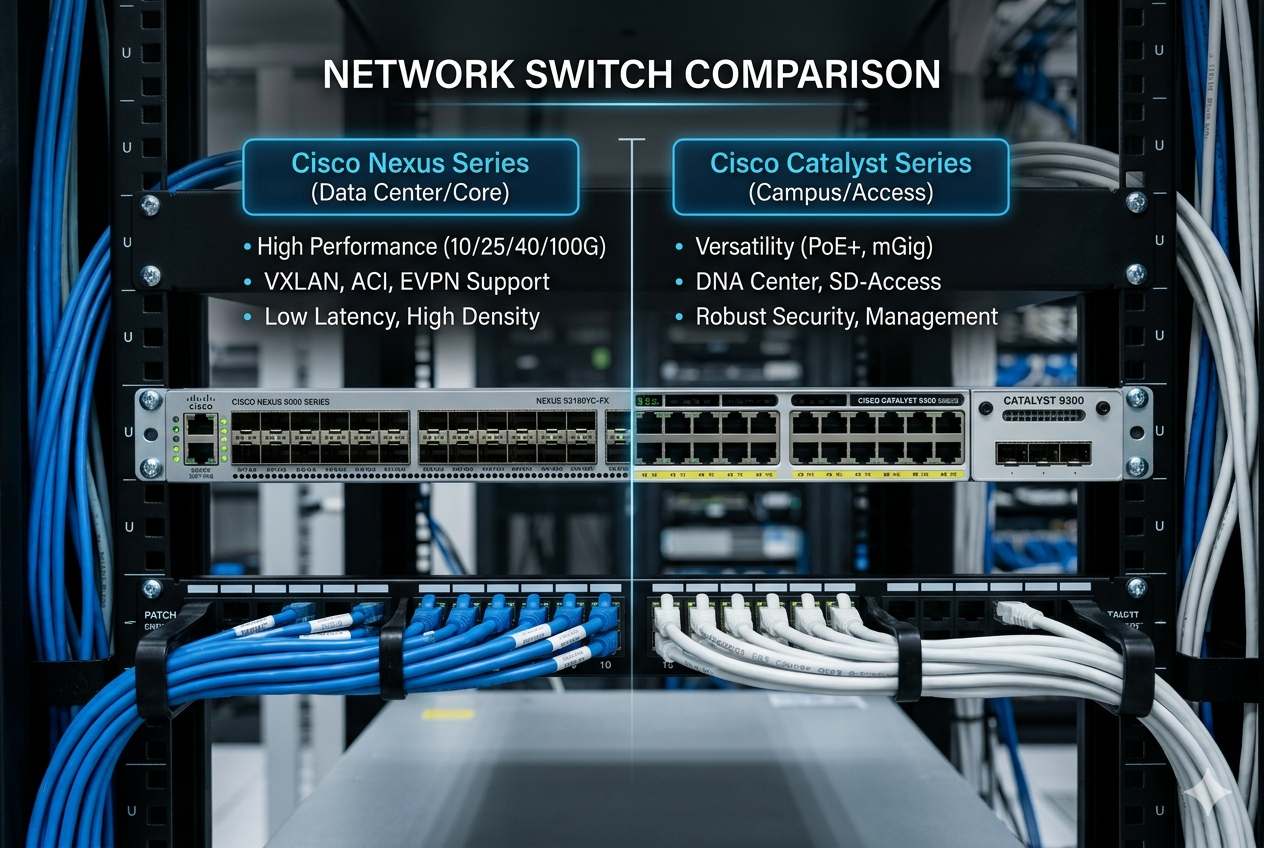
When designing or upgrading a modern network, one of the most important decisions organizations face is selecting the right switching platform. Cisco offers two of its most widely used and powerful switching families: Nexus and Catalyst. While both are built to deliver high performance, reliability, and advanced networking features, they are designed with different environments and purposes in mind. Understanding the differences between these two switch lines is essential for building efficient, scalable, and future-ready infrastructure. Choosing incorrectly can lead to performance bottlenecks, unnecessary costs, or operational limitations that affect long-term network growth.
Understanding Cisco Catalyst Switches
Cisco Catalyst switches are primarily designed for enterprise campus networks. These switches are widely used in office environments, educational institutions, branch offices, and general enterprise LAN setups. Their main focus is on delivering stable connectivity, ease of use, and advanced Layer 2 and Layer 3 features suited for day-to-day business operations.
Catalyst switches are known for their flexibility in handling access layer, distribution layer, and sometimes even core layer roles in smaller networks. They support a wide range of features such as VLAN segmentation, quality of service policies, advanced security controls, and integration with enterprise identity systems. Over the years, Catalyst switches have evolved significantly to support higher speeds, automation capabilities, and software-defined networking features, making them a reliable choice for modern enterprise environments.
One of the defining characteristics of Catalyst switches is their strong emphasis on user experience and simplified management. Network administrators can easily configure, monitor, and troubleshoot Catalyst devices using intuitive interfaces and centralized management tools. This makes them ideal for organizations that require robust performance without overly complex data center-grade configurations.
Understanding Cisco Nexus Switches
Cisco Nexus switches, on the other hand, are designed specifically for data center environments. These switches are built to handle extremely high-performance workloads, low latency requirements, and large-scale virtualization environments. Nexus switches are commonly deployed in cloud data centers, enterprise data centers, and environments where application performance and scalability are critical.
Unlike Catalyst switches, Nexus platforms prioritize high-speed connectivity, hardware-level optimization, and support for advanced data center technologies such as virtualization integration, storage networking, and automated orchestration. They are engineered to handle massive traffic loads with minimal delay, making them suitable for mission-critical applications and cloud computing infrastructures.
Nexus switches also support advanced data center architectures such as leaf-spine topologies, which allow for scalable and non-blocking network designs. This ensures consistent performance even as workloads increase dramatically. Their operating systems are also optimized for data center operations, focusing on stability, performance, and programmability rather than user-friendly campus networking features.
Architectural Differences Between Catalyst and Nexus
The architectural design of Catalyst and Nexus switches is one of the key factors that differentiates them. Catalyst switches are built with a focus on enterprise campus networking, where traffic patterns are generally more predictable and user-driven. They are optimized for north-south traffic, meaning data flows between users and centralized services.
Nexus switches are built for east-west traffic, which is common in data centers where servers communicate heavily with each other. This architectural distinction makes Nexus switches more suitable for environments where virtualization, cloud computing, and distributed applications dominate.
Catalyst switches often prioritize modular flexibility in terms of enterprise features such as access control, wireless integration, and policy enforcement. Nexus switches prioritize raw performance, scalability, and low-latency forwarding at high throughput levels. This fundamental difference shapes how each platform is used in real-world deployments.
Performance and Scalability Considerations
Performance is a critical factor when comparing Cisco Nexus and Catalyst switches. Nexus switches generally offer higher throughput and lower latency, which is essential for data centers handling thousands of virtual machines, containerized applications, and real-time processing workloads. They are engineered to support massive data flows without congestion, ensuring consistent performance even under heavy load.
Catalyst switches provide excellent performance for enterprise environments but are not typically designed for the extreme scalability requirements of large data centers. They are more than capable of supporting high-speed enterprise LANs, but their architecture is not optimized for hyperscale environments.
Scalability is another important consideration. Nexus switches are designed to scale horizontally with ease, allowing organizations to expand their data center infrastructure seamlessly. Catalyst switches, while scalable, are better suited for hierarchical enterprise network designs rather than large-scale distributed computing environments.
Use Case Differences Between Nexus and Catalyst
The use cases for these two switch families are clearly distinct. Catalyst switches are commonly deployed in environments such as corporate offices, branch networks, universities, and healthcare facilities. They support end-user connectivity, VoIP systems, wireless access points, and enterprise applications.
Nexus switches are deployed in data centers, cloud infrastructure environments, and large-scale virtualization platforms. They support server-to-server communication, storage networks, and high-performance computing workloads. Organizations that run private clouds or hybrid cloud environments often rely heavily on Nexus switches for their backend infrastructure.
Understanding the intended use case is essential when selecting between the two platforms. Using Catalyst switches in a data center environment may limit performance, while deploying Nexus switches in a small office network may result in unnecessary complexity and cost.
Management and Operational Differences
Management capabilities differ significantly between Catalyst and Nexus switches. Catalyst switches are designed for ease of use and simplified network administration. They often include user-friendly interfaces, automation features, and integration with enterprise management platforms. This makes them suitable for IT teams that manage diverse enterprise environments.
Nexus switches, however, are designed for advanced network engineers and data center operators. They provide deep configuration capabilities, advanced automation support, and integration with orchestration tools used in cloud environments. While powerful, they require a higher level of expertise to configure and manage effectively.
Operationally, Catalyst switches emphasize stability in user-facing environments, while Nexus switches emphasize performance consistency under high data loads. This difference reflects their respective target environments and operational priorities.
Security and Reliability Considerations
Both Catalyst and Nexus switches offer strong security features, but their focus differs based on environment. Catalyst switches provide enterprise-grade security features such as access control lists, port security, network segmentation, and identity-based access controls. These features are designed to protect enterprise users and endpoints from internal and external threats.
Nexus switches focus on securing data center traffic and ensuring isolation between virtualized workloads. They support advanced security mechanisms designed for multi-tenant environments, where different applications and services must remain securely separated while sharing infrastructure.
In terms of reliability, both platforms are highly resilient, but Nexus switches are built with data center redundancy and failover capabilities in mind. Catalyst switches also offer redundancy options but are generally optimized for enterprise continuity rather than hyperscale fault tolerance.
Cost and Deployment Considerations
Cost is another factor that influences the decision between Catalyst and Nexus switches. Catalyst switches are generally more cost-effective for enterprise deployments. They offer a strong balance of performance and features without the complexity or cost associated with data center-grade hardware.
Nexus switches tend to be more expensive due to their advanced capabilities, high-performance hardware, and data center-focused architecture. However, their cost is justified in environments where performance, scalability, and uptime are critical business requirements.
Deployment complexity also differs. Catalyst switches are easier to deploy in standard enterprise environments, while Nexus switches require careful planning, especially when designing large-scale data center architectures.
Conclusion
Choosing between Cisco Nexus and Catalyst switches ultimately depends on the specific needs of the network environment. Catalyst switches are ideal for enterprise campus networks where ease of use, flexibility, and reliable connectivity are the primary requirements. They are well-suited for supporting users, devices, and enterprise applications in office and branch environments.
Nexus switches are best suited for data center environments where high performance, low latency, and massive scalability are essential. They are designed to handle the demands of cloud computing, virtualization, and large-scale application workloads.
Understanding the differences in architecture, performance, use cases, and management approaches helps organizations make informed decisions that align with their long-term networking goals. Selecting the right switch line ensures not only optimal performance but also cost efficiency and future scalability as network demands continue to grow.