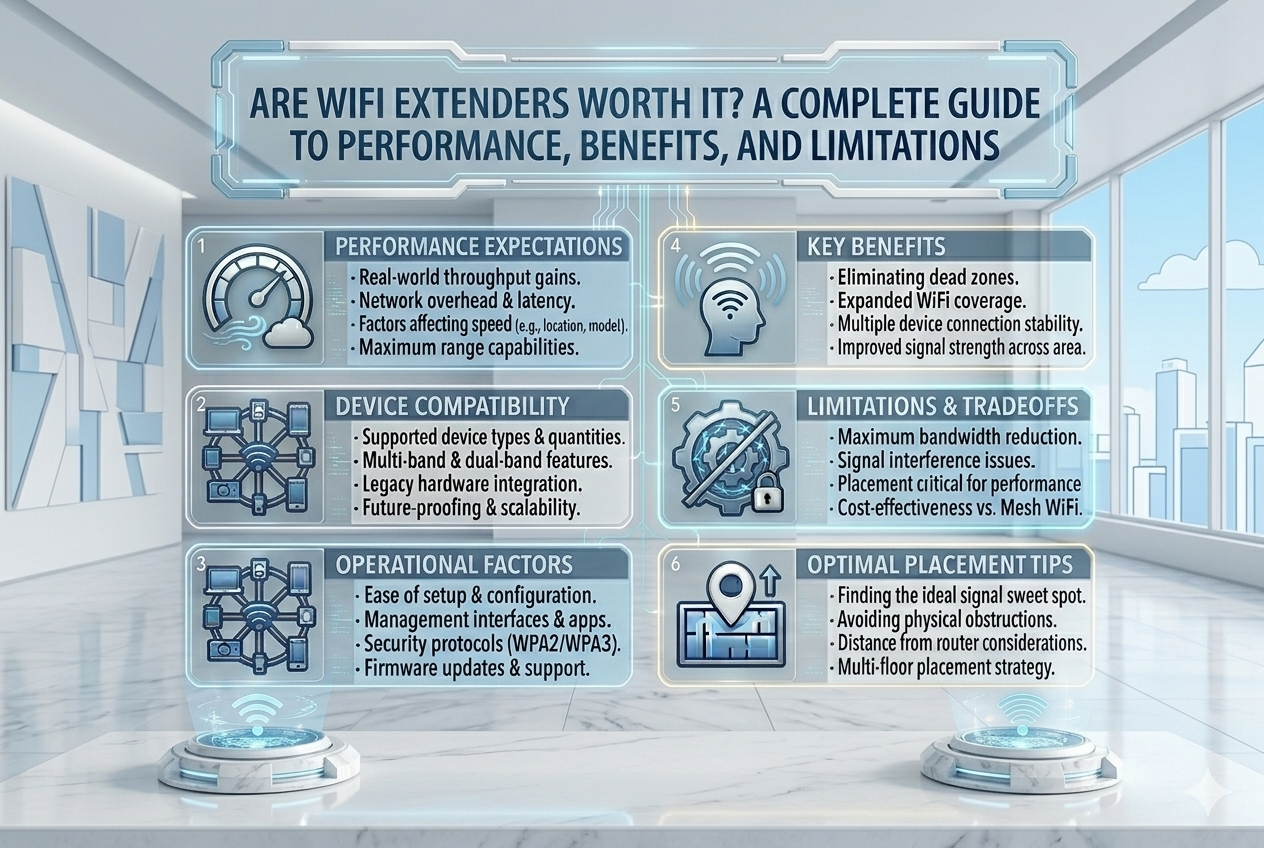
WiFi extenders are often marketed as a simple fix for weak internet coverage, but their real-world effectiveness depends on how wireless networking actually behaves in physical environments. To properly understand whether they are worth using, it helps to look beyond marketing claims and examine how WiFi signals travel, weaken, and interact with obstacles inside a home.
A WiFi signal is essentially a radio wave that spreads outward from a router in all directions. As it travels further, it naturally loses strength. This weakening becomes more severe when the signal passes through walls, metal objects, furniture, or reinforced concrete. Because of this, even a strong internet plan can feel slow or unstable in certain parts of a house if the signal cannot physically reach those areas efficiently.
When a WiFi extender is introduced, it does not generate a new internet connection. Instead, it captures the existing signal and retransmits it. This means the extender is fully dependent on the quality of the signal it receives. If the signal is already weak at the extender’s location, the rebroadcasted signal will also be weak, even if it appears to improve “bars” on your device.
Understanding the Real Performance Trade-Off
One of the most important concepts to understand about WiFi extenders is the performance trade-off they introduce. Unlike a direct connection to a router, an extender has to both receive and transmit data using the same wireless channel in most common setups. This process effectively doubles the workload on the same connection path.
Because of this, speed reduction is almost unavoidable. Even in good conditions, users often experience a noticeable drop in bandwidth. This is not due to the internet service itself, but due to the way wireless repeating works. Every time data is relayed through an extender, it adds delay and reduces available throughput.
Latency is another important factor. Latency refers to the time it takes for data to travel between your device and the internet server. With extenders, this delay increases because signals are being processed and retransmitted rather than flowing directly. While this increase may not be noticeable during basic browsing, it becomes much more visible during real-time activities like video calls or online gaming.
Why Placement Matters More Than People Expect
The effectiveness of a WiFi extender depends heavily on where it is placed. Many users assume that placing it in the weak signal area will solve the problem, but this is one of the most common mistakes. An extender needs a strong and stable signal to repeat effectively. If it is placed too far from the router, it will simply amplify a poor-quality connection.
The ideal placement is usually somewhere between the router and the dead zone. This middle area must still receive a strong and stable signal. When positioned correctly, the extender can create a usable bridge between the router and the far end of the home. When positioned incorrectly, it can make the network feel even more unstable because devices may connect to a weaker repeated signal instead of the main router.
Environmental factors also play a major role. Thick walls, especially those made of concrete or brick, significantly weaken wireless signals. Large appliances such as refrigerators or microwaves can also interfere with signal quality. Even mirrors and metal objects can reflect or disrupt WiFi waves, creating unpredictable dead zones that are difficult to fix with simple repeaters.
User Experience in Everyday Activities
In daily use, WiFi extenders tend to perform differently depending on the type of activity being done. For light tasks such as browsing websites, checking messages, or scrolling social media, most users will not notice major issues. The extended coverage often feels sufficient, especially in areas that previously had no signal at all.
However, once the demand increases, limitations become more obvious. Streaming high-definition videos may work, but buffering can occur during peak usage times or when multiple devices are connected. Video calls may suffer from occasional freezes or reduced quality, especially if the signal has to pass through multiple walls or floors before reaching the extender.
Online gaming is where extenders usually perform the worst. Games require both stable speed and extremely low latency. Even small delays can cause noticeable lag, which affects gameplay responsiveness. Since extenders inherently increase latency, they are rarely recommended for serious gaming setups.
File downloads and uploads also highlight limitations. While download speeds may appear acceptable at first, they are often lower and less consistent compared to a direct router connection. Upload performance can be even more affected, especially when multiple devices are sharing the extended network.
Interference and Network Instability
Another often overlooked issue with WiFi extenders is interference. Since they operate on the same wireless environment as the main router, they can sometimes create overlapping signals. This overlap may lead to devices switching between the router and extender more frequently than necessary.
This switching behavior can cause brief disconnections or instability. For example, a phone or laptop might move between signals while the user is stationary, especially in areas where coverage overlaps. These small interruptions can be frustrating during video calls or streaming sessions, even if they last only a few seconds.
In addition, some extenders create a separate network name, while others try to maintain a single network identity. Each approach has pros and cons, but neither fully eliminates the possibility of switching issues. Devices often try to connect to the strongest signal, but they do not always make smart decisions about which source provides the most stable performance.
Impact on Multiple Devices
Modern homes usually have many connected devices at the same time. Phones, laptops, smart TVs, tablets, gaming consoles, and smart home devices all share the same network bandwidth. In such environments, WiFi extenders can struggle because they introduce another layer of traffic handling.
When multiple devices connect through an extender, they all share the limited bandwidth that the extender receives from the router. This can quickly lead to congestion, especially during peak usage hours. As more devices compete for the same connection, performance drops become more noticeable.
This is particularly important in households where streaming, gaming, and video conferencing happen simultaneously. In these cases, the extender becomes a bottleneck rather than a solution, limiting overall network efficiency.
Physical Limitations of Wireless Repeating
The fundamental limitation of WiFi extenders lies in the nature of wireless repeating itself. Unlike wired solutions, wireless repeaters cannot fully separate incoming and outgoing signals in most basic models. This creates an inherent inefficiency because the same radio resources are used for both receiving and sending data.
This limitation is why extenders are often described as half-duplex devices in many configurations. In simple terms, they cannot send and receive data at full capacity simultaneously without some level of compromise. This is a structural limitation rather than a product flaw, which is why even high-quality extenders still experience reduced performance compared to direct router connections.
Another limitation is signal degradation over distance. Even if an extender successfully boosts coverage, the repeated signal will always be a step weaker than the original. This means that extending coverage too far can lead to diminishing returns, where each additional extension reduces overall quality further.
Realistic Expectations for Home Use
Understanding realistic expectations is key when considering a WiFi extender. Many users expect a full-speed experience in previously weak areas, but this is rarely achievable with simple repeaters. Instead, the goal should be improving usability rather than achieving maximum performance.
In small spaces, extenders can make a meaningful difference by eliminating dead zones and improving basic connectivity. In larger or more complex environments, they often serve as temporary solutions rather than permanent infrastructure upgrades.
The overall effectiveness depends on balancing expectations with physical limitations. If the goal is simply to get a usable signal in a previously unreachable room, an extender can be very helpful. If the goal is to maintain consistent high-speed performance across an entire home, more advanced networking solutions are usually required.
Where Extenders Still Make Sense
Despite their limitations, WiFi extenders still have practical value in many situations. They are especially useful in rental homes where permanent wiring changes are not possible. They also work well in small households where internet usage is light and the main issue is coverage rather than speed.
They can also serve as a temporary solution while planning a more permanent upgrade. For example, if a user is preparing to move to a mesh system or wired setup, an extender can bridge the gap in the short term.
Their low cost and easy installation make them accessible to almost anyone, which is one of their strongest advantages. Even with performance trade-offs, they remain one of the simplest ways to improve wireless coverage without technical complexity.
Transition Toward Better Networking Solutions
As internet usage continues to grow, especially with streaming, remote work, and smart devices, the limitations of basic extenders become more noticeable. This has led many users to gradually move toward more advanced systems that prioritize stability and seamless connectivity.
While extenders still serve a purpose, they are increasingly viewed as entry-level solutions rather than long-term upgrades. Their role is mainly to extend reach, not to enhance overall network performance or reliability.
Understanding this distinction helps users make better decisions based on their actual needs rather than expectations shaped by marketing.
Moving Beyond WiFi Extenders in Real Home Environments
When evaluating WiFi extenders in real-world usage, it becomes clear that their usefulness is closely tied to environment rather than technology alone. Homes today are not simple open spaces; they are filled with walls, floors, electrical interference, and an increasing number of connected devices. These factors create complex networking conditions where simple signal repeating often struggles to deliver consistent results.
In many cases, users initially install a WiFi extender hoping it will completely solve their connectivity issues. At first, there is usually some improvement, especially in areas that previously had no signal at all. However, over time, the limitations become more noticeable as usage increases or expectations rise. This gradual realization is what leads many people to reconsider whether extenders are a long-term solution or just a temporary fix.
One of the key challenges is that WiFi extenders do not intelligently manage network traffic. They simply repeat what they receive, without optimizing how data flows between devices. In modern households where multiple devices are streaming, downloading, and communicating simultaneously, this lack of intelligence becomes a major disadvantage. The network may appear to be working, but performance inconsistencies often start to emerge under load.
How Home Structure Impacts Extender Performance
The physical structure of a home plays a major role in determining whether a WiFi extender will be effective. Materials like concrete, brick, and metal significantly weaken wireless signals. Even wooden walls can reduce signal strength depending on thickness and insulation materials.
Multi-floor homes are especially challenging. WiFi signals naturally weaken as they pass vertically through floors. When an extender is placed on a different level from the router, it often receives a degraded signal that limits its ability to provide strong coverage on the next floor. This creates a chain reaction where each additional layer of extension reduces overall quality.
Long corridors and irregular layouts can also create signal dead zones that are difficult to predict. In such environments, even a well-placed extender may not provide uniform coverage. Some areas may receive strong signal while others remain weak, leading to an inconsistent user experience.
Device Behavior and Network Switching Issues
Another important factor in extender performance is how devices behave when multiple access points are available. Smartphones, laptops, and smart devices are designed to automatically connect to the strongest available signal. However, this decision-making process is not always precise.
In many cases, a device may remain connected to a weaker extender signal even when a stronger router signal is available nearby. This can result in slower speeds or intermittent performance issues. Conversely, a device might switch too frequently between router and extender, causing brief interruptions in connectivity.
These switching behaviors are often subtle but noticeable during activities that require stability. Video calls may briefly freeze, streaming may buffer unexpectedly, or online applications may refresh at inconvenient times. While these issues are not always constant, their unpredictability is what makes them frustrating.
Bandwidth Sharing and Performance Bottlenecks
WiFi extenders also introduce limitations in how bandwidth is shared across devices. Since they rely on the main router for internet access, all data passing through the extender must first travel back to the router before reaching its destination. This indirect path creates a bottleneck that becomes more pronounced as usage increases.
In households with multiple users, this can lead to uneven performance. One device may consume a large portion of available bandwidth, leaving others with reduced speeds. Since extenders do not actively manage traffic prioritization in most basic setups, they cannot effectively balance network load.
This issue becomes even more visible during peak usage times, such as evenings when streaming and browsing activity is at its highest. During these periods, the extender may struggle to maintain consistent performance, especially if it is already operating near its capacity limits.
The Role of Interference in Modern Homes
Wireless interference is another factor that significantly affects extender performance. Many electronic devices in homes operate on similar frequency ranges, which can disrupt WiFi signals. Common sources of interference include microwaves, cordless phones, Bluetooth devices, and even neighboring WiFi networks.
In densely populated areas, overlapping WiFi signals from nearby homes can create additional congestion. Extenders, which rely on the same wireless spectrum as the main router, are equally affected by this interference. As a result, performance can fluctuate depending on time of day, device usage, and environmental conditions.
This variability is one of the reasons why WiFi extenders sometimes feel unreliable. The issue is not always the device itself, but the surrounding wireless environment in which it operates.
Long-Term Reliability Considerations
Over time, users may notice that WiFi extenders require more adjustments than expected. Small changes in router placement, furniture arrangement, or device usage patterns can impact performance. This is because extenders are sensitive to changes in signal strength and environmental conditions.
Unlike more advanced networking systems, extenders do not automatically adapt to changing network demands. They require manual repositioning or configuration adjustments to maintain optimal performance. In some cases, users may find themselves frequently troubleshooting connection issues, which reduces the convenience they were originally seeking.
This lack of adaptability becomes more significant as smart homes evolve. With more devices depending on stable internet connections, consistency becomes more important than simple coverage extension.
Comparing Extenders with Modern Alternatives
As networking technology has advanced, more efficient solutions have emerged that address many of the limitations of WiFi extenders. Mesh networking systems, for example, are designed to work as a unified network rather than separate repeating points. This allows devices to move seamlessly between access points without manual switching or signal confusion.
Wired access points provide another strong alternative, especially in environments where maximum performance is required. By connecting additional access points through Ethernet cables, users can maintain full-speed connections across multiple areas without relying on wireless repeating.
While these solutions require more investment or setup effort, they provide significantly better stability and performance consistency. This is why they are increasingly preferred in modern homes, especially where internet usage is heavy or mission-critical.
Understanding the True Role of WiFi Extenders
Despite their limitations, WiFi extenders still serve a meaningful role in certain scenarios. They are best understood as accessibility tools rather than performance enhancers. Their main purpose is to extend reach into areas that would otherwise have no connectivity at all.
In environments where expectations are realistic, they can provide a simple and cost-effective improvement. However, when used as a replacement for proper network design, they often fall short of delivering a satisfying long-term experience.
Their continued popularity is largely due to affordability and ease of use. They do not require technical expertise, complex installation, or major infrastructure changes. For many users, this simplicity outweighs their performance limitations.
Evolving Expectations in Modern Connectivity
As digital lifestyles continue to evolve, expectations for home internet performance are also increasing. Activities such as remote work, high-definition streaming, cloud gaming, and smart home automation require stable and high-speed connections across entire living spaces.
In this context, WiFi extenders represent an older approach to solving connectivity problems. They were designed for simpler network demands and smaller device ecosystems. While still functional, they are increasingly being replaced by more advanced solutions that prioritize stability, scalability, and seamless connectivity.
This shift reflects a broader change in how people use the internet at home. It is no longer just about accessing websites or sending messages; it is about supporting continuous, high-bandwidth digital environments where interruptions are no longer acceptable.
Final Perspective on WiFi Extenders
WiFi extenders can still be useful, but their effectiveness depends heavily on expectations and environment. They are most suitable for small improvements in coverage rather than comprehensive network upgrades. In simple setups, they provide an affordable and easy way to eliminate dead zones.
However, in modern households with higher demands, their limitations become increasingly clear. Reduced speed, added latency, interference sensitivity, and inconsistent performance make them less ideal for long-term use in demanding environments.
Ultimately, they are best viewed as a transitional solution. They help bridge connectivity gaps when better options are not available, but they are rarely the optimal final answer for a fully connected home.
When WiFi Extenders Start to Fail in Real Usage Scenarios
As usage demands increase in modern homes, WiFi extenders begin to show their structural limitations more clearly. At a basic level, they are designed to repeat a signal, not improve or stabilize it. This distinction becomes very important when multiple devices rely on the network at the same time or when users expect consistent performance throughout the day.
One of the first signs of strain appears during peak usage periods. In the morning or evening, when multiple people are online simultaneously, extenders often struggle to maintain steady performance. The network may not completely disconnect, but fluctuations in speed and responsiveness become more frequent. Pages may take longer to load, streaming quality may automatically reduce, and voice or video communication may experience brief interruptions.
These issues occur because the extender is operating under increased load without any intelligent traffic balancing. It is simply forwarding whatever it receives from the router, regardless of how many devices are connected or how much bandwidth is being consumed. This creates a natural bottleneck that becomes more noticeable as demand rises.
The Hidden Problem of Signal Layering
Another major limitation of WiFi extenders is the concept of signal layering. Each time a signal is repeated, it loses a portion of its original strength and clarity. While this loss may not be immediately noticeable after a single extension, it becomes more significant when multiple walls, distances, or obstacles are involved.
In more complex homes, users sometimes attempt to use more than one extender to cover larger areas. While this might seem like a logical solution, it often leads to a chain reaction of degraded performance. Each extender receives a slightly weaker signal than the previous one, and the final output becomes increasingly unstable.
This layered approach can create unpredictable coverage zones where some areas have acceptable performance while others experience frequent drops or delays. The inconsistency is often more frustrating than having no signal at all, because it creates uncertainty about when the connection will perform well.
Latency Accumulation and Its Effects
Latency is one of the most overlooked aspects of wireless performance, but it plays a critical role in user experience. Even if download speeds appear acceptable, increased latency can make the network feel slow or unresponsive.
WiFi extenders naturally add extra processing steps between the device and the router. Each step introduces a small delay, and while these delays may seem minor individually, they accumulate during continuous usage. Over time, this can result in noticeable lag, especially in real-time applications.
This accumulation becomes particularly problematic for interactive services. Video conferencing, online collaboration tools, and cloud-based applications all rely on fast response times. When latency increases, users may experience delayed audio, frozen video frames, or slow input response, even if the connection appears stable on the surface.
Inconsistency Across Devices and Applications
Another challenge with WiFi extenders is that performance is not uniform across all devices or applications. Some devices may connect smoothly and experience minimal issues, while others struggle with frequent interruptions or slower speeds.
This inconsistency is often due to how different devices handle wireless signal selection and roaming. Some devices aggressively switch between available networks, while others remain fixed to a weaker signal. This behavior can create uneven performance across the same household, leading to confusion about whether the issue is with the extender or the device itself.
Similarly, different applications respond differently to network conditions. Streaming services may buffer intermittently, while web browsing remains relatively unaffected. Cloud storage uploads may slow down significantly, while social media continues to function normally. This uneven behavior makes troubleshooting more difficult because the problem does not always appear in a consistent form.
Impact of Distance and Signal Decay
Distance remains one of the most fundamental challenges in wireless networking. As distance increases between the router and extender, the quality of the signal decreases. This decay is not linear but exponential, meaning small increases in distance can lead to significant drops in performance.
Walls and floors further accelerate this decay. Each physical barrier absorbs or reflects a portion of the signal, reducing its strength before it reaches the extender. By the time the signal is retransmitted, it may already be significantly weakened.
This creates a limitation that cannot be fully solved through configuration alone. No matter how well an extender is set up, it cannot overcome the physical constraints of wireless signal propagation. This is why performance often varies dramatically depending on home layout and building materials.
Network Congestion and Shared Bandwidth Limitations
In households with multiple users, bandwidth sharing becomes a critical issue. WiFi extenders do not increase total available bandwidth; they simply redistribute it. This means all connected devices are still competing for the same internet capacity provided by the main router.
When usage increases, congestion becomes more likely. This is especially noticeable during high-demand activities such as video streaming, large downloads, or online gaming. As more devices connect through the extender, each device receives a smaller share of the available bandwidth.
Unlike advanced networking systems, basic extenders do not prioritize traffic efficiently. This lack of prioritization can lead to situations where less important background tasks consume bandwidth that could otherwise be used for more critical applications. The result is uneven performance that changes depending on network activity.
Why Extenders Struggle in Smart Homes
Modern smart homes introduce another layer of complexity. Devices such as smart TVs, cameras, voice assistants, and IoT sensors constantly communicate with the network. While each device individually uses small amounts of data, collectively they create continuous background traffic.
WiFi extenders are not designed to manage this level of persistent connectivity. As the number of smart devices increases, the extender must handle more simultaneous connections, which can reduce overall stability. Even if the devices are not actively being used, their background communication still contributes to network load.
This can lead to subtle but persistent performance issues such as delayed responses from smart devices, slower app control, or inconsistent connectivity between systems. Over time, these small delays add up and affect the overall user experience.
Environmental Sensitivity and Unpredictable Performance
WiFi extenders are highly sensitive to environmental changes. Small adjustments in furniture placement, new electronic devices, or even changes in neighboring networks can influence performance.
Because they rely entirely on wireless reception, any disruption in signal quality affects both the input and output of the extender. This makes performance less predictable compared to wired or mesh-based systems.
Users often notice that performance varies throughout the day without any clear reason. Morning usage may feel smooth, while evening performance becomes unstable. These fluctuations are often caused by changing interference levels, network congestion, or variations in connected device activity.
Psychological Perception of Improvement
One interesting aspect of WiFi extenders is how users perceive improvement. In many cases, simply having more WiFi coverage creates the impression of better performance, even if actual speed or stability has not significantly improved.
Seeing a stronger signal in previously weak areas can feel like a major upgrade, even if the underlying connection is still limited. This psychological effect often leads users to believe the extender is performing better than it actually is in terms of measurable network quality.
However, once usage becomes more demanding, the gap between perception and reality becomes more noticeable. Tasks that initially seemed improved may start to reveal underlying instability or inconsistency.
Long-Term Suitability in Evolving Networks
As home internet usage continues to evolve, the demands placed on networks are increasing steadily. High-resolution streaming, remote work, cloud computing, and real-time communication require stable and low-latency connections throughout the entire home.
WiFi extenders were originally designed for simpler usage environments where basic connectivity was the primary goal. In today’s context, they often struggle to keep up with modern expectations. While they can still provide value in limited scenarios, they are gradually being replaced by more advanced networking solutions.
Their long-term suitability depends largely on how internet usage evolves within a household. For light or occasional use, they remain functional. For heavy, continuous, or multi-device environments, their limitations become more difficult to ignore.
Overall Understanding of Their Role
WiFi extenders occupy a very specific position in home networking. They are not performance enhancers, but rather coverage expanders. Their job is to extend access, not to improve speed or stability.
When used with this understanding, they can still be helpful tools. However, when expectations exceed their design purpose, disappointment is almost inevitable. Their value lies in simplicity and accessibility, not in advanced networking capability.
In modern digital environments, this distinction is essential for making informed decisions about home connectivity.
Practical Scenarios Where WiFi Extenders Still Make Sense
Even with all their limitations, WiFi extenders are not completely outdated or useless. There are still very specific situations where they provide a practical and cost-effective solution. The key is understanding when simplicity is more important than performance.
In small living spaces, such as single-floor apartments or compact homes, extenders can work quite effectively. In these environments, the distance between rooms is limited, and walls are usually fewer in number. A properly placed extender can eliminate weak signal spots without introducing major performance issues. For users who only need basic internet access for browsing, messaging, and occasional streaming, this level of improvement is often sufficient.
They are also useful in temporary situations. For example, when someone is renting a home and cannot modify wiring or install permanent networking equipment, an extender becomes a convenient option. It requires minimal setup and can be moved easily if needed. This flexibility makes it appealing for short-term living arrangements.
Another practical use case is extending connectivity to low-demand devices. Smart home gadgets such as plugs, sensors, or basic security devices do not require high-speed connections. For these types of applications, an extender can provide stable enough connectivity without requiring a more advanced system.
Where Expectations Commonly Become Misaligned
One of the main reasons people feel disappointed with WiFi extenders is unrealistic expectations. Many users expect them to behave like full network upgrades, improving both speed and coverage. In reality, they are designed only to extend range, not enhance performance.
This misunderstanding often leads to frustration when users notice slower speeds or unstable connections in extended areas. The expectation is that coverage expansion should feel identical to being near the router, but wireless physics makes that impossible with simple repeating technology.
Another common expectation is seamless roaming between router and extender. While some modern extenders attempt to improve this experience, most basic models still require devices to switch between networks manually or semi-automatically. This switching is rarely perfect and can cause brief interruptions.
Understanding these limitations upfront helps set realistic goals. Instead of expecting a complete network upgrade, it becomes clearer that extenders are best suited for filling gaps rather than transforming the entire network.
Comparison with More Advanced Solutions
As networking technology has improved, more efficient solutions have become widely available. Mesh WiFi systems, in particular, offer a more integrated approach to home coverage. Instead of relying on signal repetition, they use multiple coordinated nodes that work together as a single network.
This design eliminates many of the problems associated with extenders, such as speed loss and unstable switching. Devices move between nodes seamlessly, and the system actively manages traffic distribution. While mesh systems are more expensive, they provide a significantly better experience in larger or more demanding environments.
Wired access points represent another strong alternative. By connecting additional access points through Ethernet cables, users can maintain full-speed performance across different areas of the home. This approach removes wireless repeating limitations entirely, but it requires physical cabling, which may not always be practical.
Compared to these solutions, WiFi extenders remain the most basic option. They are simple, affordable, and easy to deploy, but they also offer the least consistent performance.
The Role of Extenders in Budget-Conscious Decisions
Cost is one of the strongest reasons people continue to choose WiFi extenders. They are significantly cheaper than mesh systems or wired installations. For users with limited budgets, they provide an accessible way to improve coverage without major investment.
In many cases, this trade-off is acceptable. Not every household requires high-performance networking. For users with minimal internet demands, spending more on advanced systems may not be necessary. In such situations, an extender can provide just enough improvement to make daily usage comfortable.
However, it is important to recognize that lower cost often comes with performance compromises. The value of an extender depends on whether those compromises are acceptable for the intended use.
Long-Term Reliability Considerations
Over time, WiFi extenders tend to reveal their limitations more clearly. As households add more devices and increase internet usage, the demand placed on the network grows. What once felt sufficient may gradually become inadequate.
Extenders also do not scale well with increasing demand. Adding more devices or expanding coverage usually does not improve performance and may even reduce stability. Unlike more advanced systems, they are not designed to adapt to growing network complexity.
This makes them less suitable as long-term infrastructure in modern digital homes. While they can serve as a temporary or entry-level solution, they are rarely the final step in building a reliable home network.
Understanding the Balance Between Simplicity and Performance
The true value of WiFi extenders lies in their simplicity. They are easy to install, require no technical expertise, and can be set up within minutes. For many users, this ease of use is their most attractive feature.
However, simplicity comes at the cost of performance optimization. More advanced systems require more setup and investment, but they deliver better stability, speed, and scalability. Extenders sit at the opposite end of this spectrum, prioritizing convenience over efficiency.
Choosing between them ultimately depends on what matters more: immediate simplicity or long-term performance.
Conclusion
WiFi extenders are worth it only in specific and limited scenarios. They are effective for filling small coverage gaps, improving weak signal areas in compact homes, and providing basic connectivity for low-demand usage. Their affordability and ease of installation make them an attractive entry-level solution for many users.
However, they are not a true upgrade to a home network. Their inherent limitations include reduced speed, increased latency, inconsistent performance, and sensitivity to placement and environmental conditions. These issues become more noticeable as internet usage demands increase.
For modern households with multiple users, smart devices, streaming services, and remote work needs, extenders often fall short of expectations. In such environments, mesh systems or wired access points provide far more reliable and stable performance.
In conclusion, WiFi extenders should be viewed as a convenience tool rather than a performance solution. They are useful for small improvements and temporary fixes, but they are not designed to meet the demands of high-performance or future-ready home networks. Choosing them wisely depends on understanding both their strengths and their limitations in real-world use.