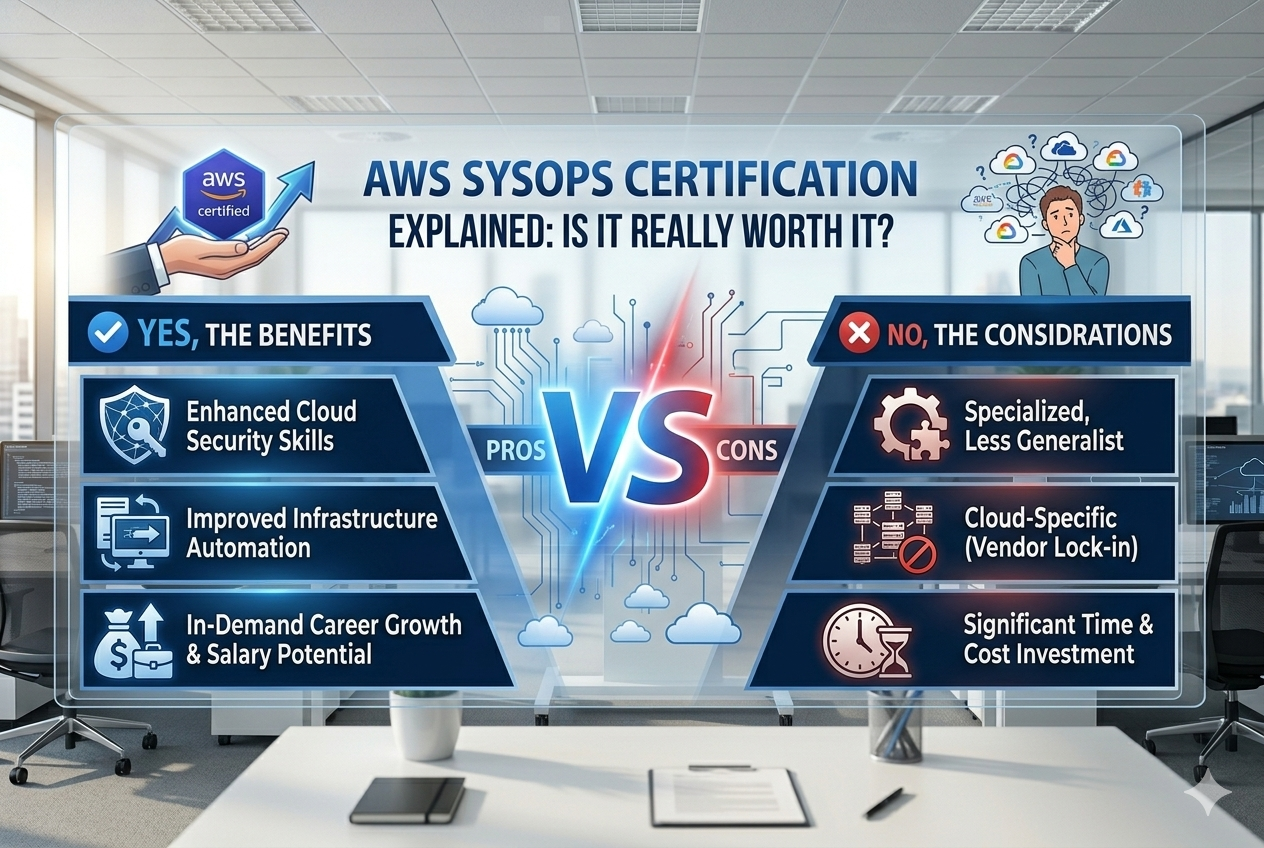
The AWS SysOps certification focuses on the operational side of cloud computing, where the main responsibility is to keep systems running smoothly, securely, and efficiently. Unlike certifications that concentrate mainly on design or architecture, this one is deeply rooted in day-to-day cloud management tasks. Professionals in this area are expected to monitor system performance, manage deployments, troubleshoot issues, and ensure that cloud environments remain stable under different workloads.
In modern IT environments, organizations rely heavily on cloud platforms to host applications, store data, and run critical services. This creates a strong demand for skilled professionals who can handle operational responsibilities without causing downtime or performance issues. The SysOps certification helps validate that a candidate has the ability to manage these responsibilities in a structured and reliable way.
Core Focus Areas of the Certification
The certification is structured around real operational domains that reflect what professionals actually do in cloud environments. These areas typically include monitoring and reporting, reliability and business continuity, deployment and provisioning, security and compliance, and automation and optimization.
Monitoring is a major part of the role, as it ensures that system health is continuously observed and any anomalies are detected early. This involves working with logs, metrics, and alerts to identify issues before they affect end users.
Deployment and provisioning focus on how resources are created and managed in the cloud. This includes understanding how to launch servers, configure networks, and deploy applications in a consistent and repeatable way.
Security and compliance are also critical, as cloud environments must be protected against unauthorized access and data breaches. Professionals are expected to implement proper access controls, encryption, and auditing practices.
Automation and optimization help reduce manual effort and improve efficiency. This includes automating repetitive tasks, optimizing resource usage, and ensuring cost-effective operations.
Skills You Develop During Preparation
Preparing for this certification builds a strong practical skill set that goes beyond theoretical knowledge. One of the most important skills gained is the ability to manage cloud infrastructure using automated tools and scripts. This reduces human error and improves consistency across environments.
Another key skill is troubleshooting. Cloud environments are complex, and issues can arise from networking, storage, security configurations, or application performance. Learning how to identify and resolve these problems quickly is essential for operational roles.
Candidates also develop a deeper understanding of monitoring systems, which allows them to track performance trends and predict potential issues before they escalate. This proactive approach is highly valued in real-world IT operations.
Cost management is another important area. Since cloud resources are billed based on usage, professionals must learn how to optimize infrastructure to avoid unnecessary expenses while maintaining performance.
Exam Structure and Difficulty Level
The AWS SysOps certification is known for being more challenging compared to entry-level cloud certifications because it emphasizes hands-on knowledge rather than memorization. The exam typically includes multiple-choice questions as well as scenario-based questions that test practical decision-making skills.
Candidates are often required to analyze real-world situations and choose the most effective solution based on AWS services and best practices. This makes it essential to have actual experience working with cloud environments rather than relying only on study materials.
The difficulty level is moderate to high, especially for individuals who are new to system operations or cloud infrastructure. However, for those with prior experience in IT administration or DevOps roles, the exam becomes more manageable with proper preparation.
Who Should Consider This Certification
This certification is ideal for system administrators, cloud engineers, and DevOps professionals who are involved in managing infrastructure. It is also suitable for individuals who want to transition from traditional IT roles into cloud-based operations.
Those who already work with cloud platforms will find the certification particularly useful, as it validates their practical experience and helps them advance in their careers. It can also be beneficial for professionals aiming to move into senior operational roles where responsibility for system stability and performance is higher.
However, it may not be the best starting point for complete beginners in cloud computing. A basic understanding of cloud concepts and some hands-on exposure is recommended before attempting this certification.
Real-World Relevance of SysOps Skills
One of the strongest advantages of this certification is its direct relevance to real-world job roles. Unlike purely theoretical certifications, SysOps focuses on tasks that professionals perform daily in production environments.
For example, monitoring system health is not just an exam concept but a critical responsibility in live environments where downtime can lead to financial losses. Similarly, automation skills are used to deploy updates, scale resources, and manage infrastructure efficiently without manual intervention.
Security management is another area where SysOps skills are applied regularly. Ensuring that only authorized users have access to systems and that data is properly protected is a constant requirement in cloud operations.
Because of this strong alignment with real job responsibilities, employers often value this certification as proof that a candidate can handle operational challenges effectively.
Comparison with Other AWS Certifications
When compared to other cloud certifications, SysOps sits in the intermediate category. It is more advanced than foundational certifications but not as design-heavy as architecture-focused certifications.
While some certifications emphasize planning and designing cloud systems, SysOps focuses more on maintaining and managing those systems once they are in production. This makes it unique because it bridges the gap between development, deployment, and operations.
It is also closely related to DevOps roles, as both involve automation, monitoring, and continuous improvement of systems. However, SysOps leans more toward infrastructure management rather than software development processes.
Common Challenges Faced by Learners
Many candidates find the hands-on nature of the certification challenging. It is not enough to simply understand concepts; one must be able to apply them in practical scenarios.
Another common difficulty is the breadth of topics covered. The exam includes networking, security, storage, compute services, and automation, all of which require a solid understanding.
Time management during preparation is also a challenge. Since the material is extensive, candidates need to balance theory with practical labs to build confidence.
Without real-world experience, it can be difficult to fully grasp certain scenarios presented in the exam, which is why hands-on practice is highly recommended.
Effective Preparation Strategy
A successful preparation strategy involves combining theoretical learning with practical experience. Reading about services alone is not enough; candidates should actively use cloud environments to deploy resources, configure systems, and troubleshoot issues.
Practicing in a live or sandbox environment helps reinforce concepts and builds confidence in handling real-world scenarios. Working on small projects such as setting up virtual networks, deploying applications, or configuring monitoring systems can be extremely helpful.
Another important approach is focusing on understanding how different services interact with each other. Cloud operations often involve multiple components working together, and understanding these relationships is key to solving exam scenarios.
Consistency in study habits is also important. Regular practice over time is more effective than last-minute preparation.
Career Growth Opportunities
Earning this certification can open up several career opportunities in cloud operations and infrastructure management. It can lead to roles such as cloud operations engineer, systems administrator, DevOps support engineer, or infrastructure specialist.
As organizations continue to migrate to cloud platforms, the demand for professionals who can manage these environments efficiently continues to grow. This makes SysOps-certified professionals valuable assets in the job market.
In addition to job opportunities, the certification can also lead to salary growth and career advancement. It demonstrates a higher level of technical competence, which is often rewarded by employers.
Long-Term Value of the Certification
The long-term value of the SysOps certification lies in the practical skills it builds. Even as cloud technologies evolve, the core principles of system monitoring, automation, and operational management remain relevant.
Professionals who gain experience through this certification are better equipped to adapt to new tools and technologies because they understand the underlying concepts of cloud operations.
It also serves as a foundation for more advanced roles in cloud architecture, DevOps engineering, and platform engineering, making it a valuable step in a long-term career path.
Advanced Learning Areas in SysOps Preparation
As learners progress deeper into AWS SysOps preparation, the focus shifts from basic cloud understanding to more advanced operational scenarios. At this stage, the emphasis is on how complex systems behave under real workloads and how different AWS services interact in large-scale environments. This includes understanding distributed systems, fault tolerance, high availability, and disaster recovery planning.
High availability is one of the most important concepts in cloud operations. It ensures that applications remain accessible even if parts of the infrastructure fail. SysOps professionals must understand how to design systems that can automatically recover from failures using redundancy and load balancing techniques.
Disaster recovery is another critical area. It involves planning how systems will be restored after major outages or failures. This requires knowledge of backup strategies, recovery time objectives, and recovery point objectives. The goal is to minimize downtime and prevent data loss during unexpected events.
Fault tolerance goes hand in hand with these concepts. It refers to a system’s ability to continue functioning even when individual components fail. In real-world operations, this is achieved by distributing workloads across multiple servers and availability zones.
Monitoring and Observability in Real Environments
Monitoring in AWS SysOps goes beyond simply checking if a server is running. It involves deep observability into system behavior, performance trends, and application health. Professionals must be able to interpret logs, metrics, and events to understand what is happening inside the system.
Effective monitoring allows teams to detect issues before users are impacted. For example, increasing latency in an application might indicate a resource bottleneck, which can be resolved before it leads to downtime.
Alerting systems are also a key part of this process. Properly configured alerts ensure that teams are notified immediately when something goes wrong. However, setting up alerts requires balance, as too many alerts can lead to noise and missed critical issues.
Log analysis plays a major role in troubleshooting. Logs provide detailed information about system activity, which helps in identifying the root cause of problems. SysOps professionals must be comfortable working with log data and identifying patterns that indicate issues.
Automation and Infrastructure as Code
Automation is one of the strongest pillars of modern cloud operations. In SysOps roles, automation reduces manual effort, improves consistency, and minimizes human error. Instead of manually configuring systems, professionals use scripts and templates to deploy infrastructure in a repeatable way.
Infrastructure as Code is a key concept in this area. It allows infrastructure to be defined and managed using code rather than manual processes. This means entire environments can be created, modified, or destroyed using automated scripts.
This approach improves scalability because it becomes easy to replicate environments across different regions or projects. It also improves reliability since configurations remain consistent across deployments.
Automation is also used in operational tasks such as scaling resources based on demand. For example, systems can automatically add or remove servers depending on traffic levels, ensuring optimal performance without manual intervention.
Security Operations in Cloud Environments
Security is a core responsibility in any cloud operations role. SysOps professionals must ensure that systems are protected from unauthorized access, data breaches, and configuration vulnerabilities.
Access management is one of the key areas of focus. This involves controlling who can access specific resources and what actions they are allowed to perform. Proper identity and access management ensures that only authorized users can interact with sensitive systems.
Encryption is another important aspect. Data must be protected both at rest and in transit to prevent unauthorized access. Understanding how to implement encryption correctly is essential for maintaining security compliance.
Security monitoring is also critical. This involves continuously checking systems for suspicious activity, unusual behavior, or potential threats. Quick detection and response can prevent serious security incidents.
Compliance requirements are often part of cloud operations as well. Organizations must follow industry standards and regulations, and SysOps professionals play a role in ensuring that systems meet these requirements.
Performance Optimization and Cost Efficiency
One of the key responsibilities in cloud operations is ensuring that systems perform efficiently while keeping costs under control. Cloud resources are flexible but can become expensive if not managed properly.
Performance optimization involves identifying bottlenecks and improving system efficiency. This may include adjusting compute resources, optimizing storage usage, or improving network configurations.
Scaling strategies are an important part of this process. Systems should be able to handle increased demand without performance degradation. This is achieved through automatic scaling mechanisms that adjust resources based on usage.
Cost optimization focuses on reducing unnecessary expenses. This includes shutting down unused resources, choosing appropriate service types, and monitoring usage patterns. Even small inefficiencies can lead to significant costs over time in large environments.
SysOps professionals must constantly balance performance and cost to ensure that systems remain both efficient and affordable.
Incident Response and Troubleshooting Skills
Incident response is a critical skill in cloud operations. When systems fail or behave unexpectedly, professionals must quickly identify the issue and restore normal operations.
Troubleshooting involves a structured approach to problem-solving. Instead of guessing, SysOps professionals follow logs, metrics, and system behavior to identify the root cause of issues.
Common problems may include network misconfigurations, resource limitations, security restrictions, or application errors. Each issue requires a different approach to resolve.
Time is a critical factor during incidents. The faster an issue is resolved, the lower the impact on users and business operations. This is why experience and familiarity with cloud systems are so important.
Post-incident analysis is also part of the process. After resolving an issue, teams often review what happened and how it can be prevented in the future. This helps improve system reliability over time.
Real Experience vs Theoretical Learning
One of the most important aspects of SysOps certification is the difference between theoretical knowledge and real-world experience. While study materials provide the foundation, actual hands-on experience is what makes a candidate truly prepared.
Working in real environments exposes professionals to unpredictable scenarios that cannot always be covered in books or courses. These experiences help build problem-solving skills and confidence.
The certification encourages practical learning because many exam questions are based on real operational situations. This means candidates who have worked with actual systems often find it easier to understand and solve scenarios.
Hands-on labs, practice environments, and personal projects are essential for building this experience. They allow learners to experiment, make mistakes, and understand system behavior deeply.
Industry Relevance and Job Market Demand
In today’s IT industry, cloud operations skills are in high demand. As more companies move their infrastructure to the cloud, the need for skilled professionals who can manage these environments continues to grow.
SysOps-certified professionals are often preferred for roles that require operational expertise. These roles involve maintaining system stability, ensuring performance, and handling production issues.
Many organizations also look for professionals who can automate processes and improve operational efficiency. This makes SysOps skills highly valuable in DevOps and cloud engineering teams.
The certification also helps candidates stand out in competitive job markets. It demonstrates both knowledge and practical capability, which is important for employers looking for reliable technical staff.
Challenges in Real-World Application
Despite its value, working in SysOps roles can be challenging. Cloud environments are constantly changing, and systems must adapt to new demands, technologies, and threats.
One of the biggest challenges is managing complexity. Large-scale cloud systems involve many interconnected services, and understanding how they work together can be difficult.
Another challenge is maintaining system reliability under pressure. High traffic, unexpected failures, and security incidents require quick and effective responses.
Continuous learning is also necessary because cloud technologies evolve rapidly. Professionals must stay updated with new services, features, and best practices.
Long-Term Career Impact of SysOps Certification
Over time, the SysOps certification can significantly impact career growth. It builds a strong foundation in cloud operations, which is essential for advanced roles in cloud architecture, DevOps engineering, and infrastructure management.
Professionals with SysOps experience often move into leadership roles where they oversee cloud operations teams and manage large-scale systems.
The skills gained from this certification remain relevant even as technology evolves, because core operational principles such as monitoring, automation, and security remain constant.
It also provides a pathway for continuous career development, allowing professionals to expand into more specialized or advanced cloud roles.
Real-World Scenarios You Must Be Ready For
As you move further into SysOps-level understanding, it becomes clear that the certification is heavily built around real operational situations rather than textbook definitions. You are expected to think like someone managing live production systems where downtime, security risks, and performance issues can happen at any moment.
One common scenario involves sudden traffic spikes. In real environments, applications may experience unpredictable demand, and SysOps professionals must ensure that systems scale automatically without crashing or slowing down. This requires a solid understanding of load balancing, auto scaling mechanisms, and resource monitoring.
Another frequent situation is system failure recovery. Servers or services may go offline due to hardware issues, configuration errors, or network disruptions. In such cases, the ability to quickly restore service using backups, redundant systems, or failover strategies becomes extremely important.
Security incidents are also part of real operational challenges. Unauthorized access attempts, misconfigured permissions, or exposed resources can create serious risks. SysOps professionals must know how to detect, isolate, and fix such issues quickly while minimizing damage.
Deep Dive into Troubleshooting Methodology
Troubleshooting in cloud environments is not random guessing but a structured process. SysOps professionals are trained to follow a logical flow when identifying and resolving issues.
The first step is usually identifying symptoms. This could be slow application performance, service unavailability, or unexpected errors. Once symptoms are identified, the next step is gathering data from logs, metrics, and monitoring tools.
After collecting information, the focus shifts to isolating the root cause. This might involve checking network configurations, resource limits, security rules, or application dependencies.
Once the root cause is identified, the solution is applied carefully to avoid creating additional issues. After resolution, systems are monitored again to ensure stability.
Finally, a post-incident review is often conducted to understand what went wrong and how similar problems can be prevented in the future. This structured approach is a key skill developed through SysOps preparation.
Importance of Cloud Networking Knowledge
Networking plays a critical role in SysOps operations. Even if systems are powerful, poor network configuration can lead to serious performance or security issues.
Understanding virtual networks, routing, subnets, and traffic flow is essential. SysOps professionals must ensure that communication between services is smooth and secure.
Network security is equally important. Firewalls, access control rules, and segmentation strategies are used to protect systems from unauthorized access. Misconfigurations in networking are one of the most common causes of cloud issues, making this knowledge area extremely important.
Latency and bandwidth management also affect system performance. Applications must be designed to handle network delays efficiently, especially in global environments where users are spread across different regions.
Operational Excellence in Cloud Environments
Operational excellence refers to the ability to run systems in a stable, efficient, and reliable manner. In SysOps roles, this is one of the most important goals.
It involves continuous monitoring, regular optimization, and proactive maintenance. Instead of reacting to problems after they occur, SysOps professionals aim to prevent issues before they impact users.
Automation is a major contributor to operational excellence. By automating repetitive tasks such as deployments, backups, and scaling, teams reduce human error and improve consistency.
Documentation is another important factor. Well-documented systems are easier to manage, troubleshoot, and improve. It also helps teams work together more effectively, especially in large organizations.
Understanding System Reliability and Resilience
Reliability means that systems consistently perform their intended functions without failure. In cloud environments, achieving reliability requires careful planning and architecture.
Resilience goes a step further by ensuring that systems can recover quickly from failures. Even if something breaks, the system should continue functioning with minimal disruption.
This is achieved through redundancy, failover systems, and distributed architectures. SysOps professionals must understand how to design and maintain such systems to ensure continuous availability.
Testing resilience is also important. Systems are often tested under failure conditions to ensure that recovery mechanisms work as expected.
The Role of Automation in Modern SysOps Workflows
Automation is not just a convenience in SysOps roles; it is a necessity. Modern cloud environments are too complex to manage manually.
Automation is used in deployment pipelines, infrastructure provisioning, monitoring, and scaling. It allows teams to manage large systems with minimal manual intervention.
For example, instead of manually launching servers, scripts can be used to automatically create and configure them based on predefined templates.
Automation also helps in maintaining consistency across environments. Whether it is development, testing, or production, automated processes ensure that configurations remain identical.
This reduces the risk of human error and makes systems more predictable and stable.
Cost Management and Resource Efficiency Strategies
One of the hidden challenges in cloud operations is managing costs effectively. Since cloud services operate on a pay-as-you-go model, inefficient usage can quickly become expensive.
SysOps professionals must continuously monitor resource usage and identify areas where costs can be reduced. This includes shutting down unused resources, optimizing storage, and selecting appropriate service tiers.
Right-sizing resources is another important strategy. Many systems are over-provisioned, meaning they use more resources than necessary. Adjusting these resources to match actual demand can significantly reduce costs.
Reserved capacity and usage planning also help organizations save money in the long term.
Continuous Learning in a Changing Cloud Landscape
Cloud technology evolves rapidly, and SysOps professionals must continuously update their knowledge. New services, features, and best practices are introduced regularly.
Staying updated is essential to remain effective in operational roles. This includes learning about new monitoring tools, security updates, and automation features.
Hands-on practice is the best way to stay current. Experimenting with new services helps professionals understand how they work in real environments.
Continuous learning also helps in career growth, as professionals who stay updated are more likely to move into advanced roles.
Common Mistakes Made by Beginners
Many beginners make the mistake of focusing only on theory without practicing in real environments. This makes it difficult to understand how systems behave in practical situations.
Another common mistake is ignoring networking and security concepts. These are critical areas in SysOps roles and often cause real-world issues if not properly understood.
Some candidates also underestimate the importance of troubleshooting skills. Simply knowing services is not enough; being able to fix problems quickly is equally important.
Overlooking automation is another mistake, as it plays a central role in modern cloud operations.
How SysOps Fits into DevOps and Cloud Ecosystems
SysOps plays an important role within the broader DevOps ecosystem. While DevOps focuses on collaboration between development and operations, SysOps is more focused on the operational side.
It ensures that systems built by development teams run smoothly in production environments. This includes deployment, monitoring, scaling, and maintenance.
SysOps professionals often work closely with DevOps engineers to implement automation pipelines and improve system reliability.
In many organizations, SysOps skills are a foundation for moving into DevOps engineering roles.
Long-Term Professional Benefits
Over time, the skills gained from SysOps certification contribute to strong professional growth. Individuals develop a deep understanding of cloud systems, operational processes, and infrastructure management.
This knowledge becomes valuable in senior technical roles where decision-making and system design responsibilities increase.
It also opens opportunities in specialized areas such as cloud security, automation engineering, and infrastructure architecture.
The ability to manage complex systems confidently is a key advantage in today’s technology-driven job market.
Evolving Role of SysOps Professionals in Modern IT
The role of SysOps professionals has evolved significantly as organizations increasingly depend on cloud infrastructure for critical business operations. Earlier, system administration was mostly about managing physical servers and on-premises infrastructure, but now it extends into highly dynamic, distributed cloud environments.
Today, SysOps professionals are expected to manage systems that scale automatically, interact with multiple cloud services, and operate across different geographic regions. This shift has made the role more complex but also more valuable, as businesses rely on uptime, speed, and security more than ever before.
In this modern landscape, SysOps is not just about maintenance but about enabling business continuity and digital transformation. Professionals in this field are expected to contribute to strategic decisions that affect system performance, cost efficiency, and reliability.
Understanding Cloud Automation at Scale
As systems grow, manual management becomes impractical. Cloud automation allows organizations to handle large-scale infrastructure without constant human intervention. In SysOps roles, automation is deeply integrated into nearly every operational task.
For example, instead of manually deploying updates to multiple servers, automated pipelines handle deployments consistently across environments. This reduces errors and ensures that all systems remain synchronized.
Scaling infrastructure is another area where automation is essential. Systems can automatically adjust resources based on demand patterns, ensuring optimal performance during peak usage and cost savings during low usage periods.
Backup processes are also automated to ensure that data is regularly saved and can be restored when needed. This reduces the risk of data loss and improves system reliability.
Security Operations and Continuous Protection
Security in cloud environments is not a one-time setup but a continuous process. SysOps professionals are responsible for ensuring that systems remain secure as new threats and vulnerabilities emerge.
Continuous monitoring of security events helps identify suspicious activities such as unauthorized access attempts or unusual data transfers. Early detection is critical in preventing major security incidents.
Identity and access management plays a central role in maintaining security. Proper configuration ensures that users only have access to the resources they need, reducing the risk of internal or external misuse.
Patch management is another important responsibility. Systems must be regularly updated to fix vulnerabilities and improve security posture. Delayed updates can expose systems to potential threats.
Encryption practices ensure that sensitive data remains protected even if it is intercepted or accessed improperly. This includes securing data both in transit and at rest.
Performance Tuning and System Optimization Techniques
System performance is a key responsibility in SysOps roles. Even well-designed systems can experience performance issues under certain conditions, making continuous optimization necessary.
One of the main techniques used is resource optimization. This involves analyzing system usage and adjusting compute, storage, and network resources to match actual demand.
Caching strategies are also used to improve performance. By storing frequently accessed data closer to users, systems can reduce latency and improve response times.
Database optimization is another important area. Efficient query design, indexing, and scaling strategies help maintain fast data retrieval even as datasets grow.
Load balancing ensures that traffic is distributed evenly across multiple servers, preventing any single server from becoming overwhelmed. This improves both performance and reliability.
Understanding Event-Driven Architecture in Operations
Modern cloud systems often rely on event-driven architecture, where actions are triggered by specific events rather than continuous processing. SysOps professionals must understand how these systems operate.
For example, a file upload might automatically trigger data processing, storage updates, or notification services. These events are handled automatically without manual intervention.
This architecture improves efficiency and scalability but also introduces complexity in monitoring and debugging. SysOps professionals must be able to trace events across multiple services to identify issues.
Understanding event flow is critical for troubleshooting performance problems or unexpected behavior in distributed systems.
Role of Logging and Data Analysis in Operations
Logs are one of the most important tools in SysOps environments. They provide detailed records of system activity, errors, and user actions.
Effective log management allows professionals to analyze system behavior and identify patterns that may indicate issues. This is especially useful in diagnosing complex problems that are not immediately visible.
Centralized logging systems are often used to collect logs from multiple sources. This makes it easier to search, analyze, and correlate data across different services.
Log retention policies ensure that important data is stored for future analysis while unnecessary data is removed to save storage costs.
High Availability Design Principles
High availability is a key design principle in cloud systems. It ensures that applications remain accessible even during failures or maintenance events.
This is achieved through redundancy, where multiple copies of systems or components are deployed across different locations. If one component fails, another can take over seamlessly.
Geographic distribution also improves availability. By hosting systems in multiple regions, organizations can ensure that users are not affected by localized failures.
Failover mechanisms automatically switch traffic to backup systems when primary systems fail. This minimizes downtime and ensures continuous service availability.
Understanding Infrastructure Lifecycle Management
Infrastructure in cloud environments goes through a lifecycle that includes creation, modification, scaling, and eventual decommissioning.
SysOps professionals must manage this lifecycle efficiently to ensure that resources are used effectively and do not become obsolete or unnecessary.
Version control of infrastructure configurations is important to track changes and maintain consistency. It also allows teams to roll back changes if issues arise.
Decommissioning unused resources is equally important, as leaving unused infrastructure running can lead to unnecessary costs.
Collaboration Between Teams in Cloud Operations
SysOps roles often require collaboration with multiple teams, including developers, security teams, and network engineers.
Close collaboration with development teams ensures that applications are deployed correctly and perform as expected in production environments.
Working with security teams helps maintain compliance and protect systems from vulnerabilities.
Coordination with network teams ensures that connectivity and traffic flow remain efficient and secure.
Effective communication between these teams is essential for maintaining system stability and resolving issues quickly.
Adapting to Cloud Service Evolution
Cloud platforms are constantly evolving, introducing new services, features, and best practices. SysOps professionals must adapt to these changes to remain effective in their roles.
New services may offer better performance, improved security, or cost savings compared to existing solutions. Evaluating and adopting these services is part of continuous improvement.
Keeping up with updates also helps professionals avoid outdated practices that may no longer be efficient or secure.
This adaptability is one of the most important traits for long-term success in cloud operations.
Building Confidence Through Hands-On Experience
Practical experience is the most effective way to build confidence in SysOps skills. Working directly with cloud environments helps professionals understand how systems behave in real scenarios.
Hands-on practice allows learners to experiment with configurations, observe system behavior, and learn from mistakes in a safe environment.
Over time, this experience builds intuition for troubleshooting, optimization, and system design.
Simulated environments and personal projects are also valuable tools for reinforcing theoretical knowledge with practical application.
Long-Term Career Stability and Growth
The demand for cloud operations professionals continues to grow as more organizations migrate to cloud infrastructure. This creates strong long-term career stability for SysOps-certified individuals.
The skills gained through this certification are transferable across industries, including finance, healthcare, technology, and government sectors.
As professionals gain experience, they can move into higher-level roles that involve architecture design, automation strategy, or cloud governance.
This progression provides continuous career growth opportunities and long-term professional development.
Final Perspective on Its True Worth
The AWS SysOps certification holds strong long-term value for individuals committed to cloud operations and infrastructure management. It is not just about passing an exam but about developing practical, real-world skills that are directly applicable in modern IT environments.
It builds expertise in automation, monitoring, security, troubleshooting, and system optimization, all of which are essential in today’s cloud-driven world.
For those who are willing to invest time in hands-on learning and continuous practice, it offers meaningful career advancement, technical depth, and strong relevance in an increasingly cloud-dependent industry.
Career Roles After Achieving SysOps Certification
After earning the AWS SysOps certification, professionals often move into roles that focus heavily on managing and maintaining cloud environments. These positions include cloud operations engineer, systems administrator, DevOps support engineer, and infrastructure specialist.
In these roles, the primary responsibility is ensuring that cloud systems remain stable, secure, and efficient. This includes monitoring system health, handling incidents, managing deployments, and optimizing performance.
Some professionals also transition into hybrid roles where they work closely with development and security teams. This collaboration helps improve the overall efficiency of cloud systems and supports continuous delivery practices.
With experience, SysOps-certified individuals can also move into senior positions where they take ownership of large-scale infrastructure and guide operational strategies for organizations.
How SysOps Builds a Strong Technical Foundation
One of the most valuable aspects of this certification is the strong technical foundation it builds. It introduces professionals to a wide range of cloud services and teaches how they work together in real environments.
This foundation includes understanding compute services, storage systems, networking concepts, monitoring tools, and automation frameworks. These core areas form the backbone of cloud operations.
By mastering these fundamentals, professionals become more confident in handling complex systems and troubleshooting issues efficiently. This knowledge is also transferable to other cloud platforms and technologies.
The certification encourages logical thinking and structured problem-solving, which are essential skills in any technical role.
Practical Exposure vs Certification Knowledge
There is often a difference between certification knowledge and real-world exposure, and SysOps bridges this gap more effectively than many other certifications.
While study materials provide theoretical understanding, real environments introduce unpredictable challenges that require quick thinking and adaptability.
For example, a system may behave differently under heavy load compared to a controlled lab environment. SysOps professionals learn how to handle these variations through practical experience.
This combination of theory and practice is what makes the certification valuable for long-term career development.
Importance of Problem-Solving Mindset
A key trait developed through SysOps preparation is a strong problem-solving mindset. Instead of relying on memorized solutions, professionals learn how to analyze situations and find effective resolutions.
This involves breaking down complex problems into smaller components, identifying root causes, and applying logical solutions.
In cloud operations, no two issues are exactly the same, so adaptability is crucial. SysOps training helps build this flexibility by exposing learners to a variety of scenarios.
Over time, this mindset becomes one of the most important assets in a technical career.
Continuous Improvement in Cloud Operations
Cloud environments are never static. They constantly evolve with new services, updates, and architectural changes. SysOps professionals must adopt a mindset of continuous improvement.
This includes regularly reviewing system performance, identifying inefficiencies, and implementing improvements.
Even small optimizations can lead to significant improvements in cost, speed, and reliability when applied consistently across large systems.
Continuous improvement also involves learning from incidents and applying lessons to prevent future issues.
Balancing Automation and Human Control
While automation is a major part of SysOps roles, human oversight remains equally important. Automation handles repetitive tasks efficiently, but human decision-making is required for complex scenarios.
SysOps professionals must know when to rely on automation and when manual intervention is necessary.
For example, automated systems may scale resources or restart services, but critical architectural decisions still require human evaluation.
This balance ensures that systems remain both efficient and controlled.
Challenges in Cloud Operations Careers
Working in cloud operations comes with several challenges. One of the biggest is dealing with high-pressure situations during system outages or performance failures.
These situations require quick decision-making and calm execution under stress.
Another challenge is keeping up with rapidly changing technologies. Cloud platforms frequently introduce new features, and professionals must continuously learn to stay relevant.
Managing complex environments with multiple interconnected services can also be difficult, especially in large organizations.
Despite these challenges, the role remains highly rewarding for those who enjoy problem-solving and technical work.
Long-Term Value of SysOps Skills
The skills gained through SysOps certification have long-term value because they are not tied to a single tool or platform. Instead, they focus on core principles of cloud operations.
These principles include system reliability, automation, monitoring, security, and performance optimization.
Even as technologies evolve, these core concepts remain relevant, making SysOps skills durable over time.
Professionals with this background are often able to adapt quickly to new platforms and tools.
Industry Demand and Future Outlook
The demand for cloud operations professionals continues to grow as more businesses migrate to cloud-based infrastructure.
Organizations are increasingly dependent on reliable and scalable systems, creating a strong need for skilled SysOps professionals.
Future trends such as hybrid cloud environments, automation-driven operations, and AI-based monitoring are likely to further increase the importance of SysOps skills.
This makes the certification a strong investment for long-term career stability.
Conclusion
The AWS SysOps certification is a practical and career-focused credential that goes beyond theoretical knowledge. It is designed for individuals who want to work directly with cloud systems and handle real operational responsibilities.
It builds essential skills in monitoring, automation, troubleshooting, security, and performance optimization, all of which are critical in modern cloud environments.
While it can be challenging due to its hands-on nature, this difficulty reflects the real-world demands of cloud operations roles.
For individuals aiming to build a strong career in cloud infrastructure, DevOps support, or system administration, this certification offers significant value. It enhances technical capability, improves problem-solving skills, and increases job opportunities in a rapidly growing industry.
Overall, the AWS SysOps certification is worth it for those who are serious about cloud operations and want to develop practical, in-demand skills that remain relevant for the long term.