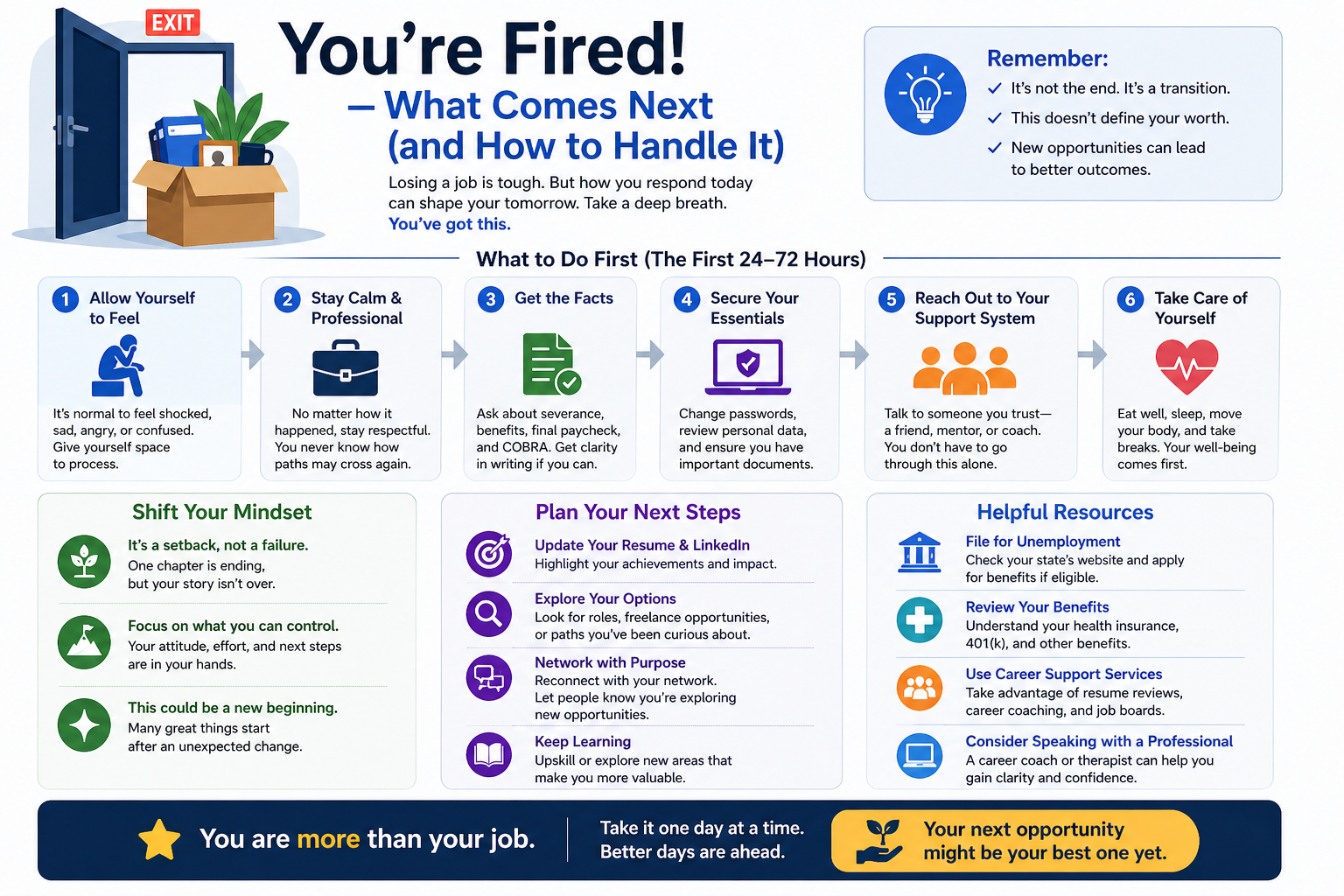
The moment employment ends unexpectedly, the mind often goes into a kind of emotional overload. Even if there were signs leading up to it, the actual confirmation still feels unreal. Many people describe it as a mix of confusion and disbelief, where thoughts become scattered and it becomes difficult to process what was just said. In professional environments like IT, where identity is often tied closely to expertise and responsibility, the emotional impact can feel even heavier.
In the first few hours, it is common to replay the conversation repeatedly, trying to find clues or mistakes. This mental replay does not immediately solve anything, but it is a natural response to sudden change. The priority during this stage is not analysis but stabilization. Accepting that the situation has happened, even without fully understanding it, is the first step toward regaining control.
Managing the Immediate Emotional Response
After the initial shock, emotions tend to surface more strongly. Anger can appear quickly, especially if the decision feels unfair or unexpected. Fear about financial stability and the future can also become overwhelming. Sadness may follow as the reality of losing routine, structure, and professional identity becomes clearer.
During this stage, reacting outwardly can create long-term consequences. Statements made in frustration or actions taken impulsively can damage professional reputation and relationships. Even if the situation feels unjust, maintaining restraint protects future opportunities. The focus should remain on minimizing additional damage rather than expressing every emotion in the moment.
It can help to physically remove oneself from the environment where the termination occurred. The change of setting allows the nervous system to settle and reduces immediate emotional pressure. What matters most is not suppressing emotions, but preventing them from dictating actions.
Understanding the Professional Reality
Job termination is often interpreted personally, but in most professional environments, it is rarely purely personal. Organizations make decisions based on performance metrics, restructuring needs, financial pressures, or strategic changes. This does not make the experience easier, but it can help separate personal identity from organizational decisions.
In technical roles, expectations can shift quickly. A skill set that was valuable a year ago may no longer align with new systems or priorities. Sometimes communication gaps, unclear expectations, or mismatched role definitions contribute to outcomes as well. Understanding this broader context allows for a more balanced reflection rather than purely emotional interpretation.
The key is not to immediately assign blame, either to oneself or others, but to gather clarity over time.
Protecting Professional Relationships
One of the most overlooked consequences of a difficult exit is the long-term impact on professional relationships. The technology industry, in particular, is highly interconnected, and individuals often cross paths multiple times across different organizations.
Even in situations where emotions are strong, maintaining respectful communication is essential. Former colleagues, managers, and even HR personnel may later play a role in references, recommendations, or hiring decisions. A calm and composed exit preserves future flexibility.
It is also important to avoid making immediate public statements about the situation. Emotional reactions shared too quickly can become permanent impressions that are difficult to reverse. Protecting reputation during this transition is just as important as finding new employment.
The First Practical Steps After Leaving
Once the immediate emotional intensity begins to settle, attention should shift toward practical actions. The first step is organizing personal and professional information. Updating a resume while experiences are still fresh helps ensure accuracy. At the same time, refreshing professional profiles ensures visibility to recruiters and hiring managers.
Reconnecting with professional contacts is another early step. Many opportunities arise through previous colleagues, industry acquaintances, or past managers. Communication at this stage does not need to be lengthy or formal, but it should be clear that the individual is open to new opportunities.
It is also important to begin monitoring financial stability early. Understanding available savings, monthly obligations, and potential adjustments helps reduce uncertainty. Planning does not eliminate stress, but it prevents panic-driven decisions later.
Reflecting Without Self-Blame
After a job loss, reflection is necessary, but it must be approached carefully. The goal is not self-criticism, but understanding. Constructive reflection focuses on identifying patterns, feedback, and areas of growth.
Questions may arise about communication style, technical performance, adaptability, or teamwork. In some cases, feedback may have been given previously but not fully acted upon. In other cases, expectations may have shifted without clear communication.
This stage is about learning rather than judging. Treating the experience as data rather than failure allows for more productive growth and prevents emotional stagnation.
Handling Financial Pressure
Financial uncertainty is often one of the most stressful aspects of job loss. Without a clear income stream, even basic expenses can feel heavier. This makes financial planning an early priority.
Reducing non-essential spending helps extend available resources. Reviewing subscriptions, lifestyle expenses, and discretionary costs can create temporary breathing room. The objective is not restriction for its own sake, but stability during transition.
At the same time, it is important to avoid panic-driven financial decisions. Selling assets or making abrupt changes should be considered carefully rather than emotionally. Stability comes from measured planning, not urgency.
Maintaining Mental and Emotional Health
The psychological impact of job loss is often underestimated. Beyond financial concerns, there is a loss of routine, structure, and daily purpose. Without active management, this can lead to prolonged stress or discouragement.
Creating a simple daily structure can help restore balance. Even small routines such as waking up at consistent times, exercising lightly, or dedicating hours to job search activities can provide stability.
If emotional strain becomes persistent, external support can be valuable. Speaking with a counselor or trusted individual provides perspective and helps prevent isolation. Mental resilience is not about handling everything alone, but about recognizing when support is needed.
Using Time Productively During Transition
Unemployment periods, while stressful, can also provide space for growth. Skill development becomes one of the most valuable uses of time during this phase. Technology fields evolve rapidly, and staying current increases future employability.
Exploring new systems, tools, or environments helps broaden expertise. Learning unfamiliar platforms or strengthening weak areas can significantly improve confidence during interviews. Practical experimentation is often more effective than passive learning, as it reinforces real understanding.
At the same time, engaging in non-technical activities is equally important. Physical activity, creative hobbies, or outdoor experiences help restore mental balance. A healthy routine includes both professional development and personal well-being.
Rebuilding Professional Confidence
Confidence often takes a hit after unexpected job loss. Even highly skilled professionals may begin questioning their abilities or decisions. Rebuilding confidence requires consistent action rather than internal reassurance alone.
Small achievements play an important role. Completing learning milestones, applying to roles, or reconnecting with contacts gradually rebuilds momentum. Confidence returns through progress, not pressure.
It is also important to recognize that employment status does not define capability. A job ending reflects a moment in time, not an entire career trajectory.
Preparing for the Next Opportunity
As stability returns, focus shifts toward preparing for future roles. This includes refining communication skills, updating technical knowledge, and understanding current industry expectations.
Interview preparation becomes more effective when combined with reflection on past experiences. Being able to explain challenges honestly, while demonstrating learning and growth, creates a stronger professional narrative.
Employers often value adaptability as much as technical expertise. Demonstrating the ability to recover, learn, and improve after setbacks can become a significant strength.
Building Long-Term Career Resilience
The most effective way to handle future uncertainty is to build resilience while employed, not only during transitions. Continuous learning ensures that skills remain relevant even as industry demands change.
Seeking feedback regularly helps identify blind spots before they become critical issues. Staying adaptable and open to change reduces vulnerability during organizational shifts.
Career stability is not based solely on job security, but on personal capability, adaptability, and ongoing development. Professionals who invest in themselves consistently are better prepared for unexpected changes.
Moving Forward With Perspective
Job loss can feel like a defining moment, but in reality, it is one part of a longer career journey. While the experience is often difficult, it can also become a turning point that leads to better direction, stronger skills, and improved self-awareness.
With time, structure, and intentional action, recovery becomes not only possible but often transformative. The situation does not define the individual; the response to it does.
Rebuilding Direction After the Initial Transition
Once the first emotional wave settles and basic actions like updating profiles and stabilizing finances are underway, the focus naturally shifts toward rebuilding direction. This stage is often less intense emotionally, but more important strategically. It is where uncertainty starts to turn into structured planning. Without this stage, job searching can feel random and exhausting rather than focused and productive.
At this point, many professionals begin to realize that losing a job also removes structure from daily life. There is no longer a fixed schedule, no defined responsibilities, and no immediate external pressure to perform tasks. While this may initially feel like freedom, it can quickly turn into aimlessness if not managed properly. Creating a personal structure becomes essential to maintain progress and motivation.
A simple but effective approach is to divide the day into consistent blocks of time. One block can be dedicated to job searching and applications, another to skill development, and another to rest or physical activity. This structure does not need to be rigid, but it helps maintain momentum and prevents days from blending into inactivity.
Rebuilding Professional Identity
After job loss, professional identity often feels temporarily disrupted. Many people strongly associate their sense of identity with their role, title, or workplace environment. When that is suddenly removed, it can create a feeling of disconnection or uncertainty about personal value.
Rebuilding this identity takes time and reflection. It helps to shift focus from job titles to skills and contributions. Instead of thinking “I was a system administrator at a company,” the perspective can shift to “I manage systems, solve infrastructure problems, and support business operations through technology.” This subtle change reinforces continuity rather than loss.
Professional identity is not defined by a single employer. It is defined by accumulated experience, problem-solving ability, and adaptability. Recognizing this helps reduce the emotional weight attached to job termination and creates a stronger foundation for future opportunities.
Strengthening Market Awareness
One important step during this phase is understanding how the job market has changed since the last time an active job search was conducted. Technology roles evolve quickly, and expectations shift based on new tools, frameworks, and industry trends.
Taking time to study current job descriptions helps identify skill gaps and emerging requirements. It also helps avoid applying blindly to roles that may not align with current capabilities. Instead, applications become more targeted and strategic.
This stage is not about rushing into the first available opportunity, but about understanding where skills fit best in the current market. Awareness leads to better positioning and stronger long-term outcomes.
Improving Skill Positioning
As gaps in knowledge become clearer, the next step is prioritizing skill improvement. This does not mean learning everything at once, but focusing on areas that increase employability and relevance.
Technical professionals often benefit from combining foundational knowledge with modern tools. For example, someone with traditional infrastructure experience may benefit from learning cloud platforms, automation tools, or container technologies. The goal is not to abandon past experience, but to build on it.
Practical application is more effective than theoretical learning alone. Working on small projects, simulations, or hands-on exercises helps solidify knowledge and provides concrete examples to discuss in interviews. Employers value demonstrated ability more than theoretical familiarity.
Rebuilding Confidence in Communication
After a job loss, confidence in interviews and professional communication may temporarily decline. This is a normal reaction, especially if the termination felt unexpected or unclear. However, communication skills can be rebuilt through preparation and repetition.
Practicing how to explain career transitions is particularly important. Employers will likely ask about the gap or job change, and having a clear, calm, and honest explanation is essential. The focus should remain on learning, growth, and forward movement rather than negative experiences.
Mock interviews, self-recording, or practicing with peers can help reduce anxiety and improve clarity. Over time, repetition restores natural confidence in speaking about experience and skills.
Managing Motivation Fluctuations
During extended job searches, motivation tends to fluctuate. Some days may feel productive and optimistic, while others may feel slow and discouraging. This variation is normal and should not be interpreted as failure or lack of progress.
Consistency matters more than intensity. Even small daily actions—such as applying to a few roles, learning for an hour, or networking with one contact—contribute to long-term progress. The key is maintaining forward movement, even when motivation is low.
It is also important to avoid comparing progress with others. Every job search is influenced by timing, location, industry demand, and individual circumstances. Comparison often creates unnecessary pressure and reduces focus.
Rebuilding Financial Stability Gradually
As time passes, financial planning may need adjustment based on the length of unemployment. Initial savings strategies may need refinement to match actual spending patterns and job search duration.
In some cases, temporary freelance or contract work may provide supplemental income. This can help reduce financial pressure while continuing the search for a full-time role. However, it is important to balance short-term income opportunities with long-term career goals.
Financial stability during this phase is not about perfection, but sustainability. The goal is to maintain enough stability to continue searching effectively without excessive stress.
Strengthening Support Networks
Social and professional support becomes increasingly important during longer transitions. Staying connected with others helps reduce isolation and provides emotional balance. Conversations with peers, former colleagues, or mentors can also lead to unexpected opportunities.
Many job opportunities are not publicly advertised and come through personal connections. Networking is not just about asking for jobs, but about staying visible within professional circles. Regular, simple communication helps maintain relationships without pressure.
Support networks also play a psychological role. They provide reassurance, perspective, and encouragement during uncertain periods. This emotional support can be just as valuable as technical preparation.
Maintaining Long-Term Perspective
During extended job searches, it is easy to become focused only on immediate outcomes. However, maintaining a long-term perspective helps reduce stress and improve decision-making. A career is not defined by a single job or a short period of unemployment.
Many professionals look back on periods of job loss as turning points that led to better roles, improved skills, or stronger career direction. While this may not be immediately visible during the transition, it often becomes clear later.
Understanding that setbacks are part of broader career development helps reduce pressure and encourages patience during the process.
Avoiding Isolation and Mental Fatigue
Extended periods without structured work can sometimes lead to isolation or mental fatigue. Without regular interaction with colleagues, the work environment, or daily challenges, it becomes easy to feel disconnected.
Maintaining external engagement is important. This can include professional meetups, online communities, learning groups, or even informal social interactions. Staying connected to the professional world helps maintain motivation and awareness.
Balancing effort with rest is equally important. Overworking the job search process can lead to burnout, while complete inactivity can lead to stagnation. A balanced rhythm is the most sustainable approach.
Preparing for Re-Entry Into Employment
As skills improve and confidence returns, attention naturally shifts toward re-entry into employment. This stage involves refining applications, targeting suitable roles, and preparing for interviews with greater clarity.
At this point, candidates often have a stronger understanding of their strengths, weaknesses, and goals than before. This clarity can lead to better job choices and improved long-term satisfaction.
Preparation is not just about getting hired quickly, but about finding the right fit. Alignment between skills, expectations, and work environment is more important than speed alone.
Recognizing Growth Through Experience
Although job loss is initially experienced as a setback, it often becomes a period of significant personal and professional growth. Skills are strengthened, awareness increases, and resilience develops naturally through experience.
Many professionals discover capabilities during transition periods that were not fully visible while working in structured environments. Independence, adaptability, and problem-solving often become stronger during uncertain phases.
This growth may not feel obvious in the moment, but it becomes more visible over time as new opportunities emerge.
Moving Toward Stability Again
Eventually, consistent effort leads to interviews, offers, and new opportunities. Re-entry into employment brings a sense of stability and structure back into daily life. However, the experience of transition often leaves a lasting impact on perspective and priorities.
Professionals who have gone through job loss often return with stronger awareness, better preparation habits, and improved adaptability. The experience reshapes how they approach work, learning, and career decisions.
Entering a New Role With a Different Mindset
Returning to work after a period of unemployment often feels different from previous job transitions. Even if the new role is similar on paper, the mindset is usually changed. There is often a stronger sense of awareness about stability, expectations, and personal growth. The experience of job loss tends to reshape how professionals view their careers, making them more intentional about decisions and more attentive to long-term direction.
The early days in a new role can feel both exciting and slightly uncertain. There is a natural pressure to prove capability again, but there is also valuable experience gained from the transition period that helps in adapting more quickly. Instead of approaching the job with routine familiarity, there is often a more conscious effort to understand systems, expectations, and workplace culture.
This phase is not just about restarting work, but about reintegrating into a structured environment with lessons learned from the past.
Applying Lessons From the Transition Period
One of the most important outcomes of a job loss experience is the set of lessons learned during the transition. These lessons are often not technical alone, but also behavioral and strategic. Professionals tend to become more aware of communication patterns, workplace expectations, and personal development needs.
There is usually a stronger emphasis on feedback. Instead of waiting for performance reviews, individuals may become more proactive in seeking input from managers and peers. This helps prevent small issues from growing into larger problems over time.
Time management also tends to improve. After experiencing a period without structured work, many professionals develop a greater appreciation for productivity and focused effort. This often leads to better prioritization and reduced time wastage in day-to-day tasks.
Rebuilding Confidence in a Professional Environment
Even after securing a new role, confidence does not always return instantly. There may still be lingering uncertainty from the previous experience. However, confidence gradually rebuilds through consistent performance and positive reinforcement in the new environment.
Small achievements play a key role in this process. Successfully completing tasks, receiving acknowledgment, or solving problems independently helps restore trust in personal ability. Over time, these experiences replace earlier doubts with renewed assurance.
It is important to recognize that confidence is not static. It naturally fluctuates based on environment, workload, and feedback. The goal is not to eliminate uncertainty completely, but to function effectively despite it.
Strengthening Communication and Clarity
One of the most noticeable improvements after a difficult career transition is in communication style. Professionals often become more precise, thoughtful, and structured in how they communicate with teams and leadership.
There is a greater awareness of how misunderstandings can develop and how important clarity is in preventing them. As a result, communication tends to become more intentional, with a stronger focus on confirmation, documentation, and alignment.
This improvement often extends to written communication as well. Emails, reports, and technical documentation become more structured and easier to understand. These small changes contribute significantly to overall workplace effectiveness.
Managing Work Pressure With Better Perspective
After experiencing job loss, work pressure is often viewed differently. Challenges still exist, but they are usually approached with a broader perspective. Difficult situations no longer feel like permanent threats, but rather temporary phases that can be managed and resolved.
This shift in perspective helps reduce stress and improves problem-solving ability. Instead of reacting emotionally to pressure, individuals are more likely to assess situations logically and prioritize effectively.
This does not mean that stress disappears, but rather that it becomes more manageable. The ability to separate immediate pressure from long-term stability becomes a valuable skill.
Improving Professional Boundaries
Another subtle but important change that often follows a career disruption is the development of healthier professional boundaries. Many individuals become more aware of workload balance, expectations, and personal limits.
This awareness helps prevent burnout and encourages more sustainable work habits. There is often a clearer understanding that while dedication is important, overextension can be counterproductive in the long run.
Setting boundaries does not reduce commitment; instead, it supports long-term performance. Professionals who maintain balance are often more consistent and reliable over time.
Reevaluating Career Direction
A period of job loss and recovery often leads to deeper reflection about long-term career direction. Some individuals may decide to specialize further in their existing field, while others may explore adjacent areas or entirely new paths.
This reevaluation is not always immediate, but it develops gradually through experience and exposure to new opportunities. The transition period provides space to think beyond daily responsibilities and consider broader goals.
In many cases, this leads to more intentional career choices. Instead of following default paths, professionals begin aligning their decisions with personal interests, strengths, and long-term aspirations.
Building Greater Adaptability
One of the strongest long-term outcomes of navigating job loss is increased adaptability. The experience of uncertainty teaches individuals how to adjust to changing circumstances, learn new skills quickly, and remain effective under different conditions.
This adaptability becomes a key professional strength. In fast-changing industries, the ability to adjust is often more valuable than fixed expertise. Technologies evolve, organizational structures change, and priorities shift frequently.
Professionals who have experienced disruption tend to be more comfortable with change, making them more resilient in dynamic environments.
Developing a Healthier Relationship With Work
After going through a difficult career transition, many individuals develop a more balanced relationship with work. While professional success remains important, there is often a greater awareness of life outside of work.
This perspective helps reduce overdependence on job identity and encourages a more holistic approach to well-being. Work is seen as an important part of life, but not the sole defining factor.
This shift often leads to improved mental health, better stress management, and a more sustainable approach to long-term career development.
Recognizing Long-Term Career Value
Looking back over time, the experience of job loss often becomes less about the immediate difficulty and more about the long-term value it created. Skills improved, awareness increased, and resilience strengthened through the process.
Many professionals realize that the transition period played a significant role in shaping their current capabilities. What initially felt like a setback often becomes a foundation for stronger performance in future roles.
This recognition does not erase the difficulty of the experience, but it reframes it as part of growth rather than failure.
Moving Forward With Stability and Awareness
As stability returns, the focus gradually shifts from recovery to growth. Work becomes more structured again, but with added awareness and perspective gained from previous challenges.
Decisions become more deliberate, communication more thoughtful, and planning more strategic. The experience of disruption adds depth to professional development and influences how future challenges are approached.
Over time, the transition becomes part of a larger narrative of resilience and continuous improvement.
A career interruption can feel overwhelming in the moment, but its long-term impact often extends far beyond the initial experience. It shapes how professionals think, work, and grow.
Through emotional adjustment, skill development, reflection, and eventual reintegration into work, individuals often emerge with stronger capability and clearer direction. The process is not easy, but it is transformative.
In the end, what defines the experience is not the moment of job loss itself, but the ability to rebuild, adapt, and move forward with greater understanding and resilience.
Rebuilding Stability With Experience as a Foundation
After returning to a stable job role and settling back into a structured routine, the long-term effects of a career disruption begin to reveal themselves more clearly. What once felt like a period of instability slowly transforms into a foundation of experience that influences future decisions, behaviors, and expectations. Work becomes familiar again, but the mindset is no longer the same as before the transition.
There is often a stronger sense of grounding in day-to-day responsibilities. Tasks are still completed, deadlines still exist, and expectations remain high, but there is a deeper awareness of how quickly circumstances can change. This awareness does not create fear; instead, it encourages more thoughtful engagement with work and long-term planning.
Stability after disruption feels different because it is no longer taken for granted. It is appreciated more consciously and maintained with greater care.
Improved Decision-Making Through Experience
One of the most significant changes after navigating job loss and recovery is improved decision-making. Professionals often become more deliberate in how they approach responsibilities, opportunities, and workplace challenges. Decisions are no longer made purely based on urgency, but with consideration of long-term impact.
There is a stronger tendency to evaluate situations more carefully before reacting. This includes analyzing risks, understanding consequences, and considering alternative approaches. As a result, work quality often improves, and mistakes caused by impulsive decisions become less frequent.
This shift in decision-making is not about hesitation, but about clarity. Experience adds depth to judgment, allowing for more balanced and informed choices.
Strengthening Problem-Solving Skills
Problem-solving abilities often improve significantly after a period of professional disruption. During unemployment or transition phases, individuals are required to solve problems independently without immediate external structure. This develops self-reliance and adaptability.
When returning to work, these skills naturally carry forward. Challenges are approached with more patience and creativity. Instead of relying on familiar solutions alone, there is greater willingness to explore new methods and perspectives.
This flexibility becomes especially valuable in technical environments where systems, tools, and requirements frequently change. The ability to adapt problem-solving strategies based on context becomes a long-term advantage.
Greater Awareness of Workplace Dynamics
Another long-term effect of career transition is increased awareness of workplace dynamics. Professionals become more attentive to communication patterns, team structures, and organizational priorities.
There is a clearer understanding that workplace decisions are influenced by multiple factors, not just individual performance. Budget constraints, strategic changes, and shifting business goals all play a role in shaping outcomes.
This awareness helps reduce misunderstandings and emotional reactions to organizational decisions. Instead of interpreting changes personally, individuals are more likely to analyze broader context.
This perspective creates a more balanced and realistic view of professional environments.
Developing Emotional Resilience Over Time
Emotional resilience strengthens gradually through experience. Facing job loss, uncertainty, and eventual recovery builds the ability to manage stress and maintain stability during difficult situations.
This resilience does not mean avoiding emotional responses, but rather processing them in a healthier and more controlled way. Challenges are still felt, but they do not overwhelm decision-making or long-term thinking.
Over time, professionals become more confident in their ability to handle uncertainty. This confidence is not based on avoidance of difficulty, but on proven experience of overcoming it.
Reinforcing Continuous Learning Habits
A major long-term benefit of career disruption is the development of continuous learning habits. During transition periods, individuals often invest time in learning new technologies or improving existing skills. When they return to work, this habit often continues.
This creates a mindset of ongoing improvement rather than static expertise. Instead of relying solely on past knowledge, professionals remain open to new tools, methods, and ideas.
In fast-evolving industries, this habit becomes a critical advantage. It ensures that skills remain relevant and adaptable over time, reducing the risk of future skill gaps.
Improved Communication With Leadership and Teams
Communication often becomes more effective after experiencing professional setbacks. There is a stronger understanding of how important clarity, structure, and alignment are in workplace interactions.
Professionals tend to communicate more proactively, asking clarifying questions and confirming expectations earlier in processes. This reduces misunderstandings and improves collaboration.
Interactions with leadership also become more strategic. Instead of focusing only on task execution, there is greater awareness of priorities, goals, and decision-making processes.
This improvement in communication contributes to stronger professional relationships and smoother teamwork.
Better Balance Between Confidence and Humility
Another important shift that develops over time is a healthier balance between confidence and humility. After experiencing both success and setback, professionals often become more grounded in their self-assessment.
Confidence becomes more stable and based on actual experience rather than assumptions. At the same time, there is greater openness to feedback and learning from others.
This balance improves workplace interactions and supports long-term growth. It allows individuals to perform effectively while remaining receptive to improvement.
Long-Term Career Planning Becomes More Intentional
Career disruption often leads to more intentional long-term planning. Instead of simply reacting to available opportunities, professionals begin to think more carefully about direction, goals, and alignment.
There is often greater focus on building skills that provide long-term value rather than short-term convenience. Decisions about roles, industries, or specializations become more thoughtful.
This does not mean every decision becomes perfectly planned, but there is a stronger sense of direction and purpose behind choices.
Reduced Fear of Future Uncertainty
One of the most meaningful long-term outcomes of navigating job loss is reduced fear of future uncertainty. Having already experienced disruption and recovery, individuals develop confidence in their ability to handle similar situations again.
This does not eliminate concern about change, but it reduces panic and emotional overwhelm. Future challenges are viewed with more perspective and less fear.
This psychological shift is important because it allows professionals to take calculated risks, explore new opportunities, and adapt more easily to change.
Strengthened Sense of Professional Identity
Over time, professional identity becomes more stable and less dependent on external validation. Instead of being defined by a single role or company, identity becomes based on skills, experience, and adaptability.
This creates a more resilient sense of self. Career changes no longer feel like identity losses but rather transitions within a broader professional journey.
This shift strengthens confidence and reduces emotional dependency on any single job or organization.
Learning to Value Progress Over Perfection
Another important long-term lesson is the ability to value progress over perfection. During transition periods, professionals often realize that waiting for ideal conditions can delay growth unnecessarily.
Instead, they begin focusing on incremental improvement. Small steps forward become more meaningful than waiting for perfect opportunities.
This mindset improves productivity and reduces hesitation in decision-making. It also encourages continuous movement, even in uncertain conditions.
Building a More Sustainable Career Approach
With experience, professionals often adopt a more sustainable approach to their careers. This includes balancing effort, learning, rest, and long-term planning in a healthier way.
There is greater awareness that burnout and overextension can be harmful in the long run. As a result, work habits become more balanced and intentional.
Sustainability becomes a guiding principle rather than constant overperformance.
Conclusion
A career disruption, while difficult in the moment, often becomes one of the most influential experiences in a professional journey. It challenges stability, tests resilience, and forces reflection in ways that routine work rarely does.
Through emotional recovery, skill development, reflection, and reintegration into work, individuals often emerge stronger, more aware, and more adaptable. The experience reshapes how they approach work, relationships, and long-term planning.
What initially feels like loss gradually transforms into growth. Confidence is rebuilt, perspective is broadened, and professional capability becomes more refined. The journey does not erase difficulty, but it reframes it as part of development rather than defeat.
In the long run, the true outcome of such an experience is not just returning to work, but returning with greater clarity, resilience, and purpose.