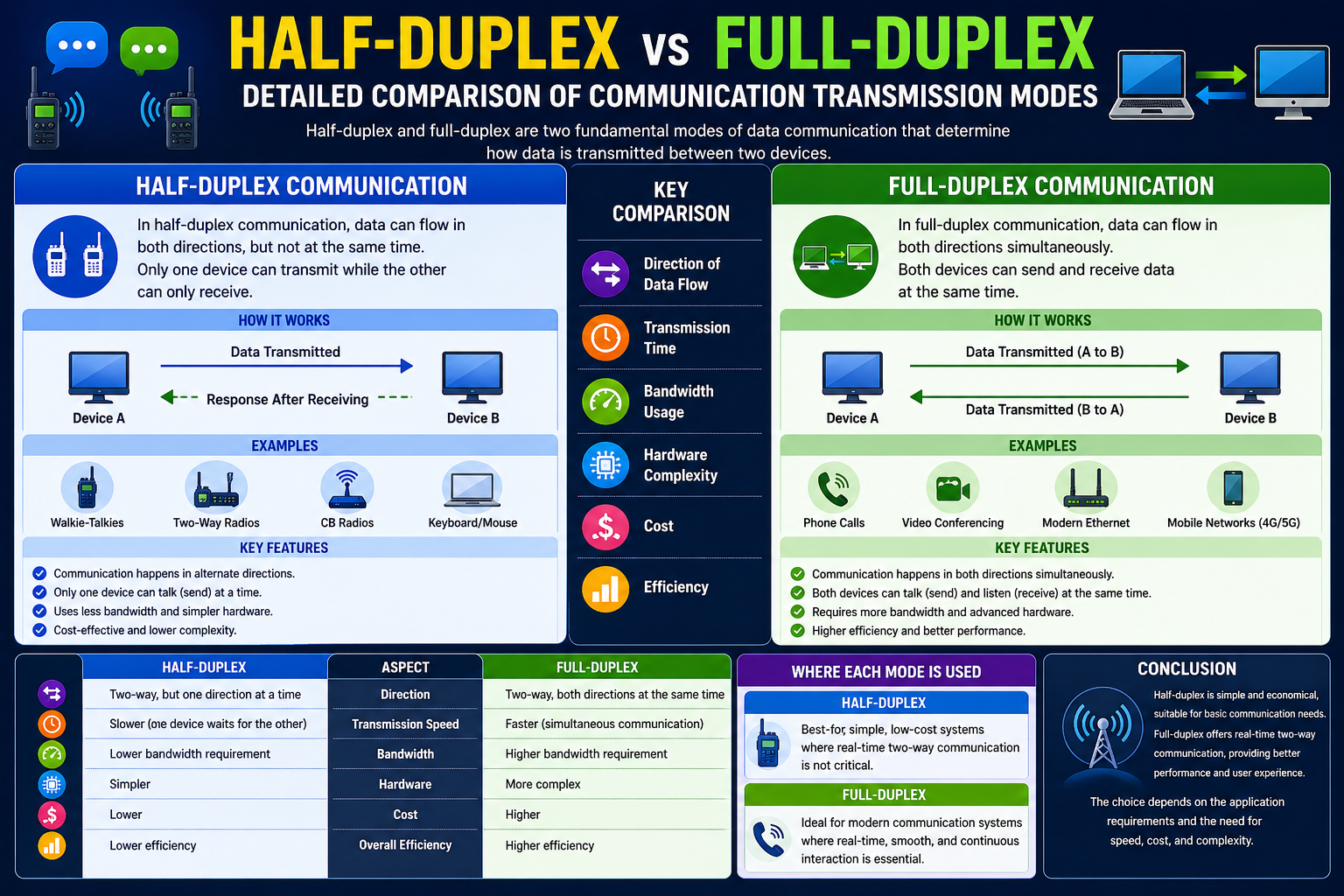
Communication between devices in a network is based on how data is transmitted and received. This transmission behavior is defined by communication modes, which determine whether signals can move in one direction or both directions at the same time. Among these modes, half-duplex and full-duplex are two widely used systems that shape the efficiency and performance of communication networks. Understanding these modes is essential because they directly affect speed, responsiveness, and overall system design in networking and telecommunication environments.
In simple terms, communication modes control how devices “talk” to each other. Some systems allow only one direction of communication at a time, while others support simultaneous exchange of information. The difference between half-duplex and full-duplex lies in this timing and direction of data flow, which significantly impacts how smoothly communication takes place.
Understanding Half-Duplex Communication
Half-duplex communication is a system where data transmission can occur in both directions, but not at the same time. This means that when one device is sending information, the other device must wait until the transmission is complete before responding. The communication channel is shared, and only one direction is active at any given moment.
This alternating pattern creates a turn-based system where devices switch roles between sender and receiver. Although both ends are capable of sending and receiving data, they cannot perform these actions simultaneously. As a result, there is a natural delay in communication, especially when frequent back-and-forth exchange is required.
Half-duplex systems are designed in a way that prioritizes simplicity over speed. Because only one direction operates at a time, the system does not require complex mechanisms to manage simultaneous signals. This makes it more cost-effective and easier to implement in certain environments.
However, the limitation lies in its efficiency. Since communication must take turns, delays can occur, especially in systems where fast response time is important. Despite this limitation, half-duplex remains useful in several applications where continuous two-way communication is not necessary.
Working Mechanism of Half-Duplex Systems
In a half-duplex system, the communication channel is shared between two devices. When one device begins transmitting data, it takes full control of the channel. The receiving device must remain in listening mode until the transmission ends. After that, roles switch, allowing the second device to respond.
This process relies on coordination between devices to avoid signal collision. Since both ends cannot send data simultaneously, the system naturally avoids interference. However, this also means that communication efficiency depends on how well the devices manage turn-taking.
A common characteristic of half-duplex systems is the presence of a switching mechanism that alternates between sending and receiving modes. This switching introduces a slight delay, which becomes more noticeable in high-frequency communication scenarios.
Understanding Full-Duplex Communication
Full-duplex communication is a more advanced system where data can be transmitted and received simultaneously between devices. In this mode, both ends of the communication channel remain active at the same time, allowing continuous two-way interaction without waiting.
This simultaneous exchange significantly improves communication speed and efficiency. Since both devices can send and receive data at the same time, there is no need for turn-taking. This leads to a smoother and more natural flow of information.
Full-duplex systems are widely used in modern communication technologies where real-time interaction is essential. They provide a more responsive experience, especially in environments that require constant data exchange.
Unlike half-duplex systems, full-duplex communication requires more advanced hardware and signal management techniques. This is because the system must handle incoming and outgoing signals simultaneously without interference.
Working Mechanism of Full-Duplex Systems
In a full-duplex system, the communication channel is designed to support two-way data flow at the same time. This is often achieved by separating transmission paths or using advanced signal processing techniques that allow simultaneous operation.
Both devices involved in communication can send and receive data without interruption. This eliminates waiting time and ensures continuous interaction. The system manages both directions independently, preventing overlap or collision of signals.
Because of this independent operation, full-duplex communication feels more natural and efficient, especially in applications where real-time exchange is critical.
Key Differences in Data Flow Behavior
The most important difference between half-duplex and full-duplex communication lies in how data flows between devices. In half-duplex systems, data flows in both directions but only one direction at a time. In full-duplex systems, data flows in both directions simultaneously.
This difference directly affects performance. Half-duplex systems experience pauses during direction switching, while full-duplex systems maintain uninterrupted communication. As a result, full-duplex systems are generally faster and more efficient in handling continuous data exchange.
The behavior of data flow also influences user experience. In half-duplex communication, responses may feel delayed, while in full-duplex communication, interaction feels instant and continuous.
Efficiency and Performance Considerations
Efficiency plays a major role in determining which communication mode is more suitable for a particular application. Half-duplex systems are less efficient in terms of speed because they require alternating transmission. However, they are efficient in terms of simplicity and resource usage.
Full-duplex systems, on the other hand, are highly efficient in performance because they maximize channel usage by allowing simultaneous transmission. This reduces waiting time and increases data throughput.
In environments where speed and responsiveness are important, full-duplex systems are preferred. In contrast, half-duplex systems are suitable where communication demands are lower and simplicity is more important than speed.
Complexity and Design Requirements
Half-duplex systems are relatively simple in design. Since only one direction of communication is active at a time, the system does not require complex mechanisms to manage simultaneous signals. This simplicity reduces cost and makes implementation easier.
Full-duplex systems are more complex because they must handle two-way communication simultaneously. This requires advanced hardware and sophisticated signal separation techniques to prevent interference between incoming and outgoing data.
The increased complexity of full-duplex systems also means higher cost and more advanced infrastructure requirements. However, this is justified by the significant improvement in communication performance.
Advantages of Half-Duplex Communication
Half-duplex communication offers several advantages despite its limitations. Its simplicity makes it cost-effective and easy to implement. It also requires less bandwidth management since only one direction is active at a time.
Another advantage is reduced risk of signal collision because devices take turns communicating. This makes the system more stable in certain environments where simultaneous transmission could cause interference.
Half-duplex systems are also suitable for applications where real-time interaction is not critical, allowing them to function efficiently without requiring advanced technology.
Limitations of Half-Duplex Communication
The primary limitation of half-duplex communication is reduced speed due to alternating transmission. Devices must wait for their turn to send or receive data, which creates delays in communication.
This system is not suitable for applications requiring continuous interaction or real-time response. The switching between modes also reduces overall efficiency in high-demand communication environments.
As communication needs evolve, the limitations of half-duplex systems become more noticeable, especially in modern high-speed networks.
Advantages of Full-Duplex Communication
Full-duplex communication provides significant advantages in terms of speed and efficiency. The ability to send and receive data simultaneously eliminates delays and allows continuous interaction between devices.
This mode improves user experience by enabling real-time communication, which is essential in modern applications such as voice calls, video conferencing, and data streaming.
Full-duplex systems also make better use of available bandwidth by allowing both directions of communication to operate at the same time.
Limitations of Full-Duplex Communication
Despite its advantages, full-duplex communication has some limitations. It requires more complex hardware and advanced signal processing techniques, which increases cost and system complexity.
There is also a need for careful management of signals to prevent interference between incoming and outgoing data. This adds to the technical challenges involved in designing such systems.
In some cases, the additional complexity may not be necessary, especially in simple communication environments where high-speed interaction is not required.
Real-World Applications of Half-Duplex Systems
Half-duplex communication is commonly used in systems where turn-based communication is sufficient. It is often found in older communication technologies and certain wireless systems where devices share a single channel.
It is also used in situations where simplicity and cost reduction are more important than speed. These systems perform well in controlled environments where communication is predictable and not time-sensitive.
Real-World Applications of Full-Duplex Systems
Full-duplex communication is widely used in modern technology. It is essential in telephone systems, internet communication, video conferencing, and other real-time applications where continuous interaction is required.
It is also used in high-speed data networks where large amounts of information need to be transmitted and received simultaneously. This makes it a critical component of modern digital communication infrastructure.
Evolving Role of Communication Modes
As technology continues to advance, the demand for faster and more efficient communication systems has increased. This has led to a greater reliance on full-duplex communication in most modern applications.
However, half-duplex systems still play a role in specific environments where simplicity and cost-effectiveness are prioritized. Both modes continue to coexist, serving different needs based on system requirements.
The evolution of communication technology reflects a shift toward more efficient and real-time data exchange, making full-duplex systems increasingly dominant in modern networks.
Half-Duplex Communication in Network Behavior and Performance
Half-duplex communication has a very specific influence on how networks behave under load. Since only one device can transmit at a time, the entire communication channel operates in a controlled alternating pattern. This structure reduces the chance of data collision, but it also introduces a natural bottleneck when traffic increases. When multiple devices rely on the same channel, they must wait for their turn, which can slow down the overall system response.
In practical networking environments, this waiting period becomes more noticeable when communication is frequent or time-sensitive. Each exchange requires a clear switch from sender to receiver, and this switching takes time. Even though the delay may seem small in individual transmissions, it accumulates when communication is continuous.
Half-duplex systems are therefore more suitable in environments where data transfer is occasional rather than constant. They are also more predictable in performance because only one direction of communication is active at a time, making traffic easier to manage.
Signal Direction Control in Half-Duplex Systems
The control of signal direction in half-duplex systems is based on strict coordination between devices. At any given moment, only one device has permission to transmit data. The other device must remain in a listening state until the channel is free.
This control is usually managed through predefined rules or protocols that ensure devices do not transmit simultaneously. The system effectively enforces discipline in communication flow, which prevents overlap of signals.
Because of this strict alternation, half-duplex communication avoids complexity in signal separation. However, it also limits flexibility, as devices cannot respond instantly while the other is transmitting.
Latency Characteristics in Half-Duplex Communication
Latency is an important factor in evaluating communication systems, and half-duplex setups naturally introduce higher latency compared to full-duplex systems. The reason is simple: every response must wait for the current transmission to complete.
This waiting period increases the time required for a full exchange of information. In applications where timing is critical, such delays can reduce performance efficiency.
However, in less time-sensitive systems, this latency is often acceptable. The predictable nature of the delay also makes system behavior easier to model and manage.
Bandwidth Utilization in Half-Duplex Systems
Half-duplex systems use bandwidth in a sequential manner. Since only one direction is active at a time, the full capacity of the channel is dedicated to either sending or receiving data, but never both simultaneously.
This results in underutilization of available bandwidth during certain periods. While the system avoids interference, it does not maximize channel efficiency.
Despite this limitation, half-duplex communication can still be effective in environments where traffic is light or intermittent. The simplicity of bandwidth management also reduces system overhead.
Full-Duplex Communication and Simultaneous Data Flow
Full-duplex communication fundamentally changes the way data flows by allowing simultaneous transmission and reception. Both devices remain active at the same time, continuously exchanging information without interruption.
This simultaneous operation eliminates the need for turn-taking. As a result, communication becomes more dynamic and responsive.
The ability to handle both directions at once significantly improves system performance, especially in environments where continuous interaction is required.
Signal Separation Techniques in Full-Duplex Systems
One of the most important aspects of full-duplex communication is the ability to separate incoming and outgoing signals. Since both directions operate at the same time, the system must ensure that signals do not interfere with each other.
This is achieved through various technical methods such as frequency separation, echo cancellation, or using distinct channels for transmission and reception. These techniques allow the system to maintain clarity in both directions of communication.
Without proper signal separation, full-duplex communication would suffer from overlap and distortion. Therefore, advanced engineering is required to maintain stability.
Efficiency Gains in Full-Duplex Communication
Full-duplex systems provide significant efficiency improvements because they eliminate idle time in communication channels. While one device is sending data, it can simultaneously receive data, ensuring that the channel is always active.
This constant utilization of communication capacity results in higher throughput. More data can be exchanged in less time compared to half-duplex systems.
The efficiency gain becomes especially important in high-demand environments such as real-time communication networks, where delays must be minimized.
Impact on Real-Time Communication
Real-time communication relies heavily on full-duplex systems. Applications such as voice conversations, live video calls, and online collaboration tools require instant two-way interaction.
In these environments, even small delays can disrupt the flow of communication. Full-duplex systems eliminate these delays by allowing continuous exchange of information.
This creates a natural conversation-like experience where both sides can speak and listen at the same time without interruption.
Resource Requirements of Full-Duplex Systems
Full-duplex communication requires more advanced system resources compared to half-duplex communication. The hardware must be capable of handling simultaneous data streams without degradation in quality.
This often involves more complex circuitry, advanced signal processing units, and better channel management techniques. As a result, full-duplex systems are generally more expensive to implement.
However, the improved performance justifies the additional cost in most modern applications.
Interference Management in Full-Duplex Systems
One of the biggest challenges in full-duplex communication is managing interference between transmitted and received signals. Since both occur at the same time, there is a risk of signal overlap.
To address this, systems use sophisticated filtering and cancellation techniques. These methods ensure that outgoing signals do not disrupt incoming data and vice versa.
Effective interference management is essential for maintaining communication quality and reliability.
Half-Duplex in Wireless Communication Environments
Half-duplex communication is commonly found in certain wireless systems where devices share a single channel. In such environments, simultaneous transmission is not possible due to physical or technical limitations.
Instead, devices coordinate access to the channel by taking turns. This method helps prevent signal collisions in shared environments.
Although it reduces speed, it provides stability in situations where multiple users or devices are connected to the same communication medium.
Full-Duplex in Modern Digital Networks
Modern digital networks rely heavily on full-duplex communication to support high-speed data transfer. Internet connections, fiber-optic communication, and cellular networks often use full-duplex systems to handle large volumes of data.
These systems are designed to support continuous data flow, ensuring that users experience minimal delay during communication.
The widespread use of full-duplex systems reflects the growing demand for real-time and high-performance connectivity.
Error Handling in Half-Duplex Systems
Error handling in half-duplex communication is relatively straightforward because only one direction of communication is active at a time. This reduces the complexity of detecting and correcting transmission errors.
However, delays caused by turn-taking can sometimes make error recovery slower. If an error occurs during transmission, the system must wait for the next turn to correct it.
Despite this limitation, the simplicity of the system makes error management easier to implement.
Error Handling in Full-Duplex Systems
In full-duplex systems, error handling is more complex due to simultaneous data flow. Errors can occur in either direction at any time, requiring continuous monitoring of both channels.
Advanced error detection and correction techniques are used to maintain data integrity. These systems are designed to quickly identify and resolve issues without interrupting communication.
The complexity of error handling is balanced by the overall improvement in communication speed and efficiency.
Scalability of Half-Duplex Systems
Half-duplex systems have limited scalability when it comes to handling high traffic volumes. Since communication is sequential, adding more devices increases waiting time and reduces efficiency.
This makes them less suitable for large-scale, high-speed networks. However, they can still perform well in small or controlled environments where traffic is manageable.
Their simplicity can be an advantage in systems where scalability is not a primary concern.
Scalability of Full-Duplex Systems
Full-duplex systems are highly scalable and can support large amounts of data traffic. Their ability to handle simultaneous communication allows them to manage multiple interactions efficiently.
This makes them suitable for modern network infrastructures that require high performance and flexibility.
As demand for faster communication grows, full-duplex systems continue to play a key role in supporting scalable network designs.
Energy Consumption Differences
Energy consumption varies between half-duplex and full-duplex systems. Half-duplex systems generally consume less energy because only one transmission path is active at a time.
Full-duplex systems consume more energy due to continuous simultaneous operation and more complex processing requirements. However, the difference is often justified by the performance benefits they provide.
In modern systems, energy efficiency is balanced against speed and functionality.
Practical Selection Between the Two Modes
The choice between half-duplex and full-duplex communication depends on system requirements. If simplicity, cost reduction, and basic communication are priorities, half-duplex systems are suitable.
If speed, real-time interaction, and high efficiency are required, full-duplex systems are the preferred choice.
Both modes serve important roles in communication systems, and their usage depends on the specific demands of the application environment.
Half-Duplex vs Full-Duplex in System Design Considerations
When designing communication systems, engineers must carefully decide whether to use half-duplex or full-duplex transmission based on performance needs, cost constraints, and technical feasibility. This decision influences not only how devices communicate but also how the entire system architecture is structured.
Half-duplex systems are often chosen when simplicity is a priority. Their design does not require complex signal separation mechanisms, which reduces both development time and implementation cost. Because only one direction of communication is active at any moment, the system architecture can be more straightforward, making it easier to deploy in controlled or limited environments.
Full-duplex systems, on the other hand, require more advanced design planning. Engineers must account for simultaneous data flow, ensuring that both transmission and reception can occur without interference. This increases the complexity of circuit design, protocol management, and hardware integration, but it results in significantly higher performance.
Protocol Behavior in Half-Duplex Communication
Communication protocols in half-duplex systems are designed to manage turn-based transmission. These protocols ensure that devices do not attempt to send data simultaneously, which would otherwise cause collisions or data loss.
Before a device begins transmission, it typically checks whether the channel is free. Once the channel is available, it sends data while the other device waits. After completion, the roles are reversed. This structured behavior ensures orderly communication but limits continuous interaction.
Such protocols are especially useful in systems where network traffic is predictable and does not require constant real-time exchange.
Protocol Behavior in Full-Duplex Communication
In full-duplex systems, protocols are designed to support simultaneous communication in both directions. Instead of managing turns, the protocol focuses on maintaining continuous data streams while ensuring synchronization between devices.
These systems often include mechanisms for flow control, error detection, and bandwidth management to handle continuous transmission efficiently. Because both devices can communicate at the same time, the protocol must ensure that data integrity is maintained in both directions without delay.
This results in a more complex but highly efficient communication structure.
Hardware Requirements in Half-Duplex Systems
Half-duplex communication requires relatively simple hardware. Since transmission occurs in one direction at a time, there is no need for separate transmission and reception channels operating simultaneously.
This reduces the need for advanced signal processing components and lowers overall system cost. The hardware is typically designed to switch between sending and receiving modes as needed.
Because of this simplicity, half-duplex systems are often used in basic communication devices or environments with limited resources.
Hardware Requirements in Full-Duplex Systems
Full-duplex communication demands more advanced hardware capable of handling simultaneous data flow. Devices must be equipped with components that can transmit and receive signals at the same time without interference.
This often involves the use of separate channels, advanced filtering systems, or sophisticated digital processing units. The hardware must be carefully engineered to ensure that signals remain clear and uninterrupted in both directions.
While this increases cost and complexity, it significantly improves communication speed and reliability.
Delay Patterns in Half-Duplex Systems
Delay in half-duplex communication is primarily caused by the need to alternate between sending and receiving modes. Each device must wait for the other to finish transmitting before responding.
This creates a predictable but noticeable delay pattern. In systems with frequent communication, these delays can accumulate and affect overall performance.
Although the delay is consistent and manageable, it limits the responsiveness of the system, especially in real-time applications.
Delay Patterns in Full-Duplex Systems
In full-duplex communication, delays are significantly reduced because both devices can transmit and receive simultaneously. There is no need to wait for the other device to finish sending data before responding.
This results in near-instant communication, which is essential for applications that require real-time interaction.
However, minor delays may still occur due to processing time, but they are generally much smaller compared to half-duplex systems.
Data Collision Handling in Half-Duplex Systems
Since half-duplex systems allow only one direction of communication at a time, data collisions are naturally minimized. The system avoids overlapping transmissions by enforcing strict turn-taking rules.
This makes the system more stable in environments where multiple devices share the same communication channel.
However, the trade-off is reduced speed and efficiency due to enforced waiting periods.
Data Collision Handling in Full-Duplex Systems
Full-duplex systems are designed to prevent data collisions even though both directions operate simultaneously. This is achieved through advanced techniques such as signal separation and echo cancellation.
These methods ensure that transmitted and received signals do not interfere with each other, maintaining communication clarity.
Proper collision management is essential for maintaining high performance in full-duplex environments.
Throughput Differences Between Modes
Throughput refers to the amount of data successfully transmitted within a given time. Full-duplex systems generally achieve higher throughput because both devices can communicate simultaneously.
Half-duplex systems have lower throughput since only one direction is active at a time. Even though the full capacity of the channel is used during transmission, the alternating nature reduces overall efficiency.
This difference becomes more significant in high-demand communication systems.
Network Efficiency in Half-Duplex Systems
Efficiency in half-duplex systems is limited by their turn-based structure. While the system avoids signal overlap, it does not fully utilize available communication potential at all times.
This makes it suitable for low-traffic environments but less ideal for high-speed networks.
Despite this limitation, half-duplex systems remain useful due to their simplicity and reliability.
Network Efficiency in Full-Duplex Systems
Full-duplex systems maximize network efficiency by enabling continuous data exchange. Both communication directions remain active, ensuring that no time is wasted waiting for channel availability.
This leads to better utilization of network resources and improved performance in demanding environments.
As a result, full-duplex communication is widely adopted in modern high-speed networks.
Synchronization Requirements in Half-Duplex Systems
Synchronization in half-duplex systems is relatively simple. Devices only need to coordinate when to switch between sending and receiving modes.
This reduces the complexity of timing mechanisms and makes system behavior easier to control.
However, strict synchronization is still necessary to avoid overlapping transmissions.
Synchronization Requirements in Full-Duplex Systems
Full-duplex systems require more advanced synchronization techniques to manage simultaneous data flow. Both transmission and reception must remain aligned to prevent data loss or distortion.
This requires precise timing control and advanced processing capabilities.
Proper synchronization ensures smooth and uninterrupted communication.
Scalability Challenges in Half-Duplex Systems
As the number of devices in a half-duplex system increases, communication delays become more pronounced. Since devices must take turns, adding more participants increases waiting time.
This limits scalability in high-density environments.
Half-duplex systems are therefore more suitable for smaller or controlled networks.
Scalability Advantages in Full-Duplex Systems
Full-duplex systems scale more effectively because simultaneous communication reduces congestion. Multiple devices can exchange data more efficiently without waiting for channel availability.
This makes full-duplex systems ideal for large-scale networks and modern communication infrastructures.
Their ability to handle high traffic loads ensures consistent performance even as demand increases.
Cost Implications of Both Systems
Half-duplex systems are generally more cost-effective due to simpler hardware and reduced processing requirements. This makes them attractive for basic communication applications.
Full-duplex systems are more expensive due to advanced hardware and complex signal processing needs. However, the increased cost is balanced by significantly improved performance.
The choice between the two often depends on budget constraints and performance expectations.
Application Suitability of Half-Duplex Communication
Half-duplex communication is suitable for environments where communication is intermittent and real-time interaction is not critical. It works well in simple data exchange systems and controlled communication channels.
Its reliability and simplicity make it practical for specific use cases where advanced performance is not required.
Application Suitability of Full-Duplex Communication
Full-duplex communication is essential in modern applications that require continuous interaction. It is widely used in voice communication, video conferencing, online gaming, and high-speed data networks.
Its ability to support real-time communication makes it indispensable in today’s digital infrastructure.
Half-Duplex vs Full-Duplex in Modern Communication Evolution
Communication technology has evolved significantly over time, moving from simple one-way and turn-based systems toward highly advanced real-time communication networks. In this evolution, half-duplex and full-duplex systems represent two important stages of development. Half-duplex reflects an earlier, simpler approach to data transmission, while full-duplex represents a more advanced and efficient communication model designed for modern needs.
As digital communication demands increased, especially with the rise of the internet, mobile communication, and real-time applications, the limitations of half-duplex systems became more apparent. This led to wider adoption of full-duplex systems, which better support continuous and high-speed data exchange.
Despite this shift, both modes still exist because they serve different purposes depending on system requirements and constraints.
Half-Duplex in Legacy and Controlled Systems
Half-duplex communication is still found in many legacy systems and controlled environments where simplicity and reliability are more important than speed. These systems often operate in conditions where communication is predictable and does not require constant interaction.
In such environments, the turn-based nature of half-duplex communication is not a disadvantage. Instead, it provides stability and reduces the chances of signal conflict. This makes it useful in systems where maintaining order is more important than achieving maximum speed.
Even in modern settings, half-duplex communication can still be seen in specific industrial, security, or specialized wireless systems where controlled data exchange is sufficient.
Full-Duplex in High-Speed Digital Ecosystems
Full-duplex communication has become the foundation of modern high-speed digital ecosystems. From internet infrastructure to mobile networks and real-time communication platforms, full-duplex systems enable continuous and efficient data flow.
This mode supports the increasing demand for instant communication, where delays are not acceptable. It allows users to interact naturally without waiting for responses, creating a seamless experience.
The ability to handle simultaneous transmission has made full-duplex communication essential in supporting today’s connected world, where large volumes of data are constantly exchanged.
Impact on User Experience
The difference between half-duplex and full-duplex communication becomes very noticeable from a user experience perspective. In half-duplex systems, users often experience delays because communication happens in turns. This can make conversations feel slower and less natural.
In contrast, full-duplex systems create a smooth and continuous interaction experience. Users can speak and listen at the same time without interruption, making communication feel immediate and fluid.
This improvement in user experience is one of the main reasons full-duplex communication is preferred in modern applications.
Technological Advancements Supporting Full-Duplex Systems
The rise of full-duplex communication has been made possible by advancements in technology. Improvements in signal processing, digital electronics, and communication protocols have allowed systems to handle simultaneous data flow efficiently.
Techniques such as echo cancellation, noise reduction, and advanced filtering have made it possible to separate overlapping signals without loss of clarity. These innovations have significantly improved the reliability of full-duplex communication.
As technology continues to advance, full-duplex systems are expected to become even more efficient and widely adopted.
Security Considerations in Communication Modes
Security plays an important role in communication systems, and both half-duplex and full-duplex modes have different implications in this area. Half-duplex systems, due to their simpler structure, can sometimes be easier to monitor and control, especially in restricted environments.
Full-duplex systems, because of their complexity and continuous data flow, require more advanced security mechanisms to ensure that data remains protected during simultaneous transmission.
Modern communication systems incorporate encryption and authentication techniques to maintain security regardless of the transmission mode.
Reliability in Half-Duplex Systems
Half-duplex systems are generally reliable because their simple structure reduces the chances of complex errors. Since only one device communicates at a time, the system is less prone to signal interference.
This controlled environment makes troubleshooting easier and improves predictability in communication behavior.
However, reliability in terms of speed and responsiveness is lower compared to full-duplex systems.
Reliability in Full-Duplex Systems
Full-duplex systems offer high reliability in terms of continuous communication. They are designed to maintain stable data flow even under heavy usage conditions.
Advanced error correction and signal management techniques help ensure that communication remains consistent and accurate.
While the system is more complex, it provides greater reliability in real-time and high-performance environments.
Future Trends in Communication Modes
The future of communication systems is strongly leaning toward full-duplex technology. As demand for faster and more responsive communication continues to grow, systems are being designed to eliminate delays and improve efficiency.
Emerging technologies such as advanced wireless networks, fiber-optic communication, and intelligent networking systems are increasingly relying on full-duplex principles.
However, half-duplex systems will continue to exist in specialized applications where simplicity and cost efficiency remain important.
Hybrid Communication Approaches
In some modern systems, hybrid approaches are used where both half-duplex and full-duplex modes are combined depending on the situation. This allows systems to balance performance and resource usage effectively.
For example, certain network segments may use full-duplex communication for high-speed data transfer, while others may use half-duplex for controlled or low-priority communication.
This flexibility allows system designers to optimize performance based on specific needs.
System Efficiency Comparison
When comparing system efficiency, full-duplex communication clearly offers superior performance due to simultaneous data transmission. It maximizes channel usage and reduces idle time.
Half-duplex systems, while less efficient in terms of speed, still offer advantages in simplicity and controlled communication environments.
The efficiency of each system ultimately depends on the context in which it is used.
Industrial and Practical Relevance
In industrial environments, both communication modes are used depending on operational requirements. Half-duplex systems may be used in machinery control or monitoring systems where simple command-response communication is sufficient.
Full-duplex systems are used in environments requiring continuous monitoring, real-time data exchange, and high-speed coordination.
The selection of communication mode directly impacts operational efficiency and system performance.
Scalability and Network Growth
As networks grow in size and complexity, full-duplex communication becomes increasingly important. It supports higher traffic loads and reduces congestion by allowing simultaneous data flow.
Half-duplex systems face limitations in scalability due to their sequential communication structure, which can create delays as more devices are added.
This difference plays a major role in modern network design decisions.
Energy and Resource Optimization
Energy consumption and resource utilization are important considerations in communication systems. Half-duplex systems generally consume less energy due to simpler operation and reduced processing requirements.
Full-duplex systems consume more energy but provide significantly higher performance and efficiency. In modern systems, energy optimization techniques are used to balance performance and power consumption.
This ensures that full-duplex systems remain sustainable even with higher resource demands.
Conclusion
Half-duplex and full-duplex communication modes represent two distinct approaches to data transmission, each with its own strengths and limitations. Half-duplex communication offers simplicity, cost efficiency, and stable performance in controlled environments, but it is limited by its turn-based nature, which reduces speed and responsiveness.
Full-duplex communication, on the other hand, enables simultaneous two-way data exchange, resulting in faster, more efficient, and more natural communication. Although it requires more complex hardware and advanced signal processing, its advantages make it essential in modern communication systems.
The choice between these two modes depends entirely on system requirements, including speed, complexity, cost, and application type. While half-duplex systems continue to serve specific roles, full-duplex systems dominate modern communication due to their superior performance and ability to support real-time, high-speed interactions.