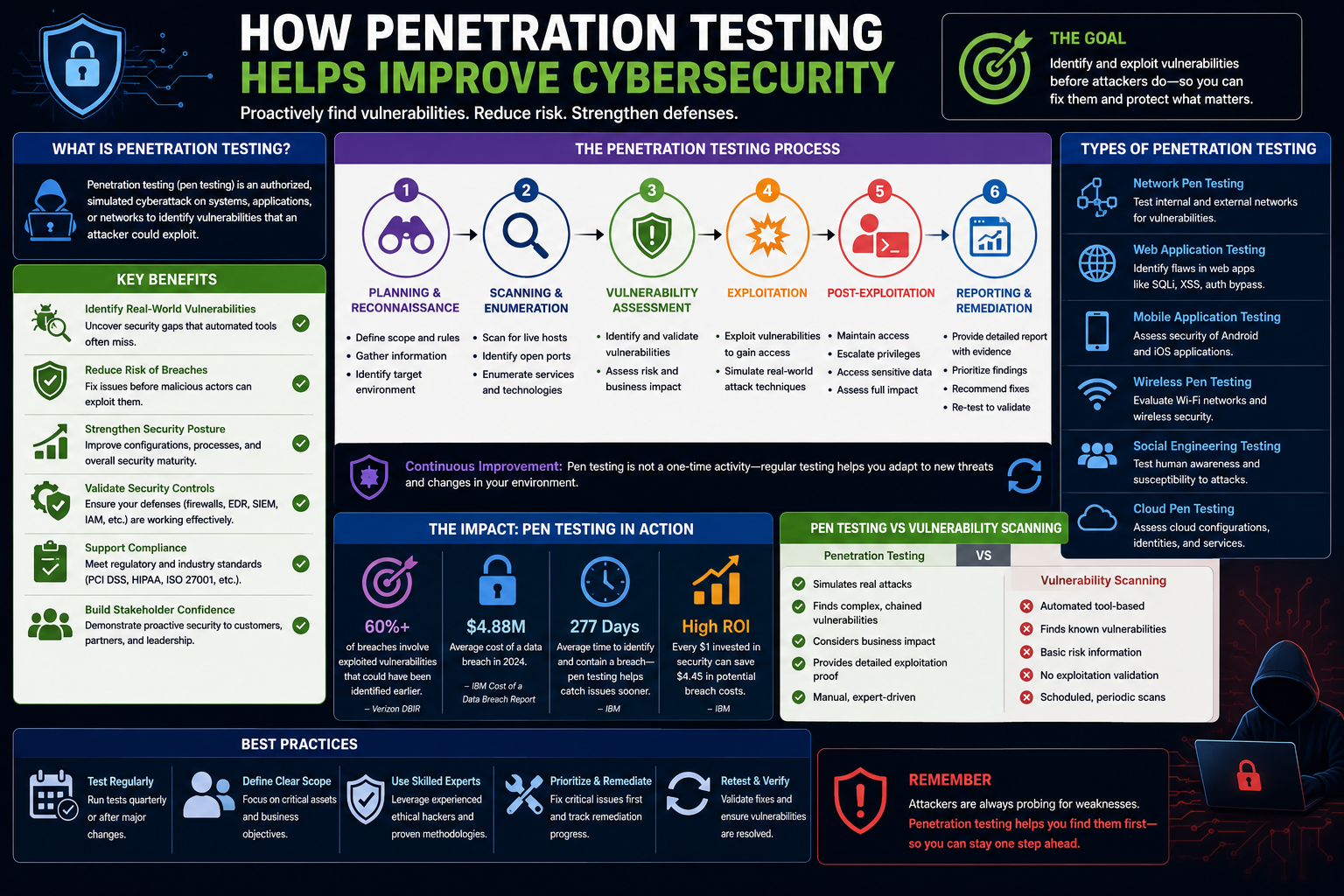
Penetration testing, often shortened to pen testing, is a cybersecurity practice used to evaluate the security of computer systems, applications, and networks. It involves authorized attempts to identify and exploit vulnerabilities in a controlled environment. The primary goal of penetration testing is to uncover weaknesses before malicious attackers can discover and exploit them.
As businesses continue to depend on digital technologies, cybersecurity threats have become more advanced and more frequent. Organizations store large amounts of sensitive information, including customer records, payment details, intellectual property, and confidential communications. If cybercriminals gain access to this information, the consequences can be severe. Financial losses, legal complications, operational downtime, and reputational damage are all possible outcomes of a successful cyberattack.
Penetration testing helps organizations understand how secure their systems truly are. Rather than assuming defenses are effective, companies can actively test them by simulating real-world attacks. Ethical hackers, also known as penetration testers, attempt to breach systems using techniques similar to those employed by actual cybercriminals. By doing so, they reveal vulnerabilities that need immediate attention.
Penetration testing is considered one of the most effective methods for evaluating cybersecurity readiness because it focuses on practical exploitation rather than theoretical analysis alone. It provides organizations with direct insight into how attackers could compromise their systems and what security improvements are necessary.
The Purpose of Penetration Testing
The main purpose of penetration testing is to identify vulnerabilities and assess the overall security posture of an organization. Security controls may appear effective on paper, but penetration testing determines whether they can withstand realistic attacks.
A penetration test helps organizations answer several important questions. Can attackers gain unauthorized access to systems? Are sensitive files exposed? Can weak passwords be exploited? Are employees vulnerable to phishing attacks? How far could an attacker move within the network after initial access?
These questions are essential because cybercriminals rarely attack organizations in predictable ways. They adapt quickly and look for any available weakness. Penetration testing allows companies to discover those weaknesses first.
Another major objective of penetration testing is risk reduction. Every vulnerability discovered during testing represents a potential opportunity for attackers. By identifying and fixing those issues early, organizations reduce the likelihood of security breaches.
Penetration testing also helps organizations prioritize security investments. Instead of guessing which vulnerabilities are most dangerous, security teams receive evidence-based findings that highlight the most critical risks. This helps businesses allocate resources more effectively.
Compliance is another important reason organizations conduct penetration tests. Many industries require regular security assessments to meet legal or regulatory obligations. Penetration testing demonstrates that organizations are taking proactive steps to secure sensitive information.
How Penetration Testing Works
Penetration testing follows a structured process designed to simulate realistic attack scenarios while minimizing operational disruption. Although testing methodologies may vary depending on the scope and objectives, most penetration tests include several common phases.
The first phase is planning and reconnaissance. During this stage, testers gather information about the target environment. This may involve identifying domain names, IP addresses, employee email addresses, publicly accessible systems, and technology stacks.
Reconnaissance can be either passive or active. Passive reconnaissance involves collecting information without directly interacting with the target systems. Examples include searching public databases, reviewing social media profiles, and examining company websites. Active reconnaissance involves direct interaction with the target environment, such as network scanning or service enumeration.
The second phase involves vulnerability identification. Testers analyze systems and applications for weaknesses such as outdated software, insecure configurations, missing security patches, weak authentication mechanisms, or coding flaws.
Once vulnerabilities are identified, testers move to the exploitation phase. Here, they attempt to exploit discovered weaknesses to gain unauthorized access or elevate privileges within the system. Exploitation demonstrates whether vulnerabilities are truly dangerous and how attackers could abuse them.
After successful exploitation, testers may conduct post-exploitation activities. This stage evaluates how far an attacker could move within the environment. Testers might attempt lateral movement across systems, access sensitive files, or escalate privileges to administrative levels.
The final phase is reporting. Penetration testers document all findings, including discovered vulnerabilities, exploitation methods, affected systems, risk severity, and remediation recommendations. Organizations use this information to strengthen their security posture.
Why Businesses Need Penetration Testing
Cybersecurity threats affect organizations of all sizes. Large enterprises often face sophisticated attacks from organized cybercriminal groups, while smaller businesses are targeted because attackers assume they have weaker security controls.
One major reason businesses need penetration testing is the growing complexity of modern IT environments. Organizations rely on cloud services, remote access technologies, mobile applications, web platforms, wireless networks, and interconnected devices. Each technology introduces potential vulnerabilities.
Traditional security tools such as firewalls and antivirus software are important, but they are not enough on their own. Attackers constantly develop new techniques to bypass defenses. Penetration testing helps organizations validate whether existing security measures can resist actual attack attempts.
Human error also contributes significantly to cybersecurity incidents. Employees may use weak passwords, fall victim to phishing emails, or misconfigure systems. Penetration testing helps uncover these weaknesses before attackers exploit them.
Another reason businesses conduct penetration tests is to protect customer trust. Customers expect organizations to safeguard their personal and financial information. A data breach can severely damage a company’s reputation and lead to long-term financial consequences.
Operational continuity is another important consideration. Cyberattacks such as ransomware can disrupt business operations for days or even weeks. Penetration testing helps identify weaknesses that could allow attackers to interrupt critical services.
Ethical Hackers and Their Role in Penetration Testing
Ethical hackers play a central role in penetration testing. Unlike malicious hackers, ethical hackers operate with authorization and within legal boundaries. Their purpose is to improve security rather than cause harm.
Ethical hackers think like attackers. They understand how cybercriminals approach targets, identify weaknesses, and exploit vulnerabilities. This attacker mindset allows them to simulate realistic attack scenarios during penetration tests.
To become effective penetration testers, ethical hackers require extensive technical knowledge. They must understand networking protocols, operating systems, web technologies, programming languages, authentication systems, and cybersecurity principles.
Ethical hackers also need strong problem-solving skills. Every environment is different, and vulnerabilities may not always be obvious. Successful testers combine technical expertise with creativity and analytical thinking.
Professional ethics are extremely important in penetration testing. Ethical hackers must respect confidentiality agreements, testing boundaries, and legal requirements. Unauthorized hacking remains illegal even if the intention is educational or exploratory.
Organizations trust ethical hackers with sensitive information and access to critical systems. Maintaining professionalism and integrity is therefore essential.
Common Vulnerabilities Found During Penetration Tests
Penetration testing often reveals a wide range of vulnerabilities across networks, systems, and applications. Some vulnerabilities result from technical flaws, while others stem from poor security practices.
Weak passwords are among the most common issues discovered during testing. Attackers frequently exploit simple or reused passwords to gain unauthorized access. Even organizations with strong technical defenses can become vulnerable if employees use insecure credentials.
Outdated software is another major problem. Software vendors regularly release security patches to fix vulnerabilities, but organizations sometimes delay updates. Attackers actively search for unpatched systems because known vulnerabilities are easier to exploit.
Misconfigured systems also create security risks. Incorrect firewall settings, exposed administrative interfaces, unnecessary services, and insecure permissions can provide attackers with entry points into networks.
Web application vulnerabilities are particularly dangerous because many organizations rely heavily on online services. Common web vulnerabilities include SQL injection, cross-site scripting, insecure authentication mechanisms, and broken access controls.
Phishing susceptibility is another issue frequently identified during penetration testing. Employees may unknowingly reveal credentials or download malicious files if they cannot recognize suspicious emails.
Insecure wireless networks can also expose organizations to attacks. Weak Wi-Fi encryption, default passwords, and improperly configured access points may allow unauthorized access.
Cloud misconfigurations have become increasingly common as organizations adopt cloud computing platforms. Publicly exposed storage buckets, overly permissive access controls, and insecure APIs can place sensitive information at risk.
The Difference Between Penetration Testing and Vulnerability Scanning
Although penetration testing and vulnerability scanning are related, they are not the same thing. Understanding the difference is important because organizations often use both approaches together.
Vulnerability scanning is typically automated. Security tools scan systems for known vulnerabilities, outdated software versions, and insecure configurations. These scans help organizations identify potential security weaknesses quickly.
However, vulnerability scanning alone cannot determine whether vulnerabilities are exploitable in real-world scenarios. Automated tools may generate false positives or fail to account for complex attack paths.
Penetration testing goes much deeper because human testers actively attempt to exploit vulnerabilities. Rather than simply identifying weaknesses, penetration testers evaluate how attackers could use them to compromise systems.
For example, a vulnerability scanner may identify a weak password policy. A penetration tester could attempt password attacks to determine whether accounts can actually be compromised.
Penetration testing also evaluates how vulnerabilities interact with each other. Individually minor issues may become serious when combined strategically by attackers.
Because penetration testing involves manual analysis and exploitation attempts, it provides a more realistic assessment of security risks than automated scanning alone.
Real-World Attack Simulation
One of the greatest strengths of penetration testing is its ability to simulate real-world cyberattacks. Attackers rarely rely on a single technique. Instead, they combine multiple tactics to achieve their objectives.
Penetration testers replicate these attack methods in controlled environments. They may begin with reconnaissance activities, gather employee information, identify exposed services, and search for publicly accessible weaknesses.
Once inside the environment, testers attempt privilege escalation and lateral movement. This helps organizations understand how attackers could expand access after compromising an initial target.
Social engineering simulations are also common during penetration testing. Testers may send phishing emails or attempt to manipulate employees into revealing sensitive information. These exercises evaluate human security awareness rather than technical defenses alone.
Realistic simulations help organizations identify gaps in detection and response capabilities. Security teams may discover that attacks go unnoticed or that incident response procedures are ineffective.
By experiencing simulated attacks, organizations gain valuable insights into how real attackers operate and how security defenses perform under pressure.
The Growing Importance of Penetration Testing
Cybersecurity threats continue to evolve rapidly. Attackers constantly develop new malware, exploit techniques, and social engineering methods. As organizations adopt emerging technologies, new security risks also emerge.
Remote work has increased reliance on internet-connected systems and remote access technologies. Employees often connect from home networks that lack enterprise-level security protections. Penetration testing helps organizations secure these remote environments.
Cloud computing introduces additional challenges. Businesses increasingly store data and run applications in cloud environments, but misconfigurations can expose sensitive information to attackers.
Internet of Things devices have also expanded attack surfaces. Smart devices, industrial systems, and connected sensors may contain weak security controls or outdated firmware.
Artificial intelligence and automation are changing both offensive and defensive cybersecurity strategies. Attackers use automation to identify targets more efficiently, while defenders use advanced monitoring tools to detect threats faster.
Because of these evolving threats, penetration testing has become an essential component of modern cybersecurity programs. Organizations cannot rely solely on assumptions or static defenses. Continuous testing and improvement are necessary to maintain security resilience.
Understanding Black Box Testing in Penetration Testing
Black box testing is one of the most widely used approaches in penetration testing. In this testing method, the penetration tester has little to no prior knowledge about the target environment before beginning the assessment. The tester approaches the organization in the same way an external attacker would, relying only on publicly available information and discovered vulnerabilities to gain access.
The term black box comes from the concept of a closed system where the internal workings are hidden from the observer. The tester can see inputs and outputs but does not initially know how the system functions internally. This creates a realistic attack scenario because most real-world attackers do not begin with insider knowledge of the target organization.
During a black box penetration test, ethical hackers typically start by gathering information through reconnaissance. They may search for domain names, public IP addresses, exposed applications, employee email addresses, and technology details. This process mirrors the early stages of a real cyberattack.
Black box testing is valuable because it evaluates how exposed an organization appears to outsiders. It demonstrates whether attackers could identify and exploit vulnerabilities without privileged access. Organizations often use black box tests to assess external attack surfaces, internet-facing systems, and public applications.
One of the major advantages of black box testing is realism. Because testers have no prior access or internal information, the assessment closely resembles the methods used by external attackers. This helps organizations understand what a real-world cybercriminal might discover and exploit.
However, black box testing also has limitations. Since testers start with minimal information, they may spend considerable time gathering data before identifying vulnerabilities. Some internal weaknesses may remain undiscovered if they are not externally visible.
Despite these limitations, black box testing remains highly effective for evaluating perimeter defenses and identifying publicly exposed weaknesses.
Understanding White Box Testing in Penetration Testing
White box testing represents the opposite end of the penetration testing spectrum. In this approach, the tester receives extensive information about the target environment before the assessment begins. This may include network diagrams, source code, administrative credentials, infrastructure documentation, and system configurations.
The name white box refers to transparency. Unlike black box testing, the internal workings of the environment are fully visible to the tester. This allows penetration testers to examine systems in great detail and conduct highly targeted security assessments.
White box testing is especially useful for identifying hidden vulnerabilities that may not be visible from external perspectives. Since testers understand how systems are configured and interconnected, they can analyze complex attack paths and internal security weaknesses more efficiently.
For example, if testers have access to source code, they can review applications for coding flaws such as insecure authentication mechanisms, improper input validation, and hardcoded credentials. These vulnerabilities might not be immediately apparent during external testing.
White box testing also allows for deeper examination of internal network segmentation, privilege management, and access controls. Testers can evaluate whether security policies are properly enforced and whether attackers could escalate privileges after initial access.
One major advantage of white box testing is efficiency. Because testers already possess detailed information about the environment, they can spend more time analyzing vulnerabilities and less time gathering reconnaissance data.
White box testing is often used during software development, internal security reviews, and compliance assessments. Organizations may conduct white box tests after major infrastructure changes or before deploying critical applications.
However, white box testing is sometimes criticized for being less realistic than black box testing. Real attackers rarely begin with complete knowledge of internal systems. Nevertheless, the depth and precision of white box assessments make them extremely valuable for uncovering hidden risks.
Understanding Gray Box Testing in Penetration Testing
Gray box testing falls between black box and white box testing. In this approach, penetration testers receive limited information about the target environment before beginning the assessment.
The amount of information provided can vary significantly depending on the organization’s objectives. Testers may receive standard user credentials, general network architecture details, or partial system documentation without full administrative access.
Gray box testing is often considered the most practical and balanced form of penetration testing because it combines elements of realism with efficient analysis. Many real-world attackers eventually obtain partial information through phishing attacks, insider threats, or leaked credentials. Gray box testing simulates these realistic conditions.
For example, a gray box tester may begin with valid employee credentials and attempt to determine whether unauthorized privilege escalation is possible. Alternatively, testers may receive general knowledge about an application’s functionality while lacking access to source code.
One advantage of gray box testing is that it allows organizations to assess both external and internal security risks simultaneously. Testers can evaluate how attackers might behave after gaining limited access to systems.
Gray box testing is also efficient because testers spend less time gathering initial reconnaissance information than in black box assessments. This allows them to focus more heavily on exploitation and privilege escalation activities.
Organizations frequently use gray box testing for internal security assessments, cloud environment evaluations, and application security testing. It provides realistic insight into how attackers might operate after compromising user accounts or gaining limited footholds within networks.
Comparing Black Box, White Box, and Gray Box Testing
Each penetration testing methodology serves different purposes and provides unique insights into organizational security. Choosing the appropriate approach depends on the organization’s goals, available resources, and desired outcomes.
Black box testing focuses heavily on realism. Testers operate as outsiders with no prior access or internal information. This approach evaluates how visible vulnerabilities appear to external attackers and whether perimeter defenses can resist unauthorized access attempts.
White box testing emphasizes depth and precision. Testers receive full access to systems, source code, and infrastructure details, allowing them to identify vulnerabilities that may not be externally visible.
Gray box testing provides a balanced middle ground. Testers begin with partial information and simulate attackers who have gained limited access or insider knowledge.
The choice between these testing methods depends largely on what the organization wants to learn. If the goal is to evaluate internet-facing defenses, black box testing may be most appropriate. If the objective is comprehensive vulnerability discovery, white box testing may provide better results. If the organization wants realistic simulations of partially informed attackers, gray box testing is often ideal.
Many organizations use multiple testing methodologies over time to gain broader visibility into their security posture.
The Importance of Reconnaissance in Penetration Testing
Reconnaissance is a critical phase in penetration testing. Before attackers attempt exploitation, they typically gather as much information as possible about the target environment. Ethical hackers follow similar practices during authorized penetration tests.
Reconnaissance can reveal valuable details about systems, applications, employees, and infrastructure. Even small pieces of information can help attackers identify potential weaknesses.
Passive reconnaissance involves collecting information without directly interacting with the target systems. Testers may search public websites, social media platforms, job postings, domain registration databases, and leaked credential repositories.
For example, employee LinkedIn profiles may reveal technologies used within the organization. Public job listings may indicate which software platforms are deployed internally. Social media posts may unintentionally expose sensitive information.
Active reconnaissance involves direct interaction with target systems. Testers may perform network scans, port enumeration, DNS analysis, or service detection. These activities help identify exposed systems and running services.
Reconnaissance is often underestimated, but it plays a major role in successful cyberattacks. Attackers who gather detailed information about targets can tailor their attack strategies more effectively.
Organizations can reduce reconnaissance risks by limiting unnecessary public exposure of technical details and implementing proper security controls.
Common Attack Techniques Used During Penetration Testing
Penetration testers use many of the same techniques employed by real attackers. These methods help organizations understand how vulnerabilities could be exploited in realistic scenarios.
Password attacks are extremely common. Testers may attempt password guessing, brute-force attacks, credential stuffing, or password spraying to determine whether weak credentials can be exploited.
Phishing simulations are another widely used technique. Ethical hackers send deceptive emails designed to trick users into revealing credentials or downloading malicious attachments. These exercises test employee awareness and social engineering resistance.
Web application attacks are also common during penetration testing. Testers may exploit vulnerabilities such as SQL injection, cross-site scripting, command injection, insecure authentication, and broken access controls.
Privilege escalation techniques allow testers to determine whether attackers can gain higher levels of access after initial compromise. Weak permissions, insecure configurations, and software vulnerabilities may enable attackers to obtain administrative privileges.
Lateral movement involves moving between systems within a compromised environment. Once attackers gain access to one machine, they often attempt to expand their reach across the network.
Wireless attacks target Wi-Fi networks, access points, and wireless protocols. Weak encryption settings, default passwords, and rogue access points may expose organizations to unauthorized access.
Physical security testing may also be included in some penetration tests. Testers may attempt to enter restricted areas, access unattended devices, or manipulate employees into granting physical access.
These attack techniques help organizations evaluate both technical defenses and human security awareness.
Social Engineering and Human Vulnerabilities
Technology alone does not determine cybersecurity strength. Human behavior plays a major role in organizational security, which is why social engineering assessments are often included in penetration testing engagements.
Social engineering involves manipulating individuals into revealing sensitive information or performing actions that compromise security. Attackers frequently target human psychology because people can be easier to exploit than technical systems.
Phishing remains one of the most effective social engineering techniques. Attackers send emails that appear legitimate, often impersonating trusted organizations or colleagues. Victims may unknowingly reveal passwords, click malicious links, or download malware.
Spear phishing is more targeted than traditional phishing. Attackers research specific individuals and tailor messages to increase credibility and effectiveness.
Phone-based attacks, sometimes called vishing, involve manipulating employees through voice communication. Attackers may impersonate IT support personnel, executives, or vendors to obtain sensitive information.
Physical social engineering attacks can also occur. Attackers may attempt to enter restricted areas by impersonating maintenance workers, delivery personnel, or contractors.
Penetration testers use these techniques ethically to evaluate employee awareness and organizational procedures. Results help organizations improve security training programs and reduce human-related risks.
Reporting and Remediation After Penetration Testing
The reporting phase is one of the most valuable parts of a penetration test. Without proper documentation and remediation, discovered vulnerabilities may remain unresolved.
Penetration testing reports typically include executive summaries, technical findings, risk ratings, exploitation details, and remediation recommendations. Executive summaries provide non-technical stakeholders with high-level overviews of security risks and business impacts.
Technical sections describe vulnerabilities in detail. Reports explain how vulnerabilities were discovered, how they were exploited, and which systems were affected.
Risk ratings help organizations prioritize remediation efforts. Critical vulnerabilities that allow remote code execution or unauthorized administrative access typically require immediate attention.
Remediation recommendations provide guidance for fixing identified issues. Recommendations may include patching software, improving password policies, reconfiguring systems, implementing multi-factor authentication, or enhancing employee security awareness training.
Organizations should treat penetration testing as part of an ongoing security improvement process rather than a one-time exercise. After vulnerabilities are fixed, retesting is often performed to verify remediation effectiveness.
Effective communication between penetration testers and organizational stakeholders is essential throughout the remediation process.
The Future of Penetration Testing
Cybersecurity continues evolving rapidly, and penetration testing must evolve alongside emerging technologies and attack methods. Organizations face increasingly sophisticated threats from cybercriminals, nation-state actors, and organized hacking groups.
Artificial intelligence is beginning to influence both offensive and defensive cybersecurity strategies. Attackers may use AI-powered automation to identify vulnerabilities more quickly, while defenders use machine learning to improve threat detection.
Cloud computing continues expanding, increasing the need for cloud-focused penetration testing. Misconfigured cloud environments remain a major source of security breaches.
The growing number of connected devices also presents new challenges. Internet of Things devices often lack strong security protections, creating additional attack surfaces.
Remote work environments require ongoing testing of remote access infrastructure, VPNs, authentication systems, and endpoint security controls.
Red team operations are becoming more common as organizations seek realistic simulations of advanced persistent threats. These engagements involve stealthy, long-term attack simulations designed to test detection and response capabilities.
Continuous penetration testing models are also emerging. Instead of relying solely on annual assessments, organizations increasingly adopt ongoing security testing practices to identify vulnerabilities more quickly.
As cyber threats continue evolving, penetration testing will remain a critical component of cybersecurity strategy. Organizations that proactively test and improve their defenses are better prepared to resist modern cyberattacks and protect sensitive information.
The Role of Penetration Testing in Modern Cybersecurity
Penetration testing has evolved into one of the most important elements of modern cybersecurity strategies. Organizations across every industry face increasing cyber threats, ranging from ransomware attacks to sophisticated data breaches. Traditional security tools such as firewalls and antivirus software are no longer enough to stop determined attackers. Businesses must continuously test their own defenses to identify weaknesses before criminals exploit them.
The role of penetration testing extends far beyond simply identifying vulnerabilities. It provides organizations with a realistic understanding of how attackers think, how they move through networks, and how far they can penetrate systems if weaknesses remain unresolved.
Modern cybersecurity environments are incredibly complex. Companies operate hybrid infrastructures that combine cloud platforms, remote work systems, mobile devices, third-party applications, wireless networks, and on-premises servers. Every component introduces potential attack surfaces. Penetration testing helps organizations evaluate these environments in practical and measurable ways.
One of the key strengths of penetration testing is that it reveals the gap between theoretical security and actual security. Many organizations believe they are secure because they have implemented security products and policies. However, penetration testing demonstrates whether those controls can withstand realistic attacks.
The findings from penetration tests often uncover weaknesses that organizations never anticipated. A single overlooked vulnerability can sometimes provide attackers with access to sensitive systems or confidential data. By discovering these weaknesses early, organizations can strengthen their security posture before attackers have the opportunity to exploit them.
Penetration testing also supports proactive cybersecurity management. Instead of reacting to attacks after damage occurs, organizations can identify and address risks in advance. This proactive approach significantly reduces the likelihood of successful breaches.
Red Teaming and Advanced Attack Simulations
As cyber threats have become more sophisticated, penetration testing has expanded into more advanced forms of attack simulation. One of the most recognized advanced testing methodologies is red teaming.
Red teaming is a highly realistic cybersecurity exercise designed to simulate the behavior of advanced attackers over extended periods. Unlike traditional penetration testing, which may focus primarily on identifying vulnerabilities, red team operations aim to test an organization’s detection and response capabilities as well.
A red team operates like a real adversary. Team members may attempt phishing attacks, exploit vulnerabilities, bypass physical security controls, compromise user accounts, and move laterally through networks while attempting to avoid detection.
The goal is not simply to break into systems. Instead, the exercise evaluates how effectively the organization’s security teams identify, respond to, and contain attacks.
Red team exercises often involve stealth and persistence. Attackers in real-world scenarios typically avoid noisy or obvious activities because they want to remain undetected for as long as possible. Red teams simulate these tactics by carefully planning operations and using subtle attack methods.
The opposing defensive team is often called the blue team. Blue teams monitor systems, investigate suspicious activity, and respond to incidents. During red team engagements, blue teams may or may not know that an exercise is taking place.
Some organizations conduct purple team exercises, where red and blue teams collaborate closely throughout the assessment. Purple teaming allows defenders to learn directly from attackers and improve detection strategies in real time.
These advanced testing exercises help organizations evaluate not only technical security controls but also operational readiness, communication procedures, and incident response capabilities.
Penetration Testing for Web Applications
Web applications are among the most common targets for cyberattacks because they are often publicly accessible over the internet. Businesses rely heavily on web applications for customer interactions, financial transactions, communication, and data management. As a result, web application penetration testing has become one of the most important areas of cybersecurity.
Web application penetration testing focuses on identifying vulnerabilities that attackers could exploit to compromise websites, online services, or backend systems.
One of the most dangerous web vulnerabilities is SQL injection. This occurs when attackers manipulate database queries through improperly validated user input. Successful SQL injection attacks can allow attackers to access sensitive databases, modify records, or bypass authentication systems.
Cross-site scripting is another common vulnerability. In these attacks, malicious scripts are injected into web pages viewed by users. Attackers may steal session cookies, redirect users to malicious websites, or manipulate page content.
Broken authentication vulnerabilities can expose user accounts and administrative systems. Weak password policies, insecure session management, and flawed authentication logic are frequent targets during penetration tests.
Insecure direct object references occur when applications fail to properly verify user permissions. Attackers may manipulate URLs or request parameters to access unauthorized information.
Security misconfigurations are also common in web environments. Default credentials, exposed administrative interfaces, verbose error messages, and unnecessary services can create serious risks.
Modern web applications often use APIs to exchange information between systems. API security testing has therefore become increasingly important. Weak API authentication, insecure data exposure, and improper authorization controls can expose sensitive information to attackers.
Web application penetration testing helps organizations identify these vulnerabilities before attackers exploit them. Since web applications are frequently updated and modified, regular testing is essential for maintaining security.
Wireless Network Penetration Testing
Wireless networks provide flexibility and convenience, but they also introduce unique security challenges. Attackers often target wireless infrastructure because signals extend beyond physical building boundaries, making remote attacks possible.
Wireless penetration testing evaluates the security of Wi-Fi networks, access points, wireless devices, and associated communication protocols.
Weak encryption remains one of the most common wireless security problems. Older encryption protocols can often be cracked using publicly available tools. Penetration testers evaluate whether wireless networks use modern encryption standards and secure authentication methods.
Default credentials are another frequent issue. Many wireless devices are deployed with factory-default usernames and passwords that attackers can easily guess or find online.
Rogue access points also create risks. Unauthorized wireless devices connected to organizational networks may bypass security controls and expose internal systems.
Penetration testers may attempt to capture wireless traffic, analyze authentication handshakes, or simulate unauthorized connection attempts. These tests help organizations identify weaknesses in wireless configurations and access controls.
Wireless security is especially important in environments such as healthcare facilities, retail stores, educational institutions, and corporate offices where large numbers of users rely on wireless connectivity daily.
Cloud Penetration Testing and Cloud Security Risks
Cloud computing has transformed modern business operations. Organizations increasingly rely on cloud platforms for data storage, application hosting, collaboration, and infrastructure management. However, cloud adoption introduces new cybersecurity risks that require specialized testing approaches.
Cloud penetration testing evaluates the security of cloud-based systems, services, and configurations. Since cloud environments differ significantly from traditional on-premises infrastructure, testers must understand cloud-specific attack vectors and security models.
Misconfigured cloud storage is one of the most common cloud security problems. Publicly exposed storage buckets have resulted in numerous data breaches involving sensitive customer information.
Identity and access management weaknesses also present major risks. Excessive permissions, poorly configured roles, and weak authentication controls can allow attackers to gain unauthorized access to cloud resources.
Insecure APIs are another important concern in cloud environments. Since cloud services rely heavily on APIs for communication and automation, vulnerabilities in these interfaces can expose systems to attack.
Multi-cloud and hybrid-cloud environments increase complexity further. Organizations may use multiple cloud providers while maintaining on-premises infrastructure simultaneously. Penetration testing helps identify security gaps across these interconnected systems.
Cloud penetration testing requires careful coordination because cloud providers often enforce strict rules regarding authorized security testing. Organizations must ensure testing activities comply with provider policies and service agreements.
As cloud adoption continues growing, cloud-focused penetration testing has become a vital component of modern cybersecurity programs.
Mobile Application Penetration Testing
Smartphones and mobile applications have become central to both personal and business activities. Organizations increasingly provide mobile apps for banking, healthcare, communication, e-commerce, and productivity. These applications often handle highly sensitive data, making them attractive targets for attackers.
Mobile application penetration testing evaluates the security of mobile software running on devices such as smartphones and tablets.
One major concern in mobile security is insecure data storage. Applications that store sensitive information locally without proper encryption may expose users to data theft if devices are lost or compromised.
Insecure communication channels also present risks. If mobile applications transmit data without proper encryption, attackers may intercept credentials, financial information, or confidential communications.
Weak authentication mechanisms can allow attackers to bypass login systems or hijack user sessions. Improper session handling, predictable tokens, and insecure password reset mechanisms are common issues.
Reverse engineering is another important consideration. Attackers may analyze application code to discover vulnerabilities, hidden functionality, or embedded secrets such as API keys.
Penetration testers examine mobile applications for these and other weaknesses using specialized tools and methodologies. The goal is to ensure applications protect user data and resist common attack techniques.
With mobile device usage continuing to expand globally, securing mobile applications has become increasingly important for organizations across every industry.
Legal and Ethical Considerations in Penetration Testing
Penetration testing must always operate within legal and ethical boundaries. Unauthorized hacking remains illegal regardless of intent. Ethical hackers and penetration testers require explicit permission before testing systems or attempting exploitation.
Before any engagement begins, organizations and penetration testers establish rules of engagement. These agreements define testing scope, authorized systems, timelines, communication procedures, and limitations.
The scope is especially important because testers must know exactly which systems they are allowed to assess. Accidentally testing unauthorized systems can lead to legal complications and operational disruptions.
Confidentiality is another critical consideration. Penetration testers often gain access to sensitive information during assessments. Ethical standards require testers to protect that information and avoid unnecessary exposure.
Organizations also need to consider operational risks during testing. Some attack techniques may affect system stability or trigger security alerts. Careful planning helps minimize disruption while maintaining realistic testing conditions.
Compliance requirements frequently influence penetration testing practices as well. Many industries require regular security assessments to protect customer information and demonstrate regulatory compliance.
Ethical behavior is fundamental to professional penetration testing. The goal is always to improve security, reduce risk, and help organizations defend against real threats.
Careers in Penetration Testing
Penetration testing has become a highly sought-after cybersecurity career path. As organizations face growing cyber threats, demand for skilled ethical hackers continues increasing worldwide.
Penetration testers require a broad range of technical skills. They must understand networking concepts, operating systems, programming languages, web technologies, cloud platforms, authentication systems, and cybersecurity principles.
Problem-solving ability is equally important. Successful penetration testers think creatively and adapt quickly to unfamiliar environments. Every assessment presents unique challenges and attack opportunities.
Many aspiring penetration testers begin their careers in IT support, system administration, network engineering, or cybersecurity analysis before transitioning into offensive security roles.
Practical experience is essential in penetration testing. Hands-on labs, capture-the-flag competitions, and simulated attack environments help individuals develop technical expertise.
Professional certifications are also valuable for demonstrating knowledge and skills. Many certifications focus specifically on penetration testing methodologies, ethical hacking techniques, and offensive security operations.
Continuous learning is critical because cybersecurity evolves constantly. Attack techniques, defensive technologies, and security frameworks change rapidly, requiring professionals to stay updated.
Penetration testing careers can involve a variety of specializations, including web application security, cloud security, wireless testing, red teaming, mobile security, and exploit development.
The field offers strong career growth opportunities, competitive salaries, and intellectually challenging work for individuals passionate about cybersecurity.
The Future of Penetration Testing
The future of penetration testing will likely be shaped by advances in technology, automation, artificial intelligence, and evolving cyber threats.
Artificial intelligence may significantly impact both attackers and defenders. Attackers could use AI-driven tools to automate reconnaissance and vulnerability discovery, while defenders may use machine learning to improve threat detection and incident response.
Continuous security testing models are becoming more popular as organizations move away from annual assessments toward ongoing vulnerability evaluation.
The expansion of Internet of Things devices introduces new security challenges. Smart devices often lack strong protections and may expose organizations to additional attack surfaces.
Critical infrastructure security is also gaining increased attention. Energy systems, transportation networks, healthcare facilities, and industrial environments depend heavily on interconnected technologies that require robust protection.
Quantum computing may eventually introduce new cybersecurity challenges by affecting encryption standards and cryptographic systems. Organizations will need to adapt their security strategies accordingly.
Despite technological changes, the core purpose of penetration testing will remain the same: identifying vulnerabilities before malicious attackers can exploit them.
Conclusion
Penetration testing plays a vital role in modern cybersecurity by helping organizations identify and address security weaknesses before attackers can exploit them. Through realistic attack simulations, ethical hackers evaluate systems, applications, networks, wireless infrastructure, cloud environments, and human security awareness.
Advanced testing methodologies such as red teaming provide deeper insight into organizational readiness and incident response capabilities. Specialized assessments for web applications, mobile platforms, wireless systems, and cloud environments help organizations secure increasingly complex technologies.
Legal and ethical considerations remain fundamental to penetration testing practices. Authorized assessments conducted within clearly defined boundaries help organizations improve security while maintaining compliance and operational stability.
As cyber threats continue evolving, penetration testing will remain an essential component of cybersecurity strategy. Organizations that proactively test their defenses are better equipped to protect sensitive information, maintain customer trust, and reduce the risks associated with modern cyberattacks.
The demand for skilled penetration testers is also expected to continue growing as businesses recognize the importance of offensive security expertise. Whether used for compliance, risk reduction, or proactive defense, penetration testing provides valuable insights that strengthen organizational security in an increasingly digital world.