Modern life depends heavily on digital communication. Businesses operate through cloud platforms, students attend online classes, gamers compete in real time, and families stream high-definition entertainment every day. Behind all of these activities lies one critical component: network performance. When a network performs efficiently, information flows quickly and reliably. When performance drops, users experience buffering, delays, interruptions, and frustration.
Many people hear terms such as bandwidth, throughput, and latency but often misunderstand their meanings. These concepts are connected, yet each describes a different aspect of network behavior. Understanding how they work together is essential for anyone involved in information technology, business infrastructure, or even everyday internet use.
A network connection may advertise extremely high speeds, but actual performance can still feel slow. Likewise, some applications work smoothly even on lower-speed connections while others struggle despite significant bandwidth. These differences are usually caused by factors beyond simple connection speed.
Network performance is influenced by the quality of the infrastructure, the efficiency of communication protocols, the distance between devices, and the condition of the network itself. By learning how these factors interact, it becomes easier to diagnose problems, improve efficiency, and understand why real-world network behavior rarely matches theoretical expectations.
Understanding the Basics of Data Transmission
Before examining throughput and bandwidth in detail, it is important to understand how data travels across a network. Every time a device communicates online, information is broken into smaller pieces called packets. These packets move through a path of switches, routers, cables, and wireless signals until they reach their destination.
Once packets arrive, they are reassembled into usable information. This process happens constantly and extremely quickly, allowing users to browse websites, send messages, stream media, and transfer files without thinking about the underlying mechanics.
The journey data takes is not always direct. Information may travel across multiple cities, countries, or even continents before reaching its final destination. Each point along the route can affect performance.
Devices on the network must also coordinate communication carefully. They need methods for verifying that information arrived correctly, handling congestion, correcting errors, and ensuring that multiple users can share resources fairly.
All of these processes influence how quickly and efficiently data moves from one point to another.
What Latency Means in Networking
Latency refers to the amount of time required for data to travel between two points in a network. In simple terms, it measures delay. Low latency means communication feels fast and responsive, while high latency creates noticeable pauses and interruptions.
Latency is usually measured in milliseconds because modern networks operate extremely quickly. Even small delays can significantly affect user experience, especially in applications that depend on real-time communication.
One common measurement is round-trip time. This represents the total time needed for information to travel from a sender to a receiver and then back again. Many communication protocols rely on acknowledgements from the receiving device before continuing transmission, making round-trip timing particularly important.
For example, when opening a webpage, the browser sends a request to the website server. The server processes the request and returns the required information. The delay involved in this exchange contributes directly to latency.
While a few milliseconds may not seem important, delays accumulate quickly during complex communication. Modern applications often involve thousands of requests and responses occurring simultaneously.
Why Latency Is Critical for User Experience
Latency plays a major role in determining how responsive a network feels. Even if a connection has enormous bandwidth, high latency can still make applications seem slow.
Real-time communication tools are especially sensitive to latency. Video conferencing platforms, internet voice calls, and online gaming require nearly instant communication between participants. If delays become too large, conversations become difficult and interactions feel unnatural.
Most people have experienced situations where participants accidentally interrupt one another during online meetings. This commonly occurs because audio reaches each person slightly later than expected. Even small delays can disrupt the natural rhythm of communication.
Gaming environments are equally affected. Competitive online games require players to react instantly to changing situations. High latency creates lag, delayed movement, and slower response times that negatively affect gameplay.
Streaming services also suffer from excessive latency. Although buffering is often associated with bandwidth limitations, delayed communication between streaming servers and user devices can worsen playback problems.
Business environments depend heavily on low latency as well. Employees using remote desktops, cloud applications, and collaborative software need quick responsiveness to remain productive.
Different Network Types and Their Latency Characteristics
Not all network technologies provide the same latency performance. Physical infrastructure, transmission methods, and distance all contribute to communication delays.
Local area networks typically provide the lowest latency because devices are physically close together. Communication within the same office or building often occurs in less than one millisecond.
Fiber optic connections also offer excellent latency performance. Fiber cables use light signals that travel rapidly and efficiently over long distances. This makes fiber one of the preferred technologies for high-performance communication.
Cable internet services generally provide moderate latency suitable for most applications. However, congestion during busy hours can sometimes increase delays.
Wireless networks face additional challenges because radio signals are vulnerable to interference from walls, electronics, and environmental conditions. As signal quality decreases, latency often increases.
Mobile networks can experience fluctuating latency depending on tower congestion, signal strength, and movement between coverage areas.
Satellite internet usually has the highest latency because data must travel enormous distances between Earth and orbiting satellites. These delays can exceed several hundred milliseconds, making real-time communication more difficult.
Understanding these differences helps explain why some internet connections feel faster and more responsive than others even when bandwidth appears similar.
The Relationship Between Distance and Latency
Physical distance is one of the most important factors influencing latency. Although digital communication occurs extremely quickly, data still requires time to travel.
Signals moving across continents or oceans inevitably experience greater delay than communication occurring within the same city. Every router, switch, and connection point along the route introduces additional processing time.
Global businesses often face challenges related to geographic distance. Employees connecting to servers located in distant countries may notice slower responsiveness despite having high-speed local internet connections.
Cloud providers attempt to reduce these delays by building data centers around the world. Content delivery networks also help improve performance by storing copies of content closer to end users.
Reducing physical distance between users and services is one of the most effective ways to improve latency.
How Communication Protocols Affect Performance
Network communication depends on protocols that define how devices exchange information. Different protocols handle data differently, and these choices affect both reliability and speed.
Some protocols prioritize accuracy and reliability. They verify that information arrives correctly and request retransmission when errors occur. This approach improves data integrity but can increase latency because communication requires constant acknowledgements.
Other protocols prioritize speed and real-time delivery. Instead of waiting for confirmations, they continuously transmit information. This reduces delay but increases the risk of missing or corrupted data.
Voice and video applications often use faster protocols because smooth real-time communication matters more than perfect accuracy. File transfers and web browsing typically use more reliable protocols to ensure complete and correct delivery.
The protocol selected for a particular application significantly influences network behavior.
What Network Throughput Really Represents
Throughput refers to the actual amount of data successfully transferred across a network within a specific period of time. It reflects the real-world performance users experience while using the network.
When downloading a file, streaming a video, or transferring data between systems, the observed transfer speed represents throughput. Unlike bandwidth, throughput accounts for practical limitations and environmental conditions.
Several factors influence throughput, including latency, packet loss, congestion, hardware performance, and communication overhead. Because of these influences, throughput is usually lower than the theoretical maximum speed of the connection.
For example, a user may subscribe to an internet service advertised at one gigabit per second. However, actual file downloads might only reach a fraction of that speed depending on server performance, routing efficiency, and network conditions.
Throughput therefore provides a more realistic picture of network performance than advertised bandwidth alone.
Why Throughput Changes Between Different Services
Users often notice that download speeds vary between websites and online services. One platform may deliver files extremely quickly while another appears significantly slower.
Several reasons explain these differences. Geographic location plays an important role. Servers located closer to the user generally provide better performance because data travels a shorter distance.
Server capacity also matters. Some organizations operate powerful infrastructure capable of serving enormous amounts of traffic efficiently. Others may have limited resources that restrict transfer speeds.
Internet routing affects performance as well. Data traveling through congested or inefficient paths may encounter delays and bottlenecks that reduce throughput.
Traffic prioritization policies can also influence results. Internet providers and service operators sometimes prioritize certain types of traffic over others.
Time of day contributes to variation too. Peak usage periods create heavier congestion, reducing available throughput for many users simultaneously.
These factors explain why network performance changes depending on what services users access and when they use them.
Understanding Packet Loss and Retransmissions
Packet loss occurs when data fails to reach its destination correctly. When this happens, the missing information usually needs to be transmitted again.
Retransmissions consume additional bandwidth and increase delays, reducing overall throughput. Even small amounts of packet loss can severely impact performance for certain applications.
Several conditions can cause packet loss. Congestion may overwhelm network equipment, forcing devices to discard packets. Faulty cables, damaged hardware, wireless interference, and software issues can also contribute.
Applications relying on reliable communication protocols are particularly affected because missing packets trigger retransmission requests before communication can continue.
Real-time applications sometimes tolerate limited packet loss better because retransmitting outdated information may provide little benefit. However, excessive loss still reduces quality and creates interruptions.
Maintaining stable connections with minimal packet loss is essential for achieving high throughput.
How Congestion Reduces Network Efficiency
Network congestion occurs when too many devices attempt to use the same resources simultaneously. When traffic exceeds available capacity, delays and packet loss increase.
Internet service providers often design networks based on expected average usage rather than maximum possible demand. This practice helps reduce infrastructure costs because most users do not fully utilize their connections constantly.
However, during periods of heavy activity, shared links can become saturated. As congestion increases, network equipment must queue packets for processing. If queues become full, packets may be discarded entirely.
Congestion affects throughput by slowing communication and increasing retransmissions. Users may notice buffering, slow downloads, delayed responses, and inconsistent performance.
Businesses monitoring network performance closely often upgrade infrastructure before congestion becomes severe enough to disrupt operations.
Traffic management strategies such as load balancing and quality-of-service policies help reduce congestion and improve efficiency.
Why Throughput Matters More Than Advertised Speed
From a practical standpoint, throughput often matters more than bandwidth because it represents usable performance rather than theoretical capability.
A connection advertising extremely high bandwidth may still perform poorly if latency, congestion, or packet loss interfere with communication. Conversely, a lower-bandwidth connection with excellent stability and low latency may provide a smoother experience.
Users care about how quickly applications respond, how smoothly videos stream, and how fast files transfer. These experiences depend primarily on throughput.
Organizations evaluating network upgrades therefore focus heavily on real-world performance testing rather than relying solely on advertised specifications.
Understanding throughput helps businesses make informed decisions about infrastructure investments, application deployment, and capacity planning.
The Growing Importance of Network Performance
Modern organizations rely on networks more heavily than ever before. Cloud computing, remote work, video collaboration, and online services all require reliable communication.
As digital transformation continues expanding, the importance of understanding latency and throughput will only increase. Businesses must ensure their infrastructure can support growing demands while maintaining consistent performance.
Consumers also expect seamless online experiences. Slow or unreliable connections quickly lead to frustration, reduced productivity, and dissatisfaction.
By understanding how networks operate and what affects performance, users and administrators can better diagnose problems, optimize infrastructure, and improve the overall communication experience.
Understanding Bandwidth in Modern Networks
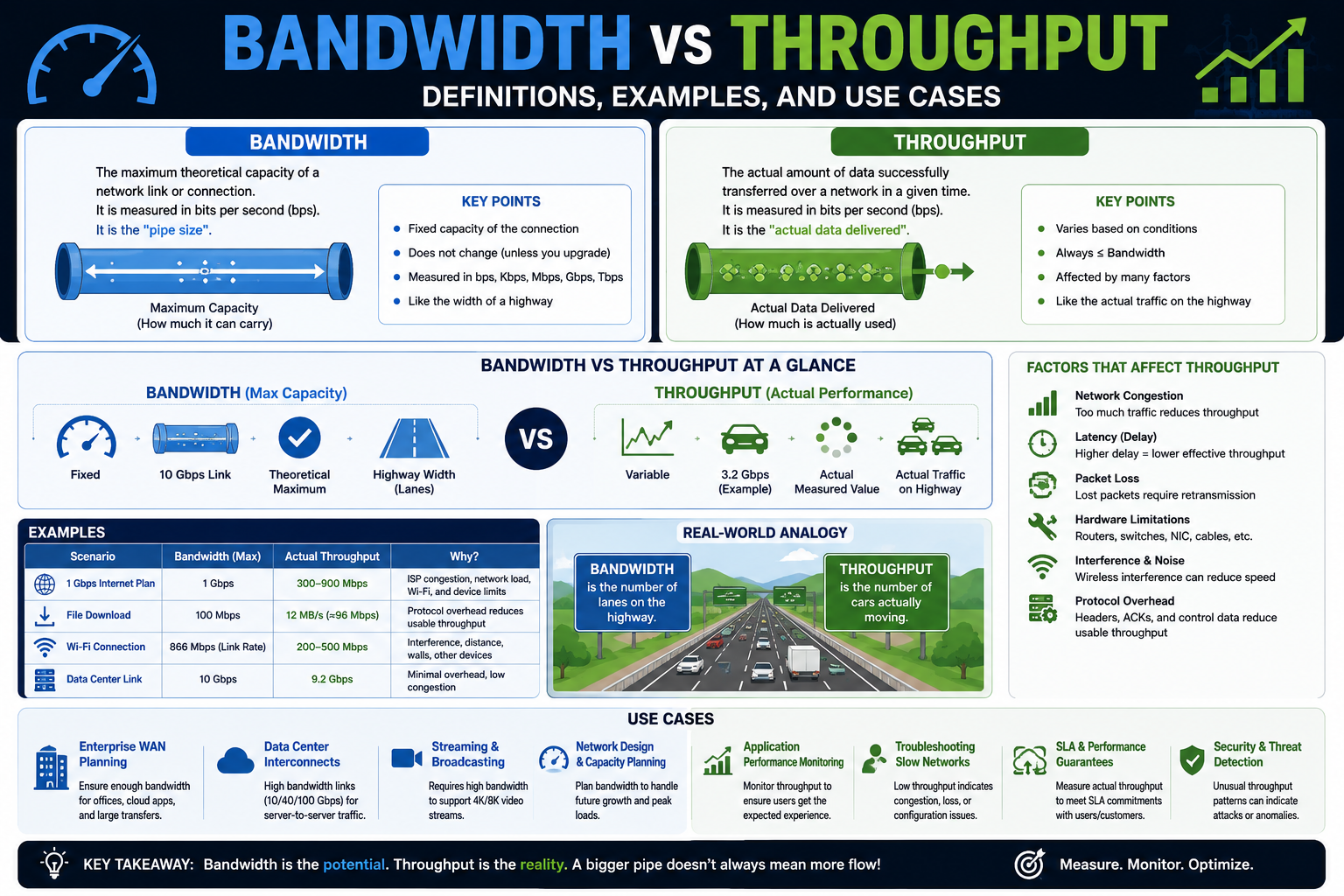
Bandwidth is one of the most commonly discussed concepts in networking, yet it is also one of the most misunderstood. Many people assume bandwidth represents the exact speed they will experience while using the internet, but bandwidth actually refers to the maximum capacity of a network connection under ideal conditions.
In networking, bandwidth describes how much data can theoretically move through a connection within a certain amount of time. It establishes the upper limit of what a connection is capable of handling. Internet providers often advertise bandwidth figures because they represent the potential performance customers can expect under perfect circumstances.
For example, a one gigabit internet connection means the network is designed to transfer up to one gigabit of data per second. However, this does not guarantee that every file download or streaming session will consistently reach that speed.
A useful analogy compares bandwidth to the width of a highway. A wider highway with more lanes can support more traffic at the same time. Similarly, higher bandwidth allows larger amounts of data to travel simultaneously through a network connection.
Even with a wide highway, however, vehicles may still slow down because of traffic jams, accidents, weather conditions, or road construction. In networking, these problems take the form of congestion, latency, packet loss, and hardware limitations.
Understanding the distinction between theoretical capacity and actual performance is essential when evaluating network quality.
How Internet Service Providers Control Bandwidth
Internet service providers use several methods to manage the bandwidth delivered to customers. Different subscription plans are designed with different capacity limits, allowing providers to charge varying prices based on speed.
Some providers limit bandwidth through software policies that control how much traffic users can send and receive. Others configure equipment to negotiate connections at specific speeds. In many cases, both methods are used together.
For example, a provider may sell residential internet plans offering speeds of one hundred megabits per second, five hundred megabits per second, or one gigabit per second. Each plan corresponds to a different bandwidth allocation within the provider’s infrastructure.
Business-grade services often provide higher guaranteed bandwidth because organizations depend heavily on stable connectivity for operations. These services may also include service-level agreements promising minimum performance standards.
Bandwidth limitations are not always intentional. Physical infrastructure also determines the maximum speed available to customers. Outdated equipment, aging cables, or long transmission distances can reduce the capacity a connection can achieve.
Even when providers advertise high-speed packages, real-world conditions still influence performance significantly.
The Impact of Cable Quality on Bandwidth
The quality of network cabling has a direct effect on bandwidth. Poor or damaged cables may prevent devices from communicating at full speed.
Ethernet cables, for example, are built according to performance categories that determine how much data they can reliably carry. Older cable standards may support slower speeds than modern ones. Using outdated cables in a high-speed network can create unexpected bottlenecks.
Physical wear also affects performance over time. Cables bend, connectors loosen, and shielding degrades through regular use. These issues can introduce interference and signal loss, forcing devices to negotiate lower connection speeds.
In some environments, electromagnetic interference from nearby equipment can disrupt communication quality. Poor cable installation practices can worsen these problems further.
Fiber optic cables generally provide superior bandwidth capabilities because they use light rather than electrical signals. Fiber connections support much higher speeds and longer distances while remaining resistant to many forms of interference.
Maintaining high-quality physical infrastructure is therefore essential for maximizing available bandwidth.
Wireless Networks and Bandwidth Challenges
Wireless communication introduces additional variables that influence bandwidth. Unlike wired connections, wireless signals travel through open air where interference and environmental conditions can affect performance.
Walls, floors, furniture, and electronic devices can weaken wireless signals. Microwave ovens, Bluetooth devices, and neighboring Wi-Fi networks may also create interference that reduces communication quality.
Distance from the wireless access point plays a major role as well. As devices move farther away, signal strength decreases and performance often declines.
Modern wireless technologies attempt to improve bandwidth through advanced techniques such as beamforming, channel management, and multiple-input multiple-output communication. These methods help increase efficiency and reduce interference.
However, wireless bandwidth is still shared among connected devices. In crowded environments such as offices, apartment buildings, or public venues, many users compete for the same wireless resources simultaneously.
As the number of connected devices increases, available bandwidth per user may decrease substantially.
Proper wireless network design is therefore critical for maintaining strong performance and reliable connectivity.
How Bandwidth Is Measured
Bandwidth is typically measured in bits per second. Because modern networks operate at extremely high speeds, larger prefixes such as kilobits, megabits, gigabits, and terabits are commonly used.
A kilobit represents one thousand bits, a megabit represents one million bits, and a gigabit represents one billion bits. These measurements describe how much information a network can theoretically transfer during one second.
Consumers often encounter confusion because file sizes are usually measured in bytes while network speeds are measured in bits. Since one byte equals eight bits, actual file download speeds appear lower when displayed in bytes per second.
For example, a one hundred megabit internet connection does not mean files download at one hundred megabytes per second. The practical transfer rate in megabytes will be significantly smaller after converting units.
Understanding these measurements helps users interpret network performance more accurately.
Why Advertised Speeds Rarely Match Real Performance
One of the most common frustrations among internet users is failing to achieve advertised speeds. Several factors contribute to this discrepancy.
First, bandwidth advertisements represent ideal conditions rather than guaranteed performance. Actual throughput depends on many additional variables beyond the local internet connection itself.
The destination server may limit transfer speeds intentionally. If a server lacks sufficient processing power or bandwidth, it cannot deliver data quickly regardless of the user’s connection quality.
Network congestion also plays a major role. During busy periods, shared infrastructure becomes overloaded as many users compete for limited resources. This congestion creates delays and reduces effective throughput.
Wi-Fi connections introduce additional variability due to interference and signal strength fluctuations. Even high-speed internet plans may perform poorly over weak wireless signals.
Hardware limitations within the user’s own environment can also create bottlenecks. Older routers, outdated network adapters, slow storage devices, and underpowered processors may prevent systems from fully utilizing available bandwidth.
Because of these combined factors, real-world throughput often falls well below theoretical bandwidth limits.
The Role of Throughput in Network Performance
While bandwidth represents capacity, throughput reflects actual performance. Throughput measures how much usable data successfully transfers across the network during a given period.
This distinction is important because users experience throughput directly. When downloading a file or streaming video, the observed transfer speed reflects throughput rather than bandwidth alone.
High bandwidth does not automatically guarantee high throughput. Real-world conditions frequently prevent networks from reaching their theoretical limits.
Latency, packet loss, congestion, and protocol overhead all reduce effective throughput. Even a powerful network connection may deliver disappointing results if these issues become severe.
For businesses, throughput is often the most important measurement because it determines how efficiently applications and services operate in practice.
Employees using cloud platforms, remote servers, and collaboration tools rely heavily on stable throughput to maintain productivity.
How Latency Affects Throughput
Latency and throughput are closely connected. High latency can reduce throughput significantly even when bandwidth remains unchanged.
Many communication protocols send data in groups before waiting for acknowledgements from the receiving device. If latency is high, the sender spends more time waiting for responses and less time transmitting useful information.
This delay limits the amount of data that can move efficiently through the connection over time.
Long-distance communication often suffers from this issue. A company may have extremely high-bandwidth internet connections at two offices located in different countries, yet large file transfers between them may still feel slow because latency delays acknowledgements.
Applications designed for real-time communication sometimes avoid these delays by using protocols that prioritize speed over reliability. However, this approach may increase the risk of lost or corrupted data.
Balancing latency and throughput is therefore essential for maintaining efficient network communication.
Understanding Packet Loss and Its Consequences
Packet loss occurs when pieces of transmitted data fail to arrive successfully at their destination. This problem can severely reduce throughput because missing information usually needs to be resent.
Congestion is one of the most common causes of packet loss. When network devices become overwhelmed, they may discard packets to manage traffic volume.
Faulty hardware, damaged cables, wireless interference, and software bugs can also contribute to packet loss.
Reliable communication protocols attempt to correct these issues by requesting retransmission of missing packets. Although this improves accuracy, it also consumes additional bandwidth and increases delays.
Even small amounts of packet loss can dramatically affect performance for certain applications. Video conferencing may experience frozen images or distorted audio, while file downloads may slow considerably.
Reducing packet loss is therefore essential for maintaining strong throughput and stable communication.
The Effect of Congestion on Networks
Congestion occurs when network demand exceeds available capacity. As more users and devices attempt to transmit data simultaneously, competition for resources intensifies.
Internet service providers often oversubscribe portions of their infrastructure because most customers do not fully utilize their connections continuously. This strategy helps reduce costs while still providing acceptable average performance.
However, during peak usage periods, shared links can become saturated. As queues build inside networking equipment, delays increase and packet loss becomes more likely.
Congestion affects all types of applications differently. Streaming services may buffer more frequently, online games may lag, and business applications may respond slowly.
Cloud computing environments are especially sensitive to congestion because many services rely on constant communication between distributed systems.
Network administrators use traffic management techniques to reduce congestion and improve efficiency. These methods include load balancing, quality-of-service policies, and infrastructure upgrades.
Monitoring congestion helps organizations identify capacity limitations before they cause widespread performance problems.
How Throughput Testing Works
Throughput testing measures how much data successfully transfers between endpoints over a certain period. These tests help determine whether networks are performing as expected.
Testing tools generate traffic between devices and calculate transfer speeds under controlled conditions. Administrators use the results to identify bottlenecks, evaluate upgrades, and troubleshoot performance issues.
Some tests focus on single data streams while others evaluate multiple simultaneous streams. Multi-stream testing is useful because certain network technologies distribute traffic more effectively when several connections operate concurrently.
Testing also helps organizations verify whether service providers are delivering expected performance levels.
In enterprise environments, throughput testing is often performed regularly to monitor network health and detect emerging problems early.
Cloud services, remote backups, and virtual private networks all benefit from careful throughput evaluation.
Single Stream Versus Multiple Stream Performance
Some networks perform differently depending on how traffic is distributed. A single data stream may not fully utilize available bandwidth because of protocol limitations or load balancing behavior.
Certain technologies distribute traffic across multiple physical links. Examples include link aggregation and channel bonding techniques used in enterprise environments.
These systems sometimes handle multiple simultaneous streams more efficiently than one large transfer. As a result, running several parallel downloads may achieve higher total throughput than a single download alone.
Understanding how traffic behaves across aggregated links helps administrators optimize performance for demanding workloads.
Large-scale data transfers, backup systems, and cloud synchronization platforms often benefit from multi-stream optimization techniques.
The Importance of Network Hardware
Network performance depends heavily on hardware quality. Routers, switches, access points, and network adapters all influence throughput and reliability.
Older hardware may lack support for modern communication standards and advanced optimization features. Processing limitations inside networking devices can create bottlenecks even when bandwidth is available.
Firmware and driver updates are also important. Manufacturers frequently release improvements that fix bugs, enhance compatibility, and optimize performance.
Consumer-grade equipment may struggle under heavy workloads or large numbers of connected devices. Business environments often require enterprise-grade hardware designed for higher reliability and greater traffic capacity.
Properly selecting and maintaining network equipment is essential for achieving stable performance and maximizing throughput.
Why Network Performance Matters More Than Ever
Modern society depends on efficient digital communication. Businesses rely on cloud computing, remote collaboration, and online services to operate effectively.
Consumers expect uninterrupted streaming, responsive gaming, fast downloads, and reliable communication. Even brief interruptions or slowdowns can create frustration and productivity loss.
As internet-connected devices continue increasing worldwide, networks face growing demands. Higher-resolution video, real-time collaboration tools, and emerging technologies such as virtual reality require increasingly strong performance.
Understanding bandwidth, throughput, latency, and congestion helps organizations and individuals make better decisions about infrastructure, troubleshooting, and optimization.
The ability to evaluate real-world network behavior is becoming one of the most important skills in modern information technology.
How Network Design Influences Performance
The design of a network has a major impact on how efficiently data moves between devices. Even when organizations invest in high-speed internet connections and advanced hardware, poor network architecture can still create bottlenecks and performance problems.
Every network consists of interconnected components such as routers, switches, firewalls, wireless access points, and transmission links. These devices must work together efficiently to ensure stable communication. If one part of the infrastructure becomes overloaded or misconfigured, overall performance can decline rapidly.
Proper network design begins with understanding how users and applications consume resources. A small office with basic internet browsing requirements has very different needs compared to a large enterprise supporting video conferencing, cloud computing, and remote employees.
Traffic patterns also influence design decisions. Some environments generate constant internal communication between systems, while others rely heavily on internet access. Identifying these patterns helps administrators allocate resources effectively.
Scalability is another important factor. Networks should be designed with future growth in mind. As organizations add more devices, services, and users, the infrastructure must continue delivering reliable performance without major disruptions.
Efficient network design reduces latency, minimizes congestion, and improves throughput by ensuring data follows optimized paths through the infrastructure.
The Importance of Routing Efficiency
Routing determines the path data takes between devices and destinations. Every time information moves across the internet or within a private network, routers make decisions about where packets should travel next.
Efficient routing is critical for maintaining strong performance. Poor routing choices can increase latency, create congestion, and reduce throughput significantly.
For example, if traffic is forced through unnecessary intermediate networks, data may travel much farther than required before reaching its destination. This increases delays and introduces additional opportunities for congestion or packet loss.
Large organizations often use advanced routing protocols to optimize traffic flow automatically. These systems evaluate network conditions and select the best available paths based on speed, reliability, and capacity.
Internet service providers also maintain complex routing infrastructures connecting cities, countries, and continents. Problems within these systems can affect performance even when local networks operate correctly.
Content delivery networks improve routing efficiency by storing copies of data in multiple geographic locations. Instead of retrieving content from a distant server, users access information from nearby systems, reducing latency and improving throughput.
Efficient routing is one of the most important factors influencing the overall user experience.
How Firewalls and Security Systems Affect Throughput
Security devices protect networks from threats, but they can also influence performance. Firewalls, intrusion prevention systems, and content filtering platforms inspect network traffic to identify malicious activity.
This inspection process consumes processing power and introduces additional delay. If security appliances lack sufficient capacity, they may become bottlenecks under heavy traffic loads.
Encrypted communication creates additional overhead because devices must process complex cryptographic operations. Virtual private networks are particularly demanding because they encrypt and decrypt all transmitted data.
Businesses often discover that enabling security features reduces maximum throughput compared to unencrypted traffic. This does not mean security should be avoided, but it highlights the importance of selecting hardware capable of handling expected workloads.
Modern enterprise security appliances are designed to process large amounts of traffic efficiently while maintaining strong protection. However, poorly configured or outdated systems can still negatively impact performance.
Balancing security and network efficiency is essential for maintaining reliable communication without compromising protection.
The Role of Network Interface Cards
Network interface cards allow devices to communicate with networks. These components are responsible for transmitting and receiving data at the hardware level.
Older network adapters may not support modern communication standards or high-speed connections. Even if the surrounding infrastructure is capable of gigabit or multi-gigabit speeds, outdated adapters can limit performance significantly.
Driver quality also matters. Manufacturers regularly release updates that improve compatibility, stability, and throughput. Failing to update drivers may leave performance problems unresolved.
Advanced network adapters often include features designed to improve efficiency. Hardware acceleration, offloading technologies, and optimized buffering mechanisms help reduce processor workload and improve throughput.
Servers handling large amounts of traffic frequently use specialized network cards with enhanced capabilities. These adapters are built to process heavy workloads while maintaining low latency and high reliability.
Choosing the right network interface hardware is an important part of building efficient systems.
Why Wireless Placement Matters
Wireless networking provides flexibility and convenience, but performance depends heavily on signal quality. Poor placement of wireless access points can create weak coverage areas, interference, and inconsistent throughput.
Walls, ceilings, furniture, and electronic devices can all weaken wireless signals. Large buildings often require multiple access points strategically positioned to provide reliable coverage throughout the environment.
Access point placement should minimize interference while maximizing signal strength. Positioning devices too close together can create overlapping signals that reduce efficiency rather than improve it.
Channel selection is also important. Wireless networks operating on the same or nearby channels may interfere with one another, especially in crowded urban environments.
Modern wireless systems often include management tools that automatically adjust channels and power levels to improve performance dynamically.
Conducting wireless site surveys helps administrators identify weak areas, interference sources, and optimal placement locations. Many smartphone applications can assist with this process by measuring signal quality and coverage.
Careful wireless planning significantly improves throughput, stability, and user experience.
The Impact of Firmware and Software Updates
Network performance is not determined solely by hardware. Firmware and software play equally important roles in maintaining efficiency and reliability.
Manufacturers frequently release updates that address bugs, improve compatibility, and optimize performance. These updates may resolve memory leaks, routing inefficiencies, or processing limitations affecting throughput.
Outdated firmware can create unexpected performance issues. Security vulnerabilities may also force devices to operate inefficiently or become unstable under heavy traffic conditions.
Operating systems and network management software also influence communication performance. Poorly optimized systems may consume excessive resources or mishandle traffic.
Updating networking equipment regularly helps ensure devices operate efficiently and securely. Businesses often schedule maintenance windows specifically for applying firmware upgrades and testing performance afterward.
Although updates occasionally introduce compatibility concerns, ignoring them entirely can leave networks vulnerable to both security risks and performance degradation.
How Virtual Private Networks Influence Throughput
Virtual private networks are widely used to secure communication across public networks. They create encrypted tunnels between devices, protecting sensitive information from interception.
While VPNs improve security, they can also reduce throughput. Encryption and decryption require processing power, adding overhead to communication.
Distance between VPN endpoints affects performance as well. Traffic routed through distant VPN servers experiences increased latency, which can further reduce throughput.
Some VPN protocols prioritize security over speed, while others attempt to balance both. The choice of protocol influences how efficiently data moves through the tunnel.
Business environments often rely heavily on VPNs for remote work access. During periods of widespread remote connectivity, organizations may discover that VPN infrastructure becomes a bottleneck.
Scaling VPN capacity and optimizing configuration settings are essential for maintaining strong performance in remote work environments.
Users may also improve VPN performance by connecting to geographically closer servers or using wired connections instead of wireless networks.
Understanding Network Oversubscription
Oversubscription occurs when service providers allocate more total customer bandwidth than their infrastructure could support if everyone used maximum capacity simultaneously.
This practice is common because most users do not constantly consume their full bandwidth allocation. Providers rely on average usage patterns rather than worst-case demand.
For example, a provider may sell multiple one hundred megabit connections while using shared infrastructure that cannot deliver full speed to every customer at the same time.
Under normal conditions, oversubscription works effectively because usage patterns vary. However, during peak periods, congestion may increase significantly.
Users often notice slower performance during evenings or major online events because shared resources become saturated.
Businesses requiring consistent high performance sometimes purchase dedicated connections that avoid oversubscription issues. These services are more expensive but provide more predictable throughput.
Understanding oversubscription helps explain why internet performance fluctuates throughout the day.
How Cloud Computing Changes Network Demands
Cloud computing has transformed how organizations use networks. Instead of relying solely on local servers, businesses increasingly access applications and storage through internet-based platforms.
This shift places much greater importance on network throughput and latency. Employees depend on reliable communication with remote cloud infrastructure to perform everyday tasks.
Slow or unstable connectivity can disrupt productivity significantly. Applications may respond slowly, file synchronization may lag, and collaboration tools may become unreliable.
Cloud environments also generate large amounts of background traffic. Backups, updates, synchronization processes, and distributed workloads continuously exchange data across networks.
Organizations migrating to cloud services often discover that their existing infrastructure requires upgrades to handle increased demand.
Bandwidth alone is not sufficient. Low latency, strong routing efficiency, and stable throughput are equally important for maintaining smooth cloud performance.
As cloud adoption continues growing, network optimization becomes increasingly critical for business success.
Why Real-Time Applications Require Special Attention
Certain applications are more sensitive to network conditions than others. Real-time communication tools require extremely consistent performance because delays directly affect usability.
Voice calls, video conferencing, online gaming, and live streaming all depend heavily on low latency and minimal packet loss.
Even brief interruptions can create distorted audio, frozen video, or delayed responses. Unlike file downloads, real-time applications cannot easily pause communication while waiting for retransmissions.
Quality-of-service technologies help prioritize these applications within networks. By giving time-sensitive traffic higher priority, administrators reduce delays and improve reliability.
Businesses increasingly rely on video collaboration platforms for meetings and remote communication. Ensuring these applications perform well is essential for productivity and user satisfaction.
As more industries adopt real-time digital communication, optimizing networks for low latency becomes increasingly important.
The Importance of Monitoring Network Performance
Continuous monitoring helps organizations identify problems before they become serious disruptions. Network conditions change constantly, making ongoing visibility essential.
Monitoring systems track metrics such as throughput, latency, packet loss, and utilization levels. Sudden changes in these measurements often indicate developing issues.
For example, rising latency may signal congestion or routing problems. Increased packet loss could indicate failing hardware or overloaded infrastructure.
Historical monitoring data also helps organizations plan upgrades. By analyzing long-term trends, administrators can predict when additional capacity will be needed.
Monitoring tools range from simple bandwidth graphs to advanced analytics platforms capable of identifying specific application behavior.
Effective monitoring improves troubleshooting speed and reduces downtime by helping administrators pinpoint problems quickly.
Without visibility into network performance, diagnosing complex issues becomes far more difficult.
How Businesses Optimize Network Throughput
Organizations use many strategies to improve throughput and maintain reliable performance.
Upgrading outdated hardware is often one of the most effective solutions. Modern routers, switches, and access points provide better processing power and support advanced optimization technologies.
Traffic prioritization helps ensure important applications receive adequate resources during periods of congestion. Businesses may prioritize voice communication, cloud applications, or critical business systems over less important traffic.
Load balancing distributes traffic across multiple links or servers, reducing bottlenecks and improving redundancy.
Caching technologies improve efficiency by storing frequently accessed content closer to users. This reduces repeated downloads and lowers bandwidth consumption.
Network segmentation separates traffic into smaller sections, reducing congestion and improving security.
Organizations also optimize wireless coverage, upgrade cabling infrastructure, and implement high-speed fiber connections to support growing demands.
Regular testing and performance analysis help ensure optimization efforts remain effective over time.
The Future of Network Performance
Network demands continue increasing as technology evolves. Higher-resolution video, cloud gaming, virtual reality, artificial intelligence, and connected devices all require stronger and more reliable communication.
Fifth-generation mobile networks promise lower latency and higher throughput for wireless communication. Fiber infrastructure continues expanding globally to support greater bandwidth demands.
Edge computing is also changing network architecture by processing data closer to users instead of relying entirely on centralized cloud systems. This reduces latency and improves responsiveness for time-sensitive applications.
Artificial intelligence is increasingly used to optimize traffic routing, predict congestion, and automate network management.
As digital services become even more integrated into daily life, the ability to maintain efficient network performance will remain critically important.
Businesses, service providers, and technology professionals must continue adapting to growing traffic volumes and rising user expectations.
Conclusion
Network throughput and bandwidth are closely related concepts, but they represent very different aspects of network performance. Bandwidth describes the theoretical capacity of a connection, while throughput reflects the actual amount of usable data transferred under real-world conditions.
Latency, congestion, packet loss, routing efficiency, hardware quality, and infrastructure design all influence how effectively a network performs. Even connections with extremely high bandwidth may deliver poor user experiences if these factors are not properly managed.
Modern organizations depend heavily on stable and efficient networks for cloud computing, collaboration, remote work, and digital communication. Consumers also expect seamless streaming, fast downloads, responsive gaming, and uninterrupted online services.
Understanding how throughput, bandwidth, and latency interact helps users diagnose problems, optimize infrastructure, and make informed decisions about networking technologies.
As the world becomes increasingly connected, maintaining strong network performance will continue to be one of the most important challenges in modern technology.