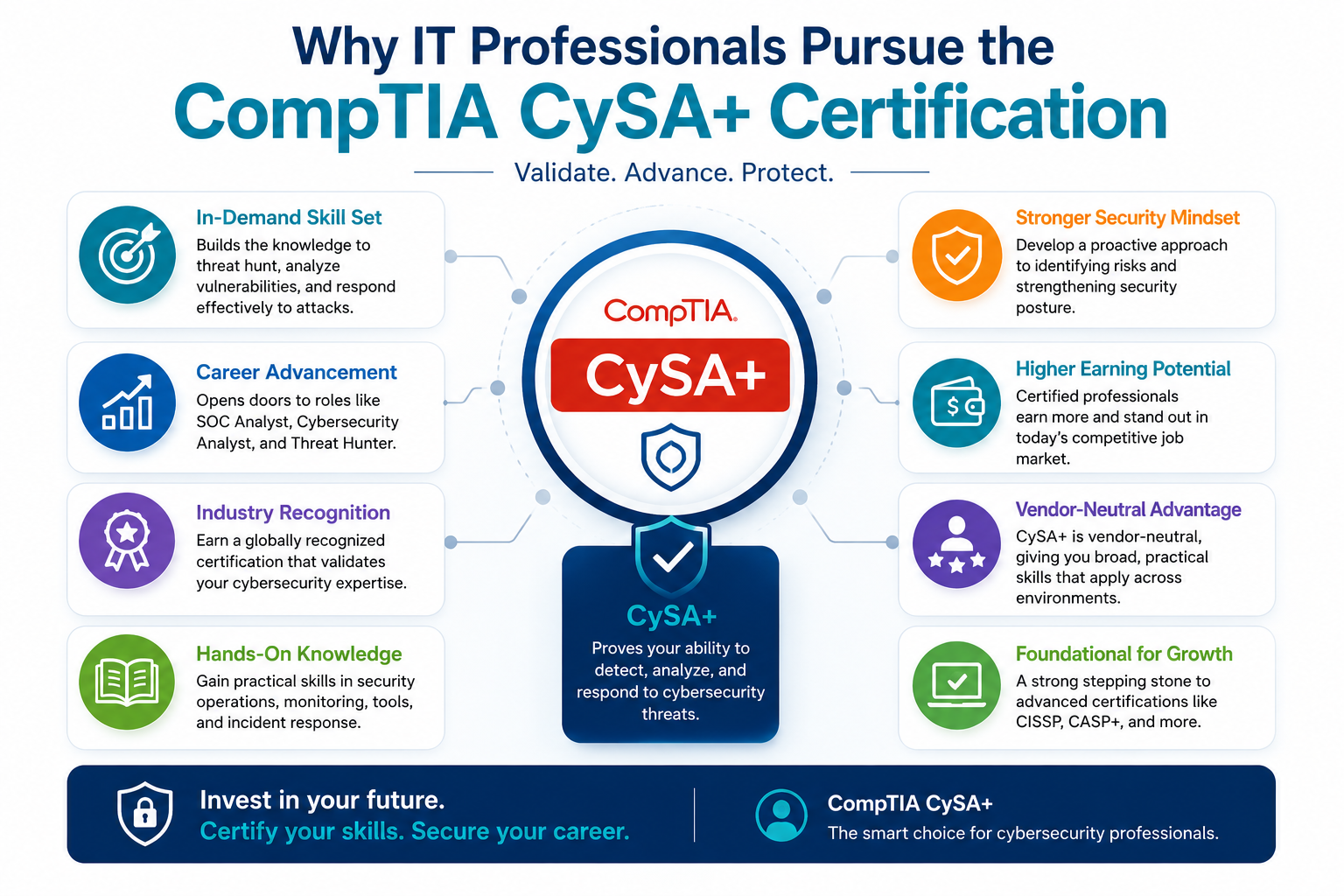
Cybersecurity has become one of the most critical areas in modern technology. Nearly every business, government organization, healthcare provider, educational institution, and financial company relies heavily on digital systems to operate successfully. As technology expands, cybercriminals continue developing more advanced attack methods that target sensitive information, financial assets, and critical infrastructure. Because of this, organizations around the world are investing heavily in cybersecurity professionals who can defend their networks and systems from increasingly sophisticated threats.
The demand for cybersecurity professionals continues to rise at an incredible pace. Companies regularly struggle to fill open positions because there are not enough qualified candidates available. This shortage has created tremendous opportunities for IT professionals who want to transition into cybersecurity or strengthen their existing security skills. Certifications have become one of the most reliable ways for professionals to prove their abilities and stand out in a competitive job market.
Cybersecurity roles are no longer limited to government agencies or massive corporations. Small businesses, online retailers, schools, and even local service providers now require cybersecurity expertise. Every connected device and cloud-based service increases the need for professionals who understand how to secure digital environments. This ongoing expansion has helped cybersecurity become one of the most stable and rewarding fields within information technology.
Professionals entering cybersecurity often discover that employers expect both technical skills and practical experience. Organizations want employees who understand how cyberattacks work and how to respond effectively when incidents occur. Certifications help demonstrate that candidates possess a verified level of knowledge and capability. This is one reason why certifications like CySA+ have become increasingly respected within the industry.
The cybersecurity field also offers strong long-term career growth. Unlike some technology trends that lose popularity over time, cybersecurity continues expanding because threats never disappear. Attackers constantly evolve their methods, forcing organizations to strengthen defenses and hire skilled analysts capable of responding to emerging dangers. This creates a career environment with ongoing demand and opportunities for advancement.
Many IT professionals begin exploring cybersecurity after gaining experience in networking, systems administration, technical support, or cloud computing. These foundational roles provide exposure to operating systems, infrastructure, and troubleshooting processes that later become valuable in security positions. Certifications such as CySA+ help professionals transition from general IT roles into specialized cybersecurity careers.
The growing importance of remote work has also contributed to cybersecurity demand. Organizations must now secure remote devices, cloud platforms, home networks, and distributed workforces. This shift has created new security challenges that require skilled professionals who can monitor activity, identify vulnerabilities, and protect sensitive information from attacks.
Cybersecurity professionals today are expected to perform far more than simple antivirus management. They must analyze suspicious behavior, investigate alerts, detect intrusions, manage vulnerabilities, and respond quickly to incidents. Modern cybersecurity is proactive rather than reactive, requiring continuous monitoring and analysis instead of relying solely on traditional perimeter defenses.
This evolution in cybersecurity practices has increased the importance of certifications that emphasize analytical and operational skills. Employers want professionals who understand how attackers operate and how to identify abnormal behavior before significant damage occurs. The CySA+ certification was designed specifically to validate these capabilities.
Another reason cybersecurity careers continue growing is the financial impact of cyberattacks. Data breaches, ransomware attacks, and service disruptions can cost organizations millions of dollars. Businesses understand that investing in cybersecurity professionals is often far less expensive than recovering from major security incidents. As a result, skilled analysts and defenders remain highly valuable.
The field also offers diverse career paths. Some professionals focus on defensive security, while others specialize in penetration testing, digital forensics, cloud security, threat intelligence, compliance, or security engineering. CySA+ supports many of these paths by providing foundational analytical and operational security knowledge.
The increasing dependence on cloud services has further transformed cybersecurity responsibilities. Security professionals must understand how to protect cloud environments, secure remote access, and monitor distributed systems. Modern analysts need broad technical knowledge that extends across networks, applications, devices, and cloud infrastructure.
Cybersecurity careers also attract individuals who enjoy problem-solving and continuous learning. Threats constantly evolve, requiring professionals to stay updated on new attack techniques and defensive strategies. This creates an environment where learning never truly stops, making the field engaging for technology enthusiasts.
As organizations continue digitizing operations and storing more information online, cybersecurity professionals will remain essential. Certifications like CySA+ help individuals demonstrate readiness for these important roles while building confidence in their technical abilities.
What the CySA+ Certification Is Designed to Do
The CompTIA Cybersecurity Analyst certification, commonly known as CySA+, was created to address a specific need within the cybersecurity industry. Before the certification existed, many professionals found a large gap between entry-level security certifications and highly advanced expert credentials. CySA+ was introduced to bridge that gap by focusing on practical cybersecurity analysis and defensive operations.
CompTIA launched the certification in 2017 in response to changing industry demands. Cybersecurity threats were becoming more sophisticated, and organizations needed professionals capable of identifying suspicious activity, investigating threats, and responding to incidents effectively. Traditional defensive measures alone were no longer enough to stop advanced attackers.
CySA+ focuses heavily on behavioral analytics and security operations. Rather than concentrating only on theory, the certification emphasizes practical skills that cybersecurity analysts use daily. Professionals preparing for the exam learn how to monitor systems, analyze threats, investigate incidents, and secure environments against attacks.
One of the defining characteristics of CySA+ is its emphasis on defensive cybersecurity. While some certifications focus primarily on offensive security or penetration testing, CySA+ concentrates on identifying and stopping attacks. This makes it particularly valuable for professionals interested in blue team roles and security operations centers.
The certification evaluates whether candidates can apply cybersecurity concepts in realistic environments. Instead of memorizing terminology alone, candidates must demonstrate understanding of threat detection, incident handling, and vulnerability management. This practical focus has helped CySA+ gain credibility among employers and technical professionals.
CySA+ is considered a mid-level certification. It builds upon foundational knowledge typically gained through certifications such as Network+ and Security+. While these earlier certifications introduce networking and security basics, CySA+ expands into advanced analysis and operational security practices.
The certification also aligns with modern cybersecurity strategies. Organizations today recognize that preventing every attack is impossible. Instead, businesses focus on detecting threats quickly and responding before attackers cause significant damage. CySA+ prepares professionals for this proactive approach by teaching continuous monitoring and analysis techniques.
Another reason the certification stands out is its vendor-neutral structure. CySA+ does not focus on one company’s products or proprietary technologies. Instead, it teaches general cybersecurity principles and practices that apply across different platforms and environments. This makes the certification broadly useful in many workplaces.
The exam itself includes both multiple-choice and performance-based questions. Performance-based questions require candidates to solve practical security problems rather than simply selecting answers from a list. This approach helps validate real-world cybersecurity skills more effectively than traditional testing methods alone.
CySA+ covers several major areas of cybersecurity operations. These include threat management, vulnerability assessment, incident response, compliance, software security, and monitoring activities. Together, these topics represent many of the daily responsibilities handled by cybersecurity analysts.
The certification also introduces candidates to important security tools commonly used in operational environments. Analysts preparing for CySA+ often work with intrusion detection systems, packet analysis tools, and security information and event management platforms. Familiarity with these technologies helps professionals perform more effectively in security roles.
Many organizations value CySA+ because it aligns with workforce development goals and government standards. The certification has been recognized within several professional cybersecurity frameworks, increasing its credibility among employers seeking qualified analysts.
Preparing for the certification often helps candidates improve both technical and analytical thinking. Security professionals must interpret information, recognize patterns, and make informed decisions quickly. CySA+ reinforces these capabilities through practical learning objectives and realistic scenarios.
The certification is also attractive because it supports career progression. Professionals who earn CySA+ demonstrate advancement beyond entry-level concepts and readiness for greater cybersecurity responsibilities. Employers often view certifications as evidence of dedication to professional growth and continuous learning.
CySA+ preparation encourages hands-on experience with security tools and monitoring processes. Candidates learn how to review logs, investigate suspicious activity, analyze alerts, and identify vulnerabilities. These practical skills are directly applicable in many cybersecurity roles.
The certification reflects the growing importance of security analytics within modern organizations. Companies increasingly rely on monitoring systems, behavioral analysis, and centralized security management platforms to identify threats. CySA+ validates the ability to work within these environments effectively.
Another strength of CySA+ is its balanced coverage of technical and operational concepts. Candidates must understand both how systems work and how to manage security activities within organizational environments. This combination makes the certification useful for a wide range of cybersecurity positions.
The exam also encourages understanding of risk management and compliance. Organizations must follow regulations and security standards designed to protect information and maintain operational integrity. Professionals with CySA+ knowledge understand how security activities connect to broader business objectives and regulatory requirements.
Many professionals pursue CySA+ because it provides a strong foundation for future cybersecurity growth. The certification introduces concepts and practices that support advancement into more specialized or advanced security roles later in a career.
The practical nature of the certification has contributed significantly to its reputation. Employers appreciate certifications that demonstrate applied skills rather than purely theoretical understanding. CySA+ shows that candidates can perform meaningful cybersecurity tasks in real operational environments.
The certification also reflects how cybersecurity responsibilities have evolved over time. Modern analysts are expected to investigate incidents, correlate information, identify patterns, and respond rapidly to suspicious activity. CySA+ aligns closely with these modern operational expectations.
For professionals seeking a balanced, practical, and respected cybersecurity certification, CySA+ offers substantial value. It provides recognition, skill validation, and preparation for real-world defensive security responsibilities.
Why Defensive Security Skills Matter More Than Ever
The cybersecurity industry has changed dramatically over the last decade. In the past, organizations focused heavily on perimeter defenses such as firewalls and antivirus software. While these technologies remain important, attackers have developed methods for bypassing traditional defenses. As a result, cybersecurity professionals now rely more heavily on monitoring, analytics, and incident response capabilities.
Modern attackers use phishing campaigns, ransomware, credential theft, social engineering, and advanced malware to compromise systems. Many of these attacks are designed specifically to avoid detection by conventional security tools. This means organizations need professionals capable of identifying unusual behavior and investigating suspicious activity quickly.
Defensive security skills have become essential because businesses cannot rely solely on prevention anymore. Organizations must assume that some attacks will succeed and prepare to detect and respond rapidly when incidents occur. This shift has increased demand for professionals trained in monitoring, analysis, and response techniques.
CySA+ addresses this need directly by focusing on operational cybersecurity activities. Professionals earning the certification learn how to analyze threats, investigate incidents, monitor systems, and identify vulnerabilities before attackers exploit them.
Continuous monitoring is one of the most important aspects of modern cybersecurity. Analysts review logs, alerts, and network traffic to identify signs of compromise. Without skilled professionals interpreting this information, organizations may fail to detect attacks until significant damage has already occurred.
Behavioral analysis has also become increasingly important. Instead of relying entirely on known attack signatures, analysts examine user behavior, system activity, and network patterns to identify anomalies. This approach helps detect previously unknown threats and advanced attacks.
Incident response skills are another critical component of defensive cybersecurity. When attacks occur, organizations need professionals who can contain threats, investigate causes, and restore operations quickly. Effective incident response minimizes damage and helps businesses recover faster from security events.
Threat intelligence also plays an important role in modern defense strategies. Analysts study attacker techniques, emerging vulnerabilities, and global threat trends to strengthen organizational defenses. Understanding how attackers operate allows defenders to anticipate threats more effectively.
Vulnerability management has become equally important. Security professionals continuously scan systems, identify weaknesses, prioritize risks, and apply remediation measures. Proactive vulnerability management helps prevent attacks before they happen.
The increasing use of cloud services has expanded defensive security responsibilities even further. Analysts must secure remote access, monitor cloud environments, and protect distributed systems from attack. This requires broad technical understanding and strong analytical abilities.
Organizations also face increasing regulatory pressure regarding cybersecurity. Businesses must comply with data protection laws and industry standards designed to safeguard information. Security professionals play a major role in maintaining compliance and reducing organizational risk.
As cyber threats continue evolving, defensive security professionals remain essential. Certifications like CySA+ help prepare individuals for these responsibilities by validating practical skills needed in modern cybersecurity operations.
What the CySA+ Exam Covers
The CySA+ certification is designed to evaluate whether a cybersecurity professional can handle real-world defensive security responsibilities. Unlike certifications that focus mostly on memorization or theoretical concepts, CySA+ emphasizes practical analysis, monitoring, threat detection, and incident response skills. The exam measures whether candidates understand how to secure systems, identify vulnerabilities, and respond effectively to modern cyber threats.
CompTIA structured the certification around several major areas of cybersecurity operations. These focus areas reflect the daily responsibilities of cybersecurity analysts and security operations teams. By covering multiple disciplines within defensive security, the certification prepares candidates for a wide range of real-world scenarios.
One of the most important topics included in the exam is threat and vulnerability management. Cybersecurity professionals must understand how attackers identify weaknesses in systems and how organizations can reduce those risks before incidents occur. This includes vulnerability scanning, patch management, risk prioritization, and remediation planning. Analysts are expected to recognize weaknesses in operating systems, applications, and network configurations while understanding how those weaknesses can be exploited.
Another major area of the exam is security operations and monitoring. Modern organizations generate enormous amounts of security data every day. Firewalls, intrusion detection systems, endpoint security tools, and cloud platforms all produce logs and alerts that analysts must review and interpret. Security professionals need strong analytical abilities to distinguish between normal activity and signs of compromise.
Monitoring responsibilities involve identifying suspicious behavior patterns, analyzing alerts, and responding to anomalies quickly. Analysts often work within security operations centers where they continuously review system activity and investigate incidents. CySA+ helps validate the ability to function effectively in these environments.
Incident response is another critical topic within the certification. Organizations must prepare for the reality that some attacks will eventually succeed despite strong defenses. Security professionals therefore need the ability to contain incidents, minimize damage, investigate root causes, and restore systems safely.
The certification teaches professionals how to follow structured response procedures during security events. This includes identifying compromised systems, collecting evidence, isolating affected devices, and coordinating recovery activities. Effective incident response can significantly reduce the operational and financial impact of cyberattacks.
Compliance and assessment also play a major role in the exam objectives. Organizations must follow various laws, standards, and security frameworks designed to protect sensitive information. Cybersecurity professionals need to understand risk management practices and compliance requirements to support organizational security goals effectively.
The exam also covers software and systems security. Professionals are expected to understand how to secure applications, operating systems, and infrastructure against attack. This includes access controls, secure configurations, patch management, authentication mechanisms, and system hardening practices.
CySA+ combines these areas into a practical and operationally focused certification. Rather than concentrating entirely on one specialty, the exam validates broad defensive cybersecurity knowledge that applies across multiple environments and job roles.
The certification uses both multiple-choice and performance-based questions. Performance-based questions require candidates to apply knowledge in simulated scenarios rather than simply selecting answers from a list. These exercises help ensure that certified professionals can perform meaningful cybersecurity tasks in practical environments.
The exam duration gives candidates enough time to work through complex questions and scenarios carefully. Because cybersecurity often involves investigation and analysis, the exam is designed to test reasoning and interpretation skills rather than simple memorization.
Preparing for CySA+ usually involves a combination of studying theory and practicing hands-on skills. Candidates often spend time working with security tools, analyzing network traffic, reviewing logs, and exploring simulated incidents. This practical preparation helps reinforce real-world analytical abilities.
The certification also encourages familiarity with commonly used security technologies. Professionals preparing for the exam often work with intrusion detection systems, packet capture tools, endpoint security platforms, and security information and event management systems. Understanding these technologies helps candidates develop operational confidence.
CySA+ is especially valuable because it reflects modern cybersecurity realities. Organizations today rely heavily on monitoring, analytics, and rapid response capabilities rather than depending solely on traditional preventative controls. The certification aligns closely with these operational requirements.
Many employers appreciate that CySA+ focuses on practical defensive security rather than purely academic concepts. Security teams need professionals who can investigate alerts, recognize threats, and respond effectively to incidents under pressure. The certification demonstrates readiness for these responsibilities.
Another advantage of the certification is its balanced structure. It covers technical knowledge, operational processes, analytical thinking, and security management concepts without becoming overly specialized. This makes it useful for professionals working in diverse cybersecurity environments.
The exam objectives are also updated periodically to reflect changes in the threat landscape and evolving cybersecurity practices. This helps ensure that the certification remains relevant as technology and attack methods continue to change.
Professionals preparing for CySA+ often discover that the certification strengthens their understanding of cybersecurity operations overall. The learning process helps candidates connect different security concepts and understand how defensive technologies work together to protect organizations.
The certification also encourages a proactive security mindset. Instead of waiting for attacks to cause damage, professionals learn how to identify suspicious behavior early and take preventative action. This proactive approach has become increasingly important in modern cybersecurity operations.
CySA+ preparation can also improve troubleshooting and analytical thinking skills. Security analysts regularly investigate unusual activity and determine whether alerts represent actual threats or harmless events. Strong analytical reasoning is therefore essential for success in cybersecurity roles.
Many professionals value the certification because it teaches practical skills applicable across different industries. Healthcare organizations, financial institutions, government agencies, and technology companies all require professionals capable of monitoring systems and responding to threats effectively.
The exam also emphasizes understanding attacker behavior. Security professionals must think critically about how cybercriminals operate and what techniques they use to compromise systems. This perspective helps analysts identify indicators of compromise more effectively.
As organizations continue adopting cloud services and remote work models, operational cybersecurity skills remain increasingly important. CySA+ supports professionals working in these modern environments by validating skills related to monitoring, response, and security management.
The certification ultimately serves as evidence that a professional can contribute meaningfully to organizational cybersecurity efforts. It demonstrates readiness for analytical and defensive security responsibilities that are critical in today’s threat environment.
The Experience Needed Before Pursuing CySA+
Although CySA+ is considered a mid-level cybersecurity certification, CompTIA does not require candidates to possess specific prerequisites before attempting the exam. However, the organization strongly recommends that professionals first develop foundational networking and security knowledge before pursuing CySA+.
Many cybersecurity professionals begin their careers in broader IT roles such as technical support, network administration, systems administration, or infrastructure management. These positions help individuals gain practical understanding of operating systems, networking, troubleshooting, and enterprise technology environments. This experience becomes extremely valuable when transitioning into cybersecurity.
CompTIA recommends that candidates possess knowledge equivalent to Network+ and Security+ certifications before pursuing CySA+. These certifications establish a strong foundation in networking concepts and security fundamentals that support more advanced analytical responsibilities.
Network+ introduces candidates to networking technologies, protocols, infrastructure devices, and troubleshooting processes. Understanding how networks function is critical for cybersecurity professionals because attacks often target communication systems, servers, and connected devices.
Security+ builds upon networking knowledge by introducing foundational cybersecurity concepts. Candidates learn about threats, vulnerabilities, risk management, authentication, encryption, and basic defensive security practices. This certification is often considered the starting point for many cybersecurity careers.
CySA+ expands significantly beyond these foundational topics. The certification assumes candidates already understand basic networking and security concepts, allowing it to focus more heavily on analysis, monitoring, and operational defense.
Professionals who skip foundational certifications may still pass CySA+, but doing so can create knowledge gaps that become problematic in real-world environments. Employers often expect cybersecurity professionals to possess strong baseline understanding of networks, operating systems, and security fundamentals.
Hands-on experience is especially important for CySA+ candidates. Security analysts work with real systems, investigate incidents, review logs, and analyze suspicious behavior regularly. Professionals with operational IT experience often adapt more easily to cybersecurity roles because they already understand how enterprise environments function.
Many successful CySA+ candidates spend several years working in IT before specializing in cybersecurity. This experience helps them understand user behavior, system administration, network communication, and troubleshooting processes. These skills become valuable during incident investigations and threat analysis.
CySA+ preparation also benefits from familiarity with common cybersecurity tools. Candidates often practice using intrusion detection systems, packet analyzers, vulnerability scanners, and security monitoring platforms during their studies. Hands-on exposure helps reinforce theoretical concepts and improve analytical skills.
Intrusion detection systems are important tools for identifying malicious or suspicious activity within networks. Analysts use these systems to monitor traffic and detect behaviors associated with attacks or policy violations. Understanding how these systems work is a valuable skill for cybersecurity professionals.
Packet capture and analysis tools also play an important role in cybersecurity operations. These tools allow analysts to inspect network traffic in detail and identify suspicious communications. Packet analysis helps professionals investigate incidents and understand how attacks move through networks.
Security information and event management platforms aggregate logs and alerts from multiple sources into centralized dashboards. Analysts use these systems to correlate events, investigate incidents, and identify patterns that may indicate compromise. Familiarity with SIEM platforms is extremely valuable for cybersecurity operations roles.
Experience with scripting and automation can also help CySA+ candidates succeed. Modern cybersecurity environments generate massive amounts of data, making automation increasingly important for improving efficiency and reducing response times.
Candidates preparing for the exam often benefit from lab environments and simulation exercises. Hands-on labs allow professionals to practice analyzing attacks, responding to incidents, and using security tools in controlled settings. This practical experience reinforces learning and improves confidence.
Many professionals preparing for CySA+ also study attack techniques used by cybercriminals. Understanding how attackers operate helps analysts recognize suspicious activity more effectively and respond appropriately to incidents.
Soft skills are another important aspect of cybersecurity work. Analysts frequently communicate with technical teams, management, and sometimes external organizations during incidents. Strong communication and documentation skills are therefore highly valuable.
Problem-solving abilities are especially critical in cybersecurity roles. Analysts regularly investigate unusual events, identify causes of security issues, and determine appropriate response actions. CySA+ preparation encourages critical thinking and analytical reasoning.
The certification is often most valuable for professionals already working toward cybersecurity careers. Individuals with foundational IT knowledge and practical experience tend to benefit the most because they can apply the certification concepts more effectively in operational environments.
Many professionals use CySA+ as a stepping stone toward advanced cybersecurity positions. The certification helps establish analytical credibility and demonstrates readiness for more specialized responsibilities within security operations and threat management.
Preparing for the certification also encourages continuous learning. Cybersecurity evolves constantly as attackers develop new techniques and organizations adopt new technologies. Professionals pursuing CySA+ often develop habits of ongoing research and skill development that support long-term career growth.
Employers frequently appreciate candidates who combine certifications with practical experience. CySA+ demonstrates verified knowledge, while operational experience shows the ability to apply that knowledge effectively in real-world situations.
The certification also helps professionals gain confidence in their cybersecurity capabilities. Studying for the exam exposes candidates to realistic scenarios, operational tools, and investigative processes that strengthen technical understanding.
Ultimately, the best preparation for CySA+ involves combining foundational knowledge, hands-on practice, operational experience, and continuous learning. Professionals who approach the certification this way often gain the greatest long-term value from the credential.
Why CySA+ Focuses on Real-World Cybersecurity Skills
One reason CySA+ has gained respect within the cybersecurity community is because of its practical approach. Many certifications focus heavily on memorization, terminology, or theoretical concepts. While theoretical understanding is important, organizations also need professionals who can apply knowledge effectively during real incidents.
CySA+ emphasizes operational cybersecurity activities that analysts perform daily. This includes reviewing alerts, analyzing logs, investigating suspicious activity, managing vulnerabilities, and responding to incidents. These practical responsibilities are central to modern cybersecurity operations.
The certification reflects how cybersecurity has evolved over time. Traditional security strategies focused mainly on prevention through firewalls and antivirus software. Today, organizations understand that attackers can sometimes bypass preventative controls. As a result, monitoring and rapid response have become equally important.
Security professionals must now identify suspicious behavior quickly and determine whether systems have been compromised. This requires analytical thinking, technical understanding, and familiarity with investigative tools. CySA+ was designed specifically to validate these capabilities.
Behavioral analytics play an increasingly important role in modern cybersecurity. Instead of relying only on known attack signatures, analysts examine user activity, network patterns, and system behavior to identify anomalies. This approach helps organizations detect previously unknown threats.
CySA+ also reinforces the importance of continuous monitoring. Cybersecurity analysts often work in environments where they monitor systems around the clock to detect threats before major damage occurs. The certification aligns closely with these operational realities.
The exam’s performance-based questions are particularly valuable because they simulate real-world problem-solving scenarios. Candidates must analyze information, interpret results, and determine appropriate actions rather than simply recalling memorized facts.
This practical focus helps employers trust the certification more. Organizations want professionals who can contribute immediately to security operations and incident response activities. CySA+ demonstrates readiness for these responsibilities more effectively than purely theoretical certifications.
Hands-on cybersecurity skills also improve long-term career growth. Professionals capable of analyzing threats and responding to incidents are often well-positioned for advancement into senior analyst, engineering, or management roles.
As cyber threats continue evolving, practical defensive security skills remain essential. Certifications like CySA+ help prepare professionals for the realities of modern cybersecurity operations while validating their ability to protect organizations against increasingly advanced attacks.
Who Should Consider Earning the CySA+ Certification
The CySA+ certification is designed for professionals who want to build or strengthen careers in defensive cybersecurity. While the certification is especially useful for cybersecurity analysts, it also benefits many other IT and security professionals responsible for protecting systems, networks, and sensitive information. Because modern cybersecurity environments require broad analytical and operational skills, CySA+ can support a wide range of career paths.
One of the primary audiences for CySA+ is security analysts. These professionals monitor systems, investigate suspicious activity, analyze alerts, and help organizations respond to security threats. Security analysts are often responsible for identifying vulnerabilities and ensuring that security controls function effectively. The certification aligns closely with the day-to-day responsibilities of these professionals, making it highly relevant for individuals already working in or pursuing analyst roles.
CySA+ is also valuable for professionals transitioning from general IT roles into cybersecurity. Many individuals begin careers in networking, systems administration, technical support, or infrastructure management before specializing in security. These professionals often possess strong technical foundations but need additional knowledge focused specifically on cybersecurity operations and threat analysis. CySA+ helps bridge that gap by validating analytical and defensive security skills.
Network administrators may also benefit from the certification because they already understand network infrastructure and communication protocols. CySA+ builds upon that knowledge by introducing threat detection, monitoring, and incident response concepts that improve overall security awareness.
Systems administrators can gain substantial value from CySA+ as well. These professionals manage servers, operating systems, user permissions, and enterprise infrastructure. Understanding cybersecurity operations helps systems administrators secure environments more effectively and respond appropriately when incidents occur.
Professionals working in security operations centers are especially strong candidates for the certification. Security operations centers rely heavily on monitoring tools, event analysis, and rapid incident response. CySA+ prepares professionals for these operational responsibilities through practical and analytical training.
Threat intelligence analysts can also benefit significantly from earning CySA+. These professionals study attacker behavior, investigate emerging threats, and analyze cybercriminal tactics. Understanding defensive security operations improves their ability to predict and evaluate attack methods.
Incident response specialists represent another group well-suited for CySA+. These professionals investigate security breaches, contain attacks, recover systems, and coordinate remediation efforts. The certification reinforces many of the practical skills required for successful incident management.
Cloud security professionals may also pursue CySA+ because modern organizations increasingly rely on cloud-based infrastructure and services. Analysts responsible for securing cloud environments must monitor activity, investigate anomalies, and protect distributed systems from cyber threats. CySA+ supports these operational responsibilities effectively.
Security engineers can also benefit from the certification even though their responsibilities often extend into architecture and infrastructure design. Understanding analytical and operational security concepts helps engineers create more secure systems and improve organizational defenses.
Many professionals pursuing penetration testing or ethical hacking careers also choose to earn CySA+. While offensive security certifications focus on attacking systems, understanding defensive techniques makes security professionals more effective overall. Ethical hackers who understand monitoring and detection capabilities can better evaluate organizational security posture.
Cybersecurity managers may also value the certification because it provides operational understanding of how modern security teams function. Managers responsible for supervising analysts and coordinating response activities benefit from knowledge of monitoring, investigation, and analytical processes.
Students and early-career professionals interested in cybersecurity often consider CySA+ after developing foundational networking and security knowledge. The certification can help them stand out during job searches and demonstrate commitment to professional growth.
Government organizations and contractors may also encourage employees to pursue CySA+ because the certification aligns with several recognized cybersecurity workforce frameworks. This recognition increases its value for professionals working in regulated or government-related environments.
Professionals interested in compliance and risk management can also gain useful knowledge from CySA+. Understanding operational security practices improves the ability to assess organizational risk and evaluate security controls effectively.
One reason CySA+ appeals to so many professionals is because cybersecurity roles increasingly overlap. Analysts may participate in incident response, engineers may assist with monitoring, and administrators may contribute to vulnerability management. The certification supports this collaborative environment by providing broad operational security knowledge.
The certification is especially attractive for individuals who enjoy analytical problem-solving. Cybersecurity analysts constantly investigate unusual activity, interpret alerts, and determine appropriate responses to potential threats. CySA+ reinforces the analytical thinking skills necessary for success in these environments.
Professionals interested in long-term cybersecurity careers may find CySA+ particularly valuable because it establishes a strong operational foundation. Many advanced cybersecurity specialties build upon the concepts covered in the certification.
Another advantage is that the certification demonstrates practical commitment to defensive cybersecurity. Employers often value certifications that show candidates understand real-world security operations rather than only theoretical concepts.
CySA+ also supports professionals interested in continuous learning. Cybersecurity evolves constantly, requiring analysts to adapt to new threats and technologies. Preparing for the certification encourages ongoing skill development and technical exploration.
Many employers view CySA+ as evidence that candidates possess practical operational knowledge and analytical capabilities. This can improve job prospects and strengthen professional credibility during hiring processes.
The certification can also help professionals gain confidence in cybersecurity environments. Working through practical scenarios and operational concepts prepares candidates for the challenges of real-world security responsibilities.
Ultimately, CySA+ is most valuable for individuals interested in defensive cybersecurity, operational monitoring, incident response, and analytical security roles. It provides broad knowledge, practical skills, and industry recognition that support long-term professional growth.
CySA+ Compared to Other Cybersecurity Certifications
The cybersecurity certification landscape includes many different credentials focused on various specialties and experience levels. Understanding how CySA+ compares to other certifications helps professionals decide whether it aligns with their career goals and current skill levels.
One of the most common certifications associated with CySA+ is Security+. Security+ is often considered an entry-level cybersecurity certification that introduces foundational security concepts. Candidates learn about threats, vulnerabilities, risk management, cryptography, access control, and basic defensive practices.
CySA+ builds upon the foundation established by Security+. While Security+ introduces core security concepts, CySA+ focuses more heavily on operational analysis, monitoring, incident response, and vulnerability management. Professionals who complete Security+ often pursue CySA+ as a natural next step in their cybersecurity development.
Another closely related certification is Network+. Networking knowledge is critical in cybersecurity because attackers frequently target network infrastructure and communication systems. Network+ provides understanding of protocols, devices, troubleshooting, and network operations that support later cybersecurity specialization.
CySA+ differs from offensive security certifications such as PenTest+. PenTest+ focuses on penetration testing, vulnerability exploitation, and ethical hacking techniques. Professionals pursuing offensive security careers often choose PenTest+ to develop attack-oriented skills.
CySA+, in contrast, emphasizes defense and monitoring. It prepares professionals to identify attacks, investigate incidents, and protect systems rather than simulate attacks themselves. While the certifications differ in focus, many professionals pursue both because understanding offense and defense together creates stronger cybersecurity expertise.
Another commonly discussed certification is the Certified Ethical Hacker credential. This certification focuses heavily on penetration testing concepts and attack methodologies. It has strong name recognition within the cybersecurity industry and is frequently referenced in job postings.
CySA+ differs because of its operational and analytical emphasis. While some certifications focus primarily on theoretical attack knowledge, CySA+ emphasizes practical monitoring, analysis, and incident response activities. Many technical professionals appreciate this practical orientation.
Advanced certifications such as CASP+ target experienced cybersecurity professionals responsible for enterprise-level architecture and advanced security management. CASP+ is generally considered a higher-level certification than CySA+ and often requires broader experience.
CySA+ serves as a strong intermediate step before pursuing more advanced certifications. Professionals can develop operational analytical skills through CySA+ before progressing toward expert-level credentials later in their careers.
Vendor-specific certifications represent another category within cybersecurity education. Companies such as Cisco, Microsoft, Palo Alto Networks, and Fortinet offer certifications focused on their technologies and platforms. These certifications can be highly valuable for professionals working directly with specific products.
CySA+, however, remains vendor-neutral. It teaches general cybersecurity principles and operational practices applicable across many environments. This broad applicability makes it useful for professionals working with diverse technologies.
Cloud-focused certifications have also become increasingly popular as organizations adopt cloud infrastructure. Certifications related to cloud security concentrate on securing cloud platforms and distributed services. CySA+ complements these credentials by strengthening operational monitoring and analytical capabilities.
Digital forensics certifications represent another specialized area of cybersecurity education. These credentials focus on evidence collection, investigation techniques, and legal procedures. While CySA+ touches on investigative concepts, its scope remains broader and more operationally focused.
Compliance and governance certifications also differ significantly from CySA+. Certifications centered around risk management, auditing, and governance focus more on organizational processes and regulatory requirements rather than technical operations.
CySA+ stands out because it balances technical knowledge with practical operational responsibilities. It does not concentrate exclusively on management, offensive security, or vendor-specific technologies. Instead, it prepares professionals for real-world analytical and defensive security activities.
Another advantage of CySA+ is accessibility. Some advanced cybersecurity certifications require extensive professional experience or expensive preparation programs. CySA+ remains relatively approachable for mid-level professionals developing operational security expertise.
The certification’s performance-based questions also help distinguish it from purely theoretical exams. Candidates must apply knowledge in practical scenarios, demonstrating operational understanding rather than memorized information alone.
Many professionals appreciate CySA+ because it aligns closely with modern cybersecurity workforce needs. Organizations require analysts capable of monitoring environments, investigating threats, and responding effectively to incidents. The certification supports these practical requirements directly.
CySA+ also fits well into broader cybersecurity career progression. Professionals can use it to validate intermediate-level analytical skills before specializing further in areas such as threat hunting, cloud security, penetration testing, or security architecture.
Another reason professionals choose CySA+ is its recognition among employers. The certification has developed a strong reputation within the cybersecurity community for emphasizing practical operational capabilities.
The certification’s focus on behavioral analytics and monitoring reflects current industry trends. Modern organizations increasingly rely on proactive detection and rapid response rather than solely depending on preventative controls. CySA+ aligns closely with these operational priorities.
Ultimately, CySA+ occupies a unique position within the cybersecurity certification landscape. It provides practical defensive security validation that complements both foundational and advanced certifications while supporting a wide variety of cybersecurity career paths.
The Career Benefits of Earning CySA+
Earning CySA+ can provide substantial career advantages for cybersecurity professionals and IT specialists transitioning into security roles. One of the biggest benefits is improved credibility. Certifications demonstrate commitment to professional development and provide evidence that a candidate possesses verified technical knowledge.
Employers often use certifications to evaluate job applicants because they help standardize skill assessment. CySA+ signals that a professional understands cybersecurity operations, monitoring, vulnerability management, and incident response processes.
The certification can also improve job opportunities. Many organizations actively seek professionals capable of analyzing threats and defending systems against attacks. As cybersecurity demand continues growing, professionals with recognized certifications may stand out more effectively during hiring processes.
CySA+ may also contribute to salary growth. Cybersecurity roles frequently offer competitive compensation because skilled professionals remain in high demand. Certifications can strengthen negotiating positions and support advancement into higher-paying roles.
Career advancement opportunities also increase with operational cybersecurity experience. Analysts who develop strong monitoring and response skills often progress into senior analyst, engineering, leadership, or consulting positions over time.
The certification also strengthens practical technical knowledge. Preparing for CySA+ exposes professionals to modern security tools, monitoring processes, and analytical techniques that improve workplace performance.
Another major benefit is increased confidence. Many professionals feel more prepared for cybersecurity responsibilities after studying for and earning the certification. Hands-on preparation helps candidates become more comfortable with incident investigation and security operations tasks.
CySA+ also supports long-term professional development. The cybersecurity industry evolves constantly, requiring continuous learning and adaptation. Professionals who pursue certifications often remain more engaged with industry trends and emerging technologies.
The certification’s vendor-neutral approach provides flexibility across industries and technologies. Professionals can apply CySA+ knowledge in healthcare, finance, government, education, retail, and many other sectors.
Many organizations also value certifications when considering promotions or internal advancement opportunities. Employees who demonstrate commitment to skill development may gain access to more specialized responsibilities and leadership opportunities.
The practical focus of CySA+ is particularly valuable because organizations need professionals capable of responding effectively to real threats. Operational analytical skills are increasingly important as businesses face sophisticated cyberattacks and complex security environments.
The certification may also serve as a stepping stone toward advanced cybersecurity education. Professionals often use CySA+ as a foundation before pursuing specialized certifications in cloud security, threat hunting, penetration testing, digital forensics, or security architecture.
Another advantage is networking opportunities within the cybersecurity community. Certified professionals often connect with peers, participate in professional organizations, and engage more actively in cybersecurity discussions and events.
CySA+ can also improve understanding of organizational security operations overall. Even professionals not working directly in analyst roles benefit from stronger awareness of monitoring, incident response, and vulnerability management processes.
The certification remains especially relevant because cybersecurity threats continue evolving. Organizations require professionals capable of adapting to changing attack methods and defending systems proactively. CySA+ supports this ongoing operational readiness.
Conclusion
CySA+ has become one of the most respected intermediate cybersecurity certifications because it focuses on practical defensive security skills that organizations genuinely need. The certification emphasizes monitoring, threat analysis, vulnerability management, and incident response rather than relying solely on theoretical knowledge. This practical orientation makes it highly valuable for professionals pursuing careers in cybersecurity operations.
The certification is particularly beneficial for security analysts, systems administrators, network professionals, and IT specialists transitioning into cybersecurity roles. It helps validate analytical abilities, strengthen operational knowledge, and improve career opportunities in a rapidly growing field.
CySA+ also stands out because of its balanced structure. It covers technical concepts, operational processes, analytical thinking, and modern cybersecurity practices while remaining vendor-neutral and broadly applicable across industries.
For professionals interested in defensive cybersecurity, security operations, and incident response, CySA+ offers strong long-term value. It supports career growth, strengthens practical skills, and demonstrates readiness for the evolving challenges of modern cybersecurity environments.