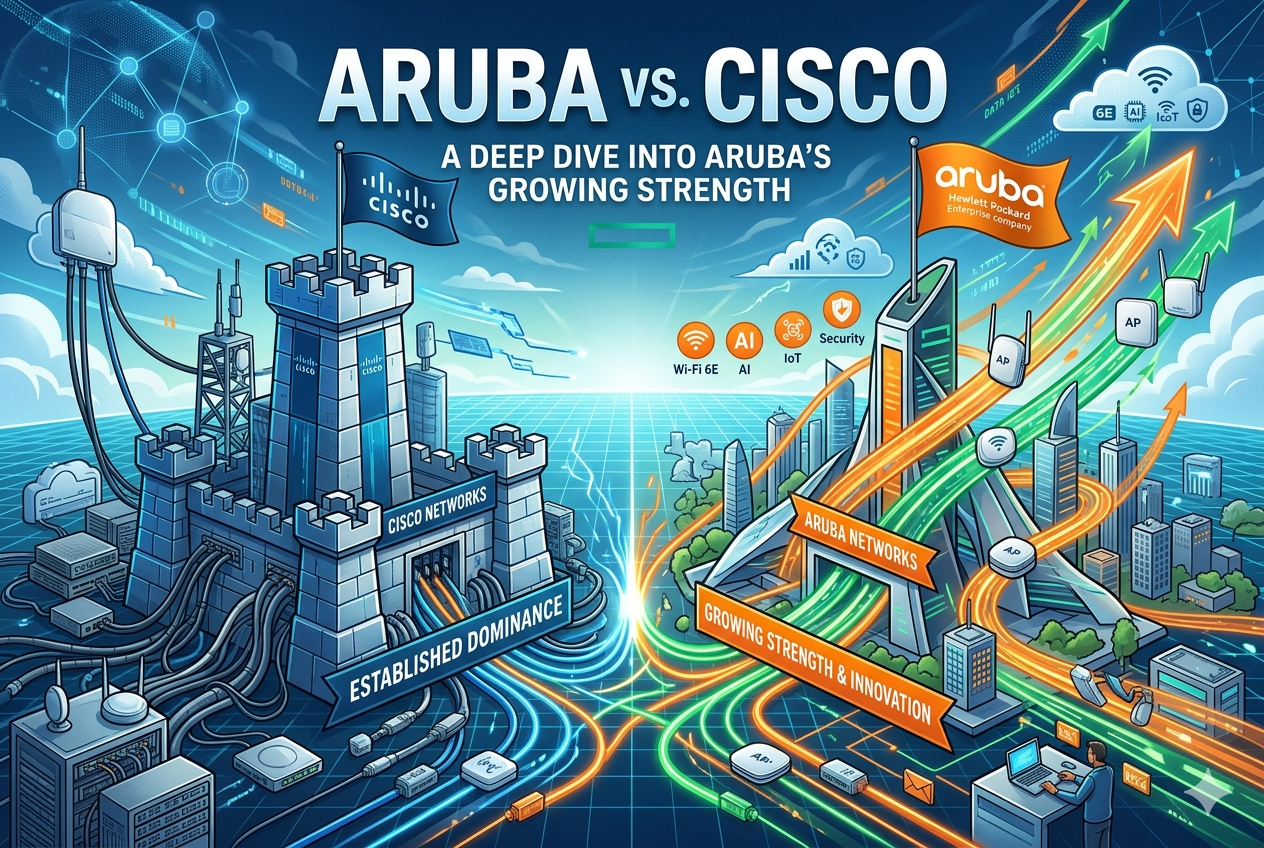
In the rapidly evolving world of enterprise networking, competition between leading vendors continues to shape how organizations design, deploy, and manage their digital infrastructure. Among the most notable rivalries is the ongoing comparison between Aruba, a Hewlett Packard Enterprise company, and Cisco, the long-established global leader in networking solutions. While Cisco has maintained dominance for decades through its extensive portfolio and strong enterprise relationships, Aruba has steadily gained momentum by focusing on cloud-native architecture, simplified management, and a security-first approach.
The growing conversation around Aruba versus Cisco is not merely about product comparison; it reflects a broader shift in enterprise priorities. Businesses today are increasingly focused on agility, scalability, and operational efficiency rather than traditional hardware-centric networking models. This shift has allowed Aruba to carve out a stronger position in the market, challenging Cisco’s long-held leadership in several key segments.
Market Position Overview
Cisco has historically been regarded as the benchmark in enterprise networking. Its dominance spans routing, switching, wireless infrastructure, and network security. With decades of presence in the market, Cisco built a strong ecosystem supported by certifications, enterprise contracts, and global service networks. Its solutions are widely deployed across large enterprises, government institutions, and service providers.
Aruba, on the other hand, entered the market as a challenger with a more focused strategy. Initially known for its wireless networking capabilities, Aruba gradually expanded its portfolio after becoming part of Hewlett Packard Enterprise. This acquisition provided Aruba with the resources and global reach necessary to compete more aggressively against Cisco.
Over time, Aruba has positioned itself as a modern networking alternative, emphasizing simplicity, cloud integration, and user-centric design. While Cisco continues to dominate in terms of installed base and breadth of offerings, Aruba’s growth trajectory has become increasingly significant, particularly in cloud-managed networking environments and mid-to-large enterprise segments.
Aruba’s Growing Momentum
Aruba’s growing strength can largely be attributed to its strategic alignment with modern IT requirements. As organizations move toward hybrid work environments and distributed infrastructure, the demand for flexible and cloud-managed networking solutions has increased significantly. Aruba has capitalized on this trend by offering platforms that reduce complexity and improve visibility across networks.
One of the key drivers of Aruba’s momentum is its focus on cloud-native networking architecture. Unlike traditional hardware-centric models, Aruba’s solutions are designed to be managed through centralized cloud platforms, enabling IT teams to monitor and configure networks from virtually anywhere. This approach aligns well with the needs of organizations adopting remote work policies and multi-site operations.
Another important factor is Aruba’s emphasis on user experience. The company has invested heavily in AI-driven analytics and automation tools that simplify network troubleshooting and optimize performance in real time. This reduces the operational burden on IT teams and allows businesses to focus more on strategic initiatives rather than routine maintenance tasks.
Additionally, Aruba has gained traction in sectors such as education, healthcare, and retail, where ease of deployment and cost efficiency are critical. Its ability to deliver reliable wireless connectivity with simplified management has made it a preferred choice for organizations looking to modernize their infrastructure without the complexity often associated with traditional enterprise networking systems.
Technology and Innovation Approach
Aruba’s innovation strategy is centered around simplification and intelligence. Rather than overwhelming customers with complex configurations and extensive manual management, Aruba focuses on delivering intuitive platforms that leverage automation and machine learning.
A key component of this approach is the integration of AI-powered network insights. These capabilities allow IT teams to identify performance issues, predict potential failures, and optimize network traffic without manual intervention. This proactive approach significantly enhances network reliability and reduces downtime.
Cisco, in contrast, has traditionally relied on a more extensive and modular product ecosystem. While this provides flexibility and scalability, it can also introduce complexity, particularly for organizations without large dedicated IT teams. Cisco has made strides in cloud and automation as well, but its legacy architecture sometimes creates challenges in achieving the same level of simplicity that Aruba promotes.
Aruba’s innovation is also evident in its unified infrastructure approach, where wired and wireless networks are managed through a single platform. This convergence reduces fragmentation and provides a more consistent user experience across different network environments.
Cloud Networking Shift
One of the most significant trends reshaping the networking industry is the shift toward cloud-managed infrastructure. Aruba has been particularly successful in this area, offering cloud-native solutions that allow organizations to manage networks without heavy on-premises infrastructure dependencies.
This shift is especially important for organizations with distributed workforces or multiple branch locations. Cloud-managed networking enables centralized control while maintaining local performance optimization, a balance that is increasingly important in modern IT environments.
Cisco has also invested heavily in cloud networking, particularly through its Meraki platform, which competes directly with Aruba’s cloud offerings. However, Aruba’s more unified and streamlined approach has resonated strongly with organizations seeking simplicity and faster deployment times.
The ability to deploy networks quickly, scale them efficiently, and manage them remotely has become a key differentiator, and Aruba has leveraged this trend effectively to expand its market share.
Security Capabilities
Security is a critical component of any modern networking solution, and both Aruba and Cisco have developed robust security frameworks to address growing cyber threats. Cisco has a long-standing reputation in enterprise security, offering a wide range of solutions that include firewalls, intrusion prevention systems, and advanced threat intelligence.
Aruba has taken a more integrated approach to security, embedding it directly into its networking architecture. Rather than treating security as a separate layer, Aruba incorporates identity-based access control, segmentation, and policy enforcement directly into the network fabric.
This approach simplifies security management and ensures consistent enforcement across all devices and users. As cyber threats become more sophisticated, the ability to enforce security policies dynamically across distributed environments has become increasingly valuable.
Aruba’s integration with broader HPE security initiatives also strengthens its position, allowing it to leverage advanced analytics and AI-driven threat detection capabilities. While Cisco remains a leader in enterprise security, Aruba’s embedded approach offers a compelling alternative for organizations seeking simplicity and efficiency.
Performance and User Experience
Network performance and user experience are central to the competition between Aruba and Cisco. Aruba has placed a strong emphasis on delivering seamless connectivity with minimal latency and high reliability. Its wireless solutions, in particular, are known for their stability and ease of deployment.
User experience extends beyond end-users to include IT administrators. Aruba’s management platforms are designed to be intuitive, reducing the learning curve and enabling faster troubleshooting. This contrasts with Cisco’s more complex configuration models, which, while powerful, often require specialized expertise.
Cisco’s performance capabilities remain industry-leading, particularly in large-scale enterprise environments where high throughput and advanced routing capabilities are essential. However, Aruba’s focus on usability and automation has allowed it to gain ground in organizations that prioritize operational efficiency.
Cisco’s Established Strength
Despite Aruba’s growing momentum, Cisco remains a dominant force in the networking industry. Its extensive product portfolio, global support infrastructure, and deep enterprise relationships give it a significant competitive advantage.
Cisco’s strength lies in its ability to provide end-to-end networking solutions that span from small branch offices to global data centers. Its ecosystem includes not only networking hardware but also collaboration tools, security platforms, and software-defined networking solutions.
The company’s long-standing reputation and continuous investment in innovation ensure that it remains a preferred choice for many large enterprises. Cisco also benefits from strong brand recognition and a vast partner network, which reinforces its market position.
Competitive Differentiation
The competition between Aruba and Cisco is increasingly defined by philosophy rather than just technology. Cisco represents a comprehensive, enterprise-grade approach with deep customization and extensive capabilities. Aruba represents a more modern, simplified, and cloud-first approach aimed at reducing complexity.
This difference in philosophy influences how organizations choose between the two. Enterprises with complex, legacy infrastructure often lean toward Cisco due to its robustness and flexibility. Organizations seeking agility, faster deployment, and simplified management often gravitate toward Aruba.
The growing popularity of hybrid work environments has further strengthened Aruba’s position, as businesses prioritize cloud-managed solutions that support distributed teams.
Enterprise Adoption Trends
Enterprise adoption trends indicate a gradual but noticeable shift toward cloud-managed networking solutions. While Cisco continues to hold a large share of the enterprise market, Aruba has been steadily increasing its presence, particularly in mid-market and digitally transforming organizations.
Industries such as education, hospitality, and healthcare have shown strong adoption of Aruba solutions due to their ease of use and cost efficiency. Meanwhile, large financial institutions and multinational corporations often continue to rely on Cisco for its extensive feature set and proven scalability.
The overall trend suggests a diversifying market where both vendors coexist, but Aruba is gaining ground in segments that prioritize agility and simplicity over complexity and customization.
Challenges and Opportunities
Aruba’s continued growth is not without challenges. Competing against Cisco requires constant innovation, strong channel partnerships, and the ability to scale globally. Cisco’s entrenched position in enterprise environments makes it difficult for challengers to displace it entirely.
However, Aruba’s opportunities lie in the ongoing digital transformation of businesses. As organizations modernize their infrastructure and adopt cloud-first strategies, Aruba’s architecture aligns closely with these evolving needs.
The increasing demand for AI-driven networking, automation, and remote management further strengthens Aruba’s value proposition. If Aruba continues to innovate at its current pace, it is likely to expand its influence in both enterprise and mid-market segments.
Conclusion
The comparison between Aruba and Cisco highlights a broader transformation in the networking industry. Cisco remains a powerful and established leader with unmatched scale and depth, while Aruba represents a rapidly growing challenger that aligns closely with modern IT demands.
Aruba’s growing momentum is driven by its focus on simplicity, cloud integration, and user-centric design. As organizations continue to prioritize agility and efficiency, Aruba is well-positioned to expand its market presence.
However, Cisco’s entrenched ecosystem and comprehensive capabilities ensure that it will remain a dominant force for years to come. Rather than a complete displacement, the future of enterprise networking is likely to be defined by coexistence and specialization, where Aruba and Cisco serve different but overlapping needs within a rapidly evolving digital landscape.