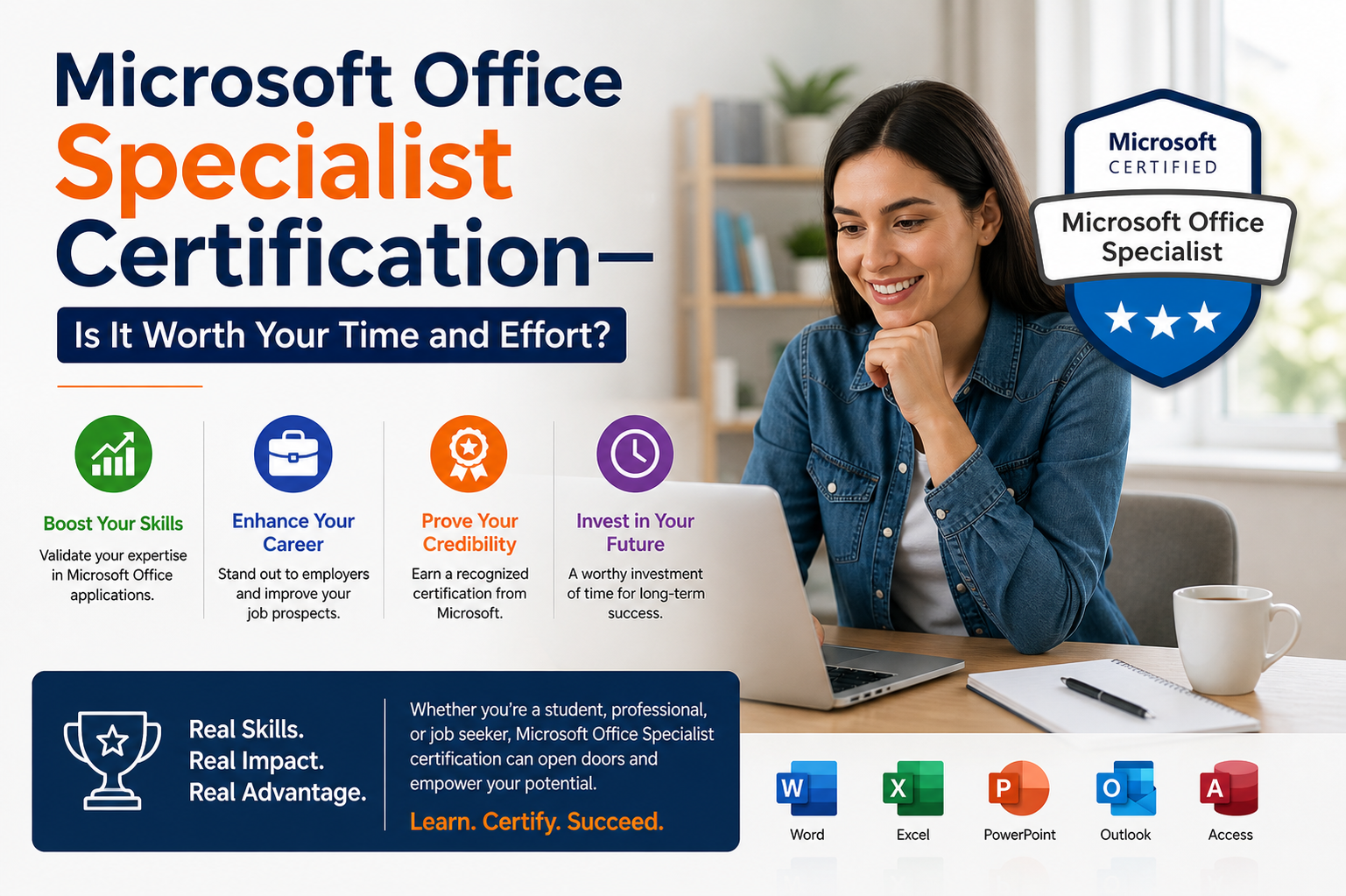
The Microsoft Office Specialist certification is often discussed as a practical credential for individuals who want to prove their proficiency in Microsoft Office tools. In today’s digital-first workplace, where almost every job involves some level of document creation, data handling, or presentation design, this certification continues to attract attention. To understand whether it is truly worth your time and effort, it is important to go beyond surface-level opinions and examine its role in education, employment, skill development, and long-term career growth.
Understanding What the Certification Actually Represents
The Microsoft Office Specialist certification is not just a basic computer literacy badge. It is a structured assessment that evaluates how well a person can use Microsoft Office applications in real-world scenarios. Instead of focusing on theory, it tests practical ability in tools like Word, Excel, PowerPoint, and Outlook. This means candidates are expected to perform tasks such as formatting documents, managing data, creating charts, designing presentations, and organizing communication efficiently.
What makes this certification different from casual software knowledge is its standardized evaluation system. Many people believe they “know Excel” or “can use Word,” but the certification measures skill depth in a consistent and globally recognized format. This distinction is important because employers often look for proof rather than assumptions when hiring or promoting candidates.
Relevance in Today’s Job Market
In modern workplaces, digital proficiency is no longer optional. Even entry-level roles require familiarity with spreadsheets, written communication tools, and presentation software. The MOS certification becomes relevant here because it acts as a clear indicator that a candidate can handle these responsibilities without extensive training.
For job seekers, especially those with limited experience, this certification can help bridge the gap between education and employment. It signals readiness for administrative roles, office coordination positions, data entry jobs, and support functions. In competitive hiring environments, small advantages like verified software skills can make a noticeable difference in shortlisting decisions.
However, it is also important to understand its limitations. While MOS certification can improve employability, it is rarely a deciding factor for advanced or specialized roles. Employers in technical, managerial, or strategic positions usually prioritize experience, problem-solving ability, and domain knowledge over software certification alone.
Skill Development Beyond Basic Usage
One of the most overlooked benefits of pursuing this certification is the structured learning process it encourages. Many users of Microsoft Office applications operate at a basic level, using only a fraction of available features. Preparing for MOS exams often forces learners to explore advanced tools and techniques they would otherwise ignore.
For example, in Excel, candidates may move beyond simple formulas and learn about data analysis functions, conditional formatting, pivot tables, and automation features. In Word, they may gain deeper understanding of styles, referencing systems, and document structuring. In PowerPoint, they may learn professional design principles rather than just creating simple slides.
This shift from casual use to structured proficiency often leads to increased productivity in real work environments. Tasks that previously took hours can be completed more efficiently once users understand optimized workflows and hidden features within the software.
Confidence and Workplace Efficiency
Another significant advantage of MOS certification is the confidence it builds. Many professionals hesitate when using advanced features in Microsoft Office applications because they are unsure of the correct methods. This hesitation can slow down productivity and lead to repeated errors.
By going through certification training, individuals develop familiarity with a wide range of tools and functions. This reduces uncertainty and increases confidence when handling workplace tasks. Employees who are confident in their technical abilities are often more independent, require less supervision, and can adapt more quickly to new responsibilities.
Efficiency is another key outcome. Certified individuals are often able to complete documentation, reporting, and presentation tasks faster because they understand shortcuts, templates, and built-in features that streamline workflow.
Academic and Student Advantages
For students, especially those in business, commerce, IT, or administrative studies, the MOS certification can serve as a practical supplement to academic learning. Many educational programs focus heavily on theory but do not always provide deep training in office software tools.
By obtaining certification, students can demonstrate job-ready skills before entering the workforce. This can be particularly helpful when applying for internships, part-time roles, or entry-level positions where practical ability is valued.
It also helps students become more efficient in academic tasks. Assignments, research papers, data analysis projects, and presentations can all be improved through better use of Microsoft Office tools. This creates a dual benefit: improved academic performance and stronger employability.
Global Recognition and Standardization
One of the strengths of the Microsoft Office Specialist certification is its global recognition. Microsoft is a widely used platform across industries and countries, which means the certification carries relevance in many job markets.
Standardization is another key factor. Unlike informal training or self-learning claims, MOS certification follows a structured evaluation system. This ensures that certified individuals meet a consistent benchmark of skill, regardless of where they are located or how they prepared.
This global consistency makes it easier for employers to evaluate candidates from different backgrounds. It provides a common reference point for assessing technical ability in Microsoft Office applications.
Limitations and Realistic Expectations
Despite its benefits, it is important to maintain realistic expectations about what MOS certification can and cannot do. It is not a substitute for professional experience, advanced technical degrees, or industry-specific expertise.
In many cases, it is considered an entry-level or foundational certification. This means its impact is strongest at the beginning of a career journey rather than at senior or specialized levels. Professionals who already have years of experience using Microsoft Office may find limited additional value unless they are seeking formal validation.
Another limitation is that the certification focuses primarily on tool usage rather than problem-solving or critical thinking. While it proves that someone can operate software efficiently, it does not measure creativity, leadership, or strategic decision-making skills.
Time Investment and Learning Curve
The time required to prepare for MOS certification varies depending on existing skill levels. For individuals already familiar with Microsoft Office tools, preparation may be relatively quick and focused on refining advanced features. For beginners, however, it may require more structured learning and practice.
The learning curve is generally manageable because the software itself is widely used and intuitive. However, achieving certification-level proficiency requires attention to detail and consistent practice. Understanding not just how tools work, but when and why to use them, is a key part of preparation.
This time investment should be viewed as a form of skill building rather than just exam preparation. The value comes not only from passing the certification but also from the improved capability gained during the learning process.
Impact on Career Progression
In early career stages, MOS certification can act as a stepping stone toward better opportunities. It can improve chances of getting shortlisted for interviews and may even influence starting salary negotiations in some cases.
As careers progress, its role typically shifts from a differentiating factor to a supporting credential. At mid and senior levels, employers focus more on experience, leadership, and specialized expertise. However, strong foundational skills in Microsoft Office remain useful throughout all career stages.
In fields such as administration, finance, marketing support, and education, these tools continue to play a central role in daily tasks. Therefore, the certification retains practical relevance even if its direct influence on hiring decisions decreases over time.
Long-Term Practical Benefits
Beyond immediate career impact, MOS certification contributes to long-term digital literacy. As workplaces continue to evolve and adopt new technologies, foundational software skills remain essential.
The ability to efficiently handle documents, analyze data, and create presentations is transferable across industries. Even if job roles change over time, these core competencies remain useful.
Additionally, individuals who build strong Microsoft Office skills often find it easier to adapt to new software systems. The logical structure and workflow understanding gained during certification preparation can be applied to other digital tools as well.
Overall Perspective on Value
When evaluating whether the Microsoft Office Specialist certification is worth the time and effort, the answer depends largely on personal and professional goals. For beginners, students, and job seekers, it offers clear advantages in skill development, confidence building, and employability.
For experienced professionals, its value may lie more in formal validation and structured skill refinement rather than career transformation. It is not a shortcut to success, but rather a supportive tool that strengthens foundational abilities.
Ultimately, its true worth is best measured not only by the certificate itself but by the improvement in practical skills and efficiency gained during the preparation process.
Microsoft Office Specialist Certification—Advanced Perspective on Career and Practical Impact
Continuing the discussion, it is important to look deeper into how the Microsoft Office Specialist certification fits into long-term career planning and whether it still holds relevance in an evolving digital landscape. While many certifications rise and fall in importance, MOS has maintained a steady position because Microsoft Office tools remain central to everyday professional work across industries. However, its real value becomes clearer when examined in terms of career strategy, workplace expectations, and evolving skill demands.
Role in Career Entry and First Job Opportunities
For individuals entering the workforce for the first time, MOS certification can serve as a practical entry point into professional environments. Many employers expect candidates to already possess basic computer literacy, but in reality, skill levels vary widely. Having a recognized certification helps eliminate doubt about a candidate’s ability to handle essential office tasks.
In roles such as administrative assistant, data entry operator, office coordinator, customer support executive, and junior analyst positions, Microsoft Office tools are used daily. Employers in these areas often prefer candidates who require minimal training and can contribute immediately. MOS certification helps demonstrate that readiness.
It is important to understand that the certification does not guarantee employment, but it can increase visibility during the selection process. In competitive applicant pools, even small advantages can influence whether a resume is shortlisted or overlooked.
Strengthening Professional Discipline and Work Habits
Beyond technical knowledge, preparing for MOS certification indirectly builds discipline in work habits. The structured nature of the exam encourages learners to focus on accuracy, efficiency, and attention to detail. These qualities are not limited to software usage but extend into general professional behavior.
For example, working with Excel formulas requires logical thinking and careful error checking. Document formatting in Word demands consistency and precision. Presentation design in PowerPoint encourages clarity and structured communication. These habits, once developed, often carry over into everyday job performance.
This type of skill development is subtle but valuable. Employers consistently look for individuals who not only complete tasks but do so with reliability and consistency.
Impact on Productivity in Real Work Environments
One of the strongest practical advantages of MOS certification is improved productivity. Many employees use Microsoft Office applications daily but are unaware of advanced features that can significantly reduce time spent on repetitive tasks.
Certified individuals are more likely to use automation tools, keyboard shortcuts, templates, and advanced functions that streamline workflow. In Excel, this might mean using formulas and data tools instead of manual calculations. In Word, it may involve using styles and formatting systems instead of repeated manual adjustments.
Over time, these improvements in efficiency can lead to measurable productivity gains. In office environments where time management is critical, such improvements can make a noticeable difference in performance evaluations.
Relevance Across Different Industries
Another important aspect of MOS certification is its cross-industry relevance. Unlike some certifications that are limited to specific fields, Microsoft Office tools are used in nearly every sector.
In finance and accounting, Excel is essential for budgeting, reporting, and analysis. In marketing, PowerPoint is widely used for presentations and proposals. In education, Word and PowerPoint support teaching materials and academic documentation. In healthcare administration, Excel and Word assist in record keeping and reporting.
This widespread usage means the certification does not become irrelevant when switching industries. Instead, it provides a consistent skill base that remains useful in different professional environments.
Comparison with Other Skill Certifications
When compared with more advanced or specialized certifications, MOS occupies a foundational level. Certifications in data science, programming, cloud computing, or project management often carry higher long-term career impact. However, these typically require stronger prerequisites and more complex learning paths.
MOS certification, on the other hand, focuses on accessibility. It is designed for a broad audience and does not require advanced technical background. This makes it particularly valuable for beginners who need to build confidence before moving into more specialized fields.
In many cases, MOS certification can act as a stepping stone toward more advanced digital skills. It helps individuals become comfortable with structured learning, exam preparation, and applied software usage.
Employer Expectations and Digital Literacy Standards
Modern employers increasingly expect employees to have strong digital literacy skills. This includes not only basic computer usage but also the ability to work efficiently with office software. MOS certification aligns closely with these expectations by validating core competencies.
However, employers also expect adaptability. Software tools evolve over time, and new features are constantly introduced. While MOS certification demonstrates current proficiency, long-term success depends on continuous learning and adaptability.
Therefore, the certification should be viewed as part of a broader skill development journey rather than a final achievement.
Return on Investment in Terms of Effort
When evaluating whether MOS certification is worth the effort, it is useful to consider the return on investment in terms of time, money, and learning outcomes. The preparation process typically requires moderate effort, especially for individuals who already use Microsoft Office regularly.
The financial cost is relatively lower compared to many professional certifications, making it accessible to students and early-career professionals. The learning benefit, however, extends beyond the exam itself. Skills gained during preparation often remain useful throughout one’s career.
In this sense, the return on investment is not limited to certification achievement but includes long-term improvement in efficiency and confidence.
Common Misunderstandings About the Certification
There are several misconceptions surrounding MOS certification. One common misunderstanding is that it guarantees a high-paying job or rapid career advancement. In reality, it is a supporting credential rather than a standalone career driver.
Another misconception is that it is only useful for beginners. While it is most impactful at entry level, even experienced professionals can benefit from refining their skills and discovering advanced features they may not use regularly.
Some also assume that practical experience is more important than certification. While experience is indeed critical, certification and experience serve different purposes. Experience demonstrates application in real scenarios, while certification validates standardized skill levels.
Long-Term Career Value and Skill Retention
Over time, the value of MOS certification is reflected in how well individuals retain and apply the skills learned. Unlike some certifications that become outdated quickly, Microsoft Office skills remain relevant because the software is continuously used in workplaces.
Even as new tools emerge, Microsoft Office remains a core productivity suite in many organizations. This ensures that the skills developed through certification continue to be useful.
Additionally, individuals who start with MOS certification often find it easier to learn other digital tools. The structured understanding of software functions helps in adapting to new platforms more quickly.
Strategic Use of Certification in Career Planning
From a strategic perspective, MOS certification should be used as part of a broader career development plan. It is most effective when combined with other skills such as communication, analytical thinking, and domain-specific knowledge.
For example, someone pursuing a career in finance may combine MOS certification with accounting knowledge. A marketing professional may use it alongside digital marketing skills. In this way, the certification enhances rather than defines career direction.
It is also useful for individuals who want to transition into office-based roles from non-technical backgrounds. It provides a structured entry point into digital workplace environments.
Evaluation of Its Worth
When viewed holistically, the Microsoft Office Specialist certification holds practical and meaningful value, especially for those at the beginning of their careers or seeking to strengthen foundational skills. It may not be a high-impact credential on its own, but it plays an important supporting role in skill development, employability, and workplace efficiency.
Its true worth lies in the combination of improved technical ability, increased confidence, and better preparedness for real-world office tasks. While it should not be seen as the ultimate career achievement, it remains a reliable and practical step toward professional growth in a digitally driven work environment.
Microsoft Office Specialist Certification—Long-Term Career Relevance and Evolving Workplace Value
As workplace environments continue to evolve with automation, artificial intelligence, and cloud-based tools, many people question whether traditional certifications like the Microsoft Office Specialist still hold value. The answer depends on how the certification is positioned within broader digital skill development. While technology changes rapidly, core productivity tools such as Word, Excel, and PowerPoint remain deeply embedded in business operations worldwide. This makes MOS certification more resilient than it may appear at first glance.
Stability of Microsoft Office in Modern Workplaces
Despite the rise of alternative productivity platforms and collaborative tools, Microsoft Office continues to dominate in corporate, educational, and government environments. Documents, spreadsheets, and presentations are still fundamental to communication and decision-making processes.
This stability means that the skills validated by MOS certification do not become outdated quickly. Even as newer features like cloud collaboration and AI-assisted writing are introduced, the core functions of these applications remain consistent. Understanding these foundations ensures that certified individuals can adapt to new updates without difficulty.
In practical terms, this stability protects the long-term value of the certification. It is not tied to a temporary technology trend but to a system that has been widely used for decades and continues to evolve gradually rather than being replaced.
Adaptability to New Features and Updates
One of the strengths of MOS certification is that it encourages familiarity with the structure of Microsoft Office applications rather than just memorizing steps. This structural understanding makes it easier for individuals to adapt when software updates introduce new features or interface changes.
For example, when Excel introduces new data analysis tools or PowerPoint enhances design capabilities, users with strong foundational knowledge can quickly integrate these changes into their workflow. Instead of relearning the entire system, they simply adjust their existing understanding.
This adaptability is increasingly important in modern workplaces where software tools are frequently updated. Employees who can adjust quickly are often more valuable than those who only know static procedures.
Role in Remote and Hybrid Work Environments
The rise of remote and hybrid work models has increased reliance on digital tools for communication and collaboration. Microsoft Office applications, especially Word, Excel, PowerPoint, and Outlook, play a central role in this environment.
MOS certification becomes relevant here because it ensures that individuals can work efficiently without in-person assistance. Tasks such as creating reports, managing spreadsheets, preparing presentations, and handling email communication must often be done independently in remote settings.
Employees who are proficient in these tools are better equipped to manage workload without constant supervision. This independence is highly valued in distributed work environments where efficiency and self-management are essential.
Contribution to Professional Communication Skills
Although MOS certification is primarily technical, it indirectly strengthens communication skills. Microsoft Word helps improve structured writing, Excel enhances data-based communication, and PowerPoint improves visual storytelling.
These tools are often used to communicate ideas, reports, and decisions within organizations. A well-formatted document or a clear presentation can significantly influence how information is received and understood.
Certified individuals tend to develop a stronger sense of clarity and structure in their communication because they learn how to present information in organized and visually effective ways. This can improve overall professional impact beyond technical execution.
Value for Freelancers and Independent Professionals
MOS certification is not limited to traditional office employees. Freelancers, consultants, and independent professionals can also benefit from it. Many freelance roles require document preparation, data analysis, reporting, or presentation design.
For freelancers, strong Microsoft Office skills can expand service offerings and improve client satisfaction. Being able to deliver polished documents, accurate spreadsheets, and professional presentations increases credibility and competitiveness in the freelance market.
Additionally, freelancers often work with clients who expect quick turnaround times. Efficiency gained through MOS-level skills can help meet deadlines more effectively, improving client relationships and repeat business opportunities.
Psychological Advantage and Professional Confidence
Beyond technical and career benefits, there is also a psychological advantage associated with certification. Many individuals experience uncertainty when using advanced software features. This hesitation can reduce efficiency and increase reliance on others.
MOS certification helps reduce this uncertainty by providing structured knowledge and practice. As confidence increases, individuals are more willing to explore new features and take on complex tasks.
This confidence often translates into better workplace performance, stronger participation in team projects, and increased willingness to take initiative. While this is not always measurable in formal evaluations, it contributes significantly to overall professional growth.
Limitations in a Rapidly Changing Digital Landscape
Even though MOS certification has long-term value, it is important to recognize its limitations in a rapidly changing digital environment. Many modern workplaces are increasingly adopting specialized tools for data analysis, project management, automation, and collaboration.
In such environments, Microsoft Office skills alone may not be sufficient. Employers may expect familiarity with additional platforms such as data visualization tools, cloud-based collaboration systems, or industry-specific software.
This does not reduce the importance of MOS certification but highlights the need for continuous learning. It should be seen as a foundation rather than a complete skill set.
Integration with Advanced Digital Skills
The most effective career strategy involves combining MOS certification with more advanced digital skills. For example, Excel knowledge can be expanded into data analytics or business intelligence. PowerPoint skills can support roles in marketing and communication strategy. Word proficiency can support documentation-heavy professions such as law, administration, or research.
This layered skill approach allows individuals to build from a strong foundation toward specialized expertise. MOS certification serves as the starting point for this progression.
It also helps learners understand basic digital workflows, making it easier to transition into more complex software ecosystems later in their careers.
Employer Perception in Modern Hiring Practices
From an employer’s perspective, MOS certification is generally viewed as a positive indicator of basic competence rather than advanced expertise. It signals that a candidate has taken the initiative to validate their skills and is comfortable with essential office tools.
However, hiring decisions are usually based on a combination of factors, including experience, problem-solving ability, communication skills, and adaptability. MOS certification contributes to the overall profile but does not dominate it.
In entry-level hiring, it can be more influential because it helps differentiate candidates with similar educational backgrounds. In mid-career or senior roles, its impact becomes more supplementary.
Educational Institutions and Training Value
Many educational institutions encourage or integrate MOS certification into their curriculum because it provides a structured way to teach digital literacy. Students benefit from hands-on learning that directly connects academic concepts with practical software usage.
This integration helps reduce the gap between academic learning and workplace expectations. Students who complete MOS training often feel more prepared for internships and entry-level roles because they have already practiced essential office tasks.
In this sense, the certification also plays an important role in shaping early career readiness.
Final Reflection on Long-Term Worth
Looking at the certification from a long-term perspective, its value is best understood as foundational and supportive rather than transformative on its own. It provides essential skills that remain relevant across industries, job roles, and career stages.
Its strongest contribution lies in building digital confidence, improving productivity, and creating a reliable base for further skill development. While it may not be the most advanced or specialized certification available, it remains one of the most practical and widely applicable.
Ultimately, the Microsoft Office Specialist certification is worth the time and effort for individuals who aim to strengthen their digital competence, improve workplace efficiency, and build a solid foundation for future career growth.
Microsoft Office Specialist Certification—Future Outlook and Evolving Career Relevance
As technology continues to advance, the role of traditional productivity tools is also evolving. Artificial intelligence, automation, and cloud-based collaboration are changing how work is performed in many industries. However, despite these changes, the Microsoft Office Specialist certification continues to maintain relevance because it is built around tools that remain deeply embedded in professional workflows.
The future value of MOS certification depends not only on the software itself but also on how individuals integrate these skills into broader digital ecosystems. Understanding this context is essential when evaluating its long-term worth.
Influence of Artificial Intelligence on Office Tools
Artificial intelligence is increasingly being integrated into Microsoft Office applications. Features such as automated writing suggestions in Word, intelligent data insights in Excel, and design recommendations in PowerPoint are becoming more common.
Rather than replacing traditional skills, these features enhance them. Users still need to understand the core functions of the software in order to use AI tools effectively. Without foundational knowledge, automation features can be misused or underutilized.
MOS certification provides that foundation. It ensures that users understand how the software works at a fundamental level before relying on advanced automation features. This combination of basic skill and intelligent assistance is likely to define the future of productivity tools.
Shift Toward Cloud-Based Collaboration
Modern workplaces are increasingly shifting toward cloud-based collaboration systems. Microsoft Office has adapted to this trend through online versions and integrated cloud services that allow real-time collaboration.
This shift does not reduce the importance of MOS certification but expands its relevance. Individuals who understand core Office applications can more easily transition into collaborative environments where documents are shared, edited, and managed in real time.
Skills such as formatting consistency, data organization, and structured presentation remain essential even in collaborative digital spaces. MOS certification helps ensure that users can maintain quality and efficiency in shared work environments.
Sustainability of Core Office Skills
While technology trends change, core office skills remain surprisingly stable. Writing structured documents, analyzing data, and creating presentations are fundamental tasks that exist across industries and job roles.
MOS certification focuses on these core skills rather than temporary software trends. This makes it more resilient compared to certifications tied to rapidly changing technologies.
Even as new tools emerge, the ability to organize information clearly and communicate it effectively will always remain valuable. This long-term stability is one of the strongest arguments in favor of the certification’s continued relevance.
Career Flexibility and Job Mobility
One of the less obvious advantages of MOS certification is its contribution to career flexibility. Because Microsoft Office is used across nearly every industry, the skills learned are transferable between different job roles and sectors.
An individual with MOS certification can move from administrative roles to finance support, education, marketing assistance, or customer service environments without needing to relearn basic tools. This flexibility is especially valuable in uncertain job markets where career changes may be necessary.
It also supports upward mobility. As individuals gain experience, their foundational Office skills continue to support more advanced responsibilities, even if the focus of their job changes over time.
Importance in Developing Economies and Emerging Markets
In developing economies and emerging job markets, MOS certification can carry even greater importance. Many employers in these regions prioritize candidates with proven digital skills because training resources may be limited.
In such environments, certification can serve as a strong indicator of readiness for office-based employment. It helps bridge the gap between education systems and workplace expectations.
Additionally, as global outsourcing and remote work opportunities increase, individuals with MOS certification can access international job markets where digital literacy is a minimum requirement.
Role in Lifelong Learning and Skill Development Culture
Modern careers increasingly require continuous learning rather than static skill sets. MOS certification can play a role in establishing this mindset early in a professional journey.
By preparing for certification, individuals become familiar with structured learning, goal-oriented practice, and skill validation. These habits are valuable beyond Microsoft Office and can be applied to other areas of professional development.
This contributes to a broader culture of lifelong learning, where individuals continuously upgrade their skills to remain competitive in changing job markets.
Limitations in Advanced Career Stages
As professionals progress in their careers, the relative importance of MOS certification tends to decrease. At senior levels, employers prioritize leadership, strategic thinking, industry expertise, and decision-making ability.
While Microsoft Office skills remain useful, they are generally assumed rather than explicitly tested. At this stage, MOS certification does not significantly influence promotions or high-level hiring decisions.
However, it can still provide value in roles that involve reporting, documentation, or team coordination, where clarity and efficiency in communication are important.
Balancing Certification with Practical Experience
One of the most important considerations is the balance between certification and real-world experience. MOS certification provides structured knowledge, but practical application in workplace environments develops deeper understanding.
The most effective professionals are those who combine both. Certification ensures technical accuracy, while experience builds adaptability and problem-solving skills.
In many cases, employers value this combination more than either element alone. MOS certification can therefore be seen as a supporting pillar within a broader professional development structure.
Evolving Expectations of Digital Competence
Digital competence is no longer limited to basic software usage. Employers now expect individuals to understand data interpretation, digital communication, and efficient workflow management.
MOS certification contributes to this foundation but must be complemented with additional skills to remain competitive. These may include data analysis, communication strategy, or familiarity with emerging digital tools.
The certification remains relevant because it teaches structured thinking within digital environments, which is a transferable skill across many platforms.
Long-Term Professional Identity Building
Over time, skills and certifications contribute to professional identity. MOS certification can be part of that identity, especially for individuals in administrative, support, or business roles.
It signals reliability, attention to detail, and technical competence in essential workplace tools. While it may not define an entire career, it contributes to how professionals are perceived in organizational settings.
This perception can influence trust, responsibility levels, and task assignments within teams.
Final Evaluation of Future Worth
Looking toward the future, Microsoft Office Specialist certification remains a practical and stable credential. Its value is not based on trend-driven technology but on consistent workplace needs that continue to exist across industries.
Its strongest contribution lies in foundational digital literacy, productivity improvement, and career entry support. While it may not be a high-level differentiator in advanced roles, it continues to serve as a reliable starting point for professional development.
Ultimately, its worth is sustained by its adaptability, widespread relevance, and ability to support lifelong digital skill growth in an evolving technological landscape.
Conclusion
The Microsoft Office Specialist certification holds steady value as a practical, skills-based credential in today’s digital workplace. Its strength lies not in being an advanced or specialized qualification, but in validating essential, everyday competencies that almost every professional environment depends on. From document creation and data management to presentations and communication, the skills it certifies remain widely used across industries.
For beginners, students, and early-career professionals, it can be a meaningful stepping stone that builds confidence, improves productivity, and strengthens employability. It helps bridge the gap between theoretical knowledge and real workplace expectations, making the transition into professional roles smoother and more structured.
For experienced professionals, its value shifts more toward refinement and formal validation rather than career transformation. It may not independently drive promotions or high-level opportunities, but it continues to support efficiency and clarity in daily tasks. Its usefulness is sustained by the fact that Microsoft Office tools remain deeply embedded in modern business operations.
At the same time, it is important to view the certification realistically. It is not a substitute for experience, critical thinking, or advanced technical expertise. Instead, it works best as part of a broader skill set that includes communication, adaptability, and domain-specific knowledge.
Overall, the Microsoft Office Specialist certification is worth the time and effort for individuals who want to build strong digital fundamentals, increase workplace efficiency, and establish a reliable base for future career growth. Its long-term value lies in its practicality, consistency, and continued relevance in an evolving digital world.