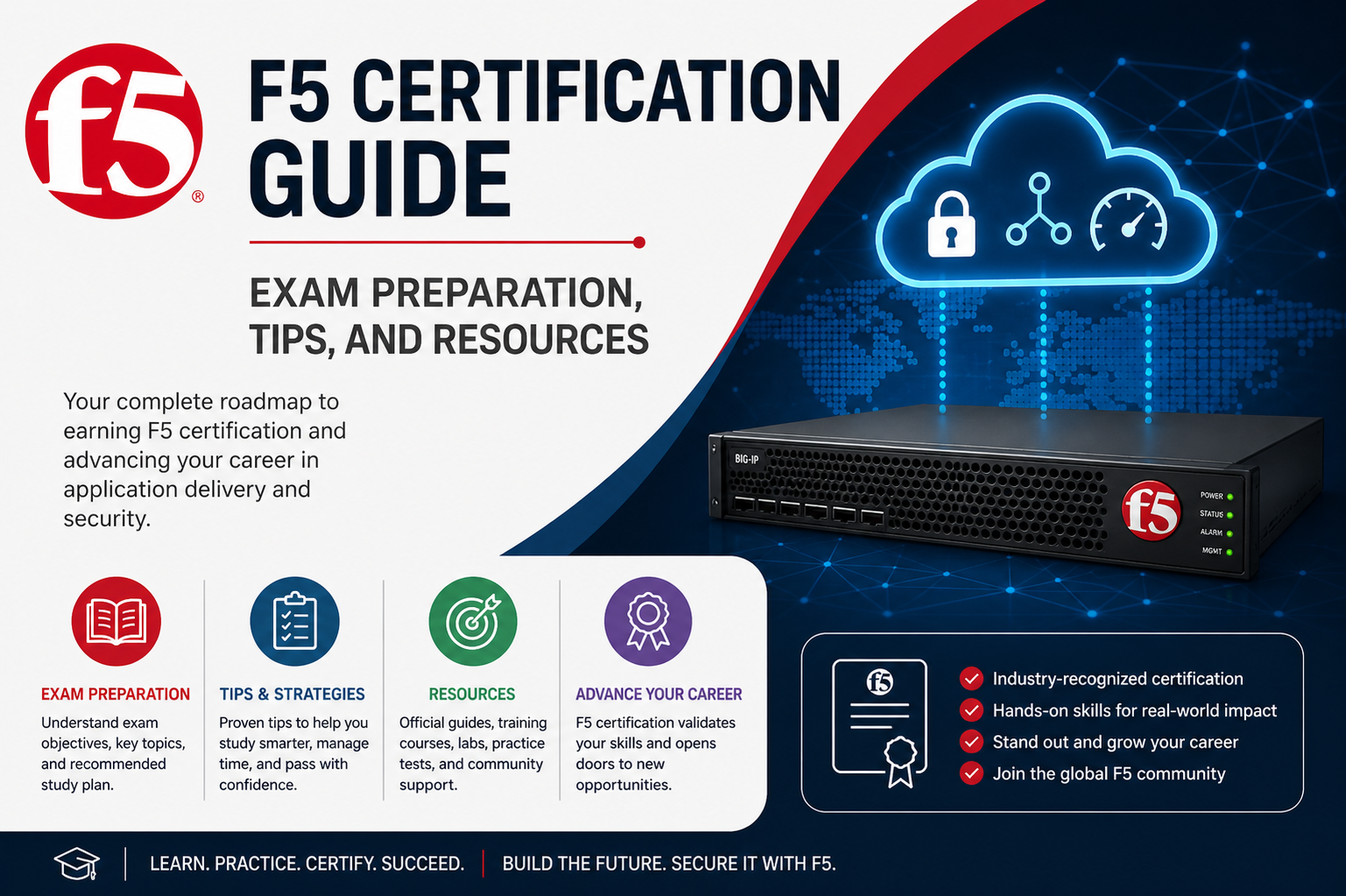
F5 certification is a professional credential designed for IT and networking specialists who want to validate their expertise in application delivery, security, and performance optimization. F5 Networks is widely known for its advanced application services, especially BIG-IP solutions, which are used by enterprises worldwide to manage traffic, secure applications, and ensure high availability.
In today’s digital environment, businesses rely heavily on application performance and cybersecurity. This is where F5-certified professionals play a crucial role. The certification demonstrates that an individual understands how to deploy, configure, and manage F5 technologies effectively in real-world environments. It also helps professionals stand out in competitive IT job markets where specialized networking skills are in high demand.
F5 certification is not just about passing an exam; it is about gaining practical knowledge that directly applies to enterprise-grade infrastructure. Organizations prefer certified professionals because they reduce system downtime, improve application delivery efficiency, and strengthen security architecture.
Overview of F5 Certification Levels
F5 certification is structured into multiple levels to support learners from beginner to advanced expertise. Each level focuses on different technical competencies and real-world applications.
At the foundational level, candidates are introduced to core networking concepts and F5 system basics. This stage helps build a strong understanding of traffic management and load balancing principles. As candidates progress, they move into more advanced topics such as security policies, automation, and troubleshooting complex network environments.
Intermediate and advanced certifications focus on deep technical mastery of BIG-IP systems, including LTM (Local Traffic Manager), ASM (Application Security Manager), and DNS modules. These certifications are ideal for professionals working in enterprise IT environments or cloud-based infrastructures.
Each certification level builds on the previous one, ensuring a structured learning path that enhances both theoretical understanding and hands-on technical skills.
Importance of BIG-IP in F5 Certification
The BIG-IP platform is the core technology behind F5 certification. It is an application delivery controller (ADC) that manages traffic between users and servers efficiently. Understanding BIG-IP is essential for anyone pursuing F5 certification because it forms the foundation of most exam topics and practical scenarios.
BIG-IP helps organizations distribute network traffic intelligently, ensuring that applications remain available even under heavy load. It also enhances security by filtering malicious traffic and applying access control policies. In modern IT environments, BIG-IP is often integrated with cloud systems, making it a critical tool for hybrid infrastructure management.
Professionals who master BIG-IP gain the ability to optimize application performance, reduce latency, and improve user experience across global networks. This makes F5 certification highly valuable in enterprise IT roles.
Career Opportunities After F5 Certification
One of the biggest advantages of F5 certification is the wide range of career opportunities it opens. Certified professionals are in demand across industries such as banking, telecommunications, healthcare, and cloud service providers.
Common job roles include network engineer, application delivery engineer, security specialist, and systems administrator. These roles involve managing large-scale IT infrastructures, ensuring application availability, and implementing security policies using F5 technologies.
As organizations continue to move toward cloud-based and hybrid environments, the demand for F5-certified professionals is expected to grow. Companies need experts who can ensure smooth application delivery while maintaining strong cybersecurity measures.
In addition to job opportunities, F5 certification often leads to higher salary packages and career advancement. Professionals with this certification are considered highly skilled, which gives them an edge in promotions and senior-level positions.
Skills Required for F5 Certification
To succeed in F5 certification, candidates should have a solid understanding of networking fundamentals. This includes knowledge of TCP/IP protocols, DNS, HTTP/HTTPS, and basic routing and switching concepts.
Hands-on experience with network devices and virtualized environments is also highly beneficial. Since F5 technologies are widely used in enterprise systems, practical exposure helps candidates understand real-world scenarios more effectively.
Problem-solving skills are equally important. Many certification exam questions are scenario-based, requiring candidates to analyze network issues and choose the best solution. Logical thinking and troubleshooting ability play a key role in passing the exam successfully.
Familiarity with Linux commands and basic scripting can also be an advantage, especially when working with advanced F5 configurations and automation tasks.
Structure of F5 Certification Exams
F5 certification exams are designed to test both theoretical knowledge and practical understanding. The exam format typically includes multiple-choice questions, scenario-based questions, and technical problem-solving tasks.
Each exam focuses on specific domains such as system configuration, traffic management, security policies, and performance optimization. Candidates are expected to understand how F5 solutions are implemented in real-world environments rather than just memorizing concepts.
Time management is an important factor during the exam. Questions are designed to evaluate decision-making skills under time constraints, simulating real IT operational challenges.
Preparation for these exams usually involves a combination of study materials, hands-on labs, and practice tests to build confidence and accuracy.
Benefits of Learning F5 Technologies
Learning F5 technologies provides significant benefits for IT professionals. One of the main advantages is gaining expertise in application delivery and network optimization, which are critical in modern enterprise systems.
F5 skills also enhance understanding of cybersecurity principles. Professionals learn how to protect applications from threats such as DDoS attacks, unauthorized access, and data breaches. This makes them valuable assets in organizations where security is a top priority.
Another major benefit is improved problem-solving ability. Working with F5 systems requires analyzing complex network issues and implementing efficient solutions. This strengthens technical thinking and prepares professionals for advanced IT roles.
F5 knowledge is also highly transferable across industries. Whether working in cloud computing, data centers, or enterprise networks, these skills remain relevant and in demand.
Real-World Applications of F5 Technology
F5 technology is used in a wide range of real-world applications. One of the most common use cases is load balancing, where traffic is distributed across multiple servers to ensure optimal performance.
It is also widely used in application security, where it helps protect web applications from cyber threats. F5 systems can detect and block malicious traffic before it reaches critical infrastructure.
In cloud environments, F5 plays an important role in managing hybrid and multi-cloud architectures. It ensures consistent application performance across different platforms and regions.
Large organizations use F5 solutions to maintain high availability of services, especially for mission-critical applications such as banking systems, online retail platforms, and government services.
Challenges in F5 Certification Preparation
Although F5 certification is highly rewarding, it can be challenging for beginners. One of the main difficulties is understanding complex networking concepts and how they apply to F5 systems.
Another challenge is gaining hands-on experience. Since F5 technologies are typically used in enterprise environments, access to real systems or lab setups may be limited for some learners.
Time management during preparation is also a common issue. The certification covers a wide range of topics, requiring consistent study and practice over time.
However, with proper planning, structured learning resources, and regular practice, these challenges can be overcome successfully.
Deep Dive into F5 BIG-IP Architecture
Understanding the architecture of F5 BIG-IP is essential for mastering advanced certification topics. BIG-IP is built as a modular system designed to handle application delivery, security enforcement, and traffic management in a highly scalable way.
At its core, BIG-IP operates as an Application Delivery Controller that sits between users and backend servers. It intelligently manages traffic flow based on configured policies, ensuring applications remain fast, secure, and available even under heavy load conditions.
The architecture is typically divided into multiple layers, including the traffic management operating system, control plane, and data plane. The control plane is responsible for configuration and management, while the data plane handles real-time traffic processing. This separation ensures high performance and reliability in enterprise environments.
A strong understanding of this architecture helps candidates answer scenario-based exam questions where system behavior, traffic flow, and module interaction are tested.
Understanding F5 Modules in Detail
F5 BIG-IP is composed of multiple modules, each serving a specific purpose in application delivery and security management. These modules are a core part of advanced certification exams and practical implementations.
The Local Traffic Manager module is responsible for distributing traffic across servers using load balancing algorithms. It ensures that no single server becomes overloaded, improving application performance and reliability.
The Application Security Manager module focuses on protecting web applications from attacks such as SQL injection, cross-site scripting, and other OWASP-based threats. It acts as a web application firewall, filtering malicious requests before they reach backend systems.
The DNS module manages domain name resolution and global traffic distribution. It ensures users are directed to the nearest or most efficient server location, improving response time and availability.
Other important modules include Access Policy Manager for identity-based access control and Advanced Firewall Manager for network-level security enforcement. Understanding how these modules interact is critical for both exams and real-world deployments.
Traffic Management and Load Balancing Concepts
Traffic management is one of the most important areas in F5 certification. It involves controlling how user requests are distributed across multiple servers to ensure optimal performance and reliability.
Load balancing algorithms play a key role in this process. Common methods include round robin, least connections, and weighted distribution. Each method is used based on application requirements and infrastructure design.
Round robin distributes requests evenly across all available servers, making it suitable for environments where all servers have similar capacity. Least connections directs traffic to the server with the fewest active connections, which is ideal for dynamic workloads.
Weighted load balancing allows administrators to assign different capacities to servers based on performance capabilities. This ensures high-performance servers handle more traffic while maintaining system balance.
Understanding these concepts is crucial for troubleshooting performance issues and designing scalable application architectures.
F5 Security Features and Application Protection
Security is a major focus area in F5 certification. Modern applications face constant threats from cyberattacks, making security enforcement a critical responsibility of F5 systems.
BIG-IP provides multiple layers of security, including network-level protection, application-level filtering, and access control mechanisms. These layers work together to ensure comprehensive defense against both external and internal threats.
Web application firewall functionality helps detect and block malicious traffic patterns. It analyzes incoming requests and compares them against predefined security policies. Suspicious requests are blocked before reaching application servers.
F5 also supports SSL offloading, which decrypts secure traffic at the load balancer level. This reduces the processing burden on backend servers and improves overall performance.
Access control policies ensure that only authorized users can access specific applications or services. This is especially important in enterprise environments where sensitive data must be protected at all times.
High Availability and Failover Mechanisms
High availability is a critical concept in F5 environments. It ensures that applications remain accessible even if hardware or software failures occur.
F5 achieves high availability through clustering and failover configurations. Multiple BIG-IP devices can be configured in active-passive or active-active setups. In an active-passive configuration, one device handles traffic while the other remains on standby. If the active device fails, the standby device takes over automatically.
In active-active setups, both devices handle traffic simultaneously, providing load distribution and redundancy. This setup improves performance while maintaining reliability.
Failover mechanisms continuously monitor system health and trigger automatic transitions when issues are detected. This ensures minimal downtime and uninterrupted service delivery.
Understanding high availability concepts is essential for both exam scenarios and real-world enterprise deployments.
Advanced Troubleshooting in F5 Systems
Troubleshooting is a key skill required for F5 certification and professional roles. It involves identifying and resolving issues related to traffic flow, performance, and configuration errors.
Common troubleshooting areas include virtual server misconfiguration, pool member health issues, SSL handshake failures, and routing problems. Each issue requires a structured approach to diagnose and resolve effectively.
F5 provides built-in diagnostic tools that help monitor system performance and identify bottlenecks. Logs, dashboards, and traffic analysis tools are widely used to investigate issues.
Candidates are often tested on scenario-based troubleshooting questions where they must analyze symptoms and determine the root cause of a problem.
Developing strong troubleshooting skills not only helps in exams but also in real-world network operations where quick problem resolution is critical.
Automation and Scripting in F5 Environments
Automation is becoming increasingly important in modern IT infrastructures, and F5 systems support automation through APIs and scripting capabilities.
Administrators can use automation tools to configure devices, deploy policies, and monitor system health without manual intervention. This improves efficiency and reduces the risk of human error.
F5 supports REST APIs that allow integration with orchestration platforms and cloud environments. These APIs enable automated deployment of load balancing configurations and security policies.
Scripting using tools like iRules allows administrators to customize traffic handling behavior. iRules are powerful scripts that can modify request and response behavior in real time based on defined conditions.
Understanding automation concepts is essential for advanced certification levels and modern DevOps-oriented environments.
Cloud Integration and Hybrid Deployments
F5 technologies are widely used in cloud and hybrid environments. Many organizations operate across multiple cloud platforms, requiring consistent application delivery and security management.
BIG-IP can be deployed in public cloud environments such as AWS, Azure, and Google Cloud. It ensures consistent traffic management policies across on-premises and cloud infrastructure.
Hybrid deployments combine traditional data centers with cloud systems, requiring seamless integration between environments. F5 helps bridge this gap by providing centralized control and unified policy enforcement.
Cloud integration is an important topic in advanced certification exams, as it reflects modern enterprise architecture trends.
Exam Preparation Strategies for Advanced Levels
Preparing for advanced F5 certification requires a structured and disciplined approach. Candidates should focus on both theoretical knowledge and hands-on practice.
Studying official documentation and training materials is essential for understanding core concepts. However, practical lab experience is equally important for reinforcing learning.
Building virtual lab environments allows candidates to simulate real-world scenarios and practice configurations. This helps in developing confidence and technical accuracy.
Time management during preparation is also critical. Breaking down topics into smaller sections and studying consistently improves retention and understanding.
Practice exams and scenario-based questions are highly recommended to simulate real test conditions and improve problem-solving speed.
Common Mistakes to Avoid During Preparation
Many candidates struggle during F5 certification due to common mistakes that can be avoided with proper planning.
One major mistake is relying only on theoretical study without practical experience. F5 exams are heavily scenario-based, requiring hands-on knowledge.
Another mistake is ignoring basic networking fundamentals. Without a strong foundation in networking, advanced concepts become difficult to understand.
Poor time management during preparation is also a common issue. Attempting to cover too many topics at once can lead to confusion and burnout.
Avoiding these mistakes significantly increases the chances of success in certification exams.
Real-World F5 Deployment Scenarios in Enterprises
In enterprise environments, F5 technologies are not used in isolation but as part of complex infrastructure ecosystems. One of the most common real-world deployments is in large-scale web applications where millions of users access services simultaneously.
Organizations such as banks, telecom companies, and e-commerce platforms use F5 BIG-IP to ensure that application traffic is distributed efficiently across multiple data centers. This prevents system overload and ensures uninterrupted service even during peak traffic periods.
In a typical deployment, F5 sits at the edge of the data center and acts as an intelligent traffic gateway. It receives incoming user requests, evaluates them based on configured policies, and forwards them to the most appropriate backend server. This process ensures optimal performance and minimal latency for end users.
F5 is also heavily used in disaster recovery setups. In case one data center goes offline, traffic is automatically redirected to a secondary location without affecting users. This capability is critical for businesses that require 24/7 availability.
Advanced Security Architecture with F5 Systems
Security at an enterprise level goes beyond basic firewall protection. F5 provides a layered security architecture that protects applications, data, and network infrastructure simultaneously.
One of the most important components in advanced security setups is the web application firewall. It inspects HTTP and HTTPS traffic in real time and blocks malicious requests before they reach application servers. This helps protect against attacks such as cross-site scripting, SQL injection, and bot-based threats.
F5 also supports advanced bot protection mechanisms. These systems can differentiate between human users and automated bots, preventing scraping, credential stuffing, and denial-of-service attacks.
Another critical feature is SSL inspection and offloading. In modern applications, a large percentage of traffic is encrypted. F5 decrypts this traffic at the edge, inspects it for threats, and then re-encrypts it before forwarding. This improves both security visibility and system performance.
Access control policies further strengthen security by ensuring that only authenticated and authorized users can access specific applications or services. This is especially important in industries handling sensitive data such as finance and healthcare.
Performance Optimization Techniques Using F5
Performance optimization is a core responsibility of F5-certified professionals. In enterprise environments, even small improvements in response time can significantly impact user experience and business outcomes.
One key optimization technique is intelligent load balancing. By analyzing server health, connection load, and response time, F5 dynamically distributes traffic to ensure optimal performance across all resources.
Caching is another important feature used to improve performance. Frequently accessed content can be stored at the F5 layer, reducing the need to repeatedly query backend servers. This significantly reduces latency and improves response times.
Compression techniques are also used to reduce bandwidth usage. F5 can compress data before sending it to users, especially for large web applications, resulting in faster load times and reduced network strain.
Connection multiplexing allows multiple user requests to be handled over fewer server connections. This reduces resource consumption and improves scalability in high-traffic environments.
High-Level Troubleshooting in Production Environments
In real production environments, troubleshooting becomes more complex due to multiple interacting systems. F5-certified professionals must be able to quickly identify and resolve issues to avoid downtime.
One common scenario involves uneven traffic distribution, where certain servers receive more load than others. This may be caused by misconfigured load balancing rules or incorrect health checks.
Another frequent issue is SSL handshake failure. This occurs when encryption settings between clients and servers are mismatched. Diagnosing this requires understanding certificate chains, encryption protocols, and cipher configurations.
Latency issues can also arise due to misconfigured routing paths or overloaded backend servers. In such cases, performance monitoring tools within F5 are used to identify bottlenecks and adjust traffic flow accordingly.
Effective troubleshooting requires a systematic approach: identifying symptoms, isolating the problem, analyzing logs, and implementing corrective actions. This structured methodology is essential for maintaining system stability in enterprise environments.
F5 in Cloud-Native and Hybrid Architectures
Modern IT infrastructures are increasingly moving toward cloud-native and hybrid models. F5 plays a critical role in bridging traditional data centers with cloud environments.
In hybrid architectures, F5 ensures consistent application delivery across on-premises systems and cloud platforms. This is achieved through centralized traffic management and unified security policies.
In cloud-native environments, F5 integrates with container orchestration platforms to manage microservices traffic. It ensures that communication between services remains secure, fast, and reliable.
Multi-cloud deployments are also becoming common, where applications are distributed across multiple cloud providers. F5 helps maintain consistency in performance and security across these environments.
This flexibility makes F5 a key technology for organizations adopting modern cloud strategies.
Automation and DevOps Integration in F5 Environments
Automation has become a critical part of modern IT operations, and F5 systems are fully integrated into DevOps workflows.
Through APIs and automation tools, F5 configurations can be deployed programmatically without manual intervention. This reduces deployment time and ensures consistency across environments.
Infrastructure as code is also supported, allowing network configurations to be version-controlled and automatically deployed. This aligns F5 systems with modern DevOps practices.
Automation also improves scalability. When traffic increases, systems can automatically adjust load balancing rules and resource allocation without human intervention.
Integration with CI/CD pipelines allows F5 configurations to be updated alongside application deployments, ensuring seamless updates and minimal downtime.
F5 Certification Career Path and Growth Opportunities
F5 certification opens up a structured career path in networking, security, and cloud infrastructure. Professionals typically begin with foundational roles and gradually move toward senior technical positions.
Entry-level roles often involve basic network configuration, monitoring, and troubleshooting. As professionals gain experience, they move into roles focused on application delivery and security architecture.
Senior-level positions include network architect, cloud infrastructure engineer, and security consultant. These roles involve designing enterprise-scale systems and managing complex deployments.
With experience and advanced certification, professionals can also move into leadership roles where they design overall IT infrastructure strategies for organizations.
The demand for skilled F5 professionals continues to grow as organizations increasingly rely on digital services and cloud-based applications.
Salary Expectations and Industry Demand
F5-certified professionals are highly valued in the IT industry due to their specialized skill set. Salaries vary depending on experience, location, and job role, but generally remain above average compared to other networking roles.
Entry-level professionals typically start with competitive salaries, while experienced engineers and architects can command significantly higher compensation packages.
Industries such as banking, telecommunications, cloud computing, and cybersecurity offer the highest demand for F5 expertise. These sectors rely heavily on application performance and security, making F5 skills essential.
As digital transformation continues globally, the demand for F5-certified professionals is expected to increase further.
Common Challenges in Real-World F5 Operations
Working with F5 systems in production environments presents several challenges. One of the most common is handling complex traffic patterns during peak usage periods.
Another challenge is maintaining consistent security policies across multiple environments. Misconfigurations can lead to vulnerabilities or service disruptions.
Integration with third-party systems can also be complex, especially in hybrid or multi-cloud setups. Ensuring compatibility and performance requires careful planning and testing.
Additionally, keeping systems updated while maintaining uptime requires advanced deployment strategies and failover planning.
Overcoming these challenges requires both technical expertise and practical experience in managing large-scale systems.
Best Practices for Long-Term F5 Success
To achieve long-term success with F5 technologies, professionals should follow industry best practices. Regular system monitoring helps identify issues before they impact users.
Maintaining updated documentation ensures that configurations and policies are well understood across teams. This reduces dependency on individual knowledge.
Continuous learning is also important, as F5 technologies evolve with new features and security enhancements.
Implementing proper backup and disaster recovery strategies ensures system resilience in case of failures.
Finally, practicing automation wherever possible improves efficiency and reduces manual errors in production environments.
F5 Certification Guide
F5 certification is more than just a technical qualification; it represents deep expertise in application delivery, security, and enterprise networking. Across all levels—from foundational knowledge to advanced real-world deployment—F5 professionals play a critical role in ensuring system performance and security.
Understanding architecture, mastering modules, and applying real-world troubleshooting skills are essential for success in both certification exams and professional environments.
As organizations continue to evolve toward cloud-native and hybrid infrastructures, the importance of F5-certified experts will only increase. With the right preparation, hands-on practice, and continuous learning, professionals can build a strong and future-proof career in this domain.
Mastering Exam Mindset for F5 Certification Success
Success in F5 certification is not only dependent on technical knowledge but also on developing the right exam mindset. Many candidates fail not because they lack understanding, but because they struggle with time pressure, scenario interpretation, and decision-making under stress.
F5 exams are designed to evaluate how well a candidate can apply concepts in real-world situations. This means questions are often layered with multiple conditions that require careful analysis. A strong exam mindset involves reading each scenario slowly, identifying key requirements, and eliminating incorrect options logically.
Another important aspect is staying calm during complex questions. It is common for candidates to feel overwhelmed when faced with long technical scenarios. The best approach is to break down the question into smaller parts and focus on one element at a time.
Confidence plays a major role. Candidates who have practiced enough labs and mock tests tend to perform better because they are familiar with question patterns and system behavior.
Advanced Study Techniques for F5 Certification Preparation
Traditional memorization is not effective for F5 certification. Instead, candidates should focus on active learning techniques that involve understanding and application.
One effective method is scenario-based learning. Instead of simply reading concepts, candidates should try to imagine real-world environments where those concepts are applied. For example, understanding load balancing is more effective when visualized in a multi-server enterprise setup.
Another powerful technique is hands-on repetition. Repeatedly configuring virtual F5 environments helps reinforce concepts and improves retention. This builds muscle memory for system navigation and configuration steps.
Note-based learning is also helpful, but it should be structured around concepts rather than definitions. Organizing notes into categories such as security, traffic management, and troubleshooting improves clarity.
Teaching concepts to others is another advanced technique. Explaining a topic forces deeper understanding and highlights gaps in knowledge that need improvement.
Building a Professional F5 Lab Environment
A practical lab environment is one of the most important tools for F5 certification success. It allows candidates to experiment with configurations, test scenarios, and understand system behavior in real time.
A typical lab setup includes virtual machines running BIG-IP software, backend application servers, and simulated client devices. This setup replicates real enterprise environments and provides hands-on experience.
Candidates should focus on building different scenarios such as load balancing configurations, failover setups, and security policy enforcement. Each scenario helps reinforce a different aspect of the certification syllabus.
It is also important to practice troubleshooting in the lab. Introducing intentional misconfigurations and then resolving them helps develop real-world problem-solving skills.
Consistency is key. Regular lab practice, even for short durations, is more effective than occasional long sessions.
Common Exam Scenarios and How to Approach Them
F5 certification exams often include scenario-based questions that test practical understanding rather than theoretical knowledge.
One common scenario involves identifying traffic distribution issues. Candidates may be asked to determine why certain servers are underutilized while others are overloaded. The correct approach involves analyzing load balancing settings, health checks, and server availability.
Another scenario focuses on security misconfigurations. Candidates must identify why legitimate traffic is being blocked or why malicious traffic is passing through. This requires understanding firewall policies and application security rules.
Performance-related scenarios are also common. These may involve diagnosing slow application response times caused by backend server overload, network latency, or incorrect compression settings.
The key to handling these scenarios is structured thinking. Instead of guessing, candidates should eliminate unlikely causes and focus on the most probable issue based on symptoms.
Time Management Techniques During the Exam
Time management is one of the most critical factors in F5 certification exams. Even well-prepared candidates can struggle if they do not manage time effectively.
The first step is to quickly scan all questions and identify easier ones. Answering straightforward questions first helps build confidence and saves time for more complex scenarios later.
Candidates should avoid spending too much time on a single question. If a question seems difficult, it is better to mark it and return later rather than getting stuck.
Reading questions carefully is essential. Many errors occur because candidates misinterpret key details or overlook small but important conditions.
Practicing timed mock exams is one of the best ways to improve time management skills. It helps simulate real exam pressure and builds speed over time.
Deep Dive into Troubleshooting Methodology
Advanced troubleshooting is a core skill required for both exams and real-world F5 operations. A structured approach ensures efficient problem resolution.
The first step is identifying the problem clearly. This involves understanding symptoms such as slow performance, connection failures, or traffic imbalance.
The next step is isolating the issue. This means narrowing down possible causes by analyzing logs, system behavior, and configuration settings.
Once the issue is isolated, candidates should test hypotheses systematically. Changing one variable at a time helps identify the root cause without introducing new issues.
After identifying the root cause, the final step is applying a fix and verifying system stability. This ensures the problem is fully resolved and does not reoccur.
Developing this structured approach is essential for handling complex exam scenarios and production environments.
F5 in Modern Cybersecurity Ecosystems
F5 plays a significant role in modern cybersecurity strategies. As cyber threats become more advanced, organizations rely on layered security models that include F5 systems.
One important aspect is threat intelligence integration. F5 systems can be configured to respond to known threat patterns and automatically block suspicious traffic.
Behavioral analysis is another advanced feature. Instead of relying only on predefined rules, F5 can detect unusual traffic behavior and flag potential attacks.
Zero trust architecture is also becoming increasingly popular. In this model, no user or device is trusted by default, and F5 plays a key role in enforcing strict access controls.
Security automation is another growing trend. Automated responses to threats help reduce response time and minimize damage from attacks.
Cloud-Native Evolution of F5 Technologies
F5 technologies are continuously evolving to support modern cloud-native architectures. Traditional monolithic systems are being replaced by microservices-based applications, requiring new traffic management approaches.
In cloud-native environments, F5 ensures that communication between microservices is secure and efficient. It manages service discovery, load balancing, and security enforcement dynamically.
Containerized applications also rely on F5 for traffic routing and performance optimization. Integration with orchestration platforms allows automatic scaling and configuration updates.
Multi-cloud strategies are becoming standard in large organizations. F5 provides consistent application delivery across multiple cloud providers, ensuring uniform performance and security.
This evolution makes F5 skills highly relevant in modern IT infrastructures.
Interview Preparation for F5 Certified Professionals
F5 certification is highly valued in technical interviews, and candidates are often tested on both theoretical and practical knowledge.
Interview questions typically focus on real-world scenarios such as troubleshooting load balancing issues, configuring security policies, and optimizing application performance.
Candidates may also be asked to explain architectural designs for enterprise systems. This requires a strong understanding of how F5 integrates with network infrastructure.
Behavioral questions may also be included to assess problem-solving approach and decision-making skills under pressure.
Preparing for interviews requires a combination of technical revision, scenario practice, and clear communication skills.
Career Progression After Advanced F5 Certification
After achieving advanced F5 certification, professionals can pursue higher-level roles in IT infrastructure and cybersecurity.
Many professionals move into roles such as senior network engineer, solution architect, or cloud infrastructure specialist. These roles involve designing and managing large-scale enterprise systems.
With further experience, professionals may transition into leadership positions such as IT manager or technical consultant.
F5 expertise also opens opportunities in specialized fields such as application security architecture and cloud networking design.
Continuous skill development is important for long-term career growth in this field.
Emerging Trends in F5 and Application Delivery
The future of F5 technology is closely linked to emerging trends in IT infrastructure and cybersecurity.
One major trend is increased automation. Organizations are moving toward fully automated infrastructure management to reduce manual effort and improve efficiency.
Artificial intelligence and machine learning are also being integrated into traffic management systems to improve decision-making and anomaly detection.
Edge computing is another growing trend. F5 technologies are being adapted to manage traffic closer to end users, reducing latency and improving performance.
Security is also evolving toward predictive models that can detect and prevent threats before they occur.
Insights on F5 Certification
F5 certification at an expert level represents deep technical mastery of application delivery, security, and enterprise networking.
Success in this field requires a combination of theoretical knowledge, hands-on experience, and continuous learning. Candidates must understand not only how systems work but also why they behave in certain ways under different conditions.
Real-world experience is just as important as exam preparation. Working with lab environments, troubleshooting scenarios, and automation tools helps build practical expertise.
As technology continues to evolve, F5-certified professionals will remain essential in ensuring secure, high-performance application delivery across complex infrastructures.
This completes the advanced journey of F5 certification, equipping learners with the knowledge required to excel in both certification exams and real-world enterprise environments.
Conclusion
F5 certification represents a strong professional pathway for anyone aiming to build expertise in application delivery, network security, and enterprise infrastructure management. Across all levels of learning—from foundational concepts to advanced deployment strategies—it develops both theoretical understanding and practical, real-world skills that are highly valued in modern IT environments.
The certification journey covers essential areas such as BIG-IP architecture, traffic management, load balancing, security enforcement, automation, cloud integration, and troubleshooting. Each of these domains plays a critical role in ensuring that applications remain fast, secure, and highly available in complex infrastructures.
Beyond technical knowledge, F5 certification also strengthens problem-solving ability, analytical thinking, and system design skills. These capabilities are essential in real enterprise environments where professionals must handle performance issues, security threats, and large-scale traffic demands efficiently.
With the increasing shift toward cloud-native systems, hybrid infrastructures, and automated network operations, the demand for skilled F5 professionals continues to grow. Organizations rely on these experts to maintain seamless application delivery and protect critical digital services.
Ultimately, F5 certification is not just an exam goal but a long-term investment in a high-demand IT career. It opens opportunities in networking, cybersecurity, cloud engineering, and architecture roles, making it a valuable credential for both beginners and experienced professionals seeking career advancement.