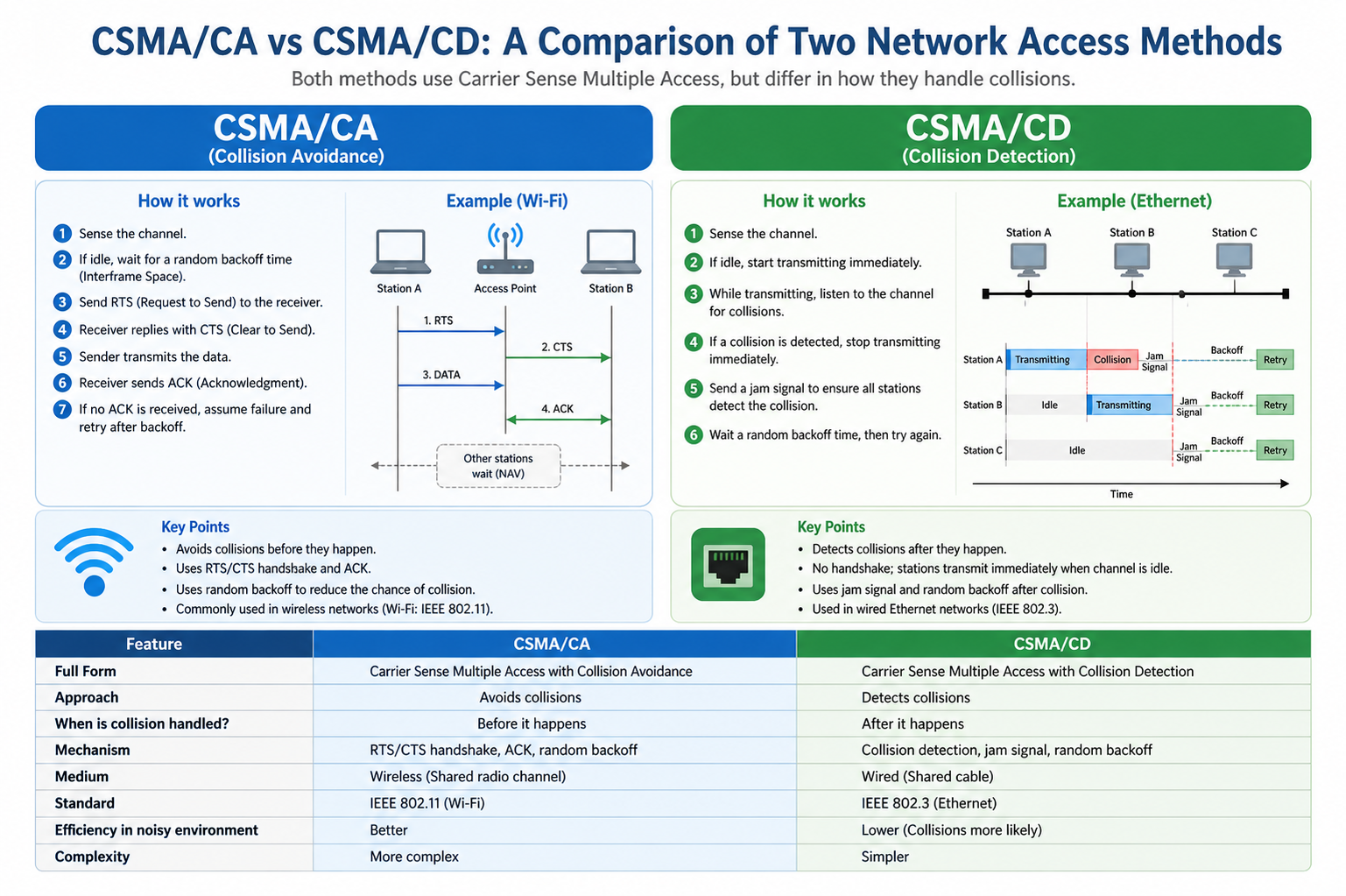
CSMA/CA, which stands for Carrier Sense Multiple Access with Collision Avoidance, is a network protocol designed primarily for wireless communication systems. It is widely used in Wi-Fi networks and other wireless technologies where collision detection is difficult due to the nature of radio communication. Unlike wired networks, wireless devices cannot easily “listen” while they are transmitting, which makes preventing collisions before they happen much more important than detecting them afterward.
CSMA/CA works by making devices first check whether the communication channel is free before they attempt to send data. This process is known as carrier sensing. If the channel is busy, the device does not transmit immediately. Instead, it waits for a random period of time before checking again. This random waiting time is called a backoff mechanism, and it plays a key role in reducing the chances of multiple devices transmitting at the same moment.
In wireless networks, multiple devices often share the same communication medium. For example, in a Wi-Fi network, laptops, smartphones, and smart devices all compete for access to the same radio channel. Without a mechanism like CSMA/CA, these devices could easily transmit at the same time, leading to data loss and repeated retransmissions. CSMA/CA reduces this risk by coordinating access to the medium in a more controlled and cautious way.
Another important feature of CSMA/CA is the use of acknowledgment signals. After a device sends data, it waits for confirmation from the receiver. If no acknowledgment is received, the device assumes that a collision or transmission failure occurred and attempts to resend the data after another random delay. This helps ensure reliability even in environments where interference is common.
CSMA/CA is especially important in environments where signal overlap and interference are unavoidable. Since wireless signals are broadcast in all directions, multiple devices may hear each other but still fail to detect ongoing transmissions accurately. This limitation makes collision avoidance more effective than collision detection in such scenarios.
In addition, CSMA/CA often uses optional techniques like RTS (Request to Send) and CTS (Clear to Send). These signals help reserve the channel before actual data transmission occurs. When a device wants to send data, it first sends an RTS message. If the receiving device is ready, it responds with a CTS message, indicating that the channel is clear for communication. This reduces the chances of hidden node problems, where two devices cannot hear each other but still interfere at a common receiver.
Overall, CSMA/CA is designed to minimize collisions before they happen by carefully managing when and how devices transmit data. Its focus on prevention rather than detection makes it highly suitable for wireless communication systems where reliability and coordination are critical.
CSMA/CD (Collision Detection)
CSMA/CD, which stands for Carrier Sense Multiple Access with Collision Detection, is a network protocol traditionally used in wired Ethernet networks. Unlike CSMA/CA, which tries to avoid collisions before they occur, CSMA/CD allows collisions to happen and then deals with them after detection. This approach is possible in wired networks because devices can transmit and listen to the network simultaneously.
In CSMA/CD, a device first checks whether the communication channel is free before sending data. If the channel is idle, it begins transmission. However, while transmitting, the device continues to monitor the network for signals that indicate a collision. If two devices transmit at the same time, their signals interfere with each other, causing a collision.
When a collision is detected, the device immediately stops transmitting. It then sends a jam signal to ensure that all other devices are aware that a collision has occurred. After that, each device waits for a random backoff period before attempting to retransmit the data. This random delay helps reduce the chance of repeated collisions between the same devices.
CSMA/CD was widely used in early Ethernet networks where multiple devices shared a common coaxial cable or hub-based topology. In such environments, collisions were more likely because all devices operated on the same communication medium. The protocol helped manage this shared access efficiently by detecting and resolving conflicts dynamically.
One of the key strengths of CSMA/CD is its simplicity in wired environments. Since electrical signals in cables are easier to monitor in real time, devices can quickly detect when a collision occurs. This makes the protocol effective for maintaining data integrity in shared wired networks.
However, CSMA/CD has limitations in modern networking environments. With the introduction of switches instead of hubs, each device often gets a dedicated communication path. This eliminates most collisions, making CSMA/CD largely unnecessary in modern Ethernet networks. As a result, many contemporary systems rely more on full-duplex communication, where devices can send and receive data simultaneously without interference.
Despite its reduced usage today, CSMA/CD played an important role in the development of early local area networks. It provided a practical solution for managing shared communication channels and helped establish the foundation for modern Ethernet standards.
The fundamental idea behind CSMA/CD is reactive management of collisions. Instead of trying to prevent them, it accepts that collisions may occur and focuses on detecting and resolving them quickly. This approach works well in controlled wired environments but is less suitable for wireless systems where signal behavior is more unpredictable.
Key Difference Between CSMA/CA and CSMA/CD
The primary difference between CSMA/CA and CSMA/CD lies in how they handle data collisions in a network. CSMA/CA focuses on preventing collisions before they happen, while CSMA/CD focuses on detecting and resolving collisions after they occur. This fundamental difference is due to the nature of the environments in which each protocol operates.
CSMA/CA is mainly used in wireless networks, where it is difficult for a device to detect collisions while transmitting. Since wireless devices cannot reliably listen while sending signals, preventing collisions beforehand becomes essential. This is achieved through carrier sensing, random backoff timers, and optional reservation mechanisms like RTS and CTS.
On the other hand, CSMA/CD is used in wired networks, where devices can transmit and listen at the same time. This makes it possible to detect collisions almost instantly. Once a collision is detected, transmission is stopped, and devices retry after waiting for a random period.
Another major difference is efficiency in modern networks. CSMA/CA remains widely used in Wi-Fi and other wireless systems because it is well-suited to shared radio environments. CSMA/CD, however, has become largely obsolete in modern Ethernet networks due to the widespread use of switches and full-duplex communication, which eliminate most collision scenarios.
In terms of performance, CSMA/CA tends to introduce more delay because devices must wait before transmitting to avoid collisions. This can reduce overall network speed but improves reliability in wireless environments. CSMA/CD, while faster in theory, can suffer from performance drops when collisions are frequent, as repeated retransmissions consume bandwidth.
Another important distinction is the method of control. CSMA/CA is proactive, meaning it tries to prevent problems before they occur. CSMA/CD is reactive, meaning it responds after a problem has already happened. This difference reflects the design requirements of wireless versus wired communication systems.
Both protocols share a common foundation in carrier sensing and multiple access control. However, their strategies diverge significantly based on the technical constraints of their environments. Understanding these differences is essential for grasping how modern networks manage data transmission efficiently and reliably.
Advantages and Disadvantages of CSMA/CA
CSMA/CA offers several advantages that make it highly suitable for wireless networking environments. One of its biggest strengths is its ability to reduce the likelihood of data collisions before they happen. By requiring devices to check whether the communication channel is free before transmitting, it significantly improves data reliability in shared wireless spaces. This is especially important in Wi-Fi networks where multiple devices constantly compete for bandwidth.
Another advantage of CSMA/CA is its ability to handle hidden node problems through mechanisms like RTS and CTS. These features help coordinate communication between devices that may not be able to directly detect each other’s transmissions. As a result, network efficiency is improved in complex wireless environments where signal overlap is common.
CSMA/CA is also highly adaptable to different wireless standards and can function effectively in environments with varying levels of interference. It is designed to work under uncertain and noisy conditions, making it suitable for modern mobile and IoT-based networks where device density is high.
However, CSMA/CA also has some disadvantages. One of the main drawbacks is increased transmission delay. Since devices must wait for the channel to become free and may also experience random backoff delays, overall communication speed can be slower compared to more direct transmission methods.
Another limitation is reduced efficiency in extremely congested networks. When many devices are competing for access, frequent waiting and backoff periods can lead to performance degradation. Although collisions are reduced, the system may still experience delays due to heavy traffic.
Additionally, CSMA/CA relies on acknowledgment signals to confirm successful transmission. If acknowledgments are lost due to interference, unnecessary retransmissions may occur, further reducing efficiency. Despite these drawbacks, its reliability in wireless environments makes it essential for modern networking.
Advantages and Disadvantages of CSMA/CD
CSMA/CD provides several benefits in wired networking environments. One of its primary advantages is its simplicity in detecting and handling collisions. Since devices can transmit and listen simultaneously, they can quickly identify when a collision occurs and take immediate action. This helps maintain data integrity in shared wired systems.
Another advantage is efficient use of bandwidth in traditional Ethernet networks. By allowing devices to transmit as soon as the channel is free, CSMA/CD minimizes unnecessary delays in low to moderate traffic conditions. This makes it effective in smaller or less congested networks.
CSMA/CD also played a key role in early network design, enabling multiple devices to share a single communication medium without requiring complex infrastructure. This helped reduce costs and made Ethernet technology widely accessible during its early development.
However, CSMA/CD has several disadvantages in modern networking. One major limitation is inefficiency under high traffic conditions. When many devices attempt to transmit simultaneously, collisions become frequent, leading to repeated retransmissions and reduced overall performance.
Another disadvantage is that CSMA/CD is not suitable for wireless environments. Since it relies on the ability to detect collisions during transmission, it cannot function effectively in radio-based communication systems where such detection is unreliable.
In addition, modern Ethernet networks have largely replaced shared media with switches and full-duplex communication. This means devices no longer compete for the same channel, making CSMA/CD unnecessary in most current systems. As a result, its relevance has significantly decreased over time.
Real-World Applications of CSMA/CA
CSMA/CA is widely used in wireless communication technologies, with Wi-Fi being the most common example. Every time a device connects to a wireless router, CSMA/CA helps manage how data is sent and received across the network. This ensures that multiple devices such as smartphones, laptops, and smart home devices can operate simultaneously without overwhelming the network.
It is also used in other wireless systems like Bluetooth and certain IoT (Internet of Things) networks. In these environments, devices often operate in close proximity and must share limited wireless channels efficiently. CSMA/CA helps maintain smooth communication by reducing interference and coordinating transmission timing.
In industrial and enterprise wireless systems, CSMA/CA plays a critical role in maintaining stable connectivity. Factories, offices, and smart buildings rely on wireless networks for communication between sensors, machines, and control systems. The protocol ensures that data flows reliably even in environments with high device density.
Real-World Applications of CSMA/CD
CSMA/CD was historically used in early Ethernet networks, especially those that relied on coaxial cables and hub-based systems. In such setups, all devices shared the same communication channel, making collision detection essential for smooth operation.
It was commonly used in office LANs during the early development of computer networking. Computers connected through shared hubs would use CSMA/CD to manage data transmission and avoid constant data corruption caused by simultaneous communication attempts.
Although it is rarely used in modern networks today, CSMA/CD remains an important part of networking history. It laid the foundation for Ethernet communication and influenced the design of more advanced networking technologies that replaced it.
Overall Comparison and Summary Insight
CSMA/CA and CSMA/CD both aim to solve the same fundamental problem: managing how multiple devices access a shared communication medium. However, they approach the problem in very different ways based on the environment in which they operate.
CSMA/CA focuses on prevention. It carefully schedules transmissions and reduces the chances of collision before data is sent. This makes it ideal for wireless networks where interference is common and collision detection is difficult.
CSMA/CD focuses on detection. It allows devices to transmit freely but monitors for collisions during transmission. When a collision occurs, it quickly responds and retries the communication. This approach works best in wired networks where signal behavior is predictable and easier to monitor.
In modern networking, CSMA/CA remains highly relevant due to the widespread use of wireless communication. CSMA/CD, on the other hand, has largely been replaced by more advanced Ethernet technologies that eliminate collisions altogether through switching and full-duplex communication.
Together, these protocols represent two important stages in the evolution of network communication. One emphasizes prevention in complex wireless environments, while the other represents efficient collision handling in simpler wired systems.
Evolution of CSMA/CA and CSMA/CD in Modern Networking
Networking technology has evolved significantly over the past few decades, and the roles of CSMA/CA and CSMA/CD have changed alongside it. In early network systems, shared communication channels were common, and both protocols were essential for managing how multiple devices accessed the same medium. However, as networks became faster and more complex, new technologies gradually reduced the need for collision-based control mechanisms.
CSMA/CD was once a core part of Ethernet networking, especially in environments where hubs were used. In those systems, all devices communicated over a single shared channel, making collisions frequent. CSMA/CD provided a practical solution by detecting collisions and allowing retransmissions. As network infrastructure improved, hubs were replaced by switches, which created dedicated communication paths between devices. This shift significantly reduced collisions, making CSMA/CD less necessary in modern Ethernet systems.
At the same time, wireless networking began to grow rapidly. The rise of Wi-Fi, mobile devices, and IoT systems created a new challenge: managing communication in a completely shared and unpredictable wireless medium. Unlike wired systems, wireless devices cannot reliably detect collisions while transmitting. This limitation made collision avoidance strategies more important than collision detection. As a result, CSMA/CA became the dominant protocol for wireless communication.
Today, CSMA/CA continues to evolve alongside modern wireless standards such as Wi-Fi 5, Wi-Fi 6, and emerging Wi-Fi 7 technologies. These newer systems include advanced scheduling, improved channel access methods, and better interference management techniques. Even though the core principle of collision avoidance remains the same, the efficiency and performance of CSMA/CA have improved significantly over time.
Why CSMA/CA is More Suitable for Wireless Networks
Wireless networks operate in a highly dynamic environment where signals travel through open air and can be affected by obstacles, interference, and distance. This makes communication less predictable compared to wired systems. CSMA/CA is specifically designed to handle these challenges by preventing multiple devices from transmitting at the same time.
One of the key reasons CSMA/CA is effective in wireless networks is the hidden node problem. In many cases, two devices may not be able to detect each other’s transmissions due to distance or obstacles, but their signals can still interfere at a common receiver. CSMA/CA addresses this issue using techniques like RTS (Request to Send) and CTS (Clear to Send), which help coordinate communication before data transmission begins.
Another reason CSMA/CA is well-suited for wireless systems is its ability to manage congestion in environments with many connected devices. In homes, offices, public spaces, and smart environments, multiple devices often compete for bandwidth. By using random backoff timers and controlled access, CSMA/CA reduces the chances of network overload and improves fairness among devices.
Additionally, wireless communication is more prone to interference from external sources such as other networks, electronic devices, and physical barriers. CSMA/CA helps mitigate these issues by ensuring that devices only transmit when the channel is likely to be clear, reducing unnecessary retransmissions and improving overall stability.
Why CSMA/CD is Less Used Today
CSMA/CD was designed for a time when shared Ethernet networks were common. In those networks, all devices communicated through a single channel, making collision detection necessary. However, modern networking has largely eliminated this setup.
The introduction of network switches changed the way Ethernet operates. Instead of sharing a single communication path, switches create dedicated links between devices. This allows full-duplex communication, where data can be sent and received simultaneously without collisions. As a result, the conditions required for CSMA/CD no longer exist in most modern networks.
Another reason CSMA/CD has become obsolete is the increase in network speed. Early Ethernet networks operated at relatively low speeds, where collision detection was manageable. However, in high-speed networks, detecting and responding to collisions becomes inefficient and unnecessary when switching technology can eliminate them entirely.
Despite its reduced usage, CSMA/CD remains an important concept in networking education. It helps explain how early Ethernet systems managed shared communication and provides a foundation for understanding how modern protocols have evolved.
Impact of Both Protocols on Network Design
Both CSMA/CA and CSMA/CD have had a significant impact on the design and development of modern communication systems. They introduced fundamental ideas about how multiple devices can share a communication medium efficiently without centralized control.
CSMA/CD influenced the development of early Ethernet standards and helped establish the principles of decentralized communication in wired networks. It demonstrated that networks could operate effectively even when multiple devices shared the same channel, as long as collisions were managed properly.
CSMA/CA, on the other hand, has shaped the development of wireless communication standards. It introduced strategies for avoiding collisions in unpredictable environments and helped make large-scale wireless connectivity possible. Without CSMA/CA, modern Wi-Fi networks and mobile communication systems would not function efficiently.
Together, these protocols represent two different approaches to the same challenge: managing shared access to a communication medium. One focuses on detection and recovery, while the other focuses on prevention and coordination.
Future of Medium Access Control Methods
As networking technology continues to advance, new methods are being developed to further improve efficiency and reduce latency. While CSMA/CA remains widely used in wireless systems, newer technologies are introducing more advanced scheduling and resource allocation techniques.
For example, modern Wi-Fi standards now use features like OFDMA (Orthogonal Frequency Division Multiple Access), which allows multiple devices to transmit simultaneously on different sub-channels. This reduces reliance on traditional contention-based methods like CSMA/CA.
In wired networks, CSMA/CD has already been replaced by more advanced switching and routing technologies. Future improvements focus more on intelligent traffic management rather than collision handling.
Despite these advancements, the core ideas behind CSMA/CA and CSMA/CD remain relevant. They continue to influence how engineers design communication systems that are efficient, scalable, and reliable.
Limitations of CSMA/CA in Modern Wireless Networks
Although CSMA/CA is widely used and essential for wireless communication, it is not without limitations. One of the major challenges is increased latency in high-traffic environments. Since every device must first check whether the channel is free and may also wait through random backoff periods, communication can become slower when many devices are active at the same time. This delay is especially noticeable in dense networks such as public Wi-Fi hotspots, stadiums, and large office environments.
Another limitation is inefficiency under heavy congestion. When too many devices compete for the same channel, the number of backoff delays increases significantly. Even though CSMA/CA reduces collisions, it does not eliminate the problem of contention. As a result, overall network throughput can decrease even when collisions are avoided.
CSMA/CA also depends heavily on acknowledgment signals for reliability. If acknowledgments are delayed or lost due to interference, devices may mistakenly assume that data transmission failed and resend packets unnecessarily. This can lead to additional network load and reduced efficiency, especially in environments with weak signal strength or high interference.
Additionally, CSMA/CA does not fully solve hidden node and exposed node problems in all scenarios. While RTS/CTS mechanisms help, they introduce extra overhead and are not always used in every transmission due to efficiency trade-offs. This means that in some cases, coordination between devices is still imperfect.
Limitations of CSMA/CD in Modern Wired Networks
CSMA/CD, while historically important, has several limitations that make it unsuitable for modern networking environments. One of the biggest limitations is its inefficiency in high-speed networks. As data transmission speeds increase, the time required to detect and respond to collisions becomes less practical, especially when compared to modern switching technologies that eliminate collisions entirely.
Another limitation is that CSMA/CD only works effectively in half-duplex communication systems. In modern Ethernet networks, full-duplex communication is standard, allowing devices to send and receive data simultaneously without interference. Since CSMA/CD is not needed in such systems, it has become largely obsolete.
CSMA/CD also performs poorly in highly congested shared networks. When multiple devices attempt to transmit at the same time, collisions become frequent, leading to repeated retransmissions and reduced network efficiency. This makes it unsuitable for large-scale or high-performance networks.
Furthermore, CSMA/CD cannot function in wireless environments because it relies on the ability to detect collisions during transmission. Since wireless devices cannot reliably listen while sending data, the protocol is fundamentally limited to wired communication systems.
Comparison of Efficiency in Real-World Scenarios
In practical applications, CSMA/CA and CSMA/CD show very different levels of efficiency depending on the environment in which they are used. CSMA/CA is highly effective in wireless networks where device mobility, interference, and shared spectrum usage are common. It ensures smoother communication by preventing collisions before they happen, even if it introduces some delay.
CSMA/CD, on the other hand, was effective in early wired networks where shared media was common. It allowed multiple devices to communicate over the same cable system without centralized control. However, its efficiency decreases significantly in modern networks due to the widespread use of switches and dedicated links.
In terms of scalability, CSMA/CA performs better in modern environments because it is designed for large numbers of devices competing for wireless access. CSMA/CD does not scale well in high-density networks and has been replaced by more advanced Ethernet technologies.
Role in Modern Networking Technologies
Even though CSMA/CD is no longer widely used, and CSMA/CA is gradually being enhanced by newer methods, both protocols still play an important educational and conceptual role in networking. They help explain the basic principles of how devices share communication channels without centralized control.
Modern wireless systems are evolving beyond traditional CSMA/CA with technologies such as OFDMA and MU-MIMO, which allow multiple devices to transmit simultaneously more efficiently. These advancements reduce reliance on strict collision avoidance mechanisms and improve overall network performance.
In wired systems, switching technology has completely changed how data is handled. Instead of shared communication channels, modern Ethernet networks use dedicated links, eliminating the need for collision management protocols like CSMA/CD.
Despite these changes, the core ideas introduced by both protocols remain relevant. Concepts like carrier sensing, backoff algorithms, and medium access control are still foundational to modern networking design.
Security and Reliability Considerations
CSMA/CA indirectly contributes to network reliability by reducing collisions and retransmissions, but it does not directly address security concerns. Wireless networks still require additional encryption and authentication mechanisms to protect data. Without proper security protocols, even a well-managed CSMA/CA system can be vulnerable to attacks such as interference or denial-of-service attempts.
CSMA/CD also does not provide any security features. Its role is strictly limited to collision detection and management in wired networks. Security must be handled by higher-layer protocols rather than the medium access control layer.
Reliability in CSMA/CA networks depends heavily on signal quality, interference levels, and device density. In environments with poor signal strength, performance can degrade despite the use of collision avoidance techniques. CSMA/CD reliability, on the other hand, depends on physical cable quality and network design, but is less affected by environmental interference compared to wireless systems.
Final Comparative Insight
When analyzing both protocols together, it becomes clear that CSMA/CA and CSMA/CD represent different stages in the evolution of networking technology. CSMA/CD reflects an earlier era of shared wired communication, while CSMA/CA represents the adaptation of networking principles to complex wireless environments.
CSMA/CA prioritizes prevention, coordination, and adaptability, making it essential for modern wireless communication. CSMA/CD prioritizes detection and correction, which was effective in older wired systems but is no longer necessary in modern Ethernet networks.
Together, they demonstrate how networking solutions evolve based on physical constraints, technological advancements, and user demand. Understanding their limitations and strengths provides a deeper insight into how data communication continues to improve in efficiency, scalability, and reliability over time.
Advanced Improvements Over CSMA/CA and CSMA/CD
Modern networking systems have evolved far beyond the original designs of CSMA/CA and CSMA/CD, introducing more intelligent and efficient methods for managing data transmission. These improvements are designed to handle the increasing demand for high-speed connectivity, low latency, and massive device connectivity in today’s digital world.
One major advancement in wireless communication is the introduction of scheduled access methods. Instead of relying purely on contention-based approaches like CSMA/CA, newer systems allocate specific time slots or frequency resources to devices. This reduces competition for the channel and significantly improves efficiency in crowded environments.
Technologies such as OFDMA (Orthogonal Frequency Division Multiple Access) allow multiple devices to transmit simultaneously on different sub-channels. This reduces waiting time and minimizes the need for traditional backoff mechanisms. As a result, network performance becomes more stable even when many devices are connected at the same time.
Another improvement is MU-MIMO (Multi-User Multiple Input Multiple Output), which enables routers and access points to communicate with multiple devices simultaneously using multiple antennas. This reduces congestion and improves overall throughput in wireless networks, making traditional CSMA/CA less central in high-performance systems.
In wired networking, the replacement of hubs with intelligent switches has completely eliminated the need for CSMA/CD. Modern switches create dedicated point-to-point connections, allowing full-duplex communication where data can flow in both directions at the same time without collisions. This architectural change has made collision detection unnecessary in most environments.
Performance Optimization in Modern Networks
Performance optimization in modern networks focuses on reducing delays, improving bandwidth utilization, and ensuring fair access to all connected devices. While CSMA/CA still plays a role in basic wireless access control, it is often combined with advanced scheduling algorithms to enhance performance.
Adaptive algorithms in modern routers can dynamically adjust transmission power, channel selection, and backoff timing based on network conditions. This helps reduce interference and improves stability in environments with fluctuating traffic loads.
Quality of Service (QoS) mechanisms also play an important role in optimizing network performance. These systems prioritize critical data such as video calls, gaming traffic, or real-time communication over less time-sensitive data. This ensures smoother user experiences even in congested networks.
In wired systems, performance optimization is achieved through traffic segmentation and VLANs (Virtual Local Area Networks). These technologies reduce unnecessary broadcast traffic and improve overall network efficiency, further reducing the relevance of CSMA/CD-based collision handling.
Real-World Importance of Medium Access Control Concepts
Even though CSMA/CA and CSMA/CD are not always directly used in their original forms in modern systems, the principles behind them remain extremely important. Concepts such as carrier sensing, contention management, and backoff strategies are still foundational in networking design.
In wireless environments, CSMA/CA continues to serve as a baseline mechanism for channel access. It ensures that devices coordinate communication in shared spectrum environments where interference is unavoidable. Without such a system, wireless networks would become unstable and highly unreliable.
In wired environments, although CSMA/CD is no longer actively used, its principles helped shape modern Ethernet design. The idea of decentralized communication and efficient medium sharing influenced the development of switching technologies and full-duplex communication systems.
These protocols also play a major role in networking education. Understanding them helps students and professionals grasp how data flows in both wired and wireless systems, and why modern networks are designed the way they are today.
Future of Network Access Technologies
The future of networking is moving toward even more efficient and intelligent systems that reduce reliance on traditional contention-based protocols. Artificial intelligence and machine learning are increasingly being used to manage network traffic dynamically.
Future wireless systems are expected to rely more on predictive scheduling, where devices are assigned transmission opportunities based on usage patterns and demand forecasting. This will further reduce the need for collision avoidance mechanisms like CSMA/CA.
In addition, 5G and upcoming 6G technologies already use highly structured communication frameworks that divide network resources into slices. This ensures that different types of traffic receive dedicated resources, improving both speed and reliability.
Edge computing is also changing how data is processed and transmitted. By handling data closer to the source, networks can reduce congestion and minimize delays, further reducing dependency on traditional medium access protocols.
Conclusion
CSMA/CA and CSMA/CD are two foundational networking protocols that shaped the development of modern communication systems. CSMA/CD was designed for early wired Ethernet networks where devices shared a common communication medium, and it focused on detecting and resolving collisions after they occurred. CSMA/CA was developed for wireless networks, where collision detection is not reliable, and it focuses on preventing collisions before data transmission begins.
Over time, technological advancements have reduced the direct use of CSMA/CD in modern networks due to the introduction of switches and full-duplex communication. However, CSMA/CA remains widely used in wireless systems, even though it is now being enhanced with more advanced scheduling and transmission technologies.
Both protocols highlight different approaches to solving the same fundamental problem: how multiple devices can efficiently share a communication channel. CSMA/CD represents a reactive approach based on detection, while CSMA/CA represents a proactive approach based on avoidance.
Understanding these protocols provides valuable insight into the evolution of networking technology. They form the foundation upon which modern high-speed, scalable, and intelligent communication systems are built. As networks continue to evolve, the core principles behind CSMA/CA and CSMA/CD will remain relevant, even as new technologies replace their direct implementation.