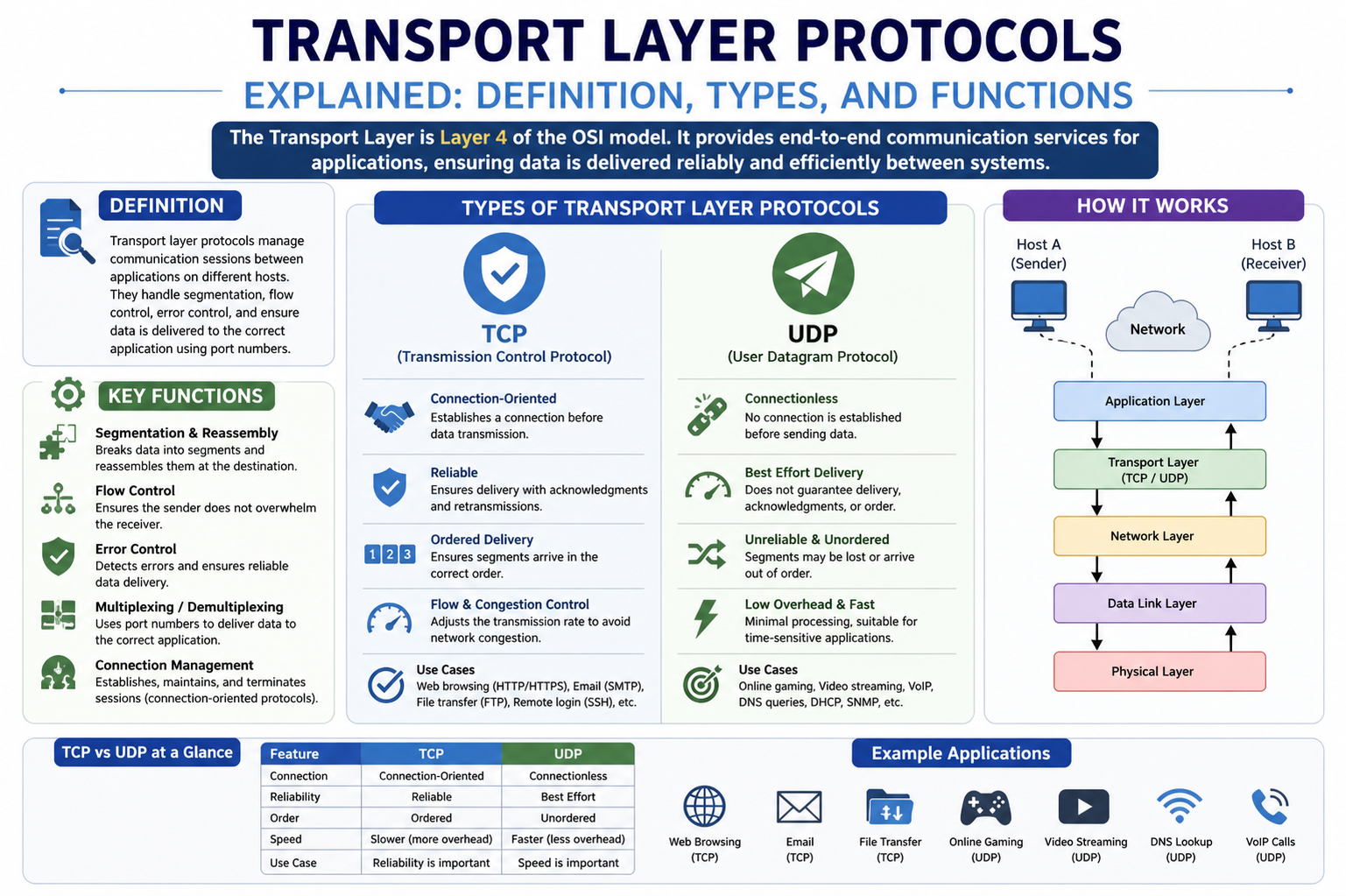
The transport layer is one of the most important layers in computer networking because it ensures smooth communication between different devices across a network. It is responsible for end-to-end communication, meaning it manages how data travels from the source device to the destination device. Unlike lower layers that focus on physical transmission or routing, the transport layer focuses on reliable data delivery, error handling, and proper sequencing of information.
In simple terms, the transport layer makes sure that when a message is sent from one computer, it reaches another computer correctly, completely, and in the right order. Without this layer, data transmission would be disorganized, incomplete, and unreliable, especially over large networks like the internet.
Definition of Transport Layer Protocols
Transport layer protocols are a set of rules that control how data is sent and received between devices in a network. These protocols operate at the transport layer of the networking model and are responsible for ensuring that communication between applications on different devices happens smoothly and accurately.
They manage segmentation of data, error detection, retransmission of lost packets, flow control, and multiplexing. In other words, transport layer protocols act like a communication manager that organizes how data is delivered between sender and receiver applications.
Role of Transport Layer in Data Communication
The transport layer plays a crucial role in ensuring reliable communication between systems. When a user sends data, such as a file, message, or request, the transport layer divides that data into smaller pieces called segments. These segments are then transmitted through the network and reassembled at the destination.
It also ensures that data from multiple applications is properly separated and delivered to the correct destination applications. This is achieved through port numbers, which help identify different services running on a device.
Types of Transport Layer Protocols
Transport layer protocols are mainly divided into two types based on how they handle communication: connection-oriented and connectionless protocols.
Transmission Control Protocol (TCP)
Transmission Control Protocol is a connection-oriented protocol, meaning it establishes a connection between sender and receiver before transmitting data. It is widely used when reliability and accuracy are important.
TCP ensures that all data packets reach their destination without errors and in the correct order. If any packet is lost during transmission, TCP automatically retransmits it. It also performs error checking and uses acknowledgment mechanisms to confirm successful delivery.
One of the most important features of TCP is the three-way handshake process. This process establishes a secure and reliable connection before data transmission begins. It involves synchronization between sender and receiver to ensure both are ready for communication.
TCP also uses flow control techniques to prevent network congestion. It adjusts the speed of data transmission based on the receiver’s capacity, ensuring that data is not lost due to overload.
User Datagram Protocol (UDP)
User Datagram Protocol is a connectionless protocol that focuses on speed rather than reliability. Unlike TCP, UDP does not establish a connection before sending data. It simply sends packets to the destination without checking whether they are received or not.
Because of this, UDP is faster but less reliable. It does not guarantee delivery, order, or error correction. However, it is useful in situations where speed is more important than accuracy, such as live streaming, online gaming, and voice communication.
UDP has lower overhead compared to TCP, which makes it efficient for real-time applications where slight data loss is acceptable.
Key Differences Between TCP and UDP
TCP and UDP differ in several important ways. TCP is reliable, connection-oriented, and ensures error-free delivery, while UDP is faster, connectionless, and does not guarantee delivery.
TCP is used in applications where data integrity is important, such as file transfer and web browsing. On the other hand, UDP is used in applications where speed matters more than accuracy, such as video streaming and online games.
TCP uses acknowledgment, sequencing, and retransmission mechanisms, whereas UDP does not use these features, making it simpler and faster.
Functions of Transport Layer Protocols
Transport layer protocols perform several essential functions that make reliable communication possible across networks.
Segmentation and Reassembly
One of the main functions of transport layer protocols is segmentation. Large data is divided into smaller segments before transmission. This makes it easier to send data across networks efficiently. At the receiving end, these segments are reassembled to form the original message.
This process ensures that data can travel through different routes and still be correctly reconstructed at the destination.
Flow Control
Flow control is used to manage the rate of data transmission between sender and receiver. If the sender transmits data too quickly, the receiver may become overwhelmed and lose data. To prevent this, transport layer protocols adjust the speed of transmission based on the receiver’s capacity.
This ensures smooth communication without data loss or congestion.
Error Control
Error control ensures that data is transmitted accurately. During transmission, data may get corrupted due to noise or interference. Transport layer protocols detect these errors using techniques such as checksums.
If an error is detected, the corrupted data is either discarded or retransmitted to ensure accuracy. This function is especially important for maintaining data integrity in communication systems.
Multiplexing and Demultiplexing
Multiplexing allows multiple applications to use the same network connection simultaneously. The transport layer assigns port numbers to different applications so that data can be properly directed.
At the receiving end, demultiplexing ensures that incoming data is delivered to the correct application based on its port number. This allows multiple services to run on a single device without confusion.
Connection Establishment and Termination
In connection-oriented protocols like TCP, the transport layer is responsible for establishing and terminating connections. Before data transfer begins, a connection is established using a handshake process. After the communication is complete, the connection is properly closed to free up resources.
This ensures that communication sessions are well-managed and do not consume unnecessary system resources.
Sequencing of Data Packets
Transport layer protocols ensure that data packets are delivered in the correct order. Since packets may take different paths in a network, they may arrive out of order. The transport layer uses sequence numbers to rearrange them properly before delivering them to the application layer.
This guarantees that the original message is reconstructed accurately.
Acknowledgment Mechanism
In reliable communication, the receiver sends acknowledgments to confirm that data packets have been received successfully. If the sender does not receive an acknowledgment within a certain time, it assumes that the packet was lost and retransmits it.
This mechanism improves reliability and ensures that no data is lost during transmission.
Importance of Transport Layer Protocols in Networking
Transport layer protocols are essential for modern communication systems. They make it possible for devices to communicate reliably over complex networks like the internet. Without these protocols, data transmission would be inconsistent, unreliable, and prone to errors.
They ensure that applications such as web browsing, video streaming, file sharing, and online communication work smoothly. By managing data flow, error correction, and delivery, transport layer protocols provide a stable foundation for digital communication.
Real-World Applications of Transport Layer Protocols
Transport layer protocols are used in almost every internet-based application. TCP is widely used in web browsing, email communication, and file transfers because these applications require accurate and reliable data delivery.
UDP is commonly used in live video streaming, online gaming, and voice calls where speed is more important than perfect accuracy. Even if some data is lost, the overall performance remains smooth and real-time.
Challenges and Limitations
Although transport layer protocols are highly effective, they also face certain limitations. TCP can sometimes be slower due to its error-checking and acknowledgment processes. This can affect performance in time-sensitive applications.
UDP, while fast, does not guarantee data delivery, which can lead to incomplete or inaccurate information in some cases. Balancing speed and reliability remains an ongoing challenge in network communication.
How Transport Layer Protocols Work in Real Networks
Transport layer protocols work as intermediaries between the application layer and the network layer. When a user sends data, the application first passes it to the transport layer. The transport layer then prepares this data for transmission by breaking it into smaller segments, assigning port numbers, and adding necessary control information.
These segments are then passed to the network layer, which routes them across different paths in the network. At the destination, the transport layer collects the incoming segments, checks for errors, arranges them in the correct order, and finally delivers them to the appropriate application.
This entire process happens in milliseconds, making communication appear instant to users.
Port Numbers and Process Communication
Port numbers are a key concept in transport layer communication. They act as identifiers for different applications running on a device. While IP addresses identify devices, port numbers identify specific processes or services within those devices.
For example, a web browser and an email application may run on the same device at the same time. The transport layer uses different port numbers to ensure that web data goes to the browser and email data goes to the email client.
This mechanism allows multiple applications to communicate over the network simultaneously without interference.
Socket Communication in Transport Layer
A socket is a combination of an IP address and a port number. It is used to establish communication between two devices over a network. Each connection between a client and server is uniquely identified using sockets.
When data is transmitted, it moves from one socket to another. This ensures that data reaches the correct application on the correct device. Sockets play a critical role in enabling structured and organized network communication.
Reliable Data Transfer Mechanism in TCP
TCP ensures reliable data transfer using several advanced techniques. One of the most important is acknowledgment-based communication, where the receiver confirms the successful reception of data packets.
TCP also uses timers. If an acknowledgment is not received within a specific time, the sender retransmits the data. This helps prevent data loss in case of network issues.
Another important feature is congestion control. TCP monitors network traffic and adjusts the rate of data transmission to avoid overwhelming the network. This improves overall performance and stability.
Sliding Window Mechanism in TCP
The sliding window mechanism is used in TCP to control the flow of data packets between sender and receiver. Instead of sending one packet and waiting for acknowledgment, TCP can send multiple packets within a window size before waiting for confirmation.
As acknowledgments are received, the window slides forward, allowing more data to be sent. This improves efficiency and reduces delays in communication.
This mechanism is essential for maintaining high-speed and reliable data transfer in large networks.
UDP in Real-Time Communication Systems
UDP plays a major role in real-time communication systems where speed is more important than accuracy. In applications like video calls or online gaming, slight data loss does not significantly affect user experience.
UDP sends data continuously without waiting for acknowledgments. This reduces delay and ensures smooth real-time performance. Since it does not perform error correction or retransmission, it is much faster than TCP.
However, this also means that UDP is not suitable for applications where complete accuracy is required.
Why TCP is More Reliable than UDP
TCP is considered more reliable because it uses multiple mechanisms to ensure data integrity. These include error detection, acknowledgment, retransmission, sequencing, and flow control.
Each packet in TCP is tracked and verified, ensuring that no data is lost or corrupted during transmission. Even if packets arrive out of order, TCP rearranges them correctly before delivering them to the application.
This makes TCP suitable for critical applications where accuracy is essential.
Connection Establishment Process in TCP
Before data transmission begins, TCP establishes a connection between sender and receiver using a process known as the three-way handshake.
First, the sender sends a synchronization request. Then the receiver responds with an acknowledgment and its own synchronization message. Finally, the sender confirms the connection.
This process ensures that both devices are ready for communication and agree on initial parameters before data transfer starts.
Connection Termination Process in TCP
After data transmission is complete, TCP properly closes the connection using a termination process. This ensures that system resources are released and the connection does not remain open unnecessarily.
The termination process involves exchanging messages between sender and receiver to confirm that communication has ended. This prevents data loss and ensures a clean shutdown of the connection.
Error Detection Techniques in Transport Layer
Error detection is a critical function of transport layer protocols. One common method is the checksum technique, where data is verified using mathematical calculations.
If the calculated checksum at the receiver does not match the sender’s checksum, the data is considered corrupted and is discarded or retransmitted.
This ensures that only accurate and valid data is delivered to the application layer.
Flow Control Techniques in Detail
Flow control ensures that the sender does not overwhelm the receiver with too much data at once. TCP uses techniques such as window-based flow control to manage data transmission rates.
The receiver communicates its buffer capacity to the sender, allowing the sender to adjust the speed of transmission accordingly. This prevents data overflow and ensures smooth communication.
Flow control is especially important in networks with varying speeds and capacities.
Congestion Control in Transport Layer Protocols
Network congestion occurs when too much data is sent over the network, causing delays and packet loss. TCP handles this problem using congestion control mechanisms.
It gradually increases the data transmission rate and reduces it when congestion is detected. This helps maintain network stability and prevents overload.
Congestion control ensures that all users get fair access to network resources.
Importance of Sequencing in Data Transmission
Since data packets may travel through different routes in a network, they may arrive in a random order. Sequencing ensures that packets are arranged correctly before delivery.
Each packet is assigned a sequence number, which helps the receiver reconstruct the original message accurately.
Without sequencing, data would be meaningless or incomplete at the receiving end.
Role of Transport Layer in Internet Communication
The transport layer is essential for internet communication because it supports all major online services. Whether it is browsing websites, sending emails, streaming videos, or playing online games, the transport layer ensures that data is transmitted correctly.
It acts as a foundation for reliable and efficient communication between millions of devices worldwide.
Performance Differences Between TCP and UDP
TCP and UDP differ significantly in performance. TCP prioritizes reliability, which can introduce delays due to error checking and retransmission. UDP prioritizes speed, which reduces delay but sacrifices reliability.
This trade-off allows developers to choose the appropriate protocol based on application requirements.
Security Considerations in Transport Layer Protocols
Although transport layer protocols focus on data delivery, they also play a role in security. TCP connections can be combined with encryption protocols to secure data transmission.
However, neither TCP nor UDP provides built-in encryption. Security is usually handled by higher-level protocols or additional layers.
Future Developments in Transport Layer Technologies
As networks continue to evolve, transport layer protocols are also being improved. Modern technologies focus on reducing latency, improving congestion control, and enhancing reliability in high-speed networks.
New protocols and enhancements aim to make communication faster, more efficient, and more adaptable to modern internet demands.
Relationship of Transport Layer with Other OSI Layers
The transport layer does not work alone; it depends on and supports other layers in the network model. It sits between the application layer and the network layer, acting as a communication bridge. The application layer generates data, while the network layer handles routing across different networks. The transport layer ensures that this data is delivered correctly between these two layers.
It takes data from applications, processes it into segments, and passes it down to the network layer for transmission. At the receiving end, it collects incoming segments from the network layer and delivers them to the correct application. This coordination between layers is essential for smooth communication.
End-to-End Communication Concept
One of the most important responsibilities of the transport layer is end-to-end communication. This means that data is managed directly between the source and destination applications, not just between intermediate devices.
Unlike the network layer, which focuses on routing packets through different paths, the transport layer ensures that communication is complete and meaningful. It guarantees that the receiving application gets exactly what the sending application intended to send.
This concept is critical for modern internet communication, where billions of devices interact simultaneously.
Data Integrity in Transport Layer Protocols
Data integrity means ensuring that information is not altered, lost, or corrupted during transmission. Transport layer protocols maintain data integrity using checks, verification methods, and retransmission strategies.
TCP is especially strong in maintaining data integrity because it checks every packet and ensures correct delivery. If any inconsistency is found, the data is retransmitted. UDP, on the other hand, provides minimal integrity checks, making it faster but less secure in terms of accuracy.
Throughput and Efficiency in Transport Layer
Throughput refers to the amount of data successfully transmitted over a network in a given time. Transport layer protocols play a key role in determining network efficiency and throughput.
TCP improves reliability but may reduce throughput due to acknowledgments and retransmissions. UDP improves throughput by sending data quickly without waiting for confirmations. The choice of protocol directly affects performance based on application needs.
Efficient transport layer design ensures that networks are neither underutilized nor overloaded.
Delay and Latency in Communication
Latency refers to the time it takes for data to travel from sender to receiver. Transport layer protocols can influence latency significantly.
TCP introduces additional delay because of connection establishment, error checking, and retransmission processes. UDP reduces latency by eliminating these steps, making it ideal for real-time communication.
Balancing latency and reliability is one of the main challenges in transport layer communication.
Quality of Service in Transport Layer Communication
Quality of Service (QoS) refers to the overall performance of a network in terms of speed, reliability, and consistency. Transport layer protocols contribute to QoS by managing data flow, controlling congestion, and ensuring proper delivery.
TCP improves reliability and consistency, which enhances QoS for applications like file transfer and web browsing. UDP supports low-latency communication, which improves QoS for live streaming and gaming.
Different applications require different levels of QoS, and transport protocols help achieve that balance.
Real-Time Applications and Transport Layer Role
Real-time applications depend heavily on transport layer protocols. These applications include video conferencing, online gaming, live broadcasts, and voice calls.
In such applications, speed is more important than perfect accuracy. UDP is commonly used because it delivers data quickly without delays caused by retransmission. Even if some packets are lost, the overall experience remains smooth.
TCP is less suitable for real-time systems because its reliability mechanisms can introduce delays.
Reliability vs Speed Trade-Off
One of the most important concepts in transport layer protocols is the trade-off between reliability and speed.
TCP focuses on reliability by ensuring error-free and ordered delivery, but this can reduce speed. UDP focuses on speed by sending data quickly without checking for errors or acknowledgments.
This trade-off allows developers to choose the right protocol depending on application requirements. There is no single best protocol; the choice depends on whether speed or accuracy is more important.
Buffering in Transport Layer Communication
Buffering is the temporary storage of data during transmission. It helps manage differences in speed between sender and receiver.
The transport layer uses buffers to store data segments before they are processed or transmitted. This prevents data loss when one side sends data faster than the other can handle.
Proper buffer management improves efficiency and prevents network congestion.
Retransmission Strategies in TCP
TCP uses retransmission strategies to ensure reliable delivery of data. If a packet is lost or corrupted, TCP resends it after a timeout period.
This process is controlled using timers and acknowledgment messages. If the sender does not receive confirmation, it assumes the packet was lost and retransmits it.
Retransmission ensures that all data eventually reaches its destination correctly.
Multipath Transmission Concept
In modern networks, data packets may travel through multiple paths before reaching the destination. This improves efficiency and reduces congestion.
The transport layer ensures that even if packets take different routes, they are correctly reassembled at the destination. Sequencing and acknowledgment mechanisms help maintain order and accuracy.
This flexibility makes transport layer protocols suitable for large-scale networks like the internet.
Error Recovery Mechanisms
Error recovery is the process of correcting data errors during transmission. TCP uses automatic repeat request (ARQ) methods to recover lost or corrupted packets.
When an error is detected, the receiver requests retransmission of the missing data. This ensures that communication remains accurate and complete.
UDP does not provide built-in error recovery, which is why it is used only in non-critical applications.
Connection-Oriented vs Connectionless Communication
Connection-oriented communication, used by TCP, requires a dedicated connection before data transfer begins. This ensures reliability and proper synchronization between sender and receiver.
Connectionless communication, used by UDP, does not require a setup phase. Data is sent immediately without establishing a formal connection.
Both methods have advantages depending on the type of application and network requirements.
Scalability of Transport Layer Protocols
Transport layer protocols are designed to work across small and large networks. They must handle communication between a few devices as well as millions of devices on the internet.
TCP and UDP both scale effectively, but in different ways. TCP scales well in applications requiring reliability, while UDP scales better in high-speed, low-latency environments.
This scalability is one of the reasons why transport layer protocols are widely used in global networks.
Impact of Transport Layer on Modern Internet
The transport layer is essential for the functioning of the modern internet. Every online activity, from browsing websites to streaming videos, depends on transport layer protocols.
Without these protocols, data communication would be chaotic, unreliable, and inefficient. They ensure that users experience smooth and consistent connectivity across all applications.
Optimization Techniques in Transport Layer
Various optimization techniques are used to improve transport layer performance. These include congestion avoidance, selective acknowledgment, and dynamic window sizing.
These techniques help improve speed, reduce packet loss, and enhance overall network efficiency. Continuous improvements in these methods are essential for handling growing internet traffic.
Transport Layer Protocol Concepts
Transport layer protocols are fundamental to modern communication systems. They ensure that data is transmitted reliably, efficiently, and in an organized manner across networks.
TCP provides reliability and accuracy, while UDP provides speed and simplicity. Together, they support a wide range of applications, from critical data transfer to real-time communication systems.
The transport layer remains a vital component of networking, enabling seamless global communication and powering the digital world.
Transport Layer in Modern Network Architecture
The transport layer plays a central role in modern network architecture by ensuring that communication between applications is structured, reliable, and efficient. It sits above the network layer and below the application layer, acting as a mediator that manages how data is prepared, transmitted, and received.
In today’s interconnected systems, billions of devices communicate simultaneously. The transport layer ensures that each communication session remains independent and organized, preventing data mix-ups and ensuring proper delivery to the correct applications.
How Applications Depend on Transport Layer Protocols
Every network-based application relies on transport layer protocols for communication. Whether it is messaging apps, video conferencing tools, cloud storage services, or web applications, all of them depend on TCP or UDP at some level.
Applications that require accuracy, such as file transfers or online transactions, depend on TCP. Applications that prioritize speed, such as live streaming or gaming, rely on UDP. Without transport layer protocols, these applications would not be able to function properly in a networked environment.
Multiplexing in Real-World Systems
Multiplexing allows multiple applications to share the same network connection simultaneously. The transport layer assigns unique port numbers to each application, ensuring that data from different sources does not get mixed.
For example, a device may be downloading a file, streaming a video, and browsing the web at the same time. The transport layer ensures that each type of data is delivered to the correct application without confusion.
This capability is essential for multitasking in modern operating systems.
Demultiplexing and Data Delivery Accuracy
Demultiplexing is the process of delivering incoming data to the correct application on a device. When data arrives at a system, the transport layer examines the port number and directs the data to the appropriate service.
This ensures that multiple applications can receive data simultaneously without interference. Without demultiplexing, network communication would be disorganized and unreliable.
Transport Layer in Cloud Computing Systems
Cloud computing systems rely heavily on transport layer protocols to manage communication between users and remote servers. TCP is widely used in cloud services because it ensures secure and reliable data transfer.
When users upload or download files from the cloud, the transport layer ensures that the data is transmitted completely and correctly. It also helps manage multiple user requests simultaneously, ensuring smooth performance even under heavy load.
Transport Layer in Streaming Services
Streaming services depend on transport layer protocols to deliver audio and video content efficiently. UDP is commonly used in live streaming because it reduces delay and provides real-time delivery.
Even if some data packets are lost during transmission, the stream continues smoothly without interruption. This is important for maintaining user experience in live broadcasts and video calls.
Impact of Packet Loss on Communication
Packet loss occurs when one or more data packets fail to reach the destination. This can happen due to network congestion, interference, or errors during transmission.
TCP handles packet loss by retransmitting missing data, ensuring complete delivery. UDP does not recover lost packets, which may result in minor disruptions in real-time applications.
The effect of packet loss depends on the type of application being used.
Importance of Timing and Synchronization
Timing and synchronization are important aspects of transport layer communication. TCP ensures that data is delivered in the correct sequence and at the correct time.
Sequence numbers help maintain order, while acknowledgment mechanisms ensure synchronization between sender and receiver. This is especially important in applications where data consistency is critical.
Transport Layer Security Considerations
Although transport layer protocols themselves do not provide encryption, they work closely with security protocols to ensure safe communication.
Secure versions of transport communication often include encryption and authentication mechanisms to protect data from unauthorized access. This is essential in applications such as online banking, e-commerce, and private communication.
Load Handling in Transport Layer Protocols
Transport layer protocols are designed to handle varying network loads. TCP adjusts its transmission rate based on network conditions to avoid congestion, while UDP continues sending data at a constant rate.
This ability to handle different loads makes transport layer protocols suitable for both small-scale and large-scale networks.
Adaptive Behavior of TCP in Networks
TCP is adaptive in nature, meaning it can adjust its behavior based on network conditions. If the network is congested, TCP reduces its transmission speed. If the network is clear, it increases the speed gradually.
This adaptive behavior helps maintain stability and prevents network collapse during high traffic conditions.
Limitations of TCP Protocol
Despite its reliability, TCP has some limitations. It introduces overhead due to connection establishment, error checking, and acknowledgment processes. This can result in slower performance in time-sensitive applications.
TCP is also more complex compared to UDP, which makes it less efficient for simple or real-time communication systems.
Limitations of UDP Protocol
UDP, while fast and efficient, has its own limitations. It does not guarantee delivery, order, or error correction. This means that data loss can occur without recovery.
Because of this, UDP is not suitable for applications where data accuracy is critical, such as file transfers or financial transactions.
Transport Layer in Mobile Networks
Mobile networks rely heavily on transport layer protocols to manage communication between devices and servers. Due to variable network conditions, transport layer protocols must adapt to changing speeds and connectivity levels.
TCP is commonly used in mobile applications that require reliability, while UDP is used in mobile gaming and streaming applications.
Role of Transport Layer in IoT Systems
The Internet of Things (IoT) involves communication between smart devices such as sensors, cameras, and home automation systems. Transport layer protocols help manage this communication efficiently.
UDP is often used in IoT systems due to its low overhead and fast transmission. However, TCP is used when reliable data delivery is necessary.
Performance Optimization in Transport Layer
Transport layer performance can be improved using various optimization techniques such as congestion avoidance, efficient window management, and selective retransmission.
These techniques help reduce delays, improve data flow, and enhance overall network performance.
Future of Transport Layer Protocols
The future of transport layer protocols is focused on improving speed, reducing latency, and increasing reliability. New technologies aim to handle massive amounts of data generated by modern applications such as artificial intelligence, virtual reality, and cloud computing.
Future protocols may become more intelligent, automatically adjusting their behavior based on real-time network conditions.
Evolution of Network Communication Systems
Transport layer protocols have evolved significantly over time. Early communication systems were slow and unreliable, but modern protocols provide high-speed, efficient, and reliable communication.
This evolution has enabled the growth of the internet and modern digital services.
Importance of Transport Layer in Digital Transformation
Digital transformation in industries depends heavily on efficient communication systems. Transport layer protocols enable this transformation by supporting cloud services, remote work, online education, and digital communication platforms.
Without these protocols, modern digital systems would not function effectively.
Transport Layer Protocol Study
Transport layer protocols are a fundamental part of computer networking that ensure efficient, reliable, and organized communication between devices. They manage how data is transmitted, controlled, and delivered across complex networks.
TCP provides reliability and accuracy, while UDP provides speed and efficiency. Both protocols serve different purposes but together support the entire ecosystem of modern internet communication.
Their importance continues to grow as technology advances, making them a critical foundation of global digital connectivity.
Conclusion
Transport layer protocols are essential components of computer networking that ensure reliable, efficient, and organized communication between devices. They manage the complete process of data transmission, including segmentation, flow control, error detection, sequencing, and delivery to the correct applications. By acting as a bridge between the application and network layers, they make sure that data moves smoothly across complex networks without confusion or loss.
The two main transport layer protocols, TCP and UDP, serve different purposes based on application needs. TCP provides reliable, connection-oriented communication with strong error checking and ordered delivery, making it suitable for tasks that require accuracy such as file transfers and web communication. UDP, on the other hand, offers fast, connectionless communication with minimal overhead, making it ideal for real-time applications like streaming, gaming, and voice calls.
Overall, transport layer protocols form the backbone of modern digital communication. They ensure that data reaches its destination in a usable form while balancing speed and reliability according to the requirements of different applications. Without them, the internet and most network-based services would not function effectively.