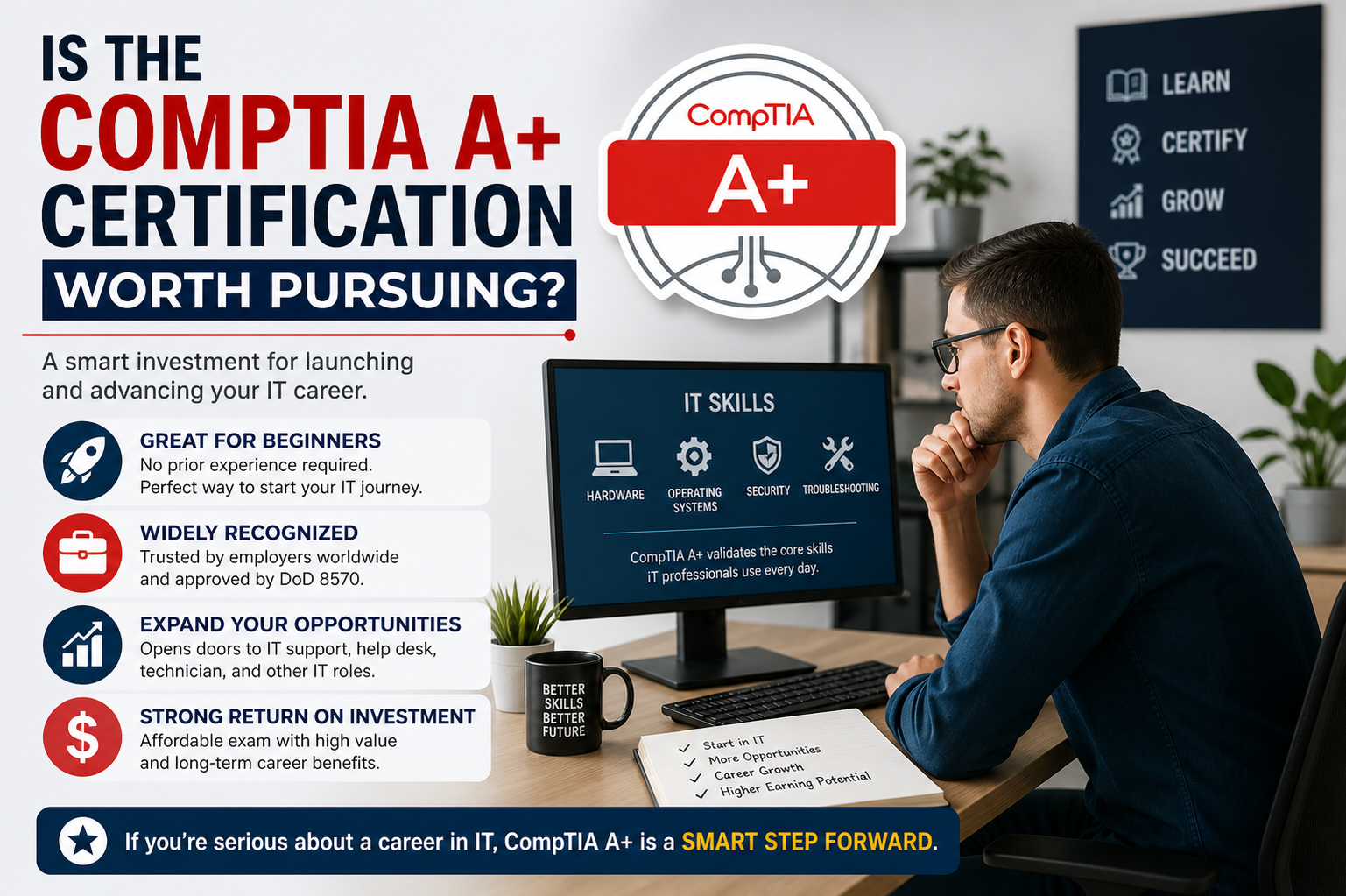
The CompTIA A+ certification is often considered one of the most recognized entry-level qualifications in the information technology industry. It is designed to build and validate fundamental technical skills that are essential for anyone looking to start a career in IT support or technical troubleshooting. For beginners, it provides a structured pathway into a field that can otherwise feel overwhelming due to the wide range of technologies and concepts involved. The certification focuses on practical knowledge that aligns closely with real-world job requirements, making it a strong foundation for future growth in more advanced IT roles.
Understanding the Purpose of the CompTIA A+ Certification
The primary purpose of the CompTIA A+ certification is to establish a baseline of technical competence for entry-level IT professionals. It is not designed for experts or specialists but rather for individuals who are new to the field or transitioning from non-technical backgrounds. The certification covers essential areas such as computer hardware, operating systems, mobile devices, basic networking, and troubleshooting methodologies. It also includes an introduction to cybersecurity principles and operational procedures that are commonly used in professional IT environments.
What makes this certification particularly valuable is its vendor-neutral nature. Instead of focusing on a single company’s products or systems, it teaches concepts that apply across a wide range of technologies. This means that the knowledge gained is transferable and not limited to one specific platform, which increases flexibility in job opportunities.
Structure and Core Knowledge Areas
The CompTIA A+ certification is typically divided into two main exam components that assess different aspects of IT knowledge. One focuses more on hardware and technical support, while the other emphasizes operating systems, security, and troubleshooting scenarios. Together, they provide a balanced understanding of both physical and software-related IT issues.
The hardware-focused portion includes topics such as assembling and disassembling computer systems, identifying internal components, understanding storage devices, and working with peripherals. It also introduces basic concepts related to power supply, memory, and motherboard functions. These foundational skills are essential for roles that involve repairing or maintaining computer systems.
The software and operating systems portion covers installation, configuration, and management of different operating systems, including Windows, Linux, and mobile platforms. It also introduces users to command-line tools, system utilities, and basic security configurations. In addition, candidates learn how to identify and resolve common software issues that occur in workplace environments.
Relevance in Today’s IT Industry
In today’s technology-driven world, the demand for IT support professionals remains strong, especially in organizations that rely heavily on computer systems and networks. The CompTIA A+ certification continues to be relevant because it aligns closely with the foundational skills required in these roles. Many employers still use it as a benchmark when hiring entry-level technicians because it demonstrates that a candidate has a verified understanding of essential IT concepts.
Although technology evolves rapidly, the core principles covered in the certification remain stable. Troubleshooting techniques, basic networking concepts, and hardware knowledge are still necessary regardless of changes in software or devices. This makes the certification a reliable starting point for long-term career development.
Career Opportunities After Certification
One of the most important considerations for anyone pursuing the CompTIA A+ certification is the type of career opportunities it can lead to. While it does not typically qualify individuals for advanced technical roles, it opens the door to several entry-level positions in IT support and infrastructure.
Common roles include help desk technician, IT support specialist, technical support representative, and desktop support technician. These positions often involve assisting users with technical issues, maintaining computer systems, installing software, and ensuring that hardware components function properly. They also provide valuable real-world experience that is essential for progressing into more specialized IT fields.
Over time, professionals who start with CompTIA A+ often move into roles such as network technician, systems administrator, cybersecurity analyst, or cloud support specialist. The certification acts as a stepping stone that helps individuals build confidence and practical skills before advancing to more complex responsibilities.
Difficulty Level and Learning Curve
The CompTIA A+ certification is considered entry-level, but it should not be mistaken for being overly simple. It requires a solid understanding of various technical topics and the ability to apply knowledge in practical scenarios. For individuals with no prior IT experience, the learning curve can be challenging at first, especially when dealing with hardware components or networking concepts.
However, with consistent study and hands-on practice, most candidates are able to grasp the material effectively. The certification is designed in a way that encourages problem-solving and practical thinking rather than memorization alone. This approach helps prepare candidates for real-world IT environments where quick and accurate troubleshooting is essential.
Skills Developed Through Certification Preparation
Preparing for the CompTIA A+ certification helps develop a wide range of technical and professional skills. On the technical side, candidates gain knowledge of computer hardware assembly, operating system installation, software troubleshooting, and basic network configuration. They also learn how to identify and resolve common system errors, which is a critical skill in IT support roles.
In addition to technical abilities, the certification also builds problem-solving and analytical thinking skills. Candidates are trained to approach issues methodically, diagnose problems step by step, and implement effective solutions. Communication skills are also indirectly strengthened, as IT support professionals often need to explain technical issues to non-technical users in a clear and simple manner.
Who Should Consider Pursuing This Certification
The CompTIA A+ certification is best suited for individuals who are new to the IT industry or those who are considering a career change into technology. It is particularly beneficial for students, entry-level job seekers, and individuals who have a general interest in computers but lack formal training.
It is also useful for people who are already working in basic technical support roles but want to formalize their knowledge and improve their career prospects. Even for those who plan to specialize in areas like cybersecurity, networking, or cloud computing, starting with A+ can provide a strong foundation that makes advanced learning easier.
Preparation Approach and Study Experience
Preparing for the CompTIA A+ certification requires a combination of theoretical learning and hands-on practice. Simply reading study material is not enough; practical experience with computer systems is essential for understanding how concepts apply in real situations. Many candidates build or disassemble computers, install operating systems, and simulate troubleshooting scenarios to reinforce their learning.
A structured study approach is often the most effective. Breaking down topics into manageable sections and focusing on one area at a time helps improve retention. Consistent practice and repetition also play an important role in mastering the material. Since the exam includes scenario-based questions, understanding how to apply knowledge is more important than memorizing definitions.
Industry Recognition and Employer Perspective
From an employer’s perspective, the CompTIA A+ certification is widely recognized as a reliable indicator of basic IT competency. While it may not be required for every entry-level job, it often gives candidates a competitive advantage over others who do not hold any certification. Employers value it because it demonstrates a commitment to learning and a willingness to develop technical skills.
In many cases, job postings for IT support roles list CompTIA A+ as either a preferred or recommended qualification. This shows that the certification is still relevant in hiring decisions and continues to hold value in the job market.
Long-Term Value and Career Growth
The long-term value of the CompTIA A+ certification lies not only in the job opportunities it creates but also in the foundation it builds for future learning. IT is a field that requires continuous development, and starting with a strong base makes it easier to progress into more advanced certifications and roles.
As professionals gain experience, they often move toward certifications in networking, cybersecurity, cloud technologies, or systems administration. The knowledge gained from A+ serves as a reference point that supports understanding of more complex topics. In this way, the certification acts as the first step in a long-term career journey rather than a final destination.
Overall Perspective on Its Worth
When evaluating whether the CompTIA A+ certification is worth pursuing, it is important to consider individual goals and career aspirations. For someone entering the IT field for the first time, it provides excellent value by offering foundational knowledge, improving employability, and building confidence. It helps bridge the gap between theoretical understanding and practical application.
While it does not guarantee high-level positions or advanced salaries on its own, it plays a critical role in starting an IT career. Its real strength lies in opening doors, building credibility, and preparing individuals for more specialized and higher-paying opportunities in the future.
Real-World Application of CompTIA A+ Skills
One of the strongest aspects of the CompTIA A+ certification is how directly its knowledge applies to real-world IT environments. Unlike purely theoretical learning, the skills gained are immediately useful in day-to-day technical support roles. Professionals often deal with hardware failures, software errors, network connectivity issues, and user-related problems, all of which are covered within the certification scope.
In practical settings, an A+ certified technician may be responsible for setting up new computers, installing operating systems, configuring user accounts, and ensuring devices are properly connected to networks. They may also troubleshoot issues such as slow system performance, printer malfunctions, or internet connectivity failures. These are common workplace problems, and the ability to resolve them efficiently is highly valued by employers.
The certification also prepares individuals to work in structured IT environments where documentation, procedures, and standard troubleshooting steps are important. This helps create consistency in how technical issues are handled and ensures that support processes remain efficient and reliable.
Importance in Building IT Confidence
For many beginners, one of the biggest challenges in IT is confidence. The field can appear complex due to the number of systems, tools, and technologies involved. The CompTIA A+ certification helps reduce this uncertainty by providing a clear learning path that introduces concepts in a logical and structured way.
As candidates progress through the material, they gradually become more comfortable with technical terminology and problem-solving approaches. This growing familiarity translates into confidence when working in real environments. Instead of feeling overwhelmed by technical issues, individuals begin to approach problems with a methodical mindset.
This confidence is particularly important in entry-level roles, where professionals are expected to handle user concerns independently. Being able to diagnose and resolve issues without constant supervision is a key skill that employers look for, and A+ helps build that ability.
Comparison With Other Entry-Level Certifications
When considering whether CompTIA A+ is worth pursuing, it is useful to compare it with other entry-level IT certifications. While there are many foundational certifications available in the market, A+ stands out due to its broad coverage of essential IT topics.
Some certifications focus only on networking or only on operating systems, but A+ combines multiple areas into one credential. This makes it more versatile for beginners who are still exploring different career paths within IT. It allows individuals to gain exposure to multiple domains before deciding on a specialization.
In contrast, more specialized certifications may offer deeper knowledge in a specific area but often require prior experience or foundational understanding. For this reason, A+ is commonly recommended as a starting point before moving into certifications related to networking, cybersecurity, or cloud computing.
Employer Expectations and Workplace Readiness
Employers in the IT industry often expect entry-level candidates to have a basic understanding of technical systems and troubleshooting processes. The CompTIA A+ certification aligns closely with these expectations, which is why it is frequently listed in job requirements.
In many workplaces, new IT employees are expected to quickly adapt to support tasks with minimal training. Having A+ certification helps demonstrate that an individual already understands core concepts such as operating system navigation, hardware components, and basic networking principles. This reduces the training burden on employers and allows new hires to become productive more quickly.
Workplace readiness is not only about technical knowledge but also about understanding how IT support functions in a professional environment. The certification introduces candidates to concepts such as ticketing systems, customer service skills, and communication practices, all of which are essential in real job roles.
Challenges Faced During Certification Preparation
Although the CompTIA A+ certification is entry-level, candidates often face several challenges during preparation. One common difficulty is the wide range of topics covered. Since the certification includes hardware, software, networking, and security basics, learners must manage multiple subject areas at once.
Another challenge is understanding technical concepts without prior experience. For example, individuals who have never worked with computer hardware may initially struggle to visualize internal components or understand how systems interact. Similarly, networking concepts such as IP addressing or subnetting can seem complex at first.
Time management is also a challenge for many candidates, especially those balancing studies or work responsibilities. Consistent study habits and practical experience are essential to overcoming these difficulties. Hands-on practice is particularly important because it helps transform abstract concepts into real, understandable processes.
Role in Career Transition Into IT
The CompTIA A+ certification is especially valuable for individuals transitioning from non-technical fields into IT. Many professionals from industries such as retail, administration, or customer service choose IT as a new career path due to better growth opportunities and demand.
For these individuals, A+ serves as an accessible entry point that does not require prior technical background. It provides structured learning that gradually introduces essential IT concepts, making the transition smoother and more manageable.
It also helps career changers demonstrate commitment to potential employers. Instead of relying solely on transferable soft skills, candidates can present a recognized technical qualification that validates their readiness for IT roles.
Long-Term Skill Retention and Development
One of the key benefits of the CompTIA A+ certification is that the knowledge gained tends to have long-term value. While specific technologies may evolve over time, the core principles of troubleshooting, system maintenance, and basic networking remain relevant.
For example, understanding how operating systems function or how hardware components interact is useful regardless of future technological changes. These foundational skills continue to support learning even when moving into more advanced areas such as cloud computing or cybersecurity.
Additionally, the certification encourages continuous learning. Many individuals who complete A+ naturally progress toward higher-level certifications, building on the foundation they have already established. This creates a structured career development path within the IT industry.
Limitations of the Certification
Despite its advantages, the CompTIA A+ certification does have limitations that should be considered. It is not designed to provide deep expertise in any single area. Instead, it focuses on broad foundational knowledge, which means it may not be sufficient for specialized roles.
For example, roles in network engineering or cybersecurity typically require additional certifications and practical experience beyond A+. Similarly, higher-level positions in systems administration or cloud architecture demand more advanced technical understanding.
Another limitation is that while the certification improves employability, it does not guarantee job placement. Practical experience, communication skills, and problem-solving ability are also critical factors that employers evaluate during hiring.
Return on Investment in Terms of Time and Effort
When evaluating whether the certification is worth pursuing, it is important to consider the return on investment in terms of time and effort. Preparing for the CompTIA A+ certification requires dedication, especially for beginners, but the potential benefits often outweigh the effort involved.
The time spent studying can lead to improved job opportunities, higher earning potential compared to non-certified candidates, and a clearer understanding of IT systems. Even if the certification is not the final step in a career journey, it often serves as a valuable foundation that accelerates future progress.
Many individuals find that the confidence and knowledge gained during preparation have lasting benefits beyond the certification itself. It helps shape their approach to problem-solving and technical thinking, which are essential skills in any IT role.
Final Perspective on Its Value
Overall, the CompTIA A+ certification remains a strong and worthwhile option for anyone entering the IT field. Its value lies not only in the credential itself but in the knowledge, skills, and confidence it builds during the learning process.
It provides a clear starting point in a complex industry and helps bridge the gap between beginner-level understanding and professional IT work. While it is not the ultimate destination in an IT career, it is an important stepping stone that supports long-term growth and development.
For individuals serious about starting a career in technology, the certification offers a practical and recognized pathway that can lead to meaningful opportunities and continued advancement in the IT industry.
Career Growth Path After CompTIA A+
After completing the CompTIA A+ certification, many individuals begin to see it as the starting point of a broader IT career journey rather than a final achievement. The knowledge gained at this stage creates a foundation that can support progression into more specialized and higher-paying roles within the technology industry.
Most professionals who start with A+ gradually move into areas such as networking, cybersecurity, systems administration, or cloud computing. This progression is natural because A+ introduces the essential building blocks that these advanced fields rely on. Without understanding hardware, operating systems, and basic troubleshooting, it becomes difficult to succeed in more complex IT domains.
As experience grows, individuals often choose certifications that align with their interests. For example, those interested in networking may pursue advanced networking credentials, while those interested in security may move toward cybersecurity certifications. The CompTIA A+ certification acts as the entry gateway that makes these transitions smoother and more structured.
Workplace Experience and Skill Enhancement
While the certification provides theoretical and practical knowledge, real growth happens when these skills are applied in actual workplace environments. Entry-level IT jobs allow professionals to deal with real users, real systems, and real technical problems.
In these roles, individuals learn how to handle pressure, prioritize issues, and manage time effectively. They also develop communication skills by interacting with users who may not have technical knowledge. This ability to translate technical information into simple explanations is highly valuable in IT support roles.
Over time, exposure to different types of issues helps professionals build intuition for troubleshooting. Instead of following steps blindly, they begin to recognize patterns and identify problems more quickly. This kind of experience cannot be gained from study alone, which is why A+ is often seen as the first step toward real-world IT competence.
Industry Demand and Job Stability
The demand for IT support professionals remains steady across many industries, including education, healthcare, business, and government sectors. Almost every organization relies on computer systems, which creates a continuous need for skilled technicians who can maintain and troubleshoot these systems.
The CompTIA A+ certification helps individuals qualify for these roles by demonstrating that they possess the essential knowledge required for technical support work. This makes it easier to enter the job market, especially for beginners who do not yet have professional experience.
Job stability in IT support roles can be relatively strong because technology infrastructure is critical to daily operations. Even as automation and advanced tools evolve, human intervention is still needed to resolve complex or unexpected issues. This ensures that entry-level IT roles remain relevant and in demand.
Developing Problem-Solving Mindset
One of the most important outcomes of pursuing the CompTIA A+ certification is the development of a structured problem-solving mindset. IT support work is rarely about knowing every answer immediately; instead, it is about knowing how to approach problems logically.
Candidates are trained to break down issues into smaller components, identify possible causes, and test solutions systematically. This approach is useful not only in IT but also in many other professional and personal situations.
Over time, this way of thinking becomes second nature. Professionals begin to approach technical challenges with confidence, knowing that most problems can be solved through structured analysis and patience. This mindset is one of the most valuable long-term benefits of the certification.
Impact on Salary and Earning Potential
While the CompTIA A+ certification is entry-level, it can still have a positive impact on earning potential, especially for individuals starting from non-technical backgrounds. Certified candidates often have an advantage over non-certified applicants when applying for entry-level IT positions.
Employers may offer slightly higher starting salaries to candidates who already possess verified technical knowledge. More importantly, the certification helps individuals qualify for roles that they may not have been eligible for otherwise, which indirectly increases earning opportunities.
However, it is important to understand that significant salary growth typically comes after gaining experience and additional certifications. A+ is the beginning of this journey, not the peak. As professionals move into more advanced roles, their earning potential increases substantially.
Importance of Continuous Learning
The IT industry is constantly evolving, which means that continuous learning is essential for long-term success. The CompTIA A+ certification introduces this concept by encouraging individuals to build on their knowledge over time.
After completing A+, many professionals continue studying new technologies, tools, and systems. This ongoing learning process helps them stay relevant in a fast-changing industry. It also opens up opportunities for career advancement and specialization.
Those who stop learning after A+ may find their growth limited, while those who continue building skills can move into high-demand areas such as cloud engineering, cybersecurity, and infrastructure management.
Challenges in Long-Term IT Career Development
Although the CompTIA A+ certification provides a strong starting point, the IT career path is not without challenges. One of the main difficulties is keeping up with rapid technological change. New systems, software updates, and security threats require constant adaptation.
Another challenge is competition in the job market. As more individuals enter the IT field, entry-level positions can become competitive. This makes it important for candidates to combine certification with practical experience and strong communication skills.
Career progression also requires patience. Advancing from entry-level support roles to higher positions does not happen overnight. It requires consistent effort, learning, and hands-on experience over time.
Why A+ Remains Relevant Today
Despite changes in technology, the CompTIA A+ certification continues to remain relevant because it focuses on core principles rather than specific tools. Hardware troubleshooting, operating system management, and basic networking are still essential skills in modern IT environments.
Even with automation and cloud-based systems becoming more common, IT support professionals are still needed to handle physical devices, user issues, and system errors. This ensures that the foundational skills taught in A+ retain their importance.
The certification also evolves over time to reflect current industry trends. This helps keep the content aligned with modern workplace requirements, ensuring that learners are not studying outdated material.
Final Evaluation of Its Worth
When evaluating the overall worth of the CompTIA A+ certification, it becomes clear that its value depends heavily on the individual’s goals. For someone entering the IT field for the first time, it provides an excellent starting point that builds both knowledge and confidence.
It helps bridge the gap between beginner-level understanding and professional IT work, making it easier to enter the job market. It also serves as a foundation for future certifications and career growth.
However, it is not a standalone solution for long-term career success. Its true value comes when it is combined with experience, continuous learning, and further specialization.
In conclusion, the CompTIA A+ certification is worth pursuing for those who are serious about starting a career in IT. It provides essential skills, improves employability, and creates a clear pathway toward advanced opportunities in the technology field.
Realistic Expectations From CompTIA A+ Certification
When considering the CompTIA A+ certification, it is important to maintain realistic expectations about what it can and cannot do for a career. Many beginners assume that earning the certification alone will guarantee immediate employment or high-paying roles, but in reality, it serves more as a foundation than a complete solution.
The certification helps demonstrate that an individual understands essential IT concepts and is capable of handling basic technical tasks. However, employers still look for additional qualities such as communication skills, problem-solving ability, and sometimes prior hands-on experience. This means that while A+ improves employability, it does not replace practical exposure or professional development.
Understanding this balance is important because it helps candidates approach their IT journey with the right mindset. Instead of viewing the certification as an endpoint, it should be seen as the first structured step into the industry.
Role in Building Professional Discipline
Another often overlooked benefit of the CompTIA A+ certification is the discipline it builds during preparation. Studying for the exams requires consistency, focus, and time management, especially when covering a wide range of technical topics.
This process teaches learners how to manage structured study schedules and stay committed to long-term goals. These habits are not only useful for passing the certification but also essential for success in IT careers, where continuous learning is a constant requirement.
Professional discipline also extends to how candidates approach technical problems. The certification encourages logical thinking and structured troubleshooting, which helps develop a more organized and efficient way of working in real job environments.
Foundation for Technical Thinking
One of the most valuable outcomes of the CompTIA A+ certification is the development of technical thinking. This refers to the ability to understand how systems interact, how problems occur, and how solutions can be applied logically.
Instead of guessing or randomly trying solutions, certified individuals learn to analyze symptoms, identify possible causes, and eliminate issues step by step. This methodical approach is critical in IT environments where efficiency and accuracy are important.
Technical thinking also helps in adapting to new technologies. Once a person understands the underlying principles of how systems work, it becomes easier to learn new tools and platforms without starting from scratch.
Entry Point Into IT Support Ecosystem
The CompTIA A+ certification essentially serves as an entry point into the broader IT support ecosystem. This ecosystem includes help desk operations, technical support teams, system maintenance roles, and user assistance services.
In many organizations, IT support is the first line of defense when technical issues arise. Professionals in these roles are responsible for ensuring that systems remain operational and users can continue working without major disruptions.
By completing A+, individuals gain the foundational knowledge required to participate in this ecosystem effectively. They learn how to interact with users, escalate issues when necessary, and maintain basic system functionality.
Transition From Theory to Practice
One of the key transitions that happens during and after the CompTIA A+ certification is the shift from theoretical learning to practical application. Initially, learners study concepts such as hardware components, operating systems, and networking principles in a structured academic format.
However, once they enter the workplace or begin hands-on practice, these concepts take on real meaning. For example, understanding how RAM works is different from diagnosing memory-related issues in a malfunctioning system. Similarly, learning about networks becomes more meaningful when troubleshooting real connectivity problems.
This transition is crucial because it bridges the gap between knowledge and experience. The certification helps prepare individuals for this shift by introducing scenario-based thinking during exam preparation.
Value in Entry-Level Job Market Competition
In competitive job markets, even entry-level positions often attract multiple candidates. In such situations, having a recognized certification like CompTIA A+ can make a significant difference.
It acts as a differentiator that shows employers the candidate has taken the initiative to learn industry-relevant skills. While it may not guarantee selection, it increases visibility and improves chances of being shortlisted for interviews.
In many cases, hiring managers use certifications as a filtering tool when reviewing applications. Candidates with A+ certification are often seen as better prepared for technical responsibilities compared to those without any formal IT training.
Importance of Hands-On Practice Alongside Certification
Although the CompTIA A+ certification provides essential theoretical knowledge, it becomes much more effective when combined with hands-on practice. Real learning happens when concepts are applied in practical environments.
Building or repairing computers, installing operating systems, configuring networks, and troubleshooting real issues all contribute to deeper understanding. This hands-on experience reinforces what is learned during certification preparation and makes it easier to retain information.
Without practical exposure, knowledge can remain abstract and difficult to apply in real situations. This is why successful candidates often combine study materials with real-world experimentation.
Limitations in Specialized Career Paths
While the CompTIA A+ certification is valuable for entry-level roles, it has limitations when it comes to specialized IT careers. Fields such as cybersecurity, data engineering, artificial intelligence, and advanced networking require deeper and more focused knowledge.
A+ does not cover these advanced topics in detail. Instead, it provides a general overview that prepares individuals for foundational roles. To move into specialized career paths, additional certifications and training are necessary.
This limitation should not be viewed negatively, as every advanced career path begins with a strong foundation. A+ simply plays its role in the early stage of professional development.
Long-Term Career Perspective
From a long-term perspective, the CompTIA A+ certification should be seen as part of a larger career journey. It is the first step in building technical expertise and professional credibility in the IT industry.
Over time, individuals who start with A+ often progress into more advanced certifications and roles. With experience, they may move into positions such as systems administrator, network engineer, cybersecurity analyst, or IT manager.
The certification itself may become less significant as experience grows, but the foundational knowledge it provides continues to support career development throughout a professional’s journey.
In conclusion, the CompTIA A+ certification remains a valuable and practical starting point for anyone entering the IT field. Its strength lies in its ability to introduce essential technical concepts, build confidence, and improve employability in entry-level roles.
It is not designed to be the final achievement in an IT career but rather the beginning of a structured learning path. Its true value is realized when it is combined with hands-on experience, continuous learning, and further specialization.
For individuals who are serious about building a career in technology, the certification offers a clear, accessible, and recognized pathway into the industry.
Conclusion
The CompTIA A+ certification holds strong value for individuals who are beginning their journey in the information technology field. It provides a structured introduction to essential IT concepts, including hardware, software, operating systems, networking basics, and troubleshooting methods. This foundational knowledge is important for understanding how modern computer systems function and how technical issues are identified and resolved in real environments.
Beyond technical skills, the certification also plays a key role in building confidence and professional readiness. It helps beginners develop a practical mindset for problem-solving while also introducing them to workplace expectations such as communication, user support, and systematic issue handling. These combined skills make it easier to transition into entry-level IT roles and adapt to real-world job responsibilities.
Although it does not guarantee advanced positions or long-term career success on its own, the certification serves as a valuable stepping stone. It improves employability, strengthens resumes, and creates opportunities for further learning and specialization. Most importantly, it lays the groundwork for future certifications and career advancement in areas such as networking, cybersecurity, and cloud computing.
In the end, the CompTIA A+ certification is worth pursuing for those who are serious about starting a career in IT. Its real value lies not only in the credential itself but in the knowledge, discipline, and direction it provides for long-term professional growth in the technology industry.