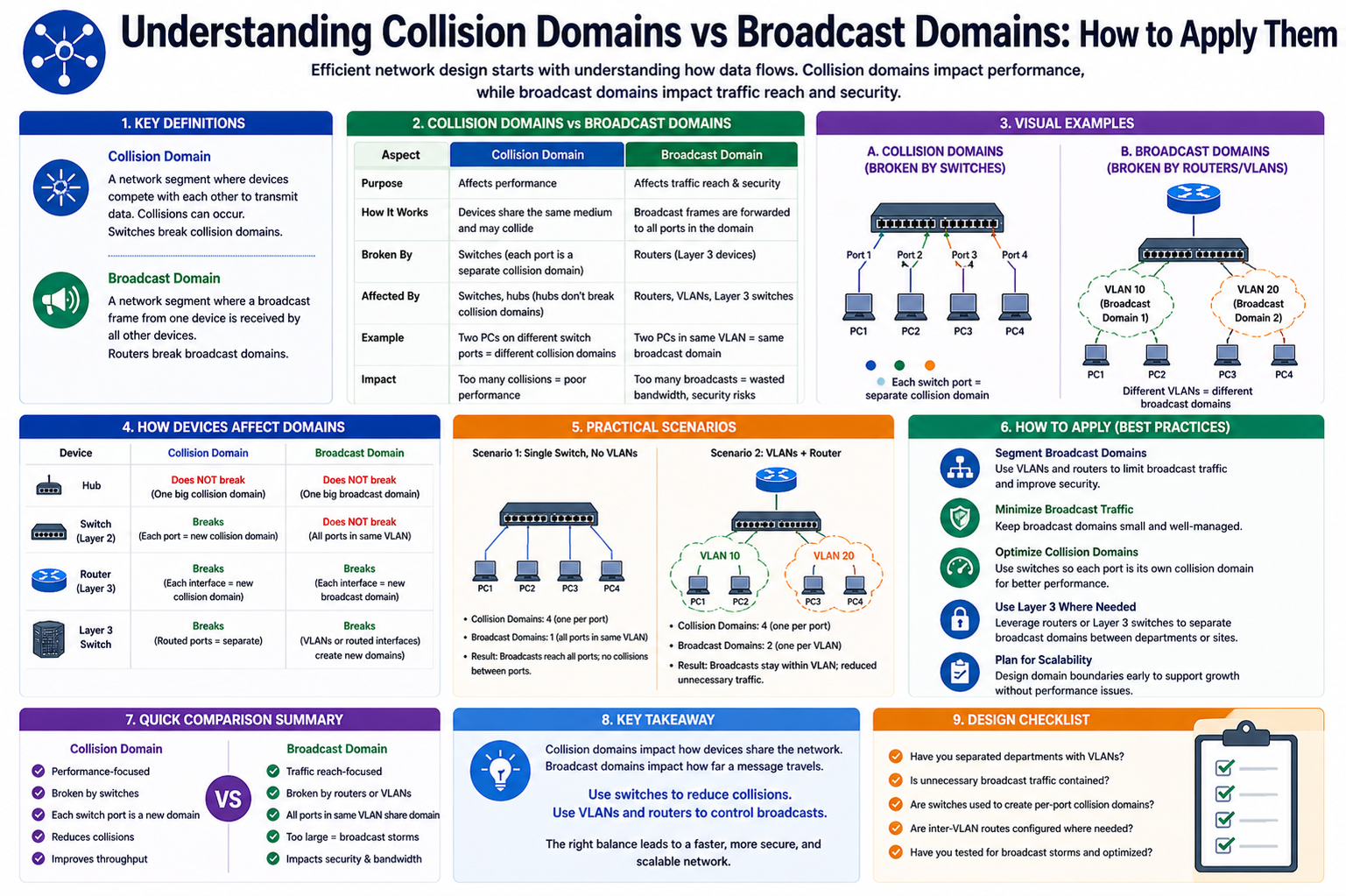
In computer networking, efficient communication depends heavily on how data travels between devices and how the network is structured to manage traffic flow. Two fundamental concepts that define this structure are collision domains and broadcast domains. These concepts are essential for understanding how data packets move, how congestion occurs, and how performance can be improved in a network. Although both relate to traffic distribution, they operate in very different ways and influence network behavior in distinct manners.
A collision domain focuses on the possibility of data packet collisions when multiple devices attempt to transmit data simultaneously over a shared medium. In contrast, a broadcast domain defines the scope within which broadcast messages are propagated to all connected devices. Understanding both concepts helps in designing networks that are efficient, scalable, and stable under heavy traffic conditions.
Understanding Collision Domains in Depth
A collision domain is essentially a network area where data packets can collide if two or more devices attempt to send data at the same time. This situation commonly occurs in older or simpler network setups where devices share the same communication channel. When a collision happens, the transmitted data becomes corrupted, and devices must resend the information, which leads to delays and reduced efficiency.
In early networking systems that used shared media, such as hubs, all connected devices operated within a single collision domain. This meant that every device had to compete for the same transmission path. As more devices were added, the likelihood of collisions increased significantly, causing performance issues and network congestion.
Modern networking equipment has largely eliminated this problem by introducing switches. Unlike hubs, switches create separate collision domains for each connected device or port. This means that communication between two devices does not interfere with others, greatly reducing the chance of collisions and improving overall network efficiency.
How Collisions Occur in Network Communication
Collisions occur when two devices transmit data at the same time over a shared medium without coordination. In traditional Ethernet-based networks, devices used a method known as carrier sense multiple access with collision detection. This system allowed devices to listen before transmitting, ensuring the medium was free. However, if two devices transmitted simultaneously, a collision would still occur.
When a collision is detected, both devices stop transmitting, wait for a random time interval, and then attempt to resend the data. While this mechanism helps manage conflicts, it also introduces delays, especially in busy networks where collisions happen frequently. The more devices that share a collision domain, the higher the probability of collisions, which directly impacts network performance.
Role of Hubs and Switches in Collision Domains
Hubs play a major role in creating large collision domains. A hub simply broadcasts incoming data to all connected ports without any intelligence to manage traffic. This means that all devices connected to a hub share the same collision domain, leading to frequent data collisions and reduced performance.
Switches, on the other hand, operate more intelligently. They learn the MAC addresses of connected devices and forward data only to the intended recipient port. This effectively creates separate collision domains for each port. As a result, devices can communicate simultaneously without interfering with each other, significantly improving network efficiency and reducing retransmissions.
Half Duplex vs Full Duplex Communication
Collision domains are closely related to the type of communication mode used in a network. In half duplex communication, data can only travel in one direction at a time. This limitation increases the chances of collisions because devices must take turns transmitting and receiving.
In full duplex communication, data can be sent and received simultaneously. This eliminates the possibility of collisions entirely because devices do not have to compete for the same transmission path. Modern switches typically support full duplex communication, making collision domains practically irrelevant in well-designed networks.
Understanding Broadcast Domains in Depth
A broadcast domain is a network segment where any broadcast message sent by a device is received by all other devices within the same segment. Broadcast messages are used for essential network functions such as discovering devices, resolving addresses, and distributing configuration information.
Unlike collision domains, which deal with transmission conflicts, broadcast domains focus on message propagation. When a device sends a broadcast, every device in the same broadcast domain processes that message, even if it is not directly intended for them. This behavior is necessary for certain network operations but can lead to unnecessary traffic if not controlled properly.
If a broadcast domain becomes too large, the network can suffer from performance degradation due to excessive broadcast traffic. This is why large networks are often divided into smaller broadcast domains using routers or logical segmentation techniques.
Types of Broadcast Traffic and Their Impact
Broadcast traffic includes messages that are sent to all devices in a network segment. Common examples include address resolution requests and network discovery processes. While these messages are essential, they can become problematic when they occur too frequently.
When too many devices exist within the same broadcast domain, the volume of broadcast traffic increases significantly. This can lead to congestion, as every device must process each broadcast message, even if it is not relevant. Over time, this reduces network efficiency and can slow down legitimate communication between devices.
Role of Routers in Broadcast Domains
Routers play a critical role in controlling broadcast domains. Unlike switches, routers do not forward broadcast traffic between different network segments. This means each interface of a router defines a separate broadcast domain.
By separating broadcast domains, routers help reduce unnecessary traffic and improve overall network performance. This segmentation is especially important in large networks where excessive broadcast traffic could otherwise overwhelm devices and degrade performance.
Switches and Broadcast Traffic Handling
While switches primarily operate at the data link layer, they still play a role in managing broadcast traffic. Switches forward broadcast messages to all ports within the same network segment. However, they do not forward these messages beyond their local network unless explicitly configured to do so.
This behavior means that switches help contain broadcast traffic within a specific area, but they do not eliminate broadcast domains entirely. Instead, they manage traffic more efficiently within a given segment.
Virtual LANs and Logical Segmentation
In modern networking, logical segmentation techniques are used to divide broadcast domains without requiring physical separation. One of the most common methods is the use of virtual LANs.
A virtual LAN allows network administrators to group devices logically, regardless of their physical location. Devices within the same virtual LAN share a broadcast domain, while devices in different virtual LANs are isolated from each other. This helps reduce broadcast traffic and improves network security and efficiency.
By using virtual segmentation, organizations can control how broadcast traffic flows across their network without changing physical infrastructure.
Impact of Collision and Broadcast Domains on Performance
Both collision and broadcast domains have a direct impact on network performance. Large collision domains increase the likelihood of data collisions, leading to retransmissions and delays. On the other hand, large broadcast domains result in excessive broadcast traffic, which consumes bandwidth and processing power.
Efficient network design aims to minimize collision domains using switches and reduce broadcast domains using routers or logical segmentation. This balance ensures smooth communication, reduced congestion, and improved scalability.
Real-World Network Behavior and Examples
In real-world environments, the difference between collision and broadcast domains becomes evident in how networks handle traffic. In a poorly designed network with shared communication paths, users may experience delays, slow file transfers, and unstable connections due to frequent collisions and broadcast storms.
In contrast, a well-designed network using switches and routers provides stable communication even under heavy load. Devices can communicate simultaneously without interference, and broadcast traffic remains controlled within defined segments.
Troubleshooting Network Issues Related to Domains
Understanding collision and broadcast domains is also important for troubleshooting network problems. High collision rates often indicate outdated hardware or improper configuration, such as full duplex mismatch or excessive use of shared media.
Similarly, excessive broadcast traffic can indicate poor network segmentation or misconfigured devices generating unnecessary broadcasts. Identifying and isolating these issues requires knowledge of how traffic flows within both types of domains.
Importance in Modern Network Design
Modern networks are designed with the goal of eliminating collision domains and controlling broadcast domains as much as possible. The widespread use of switches operating in full duplex mode has effectively removed collisions from most environments.
At the same time, routers and virtual segmentation techniques ensure that broadcast traffic remains manageable. This combination allows networks to scale efficiently while maintaining high performance and reliability.
Deeper Insight into Network Traffic Behavior
To fully understand how modern networks operate, it is important to look beyond basic definitions and examine how traffic actually behaves under different conditions. Every time a device sends data, that data follows a path influenced by the network’s physical and logical design. Collision domains and broadcast domains are two mechanisms that determine how that data is shared, segmented, and controlled. Their behavior directly impacts speed, reliability, and scalability in any network environment.
In a structured network, traffic is not simply allowed to flow freely without rules. Instead, it is carefully managed so that devices can communicate efficiently without interfering with one another. Collision domains control how devices handle simultaneous transmissions, while broadcast domains control how widely certain types of messages are distributed. Together, they form the backbone of traffic management at the data link and network layers.
Evolution from Shared Networks to Switched Networks
In early networking systems, devices were connected in a way that required them to share the same communication medium. This meant that only one device could transmit at a time, and all others had to wait. As more devices were added, the network became increasingly inefficient because collisions were frequent and performance dropped significantly.
The introduction of switching technology changed this behavior completely. Instead of sharing a single communication path, switches create dedicated paths between devices. This reduces or eliminates collisions by ensuring that each connection operates independently. As a result, modern networks are far more stable and capable of handling high volumes of traffic without degradation.
This evolution also changed how network designers think about segmentation. Instead of treating all devices as part of one large communication space, networks are now divided into smaller, more controlled segments. These segments define both collision and broadcast domains in a way that improves performance and predictability.
Role of MAC Address Learning in Traffic Control
Switches rely heavily on MAC address learning to manage traffic efficiently. When a device sends data through a switch, the switch records the source address and associates it with a specific port. Over time, it builds a table that maps devices to their physical locations within the network.
This learning process allows the switch to send data only to the intended recipient instead of broadcasting it to all devices. As a result, unnecessary traffic is reduced, and each port effectively becomes its own collision domain. This intelligent forwarding mechanism is one of the key reasons why modern networks experience far fewer performance issues compared to older systems.
However, broadcast traffic still exists even in switched environments. While switches reduce unnecessary forwarding, they still allow broadcast messages within the same segment. This is where broadcast domains continue to play an important role.
Understanding Broadcast Propagation in Detail
Broadcast messages are designed to reach all devices within a network segment. These messages are essential for certain functions, such as discovering network services or resolving unknown addresses. When a broadcast is sent, every device in the same broadcast domain processes it, even if the message is not directly relevant to them.
This behavior ensures that devices can communicate in situations where the destination is not yet known. However, it also creates overhead, because every device must examine each broadcast message. If the number of devices increases, the amount of broadcast traffic increases as well, which can lead to performance issues.
In large networks, uncontrolled broadcast propagation can result in what is known as broadcast flooding. This occurs when excessive broadcast traffic consumes bandwidth and processing resources, slowing down normal communication. Proper segmentation is therefore essential to prevent such issues.
Importance of Network Segmentation Strategies
Network segmentation is the process of dividing a larger network into smaller, more manageable parts. This strategy is used to control both collision and broadcast domains. By reducing the size of these domains, network administrators can improve performance, enhance security, and simplify troubleshooting.
Collision domains are typically segmented using switches, which isolate device connections. Broadcast domains, on the other hand, are segmented using routing devices or logical segmentation techniques. This separation ensures that broadcast traffic does not spread unnecessarily across the entire network.
Effective segmentation also improves fault isolation. If a problem occurs in one segment, it does not affect the entire network. This makes maintenance easier and reduces downtime.
Impact of Network Topology on Domain Behavior
The structure of a network, known as its topology, plays a significant role in how collision and broadcast domains behave. In a simple topology where devices are directly connected through a switch, collision domains are minimized, and communication is highly efficient.
In more complex topologies involving multiple interconnected devices, careful planning is required to ensure that broadcast domains do not become too large. Without proper design, even a well-equipped network can suffer from performance degradation due to excessive broadcast traffic.
Hierarchical network designs are commonly used to address this issue. These designs separate networks into layers, each responsible for specific types of traffic handling. This layered approach helps maintain control over both collision and broadcast domains.
Effect of Network Load on Domain Performance
Network load refers to the amount of traffic being handled by a network at any given time. As load increases, the behavior of both collision and broadcast domains becomes more critical. In poorly designed networks, high load can lead to increased collisions and excessive broadcast traffic.
In collision domains, heavy load increases the chance that multiple devices will attempt to transmit simultaneously. Even with modern switches, improper configuration or legacy systems can still experience performance issues under high traffic conditions.
In broadcast domains, high load leads to more frequent broadcast messages being processed by all devices. This increases CPU usage on devices and reduces available bandwidth for actual data transmission.
How Modern Networks Minimize Domain Issues
Modern networking solutions use a combination of hardware and logical techniques to minimize issues related to collision and broadcast domains. High-performance switches eliminate most collision-related problems by supporting full duplex communication and dedicated connections.
Routing devices and segmentation technologies control broadcast traffic by limiting its spread to specific network areas. This ensures that only relevant devices receive broadcast messages, reducing unnecessary processing.
Additionally, advanced network configurations such as segmentation policies and traffic filtering help further optimize performance. These methods allow administrators to fine-tune how data flows through the network.
Security Implications of Broadcast and Collision Domains
Both collision and broadcast domains also have implications for network security. In large broadcast domains, sensitive information in broadcast messages may be visible to all devices within the same segment. This increases the importance of isolating critical systems using proper segmentation.
Collision domains, while less directly related to security, can still affect system reliability. Frequent collisions and retransmissions can create opportunities for performance-based attacks or denial-of-service conditions in poorly managed environments.
By properly controlling both types of domains, organizations can reduce exposure to unnecessary risks and improve overall network resilience.
Troubleshooting Performance Issues Related to Domains
When network performance issues arise, understanding collision and broadcast domains can help identify the root cause. High collision rates may indicate outdated hardware, improper cabling, or incorrect duplex settings. These issues can often be resolved by upgrading equipment or reconfiguring network settings.
Excessive broadcast traffic may indicate poor segmentation or misconfigured devices generating unnecessary broadcast messages. In such cases, isolating traffic sources or redesigning the network structure can significantly improve performance.
Effective troubleshooting requires a clear understanding of how traffic flows through both types of domains and how they interact with network devices.
Real-World Applications and Practical Importance
In real-world environments such as corporate networks, data centers, and educational institutions, managing collision and broadcast domains is essential for maintaining smooth operations. Without proper control, networks can become congested, slow, and unreliable.
By implementing structured segmentation and modern switching techniques, organizations can support large numbers of devices without sacrificing performance. This is especially important in environments where real-time communication and high data throughput are required.
How Modern Switching Has Redefined Collision Behavior
In contemporary networking, collision domains have become largely invisible to end users because of the widespread adoption of advanced switching technologies. Unlike older shared-media systems, modern switches create dedicated communication paths between devices, effectively isolating each connection. This means that each switch port typically represents its own collision domain, eliminating the traditional problem of multiple devices competing for the same transmission medium.
This architectural change has transformed how networks operate at a fundamental level. Instead of managing collisions after they occur, modern systems are designed to prevent them entirely. Full-duplex communication further enhances this efficiency by allowing simultaneous sending and receiving of data, ensuring that devices no longer need to wait for a clear channel before transmitting. As a result, collision domains still exist conceptually, but their practical impact is minimal in well-designed networks.
Broadcast Domains in Large-Scale Network Environments
While collision domains have been significantly reduced in modern systems, broadcast domains remain a critical factor in network performance. In large-scale environments, broadcast traffic can quickly accumulate if not properly controlled. Every device within a broadcast domain must process incoming broadcast messages, even if they are not relevant to its operation. This creates processing overhead and consumes bandwidth across the network.
In enterprise-level infrastructures, broadcast domains are carefully structured to prevent unnecessary expansion. If a broadcast domain becomes too large, even routine network operations can generate significant traffic loads. This is why segmentation techniques are essential in maintaining performance stability across complex systems.
Difference in Control Mechanisms Between the Two Domains
The control mechanisms used for collision domains and broadcast domains are fundamentally different. Collision domains are controlled primarily through hardware-level decisions, such as the use of switches and duplex settings. These mechanisms prevent simultaneous transmission conflicts by isolating communication paths and enabling parallel data flows.
Broadcast domains, however, are controlled through logical and routing-level mechanisms. Devices such as routers determine whether broadcast traffic should be forwarded beyond a given segment. This separation ensures that broadcast messages remain localized, preventing unnecessary network-wide distribution.
The distinction between physical control (collision domains) and logical control (broadcast domains) is essential for understanding how modern networks achieve efficiency at scale.
Impact of Network Design on Domain Efficiency
Network design plays a critical role in determining how effectively collision and broadcast domains are managed. Poorly designed networks may still suffer from unnecessary traffic congestion, even if modern hardware is used. For example, connecting too many devices within a single broadcast domain can lead to excessive broadcast processing, slowing down overall performance.
Similarly, improper configuration of switching equipment can introduce inefficiencies in collision handling, even though collisions are rare in modern systems. This highlights the importance of thoughtful network architecture rather than relying solely on hardware capabilities.
Efficient design typically involves dividing networks into smaller, manageable segments, each optimized for specific types of traffic. This ensures that both collision and broadcast domains remain within acceptable limits.
Role of Layered Network Architecture
Layered network architecture helps in organizing how collision and broadcast domains are managed across different levels. At the lower layers, switching devices handle direct communication between endpoints, minimizing collision-related issues. At higher layers, routing devices manage how broadcast traffic is controlled and distributed.
This layered approach ensures that each level of the network has a specific responsibility, reducing complexity and improving scalability. By separating concerns, networks can handle large volumes of traffic without overwhelming any single component.
This structure also simplifies troubleshooting, as issues can be isolated to specific layers depending on whether they involve physical transmission problems or logical traffic distribution.
Effect of Virtualization and Modern Technologies
Modern networking environments increasingly rely on virtualization technologies, which further change how collision and broadcast domains are managed. In virtual environments, multiple virtual networks can exist on the same physical infrastructure, each with its own isolated broadcast domain.
This allows for greater flexibility and resource optimization, as multiple logical networks can operate independently without interfering with each other. Collision domains are also effectively virtualized, as virtual switches manage communication paths between virtual machines.
This abstraction layer allows for highly efficient network utilization while maintaining strict isolation between different workloads or services.
Broadcast Control in High-Traffic Environments
In high-traffic environments, controlling broadcast domains becomes even more important. Excessive broadcast traffic can lead to what is often referred to as a broadcast storm, where the network becomes overwhelmed by continuous broadcast messages. This can severely degrade performance and even cause temporary network outages.
To prevent this, modern networks implement various control mechanisms, such as limiting broadcast propagation, filtering unnecessary traffic, and segmenting networks into smaller logical units. These strategies ensure that broadcast traffic remains predictable and manageable, even under heavy load conditions.
Security Considerations in Domain Management
Security is another important factor influenced by collision and broadcast domain design. In large broadcast domains, sensitive information may be exposed to all devices within the same segment. While broadcast messages are typically not encrypted, they can still contain useful information for attackers if not properly controlled.
By reducing the size of broadcast domains, organizations can limit exposure and improve overall network security. Similarly, reducing collision domains helps prevent network instability that could be exploited in certain attack scenarios.
Proper segmentation not only improves performance but also strengthens the overall security posture of the network.
Scalability and Growth of Network Systems
As networks grow, the importance of managing collision and broadcast domains increases significantly. A small network may function efficiently even with minimal segmentation, but as the number of devices increases, unstructured traffic flow can quickly lead to performance issues.
Scalable network design ensures that new devices can be added without disrupting existing communication patterns. This is achieved by maintaining small collision domains and carefully controlled broadcast domains, allowing the network to expand without degradation.
Scalability is especially important in environments such as cloud computing, large organizations, and service providers, where thousands or even millions of devices may be connected.
Troubleshooting Advanced Network Issues
In advanced troubleshooting scenarios, understanding the behavior of collision and broadcast domains is essential. While collisions are rare in modern systems, they can still occur due to misconfigurations such as incorrect duplex settings or faulty equipment.
Broadcast-related issues are more common and can be harder to diagnose. Symptoms may include slow network performance, high CPU usage on devices, or unexplained spikes in traffic. Identifying the source of excessive broadcast traffic often requires detailed analysis of network behavior and segmentation structure.
Effective troubleshooting relies on understanding how both domains interact with network infrastructure.
Real-World Importance in Enterprise Systems
In enterprise environments, proper management of collision and broadcast domains is critical for maintaining operational efficiency. Businesses rely on stable networks for communication, data transfer, and application performance. Any disruption in network behavior can lead to productivity loss and financial impact.
By implementing structured segmentation and modern switching technologies, enterprises can ensure consistent performance even under heavy workloads. This includes isolating traffic types, controlling broadcast distribution, and minimizing any potential for data transmission conflicts.
Final Integration of Concepts
Collision domains and broadcast domains together define how data moves within a network and how efficiently that movement occurs. Collision domains focus on preventing transmission conflicts at the device level, while broadcast domains focus on controlling how widely network messages are distributed.
Modern networking systems have significantly reduced the impact of collisions while maintaining strict control over broadcast traffic. Through a combination of switching, routing, virtualization, and segmentation, networks today are able to achieve high performance, scalability, and reliability.
Understanding these concepts is essential for anyone working with network design, troubleshooting, or optimization, as they form the foundation of how digital communication systems operate efficiently at scale.
How Everyday Network Traffic Uses These Concepts
In real-world networking, collision domains and broadcast domains are not just theoretical ideas; they actively influence how everyday devices communicate. Whenever a device sends data—whether it is loading a webpage, streaming a video, or transferring files—the underlying network structure determines how smoothly that data flows. Collision domains ensure that devices do not interfere with each other during transmission, while broadcast domains determine how widely certain control messages are shared across the network.
Even though users do not directly see these processes, they experience their effects in the form of speed, responsiveness, and stability. A well-structured network reduces delays, prevents congestion, and ensures that devices can communicate without interruption.
Enterprise Network Efficiency and Optimization
In enterprise environments, maintaining efficient communication is critical because thousands of devices may be connected at the same time. Collision domains are minimized by using intelligent switching systems that allow multiple simultaneous conversations without interference. This ensures that large-scale internal communication remains fast and reliable.
Broadcast domains are carefully controlled in such environments to prevent unnecessary traffic from spreading across the entire organization. By limiting broadcast scope, enterprises ensure that only relevant devices process specific messages. This reduces load on systems and improves overall performance.
The combination of these strategies allows organizations to maintain high efficiency even as network demand grows.
Impact on Cloud and Data Center Environments
Modern cloud infrastructures and data centers rely heavily on optimized network segmentation. In these environments, collision domains are virtually eliminated through high-speed switching fabrics that support full-duplex communication at scale. This allows massive numbers of servers to communicate simultaneously without interference.
Broadcast domains, however, must still be carefully managed. In large virtual environments, excessive broadcast traffic can lead to performance bottlenecks. To prevent this, cloud systems use advanced segmentation techniques that isolate workloads into smaller broadcast domains.
This ensures that virtual machines and services operate independently without unnecessary traffic overlap, maintaining both performance and reliability.
Role in Wireless Networks
Wireless networks introduce additional complexity to collision and broadcast domain behavior. Unlike wired systems where switches can isolate collision domains effectively, wireless communication operates on shared airwaves. This means that collision avoidance mechanisms are essential to prevent devices from transmitting at the same time.
In wireless environments, collision domains are managed using protocols that coordinate transmission timing. Devices must check whether the channel is free before sending data, reducing the chance of interference.
Broadcast domains in wireless networks are also significant because broadcast messages are inherently received by all devices within range. This makes proper network configuration important to prevent excessive broadcast traffic from affecting performance.
Impact on Network Performance Metrics
The efficiency of collision and broadcast domain management directly influences key network performance metrics such as latency, throughput, and packet loss. Poorly managed collision domains can increase retransmissions, leading to higher latency and reduced throughput.
Similarly, large or poorly segmented broadcast domains can increase processing overhead on devices, reducing their ability to handle legitimate traffic efficiently. This can result in slower response times and decreased overall network performance.
By optimizing both domains, network administrators can ensure that systems operate at maximum efficiency under varying load conditions.
Importance in Internet Service Provider Networks
Internet service providers manage extremely large-scale networks where millions of devices are connected simultaneously. In such environments, controlling broadcast domains is essential to prevent unnecessary traffic from spreading across the entire infrastructure.
Collision domains are also carefully managed using high-speed switching equipment that ensures efficient data transfer between backbone systems. This allows service providers to deliver stable and high-speed connectivity to end users.
Without proper domain management, service provider networks would quickly become congested and unstable due to excessive traffic load.
Network Reliability and Fault Isolation
One of the key advantages of proper domain segmentation is improved fault isolation. If a problem occurs within a specific collision domain, it typically affects only a small portion of the network. This limits the impact and makes troubleshooting easier.
Similarly, controlling broadcast domains ensures that broadcast-related issues do not spread across the entire network. If a broadcast storm or misconfiguration occurs, its impact can be contained within a specific segment.
This isolation is critical for maintaining network reliability, especially in environments where uptime is essential.
Interaction Between Collision and Broadcast Domains
Although collision and broadcast domains serve different purposes, they often interact within the same network environment. A single device may belong to one collision domain while simultaneously being part of a larger broadcast domain.
This dual relationship highlights the importance of understanding both concepts together. While collision domains focus on transmission efficiency at the physical level, broadcast domains manage logical communication boundaries.
Proper coordination between these two layers ensures that the network operates smoothly without unnecessary delays or traffic overload.
Scalability Challenges in Expanding Networks
As networks expand, managing both collision and broadcast domains becomes increasingly complex. Adding more devices increases the potential for broadcast traffic and places additional demands on network infrastructure.
To address this, modern networks are designed with scalability in mind. Segmentation techniques ensure that new devices can be integrated without disrupting existing communication structures. This allows networks to grow while maintaining consistent performance levels.
Without proper planning, expanding networks can quickly become inefficient and difficult to manage.
Optimization Through Modern Network Technologies
Advanced networking technologies continue to improve how collision and broadcast domains are handled. High-speed switches eliminate collisions almost entirely, while intelligent routing systems control broadcast traffic more effectively than ever before.
Additionally, automation and software-defined networking allow dynamic control of network segmentation. This means that collision and broadcast domains can be adjusted in real time based on traffic conditions and performance requirements.
These innovations make modern networks more adaptive, efficient, and resilient compared to traditional systems.
Real-World Troubleshooting Scenarios
In practical troubleshooting, identifying issues related to collision and broadcast domains is an important skill. Symptoms such as slow performance, intermittent connectivity, or high network load often point to problems within these domains.
For collision-related issues, checking device configurations and ensuring full-duplex operation can often resolve the problem. For broadcast-related issues, analyzing traffic patterns and adjusting segmentation can significantly improve performance.
Understanding these relationships helps network professionals quickly diagnose and resolve complex issues.
Long-Term Importance in Networking Fundamentals
Even as networking technology continues to evolve, the concepts of collision and broadcast domains remain foundational. They provide the basis for understanding how data flows through networks and how performance can be optimized.
These principles are taught in network education because they help explain why modern systems are designed the way they are. Without this understanding, it becomes difficult to fully grasp more advanced networking topics.
Conclusion
Collision domains and broadcast domains continue to play a vital role in both theoretical and practical networking. While modern technologies have reduced the impact of collisions, the principles behind them are still essential for designing efficient systems.
Broadcast domains remain highly relevant in controlling network-wide communication and preventing unnecessary traffic spread. Together, these concepts ensure that networks remain scalable, reliable, and efficient in both small and large environments.
A clear understanding of how these domains function allows better network design, smoother troubleshooting, and improved overall performance in real-world systems.