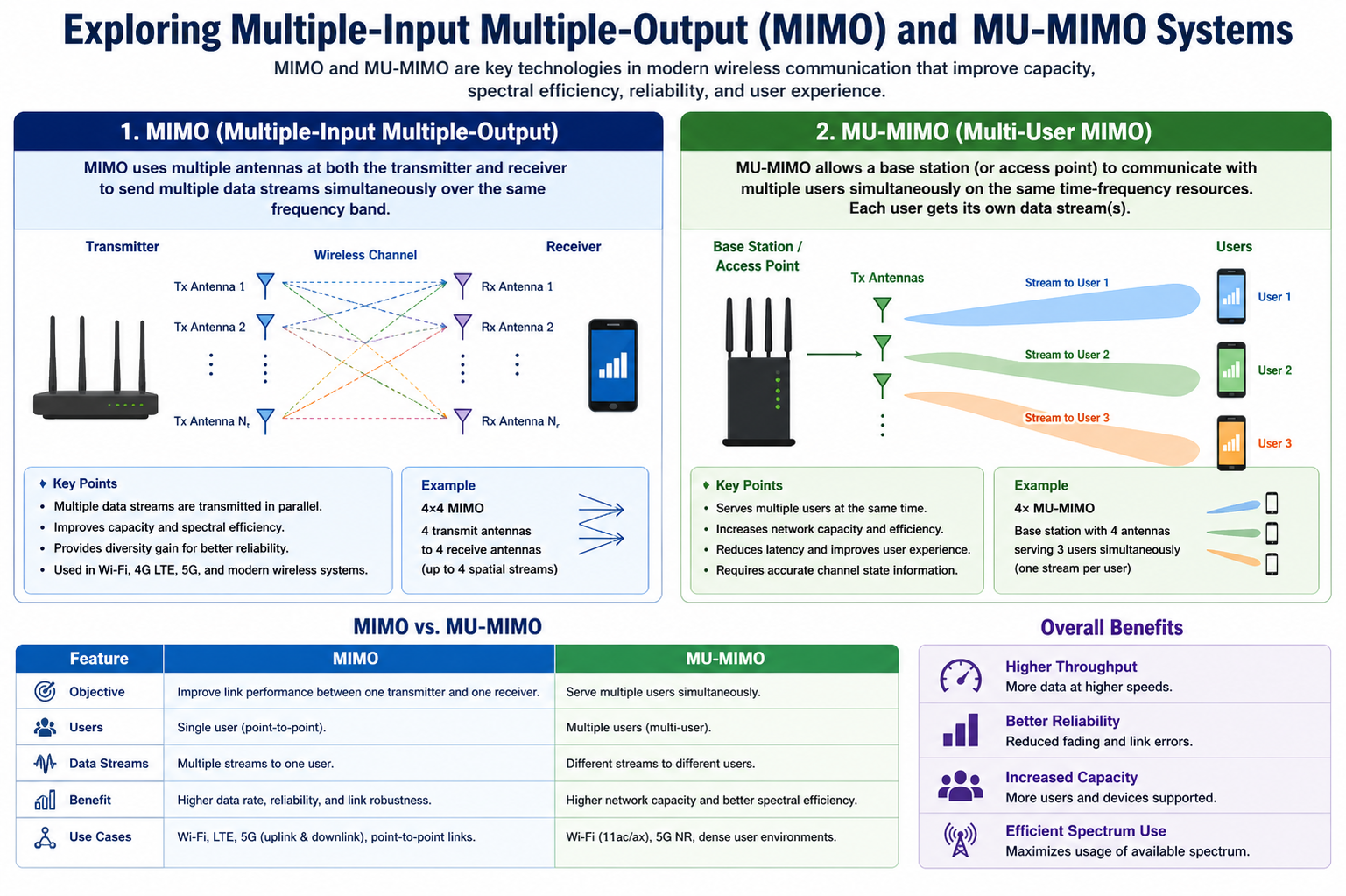
Multiple-Input Multiple-Output systems are built on the concept of using several transmitting and receiving antennas to enhance wireless communication performance. Unlike traditional single-antenna systems, MIMO leverages spatial dimension as an additional resource for data transmission. This architecture allows multiple independent data streams to be sent simultaneously over the same frequency band. At the receiver side, multiple antennas capture the mixed signals, and advanced mathematical algorithms are used to separate them into individual streams. This structure significantly improves both capacity and reliability of communication systems.
The effectiveness of MIMO depends on the rich scattering environment in wireless channels. When signals travel from transmitter to receiver, they reflect, diffract, and scatter due to obstacles such as buildings, trees, and moving objects. These multiple propagation paths create variations in signal phase and amplitude, which MIMO systems exploit to carry more information. Instead of treating multipath interference as a problem, MIMO turns it into an advantage by using it to increase data throughput.
Spatial Multiplexing in MIMO Systems
Spatial multiplexing is one of the most powerful techniques used in MIMO systems to increase data rates. In this method, a single data stream is divided into multiple independent sub-streams, each transmitted through a separate antenna. Since each signal follows a different spatial path, they arrive at the receiver with distinct characteristics. The receiver then uses signal processing algorithms to reconstruct the original data by separating these streams.
This technique effectively multiplies the capacity of a wireless link without requiring additional spectrum. However, spatial multiplexing requires good channel conditions and low correlation between antenna paths. If the channels are highly correlated, the ability to separate streams decreases, leading to reduced performance. Therefore, antenna spacing and placement play a critical role in MIMO system design.
Diversity Techniques in MIMO Systems
Another important concept in MIMO technology is diversity, which focuses on improving signal reliability rather than increasing data rate. Diversity techniques involve transmitting the same information across multiple antennas or paths. Since each signal experiences different channel conditions, the probability that all signals are simultaneously affected by deep fading is greatly reduced.
At the receiver, signals from different antennas are combined to improve overall signal strength and quality. This process enhances robustness, especially in environments with high interference or weak signal coverage. Diversity techniques are widely used in applications where stable communication is more important than high data speed, such as emergency communication systems and mobile networks in challenging environments.
Beamforming in MIMO Systems
Beamforming is a signal processing technique used in MIMO systems to direct transmission energy toward a specific receiver rather than broadcasting it in all directions. By adjusting the phase and amplitude of signals at each transmitting antenna, the system can create constructive interference in the desired direction and destructive interference elsewhere.
This focused transmission improves signal strength at the receiver while reducing interference for other users. Beamforming is particularly useful in environments with multiple users and dense network traffic. It enhances coverage, improves energy efficiency, and increases overall system capacity. Modern wireless systems heavily rely on beamforming to achieve high-performance communication in both indoor and outdoor environments.
Channel State Information in MIMO Systems
Channel State Information (CSI) plays a crucial role in MIMO performance. CSI refers to the knowledge of how signals propagate from transmitter to receiver through the wireless channel. It includes information about channel gain, phase shifts, and fading characteristics. Accurate CSI allows the transmitter to optimize signal transmission strategies such as beamforming and spatial multiplexing.
CSI can be obtained through feedback from the receiver or estimated using pilot signals. However, maintaining accurate CSI is challenging due to rapidly changing wireless environments, especially in mobile scenarios. Delays in feedback or estimation errors can reduce the effectiveness of MIMO techniques. Therefore, efficient CSI acquisition and processing are essential for high-performance systems.
MU-MIMO System Architecture
Multi-User MIMO extends the principles of MIMO by enabling simultaneous communication with multiple independent users. Instead of focusing on multiple data streams for a single user, MU-MIMO distributes spatial streams across different users within the same frequency band. This allows a base station or access point to serve multiple devices at the same time.
In MU-MIMO systems, each user is assigned a unique spatial signature, allowing the transmitter to separate signals using beamforming and advanced scheduling techniques. This improves overall network efficiency and reduces congestion in high-density environments. MU-MIMO is widely used in modern wireless networks, including Wi-Fi and cellular systems.
Working Mechanism of MU-MIMO Systems
The operation of MU-MIMO involves dividing available spatial resources among multiple users. The base station first acquires channel information for each user. Based on this information, it designs transmission beams that minimize interference between users. Each user receives a dedicated data stream, even though all transmissions occur simultaneously on the same frequency.
At the receiver end, devices decode their intended signals while ignoring others due to spatial separation. This process significantly increases network capacity and reduces latency. MU-MIMO is particularly effective in scenarios where many users are active at the same time, such as public hotspots, offices, and smart city environments.
Advantages of MU-MIMO Technology
MU-MIMO provides substantial improvements in wireless network performance. One of its main advantages is increased spectral efficiency, as multiple users can be served simultaneously without requiring additional bandwidth. It also improves fairness in network access, ensuring that no single device monopolizes resources.
Another benefit is reduced latency, as users do not need to wait for their turn to transmit or receive data. This is especially important for real-time applications such as video conferencing, online gaming, and cloud computing. MU-MIMO also enhances overall user experience by maintaining stable performance even under heavy network load.
Limitations of MIMO and MU-MIMO Systems
Despite their advantages, MIMO and MU-MIMO systems face several challenges. One major limitation is the complexity of hardware and signal processing. Multiple antennas and advanced algorithms increase system cost and computational requirements. This makes implementation more challenging, especially in low-cost devices.
Another limitation is the dependency on accurate channel information. In fast-changing environments, maintaining reliable CSI becomes difficult, which can degrade system performance. Additionally, antenna correlation and poor scattering environments can reduce the effectiveness of spatial multiplexing. These challenges require continuous improvements in system design and signal processing techniques.
MIMO and MU-MIMO in Modern Wireless Networks
MIMO and MU-MIMO technologies are integral components of modern wireless communication standards. They are widely used in advanced Wi-Fi systems and cellular networks to support high-speed data transmission and massive device connectivity. These technologies enable efficient use of limited spectrum resources, which is critical in today’s data-driven world.
In mobile communication systems, MIMO enhances coverage and data rates, while MU-MIMO allows base stations to handle multiple users simultaneously. This combination is essential for supporting the growing demand for high-speed internet, streaming services, and connected devices.
Future Developments in MIMO and MU-MIMO Systems
The future of MIMO and MU-MIMO technology is closely linked to the development of next-generation wireless networks. As communication systems evolve, there is a growing demand for higher data rates, lower latency, and massive connectivity. Advanced forms of MIMO, such as massive MIMO, are being developed to address these requirements by using a very large number of antennas at base stations.
Future systems are expected to integrate artificial intelligence and machine learning techniques to optimize beamforming, resource allocation, and channel estimation. These improvements will make wireless networks more adaptive and efficient. Additionally, research is focusing on reducing hardware complexity while maintaining high performance, which will enable wider adoption of these technologies in everyday devices.
Massive MIMO and Its Evolution
Massive MIMO represents a significant advancement over traditional MIMO systems by employing a very large number of antennas at the base station, often in the order of tens or even hundreds. This expansion allows the system to serve many users simultaneously with highly focused transmission beams. The increase in antenna elements dramatically improves spectral efficiency and energy efficiency, making it one of the core technologies for next-generation wireless networks.
In massive MIMO systems, the spatial resolution becomes extremely high, which allows signals to be directed with great precision. This reduces interference between users and increases overall system capacity. Unlike conventional MIMO, where channel conditions can limit performance, massive MIMO tends to average out channel variations due to the large number of antennas. As a result, the system becomes more stable and predictable even in complex propagation environments.
Channel Hardening Effect in Massive MIMO
One of the important phenomena observed in massive MIMO systems is channel hardening. As the number of antennas increases, the wireless channel behaves more deterministically rather than randomly fluctuating. This means that the variations in signal strength due to fading are significantly reduced.
Channel hardening simplifies signal processing at the receiver because the channel becomes more stable over time. This reduces the need for complex equalization techniques and improves reliability. It also enhances the performance of higher-layer protocols by providing a more consistent communication link. This effect is one of the reasons massive MIMO is highly suitable for real-time and mission-critical applications.
Pilot Contamination Problem in Multi-User Environments
In multi-user massive MIMO systems, one of the major challenges is pilot contamination. Since channel estimation requires pilot signals, reusing these pilots across different cells can lead to interference. When the same pilot sequences are used in neighboring cells, the base station may incorrectly estimate the channel, leading to degraded performance.
Pilot contamination limits the theoretical gains of massive MIMO, especially in dense network deployments. Researchers are actively developing advanced pilot assignment strategies and interference mitigation techniques to reduce its impact. Despite this challenge, massive MIMO still provides substantial improvements compared to traditional systems.
Beamforming in Advanced MIMO Systems
Beamforming becomes even more powerful in advanced MIMO and massive MIMO systems. With a large number of antennas, the system can create extremely narrow and precise beams that target individual users or devices. This not only improves signal quality but also minimizes interference with other users.
Digital beamforming, analog beamforming, and hybrid beamforming are commonly used approaches. Digital beamforming provides high flexibility but requires more computational power. Analog beamforming is simpler but less flexible. Hybrid beamforming combines both approaches to balance performance and complexity. These techniques are essential for enabling high-frequency communication systems such as millimeter-wave networks.
MU-MIMO in Wireless Local Area Networks
MU-MIMO has become a key feature in modern wireless local area networks. It allows a single access point to communicate with multiple devices at the same time, significantly improving network efficiency. This is particularly important in environments where many devices compete for limited bandwidth, such as homes, offices, and public spaces.
In Wi-Fi systems, MU-MIMO uses spatial streams to serve multiple users simultaneously. Each device receives data independently, which reduces congestion and improves overall throughput. This capability is especially useful for high-bandwidth applications such as video streaming, online gaming, and large file transfers.
Uplink and Downlink Transmission in MU-MIMO
MU-MIMO systems operate in both uplink and downlink directions. In downlink transmission, the base station sends data to multiple users simultaneously using beamforming techniques. In uplink transmission, multiple users send data to the base station at the same time, and the receiver separates these signals using advanced detection algorithms.
Uplink MU-MIMO is more challenging due to the need for precise synchronization between devices. However, it provides significant improvements in network efficiency. Downlink MU-MIMO is generally easier to implement and is widely used in commercial wireless systems. Both directions play a crucial role in maximizing system performance.
Interference Management in MIMO and MU-MIMO
Interference is one of the key challenges in wireless communication systems. In MIMO and MU-MIMO systems, interference can occur between different spatial streams or between multiple users. Effective interference management is essential to maintain high system performance.
Techniques such as beamforming, power control, and advanced signal processing are used to mitigate interference. Spatial separation of users also helps in reducing overlap between signals. In MU-MIMO systems, careful scheduling of users based on channel conditions further improves interference management. These strategies collectively ensure efficient use of wireless resources.
Energy Efficiency in MIMO-Based Systems
Energy efficiency is an important consideration in modern wireless communication systems. MIMO and MU-MIMO technologies contribute to energy savings by improving spectral efficiency and reducing the need for high transmission power. Beamforming allows signals to be directed precisely toward users, minimizing wasted energy.
In massive MIMO systems, the large number of antennas enables low-power transmission while maintaining strong signal quality. This makes the system more sustainable and suitable for large-scale deployments. Energy-efficient designs are particularly important for reducing operational costs in cellular networks and supporting environmentally friendly communication infrastructure.
Role of Signal Processing in MIMO Systems
Signal processing plays a central role in the operation of MIMO and MU-MIMO systems. Complex mathematical algorithms are used to encode, transmit, and decode multiple data streams. Techniques such as matrix decomposition, channel estimation, and noise reduction are essential for separating overlapping signals.
At the receiver, signal detection algorithms reconstruct the original transmitted data from mixed signals. These algorithms must be highly efficient to handle real-time communication requirements. Advances in digital signal processing have been a major factor in making MIMO technology practical for real-world applications.
MIMO in 5G and Beyond Networks
MIMO technology is a fundamental component of fifth-generation (5G) wireless networks. It enables high data rates, ultra-low latency, and massive device connectivity. In 5G systems, massive MIMO is combined with millimeter-wave communication to achieve extremely high bandwidth.
MU-MIMO also plays a critical role in supporting dense user environments. Together, these technologies ensure that 5G networks can handle the growing demand for data-intensive applications. Future generations of wireless networks are expected to further expand the use of MIMO techniques, integrating them with intelligent network management systems.
Challenges in Real-World Deployment
Despite its advantages, deploying MIMO and MU-MIMO systems in real-world environments presents several challenges. Hardware complexity increases with the number of antennas, making devices more expensive and power-hungry. Calibration of multiple antennas is also required to ensure accurate signal transmission.
Environmental factors such as obstacles, mobility, and interference can also affect system performance. In highly dynamic scenarios, maintaining accurate channel information becomes difficult. These challenges require continuous innovation in hardware design and algorithm development to fully realize the potential of MIMO technologies.
Future Trends in MIMO Technology
Future developments in MIMO technology are expected to focus on increasing scalability, intelligence, and efficiency. Artificial intelligence and machine learning techniques are being integrated into wireless systems to optimize beamforming, resource allocation, and channel prediction.
Reconfigurable intelligent surfaces are also being explored to enhance signal propagation in complex environments. These surfaces can dynamically control how signals reflect and propagate, improving coverage and performance. As wireless communication continues to evolve, MIMO and MU-MIMO will remain central technologies driving innovation and connectivity.
Advanced Beamforming Techniques in Modern MIMO Systems
Beamforming has evolved into one of the most critical techniques in advanced MIMO systems, enabling highly directional transmission and reception of wireless signals. In modern implementations, beamforming is not just about focusing energy in one direction but dynamically adapting beams based on user location, movement, and channel conditions. This adaptability allows communication systems to maintain strong and stable connections even in highly dynamic environments.
Digital beamforming provides the highest level of flexibility because it processes signals independently at each antenna using digital signal processing. This allows precise control over phase and amplitude adjustments, making it possible to form multiple beams simultaneously. However, it requires significant computational resources and power consumption. Analog beamforming, on the other hand, operates using phase shifters in the radio frequency domain and is more energy efficient but less flexible. Hybrid beamforming combines both approaches to achieve a balance between performance and hardware complexity, making it widely suitable for modern wireless networks.
Role of Antenna Arrays in MIMO Performance
Antenna arrays form the physical foundation of MIMO and MU-MIMO systems. The arrangement, spacing, and design of antennas directly influence system performance. Proper spacing between antennas is essential to ensure low correlation between transmitted signals, which improves spatial multiplexing efficiency. If antennas are placed too close, signals become correlated, reducing the benefits of MIMO.
Different antenna configurations such as linear, planar, and circular arrays are used depending on application requirements. Planar arrays are commonly used in massive MIMO systems due to their ability to support a large number of antenna elements in a compact space. These configurations allow better control over beam direction and improve spatial resolution, enhancing overall communication quality.
Channel Estimation Techniques in MIMO and MU-MIMO
Accurate channel estimation is essential for the proper functioning of MIMO systems. Since wireless channels are constantly changing due to movement and environmental factors, the system must continuously estimate channel conditions. This estimation helps in optimizing beamforming, spatial multiplexing, and interference management.
Pilot-based channel estimation is one of the most widely used techniques, where known reference signals are transmitted and analyzed at the receiver to determine channel characteristics. However, this process consumes bandwidth and becomes challenging in multi-user environments. Advanced techniques such as compressive sensing and machine learning-based estimation are being developed to improve accuracy while reducing overhead.
Spatial Diversity and Reliability Enhancement
Spatial diversity is a key feature of MIMO systems that improves communication reliability by transmitting signals through multiple independent paths. Since each path experiences different fading conditions, the likelihood of all signals being degraded simultaneously is reduced. This leads to more stable and robust communication links.
Receive diversity combines multiple received signals to improve signal quality, while transmit diversity ensures that multiple versions of the same signal are sent from different antennas. Techniques such as space-time coding further enhance diversity performance by encoding signals across both spatial and temporal dimensions. These methods are especially useful in environments with high signal interference or weak coverage.
Inter-User Interference in MU-MIMO Networks
In MU-MIMO systems, inter-user interference is a significant challenge because multiple users share the same frequency spectrum simultaneously. Even with advanced beamforming techniques, imperfect channel estimation and overlapping spatial paths can cause interference between users.
To manage this, systems use advanced scheduling algorithms that select users with favorable channel conditions and low correlation. Power allocation strategies are also employed to ensure fair distribution of resources among users. These techniques help maintain system efficiency while minimizing interference-related performance degradation.
Massive MIMO in High-Frequency Bands
Massive MIMO systems are particularly important in high-frequency communication bands such as millimeter-wave frequencies. These frequencies offer large bandwidths but suffer from high path loss and poor penetration. Massive MIMO compensates for these limitations by using large antenna arrays to focus energy and extend coverage.
At high frequencies, antenna elements are smaller, allowing more antennas to be packed into compact spaces. This makes massive MIMO highly practical for base stations operating in urban environments. However, signal blockage and atmospheric absorption remain challenges that require intelligent beam management and adaptive transmission strategies.
Hardware Constraints in MIMO Implementation
The implementation of MIMO and MU-MIMO systems requires sophisticated hardware, which introduces several constraints. Each antenna requires its own radio frequency chain, including amplifiers, converters, and filters. This increases cost, power consumption, and system complexity.
In massive MIMO systems, these challenges become even more significant due to the large number of antennas. To address this, researchers are developing low-cost hardware architectures and reducing the number of required RF chains using hybrid beamforming techniques. These innovations aim to make large-scale MIMO deployment more practical and cost-effective.
Synchronization Challenges in Multi-User Systems
Synchronization is critical in MU-MIMO systems where multiple users transmit or receive data simultaneously. Timing, frequency, and phase synchronization must be carefully maintained to avoid signal overlap and distortion. Even small synchronization errors can lead to significant performance degradation.
Achieving precise synchronization becomes more difficult in uplink transmissions where multiple devices operate independently. Advanced synchronization protocols and feedback mechanisms are used to align transmissions and maintain system stability. These techniques ensure that signals remain properly separated in the spatial domain.
Scalability of MIMO Networks
Scalability is one of the key advantages of MIMO-based systems, especially in modern wireless networks that must support billions of connected devices. As the number of antennas increases, system capacity also increases, allowing more users to be served simultaneously.
However, scalability also introduces challenges in terms of computational complexity and signal processing requirements. Efficient algorithms and distributed processing architectures are being developed to handle large-scale MIMO deployments. These solutions ensure that performance remains consistent even as network size grows.
Integration of Artificial Intelligence in MIMO Systems
Artificial intelligence is increasingly being integrated into MIMO and MU-MIMO systems to enhance performance and efficiency. Machine learning algorithms can predict channel conditions, optimize beamforming patterns, and improve resource allocation decisions.
AI-based systems can also adapt to changing network environments in real time, making communication more intelligent and responsive. This reduces the need for manual optimization and improves overall system efficiency. Deep learning techniques are particularly useful in handling complex signal environments where traditional algorithms may struggle.
Energy Harvesting and Green Communication in MIMO
Energy efficiency is becoming an important focus in wireless communication, and MIMO systems contribute significantly to this goal. By directing signals precisely toward users, MIMO reduces unnecessary power consumption. Additionally, energy harvesting techniques are being explored to further enhance sustainability.
In green communication systems, MIMO helps minimize energy waste by optimizing transmission strategies. This is especially important for large-scale networks where energy consumption can be very high. Future systems are expected to combine MIMO with renewable energy sources and intelligent power management techniques.
Future Evolution of MU-MIMO Systems
MU-MIMO systems are expected to evolve further with advancements in wireless technology. Future systems will support even larger numbers of users with improved efficiency and reduced latency. Integration with edge computing and cloud-based processing will further enhance system capabilities.
Advanced algorithms will enable more accurate user grouping and dynamic resource allocation. This will allow networks to adapt instantly to changing traffic conditions. As demand for wireless connectivity continues to grow, MU-MIMO will remain a fundamental technology for ensuring efficient and reliable communication.
System Progression
The development of MIMO and MU-MIMO systems represents a major transformation in wireless communication. From basic multi-antenna systems to massive MIMO and intelligent beamforming networks, the evolution has significantly improved data rates, reliability, and efficiency. Despite challenges such as complexity, interference, and hardware limitations, continuous research and innovation are pushing the boundaries of what is possible in wireless communication systems.
Advanced Interference Mitigation Strategies in MIMO and MU-MIMO Systems
Interference mitigation is one of the most important aspects of modern MIMO and MU-MIMO system design because multiple simultaneous transmissions inevitably create signal overlap in shared wireless environments. Advanced interference management techniques are used to ensure that each transmitted data stream reaches its intended receiver with minimal distortion. These strategies are essential for maintaining high data rates and reliable connectivity in dense communication networks.
One widely used approach is interference alignment, where signals are carefully designed so that unwanted interference is confined to specific subspaces at the receiver. This allows the desired signals to be extracted more easily. Another method is successive interference cancellation, which decodes stronger signals first and then subtracts them from the received mixture to recover weaker signals. These techniques significantly improve system efficiency, especially in multi-user scenarios where spectrum resources are heavily shared.
Adaptive Resource Allocation in Multi-User Systems
Adaptive resource allocation plays a crucial role in optimizing the performance of MU-MIMO networks. Since different users experience varying channel conditions, fixed resource distribution is inefficient. Instead, modern systems dynamically allocate power, frequency, and spatial streams based on real-time network conditions.
This adaptive behavior ensures that users with better channel quality can utilize higher data rates while maintaining fairness for users with weaker signals. Scheduling algorithms continuously evaluate network load, user demand, and channel state information to make optimal decisions. This dynamic allocation improves throughput, reduces congestion, and enhances overall user experience in high-density environments.
Latency Reduction in MIMO-Based Communication
Latency is a critical performance metric in wireless communication systems, especially for applications such as online gaming, virtual reality, autonomous systems, and real-time video conferencing. MIMO and MU-MIMO technologies help reduce latency by enabling simultaneous data transmission to multiple users and increasing spectral efficiency.
By eliminating the need for sequential communication, MU-MIMO significantly reduces waiting time for devices in a network. Beamforming further enhances this advantage by improving signal strength and reducing retransmissions caused by errors. Together, these mechanisms ensure faster and more responsive communication, which is essential for next-generation wireless applications.
Role of Coding Techniques in MIMO Systems
Coding techniques are essential in improving the reliability and efficiency of MIMO systems. Space-time coding is one of the most widely used approaches, where data is encoded across both spatial and temporal dimensions. This ensures that even if part of the signal is lost due to fading or interference, the original information can still be recovered.
Error correction codes such as convolutional codes and low-density parity-check codes are also used to enhance transmission reliability. These coding methods help detect and correct errors at the receiver, reducing the need for retransmissions. As a result, overall system performance improves in terms of both speed and reliability.
Channel Capacity Enhancement in MIMO Systems
One of the most significant contributions of MIMO technology is its ability to increase channel capacity without requiring additional bandwidth. By utilizing multiple antennas, MIMO systems create parallel transmission paths, effectively multiplying the data rate.
This capacity increase is achieved through spatial multiplexing, diversity techniques, and beamforming. The theoretical capacity of a MIMO system grows linearly with the minimum number of transmit and receive antennas under ideal conditions. This makes MIMO one of the most efficient methods for improving wireless communication performance in bandwidth-constrained environments.
Impact of Mobility on MIMO Performance
User mobility introduces significant challenges in MIMO and MU-MIMO systems. As users move, channel conditions change rapidly, making it difficult to maintain accurate channel state information. This affects beamforming accuracy and spatial multiplexing efficiency.
High mobility environments require fast adaptation mechanisms that can quickly update channel estimates and adjust transmission parameters. Doppler shifts and rapid fading also impact signal stability. Advanced prediction algorithms and adaptive filtering techniques are used to mitigate these effects and maintain reliable communication even in highly dynamic scenarios.
Hybrid Networks Using MIMO and MU-MIMO
Modern wireless communication systems often integrate both MIMO and MU-MIMO technologies to achieve optimal performance. This hybrid approach allows networks to support both high-speed single-user communication and efficient multi-user connectivity.
In such systems, MIMO enhances individual link quality, while MU-MIMO ensures efficient resource sharing among multiple users. This combination is particularly useful in cellular networks and Wi-Fi systems where diverse traffic demands exist simultaneously. The integration of these technologies ensures balanced performance across different usage scenarios.
Security Considerations in MIMO Systems
Security is an increasingly important aspect of wireless communication, and MIMO systems offer certain inherent advantages in this area. By using multiple antennas and spatial filtering, it becomes more difficult for unauthorized users to intercept signals. Beamforming can also be used to direct signals only toward intended receivers, reducing the risk of eavesdropping.
Physical layer security techniques further enhance protection by exploiting channel randomness and spatial diversity. These methods ensure that even if an attacker intercepts part of the signal, reconstructing the original information becomes extremely difficult. As wireless networks expand, security-enhanced MIMO systems play a key role in protecting data integrity and privacy.
Future Integration with 6G Networks
MIMO and MU-MIMO technologies are expected to play a central role in sixth-generation (6G) wireless networks. These future systems will require extremely high data rates, ultra-low latency, and massive device connectivity. Advanced forms of MIMO, including intelligent and reconfigurable systems, will be essential in meeting these demands.
6G networks are expected to incorporate intelligent surfaces, holographic beamforming, and AI-driven network optimization. These innovations will further enhance the capabilities of MIMO systems, making wireless communication more adaptive, efficient, and intelligent than ever before.
Conclusion
MIMO and MU-MIMO technologies have fundamentally transformed wireless communication by enabling higher data rates, improved reliability, and efficient spectrum utilization. Through techniques such as spatial multiplexing, beamforming, and diversity, these systems maximize the use of available wireless resources while minimizing interference and signal degradation.
MU-MIMO extends these benefits by allowing multiple users to be served simultaneously, significantly improving network efficiency in high-density environments. Despite challenges such as hardware complexity, channel estimation difficulties, and interference management, continuous advancements in signal processing and hardware design continue to enhance system performance.
The integration of artificial intelligence, massive antenna arrays, and advanced beamforming techniques is shaping the future of wireless communication. As networks evolve toward 5G, 6G, and beyond, MIMO and MU-MIMO will remain foundational technologies driving global connectivity, enabling faster, smarter, and more reliable communication systems across all domains.