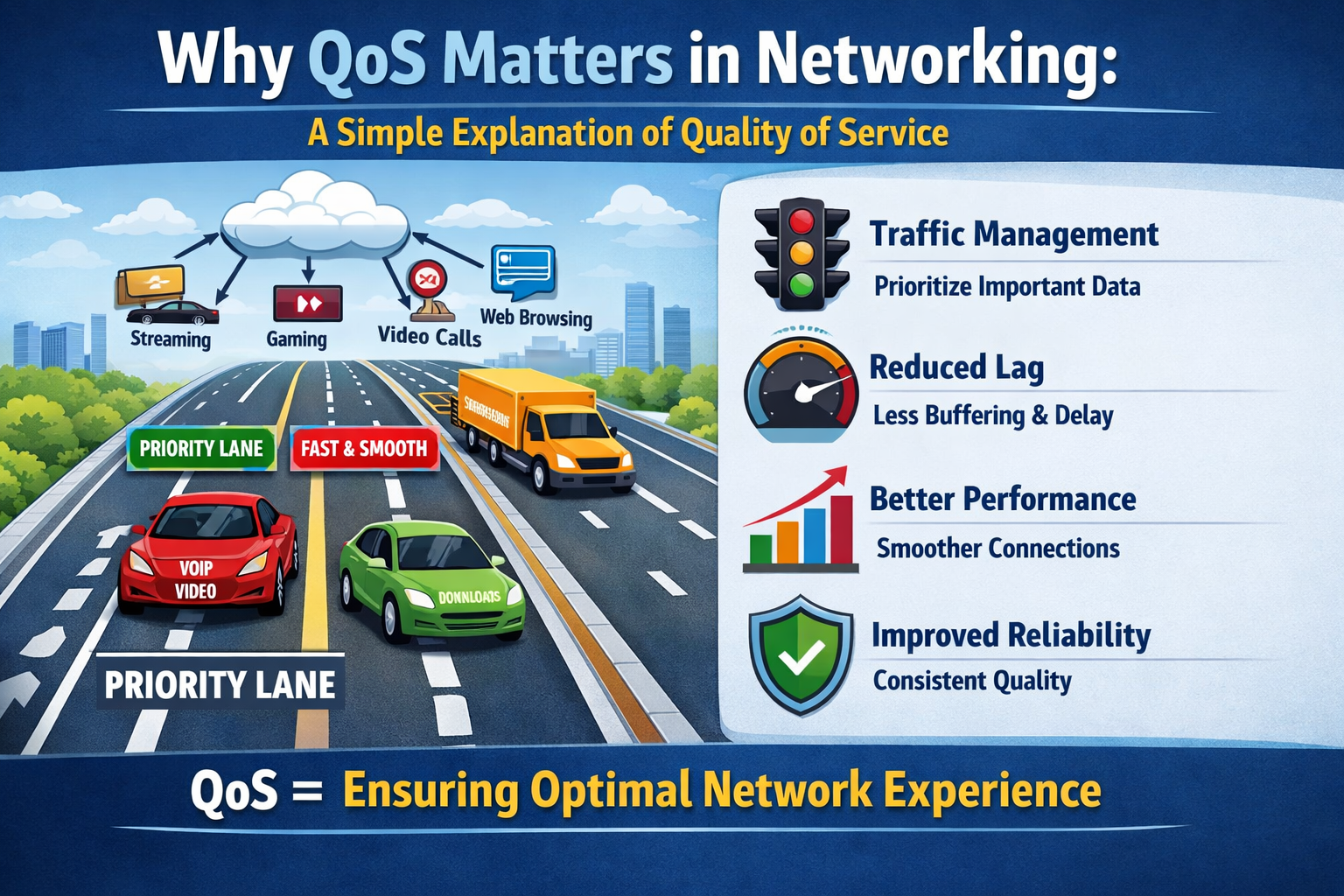
Quality of Service becomes significantly more important as networks grow in size, complexity, and demand. In basic setups, traffic may flow without strict control, but in enterprise, cloud, and service provider environments, unmanaged traffic can quickly lead to bottlenecks and degraded performance. Advanced QoS introduces structured methods to classify, prioritize, and control how data packets move across a network, ensuring predictable and stable communication even under heavy load. This level of control is essential for maintaining performance in environments where critical applications must operate without interruption.
One of the foundational ideas behind advanced QoS is traffic classification. This process involves identifying different types of network traffic and assigning them to categories based on their importance. For instance, voice over IP calls, live video streaming, and real-time collaboration tools are typically classified as high-priority traffic. On the other hand, activities such as software updates, file backups, and general web browsing may be categorized as lower priority. By classifying traffic accurately, networks can ensure that sensitive applications receive preferential treatment when resources are limited.
Another key concept is traffic marking, where packets are labeled with priority information. These markings help network devices such as routers and switches decide how to handle each packet as it moves through the network. Common marking methods include assigning values to indicate priority levels, allowing devices to quickly determine which traffic should be forwarded first. This system ensures consistency across the network, as each device follows the same set of rules when processing data packets.
Traffic Prioritization and Scheduling Techniques
Once traffic is classified and marked, QoS mechanisms use prioritization and scheduling techniques to manage packet flow. Prioritization ensures that high-value traffic is transmitted ahead of less critical data. This is particularly important in situations where network bandwidth is limited or congestion occurs. By giving precedence to time-sensitive data, QoS minimizes delays and maintains service quality.
Scheduling techniques define how packets are queued and transmitted. Different algorithms are used depending on network requirements. For example, some methods ensure that high-priority traffic is always served first, while others distribute bandwidth more evenly across all traffic types. Weighted scheduling approaches allow network administrators to assign different levels of importance to various traffic classes, ensuring a balanced and fair allocation of resources. These techniques help prevent any single type of traffic from monopolizing the network while still maintaining priority for critical applications.
Queue management is another essential aspect of QoS. When network devices receive more data than they can immediately process, packets are placed in queues. Effective queue management ensures that these packets are handled efficiently, reducing delays and preventing packet loss. Advanced queue management techniques can also drop lower-priority packets during congestion, preserving bandwidth for more important traffic. This selective handling is crucial for maintaining performance in high-demand environments.
Congestion Management and Avoidance
Network congestion occurs when the demand for bandwidth exceeds the available capacity. Without proper control, congestion can lead to packet loss, increased latency, and reduced throughput. QoS addresses this challenge through congestion management and avoidance strategies. These techniques aim to control traffic flow and prevent network overload before it becomes a serious issue.
Congestion management involves actively controlling how packets are handled during periods of high demand. This may include prioritizing certain traffic types, delaying less critical packets, or dropping packets that exceed defined thresholds. By managing congestion effectively, QoS ensures that essential services remain operational even when the network is under stress.
Congestion avoidance, on the other hand, focuses on preventing congestion from occurring in the first place. This is achieved through proactive measures such as monitoring network conditions and adjusting traffic flow accordingly. Techniques like early packet detection can identify potential congestion points and take corrective action before performance is affected. These proactive strategies help maintain a smooth and stable network environment.
Bandwidth management is closely related to congestion control. QoS allows administrators to allocate specific portions of bandwidth to different types of traffic. This ensures that critical applications always have access to the resources they need, regardless of overall network demand. By controlling bandwidth usage, QoS prevents any single application from overwhelming the network and degrading performance for others.
QoS in Different Network Environments
QoS is not limited to a single type of network; it plays a crucial role across various environments, including enterprise networks, service provider infrastructures, and cloud-based systems. Each environment has unique requirements, and QoS strategies must be tailored accordingly to achieve optimal performance.
In enterprise networks, QoS is used to support business-critical applications such as voice communication, video conferencing, and enterprise resource planning systems. These applications require consistent performance to ensure productivity and collaboration. QoS helps maintain service quality by prioritizing these applications and ensuring they receive sufficient bandwidth.
Service providers rely heavily on QoS to deliver reliable and high-quality services to customers. Internet service providers must manage large volumes of traffic from diverse sources, making QoS essential for maintaining performance and customer satisfaction. By implementing QoS policies, service providers can ensure that premium services receive higher priority, while still maintaining acceptable performance for all users.
Cloud environments present unique challenges for QoS due to their dynamic and distributed nature. Applications hosted in the cloud often rely on shared resources, making it difficult to guarantee consistent performance. QoS helps address this challenge by managing traffic between users and cloud services, ensuring that critical applications receive the necessary resources. This is particularly important for applications that require real-time interaction or handle sensitive data.
QoS for Real-Time Applications
Real-time applications are among the primary beneficiaries of QoS. These applications require low latency, minimal jitter, and high reliability to function effectively. Examples include voice calls, video conferencing, online gaming, and live streaming. Without QoS, these applications are highly susceptible to performance issues, especially in congested networks.
QoS ensures that real-time traffic is given the highest priority, allowing it to bypass delays caused by lower-priority data. This results in clearer voice calls, smoother video playback, and more responsive online experiences. By minimizing packet loss and maintaining consistent delivery times, QoS enhances the overall quality of real-time communication.
Another important aspect of QoS for real-time applications is jitter control. Jitter refers to variations in packet arrival times, which can disrupt the flow of audio and video data. QoS mechanisms help reduce jitter by ensuring consistent packet delivery, resulting in a more stable and reliable user experience. This is particularly important for applications that require continuous data streams.
QoS Policies and Implementation Strategies
Implementing QoS requires careful planning and a clear understanding of network requirements. QoS policies define how traffic is classified, prioritized, and managed within a network. These policies are typically based on factors such as application type, user roles, and business priorities.
A successful QoS implementation begins with identifying critical applications and determining their performance requirements. This involves analyzing network traffic and understanding how different applications interact with the network. Once priorities are established, QoS policies can be designed to ensure that these applications receive the necessary resources.
Policy enforcement is carried out through network devices such as routers and switches. These devices use QoS rules to manage traffic flow and ensure compliance with defined policies. Regular monitoring and adjustment are essential to maintain optimal performance, as network conditions and requirements may change over time.
Testing and validation are also important steps in QoS implementation. By simulating different network conditions, administrators can evaluate the effectiveness of QoS policies and make necessary adjustments. This ensures that the network can handle real-world scenarios and maintain performance under varying levels of demand.
Challenges and Limitations of QoS
While QoS offers significant benefits, it is not without challenges. One of the main difficulties is the complexity of implementation. Designing and managing QoS policies requires a deep understanding of network behavior and traffic patterns. Incorrect configurations can lead to unintended consequences, such as reduced performance or unfair resource allocation.
Another challenge is scalability. As networks grow, maintaining consistent QoS across all devices becomes more difficult. This is particularly true in large and distributed environments where traffic flows through multiple paths. Ensuring that QoS policies are applied consistently across the network is essential for achieving desired results.
QoS also has limitations in certain scenarios. For example, it cannot increase the total available bandwidth; it can only manage how existing resources are used. In situations where bandwidth is severely limited, QoS may not be able to fully prevent performance issues. Additionally, QoS is less effective when traffic passes through networks that do not support or honor QoS policies, such as parts of the public internet.
Future Trends in QoS
As networking technology continues to evolve, QoS is also adapting to meet new challenges. Emerging technologies such as 5G, the Internet of Things, and edge computing are placing greater demands on network performance. These technologies require highly responsive and reliable communication, making QoS more important than ever.
Modern QoS solutions are increasingly incorporating automation and intelligent decision-making. By using advanced analytics and machine learning, networks can dynamically adjust QoS policies based on real-time conditions. This allows for more efficient resource utilization and improved performance without manual intervention.
Another trend is the integration of QoS with software-defined networking. This approach allows administrators to manage network behavior through centralized control systems, making it easier to implement and modify QoS policies. By combining QoS with programmable networks, organizations can achieve greater flexibility and scalability in managing their network infrastructure.
The continued growth of cloud services and remote work is also driving the need for more sophisticated QoS strategies. As more applications move to the cloud and users access networks from diverse locations, maintaining consistent performance becomes increasingly challenging. QoS will play a critical role in ensuring that these distributed environments deliver reliable and high-quality services.
Deep Dive into QoS Models and Architectures
As networks evolved, different QoS models were developed to handle increasing traffic demands and complexity. These models define how Quality of Service is implemented across a network and how devices cooperate to maintain performance. Two of the most widely used approaches are the Integrated Services model and the Differentiated Services model. Each offers a distinct method for handling traffic, and understanding their differences is essential for designing efficient QoS strategies.
The Integrated Services approach focuses on reserving resources for specific data flows. In this model, applications request a certain level of service before transmitting data, and the network ensures that the required bandwidth and performance are available. This method provides strong guarantees for performance, making it suitable for highly sensitive applications. However, it can be complex to implement and may not scale well in large networks due to the overhead of maintaining individual reservations for each flow.
The Differentiated Services model, on the other hand, takes a more scalable approach. Instead of managing individual data flows, it classifies traffic into different categories and assigns each category a specific priority level. Network devices then handle packets based on these classifications, ensuring that higher-priority traffic receives better service. This model is widely used in modern networks because it is simpler to deploy and can handle large volumes of traffic efficiently.
Another important concept in QoS architecture is end-to-end service delivery. For QoS to be effective, policies must be applied consistently across all parts of the network. If one segment of the network does not support QoS, it can become a weak point that disrupts overall performance. Ensuring end-to-end QoS requires coordination between multiple devices and sometimes even different network providers.
QoS Mechanisms in Modern Networking Equipment
Modern networking devices are equipped with advanced QoS features that enable precise control over traffic. Routers and switches play a central role in enforcing QoS policies, as they are responsible for forwarding packets and managing data flow. These devices use a combination of hardware and software capabilities to classify, mark, queue, and schedule traffic.
One of the most important mechanisms is packet classification, where devices analyze incoming traffic and determine its type based on predefined rules. These rules can consider factors such as source and destination addresses, application type, and protocol information. Once classified, packets are marked with priority indicators that guide their treatment throughout the network.
Policing and shaping are two additional mechanisms used to control traffic flow. Traffic policing enforces strict limits on bandwidth usage by dropping or re-marking packets that exceed defined thresholds. This ensures that no single application or user consumes more than their allocated share of resources. Traffic shaping, in contrast, smooths out traffic bursts by delaying packets to maintain a steady flow. This helps prevent sudden spikes in demand from causing congestion.
Another key feature is link efficiency management. Techniques such as compression and fragmentation can improve the utilization of available bandwidth, especially in networks with limited capacity. By optimizing how data is transmitted, these mechanisms contribute to overall performance and reliability.
QoS in Wireless and Mobile Networks
Wireless and mobile networks introduce unique challenges for QoS due to their dynamic nature and limited resources. Unlike wired networks, where bandwidth is relatively stable, wireless networks are affected by factors such as signal strength, interference, and user mobility. These variables can impact performance and make it more difficult to maintain consistent Quality of Service.
In wireless environments, QoS must account for fluctuating conditions and adapt in real time. Technologies such as Wi-Fi and cellular networks implement QoS by prioritizing traffic and managing access to the shared medium. For example, voice and video traffic may be given higher priority to ensure smooth communication, while less critical data is transmitted when resources are available.
Mobile networks, particularly those based on modern standards, rely heavily on QoS to support a wide range of services. From voice calls and video streaming to online gaming and IoT applications, these networks must handle diverse traffic types with varying requirements. QoS frameworks in mobile networks are designed to allocate resources dynamically, ensuring that each service receives the appropriate level of performance.
Another important aspect is mobility management. As users move between different network cells, QoS must be maintained without interruption. This requires seamless handovers and coordination between network components to ensure that ongoing sessions are not disrupted. Maintaining QoS in such scenarios is a complex task but essential for delivering a consistent user experience.
QoS in Cloud Computing and Virtualized Environments
Cloud computing has transformed the way applications are deployed and accessed, introducing new challenges for QoS. In cloud environments, resources are shared among multiple users and applications, making it difficult to guarantee consistent performance. QoS plays a critical role in managing this shared infrastructure and ensuring that critical workloads receive the necessary resources.
Virtualization adds another layer of complexity, as multiple virtual machines may run on the same physical hardware. Each virtual machine may have different performance requirements, and QoS must ensure that these requirements are met without affecting other workloads. This is achieved through resource allocation and prioritization mechanisms that control how computing, storage, and network resources are distributed.
Software-defined networking has become a key enabler of QoS in cloud environments. By separating the control plane from the data plane, this approach allows for centralized management of network behavior. Administrators can define QoS policies at a high level and apply them across the entire network, making it easier to adapt to changing conditions and requirements.
Another important trend is the use of network function virtualization, where traditional network functions are implemented as software rather than dedicated hardware. This approach provides greater flexibility and scalability, allowing QoS mechanisms to be deployed and updated more easily. As cloud environments continue to grow, these technologies will play an increasingly important role in maintaining performance and reliability.
Security Considerations in QoS
While QoS is primarily focused on performance, it also has important implications for network security. Improperly configured QoS policies can be exploited by malicious users to gain unfair access to network resources. For example, an attacker might attempt to mark their traffic as high priority to bypass restrictions and consume excessive bandwidth.
To address these risks, QoS implementations must include safeguards that verify and enforce policy compliance. This may involve validating packet markings, monitoring traffic patterns, and applying access controls to prevent unauthorized use of high-priority services. By integrating security measures with QoS, networks can ensure both performance and protection.
Another consideration is the impact of denial-of-service attacks. These attacks aim to overwhelm a network with excessive traffic, causing disruption to legitimate users. QoS can help mitigate such attacks by prioritizing critical services and limiting the impact of malicious traffic. However, it must be combined with other security mechanisms to provide comprehensive protection.
Encryption and secure communication protocols also interact with QoS. While encryption enhances security, it can make it more difficult to classify and prioritize traffic, as packet contents are not easily visible. Advanced QoS systems use metadata and other techniques to maintain performance without compromising security.
Monitoring and Optimization of QoS
Effective QoS implementation requires continuous monitoring and optimization. Network conditions can change rapidly, and QoS policies must adapt to maintain performance. Monitoring tools provide insights into traffic patterns, bandwidth usage, and performance metrics, allowing administrators to identify issues and make informed decisions.
Key performance indicators such as latency, jitter, packet loss, and throughput are used to evaluate QoS effectiveness. By analyzing these metrics, administrators can determine whether QoS policies are achieving their intended goals. If performance issues are detected, adjustments can be made to improve efficiency and reliability.
Automation is becoming increasingly important in QoS management. Advanced systems can analyze network conditions in real time and adjust policies automatically, reducing the need for manual intervention. This not only improves efficiency but also ensures a more responsive and adaptive network environment.
Regular testing is also essential for maintaining QoS performance. Simulating different traffic scenarios helps identify potential weaknesses and ensures that the network can handle varying levels of demand. This proactive approach helps prevent issues before they impact users.
Real-World Applications of QoS
QoS is widely used across various industries and applications, demonstrating its importance in modern networking. In the healthcare sector, QoS ensures that critical systems such as remote monitoring and telemedicine operate reliably. In the financial industry, it supports real-time transactions and data processing, where delays can have significant consequences.
In education, QoS enables smooth delivery of online learning platforms, ensuring that video lectures and interactive sessions are not disrupted. In entertainment, it enhances streaming services and online gaming by reducing buffering and latency. These examples highlight how QoS contributes to improved user experiences across different domains.
Businesses rely on QoS to maintain productivity and ensure the smooth operation of communication and collaboration tools. By prioritizing critical applications, organizations can optimize their network performance and support their operational needs effectively.
QoS Design Best Practices and Strategic Planning
Designing an effective Quality of Service strategy requires more than simply enabling features on networking devices. It involves a thoughtful approach that aligns technical capabilities with organizational needs. A well-planned QoS design begins with a clear understanding of business goals, application requirements, and user expectations. Without this foundation, even advanced QoS mechanisms may fail to deliver meaningful improvements in performance.
One of the most important best practices is to keep the design simple and scalable. Overly complex QoS configurations can be difficult to manage and troubleshoot, especially as networks grow. A streamlined approach that focuses on a limited number of traffic classes and clearly defined priorities is often more effective. This not only reduces administrative overhead but also minimizes the risk of configuration errors.
Another key consideration is consistency across the network. QoS policies must be applied uniformly on all devices to ensure predictable behavior. Inconsistent configurations can lead to unexpected performance issues, as traffic may be treated differently at various points in the network. Establishing standardized policies and regularly auditing configurations helps maintain consistency and reliability.
Capacity planning also plays a critical role in QoS design. While QoS can optimize the use of available bandwidth, it cannot compensate for insufficient resources. Networks must be designed with adequate capacity to handle expected traffic loads, including future growth. By combining proper capacity planning with QoS, organizations can achieve both efficiency and scalability.
QoS in Multi-Service Networks
Modern networks often support a wide range of services, each with unique performance requirements. These multi-service environments include voice, video, data, and emerging applications such as virtual reality and IoT devices. Managing such diverse traffic types requires a flexible and adaptive QoS strategy.
In multi-service networks, traffic must be carefully categorized to ensure that each service receives the appropriate level of priority. Real-time services typically require low latency and minimal packet loss, while other applications may tolerate delays but require higher bandwidth. QoS enables the network to balance these requirements, ensuring that no single service negatively impacts others.
Service differentiation is another important aspect. By assigning different levels of service quality to various applications or user groups, organizations can optimize resource allocation. For example, critical business applications may be given higher priority than general internet usage. This approach ensures that essential operations are not disrupted by less important activities.
Interoperability is also a challenge in multi-service networks. Different devices and technologies must work together seamlessly to enforce QoS policies. Ensuring compatibility and proper configuration across all components is essential for achieving consistent performance.
QoS in Internet of Things Environments
The rapid growth of the Internet of Things has introduced new demands on network performance. IoT devices generate large volumes of data and often require real-time communication. QoS plays a crucial role in managing this traffic and ensuring that critical data is transmitted reliably.
IoT environments are characterized by a wide variety of devices, ranging from simple sensors to complex systems. Each device may have different communication requirements, making it challenging to implement a one-size-fits-all QoS strategy. By classifying IoT traffic based on its importance and sensitivity, networks can prioritize critical data while efficiently handling less urgent information.
Another challenge is the sheer scale of IoT deployments. As the number of connected devices increases, so does the potential for congestion and performance issues. QoS helps mitigate these challenges by controlling traffic flow and ensuring that network resources are used efficiently. This is particularly important in applications such as smart cities, healthcare monitoring, and industrial automation, where reliable communication is essential.
Energy efficiency is also a consideration in IoT networks. Many devices operate on limited power sources, and efficient data transmission can help conserve energy. QoS mechanisms that reduce unnecessary retransmissions and optimize communication contribute to longer device lifespans and more sustainable operations.
QoS and User Experience Optimization
At its core, QoS is about improving the user experience. Whether it is a business professional participating in a video conference or a consumer streaming content, the quality of the network directly impacts satisfaction. QoS ensures that users receive consistent and reliable performance, even in challenging conditions.
User experience optimization involves more than just technical performance metrics. It also includes factors such as responsiveness, reliability, and perceived quality. QoS helps achieve these goals by prioritizing traffic that directly affects user interactions. For example, ensuring smooth video playback or clear voice communication can significantly enhance the overall experience.
Feedback and monitoring are essential for maintaining a high level of user satisfaction. By collecting data on network performance and user behavior, organizations can identify areas for improvement and adjust QoS policies accordingly. This continuous improvement process ensures that the network evolves to meet changing needs.
Another important aspect is fairness. While prioritizing certain types of traffic is necessary, it is also important to ensure that all users have access to acceptable levels of service. QoS strategies must strike a balance between prioritization and fairness to maintain a positive experience for all users.
Emerging Technologies and the Future of QoS
The future of Quality of Service is closely tied to the evolution of networking technologies. As new applications and services emerge, the demands on network performance continue to grow. Technologies such as artificial intelligence, edge computing, and advanced wireless systems are shaping the next generation of QoS solutions.
Artificial intelligence is playing an increasingly important role in QoS management. By analyzing large volumes of data, AI systems can identify patterns and predict network behavior. This enables more proactive and adaptive QoS strategies, where policies are adjusted automatically based on real-time conditions. Such intelligent systems can optimize performance more effectively than traditional manual approaches.
Edge computing is another trend that is influencing QoS. By processing data closer to the source, edge computing reduces latency and improves responsiveness. QoS mechanisms must adapt to this distributed architecture, ensuring that performance is maintained across both centralized and edge-based resources.
Advanced wireless technologies, including next-generation mobile networks, are also driving changes in QoS. These networks are designed to support a wide range of applications, from high-speed data services to mission-critical communications. QoS frameworks in these environments must be highly flexible and capable of handling diverse requirements.
Network automation and programmability are further enhancing QoS capabilities. By enabling dynamic configuration and control, these technologies allow networks to respond quickly to changing conditions. This level of agility is essential for supporting modern applications and ensuring consistent performance.
Practical Steps for Implementing QoS Successfully
Implementing QoS in a real-world environment requires a structured approach. The first step is to conduct a thorough assessment of network requirements and identify critical applications. This involves understanding how different types of traffic impact overall performance and determining which applications require priority treatment.
Once requirements are defined, the next step is to design QoS policies that align with these needs. This includes defining traffic classes, assigning priorities, and configuring bandwidth allocation. Careful planning is essential to ensure that policies are both effective and manageable.
Deployment should be carried out in stages, starting with a pilot implementation. This allows administrators to test QoS policies in a controlled environment and make adjustments before full-scale deployment. Monitoring and feedback during this phase are crucial for identifying potential issues and refining the configuration.
Ongoing management is equally important. QoS is not a one-time setup but a continuous process that requires regular monitoring and optimization. As network conditions and requirements change, policies must be updated to maintain performance. This iterative approach ensures that QoS remains effective over time.
Training and documentation also play a key role in successful implementation. Network administrators must have a clear understanding of QoS concepts and tools to manage the system effectively. Comprehensive documentation helps maintain consistency and provides a reference for troubleshooting and future enhancements.
Quality of Service is a fundamental aspect of modern networking that enables efficient, reliable, and user-focused communication. From strategic planning and design to implementation and optimization, QoS provides the framework needed to manage complex network environments. As technology continues to evolve, the importance of QoS will only increase, making it an essential skill and concept for anyone involved in networking.
QoS Troubleshooting and Performance Tuning
Even with a well-designed Quality of Service strategy, networks can still encounter performance issues that require careful troubleshooting. Identifying the root cause of QoS-related problems involves analyzing traffic patterns, monitoring performance metrics, and verifying that policies are being applied correctly. Common issues include misclassification of traffic, incorrect priority assignments, and bandwidth misallocation, all of which can negatively impact network performance.
A systematic approach to troubleshooting begins with validating QoS configurations on all network devices. Ensuring that classification, marking, and queuing policies are consistent across the network is essential. In many cases, performance issues arise because QoS rules are not uniformly enforced, leading to unpredictable behavior. By reviewing configurations and comparing them with design requirements, administrators can identify and correct inconsistencies.
Performance tuning is the next step after identifying issues. This involves adjusting QoS parameters to better align with actual network conditions. For example, bandwidth allocations may need to be increased for high-priority applications, or queue thresholds may need to be modified to reduce packet loss. Continuous monitoring and fine-tuning ensure that QoS remains effective as traffic patterns evolve.
Another important aspect of troubleshooting is the use of diagnostic tools. Network monitoring systems provide detailed insights into traffic flows, latency, jitter, and packet loss. These tools help administrators pinpoint bottlenecks and evaluate the effectiveness of QoS policies. By leveraging accurate data, organizations can make informed decisions and improve overall network performance.
QoS Metrics and Measurement Techniques
Measuring the effectiveness of QoS requires a clear understanding of key performance metrics. These metrics provide valuable information about how well the network is handling traffic and whether QoS objectives are being met. Among the most important metrics are latency, jitter, packet loss, and throughput.
Latency refers to the time it takes for data to travel from source to destination. In applications such as voice and video communication, low latency is critical for maintaining a smooth and responsive experience. QoS mechanisms aim to minimize latency by prioritizing time-sensitive traffic and reducing delays.
Jitter measures the variation in packet arrival times. High jitter can disrupt real-time applications, causing audio and video streams to become inconsistent. QoS helps control jitter by ensuring steady and predictable packet delivery, which is essential for maintaining quality in real-time communication.
Packet loss occurs when data packets are dropped during transmission, often due to congestion or insufficient resources. QoS reduces packet loss by managing traffic flow and prioritizing critical data. Minimizing packet loss is crucial for maintaining data integrity and ensuring reliable communication.
Throughput represents the amount of data successfully transmitted over a network within a given time. While high throughput is desirable, it must be balanced with other metrics to ensure overall performance. QoS helps achieve this balance by allocating resources efficiently and preventing congestion.
QoS in Hybrid and Distributed Networks
Modern networking environments are increasingly hybrid and distributed, combining on-premises infrastructure with cloud services and remote users. This complexity introduces new challenges for QoS, as traffic must be managed across diverse and often unpredictable network paths.
In hybrid networks, maintaining consistent QoS requires coordination between different environments. Policies must be aligned across on-premises systems, cloud platforms, and external service providers. Any gap in QoS enforcement can lead to performance degradation, particularly for applications that rely on end-to-end connectivity.
Distributed networks, including those supporting remote work, further complicate QoS implementation. Users may connect from various locations with different network conditions, making it difficult to guarantee consistent performance. QoS strategies must account for these variations and provide adaptive solutions that ensure reliability regardless of location.
Technologies such as virtual private networks and software-defined wide area networking play a significant role in enabling QoS in distributed environments. These solutions provide greater control over traffic routing and prioritization, helping maintain performance across multiple network segments.
QoS and Service Level Agreements
Quality of Service is closely linked to service level agreements, which define the expected performance standards for network services. These agreements specify metrics such as uptime, latency, and throughput, providing a benchmark for evaluating network performance. QoS mechanisms are used to meet these requirements and ensure compliance with agreed standards.
Service providers rely on QoS to deliver consistent and reliable services to their customers. By implementing effective QoS policies, they can guarantee a certain level of performance and differentiate their offerings in a competitive market. This is particularly important for premium services that require higher levels of reliability and responsiveness.
For organizations, aligning QoS with service level agreements ensures that critical applications receive the necessary resources. This alignment helps maintain business continuity and supports operational efficiency. Regular monitoring and reporting are essential to verify that QoS objectives are being met and that service commitments are fulfilled.
Ethical and Policy Considerations in QoS
While QoS provides significant benefits, it also raises important ethical and policy considerations. One of the most widely discussed topics is the concept of network neutrality, which advocates for equal treatment of all internet traffic. QoS, by its nature, involves prioritizing certain types of traffic, which can lead to concerns about fairness and accessibility.
Balancing performance optimization with fairness is a key challenge. Organizations must ensure that QoS policies are transparent and do not unfairly disadvantage certain users or applications. Clear guidelines and responsible implementation help address these concerns and maintain trust among users.
Policy considerations also extend to regulatory compliance. Different regions may have specific rules governing how network traffic can be managed. Ensuring that QoS practices align with these regulations is essential for avoiding legal issues and maintaining ethical standards.
Another aspect is the potential for misuse. If not properly controlled, QoS mechanisms could be used to favor certain services or restrict access to others. Implementing safeguards and maintaining accountability are important for preventing abuse and ensuring that QoS is used responsibly.
Conclusion
Quality of Service in networking is a comprehensive framework that enables efficient, reliable, and user-focused data transmission. From basic concepts to advanced implementations, QoS plays a critical role in managing network performance and ensuring that essential applications function smoothly. By prioritizing traffic, controlling congestion, and optimizing resource allocation, QoS helps networks meet the demands of modern digital communication.
Throughout this discussion, it becomes clear that QoS is not a single feature but a combination of strategies, technologies, and best practices. Its effectiveness depends on careful planning, consistent implementation, and continuous monitoring. As networks continue to evolve with emerging technologies and increasing complexity, the importance of QoS will only grow.
Ultimately, QoS is about delivering a better experience for users while maintaining efficiency and reliability. Whether in enterprise environments, cloud systems, or global communication networks, QoS provides the foundation for high-quality connectivity. By understanding and applying its principles effectively, organizations can ensure that their networks remain robust, adaptable, and capable of supporting the ever-changing demands of the digital world.