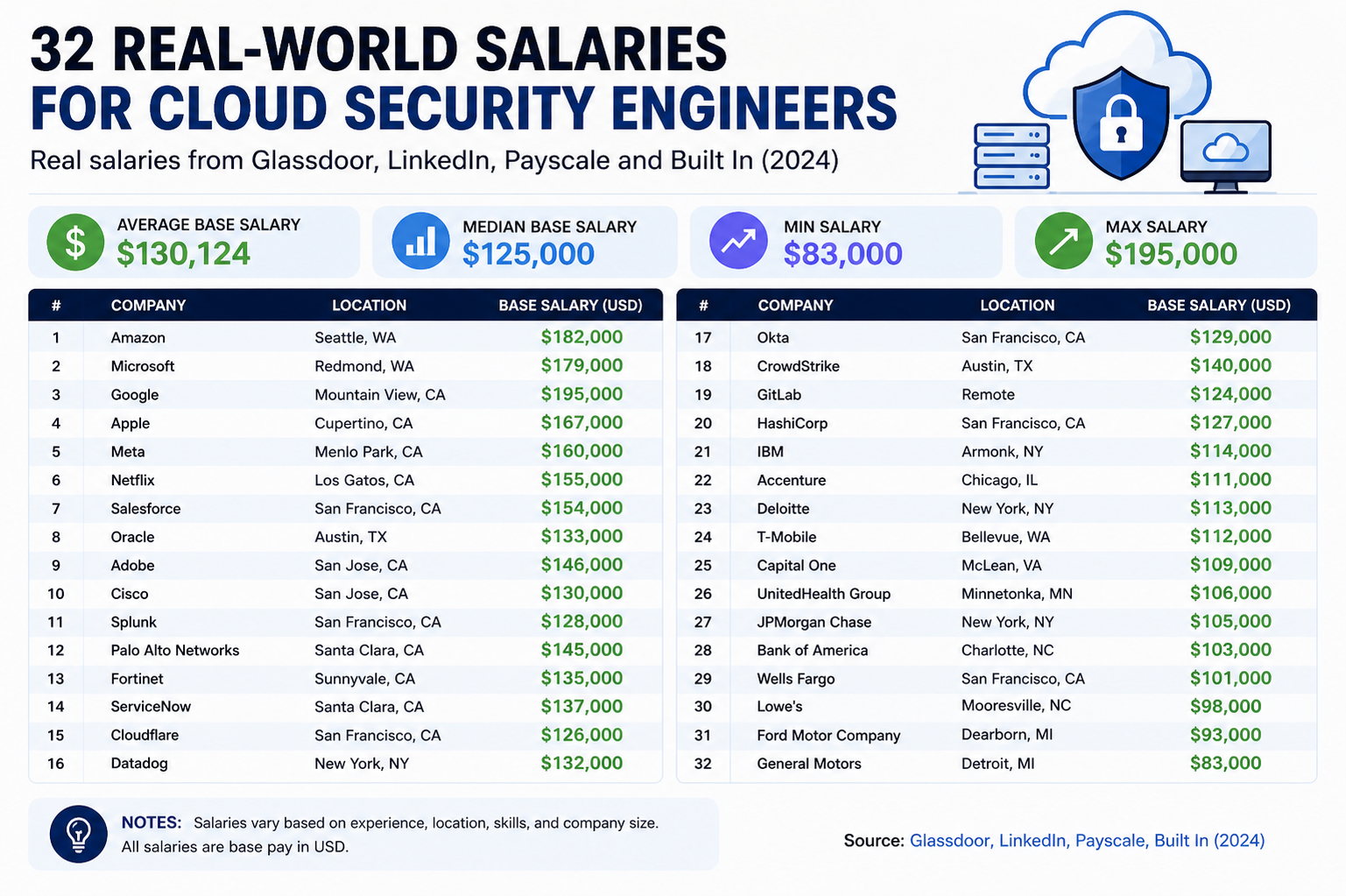
Cloud security engineering salaries are strongly influenced by experience, and the progression from entry-level to senior roles shows a clear upward trajectory. At the entry level, professionals typically focus on foundational tasks such as monitoring cloud environments, assisting with configuration management, and supporting security audits. Compensation at this stage is generally lower compared to other tiers, but it provides essential exposure to real-world cloud security systems and practices.
As engineers gain 2–5 years of experience, they transition into mid-level positions where responsibilities expand significantly. These roles involve implementing security controls, managing identity and access management systems, and actively participating in incident response. Salaries at this stage increase substantially because professionals are expected to operate with greater independence and technical depth.
Senior-level cloud security engineers, usually with 6–10+ years of experience, often command premium compensation. Their work focuses on designing enterprise-wide security architectures, leading security teams, and ensuring compliance with international security standards. These professionals are trusted with high-impact decisions, which directly affects organizational risk posture.
Beyond senior roles, principal or lead cloud security engineers occupy strategic positions within organizations. They influence long-term security roadmaps, evaluate emerging threats, and guide cross-functional teams across cloud, DevOps, and infrastructure domains. Compensation at this level is among the highest in the cybersecurity field.
Salary Variation Across Geographic Regions
Geographic location plays a major role in determining cloud security engineer salaries. In high-cost regions with strong demand for cybersecurity talent, compensation tends to be significantly higher. These areas often include major technology hubs where companies compete aggressively for skilled professionals.
In contrast, regions with lower living costs or emerging tech markets may offer comparatively modest salaries. However, remote work opportunities are increasingly bridging this gap, allowing engineers in lower-cost regions to earn competitive global wages while working for international organizations.
North American markets typically offer some of the highest compensation packages due to strong demand and advanced cloud adoption. European salaries vary widely depending on the country, with Western Europe generally offering higher pay than Eastern Europe. In Asia-Pacific regions, compensation is rapidly growing, especially in countries investing heavily in cloud infrastructure and cybersecurity modernization.
Impact of Cloud Platforms on Salary Levels
Proficiency in major cloud platforms is a key driver of salary differences. Engineers with expertise in widely used platforms tend to earn more because their skills are directly applicable to large-scale enterprise environments.
Cloud security professionals who are experienced in multi-cloud environments are especially valued. Organizations increasingly adopt hybrid infrastructures, combining multiple cloud providers, which requires engineers who can secure complex and distributed systems.
Knowledge of cloud-native security tools, container security, and infrastructure-as-code practices further increases earning potential. Employers place high value on professionals who can integrate security seamlessly into automated deployment pipelines.
Certifications and Their Influence on Compensation
Certifications play a significant role in shaping cloud security engineer salaries. Professionals with recognized cybersecurity and cloud certifications often receive higher compensation offers due to validated technical expertise.
Certifications demonstrate proficiency in areas such as secure architecture design, threat detection, risk management, and compliance frameworks. They also indicate commitment to continuous learning, which is essential in a rapidly evolving field like cloud security.
While certifications alone do not guarantee high salaries, they significantly enhance job competitiveness when combined with practical experience. Employers often use them as benchmarks during hiring and promotion decisions.
Industry-Based Salary Differences
Different industries offer varying compensation levels for cloud security engineers based on risk exposure and regulatory requirements.
The financial sector typically offers some of the highest salaries due to strict security regulations and high-value data protection needs. Cloud security engineers in banking and fintech environments are responsible for safeguarding sensitive financial transactions and preventing fraud.
Healthcare organizations also provide competitive compensation due to the need to secure patient data and comply with privacy regulations. However, salaries may vary depending on organizational size and funding.
Technology companies, especially large-scale cloud service providers and software firms, offer highly competitive packages. These organizations prioritize innovation and require advanced cloud security expertise to protect massive distributed systems.
Government and public sector roles may offer relatively stable but moderate salaries compared to private industry. However, these positions often provide strong job security and long-term benefits.
Role Complexity and Responsibility Level
Salary levels increase significantly with the complexity of responsibilities assigned to cloud security engineers. Professionals handling basic monitoring tasks earn less compared to those designing entire security infrastructures.
Engineers responsible for threat modeling, penetration testing, and incident response typically fall into higher compensation brackets. These roles require deep technical expertise and the ability to respond quickly to evolving threats.
At higher levels, professionals are expected to make architectural decisions that directly impact organizational security posture. This includes selecting security frameworks, designing encryption strategies, and defining access control policies across cloud environments.
Leadership responsibilities also influence compensation. Engineers who manage teams or coordinate cross-functional security initiatives typically earn significantly more than individual contributors.
Impact of Emerging Technologies on Salary Trends
The evolution of cloud technologies continues to shape salary trends in cloud security engineering. Emerging technologies such as artificial intelligence, machine learning, and automation are increasingly integrated into security systems.
Engineers who understand how to secure AI-driven systems and automate threat detection workflows are in high demand. This specialization often leads to higher compensation due to its niche nature and growing importance.
Serverless computing and containerized environments have also introduced new security challenges. Professionals skilled in securing these architectures are highly valued in modern cloud ecosystems.
Zero-trust security models are becoming standard across industries, further increasing demand for engineers who can implement and manage such frameworks effectively.
Remote Work and Global Salary Competition
Remote work has significantly transformed salary structures in cloud security engineering. Professionals are no longer limited to local job markets and can access global opportunities.
This shift has created both opportunities and competition. Engineers in lower-cost regions can now earn salaries aligned with global standards, while employers benefit from a wider talent pool.
However, this also means increased competition among professionals worldwide, making skills, experience, and specialization more important than ever in determining compensation levels.
Companies increasingly adopt location-based pay models or standardized global salary bands depending on their workforce strategy.
Career Growth and Long-Term Earning Potential
Cloud security engineering offers strong long-term earning potential due to continuous demand for cybersecurity expertise. As organizations migrate more infrastructure to the cloud, the need for skilled security professionals continues to grow.
Career progression typically follows a structured path from junior engineer to senior engineer, and eventually to architect or leadership roles. Each stage brings a substantial increase in compensation.
Professionals who continuously upgrade their skills, learn new technologies, and adapt to evolving threats tend to experience faster salary growth.
Specializing in niche areas such as cloud incident response, security automation, or cloud compliance can further enhance long-term earning potential.
Negotiation and Compensation Strategy
Salary negotiation plays an important role in determining final compensation. Cloud security engineers who effectively communicate their skills, certifications, and project experience often secure higher pay packages.
Understanding market rates, regional salary benchmarks, and industry standards helps professionals position themselves more effectively during negotiations.
Additional compensation components such as bonuses, stock options, and benefits also contribute significantly to overall earnings, especially in large technology companies.
Professionals who demonstrate measurable impact, such as reducing security incidents or improving system resilience, often have stronger leverage during salary discussions.
Future Outlook of Cloud Security Salaries
The future of cloud security engineering salaries remains highly positive. As cyber threats become more sophisticated, organizations will continue to invest heavily in security talent.
Demand is expected to grow across all industries, particularly in sectors undergoing rapid digital transformation. This sustained demand will likely continue driving salaries upward over time.
Professionals who stay updated with evolving technologies and maintain strong technical expertise will remain highly competitive in the job market.
Overall, cloud security engineering is positioned as one of the most stable and rewarding career paths in the broader cybersecurity landscape, with strong financial and professional growth opportunities.
Advanced Compensation Trends in Cloud Security Engineering
As cloud security engineering matures as a profession, compensation structures are becoming more layered and performance-driven. Beyond base salary, many organizations now design total compensation packages that include bonuses, equity, and long-term incentive plans. This shift reflects how critical cloud security has become to business continuity and digital trust.
In many mid-to-large organizations, performance bonuses are tied directly to measurable security outcomes. These may include reduced incident response time, improved compliance scores, or successful implementation of zero-trust architectures. Engineers who consistently contribute to lowering risk exposure often see faster salary growth compared to peers focused only on operational tasks.
Equity-based compensation is especially common in technology companies. Cloud security engineers working in high-growth environments may receive stock options or restricted stock units as part of their package. Over time, this can significantly increase total earnings, particularly if the company performs well in the market.
Specialization and Its Impact on Earning Power
Specialization is one of the strongest factors influencing long-term salary potential in cloud security engineering. Generalists typically earn stable but moderate salaries, while specialists in high-demand areas often command premium pay.
Engineers specializing in cloud incident response are particularly valuable because they handle real-time security breaches and system compromises. Their ability to quickly contain threats and minimize damage directly impacts business continuity, making them highly compensated professionals.
Another high-value specialization is cloud security architecture. These professionals design secure frameworks for entire organizations, ensuring that infrastructure, applications, and data systems are protected from the ground up. Their decisions often define the security posture of the entire enterprise.
DevSecOps specialists also earn competitive salaries due to their role in integrating security into automated development pipelines. As organizations shift toward continuous deployment models, these engineers ensure that security is embedded at every stage of software delivery.
Influence of Organizational Size on Salaries
The size of an organization plays a major role in determining compensation levels. Large enterprises with global operations typically offer higher salaries compared to smaller companies due to the complexity and scale of their cloud environments.
In large corporations, cloud security engineers often manage systems that span multiple regions, cloud providers, and regulatory jurisdictions. This complexity requires advanced expertise, which is reflected in higher pay scales.
Mid-sized companies offer competitive but slightly lower salaries, often balancing compensation with broader responsibilities. Engineers in these environments may handle a wider range of tasks, from security monitoring to architecture design, which provides valuable experience.
Startups may offer lower base salaries but compensate with equity and faster career progression opportunities. In some cases, early-stage startups provide significant upside potential if the company scales successfully.
Role of Risk Management in Salary Growth
Cloud security engineering is fundamentally tied to risk management, and professionals who excel in this area often experience stronger salary growth. Organizations prioritize engineers who can identify vulnerabilities before they are exploited.
Risk assessment capabilities, including threat modeling and vulnerability analysis, are highly valued. Engineers who can translate technical risks into business impact are especially important for leadership decision-making.
The ability to implement proactive security strategies rather than reactive fixes also enhances earning potential. Companies are willing to pay more for engineers who reduce the likelihood of security incidents rather than simply responding to them.
Certifications That Drive Higher Salary Bands
While experience remains the most important factor, advanced certifications can significantly influence salary bands. Certifications focused on cloud architecture, security operations, and ethical hacking are particularly valuable.
Professionals with multiple advanced certifications often position themselves for senior or lead roles more quickly. Employers view these certifications as indicators of both technical depth and commitment to professional development.
In competitive job markets, certifications can sometimes act as differentiators between candidates with similar experience levels. This can directly influence initial salary offers as well as promotion opportunities.
However, certifications are most effective when paired with real-world project experience. Employers prioritize practical problem-solving ability over theoretical knowledge alone.
Automation and Its Effect on Salary Structures
Automation is reshaping the cloud security landscape and influencing how salaries are structured. As routine security tasks become automated, engineers are increasingly expected to focus on strategic and analytical responsibilities.
This shift has increased demand for professionals who can design and manage automated security systems. Engineers with expertise in security orchestration, automation, and response (SOAR) tools are seeing stronger salary growth.
While automation reduces manual workload, it also raises the skill bar for cloud security engineers. Professionals must now understand scripting, infrastructure automation, and cloud-native security frameworks to remain competitive.
As a result, salary differences between basic operational roles and advanced automation-focused roles are widening.
Leadership Roles and Executive-Level Compensation
At the highest levels, cloud security engineers transition into leadership positions such as security managers, directors, or chief information security officers with cloud specialization.
These roles involve strategic decision-making, budgeting, team leadership, and enterprise-wide security planning. Compensation at this level extends far beyond base salary and often includes significant performance bonuses and equity packages.
Leadership roles require not only technical expertise but also strong communication and organizational skills. Professionals must align security strategies with business objectives while managing risk across complex infrastructures.
Executive-level compensation reflects both responsibility and impact, often placing these roles among the highest-paid positions in the technology sector.
Global Demand and Talent Shortages
One of the most important drivers of cloud security salaries is global talent shortage. The demand for skilled cloud security engineers continues to outpace supply, creating upward pressure on compensation.
Organizations across industries are competing for a limited pool of experienced professionals. This competition often results in higher salary offers, accelerated promotions, and enhanced benefits packages.
Emerging markets are also contributing to this trend as companies expand cloud adoption. As digital transformation accelerates globally, the need for skilled security professionals continues to grow.
This shortage is expected to persist, making cloud security engineering a high-value career path for the foreseeable future.
Long-Term Career Stability and Financial Growth
Cloud security engineering offers strong long-term career stability due to the persistent nature of cybersecurity threats. Unlike some technology roles that may become obsolete, security expertise remains consistently in demand.
Professionals who continuously update their skills tend to experience steady financial growth over time. Career progression is often less linear and more skill-driven compared to traditional IT roles.
Over a 10–15 year span, cloud security engineers can move from technical roles into architecture, consulting, or executive positions, each offering significantly higher compensation.
The combination of high demand, specialization opportunities, and global applicability makes this field one of the most financially rewarding in the technology sector.
Evolving Salary Expectations in the Industry
Salary expectations in cloud security engineering continue to evolve as the industry matures. What was considered a high salary a few years ago is now often seen as standard in many markets.
Employers are increasingly benchmarking salaries against global standards rather than local averages. This shift is driven by remote work and global talent competition.
As cloud environments become more complex, the value placed on skilled security engineers continues to rise. Professionals who can bridge the gap between cloud infrastructure and cybersecurity are particularly well compensated.
Overall, the trajectory of cloud security salaries reflects a field that is still expanding, adapting, and increasing in strategic importance across all sectors.
Cloud Security Engineer Salary Distribution Across Real-World Scenarios
Cloud security engineer salaries are not uniform; they vary across multiple real-world scenarios depending on responsibility, environment complexity, and organizational maturity. In smaller IT teams where engineers wear multiple hats, compensation tends to cluster in a moderate range because the role combines cloud security with general system administration duties. These positions often prioritize versatility over deep specialization, which slightly limits upper salary potential.
In contrast, dedicated cloud security roles within large enterprises show much wider salary dispersion. Engineers working in these environments may focus exclusively on securing multi-cloud architectures, managing large-scale identity systems, and overseeing compliance across global infrastructures. The complexity of these environments pushes salaries significantly higher, especially when engineers are responsible for high-availability systems.
Contract-based cloud security roles also introduce variability. Independent consultants and contractors can earn higher hourly rates compared to full-time employees, but their income is less stable. These professionals are often brought in for short-term projects such as cloud migration security audits, penetration testing, or architecture redesigns.
Salary Differences Based on Technical Depth
Technical depth is one of the most important factors influencing compensation. Engineers who only handle monitoring and alerting systems typically fall into lower salary brackets, even if they are experienced. These roles are essential but often considered operational rather than strategic.
Mid-tier engineers with hands-on expertise in cloud infrastructure security, identity management, and vulnerability assessment see a noticeable salary increase. They are expected to actively secure environments and respond to incidents with minimal supervision.
At the higher end, engineers with deep architectural expertise command premium salaries. These professionals design security frameworks that govern entire cloud ecosystems. Their work includes encryption strategy, network segmentation, zero-trust implementation, and advanced threat modeling. Because their decisions affect enterprise-wide security posture, their compensation reflects high accountability.
Impact of Security Incidents and Crisis Management Experience
Experience in handling real security incidents significantly increases salary potential. Engineers who have managed major breaches or large-scale cloud outages are highly valued because they bring real-world crisis experience that cannot be replicated through theoretical knowledge alone.
Organizations place strong emphasis on professionals who can remain effective under pressure. Incident response experience demonstrates not only technical skill but also decision-making ability during high-risk situations.
Engineers who specialize in forensic investigation of cloud environments or post-incident analysis often receive higher compensation due to the rarity of their expertise. Their ability to identify root causes and prevent recurrence adds measurable value to organizations.
Cloud Security Salary Progression Over Time
Salary progression in cloud security engineering is typically steep in the first 5–7 years of a career. Early growth is driven by rapid skill acquisition and exposure to diverse environments. During this period, engineers often move from junior operational roles into mid-level engineering positions.
Between 5–10 years of experience, salary growth becomes more dependent on specialization and leadership responsibilities. Engineers who develop niche expertise or transition into design-focused roles tend to see faster compensation increases.
Beyond 10 years, salary growth stabilizes but can spike significantly for those who move into architecture leadership or executive roles. At this stage, compensation is less tied to technical execution and more aligned with strategic influence and organizational impact.
Influence of Compliance and Regulatory Knowledge
Cloud security engineers with strong knowledge of regulatory frameworks often earn higher salaries. Industries such as finance, healthcare, and government require strict compliance with data protection laws and security standards.
Engineers who understand frameworks such as GDPR, HIPAA, ISO standards, and cloud security governance models are highly valued. Their ability to ensure compliance reduces legal and financial risk for organizations.
Compliance-focused roles often involve collaboration with legal, audit, and risk management teams. This cross-functional responsibility increases the strategic importance of the role and contributes to higher compensation.
Hybrid Cloud and Multi-Cloud Expertise Premium
Professionals with expertise in hybrid and multi-cloud environments consistently earn more than those working in single-cloud ecosystems. Modern enterprises rarely rely on a single provider, making cross-platform security expertise essential.
Managing security across multiple cloud platforms introduces complexity in identity management, network configuration, and data protection policies. Engineers who can unify these environments under consistent security frameworks are highly sought after.
This skill set is particularly valuable in large organizations undergoing cloud transformation, where legacy systems must be integrated with modern cloud infrastructure.
Soft Skills and Their Hidden Impact on Salary
While technical expertise is the primary driver of compensation, soft skills also play a critical role in salary growth. Communication skills, leadership ability, and cross-team collaboration significantly influence career advancement.
Cloud security engineers who can clearly explain technical risks to non-technical stakeholders are often promoted faster. Their ability to translate complex security issues into business impact makes them valuable in decision-making processes.
Leadership potential is another important factor. Engineers who mentor junior staff, lead projects, or coordinate cross-department initiatives are more likely to move into higher-paying roles.
Salary Differences Between Product and Service-Based Companies
Product-based companies often offer higher compensation compared to service-based organizations. This is primarily due to the scalability and long-term value of their platforms, which require highly secure and resilient cloud infrastructure.
In product companies, cloud security engineers work closely with development teams to secure applications used by millions of users. The scale and impact of their work justify higher salaries.
Service-based companies, on the other hand, focus on client-specific projects. While they offer strong experience diversity, compensation may be slightly lower due to project-based revenue models.
Impact of Continuous Learning on Salary Growth
Continuous learning is essential for sustained salary growth in cloud security engineering. The field evolves rapidly, and professionals who fail to update their skills risk stagnation in both role and compensation.
Engineers who consistently learn new cloud services, security frameworks, and automation tools tend to progress faster in their careers. This adaptability makes them more valuable to employers.
Participation in real-world projects, labs, and advanced training programs often leads to better job opportunities and higher salary offers.
Emerging Roles Creating New Salary Bands
New cloud security roles are emerging as technology evolves. Positions focused on cloud-native application security, AI-driven threat detection, and automated compliance monitoring are becoming increasingly common.
These emerging roles often command higher salaries due to limited talent availability. Early adopters of these specializations benefit from strong market demand and limited competition.
As cloud ecosystems continue to evolve, entirely new salary bands are expected to form around advanced security automation and AI-integrated security systems.
Long-Term Industry Outlook for Earnings
The long-term outlook for cloud security engineer salaries remains highly positive. As organizations deepen their reliance on cloud infrastructure, the importance of security will continue to grow.
Cyber threats are becoming more sophisticated, requiring increasingly advanced defense mechanisms. This ensures sustained demand for skilled professionals across all experience levels.
Over time, cloud security engineering is expected to remain one of the most financially stable and strategically important careers in the technology industry.
Professionals who combine deep technical knowledge with adaptability and leadership capability are likely to see the strongest long-term financial growth.
Advanced Market Dynamics Shaping Cloud Security Engineer Salaries
Cloud security engineer salaries are increasingly influenced by broader market dynamics rather than isolated technical skills alone. One of the most significant factors is global digital transformation, where organizations across all industries are shifting workloads to the cloud. This large-scale migration creates sustained demand for professionals who can secure complex distributed environments.
Another important dynamic is cybersecurity risk escalation. As cyberattacks become more sophisticated and frequent, organizations are allocating larger budgets to security functions. Cloud security engineers directly benefit from this shift because they are responsible for protecting critical infrastructure and sensitive data in cloud environments.
Economic conditions also play a role in salary fluctuations. During periods of rapid digital investment, compensation tends to rise due to aggressive hiring. In contrast, during economic slowdowns, salary growth may stabilize, but cloud security roles generally remain resilient compared to many other IT positions due to their critical nature.
Role of Organizational Maturity in Salary Structures
The maturity level of an organization’s cloud security practices significantly impacts salary distribution. Early-stage cloud adopters often rely on general IT staff to manage basic security tasks, resulting in relatively lower compensation structures for cloud security responsibilities.
As organizations mature and adopt advanced cloud-native architectures, they begin to establish dedicated cloud security teams. These teams require specialized expertise, which leads to higher salary brackets and more clearly defined career paths.
In highly mature organizations, cloud security engineering becomes a strategic function rather than just a technical one. Engineers at this level contribute to enterprise risk management, compliance strategy, and long-term infrastructure planning, all of which justify premium compensation.
Cloud Security Engineering in High-Stakes Industries
Certain industries consistently offer higher salaries due to the sensitivity and critical nature of their data. Financial services, for example, rely heavily on cloud infrastructure for transaction processing, fraud detection, and digital banking systems. This creates a strong need for highly skilled cloud security engineers who can prevent financial losses and ensure regulatory compliance.
In the healthcare sector, protecting patient data and maintaining system availability are top priorities. Cloud security engineers in this industry often work on securing electronic health records, telemedicine platforms, and cloud-based diagnostic systems. The high stakes involved in data privacy contribute to competitive compensation.
The technology sector itself remains one of the largest employers of cloud security engineers. Companies operating large-scale cloud platforms require advanced security frameworks to protect millions of users globally. This scale naturally drives salaries upward due to complexity and responsibility.
Skill Convergence and Cross-Domain Expertise Premium
One of the strongest emerging trends in cloud security compensation is the premium placed on cross-domain expertise. Engineers who combine cloud security knowledge with networking, software development, or data engineering skills are increasingly valuable.
This convergence allows professionals to understand security challenges across the entire technology stack. As a result, they can design more effective and integrated security solutions.
For example, engineers who understand both application development and cloud infrastructure can better implement DevSecOps practices. Similarly, those with networking expertise can optimize secure cloud architectures with greater efficiency.
This cross-functional knowledge significantly increases salary potential because it reduces dependency on multiple specialized roles within an organization.
Performance Metrics and Salary Growth Correlation
Modern organizations are increasingly tying salary growth to measurable performance metrics. Cloud security engineers are often evaluated based on system uptime, incident frequency reduction, vulnerability resolution time, and compliance audit outcomes.
Engineers who consistently demonstrate strong performance across these metrics are more likely to receive faster promotions and higher compensation increases.
Additionally, contributions to automation, such as reducing manual security tasks through scripting or orchestration, are highly valued. These improvements not only increase efficiency but also reduce operational risk, which directly impacts business outcomes.
Consulting and Freelance Cloud Security Earnings
Beyond traditional employment, consulting roles offer an alternative high-earning path for cloud security engineers. Experienced professionals often transition into freelance or advisory positions where they provide specialized expertise to multiple organizations.
Consultants are typically paid on a project or hourly basis, and their rates can exceed standard full-time salaries, especially for niche expertise such as cloud incident response or multi-cloud architecture design.
However, consulting work requires strong reputation, proven experience, and the ability to quickly adapt to different organizational environments. While financially rewarding, it also comes with variability in workload and income stability.
Future Evolution of Salary Structures
Cloud security salary structures are expected to continue evolving as technology advances. One key trend is the increasing integration of artificial intelligence into security systems. Engineers who can manage AI-driven threat detection platforms will likely see higher compensation in the future.
Another trend is the expansion of automated security governance. As organizations adopt more automation, engineers will shift toward overseeing intelligent systems rather than performing manual tasks. This transition will further elevate the importance of strategic and architectural roles.
Additionally, as regulatory frameworks become more complex globally, compliance-driven security expertise will continue to gain value, further influencing salary growth patterns.
Career Mobility and Global Opportunities
Cloud security engineering offers strong career mobility due to its global relevance. Skills in cloud security are transferable across countries and industries, allowing professionals to explore international job opportunities.
Remote work has further expanded this mobility, enabling engineers to work for global companies without relocating. This has effectively widened access to higher-paying markets, especially for professionals in regions with lower local salary averages.
Global demand ensures that skilled cloud security engineers can continuously find new opportunities, often with competitive compensation packages.
Conclusion
Cloud security engineering stands out as one of the most stable, high-growth, and financially rewarding careers in the modern technology landscape. Across all experience levels, from entry to executive roles, compensation reflects the critical importance of securing cloud-based infrastructure.
Salary variation is influenced by multiple interconnected factors, including experience, specialization, geographic region, industry type, and organizational complexity. However, the overall trajectory remains strongly upward due to sustained global demand for cybersecurity expertise.
Professionals who continuously develop technical depth, adapt to emerging technologies, and expand into strategic roles are positioned for long-term financial growth. Specialization in areas such as multi-cloud security, automation, and incident response further enhances earning potential.
Ultimately, cloud security engineering is not just a technical career path but a strategic profession that directly supports the stability and trust of modern digital systems. As cloud adoption continues to expand globally, the value and compensation of skilled cloud security engineers are expected to remain strong for years to come.