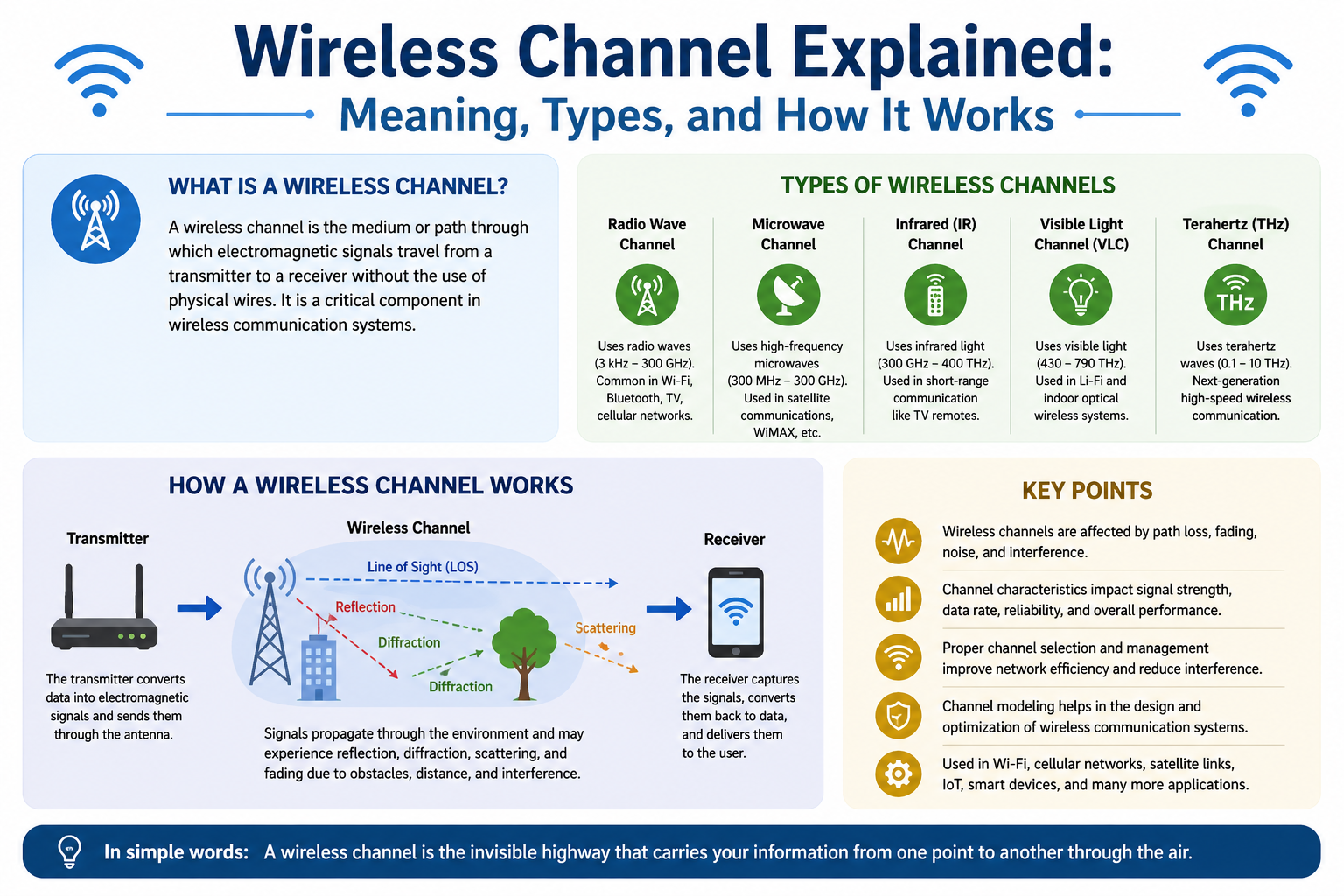
Wireless channels are not static; they are highly dynamic and unpredictable in nature. Unlike wired communication, where the signal path is fixed and controlled, wireless signals travel through an open environment where many factors continuously affect them. These characteristics make wireless communication both flexible and challenging. The main behavior of a wireless channel depends on how signals propagate, interact with objects, and reach the receiver under varying conditions.
One of the most important characteristics of a wireless channel is attenuation. Attenuation refers to the gradual loss of signal strength as it travels through space. As the distance between transmitter and receiver increases, the signal becomes weaker. This happens because the energy of the wave spreads out over a larger area. Physical obstacles such as buildings, walls, and trees can further reduce signal strength by absorbing or blocking parts of the wave.
Another key characteristic is noise. In wireless communication, noise refers to unwanted signals that interfere with the original transmission. These unwanted signals may come from natural sources such as atmospheric disturbances or from artificial sources like electronic devices. Noise can distort the original message and make it difficult for the receiver to interpret the signal correctly.
Signal Propagation in Wireless Channels
Signal propagation is the process by which wireless signals travel from the transmitter to the receiver. In real-world environments, signals rarely follow a straight path. Instead, they interact with the surroundings in complex ways. The main mechanisms of propagation include reflection, diffraction, and scattering.
Reflection occurs when a signal bounces off large surfaces such as buildings, walls, or the ground. This creates multiple copies of the same signal reaching the receiver at different times. Diffraction happens when a signal bends around obstacles, allowing it to reach areas that are not in direct line of sight. Scattering occurs when signals hit small objects like street signs, leaves, or lamp posts, causing the wave to spread in different directions.
These propagation effects are responsible for creating multiple versions of the same signal at the receiver, which can either improve or degrade communication depending on the conditions.
Multipath Effect in Wireless Communication
One of the most significant phenomena in wireless channels is the multipath effect. Multipath occurs when transmitted signals reach the receiver through multiple paths due to reflection, diffraction, and scattering. As a result, the receiver receives several copies of the same signal at different times and with different strengths.
This can lead to constructive or destructive interference. In constructive interference, the signals combine to strengthen the received signal. In destructive interference, the signals cancel each other out partially or completely, leading to signal fading or loss. Multipath is especially common in urban environments where buildings and structures create numerous reflection surfaces.
Multipath can cause issues such as signal delay, distortion, and reduced data quality. However, modern communication systems use advanced techniques such as equalization and diversity reception to minimize its negative effects.
Fading in Wireless Channels
Fading refers to the variation in signal strength over time or space. It is one of the most challenging aspects of wireless communication. Fading occurs due to changes in the propagation environment, movement of objects, or movement of the transmitter or receiver.
There are different types of fading, including slow fading and fast fading. Slow fading occurs when the signal strength changes gradually due to large obstacles such as hills or buildings. Fast fading occurs when the signal fluctuates rapidly due to multipath effects and movement.
Fading can severely affect the quality of communication by causing sudden drops in signal strength. To overcome fading, systems use techniques such as diversity, where multiple antennas are used to receive the same signal through different paths.
Path Loss and Its Impact
Path loss is another critical factor in wireless channels. It refers to the reduction in signal power as it travels from transmitter to receiver. Path loss increases with distance and is influenced by the environment. In open areas, path loss is lower compared to urban environments where obstacles are more frequent.
Path loss is usually measured in decibels and is an important factor in designing wireless networks. Engineers must carefully calculate expected path loss to ensure that signals remain strong enough to be received correctly.
Interference in Wireless Communication
Interference occurs when unwanted signals disrupt the intended transmission. It is one of the major challenges in wireless communication systems. Interference can come from other wireless devices operating in the same frequency range or from external electromagnetic sources.
There are different types of interference, including co-channel interference and adjacent channel interference. Co-channel interference occurs when multiple transmitters use the same frequency channel. Adjacent channel interference happens when signals from nearby frequency bands overlap.
Interference reduces the clarity of communication and can lead to data errors. To reduce interference, systems use techniques such as frequency planning, channel allocation, and advanced filtering methods.
Doppler Effect in Wireless Channels
The Doppler effect is observed when there is relative motion between the transmitter and receiver. In wireless communication, this often happens when either the sender or receiver is moving, such as in mobile phones or vehicles.
When the receiver moves towards the transmitter, the frequency of the received signal increases. When moving away, the frequency decreases. This shift in frequency can affect signal quality and must be considered in mobile communication systems.
The Doppler effect becomes more significant at higher speeds, such as in high-speed trains or aircraft communication systems.
Channel Capacity and Data Transmission
Channel capacity refers to the maximum rate at which data can be transmitted over a wireless channel without significant errors. It depends on factors such as bandwidth, signal strength, and noise level.
A higher bandwidth allows more data to be transmitted, while higher noise reduces channel efficiency. The relationship between these factors determines how effectively a wireless channel can carry information.
Modern communication systems aim to maximize channel capacity while minimizing errors. This is achieved through advanced coding techniques, modulation schemes, and signal processing methods.
Wireless Channel Modeling
To design efficient communication systems, engineers create mathematical models of wireless channels. These models simulate real-world conditions such as fading, interference, and multipath propagation.
Channel models help predict how signals will behave in different environments, such as urban areas, rural regions, or indoor spaces. By using these models, network designers can optimize system performance and reduce communication errors.
Common types of channel models include deterministic models, which use fixed equations, and statistical models, which use probability distributions to represent random behavior.
Importance of Wireless Channels in Modern Communication
Wireless channels are the backbone of modern communication systems. They enable technologies such as mobile networks, Wi-Fi, satellite communication, and IoT devices. Without wireless channels, seamless global connectivity would not be possible.
They provide flexibility, mobility, and convenience, allowing users to communicate without physical connections. However, they also require complex engineering solutions to manage their unpredictable nature.
Advancements in wireless technology continue to improve channel performance through better modulation techniques, smart antennas, and adaptive signal processing. These innovations help overcome challenges like fading, interference, and noise, making wireless communication more reliable and efficient.
Wireless Channel Understanding
Wireless channels form the foundation of modern digital communication systems. They allow data to be transmitted through free space using electromagnetic waves, but their behavior is influenced by many environmental factors. Understanding how wireless channels work, including their characteristics, propagation methods, and challenges, is essential for designing efficient communication networks. As technology continues to evolve, improvements in wireless channel management will further enhance global connectivity and data transmission quality.
Wireless Channel Noise and Its Sources
Noise in a wireless channel refers to any unwanted disturbance that affects the transmitted signal and makes communication less reliable. It is one of the most limiting factors in wireless communication systems because it directly impacts the clarity and accuracy of received data. Unlike wired channels, where shielding can reduce external interference, wireless channels are exposed to a wide range of natural and artificial noise sources.
Thermal noise is one of the most common types of noise. It is generated by the random motion of electrons in electronic devices and is always present in communication systems. This type of noise increases with temperature and affects all frequency ranges equally. Another type is atmospheric noise, which is caused by natural phenomena such as lightning and thunderstorms. These disturbances generate electromagnetic waves that interfere with wireless signals, especially in lower frequency bands.
Man-made noise is also a significant issue in modern environments. It comes from electronic devices such as motors, power lines, computers, and other wireless systems operating nearby. As the number of wireless devices increases, the level of interference in shared frequency bands also increases, making signal management more complex.
Wireless Channel Capacity and Data Limits
Channel capacity defines the maximum amount of information that can be transmitted over a wireless channel with an acceptably low error rate. It depends on three major factors: bandwidth, signal power, and noise level. A wider bandwidth allows more data to pass through the channel, while higher signal power improves transmission quality. On the other hand, increased noise reduces the effective capacity of the channel.
In real-world systems, achieving maximum theoretical capacity is not possible due to environmental limitations. Engineers aim to approach this limit by using efficient encoding and modulation techniques. The concept of channel capacity is fundamental in designing high-speed communication systems such as 4G, 5G, and future wireless networks.
Modulation Techniques in Wireless Communication
Modulation is the process of modifying a carrier signal to encode information for transmission over a wireless channel. It plays a critical role in ensuring that data can travel efficiently over long distances and through various environmental conditions. Without modulation, raw data cannot be transmitted effectively in wireless systems.
There are different types of modulation techniques used in wireless communication. Amplitude modulation involves changing the strength of the carrier wave according to the input signal. Frequency modulation changes the frequency of the carrier wave, while phase modulation alters its phase. Each technique has its advantages and is chosen based on system requirements such as bandwidth efficiency, noise resistance, and complexity.
Modern systems often use advanced modulation schemes like Quadrature Amplitude Modulation, which combines both amplitude and phase variations to increase data transmission efficiency. These techniques allow more bits of information to be transmitted in the same bandwidth, improving overall system performance.
Equalization in Wireless Channels
Equalization is a technique used to reduce the effects of distortion in wireless channels caused by multipath propagation and fading. When signals travel through multiple paths, they may arrive at the receiver at different times, causing overlap and interference. This leads to signal distortion and makes it difficult to recover the original information accurately.
An equalizer is a system that processes the received signal to reverse these distortions. It adjusts the amplitude and phase of the signal components to reconstruct the original transmission. Equalization is especially important in high-speed communication systems where data is transmitted rapidly and is more sensitive to timing errors.
Adaptive equalizers are commonly used in modern systems. They automatically adjust their parameters based on changing channel conditions, making them highly effective in dynamic environments such as mobile communication.
Diversity Techniques in Wireless Communication
Diversity is a technique used to improve the reliability of wireless communication by using multiple transmission or reception paths. The main idea behind diversity is that if one signal path is weak or affected by fading, another path may still carry a strong signal. This increases the chances of receiving a clear and accurate message.
There are different types of diversity techniques. Spatial diversity uses multiple antennas placed at different locations to receive the same signal. Frequency diversity transmits the same information over different frequency bands. Time diversity sends the same signal at different time intervals to reduce the impact of temporary interference.
Diversity significantly improves signal quality and reduces the effects of fading and interference. It is widely used in modern wireless systems such as mobile networks and Wi-Fi technology.
MIMO Technology in Wireless Channels
Multiple Input Multiple Output is an advanced wireless communication technology that uses multiple antennas at both the transmitter and receiver ends. This allows multiple data streams to be transmitted simultaneously over the same channel, increasing data throughput and improving signal reliability.
MIMO systems take advantage of multipath propagation instead of treating it as a problem. By using multiple signal paths, MIMO can significantly enhance channel capacity without requiring additional bandwidth. This makes it one of the most important technologies in modern wireless standards such as 4G and 5G networks.
MIMO also improves resistance to interference and fading, making communication more stable in complex environments like urban areas and indoor spaces.
OFDM in Wireless Communication Systems
Orthogonal Frequency Division Multiplexing is a modulation technique used to transmit data over multiple closely spaced carrier frequencies. It divides a high-speed data stream into several lower-speed streams, each transmitted over a separate subcarrier. These subcarriers are mathematically orthogonal, meaning they do not interfere with each other.
OFDM is highly effective in reducing the effects of multipath fading and inter-symbol interference. It is widely used in modern wireless systems such as Wi-Fi, LTE, and 5G networks. By breaking data into smaller parts and transmitting them simultaneously, OFDM improves efficiency and reliability in wireless communication.
This technique also simplifies equalization, as each subcarrier experiences a relatively flat channel response, making signal processing easier at the receiver.
Error Control in Wireless Channels
Error control is essential in wireless communication because signals are often affected by noise, interference, and fading. These disturbances can introduce errors in transmitted data, leading to incorrect information at the receiver.
To handle this, error detection and correction techniques are used. Error detection identifies whether an error has occurred in the transmitted data, while error correction attempts to fix the errors without requiring retransmission. Common methods include parity checks, cyclic redundancy checks, and forward error correction codes.
Forward error correction is especially important in wireless systems because it allows the receiver to correct errors on its own, reducing the need for repeated transmissions and improving efficiency.
Adaptive Techniques in Wireless Channels
Wireless channels are constantly changing due to movement, environmental conditions, and interference. To handle this variability, adaptive techniques are used in communication systems. These techniques allow the system to adjust its parameters in real time based on current channel conditions.
Adaptive modulation changes the modulation scheme depending on signal quality. When the channel is clear, higher-order modulation is used for faster data transmission. When the channel is noisy, lower-order modulation is used for better reliability.
Adaptive coding adjusts the level of error correction based on channel conditions. Together, these adaptive methods ensure efficient and reliable communication even in unpredictable environments.
Channel Estimation in Wireless Systems
Channel estimation is the process of determining the characteristics of a wireless channel to improve communication performance. Since wireless channels are constantly changing, it is important for the receiver to estimate the current state of the channel accurately.
This estimation helps in compensating for distortions caused by fading, interference, and noise. It is usually done using known reference signals or pilot signals that are transmitted along with the actual data. By analyzing these signals, the receiver can understand how the channel is affecting the transmission and adjust accordingly.
Accurate channel estimation is critical for advanced communication systems, especially those using MIMO and OFDM technologies.
Future of Wireless Channel Technology
Wireless channel technology continues to evolve rapidly with advancements in communication systems. Future networks are expected to support extremely high data rates, ultra-low latency, and massive device connectivity. Technologies such as artificial intelligence, machine learning, and intelligent signal processing are being integrated to optimize wireless channel performance.
Smart antennas, beamforming techniques, and dynamic spectrum allocation are also improving how wireless signals are transmitted and received. These innovations aim to reduce interference, increase capacity, and enhance overall communication quality.
As demand for wireless connectivity continues to grow, especially with the rise of smart devices and Internet-based applications, the importance of efficient wireless channel management will become even greater.
Advanced Wireless Channel Challenges in Modern Networks
Modern wireless communication systems operate in highly complex environments where multiple challenges occur simultaneously. As technology advances and the number of connected devices increases, wireless channels must handle greater traffic, higher data rates, and more interference sources. These challenges make it necessary to design more intelligent and adaptive communication systems.
One of the major challenges is spectrum scarcity. The radio frequency spectrum is a limited resource, and with the rapid growth of wireless devices, demand for bandwidth is continuously increasing. Efficient spectrum utilization is essential to ensure that multiple systems can operate without causing significant interference to each other. Techniques such as dynamic spectrum sharing and cognitive radio systems are being developed to address this issue.
Another challenge is signal blockage in dense environments. In urban areas, tall buildings, walls, and other structures can block or weaken wireless signals. This leads to poor coverage and inconsistent connectivity. Indoor environments also present difficulties due to signal reflection and absorption by materials such as concrete, metal, and glass. These obstacles require advanced signal processing techniques to maintain stable communication.
Shadowing Effects in Wireless Channels
Shadowing refers to the variation in signal strength caused by large obstacles obstructing the line of sight between transmitter and receiver. Unlike fast fading, which changes rapidly over short distances, shadowing occurs over larger distances and is more gradual in nature.
When a signal passes through or around large objects such as buildings, hills, or trees, its strength reduces significantly. This creates areas with weak signal coverage known as shadow zones. Shadowing is a major concern in mobile communication systems, especially in urban and rural environments with uneven terrain.
Engineers use statistical models to predict shadowing behavior and design networks that minimize its impact. By strategically placing base stations and using signal repeaters, communication systems can reduce the effects of shadowing and improve coverage.
Cellular Structure and Wireless Channel Management
Cellular networks divide geographical areas into smaller regions called cells. Each cell is served by a base station that manages communication within its coverage area. This structure allows efficient use of frequency spectrum and supports a large number of users simultaneously.
Wireless channels in cellular systems are carefully managed to avoid interference between neighboring cells. Frequency reuse is a key concept in this design, where the same frequency bands are used in different cells that are far enough apart to avoid interference.
However, as network density increases, managing wireless channels becomes more complex. Small cells, macro cells, and micro cells are used together to provide better coverage and capacity. This layered approach helps balance traffic load and improve overall system performance.
Beamforming in Wireless Communication
Beamforming is an advanced signal processing technique used to direct wireless signals toward a specific receiver rather than broadcasting them in all directions. This improves signal strength, reduces interference, and enhances overall communication efficiency.
In beamforming, multiple antennas work together to focus the signal in a particular direction. By adjusting the phase and amplitude of signals at each antenna, the system can control the direction of the transmitted beam. This allows stronger and more reliable communication with the intended receiver.
Beamforming is widely used in modern wireless systems such as 5G networks and Wi-Fi 6. It plays a crucial role in improving coverage, especially in crowded environments where multiple devices are competing for bandwidth.
Channel Diversity in Mobile Environments
Mobile environments are highly dynamic due to constant movement of users and surrounding objects. This leads to frequent changes in wireless channel conditions. Channel diversity techniques are used to improve reliability in such environments by providing multiple transmission paths.
Time diversity ensures that the same information is transmitted at different time intervals. Frequency diversity uses multiple frequency bands to transmit the same data. Spatial diversity uses multiple antennas to capture signals from different directions.
By combining these techniques, wireless systems can significantly reduce the impact of fading and interference. Diversity is especially important in mobile networks where signal conditions can change rapidly.
Signal-to-Noise Ratio in Wireless Channels
Signal-to-Noise Ratio is a key performance metric in wireless communication. It measures the strength of the desired signal compared to the level of background noise. A higher ratio indicates a clearer and more reliable communication channel.
When the signal strength is much higher than noise, the receiver can easily decode the information with minimal errors. However, when noise levels increase or signal strength decreases, communication quality degrades.
Improving signal-to-noise ratio is a primary goal in wireless system design. Techniques such as power control, antenna optimization, and noise reduction algorithms are used to maintain high-quality communication.
Wireless Channel Security Challenges
Security is an important aspect of wireless communication because signals are transmitted through open space and can be intercepted by unauthorized users. Unlike wired systems, wireless channels are more vulnerable to eavesdropping and signal manipulation.
Encryption techniques are used to protect data during transmission. These methods convert information into coded formats that can only be decoded by authorized receivers. Authentication mechanisms ensure that only trusted devices can access the network.
Despite these measures, wireless channels still face security threats such as signal jamming and spoofing. Continuous improvements in cryptographic methods and secure communication protocols are necessary to protect wireless systems.
Inter-symbol Interference in Wireless Channels
Inter-symbol interference occurs when multiple transmitted symbols overlap and interfere with each other at the receiver. This problem is common in wireless channels where multipath propagation causes delayed versions of the signal to overlap with current signals.
ISI can lead to errors in data interpretation and reduce communication efficiency. It becomes more severe at higher data rates where symbols are transmitted more quickly.
To reduce ISI, systems use techniques such as equalization, pulse shaping, and guard intervals. OFDM technology also helps in minimizing inter-symbol interference by dividing data into multiple subcarriers.
Latency in Wireless Communication Systems
Latency refers to the delay between sending and receiving information in a wireless channel. It is an important factor in applications that require real-time communication such as video calls, online gaming, and autonomous systems.
Latency is influenced by several factors including signal processing time, propagation delay, and network congestion. High latency can degrade user experience and reduce system efficiency.
Modern wireless systems aim to reduce latency through optimized routing, faster processing techniques, and improved network architectures. Low-latency communication is a key requirement for future technologies such as autonomous vehicles and remote surgery.
Energy Efficiency in Wireless Channels
Energy efficiency is becoming increasingly important in wireless communication systems, especially with the growth of battery-powered devices. Efficient use of energy helps extend device battery life and reduce operational costs in large networks.
Wireless channels consume energy during transmission, signal processing, and reception. Techniques such as power control, sleep modes, and efficient modulation schemes help reduce energy consumption.
Energy-efficient communication is also important for environmental sustainability. As the number of connected devices increases, optimizing energy usage in wireless systems becomes a critical design consideration.
Wireless Channel Concepts
Wireless channels are the foundation of modern communication systems, enabling seamless connectivity across vast distances without physical connections. They are influenced by many factors including noise, fading, interference, and environmental conditions. Understanding these challenges and applying advanced techniques such as MIMO, OFDM, beamforming, and diversity allows engineers to build more reliable and efficient networks.
As wireless technology continues to evolve, future communication systems will become faster, more intelligent, and more adaptive. The continuous improvement of wireless channel management will play a key role in supporting global connectivity and next-generation digital applications.
Wireless Channel in 5G and Beyond Networks
Wireless channels in 5G and future generations of communication systems are designed to handle extremely high data rates, massive device connectivity, and ultra-low latency requirements. Unlike previous generations, modern networks rely heavily on advanced signal processing and intelligent channel management to maintain performance in highly dense and dynamic environments.
In 5G systems, wireless channels operate across a wide range of frequency bands, including sub-6 GHz and millimeter-wave frequencies. These higher frequency bands allow faster data transmission but come with challenges such as higher path loss and reduced coverage range. As a result, networks must use dense base station deployment and advanced beamforming techniques to maintain stable connections.
Future wireless systems are expected to integrate artificial intelligence into channel management. AI-based algorithms can analyze real-time channel conditions and automatically adjust transmission parameters for optimal performance. This allows networks to become more adaptive and efficient in handling varying user demands.
Millimeter Wave Communication in Wireless Channels
Millimeter wave communication is a key feature of modern wireless systems, especially in 5G networks. It uses extremely high-frequency signals to achieve very fast data transmission rates. However, these signals behave differently from traditional lower-frequency waves.
Millimeter waves have limited range and are highly sensitive to obstacles such as walls, trees, and even human bodies. They cannot penetrate solid objects easily, which makes line-of-sight communication more important. To overcome these limitations, networks use small cells and beamforming to maintain strong and focused connections.
Despite these challenges, millimeter wave technology plays a crucial role in supporting applications that require high bandwidth, such as virtual reality, augmented reality, and ultra-high-definition streaming.
Small Cell Technology in Wireless Channels
Small cell technology is used to improve network coverage and capacity in areas with high user density. Instead of relying only on large base stations, small cells are deployed in closer proximity to users. This helps reduce the distance between transmitter and receiver, improving signal strength and reducing path loss.
Small cells are especially useful in urban environments, stadiums, shopping centers, and office buildings where network traffic is extremely high. By distributing the load across multiple small cells, wireless networks can handle more users efficiently without congestion.
This approach also reduces interference and improves overall channel quality. However, it requires careful coordination between cells to avoid overlapping signals and frequency conflicts.
Handover Process in Mobile Wireless Channels
Handover is a critical process in mobile communication systems that ensures uninterrupted connectivity when a user moves from one cell to another. As a mobile device moves, it continuously switches its connection between different base stations.
During handover, the wireless channel conditions are constantly changing. The system must quickly transfer the ongoing connection without dropping the call or data session. This process requires accurate signal measurement and fast decision-making.
There are different types of handovers, including hard handover and soft handover. In hard handover, the connection to the old base station is terminated before connecting to the new one. In soft handover, the device is connected to multiple base stations at the same time during the transition, improving stability.
Cognitive Radio in Wireless Channels
Cognitive radio is an advanced technology that allows wireless systems to intelligently detect available spectrum and adapt their transmission parameters accordingly. It helps improve spectrum utilization by allowing devices to use unused frequency bands without causing interference to primary users.
In cognitive radio systems, the wireless channel is continuously monitored to identify free channels. When a suitable channel is found, the device dynamically adjusts its frequency, power, and modulation scheme to optimize communication.
This technology is especially useful in environments where spectrum resources are limited and demand is high. It enables more flexible and efficient use of wireless channels.
Wireless Channel Estimation Techniques in Depth
Accurate channel estimation is essential for maintaining high-quality wireless communication. Since wireless channels are constantly changing, systems must continuously estimate channel conditions to adjust transmission strategies.
One common technique is pilot-based estimation, where known reference signals are transmitted along with data. The receiver compares the received pilot signals with the original ones to determine channel characteristics.
Another approach is blind estimation, where the channel is estimated without using reference signals. This method relies on statistical properties of the received signal but is more complex and less accurate in some cases.
Accurate channel estimation improves decoding accuracy, reduces errors, and enhances overall system performance.
Massive MIMO and Its Role in Wireless Channels
Massive Multiple Input Multiple Output is an advanced version of MIMO technology that uses a very large number of antennas at the base station. This allows the system to serve many users simultaneously while improving signal strength and efficiency.
In massive MIMO systems, wireless channels become highly directional, which reduces interference and increases capacity. Each user receives a focused signal beam, improving reliability even in crowded environments.
This technology is a key component of modern and future wireless networks. It significantly enhances spectral efficiency and supports high-speed communication in dense urban areas.
Channel Coding Techniques for Error Reduction
Channel coding is used to detect and correct errors in wireless communication. Since wireless channels are prone to noise and interference, coding techniques are essential for ensuring data integrity.
In channel coding, extra bits are added to the original data before transmission. These redundant bits help the receiver detect and correct errors without needing retransmission.
Common coding techniques include convolutional coding, block coding, and turbo coding. These methods improve communication reliability and are widely used in modern wireless systems.
Hybrid Automatic Repeat Request in Wireless Channels
Hybrid Automatic Repeat Request is a technique that combines error correction and retransmission to improve communication reliability. When the receiver detects errors in received data, it requests retransmission from the sender.
At the same time, error correction techniques are used to fix minor errors without retransmission. This combination reduces delay and improves efficiency.
Hybrid systems are widely used in modern wireless networks because they provide a balance between speed and reliability.
Propagation Delay in Wireless Channels
Propagation delay refers to the time it takes for a signal to travel from the transmitter to the receiver. It depends on the distance between devices and the speed of electromagnetic waves.
In most wireless systems, propagation delay is very small, but it becomes significant in long-distance communication such as satellite systems. High latency caused by propagation delay can affect real-time applications.
Understanding and minimizing delay is important for designing efficient communication systems.
Future Trends in Wireless Channel Evolution
The future of wireless channels is focused on making communication faster, more reliable, and more intelligent. Emerging technologies such as 6G are expected to provide extremely high data rates, near-zero latency, and seamless global connectivity.
Future wireless channels will rely heavily on artificial intelligence, machine learning, and automation to manage complex environments. Intelligent systems will dynamically adjust network parameters based on real-time conditions.
Integration of satellite networks, terrestrial networks, and aerial platforms such as drones will create a unified communication system that provides global coverage.
Advancements in materials, antenna design, and signal processing will further enhance wireless channel performance, making communication more efficient than ever before.
Final Understanding of Wireless Channel Systems
Wireless channels are the backbone of modern communication infrastructure. They enable the transmission of data without physical connections, allowing mobility and flexibility across all types of devices. Despite their challenges such as noise, fading, interference, and signal loss, continuous advancements in technology have significantly improved their performance.
With the integration of advanced techniques like MIMO, beamforming, cognitive radio, and AI-driven optimization, wireless channels are becoming more intelligent and efficient. As technology continues to evolve, wireless communication will play an even more critical role in connecting the world and enabling future digital innovations.
Conclusion
Wireless channels are an essential part of modern communication systems, enabling the transfer of information without physical connections. They use electromagnetic waves to carry data between transmitter and receiver, making communication flexible, mobile, and widely accessible. However, the behavior of wireless channels is highly complex because signals are affected by many unpredictable factors in the environment.
Throughout wireless transmission, signals experience challenges such as noise, interference, fading, path loss, and multipath propagation. These factors can weaken or distort the original signal, making it difficult to maintain perfect communication. Despite these limitations, advanced technologies and signal processing techniques have made it possible to achieve highly reliable wireless systems.
Modern communication methods such as MIMO, OFDM, beamforming, and adaptive modulation have significantly improved the efficiency and performance of wireless channels. These techniques help in increasing data speed, reducing errors, and enhancing signal quality even in challenging environments. As a result, wireless communication has become faster, more stable, and more efficient than ever before.
Wireless channels also play a vital role in supporting emerging technologies such as mobile networks, satellite communication, Internet of Things, and next-generation systems. Their importance continues to grow as the demand for high-speed connectivity and global communication increases.
In conclusion, wireless channels form the backbone of modern digital communication. Despite their inherent challenges, continuous technological advancements are making them more reliable and powerful, ensuring seamless connectivity and driving the future of global communication networks.