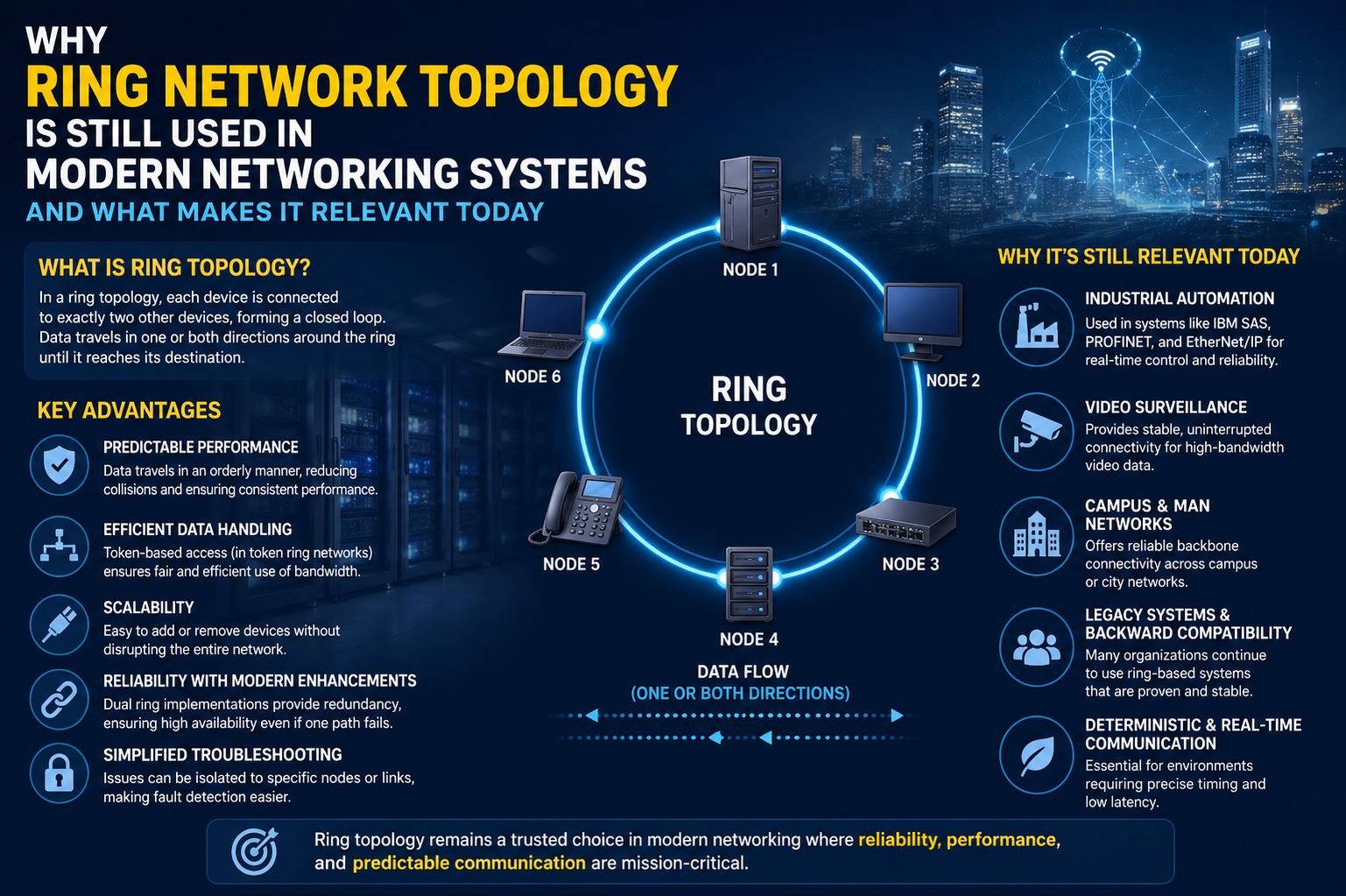
Ring network topology has evolved significantly from its early implementations, adapting to modern requirements without losing its core principles. In its traditional form, it was widely used in early local area networks, where simplicity and structured communication were primary goals. Over time, as networking demands increased, the pure ring model was refined into more advanced and resilient versions. These modern adaptations maintain the circular data flow concept while introducing improvements that address speed, reliability, and fault tolerance.
The evolution of ring topology is closely tied to the development of industrial and metropolitan communication systems. Instead of being replaced entirely by newer topologies, it has been reshaped into more efficient frameworks. This transformation highlights its flexibility and explains why it still appears in certain high-performance environments today. The ability to adapt rather than become obsolete is one of its strongest advantages in the networking landscape.
Structured Data Flow and Network Determinism
One of the most important features that keeps ring topology relevant is its structured data flow. Unlike more chaotic network designs where data can take multiple unpredictable paths, ring topology enforces a strict sequence. Each node receives data and passes it to the next node until it reaches its destination. This deterministic behavior ensures that network traffic is organized and avoids random congestion.
In modern systems where timing and synchronization are essential, this predictable flow becomes highly valuable. Applications that rely on consistent data transmission benefit from the stability of ring-based communication. Even though faster technologies exist, the reliability of a controlled transmission path ensures that data arrives in a predictable order, which is often more important than raw speed in critical systems.
Performance Stability in Controlled Environments
Ring topology is particularly effective in environments where performance stability is prioritized over maximum throughput. Industrial automation systems, monitoring networks, and certain communication backbones rely on consistent performance rather than fluctuating high speeds. In these environments, the ring structure provides a balanced load across all connected devices.
Since each node participates equally in the transmission process, no single device becomes a bottleneck. This equal participation ensures that network performance remains stable even under continuous usage. Modern implementations often enhance this by introducing token-based systems, where only the device holding the token can transmit data, further reducing the chances of congestion.
Role in Industrial and Mission-Critical Systems
In mission-critical systems, reliability is more important than flexibility. Ring topology is still used in such environments because of its ability to maintain consistent communication paths. Industrial control systems, transportation networks, and utility monitoring infrastructures often rely on this structured approach.
These systems benefit from the fact that ring topology minimizes uncertainty. Since each node has a fixed role in the communication cycle, diagnosing issues becomes easier and more systematic. If a problem occurs, administrators can quickly trace the direction of data flow and identify the affected segment of the network.
Fault Detection and Self-Healing Mechanisms
Modern ring networks are no longer limited to simple unidirectional data flow. Many advanced implementations include self-healing capabilities that allow the network to automatically adjust in case of a failure. If one connection in the ring is broken, the system can redirect data in the opposite direction, maintaining continuity.
This ability to recover from faults without manual intervention significantly improves reliability. In older versions of ring topology, a single break could disrupt the entire network. However, modern enhancements have eliminated this weakness, making ring structures far more practical for real-world applications.
The presence of fault detection mechanisms also improves maintenance efficiency. Network administrators can quickly identify where a failure has occurred, reducing downtime and improving overall system resilience.
Balanced Load Distribution Across Nodes
Another reason ring topology remains relevant is its natural ability to distribute network load evenly. Since data passes through each node in sequence, no single device is overloaded with traffic. This balanced approach helps prevent performance degradation caused by uneven data distribution.
In modern networking environments where traffic spikes can occur unpredictably, having a built-in load balancing mechanism is highly beneficial. While more complex topologies use algorithms to distribute load dynamically, ring topology achieves a simpler form of balance through its structural design.
This simplicity reduces the need for advanced configuration and makes it easier to implement in systems where resources are limited or where simplicity is preferred over complexity.
Scalability Considerations in Modern Systems
Although ring topology is not the most scalable design compared to mesh or star configurations, it still holds value in controlled scaling environments. Adding new nodes to a ring network is straightforward, but it must be done carefully to maintain the integrity of the loop.
Modern systems often use hybrid approaches where ring segments are integrated into larger networks. This allows organizations to benefit from the stability of ring topology while still expanding their infrastructure as needed. In such designs, ring structures act as reliable sub-networks within a broader system.
This controlled scalability makes ring topology suitable for environments that grow gradually and require predictable expansion rather than rapid, uncontrolled scaling.
Synchronization and Timing Efficiency
Ring topology is also relevant in systems where synchronization is critical. Because data travels in an orderly sequence, it is easier to maintain timing consistency across all connected devices. This is especially important in environments where devices must operate in coordination with each other.
For example, communication systems that require synchronized data transfer benefit from the predictable timing of ring-based networks. Each node processes data in a defined order, reducing timing discrepancies and ensuring smoother coordination.
This structured timing mechanism is difficult to achieve in more random network topologies, making ring design a preferred choice in specific technical applications.
Reduced Collision Probability in Data Transmission
One of the fundamental advantages of ring topology is its near-elimination of data collisions. Since data follows a single path and only one device transmits at a time in many implementations, the chances of two data packets interfering with each other are extremely low.
In modern networks, collision avoidance is often handled through complex protocols. However, ring topology achieves this naturally through its structure. This makes it especially useful in systems where minimizing communication errors is critical.
Even in upgraded versions where multiple transmission paths exist, collision control remains more efficient compared to less structured network designs.
Integration with Modern Networking Technologies
Ring topology has not remained static; it has been integrated with modern networking technologies to improve its performance. It is often combined with fiber optic communication systems, which significantly increase data transmission speed and reduce latency.
These integrations allow ring networks to operate in high-speed environments while maintaining their structural advantages. As a result, they are still found in backbone communication systems and metropolitan network designs.
Modern protocols also enhance ring topology by adding intelligence to data routing, allowing it to function more efficiently within complex digital ecosystems.
Energy Efficiency and Resource Optimization
Another important factor contributing to the continued relevance of ring topology is its efficient use of network resources. Because it does not require complex routing decisions or multiple redundant pathways in its basic form, it consumes less computational power compared to more complex topologies.
This simplicity translates into lower energy consumption, which is increasingly important in modern infrastructure planning. Organizations looking to reduce operational costs and improve energy efficiency often consider structured topologies like ring networks for specific segments of their systems.
Reliability Through Controlled Communication Paths
Reliability is a defining characteristic of ring topology. The controlled communication path ensures that data follows a predictable route, reducing uncertainty in transmission. This is particularly important in environments where data integrity is critical.
Even when enhanced with modern features, the core principle remains the same: data moves in a defined loop. This controlled movement allows for easier monitoring and management, making the network more dependable over time.
Continued Relevance in Hybrid Network Architectures
In modern networking design, pure topologies are rarely used in isolation. Instead, hybrid architectures dominate, combining the strengths of multiple designs. Ring topology plays an important role in these hybrid systems by providing structured communication segments within larger, more flexible networks.
These hybrid models take advantage of ring stability while incorporating the scalability of star or mesh networks. As a result, ring topology continues to contribute meaningfully to modern network architecture rather than being replaced entirely.
Advanced Fault Tolerance and Modern Redundancy Techniques
Modern ring network topology has significantly improved its ability to handle failures through advanced redundancy mechanisms. In earlier implementations, a single break in the loop could disrupt the entire communication flow, making it less reliable for critical applications. However, today’s systems often incorporate dual-ring or counter-rotating ring structures, where data can travel in both clockwise and counterclockwise directions. This design ensures that if one path becomes unavailable, the system can immediately switch to an alternate route without interrupting communication.
These redundancy techniques are especially important in environments where continuous uptime is essential. Networks that support financial transactions, transportation systems, or industrial monitoring cannot afford prolonged downtime. The improved fault tolerance of modern ring-based designs allows them to meet these strict requirements. The system’s ability to automatically detect a failure and reroute data contributes to its reputation as a dependable and resilient network structure.
Dual-Ring Architecture and Its Operational Strength
The introduction of dual-ring architecture has been a major step in modernizing ring topology. In this configuration, two separate rings operate simultaneously, often carrying data in opposite directions. This setup provides a built-in backup mechanism, ensuring that even if one ring is compromised, the second can continue handling traffic.
This design not only improves reliability but also enhances performance by distributing traffic more efficiently. During normal operation, data can be balanced between both rings, reducing congestion and improving overall throughput. In high-demand environments, this dual-path system allows networks to maintain stability even under heavy load conditions.
Use in Metropolitan and Wide-Area Networks
Ring topology continues to play an important role in metropolitan and wide-area networks, where large-scale communication infrastructure is required. In such systems, cities or regions are often connected through ring-based fiber optic layouts. This approach ensures that communication between different locations remains stable and redundant.
If a connection between two points fails, data can be rerouted in the opposite direction around the ring, maintaining connectivity across the entire network. This feature is particularly valuable in urban infrastructure, where disruptions can have widespread consequences. The structured nature of ring topology makes it suitable for managing complex geographical networks in a controlled and efficient manner.
Integration with Fiber Optic Technology
One of the most important advancements that has strengthened ring topology is its integration with fiber optic communication. Fiber optics allow for extremely high-speed data transmission with minimal signal loss, making them ideal for large-scale ring networks.
When combined with ring architecture, fiber optics create a powerful communication system capable of handling vast amounts of data while maintaining structural stability. This combination is widely used in backbone networks that connect major communication hubs. The high bandwidth capacity of fiber optics complements the deterministic nature of ring topology, resulting in a balanced and efficient system.
Improved Data Security Through Controlled Pathways
Ring topology also offers advantages in terms of data security. Because data follows a fixed path through each node, there are fewer unpredictable routing points where interception can occur. This controlled movement makes it easier to monitor and secure communication channels.
In modern implementations, additional encryption and monitoring systems are often layered on top of the ring structure, further enhancing security. This makes it suitable for environments where data integrity and confidentiality are important. While it is not a standalone security solution, its predictable structure contributes to a more manageable security framework.
Efficient Bandwidth Utilization in Structured Networks
Bandwidth efficiency is another reason ring topology continues to be relevant. Since data flows in a structured manner, network resources are utilized in a more predictable way. There is less risk of sudden congestion spikes compared to more decentralized network models.
This efficient usage of bandwidth makes ring networks particularly useful in environments where resources are limited or must be carefully managed. By ensuring that each node participates equally in data transmission, the system avoids overloading specific parts of the network.
Role in Telecommunications Infrastructure
Telecommunications systems have historically relied on ring topology and continue to use it in various forms. Modern telecom networks often incorporate ring-based designs to ensure continuous connectivity between switching centers and distribution points.
This is especially important in large-scale communication systems where service interruptions must be minimized. The ring structure provides a natural backup path, ensuring that communication can continue even if part of the infrastructure fails. This reliability is one of the main reasons it remains embedded in modern telecom architecture.
Predictability in Network Management and Troubleshooting
Network administrators often prefer systems that are easy to manage and troubleshoot. Ring topology offers this advantage because of its predictable structure. Since each node has a defined position in the network, identifying faults becomes more straightforward.
When an issue occurs, administrators can trace the direction of data flow to isolate the problem area. This reduces diagnostic time and improves maintenance efficiency. In complex systems where quick recovery is important, this structured approach provides a significant operational advantage.
Compatibility with Real-Time Systems
Ring topology is also well-suited for real-time systems where timing consistency is critical. Applications such as industrial automation, sensor networks, and process control systems require data to be delivered in a consistent and timely manner.
Because ring networks follow a controlled transmission sequence, they help maintain synchronization across connected devices. This reduces delays and ensures that system components operate in harmony. Even though newer topologies offer higher speeds, ring structures remain valuable in environments where timing accuracy is more important than maximum throughput.
Hybridization with Star and Mesh Topologies
Modern networking rarely relies on a single topology. Instead, hybrid systems combine multiple structures to achieve a balance of performance, scalability, and reliability. Ring topology is often used as a foundational element within these hybrid designs.
For example, a ring structure may connect several star-based networks, creating a layered architecture that benefits from both centralized control and distributed stability. Similarly, ring segments can be integrated into mesh networks to provide structured redundancy within a highly connected environment.
This hybridization ensures that ring topology continues to evolve and remain relevant in modern networking strategies.
Cost Efficiency in Infrastructure Deployment
Another factor contributing to the continued use of ring topology is its cost efficiency in certain scenarios. Compared to more complex network designs that require extensive cabling and hardware, ring networks can be implemented with relatively fewer resources.
This makes them attractive for organizations that need reliable communication systems without incurring excessive infrastructure costs. While they may not be the cheapest option in every case, their balance of cost and reliability makes them a practical choice for specific applications.
Scalability Limitations and Managed Expansion
Although ring topology has limitations in scalability, modern implementations have addressed this through controlled expansion strategies. Instead of rapidly adding large numbers of nodes, ring networks are often expanded in planned stages.
This controlled growth ensures that performance remains stable as the network expands. In many cases, new rings are added and interconnected rather than extending a single loop indefinitely. This modular approach allows organizations to scale their infrastructure while preserving the advantages of ring design.
Importance in Critical Infrastructure Systems
Critical infrastructure systems such as power grids, transportation signaling, and emergency communication networks often require high reliability and predictable behavior. Ring topology contributes to these requirements by providing structured and resilient communication paths.
Even a temporary disruption in such systems can have serious consequences, so redundancy and fault tolerance are essential. The ability of ring networks to maintain communication through alternate paths makes them suitable for these high-stakes environments.
Continued Technological Relevance Despite New Topologies
Despite the rise of more advanced topologies such as mesh and cloud-based architectures, ring topology has not disappeared. Instead, it has adapted and found a stable place in modern networking ecosystems.
Its continued relevance is not based on competition with newer systems but on its ability to fulfill specific roles that require predictability, structure, and reliability. This ensures that it remains a valuable part of network design strategies.
Scalability Improvements Through Modern Engineering Approaches
Ring network topology, while traditionally seen as limited in scalability, has been significantly enhanced through modern engineering approaches. Instead of relying on a single continuous loop that expands indefinitely, contemporary designs break networks into smaller, manageable ring segments. These segments are then interconnected in a hierarchical or hybrid manner. This modular approach allows organizations to expand their infrastructure without compromising performance stability.
This improvement is particularly important in environments where gradual expansion is required. Rather than redesigning the entire network when new nodes are added, engineers can integrate additional ring segments with minimal disruption. This makes ring topology more practical for growing systems that still require predictable communication patterns.
Segmented Ring Structures for Large-Scale Networks
Segmented ring structures represent a major advancement in making ring topology suitable for large-scale deployment. In these systems, multiple smaller rings operate independently but are connected through bridging nodes or distribution points. This prevents the inefficiency that would occur if too many devices were placed on a single loop.
Each segment maintains its own controlled data flow, ensuring that performance remains stable even as the overall network grows. This segmentation also improves fault isolation, meaning that issues within one ring do not necessarily affect the entire system. As a result, segmented ring structures combine scalability with reliability in a balanced way.
Enhanced Load Distribution Strategies
Modern implementations of ring topology often include enhanced load distribution mechanisms that go beyond the basic sequential data flow. While traditional ring networks pass data from one node to the next in a fixed order, advanced systems introduce intelligent scheduling and traffic prioritization.
These enhancements ensure that high-priority data is transmitted more efficiently while still maintaining the structured nature of the network. Load distribution improvements help prevent delays in time-sensitive applications, making ring topology more suitable for modern digital environments where data demands are more dynamic than in the past.
Role in Data Center Interconnectivity
Ring topology has also found relevance in modern data center interconnectivity. Large-scale data centers often require reliable communication between multiple server clusters. Ring-based connections can provide a stable backbone for these internal communications.
The structured nature of ring topology ensures that data flows consistently between clusters, reducing the likelihood of bottlenecks. Even when traffic increases significantly, the predictable routing path helps maintain stability. In combination with other advanced network designs, ring structures contribute to the overall efficiency of data center operations.
Improved Latency Management in Modern Systems
Latency management is a critical concern in modern networking environments, and ring topology addresses this through predictable transmission paths. While it may not always offer the lowest possible latency compared to direct point-to-point connections, its consistency in delivery time is a significant advantage.
In systems where variability in latency can cause operational issues, such as synchronization errors or timing mismatches, ring topology provides a stable alternative. The predictable nature of data movement ensures that latency remains within a controlled range, which is often more important than achieving the absolute minimum delay.
Application in Smart Infrastructure Systems
Smart infrastructure systems, including smart cities and automated industrial environments, often rely on structured communication networks. Ring topology is well-suited for these applications because it supports organized data exchange between interconnected devices.
In such environments, sensors, controllers, and monitoring systems must communicate in a coordinated manner. The sequential flow of data in ring networks helps maintain order and consistency across the system. This structured communication is essential for maintaining operational efficiency in complex, automated environments.
Fault Isolation and Network Recovery Efficiency
One of the most valuable features of modern ring networks is their improved ability to isolate faults. When a problem occurs in a specific segment of the network, it can often be contained without affecting the entire system. This localized fault isolation reduces downtime and simplifies troubleshooting.
Recovery mechanisms are also more efficient in modern designs. Instead of requiring manual reconfiguration, many ring systems can automatically reroute traffic or bypass faulty nodes. This self-adjusting capability enhances overall system resilience and reduces the operational burden on network administrators.
Energy Efficiency in Structured Network Operations
Energy efficiency has become an important consideration in modern network design, and ring topology offers advantages in this area. Because it relies on a structured and predictable communication path, it reduces the need for complex routing computations and excessive hardware usage.
This streamlined operation results in lower energy consumption compared to more complex topologies that require continuous recalculation of routing paths. In large-scale systems, even small improvements in energy efficiency can lead to significant cost savings over time.
Integration with Software-Defined Networking Concepts
Modern networking increasingly incorporates software-defined networking concepts, which allow centralized control of network behavior. Ring topology can be effectively integrated into such systems, where software controls the flow of data across the ring structure.
This integration enhances flexibility while preserving the structural advantages of the ring design. Administrators can dynamically adjust traffic flow, prioritize certain types of data, or reconfigure segments without physically altering the network layout. This combination of structure and software control represents a major advancement in how ring topology is used today.
Use in High-Reliability Communication Systems
High-reliability communication systems, such as emergency response networks and critical monitoring infrastructure, often require guaranteed communication continuity. Ring topology is still used in these environments because of its inherent redundancy and predictable behavior.
Even when individual components fail, the network can continue operating through alternate paths. This ensures that communication remains uninterrupted during critical situations. The reliability provided by ring-based systems makes them suitable for applications where failure is not an option.
Support for Deterministic Networking Requirements
Deterministic networking refers to systems where data transmission must follow strict timing and ordering rules. Ring topology naturally aligns with these requirements due to its sequential data flow. Each node in the network has a defined position in the communication cycle, ensuring that data is transmitted in a controlled manner.
This predictability is essential in environments such as industrial automation, robotics, and synchronized control systems. By maintaining consistent transmission timing, ring topology helps ensure that all components operate in harmony.
Adaptation for High-Speed Digital Communication
Although ring topology was originally developed for much slower network systems, it has been successfully adapted for high-speed digital communication. Advances in hardware, fiber optics, and signal processing have significantly increased its performance capabilities.
Modern ring networks can handle large volumes of data while maintaining structural integrity. This adaptation demonstrates the flexibility of ring topology and its ability to remain relevant even as technological demands evolve.
Hybrid Redundancy with Other Network Topologies
In many modern systems, ring topology is combined with other network structures to create hybrid redundancy models. These models use ring segments as backup pathways or secondary communication routes within larger, more complex architectures.
This hybrid approach ensures that if one part of the network fails, alternative pathways are available to maintain connectivity. By combining the strengths of multiple topologies, engineers can design systems that are both efficient and highly resilient.
Importance in Legacy System Integration
Many industries still rely on legacy systems that were originally built using ring topology or are compatible with it. Modern networking solutions often need to integrate with these existing infrastructures rather than replacing them entirely.
Ring topology provides a bridge between older systems and modern technologies, allowing seamless communication between different generations of network designs. This compatibility ensures that older investments in infrastructure continue to remain useful.
Role in High-Availability and Mission-Critical Environments
Ring network topology continues to hold strong relevance in high-availability systems where uninterrupted communication is essential. In environments such as emergency response coordination, financial transaction systems, and transportation control networks, even a brief disruption can cause significant operational issues. Ring topology supports these environments by providing a structured communication path with built-in redundancy.
Modern ring systems are designed to ensure that communication continues even during partial network failures. This reliability is achieved through alternative routing paths and automatic recovery mechanisms. As a result, organizations that require continuous uptime often incorporate ring-based structures as part of their broader network architecture.
Time-Sensitive Communication and Deterministic Behavior
One of the most valuable strengths of ring topology in modern systems is its deterministic behavior, especially in time-sensitive applications. In such environments, the order and timing of data delivery are just as important as the data itself. Ring topology naturally enforces a sequential flow, ensuring that each node receives and transmits data in a predictable cycle.
This predictable timing is particularly useful in systems where synchronization between devices is required. Industrial automation, robotic coordination, and sensor-based monitoring systems rely on this level of consistency. The ability to maintain structured timing without complex routing decisions gives ring topology a unique advantage in deterministic networking scenarios.
Modern Fault Recovery and Network Continuity
Fault recovery mechanisms in modern ring networks have evolved to become highly efficient and automated. Unlike earlier versions where a single break could disrupt the entire system, modern designs incorporate self-healing capabilities that allow traffic to be rerouted instantly.
This ensures that communication continues even when part of the network is compromised. The system can detect failures, isolate affected segments, and restore connectivity through alternative paths. This level of automation reduces downtime and minimizes the need for manual intervention, making ring topology more practical for modern infrastructures.
Integration with Cloud and Virtualized Environments
Ring topology has also found relevance in cloud computing and virtualized network environments. While cloud systems are highly dynamic and distributed, underlying physical infrastructure often still uses structured topologies like ring designs for internal communication pathways.
In virtualized environments, ring-based logic can be implemented at the software level to manage data flow between virtual machines and services. This allows cloud systems to benefit from the stability and predictability of ring structures while maintaining the flexibility of virtual infrastructure.
Industrial Internet of Things (IIoT) Applications
The rise of Industrial Internet of Things systems has created new opportunities for ring topology. In IIoT environments, large numbers of interconnected sensors and devices must communicate continuously and reliably.
Ring topology provides a structured method for organizing this communication. Each device participates in a controlled data exchange cycle, reducing congestion and ensuring consistent data delivery. This makes it suitable for environments such as manufacturing plants, energy distribution systems, and automated logistics networks.
Predictable Maintenance and Operational Monitoring
Another important advantage of ring topology in modern systems is its contribution to predictable maintenance and monitoring. Because the network structure is organized and sequential, it becomes easier to identify performance patterns and detect irregularities.
Network administrators can monitor the flow of data in a structured manner, allowing them to detect potential issues before they escalate into major failures. This predictive capability improves overall system reliability and reduces long-term maintenance costs.
Hybrid Network Optimization in Large Systems
Modern network design rarely relies on a single topology. Instead, ring structures are often used as part of hybrid optimization strategies. In large-scale systems, ring segments may serve as backbone communication loops connecting more flexible network layers such as star or mesh configurations.
This hybrid approach allows organizations to balance structure and flexibility. Ring topology provides stability and predictable flow, while other topologies offer scalability and dynamic routing. Together, they create optimized network environments capable of handling diverse operational requirements.
Security Enhancement Through Controlled Access Paths
Ring topology contributes indirectly to network security through its controlled access structure. Since data travels through defined paths, monitoring and controlling access becomes more straightforward. This reduces the number of unpredictable entry points within the network.
Modern implementations often enhance this with encryption and authentication mechanisms at each node. Combined with the structured flow of ring topology, this creates a more manageable and secure communication environment, particularly in sensitive applications.
Efficient Communication in Distributed Systems
Distributed systems require efficient coordination between multiple interconnected nodes. Ring topology supports this by ensuring that each node communicates in a structured sequence. This reduces communication conflicts and ensures that data exchange occurs in an organized manner.
While distributed systems often rely on complex networking models, ring-based communication still plays a role in maintaining order within specific subsystems. This makes it a useful component in large-scale distributed architectures.
Long-Term Relevance in Evolving Network Technologies
Despite rapid advancements in networking technologies, ring topology continues to maintain long-term relevance. Its ability to adapt to new environments, integrate with modern systems, and provide stable communication ensures that it remains part of contemporary network design strategies.
Rather than being replaced, it has been transformed and incorporated into more advanced frameworks. This evolution demonstrates its flexibility and continued importance in the field of networking.
Conclusion
Ring network topology remains relevant in modern networking systems because it provides a unique combination of structure, predictability, and reliability. While newer topologies offer greater flexibility and speed, ring-based designs excel in environments where controlled communication, fault tolerance, and deterministic behavior are essential.
Through modern enhancements such as dual-ring structures, self-healing mechanisms, fiber optic integration, and hybrid networking models, ring topology has evolved far beyond its original limitations. It now plays a critical role in industrial systems, telecommunications, distributed networks, and high-availability infrastructures.
Its continued use is not based on tradition but on practical value. In specific scenarios where stability, order, and reliability are more important than maximum flexibility, ring topology remains an effective and trusted solution in modern network architecture.