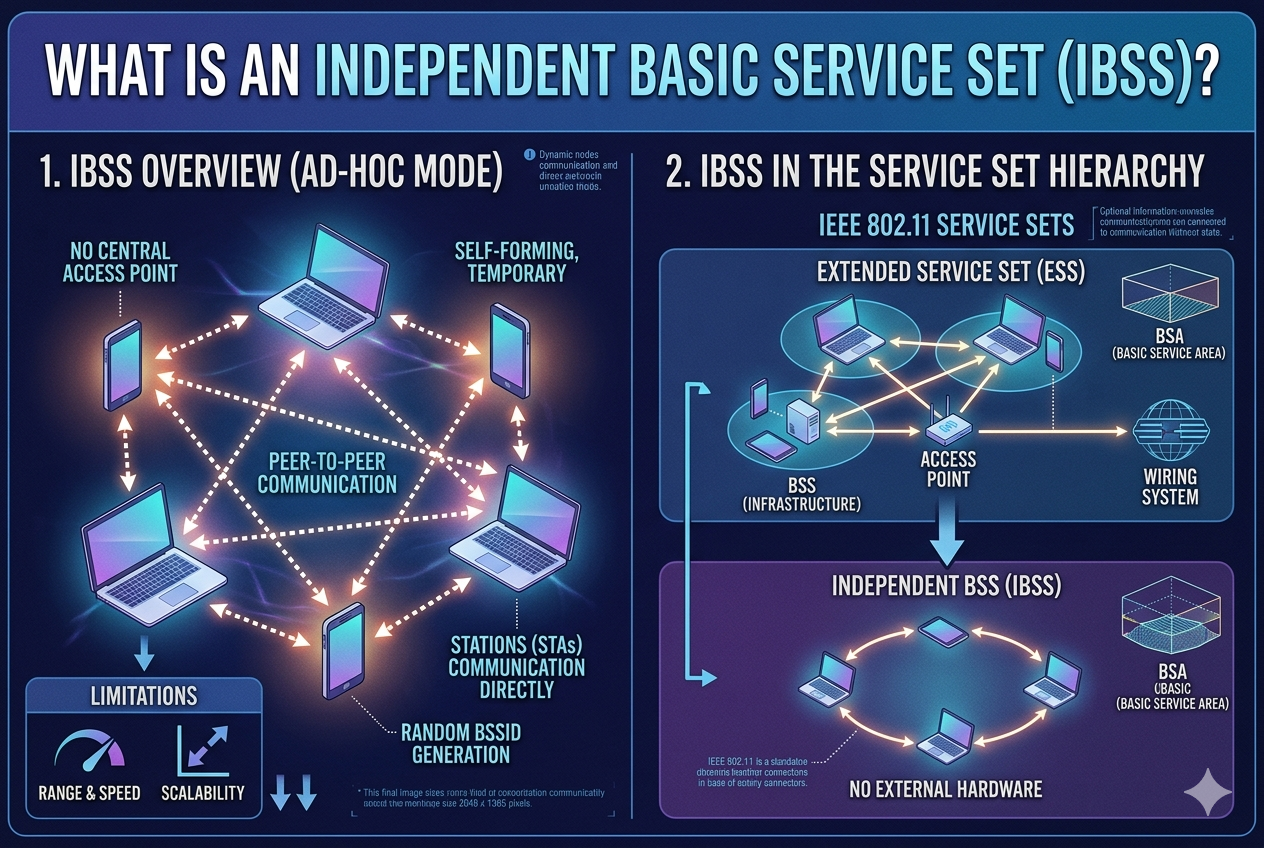
An Independent Basic Service Set (IBSS) is a wireless networking configuration defined under IEEE 802.11 standards that enables devices to communicate directly with each other without relying on any centralized infrastructure such as a wireless access point or router. It is often referred to as an ad hoc network because it is created spontaneously for a specific purpose and dissolved once that purpose is complete.
Unlike traditional wireless networks where all communication flows through a central device, IBSS operates on a peer-to-peer model. Every device in the network has equal responsibility, and each node participates in both transmitting and receiving data. This structure makes IBSS highly flexible and suitable for temporary networking scenarios where setting up infrastructure is not practical.
The concept of IBSS plays an important role in understanding how decentralized wireless communication works. It represents one of the simplest forms of wireless networking, yet it introduces several complex challenges related to coordination, timing, and efficiency.
Formation of an IBSS Network
The creation of an IBSS network begins when a device decides to initiate an ad hoc wireless connection. This device selects a network name, known as the Service Set Identifier, and chooses a wireless channel. Other devices that are within range and configured with the same SSID and channel can then join the network.
Unlike infrastructure networks where a router broadcasts its presence continuously, IBSS relies on periodic signaling between devices. If no existing network is found, a device may create a new IBSS and effectively become the first participant in that network.
Once multiple devices join, they form a decentralized group where each device maintains awareness of others. This awareness is essential for coordinating communication and avoiding data collisions. The network exists only as long as devices remain active and within range.
Communication Process in IBSS
In an IBSS network, communication is handled directly between devices using radio frequency signals. When a device wants to send data, it must first check whether the wireless medium is free. If the channel is busy, the device waits for a random backoff period before attempting transmission again.
This process is governed by the distributed coordination function, which ensures that devices take turns using the shared medium. Since there is no central controller, every device independently follows the same rules to maintain order in communication.
Data packets are transmitted directly from one device to another. If multiple devices attempt to send data simultaneously, collisions can occur, which may result in retransmission. This makes IBSS less efficient in environments with heavy traffic.
Synchronization and Timing in IBSS
One of the most important aspects of IBSS operation is synchronization. Because there is no access point to coordinate timing, devices must synchronize among themselves. This is achieved through beacon frames, which are periodically transmitted by devices in the network.
Beacon frames contain essential information about the network, including timing details and configuration parameters. Each device alternates in sending these beacons to maintain synchronization across the network.
However, synchronization in IBSS is not as precise as in infrastructure networks. Small timing differences can accumulate, leading to inconsistencies in communication. Despite this, the system is generally effective for small-scale networks.
Role of Beacon Frames
Beacon frames play a critical role in maintaining IBSS functionality. They allow devices to discover the network, stay synchronized, and maintain awareness of other participants.
Each device in an IBSS periodically broadcasts beacon frames, which include information such as the network identifier, supported data rates, and timing synchronization details. When a new device enters the network, it listens for these beacons to align itself with the existing network structure.
If beacon frames are not received for a certain period, devices may assume that the network has disappeared and may attempt to form a new IBSS or search for another network.
Challenges in IBSS Networks
One of the major challenges in IBSS networks is the hidden node problem. This occurs when two devices are within range of a third device but not within range of each other. As a result, they may transmit data simultaneously, causing collisions.
Since there is no centralized control to manage communication, resolving such issues becomes more complex. Devices rely on basic coordination mechanisms, but these are not always sufficient in dense network environments.
Another challenge is limited scalability. As more devices join the network, the probability of collisions increases, and overall performance begins to degrade. This makes IBSS unsuitable for large-scale deployments.
Power management is also more difficult in IBSS networks. Since devices must actively participate in communication and synchronization, energy consumption can be higher compared to infrastructure-based networks.
Security in IBSS Environments
Security in IBSS networks is inherently weaker due to the absence of centralized authentication and management. Each device is responsible for implementing its own security measures, which can lead to inconsistencies.
Encryption protocols may still be used, but enforcing uniform security policies across all devices is challenging. This makes IBSS more vulnerable to unauthorized access or interception, especially in open environments.
Because of these limitations, IBSS is typically used in controlled or temporary scenarios where security risks are minimal.
Performance Considerations
The performance of an IBSS network depends heavily on the number of devices, signal strength, and environmental conditions. In small networks with few devices, performance can be quite efficient. However, as the network grows, performance tends to degrade.
Bandwidth is shared equally among all devices, which means that increased traffic can lead to congestion. Additionally, the lack of centralized scheduling can result in uneven communication patterns.
Interference from other wireless networks can also affect performance, especially since IBSS devices often operate on common frequency channels.
IBSS in Comparison with Other Wireless Models
IBSS differs significantly from infrastructure-based wireless networks. In infrastructure mode, an access point manages all communication, providing better control, stability, and scalability. In contrast, IBSS distributes responsibility among all devices.
Another emerging model is mesh networking, which is sometimes confused with IBSS. While both are decentralized, mesh networks include routing capabilities that allow data to travel across multiple hops. IBSS, on the other hand, typically relies on direct single-hop communication between devices.
This limitation makes IBSS simpler but less capable in complex networking scenarios.
Real-World Applications of IBSS
IBSS networks are widely used in temporary and emergency communication scenarios. In disaster situations where infrastructure is damaged, IBSS allows rescue teams to establish immediate communication channels.
They are also useful in business environments for quick file sharing or collaborative work during meetings where network access is restricted or unavailable.
In educational settings, IBSS enables students to form quick peer-to-peer networks for group assignments or presentations.
Gaming is another area where IBSS has been used historically, allowing players to connect directly without internet access.
Advantages of IBSS
One of the main advantages of IBSS is its simplicity. It requires no additional hardware beyond standard wireless devices, making it easy to deploy.
It is also highly flexible, allowing devices to join or leave the network at any time without complex configuration. This makes it ideal for dynamic environments.
IBSS networks can be created quickly, often within seconds, making them highly suitable for urgent communication needs.
Cost efficiency is another advantage, as no routers or access points are required.
Limitations of IBSS
Despite its advantages, IBSS has several limitations. It is not suitable for large networks due to performance degradation as the number of devices increases.
Range is limited because all devices must be within direct communication distance.
Security is weaker compared to structured networks, making it unsuitable for sensitive data transmission.
Network management becomes increasingly complex as more devices are added.
These limitations restrict IBSS to small-scale, temporary use cases.
Troubleshooting IBSS Networks
Common issues in IBSS networks include connection failures, synchronization problems, and data collisions. These issues are often caused by misconfigured settings such as mismatched SSIDs or channels.
Signal interference can also disrupt communication, especially in environments with multiple wireless networks.
Restarting devices, ensuring consistent configuration, and reducing the number of active devices can help improve stability.
Future Relevance of IBSS
While IBSS is not as commonly used today due to the dominance of infrastructure and mesh networks, it still holds relevance in specific scenarios. Its simplicity and independence from infrastructure make it valuable for emergency communication and temporary setups.
As wireless technology continues to evolve, IBSS remains an important foundational concept for understanding decentralized networking principles.
Conclusion
The Independent Basic Service Set represents one of the simplest forms of wireless networking, where devices communicate directly without centralized control. It is based on a peer-to-peer architecture that allows rapid and flexible network formation.
Although it offers advantages such as simplicity, flexibility, and cost efficiency, it also comes with limitations in scalability, performance, and security. These trade-offs make it suitable primarily for small, temporary, or emergency use cases.
Understanding IBSS provides valuable insight into how wireless devices can coordinate without infrastructure and highlights the fundamental principles behind decentralized communication systems.