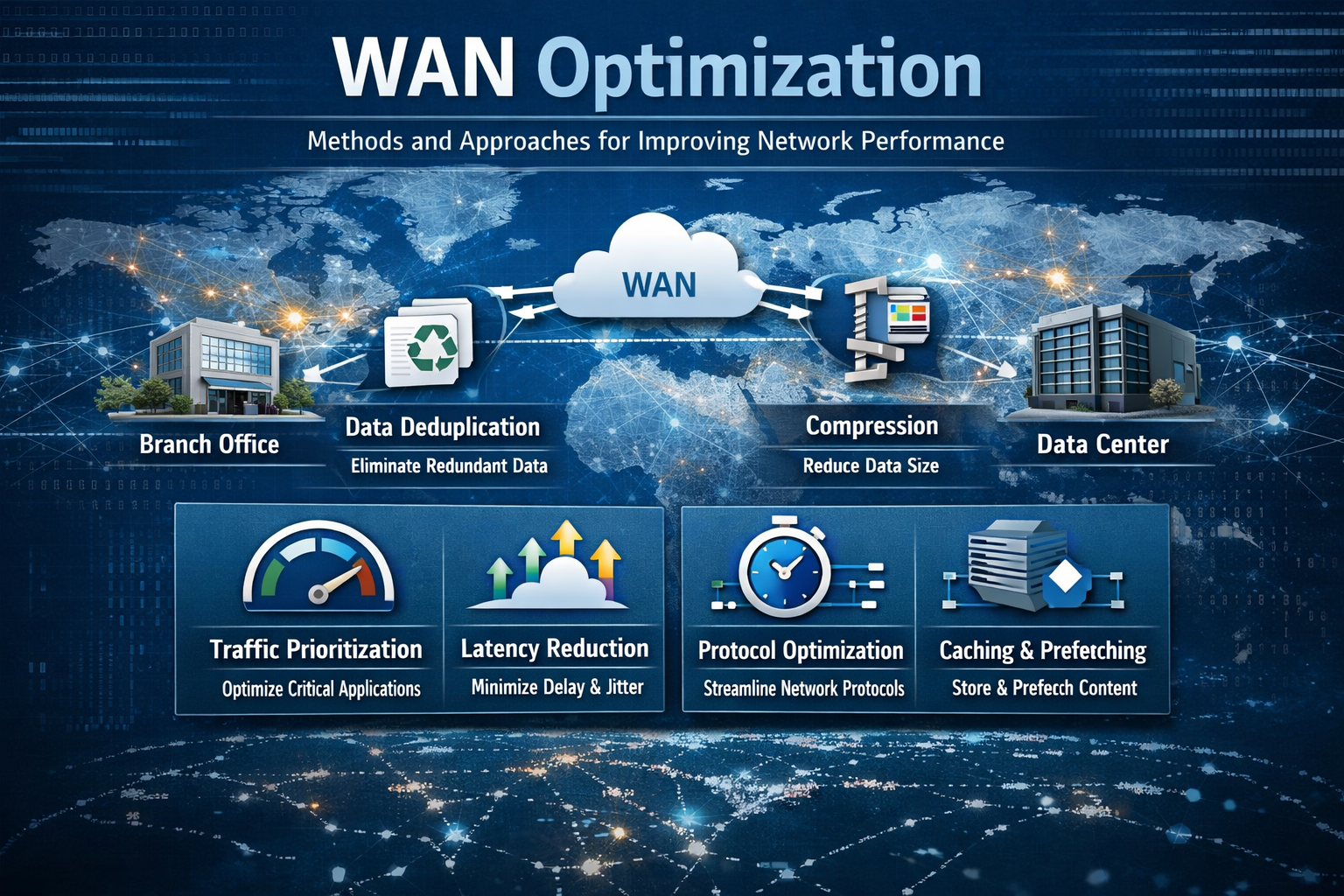
WAN optimization is a collection of advanced techniques used to improve the performance, reliability, and efficiency of data transmission across wide area networks. These networks connect different branches, offices, and data centers that may be located far apart geographically. As modern businesses increasingly depend on cloud services, real-time collaboration tools, and centralized applications, the demand for smooth and fast WAN performance has become critical. Without optimization, users often experience delays, slow application response, and inefficient use of network resources, which can negatively impact productivity and business operations.
Understanding the Need for WAN Optimization
The growing complexity of enterprise networks has made WAN optimization more important than ever. Traditional WAN connections were not designed to handle today’s high-volume, latency-sensitive applications. As organizations expand globally, data must travel longer distances, which naturally introduces delays. In addition, the rise of cloud computing and SaaS applications has shifted traffic patterns, making networks more congested and harder to manage. WAN optimization addresses these challenges by improving how data is transmitted, reducing unnecessary traffic, and ensuring that critical applications perform efficiently even under heavy load.
Another important reason for WAN optimization is the cost of bandwidth. Increasing bandwidth alone is not always a practical solution, especially for large enterprises operating across multiple regions. Optimization techniques allow organizations to make better use of existing bandwidth rather than constantly upgrading infrastructure. This results in cost savings while still improving performance.
Data Compression Techniques in WAN Optimization
Data compression is one of the foundational techniques used in WAN optimization. It works by reducing the size of data before it is transmitted across the network. When data is compressed, fewer bits are required to represent the same information, which leads to faster transmission and reduced bandwidth usage. Once the data reaches its destination, it is decompressed and restored to its original form.
This process is especially useful for transferring large files, backups, and repetitive data streams. Compression algorithms can be applied in real time, allowing continuous data flow without significant delays. By minimizing the amount of data traveling across the WAN, compression significantly enhances network efficiency and reduces congestion during peak usage periods.
Data Deduplication and Redundancy Elimination
Data deduplication is another powerful method used to optimize WAN performance. In many networks, the same data is transmitted repeatedly between locations. Deduplication eliminates this redundancy by identifying duplicate data segments and sending only unique information across the network.
Instead of transmitting identical files or repeated data blocks multiple times, the system sends a reference or pointer to previously sent data. This reduces the overall data volume significantly, especially in environments where backups, file sharing, and replication are frequent. Over time, deduplication can lead to substantial bandwidth savings and improved transmission speed.
Caching Mechanisms for Faster Data Access
Caching plays a vital role in reducing latency and improving user experience in WAN environments. It involves storing frequently accessed data closer to the end user so that future requests can be served quickly without retrieving the data from a distant server.
When users access commonly used applications or files, the data is delivered from the local cache instead of traveling across the entire network. This reduces response time and minimizes the load on the central server. Caching is particularly effective for web content, multimedia files, and software updates that are accessed repeatedly by multiple users.
By reducing repeated data transfers, caching not only improves performance but also helps in conserving bandwidth for more critical operations.
Traffic Prioritization and Quality of Service
Traffic prioritization ensures that important applications receive the necessary bandwidth and network resources they require to function effectively. In a shared network environment, not all data has the same level of importance. For example, real-time applications such as video conferencing, VoIP calls, and cloud-based collaboration tools require low latency and consistent performance.
Quality of Service mechanisms are used to classify and manage different types of traffic based on priority levels. High-priority traffic is given preference over less critical data, ensuring that essential services remain unaffected even during periods of high network congestion. This approach helps maintain stability and prevents performance degradation for mission-critical applications.
Latency Reduction Techniques
Latency refers to the delay experienced when data travels from one point to another across a network. In WAN environments, latency is often unavoidable due to physical distance and multiple network hops. However, optimization techniques can significantly reduce its impact.
One approach involves streamlining communication protocols to reduce unnecessary exchanges between devices. Another technique includes data prefetching, where required data is anticipated and loaded in advance. Additionally, accelerating packet delivery through optimized routing paths helps reduce travel time across the network.
By minimizing delays, WAN optimization ensures smoother application performance and better user experience, especially for real-time services.
Protocol Optimization and Efficiency Improvements
Network protocols are essential for communication between devices, but many traditional protocols were not designed for high-latency WAN environments. Protocol optimization focuses on improving these communication methods to reduce overhead and enhance efficiency.
This can involve reducing the number of round trips required for data exchange, minimizing acknowledgment traffic, and improving session handling. By optimizing how protocols behave over long distances, organizations can significantly improve throughput and reduce delays.
Efficient protocol handling is particularly important for applications that require continuous communication between clients and servers, such as enterprise software systems and cloud platforms.
Bandwidth Management Strategies
Bandwidth management is a critical component of WAN optimization. It involves controlling and allocating network resources to ensure fair and efficient usage among all applications and users. Without proper management, certain applications can consume excessive bandwidth, leading to congestion and performance issues.
By monitoring traffic patterns and adjusting bandwidth allocation dynamically, organizations can maintain balanced network performance. This ensures that no single application dominates the network and that all users receive consistent service quality.
Bandwidth management also helps in predicting usage trends and planning for future network expansion more effectively.
Load Balancing for Network Stability
Load balancing distributes network traffic across multiple paths, servers, or connections to avoid overloading any single resource. This improves reliability and ensures continuous availability of services.
In WAN environments, load balancing is especially useful when multiple data routes are available between locations. By intelligently distributing traffic, the system prevents bottlenecks and enhances overall performance. If one path becomes congested or fails, traffic can be automatically rerouted through alternative paths without disrupting service.
This approach improves fault tolerance and ensures that network performance remains stable even under varying conditions.
Security Integration in WAN Optimization
While improving performance is the primary goal of WAN optimization, security remains equally important. Data traveling across wide area networks is often exposed to various risks, including interception and unauthorized access.
To address this, WAN optimization techniques often include encryption and secure tunneling methods. These ensure that data remains protected while being transmitted across public or shared networks. Security integration allows organizations to maintain confidentiality and integrity of their data without compromising performance.
Balancing security and optimization is essential for maintaining a robust and trustworthy network infrastructure.
Role of WAN Optimization in Cloud Environments
With the increasing adoption of cloud computing, WAN optimization has become even more relevant. Cloud-based applications require constant communication between users and remote servers, which can introduce latency issues if not properly managed.
Optimization techniques help improve connectivity to cloud services by reducing delays, improving data transfer efficiency, and ensuring smoother access to applications hosted in remote data centers. This is particularly important for organizations that rely heavily on SaaS platforms and hybrid cloud environments.
By enhancing cloud performance, WAN optimization supports modern digital transformation initiatives and enables seamless remote operations.
Future Trends in WAN Optimization
As technology continues to evolve, WAN optimization is also advancing. The integration of artificial intelligence and machine learning is enabling smarter traffic management and predictive optimization. These technologies can analyze network patterns in real time and make automatic adjustments to improve performance.
Software-defined networking is another emerging trend that is transforming WAN optimization. It allows centralized control of network traffic and more flexible resource allocation. This makes it easier for organizations to adapt to changing demands and scale their networks efficiently.
The future of WAN optimization is expected to focus on greater automation, improved adaptability, and deeper integration with cloud and edge computing environments.
Advanced Acceleration Techniques in WAN Optimization
Advanced acceleration techniques are designed to improve the speed and responsiveness of data transmission across wide area networks. These methods focus on reducing the impact of distance-related delays and improving the efficiency of communication between remote sites. By optimizing how data is packaged, transmitted, and received, acceleration techniques help applications behave as if they are operating on a local network rather than across geographically separated locations.
One common approach is transport streamlining, where the number of network round trips required for data exchange is reduced. Traditional communication protocols often require multiple acknowledgments before completing a transaction, which increases latency. Acceleration techniques minimize these exchanges and allow more data to flow with fewer interruptions. This leads to faster application response times and improved user experience.
Another aspect of acceleration involves optimizing how data packets are handled in transit. By reducing packet fragmentation and improving reassembly processes, networks can transmit information more efficiently. This is especially useful for applications that rely on continuous data streams such as multimedia services, real-time analytics, and enterprise communication tools.
Application-Level Optimization Strategies
Application-level optimization focuses on improving the performance of specific software applications running over WAN connections. Different applications behave differently on networks, and not all of them are equally sensitive to latency or bandwidth limitations. Optimization at this level ensures that each application receives the appropriate treatment based on its requirements.
For example, enterprise resource planning systems often involve frequent database queries and updates. WAN optimization techniques can reduce the number of database calls or combine multiple requests into a single transaction, significantly reducing network overhead. Similarly, file-sharing applications can be optimized to transfer only modified portions of files instead of sending entire datasets repeatedly.
Another important aspect is improving the way applications interact with remote servers. By reducing chatty communication patterns and optimizing session handling, application-level techniques help minimize unnecessary traffic. This results in faster execution and more efficient use of network resources.
Network Path Optimization and Routing Efficiency
Network path optimization involves selecting the most efficient route for data to travel across a WAN. In complex network environments, there are often multiple paths available between two points. However, not all paths provide the same level of performance. Some may have higher latency, congestion, or packet loss.
Optimization systems continuously monitor network conditions and dynamically choose the best available path for data transmission. This ensures that traffic is routed through the least congested and most reliable connections. In some cases, data may be split across multiple paths to maximize throughput and improve resilience.
Routing efficiency also includes minimizing unnecessary hops between network nodes. Fewer hops mean reduced latency and faster delivery of data. By optimizing routing decisions in real time, WAN systems can significantly enhance performance and reliability.
TCP Optimization and Protocol Enhancements
Transmission Control Protocol plays a central role in most network communications, but it was originally designed for reliable delivery rather than high-speed long-distance performance. WAN optimization introduces enhancements to improve TCP behavior over wide area networks.
One key improvement is window scaling, which allows more data to be sent before requiring an acknowledgment. This increases throughput and reduces delays caused by frequent confirmation messages. Another enhancement involves selective acknowledgments, which ensure that only missing data segments are retransmitted instead of resending entire sequences.
TCP acceleration techniques also help reduce connection setup times and improve session persistence. By maintaining optimized connections between endpoints, networks can avoid repetitive handshakes and improve overall efficiency.
Bandwidth Reservation and Traffic Shaping
Bandwidth reservation ensures that critical applications always have access to a guaranteed portion of network resources. This is particularly important in environments where multiple applications compete for limited bandwidth. By reserving capacity for essential services, organizations can prevent performance degradation during peak usage periods.
Traffic shaping complements this approach by controlling the flow of data based on predefined policies. It regulates how much bandwidth each application or user can consume over a given period. This prevents network congestion and ensures fair distribution of resources.
Together, these techniques help maintain consistent performance and avoid sudden spikes in traffic that could disrupt network stability.
Edge Optimization and Distributed Processing
Edge optimization involves processing data closer to its source rather than relying entirely on centralized data centers. This reduces the distance data must travel and significantly lowers latency. By distributing computing tasks across edge locations, organizations can achieve faster response times and improved efficiency.
In WAN environments, edge devices can perform functions such as data filtering, compression, and caching. This reduces the amount of traffic sent over the network backbone and improves overall performance. Edge optimization is particularly useful for IoT systems, remote offices, and applications requiring real-time decision-making.
Distributed processing also enhances scalability, allowing networks to handle increasing workloads without major infrastructure changes.
Packet Loss Reduction and Error Handling
Packet loss occurs when data packets fail to reach their destination, often due to congestion or network instability. WAN optimization techniques aim to minimize packet loss and improve data reliability.
One method involves improving error detection and correction mechanisms. By identifying lost or corrupted packets quickly, the system can retransmit only the affected data instead of the entire stream. This reduces unnecessary retransmissions and improves efficiency.
Another approach is buffering, where data is temporarily stored during transmission to prevent loss during network fluctuations. This ensures smoother delivery even in unstable network conditions.
Monitoring and Performance Analytics
Continuous monitoring is essential for effective WAN optimization. By analyzing network performance in real time, organizations can identify bottlenecks, detect anomalies, and make informed optimization decisions.
Performance analytics tools collect data on bandwidth usage, latency, packet loss, and application behavior. This information helps network administrators understand how resources are being utilized and where improvements are needed. Over time, this leads to more efficient network planning and better optimization strategies.
Monitoring also supports predictive analysis, allowing potential issues to be identified before they impact performance. This proactive approach improves reliability and reduces downtime.
Scalability Considerations in WAN Optimization
As organizations grow, their network requirements also expand. WAN optimization must be scalable to accommodate increasing data volumes and additional users. Scalable optimization systems can adapt to changing workloads without requiring major infrastructure overhauls.
Scalability is achieved through modular design, allowing new optimization components to be added as needed. Cloud-based optimization solutions also support scalability by providing flexible resource allocation based on demand.
This ensures that network performance remains consistent even as organizational needs evolve over time.
Impact of Virtualization on WAN Optimization
Virtualization has significantly changed how networks operate by enabling multiple virtual environments to run on a single physical infrastructure. WAN optimization plays a key role in supporting virtualized environments by improving communication between virtual machines and remote data centers.
Virtualization increases network complexity, as multiple virtual instances often share the same physical resources. Optimization techniques help manage this complexity by prioritizing traffic, reducing overhead, and improving data flow efficiency.
This leads to better resource utilization and improved performance for virtualized applications.
Energy Efficiency in WAN Optimization
Modern WAN optimization also considers energy efficiency as an important factor. Efficient data transmission reduces the amount of processing and network activity required, which in turn lowers energy consumption.
By minimizing redundant data transfers and optimizing routing paths, organizations can reduce the overall energy footprint of their network infrastructure. This is especially important for large-scale data centers and enterprise environments aiming to improve sustainability.
Energy-efficient optimization not only reduces operational costs but also supports environmentally responsible computing practices.
Role of Cloud Integration in WAN Optimization
Cloud integration has become a central factor in modern WAN optimization as organizations increasingly rely on cloud-based services for storage, computing, and application delivery. The main challenge in cloud environments is maintaining consistent performance when data must travel between on-premises systems and remote cloud servers. WAN optimization helps bridge this gap by improving data transfer efficiency and reducing latency in hybrid and multi-cloud architectures.
By using techniques such as intelligent routing, caching, and data compression, WAN optimization ensures smoother interaction with cloud platforms. It reduces delays in accessing cloud-hosted applications and improves synchronization between distributed systems. This is particularly important for businesses that depend on real-time data access, collaboration tools, and large-scale cloud storage systems.
Cloud-aware optimization solutions also dynamically adjust to changing network conditions. They can identify the nearest cloud region or most efficient access point to reduce travel distance for data. This leads to faster response times and more reliable application performance across global networks.
Impact of Virtual Private Networks on WAN Performance
Virtual Private Networks are commonly used to secure communication over wide area networks, but they can introduce additional overhead that affects performance. WAN optimization helps mitigate these challenges by streamlining encrypted traffic and reducing the performance impact of secure tunnels.
Encryption processes in VPNs add extra data processing requirements, which can increase latency. Optimization techniques address this by improving packet handling efficiency and reducing redundant encryption operations where possible. This ensures that security does not significantly compromise speed.
In enterprise environments, WAN optimization works alongside VPNs to maintain both performance and confidentiality. This balance is essential for organizations that handle sensitive data while still requiring fast and reliable connectivity between remote locations.
Real-Time Application Optimization
Real-time applications such as voice communication, video conferencing, and live collaboration tools require extremely low latency and stable connections. WAN optimization plays a critical role in ensuring these applications function smoothly across long distances.
One of the main strategies used is jitter reduction, which stabilizes variations in packet arrival times. This is important for maintaining clear audio and video quality during real-time communication. Another technique is packet prioritization, where real-time data is given higher priority over less time-sensitive traffic.
Additionally, optimization systems reduce buffering delays and improve synchronization between data streams. This ensures that users experience minimal lag and uninterrupted communication, even when network conditions fluctuate.
Artificial Intelligence in WAN Optimization
Artificial intelligence is increasingly being integrated into WAN optimization systems to improve decision-making and automation. AI-based systems can analyze large volumes of network data in real time and identify patterns that are not easily detectable through traditional monitoring methods.
By learning from historical traffic behavior, AI can predict congestion points and automatically adjust routing or bandwidth allocation to prevent performance issues. This proactive approach reduces downtime and improves overall network efficiency.
Machine learning models also help in anomaly detection, identifying unusual traffic patterns that may indicate faults or security threats. This allows network administrators to respond quickly before issues escalate into major disruptions.
Automation and Self-Optimizing Networks
Automation is a key advancement in WAN optimization, enabling networks to adjust themselves without manual intervention. Self-optimizing networks continuously monitor performance metrics and automatically apply optimization techniques based on current conditions.
For example, if network congestion is detected, the system can reroute traffic, adjust bandwidth allocation, or activate caching mechanisms without requiring human input. This improves response time and reduces the workload on network administrators.
Automation also ensures consistent performance across distributed environments, especially in large organizations with multiple branches and complex infrastructure setups. It enhances reliability while reducing operational complexity.
Impact of Internet of Things on WAN Optimization
The Internet of Things has introduced a massive increase in connected devices generating continuous data streams. These devices often operate in real time and require efficient network communication to function effectively.
WAN optimization helps manage IoT traffic by reducing unnecessary data transmissions and prioritizing critical sensor information. Since IoT devices often send small but frequent data packets, optimization techniques ensure that network resources are not overwhelmed.
Edge processing is particularly important in IoT environments, as it allows data to be analyzed closer to the source before being transmitted over the WAN. This reduces bandwidth usage and improves response times for time-sensitive applications.
Latency-Sensitive Industry Applications
Certain industries depend heavily on low-latency WAN performance. For example, financial services require real-time transaction processing, while healthcare systems rely on fast access to patient data across locations. In such environments, even minor delays can have significant consequences.
WAN optimization ensures that critical applications receive the necessary network priority and performance consistency. Techniques such as traffic prioritization, protocol acceleration, and path optimization are essential in maintaining service quality in these high-demand sectors.
Manufacturing and logistics industries also benefit from optimized WAN performance, as they depend on real-time tracking, automation systems, and distributed coordination between facilities.
Disaster Recovery and Data Replication Efficiency
Disaster recovery systems rely on continuous data replication between primary and backup locations. However, transferring large volumes of data across WAN links can be resource-intensive. WAN optimization improves this process by reducing replication time and bandwidth usage.
Techniques such as incremental data transfer ensure that only changed data is replicated instead of entire datasets. This significantly reduces network load and speeds up recovery processes.
Efficient replication ensures that backup systems remain up to date and ready to take over in case of system failure, improving overall business continuity.
Mobile Workforce and Remote Connectivity Optimization
The rise of remote work has increased the importance of WAN optimization for mobile and distributed users. Employees accessing corporate systems from various locations often experience inconsistent network conditions.
Optimization techniques help improve remote connectivity by reducing latency and enhancing application responsiveness. Caching, compression, and traffic prioritization ensure that remote users receive consistent performance regardless of their location.
This improves productivity and ensures that remote work environments function smoothly without network-related interruptions.
Future Developments in WAN Optimization Technologies
The future of WAN optimization is expected to be driven by deeper integration with cloud-native architectures, artificial intelligence, and edge computing. Networks will become increasingly adaptive, capable of automatically adjusting to changing workloads and application demands.
Software-defined WAN technologies will continue to evolve, offering greater flexibility and centralized control over distributed networks. These systems will allow organizations to manage global infrastructure more efficiently and respond quickly to performance challenges.
As data volumes continue to grow, WAN optimization will play an even more important role in ensuring that networks remain fast, secure, and scalable in an increasingly connected world.
Security-Aware WAN Optimization Techniques
Modern WAN optimization is no longer focused only on speed and efficiency; it must also ensure strong security across data transmission paths. As organizations expand their digital infrastructure, sensitive information is constantly exchanged between branches, cloud platforms, and remote users. This makes secure optimization a critical requirement.
Security-aware optimization techniques ensure that data remains protected while still being efficiently transmitted. Encryption is applied to safeguard information, but optimization systems are designed to handle encrypted traffic in a way that minimizes performance loss. Instead of decrypting and re-encrypting data unnecessarily, intelligent handling mechanisms are used to preserve both security and speed.
Firewalls, intrusion detection systems, and secure tunneling methods are often integrated into WAN optimization frameworks. These tools work together to prevent unauthorized access while maintaining smooth data flow. The challenge lies in balancing strict security enforcement with high-performance networking, and modern optimization solutions are designed specifically to achieve this balance.
Impact of Big Data on WAN Optimization
The rise of big data has dramatically increased the volume, variety, and velocity of information being transmitted across networks. Organizations now process massive datasets for analytics, forecasting, and decision-making. This creates significant pressure on WAN infrastructure, making optimization essential for efficient data handling.
WAN optimization techniques help reduce the strain caused by large-scale data transfers by minimizing redundancy and improving transfer efficiency. Compression and deduplication are especially valuable in big data environments, where repeated patterns and large datasets are common.
Data staging is another important concept, where information is temporarily stored and processed closer to its source before being transmitted across the WAN. This reduces unnecessary long-distance data movement and improves processing speed.
Optimization in Hybrid Network Environments
Many organizations operate in hybrid network environments that combine private data centers with public cloud services. These environments introduce complexity because data must move seamlessly between different infrastructures.
WAN optimization ensures smooth communication between these systems by standardizing data flow and improving compatibility between different network types. Intelligent routing mechanisms help determine the best path for data depending on whether it is moving to a cloud platform or an internal server.
Hybrid environments also benefit from centralized management tools that monitor performance across all connected systems. This allows administrators to maintain consistent optimization policies regardless of where the data is stored or processed.
Role of Machine Learning in Predictive Optimization
Machine learning is playing an increasingly important role in predictive WAN optimization. Instead of reacting to network problems after they occur, machine learning models analyze historical and real-time data to predict potential issues in advance.
These systems can identify traffic patterns, detect early signs of congestion, and recommend or automatically apply corrective actions. For example, if a specific network route consistently experiences high latency during certain hours, the system can proactively reroute traffic before performance is affected.
Predictive optimization improves network stability and reduces downtime by ensuring that issues are addressed before they impact users. Over time, machine learning models become more accurate as they continue to learn from network behavior.
Multi-Site Enterprise Connectivity Optimization
Large enterprises often operate across multiple geographical locations, requiring efficient communication between various offices, branches, and data centers. WAN optimization ensures that these multi-site environments remain connected with minimal delays and maximum efficiency.
One of the key challenges in multi-site networks is maintaining consistent performance across all locations. Differences in distance, bandwidth availability, and local infrastructure can affect communication quality. Optimization techniques help standardize performance by balancing traffic and improving data transfer efficiency across all sites.
Centralized policy management ensures that all branches follow the same optimization rules, while local optimization appliances handle real-time data processing at each site. This combination improves scalability and operational consistency.
Reducing Bandwidth Bottlenecks in Enterprise Networks
Bandwidth bottlenecks occur when network demand exceeds available capacity, leading to slow performance and congestion. WAN optimization addresses this issue by making more efficient use of existing bandwidth rather than simply increasing capacity.
Techniques such as traffic shaping, compression, and caching reduce the amount of data that needs to travel across the network. By eliminating unnecessary traffic and optimizing data flow, networks can support more users and applications without performance degradation.
In addition, intelligent monitoring systems identify bottleneck points and suggest improvements to network design or configuration. This proactive approach helps organizations maintain stable performance even during peak usage periods.
Role of Content Delivery Optimization
Content delivery optimization focuses on improving how digital content such as files, applications, and media is distributed across WAN environments. Instead of retrieving data repeatedly from central servers, optimized systems deliver content from the nearest available location.
This reduces latency and improves user experience, especially for organizations with global operations. Frequently accessed content is cached and distributed strategically to minimize retrieval time.
Content optimization also ensures that updates and large file transfers are handled efficiently, preventing unnecessary strain on the network backbone.
Improving Collaboration Tools Over WAN
Modern organizations rely heavily on collaboration tools such as shared workspaces, messaging platforms, and video conferencing systems. These applications require stable and responsive network performance to function effectively.
WAN optimization enhances collaboration tools by reducing latency, improving synchronization, and prioritizing real-time communication traffic. This ensures that users can interact smoothly without delays or interruptions.
File sharing within collaboration platforms is also optimized to avoid repeated data transfers, making teamwork more efficient across distributed teams.
Enhancing User Experience Through WAN Optimization
User experience is one of the most important outcomes of effective WAN optimization. Slow applications, delayed responses, and network interruptions can significantly reduce productivity and user satisfaction.
By improving data delivery speed, reducing latency, and ensuring consistent performance, WAN optimization directly enhances the experience of end users. Applications feel faster and more responsive, even when accessed over long distances.
Consistent performance across different locations ensures that all users, regardless of geography, receive the same level of service quality.
Sustainability and Resource Efficiency in WAN Systems
Sustainability is becoming an increasingly important consideration in network design and optimization. Efficient WAN systems consume fewer resources and reduce energy usage by minimizing unnecessary data transmission and processing.
By optimizing traffic flow and reducing redundant operations, organizations can lower the overall energy demand of their network infrastructure. This contributes to cost savings as well as environmental sustainability goals.
Efficient resource utilization also extends the lifespan of network hardware by reducing operational stress and workload.
Evolution Toward Autonomous WAN Networks
The future of WAN optimization is moving toward fully autonomous networks that can manage and optimize themselves without human intervention. These systems will rely heavily on artificial intelligence, machine learning, and real-time analytics.
Autonomous networks will be capable of detecting issues, adjusting configurations, and optimizing performance continuously. This will significantly reduce the need for manual network management while improving reliability and efficiency.
As networks become more complex, autonomy will play a key role in ensuring scalability and consistent performance across global infrastructures.
Final Perspective on WAN Optimization Growth
WAN optimization continues to evolve in response to increasing data demands, cloud adoption, and global connectivity requirements. It is no longer just a performance enhancement tool but a critical component of modern digital infrastructure.
With advancements in AI, edge computing, and automation, WAN optimization is becoming more intelligent and adaptive. These improvements are enabling organizations to handle larger workloads, support remote operations, and maintain high-quality user experiences across distributed environments.
The continuous evolution of optimization technologies ensures that WAN systems will remain efficient, scalable, and reliable in the future digital landscape.
Conclusion
WAN optimization plays a crucial role in modern network environments where organizations depend heavily on fast, reliable, and secure communication across geographically distributed systems. As data volumes continue to grow and applications become more complex, the need for efficient wide area network performance becomes increasingly important.
Through techniques such as compression, caching, deduplication, traffic prioritization, and protocol optimization, WAN optimization significantly improves data transfer efficiency while reducing latency and bandwidth consumption. These methods ensure that critical applications perform smoothly even under heavy network load and across long distances.
The integration of advanced technologies such as artificial intelligence, automation, cloud computing, and edge processing has further strengthened WAN optimization capabilities. Networks are now becoming more intelligent and adaptive, capable of predicting issues, adjusting traffic flow, and maintaining consistent performance without constant manual intervention.
WAN optimization also supports modern business requirements such as remote work, real-time collaboration, hybrid cloud environments, and global connectivity. It ensures that users experience stable and responsive applications regardless of their location, which directly contributes to productivity and operational efficiency.
In addition, security and sustainability have become essential aspects of WAN optimization. Secure data handling ensures that performance improvements do not compromise data protection, while efficient resource utilization helps reduce energy consumption and operational costs.
Overall, WAN optimization is not just a technical enhancement but a fundamental requirement for modern digital infrastructure. It enables organizations to build scalable, efficient, and high-performing networks that can adapt to future technological advancements and growing connectivity demands.