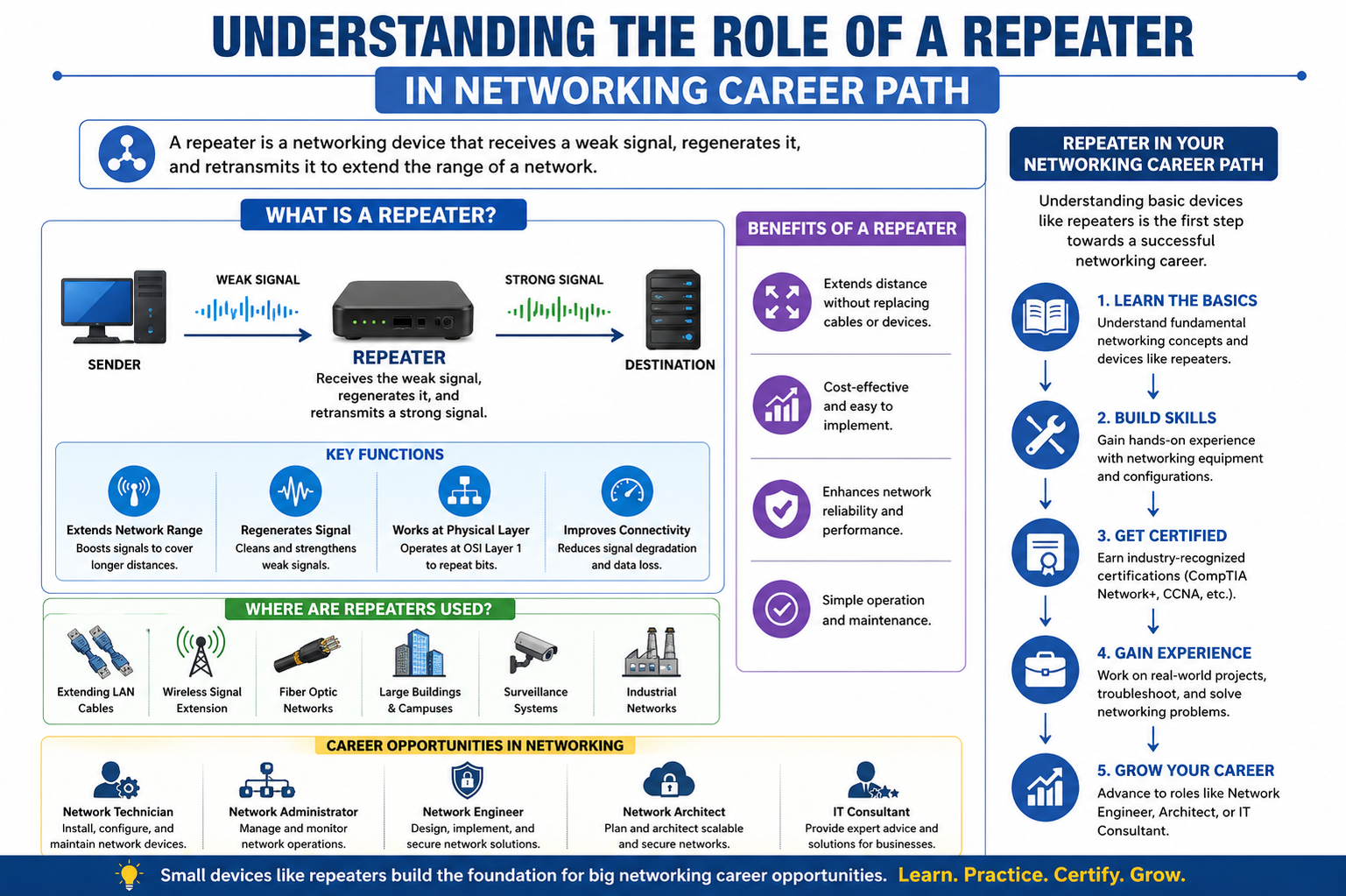
A repeater is one of the most fundamental devices used in computer networking, especially in systems where communication signals need to travel over long distances. Its primary purpose is to ensure that data signals remain strong, clear, and usable even after traveling through extended transmission media such as cables or wireless channels. Without such a device, networks would face severe limitations in coverage, as signals naturally weaken the farther they move from their source.
Signal Attenuation in Networking
One of the biggest challenges in any communication system is signal attenuation. As a signal travels through a medium like copper wire, fiber optic cable, or air, it gradually loses strength due to resistance, interference, and environmental factors. This weakening can result in data loss, corruption, or complete failure in communication if the signal becomes too weak to be interpreted correctly at the receiving end.
Attenuation is not just a physical limitation but also a practical barrier in designing large-scale networks. Engineers must account for how far a signal can travel before it becomes unreliable. This is where repeaters become essential, as they restore the signal to its original strength and allow communication to continue beyond normal distance limitations.
Working Mechanism of a Repeater
A repeater operates by receiving an incoming weak or distorted signal, processing it, and then retransmitting it at a higher power level. It does not analyze or modify the content of the data; instead, it focuses solely on restoring the signal’s physical integrity.
When a signal enters a repeater, it is first cleaned of noise and distortion that may have accumulated during transmission. The repeater then regenerates the signal in its original waveform and sends it forward. This regeneration process ensures that the signal can continue traveling across long distances without significant degradation.
Because repeaters operate at the physical layer of the networking model, they deal only with electrical or optical signals rather than data packets or protocols. This makes them simple but highly effective devices for extending communication range.
Types of Repeaters in Networking
Repeaters can be broadly categorized based on the type of signal they handle and the environment in which they operate. One common type is the analog repeater, which is used in traditional communication systems. It amplifies the incoming signal along with any noise present, which can sometimes reduce overall quality but still extend the transmission distance.
Another type is the digital repeater, which is more advanced and widely used in modern networking. Instead of simply amplifying the signal, it regenerates it by reconstructing the digital data from scratch. This process eliminates noise and ensures a much cleaner output compared to analog systems.
Wireless repeaters are also commonly used in Wi-Fi networks to extend coverage areas. These devices receive wireless signals and rebroadcast them, helping eliminate dead zones in homes, offices, or public spaces.
Role in the OSI Model
In the OSI (Open Systems Interconnection) model, a repeater functions at the physical layer, which is the lowest layer responsible for the transmission of raw bits over a communication channel. This means the repeater does not interact with higher-level data structures such as frames, packets, or sessions.
Because it operates at this basic level, the repeater is unaware of the content being transmitted. Its only responsibility is to ensure that the electrical or optical signal remains strong enough to reach its destination or the next network segment.
Importance of Repeaters in Network Expansion
Repeaters play a critical role in expanding network infrastructure. In large organizations, campuses, or industrial environments, network devices are often spread over wide geographical areas. Without signal regeneration, it would be impossible to maintain reliable communication across such distances.
By strategically placing repeaters at intervals, network designers can ensure that signals remain strong from the source to the destination. This allows seamless connectivity between devices that would otherwise be too far apart to communicate effectively.
Advantages of Using Repeaters
One of the main advantages of repeaters is their ability to extend network range without requiring complex configuration. They are relatively simple devices that can be installed in existing networks with minimal effort.
Another advantage is cost-effectiveness. Compared to more advanced networking equipment, repeaters are generally affordable and provide a straightforward solution for signal degradation issues.
Repeaters also help maintain signal integrity over long distances, especially in environments where interference is unavoidable. By regenerating the signal, they reduce the chances of data loss and improve overall communication reliability.
Limitations of Repeaters
Despite their usefulness, repeaters have several limitations. One major drawback is that they cannot distinguish between good and bad data. If a signal is already corrupted, the repeater will still amplify it, potentially spreading errors further along the network.
Another limitation is that repeaters do not manage traffic or provide any form of intelligence. They cannot filter data, prioritize packets, or make routing decisions. Their functionality is strictly limited to signal regeneration.
Additionally, excessive use of repeaters in a network can introduce delays and synchronization issues, especially in large or complex systems.
Difference Between Repeaters, Hubs, and Routers
Although repeaters are sometimes confused with hubs and routers, they serve different purposes in networking. A repeater simply regenerates signals without any additional processing. A hub, on the other hand, is a slightly more advanced device that connects multiple network devices and broadcasts data to all connected nodes.
Routers are far more intelligent devices that operate at higher layers of the OSI model. They analyze data packets and determine the best path for forwarding them to their destination. Unlike repeaters, routers can manage traffic and connect different networks.
Understanding these differences is important when designing or troubleshooting network systems, as each device serves a specific role.
Practical Applications of Repeaters
Repeaters are widely used in various real-world scenarios. In office buildings, they help extend wired network connections across multiple floors or distant rooms. In wireless networks, they improve Wi-Fi coverage by eliminating weak signal areas.
They are also used in telecommunications systems, where signals must travel long distances through fiber optic cables or microwave links. In such cases, repeaters ensure that communication remains stable over hundreds or even thousands of kilometers.
In industrial environments, repeaters support machine-to-machine communication across large factory floors, ensuring that automated systems remain connected and synchronized.
Installation and Placement Considerations
Proper placement of repeaters is essential for optimal network performance. They should be installed at points where the signal begins to weaken but is still strong enough to be accurately regenerated. Placing a repeater too far from the source may result in poor signal reception, while placing it too close may be unnecessary.
Network engineers often conduct site surveys to determine the best locations for repeaters. Factors such as interference, physical obstacles, and transmission medium are taken into account during planning.
Troubleshooting Repeater Issues
Like any networking device, repeaters can sometimes experience issues. Common problems include power failure, improper placement, or environmental interference. When a repeater fails, users may notice weak signals, dropped connections, or reduced network performance.
Troubleshooting typically involves checking power supply, verifying connections, and ensuring that the repeater is correctly positioned within the network. In wireless systems, adjusting antenna direction or reducing interference sources can also improve performance.
Modern Relevance of Repeaters
Although modern networking technologies have become more advanced, repeaters still play an important role. In many cases, they are integrated into more complex devices such as switches, access points, and signal boosters.
In wireless communication, especially with Wi-Fi networks, repeaters remain a simple and effective solution for extending coverage without requiring major infrastructure changes.
Even in fiber optic systems, signal regeneration concepts similar to repeaters are still used to maintain long-distance communication.
Future of Signal Regeneration Technologies
As networking technology continues to evolve, the basic concept of signal regeneration is also advancing. Modern systems are incorporating smarter, more efficient devices that combine the functions of repeaters with data processing capabilities.
Future networking solutions may rely less on standalone repeaters and more on integrated systems that automatically manage signal strength, reduce interference, and optimize network performance in real time.
Advanced Role of Repeaters in Modern Networking
In modern networking environments, the role of repeaters has evolved beyond simple signal regeneration. While their basic function remains the same, they are now often integrated into more complex networking systems where they work alongside switches, access points, and other infrastructure components. This integration allows networks to achieve wider coverage, better stability, and improved performance without requiring entirely new communication pathways.
Repeaters in Wireless Networking
Wireless networks rely heavily on repeaters to extend coverage in areas where signals are weak or obstructed. Walls, furniture, and other physical barriers can significantly reduce Wi-Fi strength, creating dead zones where connectivity is poor or completely unavailable. Wireless repeaters solve this problem by receiving the existing Wi-Fi signal, amplifying it, and rebroadcasting it to extend coverage.
In homes, this allows users to access the internet in distant rooms, basements, or upper floors where the main router signal may not reach effectively. In commercial environments such as offices, hotels, and campuses, wireless repeaters ensure seamless connectivity across large areas, supporting multiple users without major infrastructure changes.
Integration with Network Extenders
Repeaters are often confused with network extenders, but in many modern systems, they function together. A network extender may include repeater functionality along with additional features such as signal optimization, bandwidth management, and device prioritization.
This integration allows more efficient use of available bandwidth, ensuring that extended networks do not suffer from significant performance drops. By combining amplification and intelligent routing, modern devices provide a more stable and user-friendly networking experience.
Impact on Data Transmission Quality
One important aspect of repeaters is their impact on data transmission quality. While they restore signal strength, they do not improve the quality of the original data. If interference or noise affects the signal before it reaches the repeater, those issues may still persist after regeneration.
Digital repeaters help minimize this problem by reconstructing the signal more accurately. Instead of simply boosting weak signals, they decode and rebuild the original data pattern, which significantly reduces the chances of error propagation across the network.
Role in Long-Distance Communication Systems
Repeaters are essential in long-distance communication systems such as fiber optic networks, satellite links, and undersea cables. In these environments, signals must travel extremely long distances, often across continents or oceans, before reaching their destination.
In fiber optic systems, optical repeaters convert light signals into electrical signals, amplify them, and then convert them back into light for continued transmission. This ensures that data can travel thousands of kilometers without losing integrity or speed.
Without such regeneration points, modern global communication systems such as the internet, international calling, and data transfer services would not function efficiently.
Environmental Factors Affecting Repeater Performance
The performance of a repeater can be influenced by environmental conditions. In wired networks, temperature changes, cable quality, and electromagnetic interference can affect signal strength. In wireless networks, physical obstacles such as walls, metal structures, and even weather conditions can reduce signal efficiency.
To maintain optimal performance, repeaters must be placed in locations that minimize interference and maximize signal reception. Proper installation is essential to ensure that the device can effectively capture and retransmit signals without degradation.
Security Considerations in Repeater Usage
While repeaters improve connectivity, they also introduce certain security considerations. Since they simply retransmit signals, they do not inherently provide encryption or data protection. This means that if a network is not properly secured, repeated signals could potentially be intercepted.
In wireless environments, it is important to use secure encryption protocols such as WPA2 or WPA3 to protect data being transmitted through repeaters. Network administrators must also ensure that repeaters are configured correctly to prevent unauthorized access or signal misuse.
Scalability in Large Networks
Repeaters contribute significantly to network scalability, allowing systems to expand without major structural changes. In large organizations, adding repeaters can extend network reach to new floors, buildings, or outdoor areas without requiring complete rewiring or redesign.
This scalability makes repeaters a cost-effective solution for growing networks. Instead of replacing entire systems, administrators can strategically add repeaters to improve coverage and performance as needed.
Latency and Performance Considerations
Although repeaters extend signal range, they can introduce slight delays in transmission known as latency. Each time a signal is received and retransmitted, a small amount of processing time is added. In most cases, this delay is minimal and not noticeable to users.
However, in high-performance environments such as gaming, video conferencing, or financial trading systems, even small delays can matter. In such cases, network designers must carefully balance the use of repeaters with other networking solutions to maintain optimal performance.
Difference Between Analog and Digital Regeneration
Analog repeaters work by simply amplifying incoming signals, including both useful data and unwanted noise. This means that over multiple stages of amplification, signal quality can gradually degrade.
Digital repeaters, on the other hand, interpret the signal as data, reconstruct it, and then transmit a clean version. This process eliminates accumulated noise and results in much higher transmission accuracy. As a result, digital repeaters are more commonly used in modern networking systems.
Role in Emergency Communication Systems
Repeaters also play an important role in emergency communication systems. In situations such as natural disasters, infrastructure damage, or remote area operations, communication networks may become weak or partially unavailable.
Portable repeaters can be quickly deployed to restore connectivity in affected areas. This allows emergency responders to maintain communication, coordinate rescue operations, and share critical information effectively.
Industrial Applications of Repeaters
In industrial environments, repeaters support automation systems, sensors, and machine communication across large facilities. Factories often span wide physical areas where direct communication between devices may not be possible without signal boosting.
By using repeaters, industrial systems can maintain continuous data flow between machines, control systems, and monitoring devices. This improves efficiency, reduces downtime, and enhances operational safety.
Repeaters in Smart Infrastructure
Modern smart cities and smart buildings also rely on repeaters to maintain connectivity between IoT devices, sensors, and control systems. These devices often need to communicate in real time, and signal degradation can disrupt their functionality.
Repeaters help ensure that smart systems remain connected across large urban environments, supporting applications such as traffic monitoring, energy management, and environmental sensing.
Limitations in High-Density Networks
In high-density networks where many devices are connected simultaneously, repeaters may face performance challenges. Since they retransmit all signals they receive, they do not prioritize traffic or manage bandwidth.
This can lead to congestion in heavily loaded networks. As a result, modern systems often combine repeaters with intelligent network devices that can handle traffic management more effectively.
Technological Evolution Beyond Traditional Repeaters
As networking technology continues to evolve, traditional repeaters are being enhanced or replaced by smarter alternatives. Devices now often include built-in signal optimization, adaptive routing, and automatic interference reduction features.
These advancements allow networks to maintain strong performance without relying solely on basic signal amplification. However, the core principle of signal regeneration remains central to all these technologies.
Repeater Functionality Overview
Repeaters continue to be a vital component of networking systems, ensuring that communication signals can travel long distances without losing strength or clarity. Whether used in wired networks, wireless systems, industrial environments, or global communication infrastructure, their role in maintaining connectivity is essential.
Even as technology advances, the fundamental need for signal regeneration remains unchanged, making repeaters an enduring and important part of modern networking architecture.
Evolution of Repeaters in Modern Network Architecture
As networking systems have grown more complex, repeaters have also evolved from simple signal boosters into more adaptive and efficient devices. In earlier systems, repeaters were standalone hardware units with a single purpose: to regenerate weakened signals. In modern networks, however, their functionality is often embedded within multi-purpose devices that combine amplification, signal filtering, and sometimes even basic routing capabilities.
This evolution reflects the increasing demand for faster, more reliable communication across both wired and wireless infrastructures. Instead of relying solely on separate repeaters placed along a network path, modern systems distribute signal enhancement more intelligently across integrated hardware.
Role of Repeaters in Hybrid Networks
Hybrid networks, which combine different transmission media such as fiber optics, copper cables, and wireless links, rely on repeaters to maintain consistency between segments. Each medium has different signal characteristics, and transitions between them can lead to degradation or mismatch in signal strength.
Repeaters help bridge these gaps by standardizing signal levels as data moves from one medium to another. This ensures smooth communication across mixed infrastructures, which is common in modern enterprise and telecom environments.
Signal Regeneration vs Signal Amplification
A key distinction in understanding repeaters lies between signal amplification and signal regeneration. Amplification simply increases the power of an existing signal, including any noise or distortion present. This can sometimes worsen signal quality over long distances due to cumulative interference.
Signal regeneration, on the other hand, involves reconstructing the original signal before retransmitting it. Digital repeaters use this approach to eliminate errors and restore data integrity. This makes regeneration significantly more reliable for modern digital communication systems where accuracy is critical.
Repeaters in Fiber Optic Communication
Fiber optic networks rely heavily on repeaters, often referred to as optical regenerators or optical amplifiers depending on their function. Since light signals weaken as they travel through fiber cables, especially over long distances, periodic regeneration is necessary.
In traditional optical repeaters, the incoming light signal is converted into an electrical signal, processed, cleaned, and then converted back into light for further transmission. In more advanced systems, optical amplifiers boost the light signal directly without conversion, making the process faster and more efficient.
These technologies are essential for global internet infrastructure, undersea communication cables, and long-distance data transmission systems.
Impact on Network Design Strategy
The presence of repeaters significantly influences how networks are designed. Engineers must consider the maximum transmission distance of a signal before degradation occurs. Based on this, they determine where repeaters should be placed to maintain consistent communication quality.
This planning process ensures that networks remain balanced, avoiding both weak signal zones and unnecessary redundancy. Proper design also helps reduce maintenance costs and improves overall system efficiency.
Repeaters in Rural and Remote Connectivity
In rural and remote areas, repeaters play a crucial role in providing access to communication services. These regions often lack dense infrastructure, making it difficult to deploy full-scale networking systems.
By using repeaters, service providers can extend coverage from a central hub to distant locations without building entirely new transmission lines. This makes communication services more accessible and affordable for underserved regions.
Wireless repeaters are especially useful in these environments, as they can be installed quickly and require minimal physical infrastructure.
Energy Efficiency Considerations
Modern network design also takes energy efficiency into account. Repeaters consume power continuously to maintain signal regeneration, so optimizing their placement and usage is important for reducing overall energy consumption.
Advanced repeaters are designed to operate more efficiently, using low-power components and adaptive signal processing techniques. Some systems even include sleep modes or dynamic power adjustment features that reduce energy usage during periods of low network activity.
Interference Management in Repeater Systems
Interference is a major challenge in any communication system. Since repeaters retransmit signals, they can also amplify unwanted interference if not properly configured. This can lead to reduced performance or signal distortion in densely populated networks.
To address this, modern repeaters often include filtering mechanisms that help reduce noise and isolate useful signals. In wireless systems, frequency management techniques are also used to minimize overlap and interference between channels.
Role in Satellite Communication Networks
Repeaters are also used in satellite communication systems, where signals travel vast distances between Earth and space. In these systems, signal degradation occurs due to atmospheric conditions, distance, and transmission delays.
Satellite repeaters, often called transponders, receive signals from Earth, amplify them, and retransmit them back to another location on the planet. This enables global communication services such as television broadcasting, GPS systems, and international data transfer.
Scalability Challenges in Large-Scale Deployments
While repeaters help extend network reach, managing them in large-scale deployments can become complex. As the number of repeaters increases, maintaining synchronization and consistent signal quality becomes more challenging.
Improperly configured repeaters can create overlapping signals, leading to interference or network inefficiencies. Therefore, large-scale systems require careful monitoring and centralized management to ensure optimal performance.
Maintenance and Reliability Factors
Repeaters are generally low-maintenance devices, but they still require periodic inspection to ensure proper operation. Power supply stability, environmental conditions, and hardware aging can all affect performance over time.
In critical systems, redundancy is often used to ensure reliability. This means that if one repeater fails, another can take over its function without disrupting communication. Such redundancy is essential in systems where continuous connectivity is required.
Role in Internet Backbone Infrastructure
The global internet backbone relies on a combination of fiber optic cables, routers, and signal regeneration points that function similarly to repeaters. These systems ensure that data can travel across continents without significant loss of quality or speed.
Without signal regeneration, internet communication between distant regions would be slow, unreliable, or even impossible. Repeaters and similar technologies form the backbone of global digital connectivity.
Future Trends in Signal Extension Technology
The future of repeater technology is moving toward smarter, software-driven systems. Instead of simple hardware-based signal boosting, future devices are expected to use artificial intelligence and adaptive algorithms to manage signal flow dynamically.
These systems will be able to analyze network conditions in real time and adjust signal strength, routing, and interference management automatically. This will reduce the need for manual configuration and improve overall network efficiency.
Integration with 5G and Beyond
With the expansion of 5G networks and future 6G development, repeaters are becoming more advanced and specialized. High-frequency signals used in these networks have shorter ranges and are more easily obstructed, increasing the need for dense signal regeneration infrastructure.
Modern repeaters in these systems are designed to handle high data rates, low latency requirements, and dynamic network conditions. They are often integrated into small cell networks that provide localized coverage in urban environments.
Advanced Repeater Concepts
Repeaters remain an essential part of modern communication systems, even as technology continues to advance. Their ability to maintain signal strength over distance ensures that networks remain functional, stable, and scalable.
From basic wired connections to complex global communication systems, repeaters support the foundation of digital connectivity. As networks become faster and more intelligent, repeaters will continue to evolve, playing a key role in ensuring seamless communication across all environments.
Future Innovations in Repeater Technology
The future of repeater technology is closely tied to the rapid evolution of networking systems, especially with the growing demand for high-speed data transmission and low-latency communication. Traditional repeaters are gradually being replaced or upgraded into more intelligent devices that are capable of not only regenerating signals but also analyzing network conditions in real time. These advanced systems are designed to adapt automatically to varying traffic loads, interference levels, and environmental conditions.
Modern research is focused on developing repeaters that integrate artificial intelligence and machine learning algorithms. These smart repeaters can predict signal degradation before it occurs and adjust amplification levels accordingly. Instead of passively boosting signals, they actively optimize performance, ensuring more stable and efficient communication across networks.
Role of Repeaters in 6G and Next-Generation Networks
As the world moves beyond 5G technology, future 6G networks will require extremely dense infrastructure due to the use of high-frequency bands such as terahertz waves. These frequencies provide ultra-fast data speeds but suffer from very limited range and poor penetration through obstacles.
Repeaters in such environments will play a far more critical role than ever before. They will not only extend signal coverage but also dynamically manage beamforming, frequency allocation, and interference reduction. In essence, repeaters will evolve into intelligent network nodes that actively participate in communication rather than simply supporting it.
These advanced systems will ensure seamless connectivity in smart cities, autonomous transportation networks, virtual reality environments, and large-scale Internet of Things ecosystems.
Integration of Repeaters with Edge Computing
Edge computing is becoming an important part of modern network architecture, where data processing is moved closer to the source of data generation. In this context, repeaters are beginning to integrate edge computing capabilities, allowing them to process and filter data locally before retransmitting it.
This reduces latency and improves efficiency by minimizing the amount of unnecessary data sent across the network. For example, in industrial automation systems, a repeater with edge processing capabilities can analyze sensor data in real time and only forward critical information to central servers.
This combination of signal regeneration and local processing marks a significant advancement in networking technology.
Software-Defined Repeaters
Another emerging trend is the development of software-defined networking components, including software-controlled repeaters. Unlike traditional hardware-based systems, software-defined repeaters can be configured and managed remotely through centralized controllers.
This allows network administrators to adjust signal behavior dynamically based on demand. For instance, during peak usage hours, repeaters can increase capacity, while during low activity periods, they can reduce power consumption.
This flexibility makes software-defined repeaters highly suitable for large-scale and dynamic environments such as data centers, smart cities, and cloud-based infrastructures.
Repeaters in Space and Deep-Space Communication
Communication beyond Earth, especially in satellite networks and deep-space missions, relies heavily on advanced repeater-like systems. Space communication involves extremely long distances, where signals can take minutes or even hours to travel.
In these systems, repeaters are used in satellites, space probes, and planetary orbiters to receive weak signals, amplify them, and transmit them back to Earth. These devices must operate under extreme conditions, including radiation, temperature fluctuations, and limited power availability.
Future space missions, including Mars exploration and deep-space observation, will require even more advanced repeater technologies capable of handling higher data volumes and maintaining stable communication across vast distances.
Security Enhancements in Modern Repeaters
As networks become more complex and interconnected, security becomes an increasingly important concern. Traditional repeaters do not offer any security features, as they simply transmit signals without analyzing content. However, modern repeaters are being designed with built-in security protocols to protect data integrity.
These advanced systems may include encryption handling, intrusion detection, and secure authentication mechanisms. By integrating security features directly into signal regeneration devices, networks can reduce vulnerabilities and prevent unauthorized access or data interception.
This is especially important in sensitive environments such as financial systems, military communication networks, and healthcare data infrastructure.
Energy-Efficient Repeater Systems
With the growing emphasis on sustainability, energy efficiency has become a key focus in networking technology. Repeaters, which operate continuously to maintain signal strength, can consume significant amounts of power in large-scale deployments.
To address this, researchers are developing energy-efficient repeater systems that use adaptive power management. These systems can adjust their energy usage based on network demand, reducing consumption during periods of low traffic.
Some advanced designs also incorporate renewable energy sources such as solar power, especially in remote or off-grid installations. This not only reduces operational costs but also supports environmentally friendly network expansion.
Role of Repeaters in Autonomous Systems
Autonomous systems such as self-driving cars, drones, and robotic networks rely heavily on continuous and reliable communication. Repeaters play a key role in maintaining connectivity between these systems, especially in environments where direct communication with central servers may not always be possible.
In smart transportation systems, for example, repeaters help maintain communication between vehicles, traffic infrastructure, and control centers. This ensures real-time data exchange, which is essential for safety and coordination.
In drone networks, repeaters extend communication range, allowing drones to operate over larger areas without losing connection to control systems.
Challenges in Modern Repeater Deployment
Despite their advantages, deploying repeaters in modern networks comes with several challenges. One major issue is network complexity. As networks grow larger, managing multiple repeaters becomes increasingly difficult, especially when they interact with other intelligent devices.
Another challenge is signal interference in dense environments. In urban areas with many overlapping networks, repeaters may unintentionally amplify competing signals, leading to congestion and reduced performance.
Physical installation constraints also pose difficulties, especially in rugged terrain, underground systems, or high-rise urban environments where access is limited.
Importance of Standardization in Repeater Systems
To ensure compatibility and efficiency, standardization plays a crucial role in repeater technology. International communication standards define how repeaters should operate within different types of networks, ensuring interoperability between devices from different manufacturers.
These standards help maintain consistent performance, reduce technical conflicts, and ensure that networks can scale smoothly across regions and technologies.
Real-Time Network Optimization with Repeaters
Modern repeaters are increasingly being used as part of real-time network optimization systems. Instead of functioning independently, they are connected to centralized monitoring systems that analyze network performance continuously.
This allows dynamic adjustments in signal strength, routing paths, and bandwidth allocation. If a network segment becomes overloaded, repeaters can automatically adjust their behavior to balance traffic and reduce congestion.
This level of automation significantly improves overall network efficiency and reliability.
Role of Repeaters in Disaster Recovery Networks
In disaster scenarios such as earthquakes, floods, or infrastructure failures, communication networks are often severely damaged. Repeaters can be rapidly deployed to restore basic connectivity in affected areas.
Portable repeater systems are commonly used by emergency response teams to establish temporary communication networks. These systems help coordinate rescue operations, medical assistance, and resource distribution.
Their ability to quickly restore communication makes them a vital component of disaster recovery strategies.
Comparison Between Traditional and Modern Repeaters
Traditional repeaters were simple devices focused solely on signal amplification. They had no intelligence, no adaptability, and limited functionality. In contrast, modern repeaters are highly sophisticated systems capable of dynamic adjustment, data filtering, and integration with advanced network architectures.
This evolution reflects the broader transformation of networking technology from static infrastructure to intelligent, adaptive systems.
Conclusion
Repeaters have played a foundational role in the development of modern communication systems. From basic signal amplification in early networks to advanced intelligent nodes in today’s complex infrastructures, their importance has remained constant despite rapid technological change.
They enable long-distance communication, support wireless connectivity, and ensure that data can travel reliably across global networks. As technology continues to evolve, repeaters are becoming more intelligent, energy-efficient, and integrated with advanced systems such as edge computing, AI-driven networks, and next-generation wireless technologies.
In the future, repeaters will no longer be seen as simple signal boosters but as essential components of intelligent communication ecosystems. Their role will expand beyond regeneration to include optimization, security, and real-time decision-making within networks.
Ultimately, the concept of the repeater remains a cornerstone of networking—ensuring that no matter how far a signal must travel, communication remains strong, stable, and continuous across all environments.