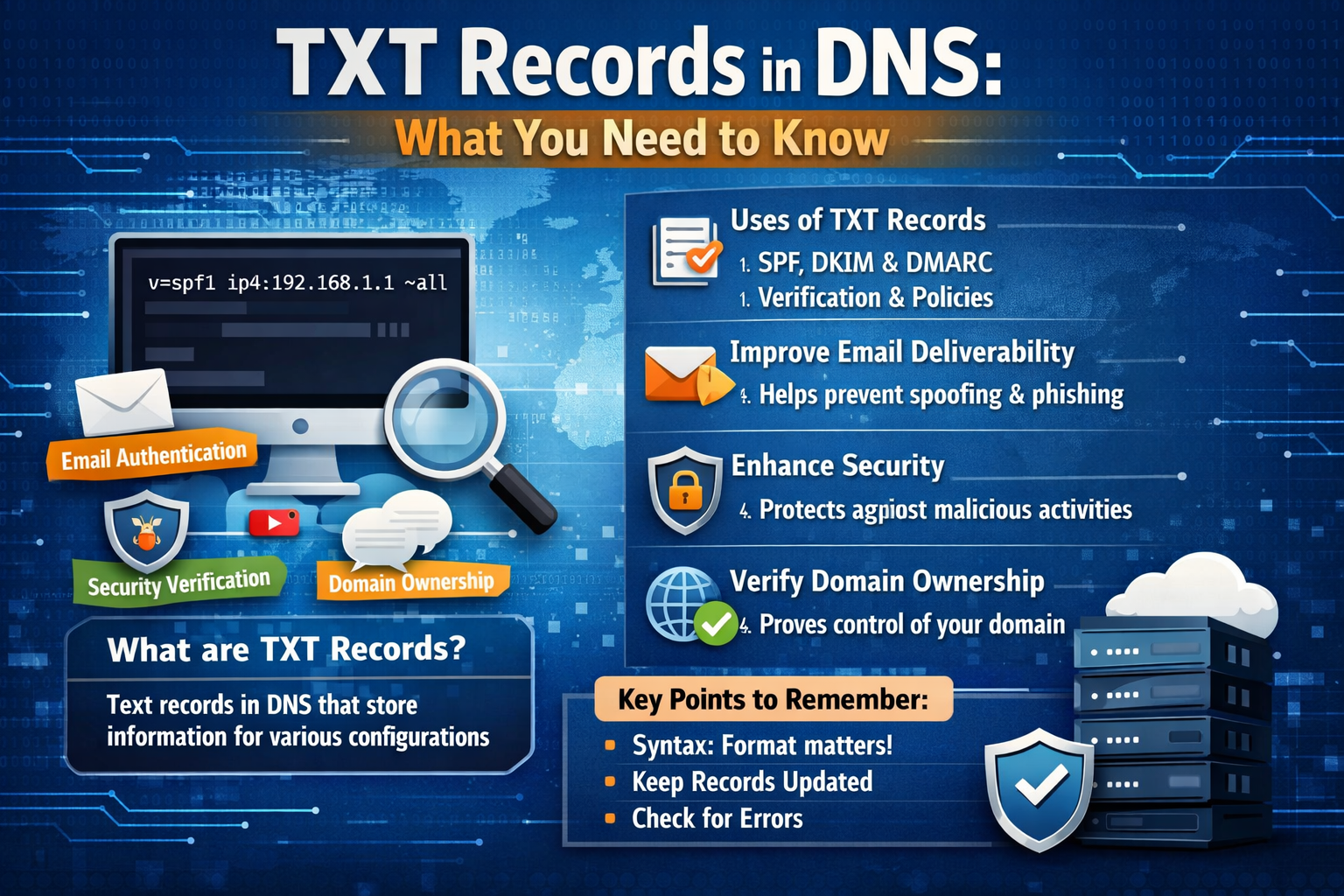
TXT records are one of the most versatile and widely used types of records in DNS. They are designed to store plain text information linked to a specific internet address configuration, allowing systems and services to read and interpret that data when needed. Unlike other records that strictly define routing or addressing behavior, TXT records act as a flexible container for informational and verification purposes.
How TXT Records Work
TXT records function by attaching readable text strings to a DNS entry. When a system queries DNS for a particular purpose, it can retrieve these text values and use them to validate identity, configuration settings, or service instructions.
These records do not directly control how traffic moves across the internet. Instead, they provide supporting data that external services rely on for confirmation and security checks. Because of this, TXT records are often used alongside other DNS entries rather than replacing them.
Each TXT record can contain one or more strings of text. These strings are interpreted by external systems depending on the service requesting the information. Some services may look for specific formats or keywords within the text to perform validation or authentication tasks.
Purpose and Importance of TXT Records
TXT records play an important role in modern internet infrastructure because they help establish trust between services. Many systems rely on them to verify that a particular entity has control over a specific configuration before granting access or enabling features.
They are especially valuable in environments where security and identity verification are critical. By allowing systems to publish verifiable information in a publicly accessible way, TXT records help reduce fraudulent activity and improve overall trust between connected services.
Another key purpose is flexibility. Unlike rigid record types, TXT records can store different kinds of information without requiring structural changes. This makes them adaptable to new technologies and evolving security requirements.
TXT Records and Email Security
One of the most common uses of TXT records is in email security. Many email authentication systems depend on them to verify whether a message originates from a legitimate source.
Email spoofing, where attackers send messages pretending to be someone else, is a major security concern. TXT records help reduce this risk by allowing systems to define rules that specify which sources are authorized to send emails on behalf of a configuration.
These rules are stored as text entries and are checked automatically when an email is received. If the message does not comply with the defined rules, it may be flagged as suspicious or rejected entirely.
This mechanism helps protect both organizations and individuals from phishing attempts and fraudulent communication.
Verification and Ownership Confirmation
TXT records are also widely used for verifying ownership of online services. When a new service is connected to a configuration, it often requires proof that the user has control over it.
This is typically done by asking the user to add a specific text string into a TXT record. Once added, the service checks for the presence of that exact string. If it is found, ownership is confirmed.
This method is popular because it is simple, secure, and does not require changes to other system configurations. It only involves adding a text value, making it accessible even for users without advanced technical knowledge.
Structure of TXT Records
A TXT record generally consists of a name and one or more text values. The name identifies where the record is applied, while the text value contains the actual information.
The text itself can vary depending on its purpose. In some cases, it may contain verification codes, while in others it may include configuration rules or policy definitions.
Some systems allow multiple strings within a single record, which are combined and interpreted as one continuous value. This flexibility allows TXT records to support complex instructions when necessary.
Common Use Cases of TXT Records
TXT records are used in many different scenarios across digital systems. One of the most common is service verification, where external platforms confirm that a user controls a specific configuration before enabling features.
They are also used in security policies that define how communication should be handled. These policies help receiving systems decide whether incoming messages are trustworthy.
Another use is service integration, where third-party platforms require validation before connecting. By placing a specific string in a TXT record, users can authorize integration securely without sharing sensitive credentials.
Additionally, TXT records are sometimes used for system documentation. Organizations may store internal notes or configuration references that can be accessed by automated tools.
How Systems Read TXT Records
When a system needs to check a TXT record, it sends a query to retrieve the associated text data. The response contains the stored values, which are then analyzed according to predefined rules.
Different systems interpret TXT data in different ways. Some look for exact matches, while others scan for specific patterns or keywords within the text.
This process is automatic and typically happens within seconds. It allows services to validate information quickly without requiring manual intervention.
Propagation and Update Behavior
When a TXT record is created or modified, it does not become active instantly across all systems. Instead, it goes through a propagation process where updates gradually spread across networks.
During this time, different systems may temporarily see different versions of the record. This is normal and depends on caching behavior.
Propagation time can vary depending on configuration settings and network conditions. Once fully propagated, all systems will consistently read the updated version.
Security Role of TXT Records
TXT records contribute significantly to internet security. By allowing systems to publish verification rules and policies, they help prevent unauthorized access and impersonation.
They also support encryption-related configurations and authentication mechanisms used by modern communication systems.
Because TXT records are publicly readable, they are not used to store sensitive private data. Instead, they are designed for information that needs to be verified openly without exposing confidential content.
Limitations of TXT Records
Despite their usefulness, TXT records have certain limitations. Since they store plain text, they cannot enforce behavior directly. They only provide information that other systems interpret.
This means their effectiveness depends on how external services implement validation rules. If a system does not correctly interpret TXT data, the intended security or verification effect may not work properly.
Another limitation is lack of structure. Because TXT records are flexible, they can sometimes become inconsistent or difficult to manage if not properly organized.
Best Practices for Using TXT Records
To ensure reliable use of TXT records, it is important to keep entries clear and well-structured. Each record should serve a specific purpose and avoid unnecessary complexity.
Consistency is also important. Using standardized formats for verification and policy data helps external systems interpret records correctly.
It is also recommended to review and update TXT entries regularly. Outdated or unused records can create confusion or reduce security effectiveness.
Keeping records minimal and purposeful ensures better performance and easier management over time.
Troubleshooting Common Issues
Sometimes TXT records may not work as expected. One common issue is delay in propagation, where changes take time to become visible across systems.
Another issue is incorrect formatting. If the text value does not match the expected pattern exactly, verification may fail.
Caching can also cause confusion, as some systems may temporarily display older values.
In most cases, these issues resolve once propagation completes or formatting is corrected.
Role in Modern Internet Infrastructure
TXT records have become an essential part of modern internet systems. They support a wide range of functions beyond simple verification, including authentication, security enforcement, and service integration.
As digital ecosystems become more interconnected, the importance of reliable verification methods continues to grow. TXT records provide a simple yet powerful way to exchange trust-related information between systems.
Their flexibility allows them to adapt to new technologies without requiring major structural changes, making them a long-standing component of internet infrastructure.
Advanced Uses of TXT Records
Beyond basic verification and email security, TXT records are increasingly used in more advanced system configurations. Modern online services rely on them to communicate structured instructions between platforms in a lightweight and universally accessible format. This makes them a practical choice for scenarios where systems need to exchange validation or policy data without requiring complex integration layers.
In many enterprise environments, TXT records are used to support automated workflows. These workflows often involve multiple services that must confirm shared configurations before interacting with each other. TXT records act as a neutral source of truth that each system can independently verify, reducing dependency on direct system-to-system communication.
They are also used in cloud-based environments where resources are frequently created and destroyed. Instead of manually configuring trust relationships, systems can dynamically check TXT-based verification entries to confirm legitimacy before allowing access.
TXT Records in Domain Authentication
Domain authentication is one of the most critical areas where TXT records are applied. Many modern security protocols rely on them to validate whether a configuration is authorized to send or manage specific types of traffic.
This process typically involves publishing a unique string in a TXT record that external services can validate. Once the string is detected, the system assumes that the requesting party has control over the domain configuration.
This method is widely used because it does not require exposing sensitive credentials or modifying core infrastructure. It simply verifies control through DNS-level confirmation, which is both secure and scalable.
Over time, this approach has become a standard method for establishing trust between independent systems that do not share internal access.
TXT Records and Anti-Spoofing Protection
One of the most important roles of TXT records is preventing spoofing attacks, particularly in communication systems. Spoofing occurs when an attacker impersonates a trusted source to deceive recipients.
TXT-based authentication mechanisms help reduce this risk by defining strict rules about which sources are allowed to send messages on behalf of a configuration. When a message is received, the system checks these rules before accepting or rejecting the communication.
If the message fails validation, it can be flagged as suspicious or completely blocked. This significantly reduces the chances of successful impersonation attempts and improves overall communication trust.
These protections are especially important for organizations that rely heavily on digital communication, as they help safeguard both reputation and data integrity.
Role in Service Integration
TXT records are also widely used in integrating third-party services. Many platforms require users to prove ownership or authorization before enabling advanced features or connections.
Instead of sharing credentials or internal access, users can simply add a verification string to a TXT record. Once the external service detects this string, it confirms that the user has control over the configuration.
This approach simplifies integration while maintaining strong security boundaries. It also allows services to scale more easily, as verification can be handled automatically without manual approval steps.
Because of this simplicity, TXT records have become a preferred method for onboarding new services in many digital ecosystems.
Flexibility in Data Representation
One of the defining strengths of TXT records is their flexibility. Unlike rigid data structures, they allow free-form text that can be adapted to different use cases.
This flexibility enables them to support a wide range of systems, from authentication protocols to configuration metadata. Developers can design custom formats within TXT records to suit specific needs, as long as the receiving system knows how to interpret them.
However, this flexibility also means that consistency becomes important. Without standardized formats, TXT data can become difficult to interpret across different platforms.
To address this, many systems define strict formatting rules for how TXT data should be structured, ensuring consistent interpretation across environments.
Performance Considerations
Although TXT records are lightweight, they can still impact system performance if not managed properly. Large or excessively complex records may increase query time or processing overhead.
Most systems are optimized to handle TXT queries efficiently, but repeated or unnecessary lookups can still introduce delays. Caching mechanisms are often used to reduce repeated queries and improve response speed.
Proper management of TXT records ensures that they remain efficient and do not negatively affect system performance.
Security Considerations
While TXT records play a key role in security, they must be used correctly to be effective. Since they are publicly readable, they should never contain sensitive or confidential information.
Instead, they should only include verification data, policy definitions, or non-sensitive configuration details.
If improperly configured, TXT records can expose unnecessary information that may assist attackers in understanding system structure. For this reason, careful planning and minimal exposure are recommended.
Security effectiveness also depends on how external systems interpret TXT data. Even well-structured records must be supported by proper validation mechanisms to be effective.
Common Formatting Issues
One of the most frequent problems with TXT records is incorrect formatting. Even small errors in spacing, quotation marks, or character placement can cause validation failures.
Some systems require exact string matching, meaning even minor deviations will result in rejection. Others allow more flexible interpretation, but consistency is still important.
Another common issue is splitting or fragmentation of text values. In some cases, long TXT entries may be divided into multiple segments, which must be correctly combined by the receiving system.
Understanding formatting rules is essential for ensuring that TXT records function as intended across different platforms.
Propagation Behavior in Detail
When a TXT record is updated, the change does not appear instantly across all systems. Instead, it spreads gradually through a process known as propagation.
During this period, some systems may still see the old value while others see the updated version. This inconsistency is temporary but can affect time-sensitive verification processes.
Caching plays a major role in propagation behavior. Many systems store previously retrieved values to reduce repeated queries, which can delay visibility of updates.
Once caching expires and propagation completes, all systems will reflect the updated record consistently.
Error Handling and Validation Failures
When TXT records are used for verification, failures can occur if the expected value is missing or incorrect. These failures are typically detected immediately by the requesting system.
Common causes include incorrect entry, incomplete propagation, or mismatched formatting. In some cases, the issue may also arise from caching outdated data.
Systems that rely heavily on TXT validation often include retry mechanisms to handle temporary failures. This ensures that short-term issues do not disrupt overall functionality.
Proper monitoring and validation checks help reduce the likelihood of persistent errors.
Scalability and Modern Infrastructure Use
TXT records scale effectively across large systems because they are simple and lightweight. They do not require complex processing or dedicated infrastructure, making them suitable for high-volume environments.
In modern cloud architectures, TXT records are often used as part of automated provisioning and identity verification systems. They help different components confirm trust relationships without requiring direct integration.
This scalability makes them especially valuable in distributed systems where components frequently interact across different environments.
Evolving Role in Internet Systems
Over time, the role of TXT records has expanded significantly. What began as a simple method for storing descriptive text has evolved into a critical component of authentication and security infrastructure.
As internet systems continue to grow more complex, TXT records remain relevant due to their simplicity and adaptability. New security standards and verification methods continue to build on their foundation.
Their continued use demonstrates how simple design can remain effective even as technology evolves.
Organizing TXT Records in Large Systems
In large-scale environments, TXT records are often used in significant volumes, which makes organization extremely important. Without proper structure, managing multiple entries across different purposes can become confusing and error-prone.
To handle this, many systems adopt naming conventions or grouping strategies. These help separate verification records, security policies, and service configurations into clearly identifiable patterns. Even though TXT records themselves do not enforce structure, consistent internal standards make them much easier to manage.
Organizations that rely on multiple external integrations typically maintain documentation alongside TXT configurations. This ensures that every record has a clearly defined purpose and avoids duplication or conflicts.
TXT Records in Automated Systems
Automation has significantly increased the importance of TXT records in modern infrastructure. Many systems now automatically generate, verify, and update TXT entries without manual intervention.
For example, when a new service is deployed, automation tools can instantly create the required TXT records for verification. Once the external system confirms the record, access or integration is automatically enabled.
This reduces human error and speeds up deployment processes. It also ensures consistency across environments, especially when systems are frequently scaled or updated.
Automation also helps maintain security by ensuring that outdated or unused TXT records are removed or updated promptly.
Interaction with Other DNS Records
TXT records do not function in isolation. They often work alongside other DNS record types to provide a complete configuration setup.
While other records handle routing, addressing, and service location, TXT records provide supporting information such as verification data and policy instructions. This separation of roles helps maintain clarity and efficiency in system design.
By combining different record types, systems can achieve both operational functionality and security validation without overlapping responsibilities.
TXT Records in Multi-Service Environments
In environments where multiple services interact with the same configuration, TXT records play a central role in coordination. Each service may require its own verification or policy entry, all stored within the same framework.
This allows different platforms to independently verify access rights without interfering with each other’s operations. It also ensures that updates made for one service do not unintentionally affect others.
However, careful management is required to avoid conflicts or overlapping entries, especially when multiple services rely on similar verification mechanisms.
Human Readability and Debugging
One of the advantages of TXT records is that they are human-readable. This makes them easier to inspect and debug compared to more complex system configurations.
When issues arise, administrators can directly view the stored text to understand what value is being used for verification or policy enforcement. This transparency simplifies troubleshooting and reduces dependency on specialized tools.
Because of this readability, TXT records are often used as a first step in diagnosing configuration problems in integrated systems.
Common Misconfigurations
Misconfiguration of TXT records is a frequent source of issues. Even small mistakes such as missing characters, incorrect formatting, or outdated values can lead to system failures.
One common issue is duplication, where multiple conflicting entries exist for the same purpose. This can confuse external systems and result in failed verification attempts.
Another issue is outdated records that are no longer relevant but still remain active. These can interfere with new configurations and create unexpected behavior.
Regular audits are important to ensure that TXT records remain accurate and aligned with current system requirements.
Impact of Caching on TXT Records
Caching plays a significant role in how TXT records are accessed and interpreted. Many systems store previously retrieved TXT values to reduce repeated queries and improve performance.
While caching improves efficiency, it can also delay updates. If a TXT record is changed, some systems may continue using the cached version until it expires.
This behavior is important to consider when making time-sensitive changes, especially during verification or authentication processes.
Proper understanding of caching mechanisms helps prevent confusion when updates do not appear immediately.
Security Best Practices
To ensure TXT records remain secure and effective, certain best practices should be followed. One key principle is to avoid storing sensitive or confidential information within TXT entries.
Since these records are publicly accessible, they should only contain data that is safe to expose. This includes verification strings, policy definitions, or non-sensitive configuration details.
It is also important to limit the number of records to only what is necessary. Reducing unnecessary entries minimizes exposure and simplifies management.
Regular review of TXT records helps ensure that outdated or unused entries are removed promptly.
Scalability in Distributed Systems
TXT records are particularly well-suited for distributed systems because they do not rely on centralized control. Each system can independently query and validate records as needed.
This decentralized approach allows large-scale environments to operate efficiently without creating bottlenecks. It also supports dynamic scaling, where new services can be added or removed without major configuration changes.
Because of this scalability, TXT records are widely used in cloud-based and microservices architectures.
Role in Identity Verification
Identity verification is one of the most important applications of TXT records. Many systems use them to confirm that a user or service has control over a specific configuration.
This process typically involves adding a unique string that can be checked by an external system. If the string is found, identity is confirmed.
This method is widely trusted because it relies on direct control over configuration data rather than shared credentials or internal access.
It provides a secure and straightforward way to establish ownership in digital environments.
Error Recovery Mechanisms
When TXT record verification fails, many systems include recovery mechanisms to handle temporary issues. These may include retry attempts, extended verification windows, or alternative validation methods.
Such mechanisms are important because DNS changes can take time to propagate. Without recovery options, temporary inconsistencies could lead to unnecessary failures.
By allowing retries and delayed checks, systems ensure that verification processes remain reliable even during transitional states.
Evolution of TXT Record Usage
Over time, TXT records have evolved far beyond their original purpose. Initially intended for simple text storage, they are now a core part of modern authentication and configuration systems.
This evolution has been driven by the need for simple, universal methods of exchanging verification data across diverse platforms. TXT records provide a lightweight solution that does not require specialized infrastructure.
As technology continues to advance, their role is expected to expand further, particularly in automated and distributed environments.
Challenges in Standardization
One of the ongoing challenges with TXT records is the lack of strict standardization. Because they allow free-form text, different systems may interpret or format data differently.
This can lead to compatibility issues when integrating multiple platforms. To address this, many organizations adopt internal standards or follow widely accepted formatting conventions.
Standardization helps ensure that TXT data remains consistent and interpretable across different systems.
Monitoring and Maintenance
Effective use of TXT records requires ongoing monitoring and maintenance. Without regular checks, records can become outdated or misaligned with current system requirements.
Monitoring tools can help detect inconsistencies, missing entries, or formatting errors. This allows administrators to address issues before they impact system functionality.
Maintenance also includes updating verification strings when services change or evolve. Keeping records current is essential for maintaining security and reliability.
Real-World Importance of TXT Records
TXT records have become a quiet but essential part of how modern digital systems operate. While they are not visible to everyday users, they support many behind-the-scenes functions that keep online services secure and reliable.
Most websites, communication platforms, and cloud-based services depend on TXT records in some form. They help confirm identity, validate services, and enforce security rules without requiring direct interaction from users. This invisible layer of verification is what allows many systems to trust each other across the internet.
Because of this, TXT records are often considered a foundational element of digital trust infrastructure, even though they operate in a very simple and lightweight way.
TXT Records in Cloud Ecosystems
Cloud environments rely heavily on automated and distributed systems, and TXT records fit naturally into this structure. They provide a simple way for different cloud components to verify configuration and ownership without direct internal access.
When a new service is deployed in a cloud environment, TXT records are often used to confirm that the correct user or system controls the configuration. This allows secure onboarding without exposing sensitive credentials or internal settings.
In multi-cloud or hybrid setups, TXT records also help bridge communication between different platforms, ensuring that verification processes remain consistent even when infrastructure spans multiple providers.
Role in Continuous Deployment Systems
Modern software development relies heavily on continuous deployment pipelines, where updates are frequently pushed to production environments. TXT records support these workflows by enabling automated verification steps.
Before a system goes live, deployment tools may check TXT records to confirm configuration accuracy or service ownership. This ensures that only authorized changes are deployed.
Because these checks are automated, they reduce the risk of human error and speed up release cycles. TXT records act as a stable reference point that deployment systems can rely on during each update.
TXT Records in Security Layering
Security in modern systems is rarely based on a single method. Instead, it uses multiple layers of protection, and TXT records form one of those layers.
They are often combined with encryption protocols, authentication systems, and access controls to create a more complete security structure. While TXT records alone do not provide full protection, they contribute important verification data that strengthens overall security.
This layered approach ensures that even if one mechanism fails, others can still help maintain system integrity.
Dynamic Updates and Flexibility
One of the strengths of TXT records is their ability to adapt to dynamic environments. Many modern systems change frequently, with services being added, removed, or modified on a regular basis.
TXT records can be updated quickly to reflect these changes. This makes them ideal for environments where flexibility is required.
However, this flexibility also requires careful coordination. Without proper management, frequent updates can lead to inconsistencies or temporary mismatches across systems.
Human vs Machine Interpretation
TXT records are primarily designed for machine interpretation, but they remain readable by humans. This dual nature makes them useful for both automated systems and manual troubleshooting.
Machines rely on strict patterns and predefined formats when reading TXT data. Humans, on the other hand, can interpret the same data more loosely when diagnosing issues or reviewing configurations.
This combination of readability and machine compatibility makes TXT records uniquely versatile in technical environments.
Common Security Misunderstandings
A common misconception is that TXT records themselves provide security. In reality, they do not enforce protection directly. Instead, they provide data that other systems use to make security decisions.
The actual enforcement happens in the systems that read and interpret TXT data. If those systems are misconfigured, security can still be compromised even if TXT records are correctly set up.
Understanding this distinction is important for designing secure systems that rely on multiple verification layers.
Error Propagation in Large Networks
In large-scale systems, errors in TXT records can spread across multiple services if not detected early. Because many systems rely on shared verification data, a single incorrect record can affect multiple integrations.
This makes monitoring and validation critical. Automated tools are often used to detect inconsistencies before they impact dependent systems.
Once detected, corrections must be carefully propagated to ensure that all systems return to a consistent state.
Versioning and Change Tracking
As systems evolve, TXT records often change over time. Some organizations implement version tracking to manage these changes effectively.
Versioning helps identify when a record was modified and what changes were made. This is especially useful in environments where multiple teams manage different services.
By tracking changes, organizations can quickly identify when a misconfiguration was introduced and roll back if necessary.
Integration with Security Protocols
TXT records are frequently integrated into broader security protocols. These protocols use TXT data to validate configuration authenticity and enforce compliance rules.
This integration allows systems to automatically check whether configurations meet security requirements before enabling access or communication.
Because TXT records are publicly accessible, they serve as a transparent verification layer that can be independently checked by multiple systems.
Limitations in High-Security Environments
While TXT records are useful, they are not suitable for storing sensitive or confidential data. In high-security environments, their use must be carefully controlled.
Since TXT records can be publicly queried, any exposed information is visible to external systems. This limits their use to non-sensitive verification and configuration data only.
In environments with strict security requirements, TXT records are typically combined with stronger encryption and authentication mechanisms.
Operational Efficiency Benefits
One of the reasons TXT records remain widely used is their efficiency. They require minimal processing overhead and can be quickly queried by external systems.
This makes them ideal for large-scale environments where performance and speed are important. Their simplicity also reduces the risk of configuration errors compared to more complex systems.
Because of these advantages, TXT records continue to be a reliable component of modern infrastructure.
Maintenance Challenges
Despite their simplicity, TXT records require ongoing maintenance. As systems grow and change, outdated or unused records can accumulate.
These outdated entries can create confusion or interfere with new configurations if not properly managed. Regular audits help ensure that only relevant records remain active.
Maintenance also involves verifying that all entries still align with current system requirements and security policies.
Future Role in Internet Infrastructure
The role of TXT records is likely to continue evolving as internet systems become more automated and interconnected. Their simplicity makes them well-suited for future use in distributed and decentralized environments.
As new technologies emerge, TXT records may be adapted to support additional verification and communication methods. Their flexibility ensures that they remain relevant even as infrastructure becomes more complex.
They are expected to continue serving as a basic but essential building block for system verification and trust.
Conclusion
TXT records are a fundamental part of DNS that support a wide range of modern internet functions, especially in verification, authentication, and system configuration. Their simplicity allows them to store flexible text-based information that can be interpreted by different services for various purposes, making them highly adaptable across diverse digital environments.
Although they do not directly control traffic or enforce security on their own, TXT records play a critical supporting role in building trust between systems. They help confirm ownership, strengthen communication security, and enable safe integration between platforms without exposing sensitive data or requiring complex connections.
Their continued importance in cloud systems, automated workflows, and large-scale infrastructure shows how essential they have become in maintaining reliable and secure digital operations. When properly managed, TXT records contribute to a stable, efficient, and trustworthy internet ecosystem that can scale with evolving technology needs.