In project management, understanding how activities relate to one another is essential for building realistic schedules, managing dependencies, and ensuring that work progresses in a logical and efficient order. Every project consists of multiple tasks that cannot always be completed independently. Some tasks must wait for others to finish, while some can begin simultaneously, and others may even overlap in more complex ways. These relationships between activities are known as activity dependencies or activity relationships.
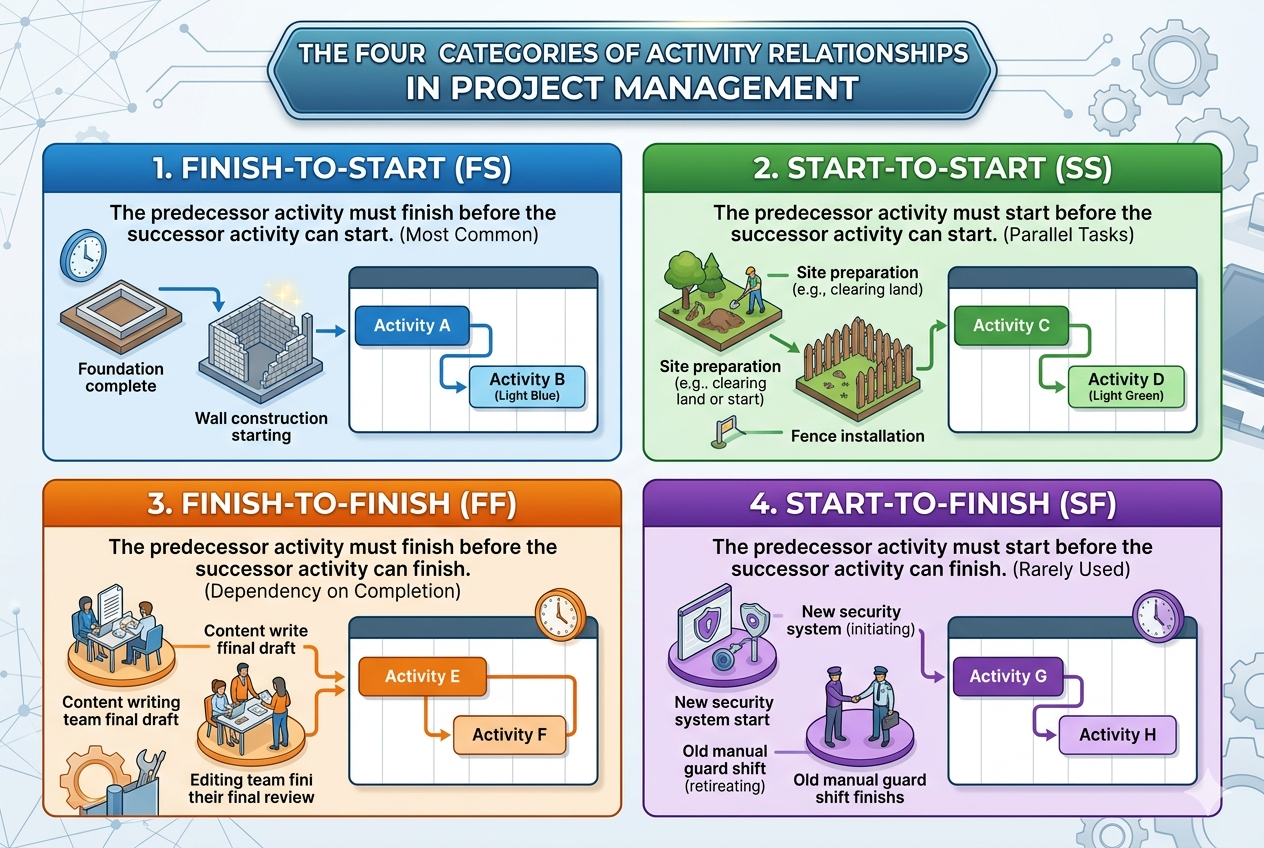
There are four primary types of activity relationships used in project scheduling: Finish to Start, Start to Start, Finish to Finish, and Start to Finish. Each type defines a different way in which two activities can be connected. These relationships form the backbone of project scheduling techniques such as the critical path method and are widely used in construction, software development, engineering, business operations, and many other fields where structured planning is required.
Finish to Start Relationship
The Finish to Start relationship is the most common and widely used dependency in project management. In this relationship, one activity must be completed before the next activity can begin. The first activity is referred to as the predecessor, while the second activity is the successor. The successor cannot start until the predecessor has fully finished.
This type of relationship reflects a natural workflow in many real-world scenarios. For example, in construction, the foundation of a building must be completed before walls can be constructed. Similarly, in software development, requirements gathering must be completed before coding begins. The logic behind this relationship is straightforward: certain tasks depend entirely on the completion of previous work before they can proceed.
The Finish to Start relationship helps maintain order and structure in a project. It prevents premature execution of tasks that rely on incomplete information or unfinished deliverables. However, it can also introduce delays if predecessor tasks take longer than expected, which may affect the overall project timeline. Because of this, project managers often pay close attention to critical Finish to Start dependencies when identifying the critical path of a project.
Although it is the most restrictive type of relationship, it is also the most predictable. It ensures that tasks follow a clear sequence, reducing the risk of confusion or rework. In many projects, the majority of dependencies fall under this category.
Start to Start Relationship
The Start to Start relationship occurs when one activity cannot begin until another activity has started. Unlike the Finish to Start relationship, the successor does not need to wait for the predecessor to be completed. Instead, both activities can progress in parallel once the initial activity has begun.
This type of relationship is often used when tasks are partially independent but still require coordination. For example, in software development, testing may begin as soon as coding starts. The testers do not need to wait for the entire software to be completed; instead, they can begin testing modules as soon as they are developed. Similarly, in event planning, marketing activities may begin once event planning has started, even if the planning process is not yet complete.
The Start to Start relationship allows for overlapping work, which can significantly reduce project duration. By enabling parallel execution of tasks, it improves efficiency and resource utilization. However, it also requires careful coordination because both activities are progressing simultaneously. Any delay in the predecessor activity may impact the start or progress of the successor activity.
Project managers often use lag time in Start to Start relationships. Lag time refers to the delay between the start of the predecessor and the start of the successor. This helps fine-tune scheduling and ensures that dependencies are realistic and achievable.
While this relationship increases flexibility, it also increases complexity in project tracking. Proper communication and monitoring are essential to ensure that both activities remain aligned throughout the project lifecycle.
Finish to Finish Relationship
The Finish to Finish relationship defines a dependency where one activity cannot finish until another activity has finished. In this case, the completion of both tasks is linked, but their start times do not necessarily depend on each other.
This type of relationship is commonly used when two activities are closely connected in terms of deliverables but can begin independently. For example, in content production, writing and editing may be two separate activities. Writing may start first, but editing cannot be completed until writing is finished. However, editing does not necessarily need to wait for the entire writing process to begin; it can proceed alongside it. Both activities, however, must finish around the same time for the final output to be complete.
Another example can be found in manufacturing processes where quality inspection cannot be completed until production is finished. Even if inspection begins earlier, the final approval depends on the completion of production output.
The Finish to Finish relationship helps synchronize tasks that contribute to a shared deliverable. It ensures that dependent activities conclude in coordination, preventing incomplete outputs from moving forward in the project lifecycle.
Like other relationships, lag time can also be applied in Finish to Finish dependencies. This allows one activity to finish slightly earlier or later than the other, depending on project requirements.
This relationship is particularly useful in projects where final outputs must be aligned, even if the tasks themselves are executed independently. It enhances coordination at the completion stage of project activities.
Start to Finish Relationship
The Start to Finish relationship is the least common and often the most complex type of dependency in project management. In this relationship, one activity cannot finish until another activity starts. In other words, the start of the successor activity triggers the completion of the predecessor activity.
This type of relationship is rarely used in traditional project environments but can be found in specific operational or shift-based systems. For example, in a 24-hour customer support center, the night shift may not end until the morning shift starts. The presence of the incoming team allows the outgoing team to complete their work and leave.
Another example can be seen in live operations or continuous service environments where one process must continue until another process takes over. This ensures uninterrupted workflow and smooth transition between tasks or teams.
The Start to Finish relationship is counterintuitive compared to other dependencies, which is why it is less frequently applied. However, in situations where continuity of operations is critical, it becomes an important scheduling tool.
Due to its unusual nature, careful planning is required when using this relationship. Mismanagement can lead to confusion in scheduling and resource allocation. It is typically used only when there is a strong operational justification.
Importance of Activity Relationships in Project Management
Understanding activity relationships is essential for effective project planning and execution. These relationships help project managers define the logical sequence of tasks and identify dependencies that may affect the project timeline. Without clearly defined relationships, projects can become disorganized, leading to delays, resource conflicts, and inefficiencies.
Activity relationships also play a key role in identifying the critical path of a project. The critical path is the sequence of activities that determines the minimum project duration. Any delay in critical path activities directly impacts the overall project completion time. By analyzing relationships between activities, project managers can better understand where flexibility exists and where strict scheduling is required.
Another important benefit of defining activity relationships is improved resource management. When tasks are properly sequenced or overlapped, resources such as personnel, equipment, and materials can be allocated more efficiently. This reduces downtime and ensures that work progresses smoothly.
Additionally, activity relationships support better risk management. By understanding dependencies, project managers can anticipate potential delays and take corrective actions in advance. This proactive approach helps minimize disruptions and keeps the project on track.
Conclusion
The four types of activity relationships—Finish to Start, Start to Start, Finish to Finish, and Start to Finish—form the foundation of project scheduling and planning. Each relationship defines a unique way in which tasks depend on one another and influences how work is organized and executed within a project.
Finish to Start ensures sequential execution, Start to Start enables parallel progress, Finish to Finish aligns completion of related tasks, and Start to Finish supports continuous operational transitions. Together, these relationships provide the structure needed to manage complex projects effectively.
By understanding and applying these relationships correctly, project managers can create realistic schedules, improve efficiency, reduce delays, and ensure successful project delivery.