Modern enterprise networks are built with one primary expectation: continuous availability. Organizations depend on uninterrupted access to applications, services, and communication platforms. Even a short network outage can affect business operations, reduce productivity, and in some cases cause financial loss. Because of this, redundancy mechanisms are a core part of network design. Redundancy ensures that if one device or path fails, another immediately takes over without affecting end users.
One of the most important areas where redundancy is required is the default gateway. Every device in a network needs a gateway to communicate outside its local subnet. If that gateway fails, devices lose access beyond their local network. Hot Standby Router Protocol (HSRP) is designed to solve this exact problem by providing a virtual gateway that is shared between multiple Layer 3 devices. When implemented on Layer 3 switches, HSRP becomes a powerful tool for achieving high availability in enterprise environments.
Understanding Layer 3 Switch Architecture and Its Role
Layer 3 switches combine the capabilities of switching and routing in a single device. Unlike Layer 2 switches that only forward traffic within the same broadcast domain using MAC addresses, Layer 3 switches can make forwarding decisions based on IP addresses. This allows them to perform routing between VLANs internally, improving performance and reducing dependency on external routers.
In a typical enterprise design, Layer 3 switches are placed in the distribution or core layer of the network. They handle inter-VLAN routing and act as default gateways for end devices. Each VLAN interface on a Layer 3 switch is assigned an IP address that functions as the gateway for that VLAN. However, if that single switch fails, all devices connected to it lose external connectivity. This limitation makes redundancy essential, and HSRP provides a structured solution to eliminate this single point of failure.
Fundamentals of Hot Standby Router Protocol (HSRP)
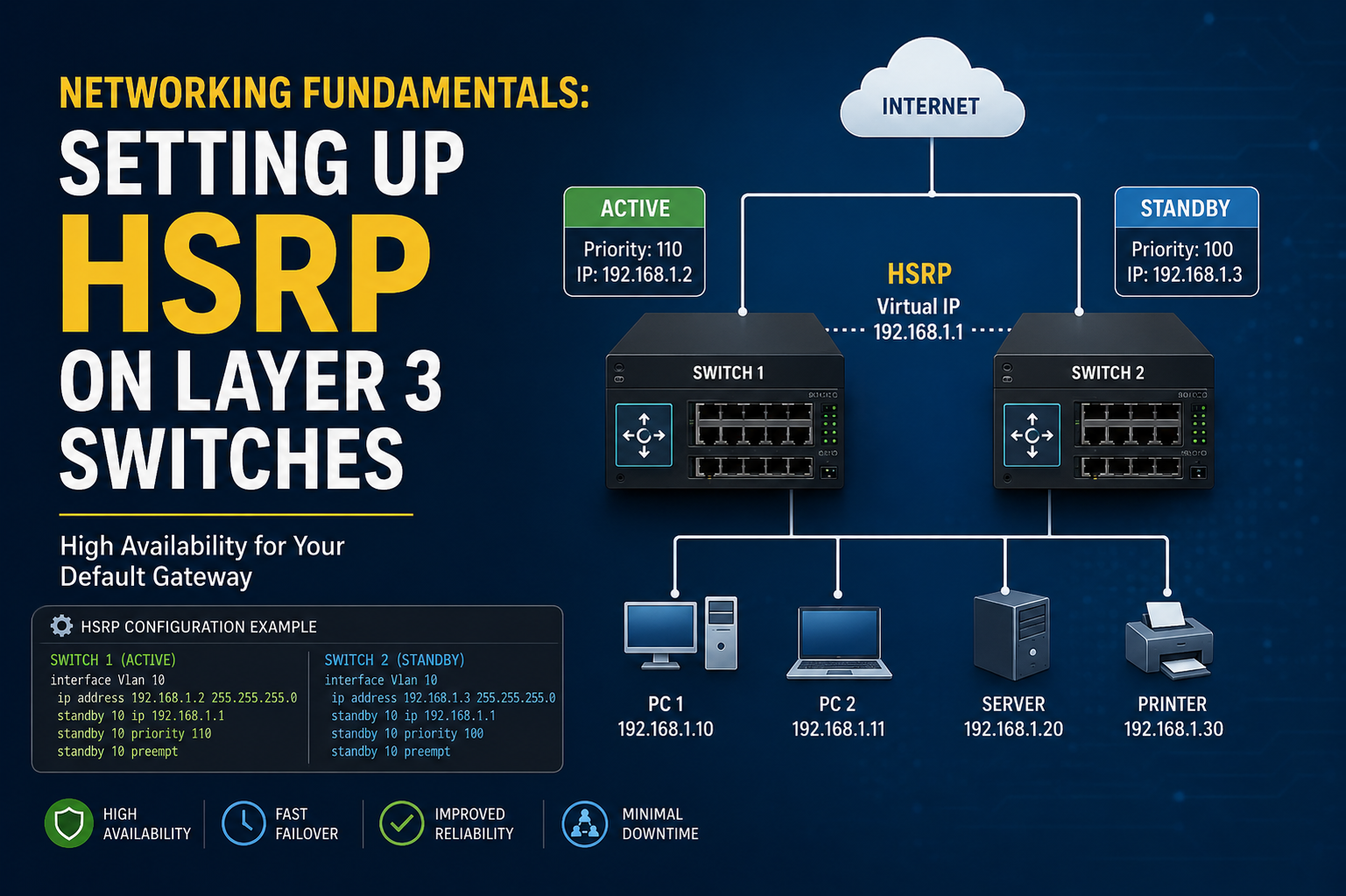
HSRP is a Cisco-developed first-hop redundancy protocol designed to provide network gateway resilience. It works by creating a group of routers or Layer 3 switches that share a virtual IP address. This virtual IP is configured as the default gateway on end devices instead of using the physical IP address of any single device.
Within an HSRP group, one device becomes the active router responsible for forwarding traffic. Another device remains in standby mode, continuously monitoring the active device. If the active device fails, the standby device immediately takes over using the same virtual IP address. This failover process is transparent to end users, meaning they do not need to change configurations or reconnect manually.
HSRP uses both a virtual IP address and a virtual MAC address. The virtual MAC address is automatically generated based on the HSRP group number. This ensures that devices in the network always send traffic to the same logical gateway regardless of which physical device is active at the moment.
HSRP Roles and Operational States
HSRP defines specific roles for devices within a group. The active router is responsible for forwarding all packets sent to the virtual gateway. The standby router remains ready to take over if the active router becomes unavailable. Additional routers in the group remain in a listening state, waiting for an opportunity to become standby if needed.
The transition between states is controlled by periodic hello messages exchanged between devices. These messages confirm that each device is operational. If the standby device stops receiving hello messages from the active device within a defined hold time, it assumes that the active device has failed and initiates a role transition.
The state machine in HSRP ensures stability by preventing unnecessary role changes. Devices do not immediately switch roles upon minor delays or packet loss. Instead, they rely on timers and verification to ensure that a failure has truly occurred before triggering a failover.
Priority Mechanism and Active Device Selection
The selection of the active router in HSRP is based on priority values assigned to each device. Each device in the group is configured with a priority value ranging from 0 to 255. The device with the highest priority becomes the active router. If two devices have the same priority, the device with the higher IP address is selected.
Priority values allow network administrators to control which device should ideally handle traffic. For example, a more powerful Layer 3 switch can be assigned a higher priority so that it becomes the primary gateway under normal conditions. This ensures efficient use of network resources.
HSRP also supports preemption, which allows a device with a higher priority to take over the active role when it becomes available after a failure or reboot. Without preemption, the current active device continues its role even if a better candidate becomes available later. Preemption ensures that the network always uses the most preferred device as the active gateway.
Hello Messages, Hold Timers, and Failover Behavior
HSRP relies on hello packets to maintain communication between devices. These packets are sent periodically by the active router to inform other devices that it is still operational. The standby router listens for these messages and uses them to monitor the health of the active router.
If hello packets are not received within the hold time, the standby router assumes that the active router is no longer functioning. It then transitions to the active state and begins forwarding traffic using the virtual IP address. This process is designed to be fast and seamless to minimize downtime.
The default timer values are designed to provide a balance between stability and responsiveness. However, in environments requiring faster failover, these timers can be adjusted. Shorter timers allow quicker detection of failures but may increase network overhead due to more frequent messaging.
Interface Tracking for Intelligent Failover Decisions
In more advanced implementations, HSRP can be combined with interface tracking. Interface tracking allows a device to adjust its priority based on the status of specific interfaces. For example, if a Layer 3 switch loses its uplink to the core network, its priority can be automatically reduced.
This dynamic adjustment ensures that the most suitable device remains the active router. Without interface tracking, a device could remain active even if it loses critical connectivity, leading to suboptimal routing. By linking priority to interface status, HSRP becomes more intelligent and responsive to real network conditions.
HSRP Configuration Concepts on Layer 3 Switches
Configuring HSRP on Layer 3 switches begins with enabling routing capabilities on the device. Each VLAN interface is assigned an IP address that acts as the physical gateway for that switch. After this, an HSRP group is created on the VLAN interface, and a virtual IP address is defined.
This virtual IP is what end devices use as their default gateway. Both Layer 3 switches in the redundancy pair are configured with the same virtual IP but different physical IPs. Priority values are then assigned to determine which switch will act as the active router.
Preemption is enabled if automatic role switching is required based on priority changes. Additional configuration options include interface tracking and timer adjustments. Once configured, both switches begin exchanging hello messages and establish their roles within the HSRP group.
Design Considerations for Enterprise Deployment
Designing HSRP in enterprise networks requires careful planning. One important consideration is VLAN distribution across multiple switches. Instead of relying on a single switch for all VLANs, different switches can be configured as active gateways for different VLANs. This creates a form of load balancing while maintaining redundancy.
Another important factor is physical topology. Layer 3 switches should be placed in redundant pairs, often at the distribution layer. They should also be connected using multiple links to ensure that a single cable failure does not affect communication between devices.
Network engineers must also consider convergence time requirements. Applications that require high availability, such as voice or financial systems, may need faster failover mechanisms. In such cases, timer tuning and interface tracking become critical components of the design.
Common Issues in HSRP Deployments and Their Causes
Although HSRP is reliable, configuration mistakes can lead to issues. One common problem is mismatched HSRP group numbers or virtual IP addresses, which prevents devices from forming a proper redundancy group. Another issue arises when VLAN configurations are inconsistent between switches.
Preemption misconfiguration can also cause unexpected behavior. If preemption is disabled, the network may continue using a suboptimal active router even after a better device becomes available. Similarly, incorrect priority settings may lead to unintended selection of the active device.
Physical connectivity issues such as failed trunk links or misconfigured interfaces can also disrupt HSRP operation. In such cases, devices may lose communication, triggering unnecessary failovers or instability.
Troubleshooting HSRP in Layer 3 Environments
Troubleshooting HSRP involves checking several key components. First, interface status should be verified to ensure that VLAN interfaces are operational. Next, HSRP state information should be examined to confirm whether devices are in active, standby, or initial states.
Consistency between configuration parameters is critical. Group numbers, virtual IP addresses, and authentication settings must match on all participating devices. Any mismatch can prevent proper formation of the HSRP group.
Monitoring tools and diagnostic commands help identify issues related to failover, timers, or interface tracking. Regular testing of failover scenarios is also important to ensure that redundancy behaves as expected under real failure conditions.
Best Practices for Reliable HSRP Implementation
To ensure a stable HSRP deployment, several best practices should be followed. Configuration consistency across all devices is essential. Priority values should be carefully planned based on device capacity.
Preemption should be enabled when deterministic control over active roles is required. Interface tracking should be used in environments with multiple uplinks to ensure intelligent failover decisions. Timer adjustments should be made carefully to balance speed and stability.
Proper documentation of HSRP configurations helps simplify troubleshooting and future upgrades. Regular monitoring of HSRP states ensures that any anomalies are detected early before they impact users.
Conclusion
HSRP is a fundamental protocol for achieving high availability at the network gateway level. When implemented on Layer 3 switches, it ensures that end devices always have a reliable default gateway, even in the event of hardware or link failures.
By combining virtual IP addressing, priority-based role selection, and automatic failover mechanisms, HSRP eliminates single points of failure in enterprise networks. Its integration with Layer 3 switching enhances both performance and reliability, making it a critical component of modern network design.
A well-planned HSRP deployment requires careful attention to configuration, topology, and operational behavior. When properly implemented, it provides seamless redundancy that supports business continuity and ensures that network services remain consistently available under all conditions.