Network cables may not receive as much attention as cloud computing, cybersecurity, or artificial intelligence, but they remain one of the most important parts of any IT infrastructure. Every internet connection, server communication, VoIP call, and data transfer depends on reliable cabling. Choosing the wrong cable type can lead to safety violations, poor network performance, higher maintenance costs, and even serious fire hazards.
Two of the most commonly discussed cable types in commercial networking are plenum cables and riser-rated cables. While they may appear nearly identical from the outside, they are engineered for completely different environments. Understanding their differences is essential for IT professionals, network installers, facilities managers, and business owners responsible for maintaining safe and efficient networking systems.
Knowing when to use plenum cable and when to use riser-rated cable can help prevent costly installation mistakes and ensure compliance with building safety regulations. These cable types are specifically designed to handle different airflow and fire-protection conditions inside buildings, making proper selection critical for both performance and safety.
What Is a Plenum Cable?
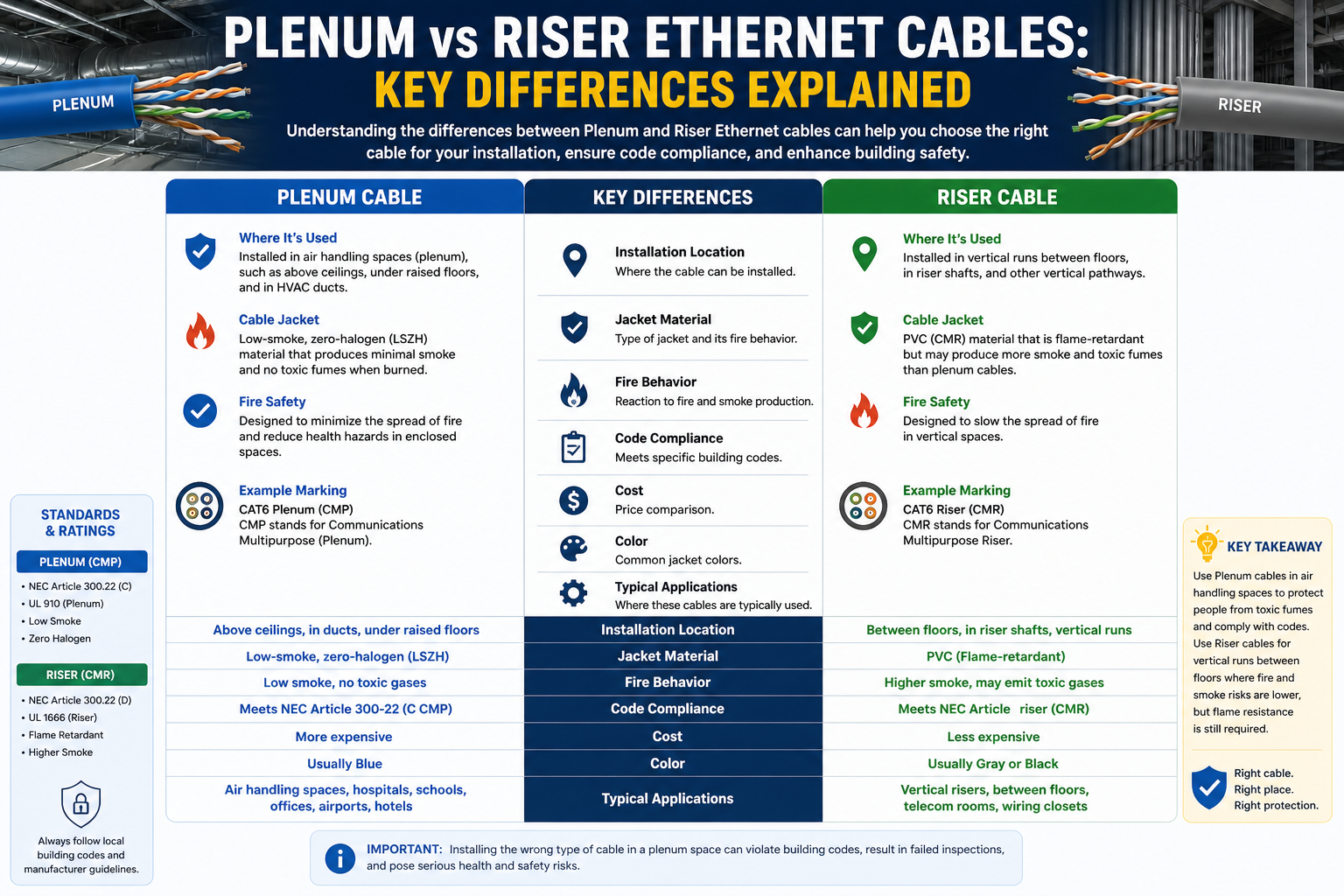
Plenum cable is a specialized Ethernet cable designed for installation in plenum spaces within buildings. A plenum space refers to any area used for air circulation in heating, ventilation, and air conditioning systems. Common examples include the open space above suspended ceilings or below raised floors where air moves throughout a building.
Because these spaces circulate breathable air, any fire or smoke generated inside them can spread rapidly through the structure. For this reason, plenum cables are manufactured with highly fire-resistant materials that produce very little smoke when exposed to flames.
Most plenum-rated cables use jackets made from low-smoke materials such as fluorinated ethylene polymer or specially treated PVC compounds. These materials help reduce toxic smoke emissions and slow the spread of flames during a fire emergency.
Plenum cables are usually labeled CMP, which stands for Communications Multipurpose Plenum. This designation confirms that the cable meets strict fire safety standards required for plenum installations.
Why Plenum Cables Are Important
The primary advantage of plenum cable is safety. In commercial buildings where hundreds of people may be present, reducing smoke toxicity during a fire can save lives. Smoke inhalation often causes more injuries during fires than flames themselves, making low-smoke cable materials extremely valuable.
Plenum cables also help organizations comply with building codes and fire regulations. Many local and national electrical codes require plenum-rated cable in air-handling spaces. Failure to use the correct cable can result in failed inspections, expensive replacement projects, or legal liabilities.
Another benefit is long-term reliability. Plenum cables are designed to maintain performance standards even in demanding environmental conditions. They are commonly used in schools, hospitals, office buildings, government facilities, and data centers where safety standards are strict.
Common Applications of Plenum Cable
Plenum cables are typically installed in locations where air circulates freely throughout the building. These environments include:
- Suspended ceilings in office buildings
- Raised flooring systems in data centers
- HVAC air-return spaces
- Educational institutions
- Healthcare facilities
- Airports and government buildings
In many modern office buildings, networking cables run above drop ceilings because this provides convenient access for maintenance and expansion. Since these ceiling spaces often serve as air pathways for HVAC systems, plenum-rated cable becomes mandatory.
Data centers may also use plenum cable beneath raised floors where cooling systems direct airflow toward servers and networking equipment.
Limitations of Plenum Cable
Although plenum cable offers superior fire protection, it also comes with several disadvantages.
The biggest drawback is cost. Plenum-rated cable is significantly more expensive than riser-rated cable because of the specialized materials used in manufacturing. Large installations can become costly very quickly, especially in enterprise environments with extensive cabling requirements.
Plenum cable is also somewhat stiffer than other cable types. The fire-resistant jacket can make installation more difficult, particularly when routing cable through tight bends or crowded conduits.
Additionally, using plenum cable in areas where it is not required may increase project expenses unnecessarily. While plenum cable can technically be used almost anywhere, many organizations choose riser-rated cable in non-plenum environments to reduce costs.
What Is a Riser-Rated Cable?
Riser-rated cable is another type of Ethernet cable specifically designed for vertical cable runs between floors in multi-story buildings. These vertical pathways are commonly known as risers and usually include wall cavities, conduits, or utility shafts connecting different levels of a structure.
Riser-rated cables are manufactured to resist fire spread between floors. Unlike plenum cable, however, they are not designed for air-handling spaces. Their fire resistance standards focus primarily on preventing flames from rapidly traveling upward through vertical shafts.
Most riser-rated cables are labeled CMR, meaning Communications Multipurpose Riser. This rating confirms compliance with fire safety standards intended for vertical installations.
Riser cable jackets are typically made from materials that provide good fire resistance while remaining more flexible and affordable than plenum cable materials.
Advantages of Riser-Rated Cable
One of the biggest benefits of riser-rated cable is affordability. Because the materials used are less expensive, organizations can significantly reduce cabling costs in large installations.
Riser cable is also easier to install. Its more flexible jacket simplifies routing through walls, conduits, and cable trays. Installers often prefer working with riser cable because it bends more easily and requires less effort during large-scale deployments.
Another advantage is that riser-rated cable still provides strong fire protection for vertical applications. It is specifically engineered to prevent flames from spreading quickly between building floors, helping contain fires within isolated areas.
For many office buildings and apartment complexes, riser cable offers an excellent balance between safety, performance, and cost-effectiveness.
Common Applications of Riser-Rated Cable
Riser-rated cable is commonly used in:
- Vertical cable shafts
- Wall cavities
- Utility risers between floors
- Apartment buildings
- Office towers
- Multi-level educational facilities
- Commercial networking closets
Whenever Ethernet cables need to move from one floor to another without entering air-handling spaces, riser-rated cable is often the preferred option.
For example, a network installer wiring a five-story office building may use riser cable to connect telecommunications closets on each floor while reserving plenum cable only for ceiling spaces that handle airflow.
Limitations of Riser-Rated Cable
Despite its advantages, riser-rated cable has important limitations.
The most critical limitation is that riser cable cannot legally or safely be installed in plenum spaces. Doing so may violate building codes and increase fire risks because riser cable produces more smoke and toxic fumes when burned.
Riser cable also offers slightly lower fire resistance compared to plenum cable in high-airflow environments. While it performs well in enclosed walls and shafts, it is not engineered for open-air circulation systems.
Organizations that incorrectly install riser cable in plenum environments may face inspection failures, costly rewiring projects, and potential safety liabilities.
Key Differences Between Plenum and Riser-Rated Cables
Although both cable types support Ethernet networking and may look nearly identical, their intended environments are completely different.
Plenum cable is designed for horizontal runs in spaces where air circulates through HVAC systems. Its primary purpose is minimizing smoke production and slowing flame spread in airflow environments.
Riser-rated cable, by contrast, is designed for vertical runs between floors. Its focus is containing flames within riser shafts and preventing rapid vertical fire spread.
Another major difference involves material composition. Plenum cables use advanced low-smoke compounds, while riser cables use more affordable fire-resistant materials.
Cost also separates the two. Plenum cable is generally more expensive because of stricter fire safety standards and specialized manufacturing requirements.
Finally, flexibility differs between the two cable types. Riser cable tends to be easier to handle during installation, while plenum cable is usually stiffer and harder to maneuver.
How Building Codes Influence Cable Selection
Building codes play a major role in determining which cable type should be used. Electrical and fire regulations often specify exactly where plenum or riser-rated cable is required.
Inspectors typically examine cable installations carefully during commercial construction or renovation projects. Using the wrong cable type can delay approvals and increase project costs.
The National Electrical Code provides general guidelines for cable safety, but local regulations may introduce additional requirements. Some jurisdictions enforce even stricter standards for hospitals, schools, and government facilities.
Before beginning any cabling project, installers should verify local code requirements and consult building inspectors if necessary.
Choosing the Right Cable for Your Environment
Selecting the proper Ethernet cable depends on several factors.
The first consideration is installation location. If the cable will pass through air-handling spaces, plenum cable is usually required. If the cable runs vertically between floors inside enclosed shafts or walls, riser cable is typically sufficient.
Budget is another important factor. Large installations can involve thousands of feet of cable, making cost differences significant. Organizations often reserve plenum cable only for areas where it is mandatory while using riser cable elsewhere.
Environmental conditions should also be evaluated carefully. Areas with high electromagnetic interference, moisture exposure, or heavy machinery may require additional cable protection or shielding.
Future scalability matters as well. Installing higher-quality cable during initial construction can simplify future network upgrades and reduce replacement costs later.
Understanding Shielded Ethernet Cables
Some networking environments require shielded twisted pair cables to protect against electromagnetic interference. These cables include metallic shielding that reduces signal disruption caused by nearby electrical equipment.
Shielded cables are especially useful in factories, industrial facilities, hospitals, and data centers where electrical noise levels are high.
However, shielded cables require proper grounding. Incorrect grounding can create signal problems instead of preventing them. Poor installations may lead to intermittent connectivity, packet loss, or reduced performance.
When using shielded cables alongside plenum or riser-rated designs, installers must ensure that both fire safety requirements and grounding standards are properly followed.
Troubleshooting Ethernet Cable Connectivity Problems
Even properly installed cables can experience connectivity issues over time. Physical damage, interference, improper termination, and environmental conditions can all impact network performance.
The first troubleshooting step is visual inspection. Check for sharp bends, crushed sections, loose connectors, or exposed wiring. Damaged cable jackets can compromise shielding and signal quality.
Next, verify cable terminations. Improperly crimped connectors often cause intermittent connectivity problems and packet errors.
Cable routing should also be examined. Ethernet cables placed too close to fluorescent lights, electrical motors, or power lines may experience electromagnetic interference.
Cable testing tools are extremely valuable during troubleshooting. Continuity testers confirm proper wiring sequences, while advanced cable certifiers measure performance against industry standards such as Cat6 or Cat6a specifications.
Spectrum analyzers and network scanners can help identify hidden interference sources and pinpoint connection failures in large environments.
Real-World Example of Cable Interference
Imagine a manufacturing facility experiencing random network slowdowns during production hours. Initial testing shows no obvious hardware failures, yet packet loss increases whenever heavy machinery operates.
Further investigation reveals that Ethernet cables were installed too close to industrial motors generating strong electromagnetic interference. Shielded cables were present but improperly grounded, reducing their effectiveness.
The solution involves rerouting the cables away from high-interference areas and properly grounding the shielding system. Once completed, network stability improves immediately.
This example highlights how cable selection and installation quality directly affect network reliability.
Conclusion
Plenum and riser-rated Ethernet cables serve different but equally important purposes in modern networking infrastructure. Plenum cable is designed for air-handling spaces where minimizing smoke and flame spread is critical for safety. Riser-rated cable is intended for vertical runs between floors where controlling fire movement through shafts and walls is the main concern.
Understanding these differences helps organizations maintain compliance with building codes while ensuring safe and reliable network performance. Choosing the wrong cable can lead to failed inspections, unnecessary expenses, and increased safety risks.
Successful cabling projects require careful planning, proper installation practices, and awareness of environmental conditions. Whether designing a small office network or deploying infrastructure across a large enterprise building, selecting the correct cable type is one of the most important decisions an installer can make.
Reliable networking starts with the right foundation, and in many cases, that foundation begins with choosing the correct Ethernet cable.