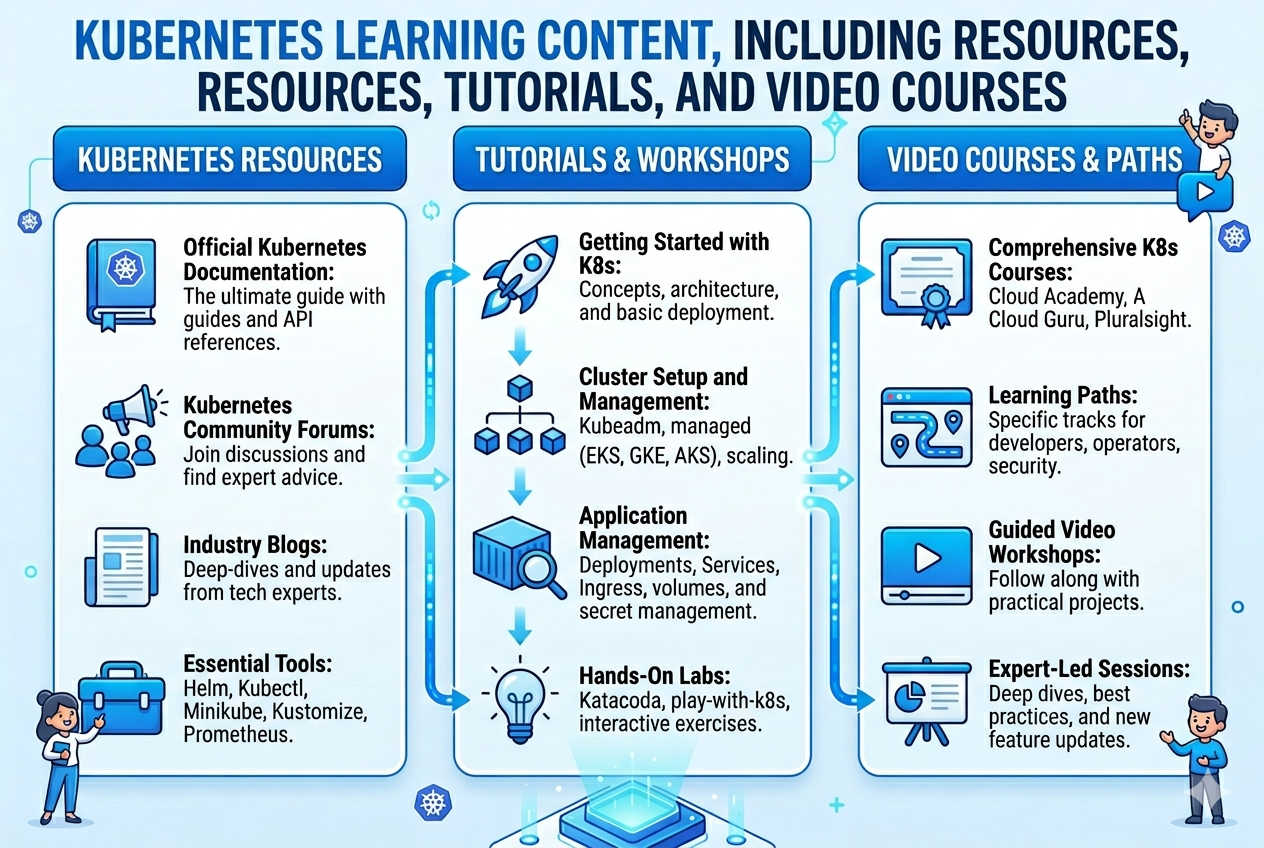
Kubernetes is a highly advanced container orchestration system designed to manage applications that run inside containers across clusters of machines. Learning Kubernetes requires more than memorizing commands; it requires understanding how distributed systems operate, how workloads are scheduled, and how applications remain resilient in changing environments. At its core, Kubernetes abstracts infrastructure complexity and provides a unified way to deploy, scale, and manage applications efficiently.
The learning journey typically begins with understanding why container orchestration exists in the first place. Modern applications are rarely single processes running on one machine. Instead, they are composed of multiple services that must communicate with each other, scale independently, and remain available even during failures. Kubernetes solves this by grouping containers into logical units, managing their lifecycle, and ensuring desired states are maintained continuously.
Before diving deeper into Kubernetes itself, it is important to understand container technology. Containers package applications along with their dependencies so they can run consistently across environments. Once this concept is clear, Kubernetes becomes the system that coordinates these containers at scale, ensuring they are deployed, replaced when they fail, and distributed efficiently across available computing resources.
Understanding Kubernetes Architecture in Depth
Kubernetes architecture is based on a master-worker model. The control plane manages the overall state of the system, while worker nodes run the actual applications. This separation allows Kubernetes to maintain stability even when workloads scale massively.
The control plane includes components that make global decisions about the cluster. It schedules workloads, monitors system health, and maintains configuration consistency. Worker nodes, on the other hand, are responsible for running pods, which are the smallest deployable units in Kubernetes.
Each node contains essential components that allow it to communicate with the control plane and manage containers. These components ensure that instructions from the control plane are executed correctly and that running applications remain healthy.
Understanding this architecture is critical because most Kubernetes troubleshooting and design decisions depend on how these components interact. When something goes wrong, it is usually due to miscommunication between the control plane and worker nodes or incorrect configuration of workloads.
Core Kubernetes Objects and Their Roles
Kubernetes uses several core objects to define and manage applications. Among the most important are pods, deployments, services, and namespaces. Each object serves a specific purpose in maintaining system organization and application behavior.
Pods are the smallest deployable units and typically contain one or more containers that share networking and storage resources. They are ephemeral, meaning they can be created and destroyed dynamically. Because of this, pods are not usually managed directly in production environments.
Deployments provide a higher-level abstraction for managing pods. They define how many replicas of an application should run and ensure that updates are applied smoothly without downtime. Deployments also handle rollback scenarios when updates fail, making them essential for production-grade systems.
Services enable communication between different parts of an application. Since pods are constantly changing, services provide a stable networking endpoint that automatically routes traffic to healthy pods. This abstraction simplifies internal and external communication significantly.
Namespaces allow logical separation within a Kubernetes cluster. They are commonly used to isolate environments such as development, testing, and production within the same infrastructure.
Working with Kubernetes Clusters and Environments
A Kubernetes cluster consists of multiple machines working together to run containerized applications. Setting up a cluster can be done in different ways depending on learning goals. Local environments are often used for practice, while cloud-based clusters simulate real production systems.
When working with clusters, understanding how resources are allocated is essential. Each node has limits on CPU and memory, and Kubernetes schedules workloads based on availability and defined constraints. This ensures that applications are distributed efficiently without overloading individual machines.
Cluster management also involves monitoring node health. If a node becomes unhealthy, Kubernetes automatically redistributes workloads to other available nodes. This self-healing capability is one of the key strengths of the system and is central to its reliability.
Introduction to kubectl and Command-Line Interaction
The primary way to interact with Kubernetes is through a command-line tool that communicates with the cluster. This tool allows users to create resources, inspect system status, and debug applications.
Learning how to use this interface effectively is crucial because almost all Kubernetes operations are performed through it. Common actions include deploying applications, viewing logs, describing resources, and scaling workloads.
Understanding output formats and resource states helps in diagnosing issues quickly. For example, a pod may appear as running but still fail internally due to configuration errors or missing dependencies. Being able to interpret system feedback is an important skill in Kubernetes operations.
Pods and Container Lifecycle Management
Pods represent the most fundamental execution unit in Kubernetes. Each pod encapsulates one or more containers that share the same network identity and storage volumes. This design allows containers within a pod to communicate efficiently using local networking.
The lifecycle of a pod includes creation, scheduling, execution, and termination. Kubernetes constantly monitors pod health and replaces failed pods automatically. This ensures that applications remain available even when individual containers fail.
Understanding how pods are scheduled across nodes is also important. Kubernetes uses scheduling algorithms that consider resource availability, constraints, and affinity rules to decide where pods should run.
Deployments and Application Scaling Strategies
Deployments are used to manage the desired state of applications. Instead of manually creating pods, users define a deployment configuration that specifies how many replicas should exist and how updates should be handled.
Scaling applications is one of the key features of deployments. When demand increases, additional replicas can be created automatically or manually. Similarly, when demand decreases, unnecessary replicas are removed to optimize resource usage.
Rolling updates allow applications to be updated without downtime. Kubernetes gradually replaces old versions of pods with new ones, ensuring continuous availability. If something goes wrong during the update process, the system can automatically roll back to a previous stable version.
Networking Concepts in Kubernetes
Networking is one of the most complex aspects of Kubernetes. Every pod receives its own IP address, allowing direct communication between pods without additional network translation layers. However, because pods are ephemeral, direct communication is not reliable for long-term interactions.
Services solve this problem by providing stable endpoints that route traffic to appropriate pods. Different service types exist depending on whether communication is internal or external.
Cluster networking also involves rules for how traffic flows between nodes and how external users access applications. Understanding these patterns is essential for designing scalable and secure systems.
Configuration Management and Secrets Handling
Applications often require configuration data such as environment variables, configuration files, and credentials. Kubernetes provides dedicated objects to manage this information separately from application code.
Configuration objects allow non-sensitive data to be injected into containers at runtime. This makes applications more flexible and easier to manage across different environments.
Sensitive data such as passwords or API keys is handled separately through secure storage mechanisms. These values are encrypted and only exposed to containers that explicitly require them.
Proper management of configuration and secrets is critical for maintaining security and scalability in production systems.
Storage and Persistent Data Management
Many applications require persistent storage that survives container restarts. Kubernetes provides mechanisms for connecting containers to external storage systems.
Persistent volumes allow data to exist independently of pod lifecycle. This ensures that important information such as databases, logs, and user-generated content is not lost when containers are recreated.
Storage management also includes defining storage classes and dynamic provisioning, which automate the process of allocating storage resources when needed.
Debugging and Troubleshooting Kubernetes Applications
Troubleshooting is an essential skill when working with Kubernetes. Applications may fail due to configuration errors, resource limitations, networking issues, or image problems.
Understanding how to inspect logs, describe resources, and analyze system events helps identify root causes quickly. Many issues appear at the pod level but originate from higher-level misconfigurations.
Effective debugging also involves understanding cluster-wide behavior, such as node pressure, scheduling failures, or resource exhaustion.
Hands-On Practice and Learning Progression
Practical experience is the most important part of learning Kubernetes. Reading concepts alone is not enough; hands-on experimentation is required to build real understanding.
A good approach is to start with simple workloads such as deploying a single containerized application. From there, gradually introduce complexity by adding services, scaling replicas, and simulating failures.
Building small real-world scenarios such as multi-tier applications helps reinforce how different Kubernetes components interact. Over time, these exercises build intuition for how systems behave under different conditions.
Developing Advanced Kubernetes Understanding
As learners progress, they begin exploring advanced topics such as autoscaling, ingress management, and observability. These concepts are used in production environments where systems must handle unpredictable workloads and maintain high availability.
Autoscaling allows applications to adjust resource usage dynamically based on demand. Ingress management controls how external traffic enters the cluster. Observability tools help monitor system performance and detect issues early.
Mastering these advanced concepts requires both theoretical understanding and repeated hands-on practice in realistic environments.
Building Long-Term Kubernetes Skills
Kubernetes is not a technology that can be learned quickly. It requires continuous learning, experimentation, and exposure to real-world scenarios. Over time, learners develop the ability to design scalable systems, troubleshoot complex issues, and manage distributed applications efficiently.
The key to mastery lies in consistent practice, curiosity, and the ability to connect different concepts into a unified understanding of how distributed systems operate.
Kubernetes Ecosystem and Tooling Landscape
The Kubernetes ecosystem extends far beyond the core platform itself. While Kubernetes provides the foundation for container orchestration, real-world usage depends heavily on a wide range of supporting tools and integrations. These tools help with deployment automation, monitoring, security, networking, and application delivery. Understanding this ecosystem is essential because Kubernetes alone rarely exists in isolation in production environments.
A major part of the ecosystem includes package management tools that simplify application deployment. Instead of manually creating multiple resource definitions, these tools allow applications to be packaged into reusable formats. This makes it easier to install, upgrade, and manage complex applications across different environments. Over time, this approach has become the standard way of distributing Kubernetes applications.
Another important category includes tools for cluster management and visualization. These tools provide dashboards that help users understand cluster health, resource usage, and workload distribution. While command-line tools remain powerful, visual interfaces make it easier for beginners and operators to monitor systems and identify issues quickly.
Monitoring, Logging, and Observability in Kubernetes
Observability is one of the most important aspects of managing Kubernetes at scale. Since Kubernetes runs distributed systems, issues can occur in multiple layers simultaneously. Monitoring tools help track system health, while logging systems capture detailed information about application behavior.
Metrics provide quantitative insights such as CPU usage, memory consumption, and request rates. These metrics are crucial for understanding how applications perform under load. By analyzing trends, operators can identify bottlenecks before they become critical failures.
Logging provides a deeper view into application behavior. Each container generates logs that can be aggregated and analyzed centrally. This allows developers and operators to trace errors, debug failures, and understand system behavior over time.
Tracing is another important component of observability. It helps track requests as they move through multiple services in a distributed system. This is especially useful in microservices architectures where a single user request may pass through several components before completing.
Security Concepts in Kubernetes Environments
Security in Kubernetes is a multi-layered concept that includes authentication, authorization, network policies, and workload isolation. Since Kubernetes often runs critical applications, securing clusters is essential to prevent unauthorized access and data breaches.
Authentication ensures that only valid users or systems can access the cluster. Authorization defines what actions those users are allowed to perform. Together, these mechanisms control access to cluster resources and prevent misuse.
Network security is another important layer. Kubernetes allows administrators to define rules that control how pods communicate with each other. These rules help isolate sensitive workloads and prevent unwanted traffic between services.
Container security is also critical. Since containers share the host operating system kernel, vulnerabilities can lead to broader system risks. Best practices include using minimal base images, scanning for vulnerabilities, and restricting container permissions.
Scaling Strategies and Performance Optimization
One of Kubernetes’ strongest features is its ability to scale applications efficiently. Scaling can be horizontal or vertical depending on application needs. Horizontal scaling involves adding more instances of a workload, while vertical scaling increases the resources allocated to existing instances.
Automatic scaling mechanisms adjust resources based on real-time demand. This ensures that applications remain responsive during traffic spikes while minimizing resource waste during low usage periods.
Performance optimization also involves fine-tuning resource requests and limits. These settings help Kubernetes make better scheduling decisions and prevent workloads from consuming excessive resources.
Efficient scaling requires understanding workload behavior. Some applications scale linearly with traffic, while others may require more complex strategies involving caching, load balancing, or asynchronous processing.
Networking Deep Dive and Service Communication
Networking in Kubernetes is built on the principle that every pod should be able to communicate with every other pod without complex network address translation. This simplifies application design but introduces challenges in routing and traffic management.
Services act as stable abstraction layers that route traffic to dynamic sets of pods. This ensures that even if pods are replaced or moved, communication remains uninterrupted.
Ingress resources provide external access to services within the cluster. They define rules for routing external HTTP or HTTPS traffic to internal services. This is commonly used for exposing web applications.
Advanced networking configurations include service meshes, which provide additional control over service-to-service communication. These systems manage traffic routing, retries, security, and observability at a granular level.
Stateful Applications and Data Persistence Challenges
While Kubernetes is often associated with stateless applications, many real-world systems require persistent state. Databases, message queues, and storage systems need stable data storage across restarts.
Stateful workloads are managed using specialized mechanisms that ensure consistent identity and storage allocation. Unlike stateless pods, stateful applications require stable network identities and persistent storage bindings.
Managing stateful applications introduces additional complexity, especially when scaling or recovering from failures. Backup strategies, replication, and data consistency become critical considerations.
Storage systems integrated with Kubernetes allow dynamic provisioning of storage resources. This ensures that applications can request and use storage without manual intervention.
CI/CD Integration and Automation Workflows
Kubernetes plays a central role in modern continuous integration and continuous deployment workflows. Automation pipelines build, test, and deploy applications directly into Kubernetes clusters.
CI/CD pipelines help ensure that new code changes are tested and deployed consistently. This reduces human error and accelerates delivery cycles. Kubernetes enables seamless rolling updates and rollbacks, making it ideal for automated deployments.
Automation also includes infrastructure provisioning. Entire clusters and environments can be created and managed using declarative configurations. This approach improves reproducibility and reduces configuration drift between environments.
Multi-Cluster and Hybrid Deployments
As organizations grow, they often operate multiple Kubernetes clusters across different environments or regions. Multi-cluster setups improve availability, reduce latency, and provide disaster recovery options.
Managing multiple clusters introduces new challenges such as synchronization, configuration consistency, and traffic distribution. Specialized tools and strategies are used to manage workloads across clusters efficiently.
Hybrid deployments combine on-premises infrastructure with cloud-based clusters. This allows organizations to balance cost, performance, and regulatory requirements.
Real-World Application Architectures on Kubernetes
Kubernetes is widely used to host microservices architectures, where applications are broken into smaller independent services. Each service runs in its own container and communicates through APIs or messaging systems.
This architecture improves scalability and maintainability but requires careful design of service boundaries. Kubernetes supports this model well by providing service discovery, load balancing, and independent scaling.
Another common use case is hosting machine learning workloads. Kubernetes can manage training jobs, distributed processing, and model deployment in a scalable way.
Common Challenges in Kubernetes Adoption
Despite its power, Kubernetes introduces complexity. One of the biggest challenges is the learning curve. Understanding how all components interact requires time and hands-on experience.
Another challenge is debugging distributed systems. Issues may span multiple services, making root cause analysis difficult. Effective logging and monitoring systems are essential to address this.
Resource management can also be challenging. Improper configuration may lead to inefficient resource usage or application instability.
Best Practices for Effective Kubernetes Usage
Successful Kubernetes usage requires following best practices in design, security, and operations. Applications should be designed to be stateless where possible, enabling easier scaling and recovery.
Resource limits should always be defined to prevent workloads from consuming excessive resources. Security policies should be applied to restrict unnecessary access.
Automation should be used wherever possible to reduce manual intervention. Infrastructure should be defined declaratively to ensure consistency across environments.
Continuous Skill Development in Kubernetes
Kubernetes evolves rapidly, and staying updated is essential. New features, tools, and best practices are continuously introduced. Developers and operators must regularly practice and explore new concepts to remain effective.
Hands-on experimentation remains the most valuable learning method. Building real systems, breaking them, and fixing them provides deeper understanding than theoretical study alone.
Over time, consistent practice leads to intuitive understanding of distributed systems, enabling confident design and management of scalable applications in production environments.
Kubernetes Production Architecture and System Design Thinking
In production environments, Kubernetes is not just a platform for running containers but a complete system for designing scalable, resilient, and self-healing applications. At this stage of learning, the focus shifts from basic usage to architectural thinking. This means understanding how applications are structured, how services interact under load, and how failures are handled without affecting users.
A production-grade Kubernetes setup is designed with redundancy in mind. Multiple nodes exist to ensure that if one fails, workloads are automatically redistributed. This design requires careful planning of resource allocation, network design, and service boundaries. The goal is to ensure that no single point of failure can bring down the system.
Application design in Kubernetes also emphasizes loose coupling. Instead of tightly connected components, systems are broken into independent services that communicate through well-defined interfaces. This allows each service to scale independently and be updated without affecting the entire system.
Cluster Federation and Large-Scale Operations
As systems grow, organizations often move beyond a single cluster. Multiple clusters may be deployed across different regions or cloud providers to improve performance and reliability. Managing these clusters individually becomes inefficient, so higher-level coordination strategies are used.
Cluster federation allows multiple Kubernetes clusters to be managed as a unified system. This approach enables workload distribution across regions and improves disaster recovery capabilities. If one cluster fails, workloads can be shifted to another cluster with minimal disruption.
Large-scale operations also require standardization. Consistent naming conventions, deployment strategies, and resource policies help maintain order across complex environments. Without these standards, managing large Kubernetes systems becomes extremely difficult.
Advanced Scheduling and Resource Allocation
Kubernetes scheduling is more than just placing pods on available nodes. It involves evaluating multiple constraints such as CPU, memory, storage, affinity rules, and taints. These factors ensure that workloads are placed in optimal locations based on their requirements.
Affinity and anti-affinity rules allow fine-grained control over pod placement. For example, certain applications may need to run close to each other for performance reasons, while others must be separated for reliability. These rules help design efficient and resilient systems.
Resource allocation also involves priority management. Some workloads are more critical than others and must be prioritized during resource contention. Kubernetes supports this through priority classes that influence scheduling decisions.
Fault Tolerance and Self-Healing Systems
One of the most powerful features of Kubernetes is its ability to automatically recover from failures. This self-healing behavior ensures that applications remain available even when underlying infrastructure fails.
If a container crashes, Kubernetes automatically restarts it. If a node becomes unhealthy, workloads are rescheduled to healthy nodes. If an application does not respond correctly, health checks detect the issue and trigger recovery actions.
Health checks include readiness probes and liveness probes. Readiness probes determine when a container is ready to serve traffic, while liveness probes detect whether a container is still functioning correctly. These mechanisms are essential for maintaining system stability.
Service Mesh and Advanced Traffic Control
In complex microservices environments, controlling traffic between services becomes increasingly important. A service mesh provides a dedicated infrastructure layer for managing service-to-service communication.
This layer handles routing, load balancing, encryption, and observability without requiring changes to application code. It provides advanced capabilities such as traffic splitting, retries, and circuit breaking.
Service meshes also improve security by enabling mutual authentication between services. This ensures that only trusted services can communicate within the cluster.
Identity, Access Control, and Governance
As Kubernetes environments scale, managing access becomes critical. Identity and access control systems ensure that users and applications only have permissions necessary for their roles.
Role-based access control defines what actions users can perform within the cluster. This includes creating resources, viewing logs, or modifying configurations. Proper configuration of access control reduces security risks significantly.
Governance policies are also applied at scale to enforce organizational standards. These policies ensure compliance with security requirements, resource usage rules, and deployment practices.
Disaster Recovery and Backup Strategies
In production systems, failure is not a possibility but an expectation. Disaster recovery strategies ensure that systems can recover quickly from unexpected failures.
Backups of critical data and configuration are essential. Persistent storage systems must be replicated or backed up regularly to prevent data loss. Recovery processes should be tested to ensure reliability.
Cluster-level disaster recovery involves recreating environments from predefined configurations. Infrastructure as code plays a key role in this process, allowing entire systems to be rebuilt consistently.
Cost Optimization and Resource Efficiency
Running Kubernetes at scale can become expensive if resources are not managed properly. Cost optimization involves balancing performance with resource usage.
Right-sizing workloads ensures that applications only use the resources they need. Over-provisioning leads to wasted resources, while under-provisioning can cause performance issues.
Autoscaling mechanisms help adjust resource usage dynamically based on demand. This ensures that systems remain efficient during both high and low traffic periods.
Observability at Scale and Distributed Tracing
At production scale, observability becomes more complex. Simple monitoring is not enough to understand system behavior. Distributed tracing becomes essential for tracking requests across multiple services.
Tracing helps identify performance bottlenecks and failure points in microservices architectures. It provides a complete view of how requests flow through the system.
Combining metrics, logs, and traces creates a full observability stack. This allows operators to diagnose issues quickly and understand system behavior in detail.
Kubernetes in Cloud-Native Architectures
Kubernetes is a core component of cloud-native architecture. Cloud-native systems are designed to take full advantage of dynamic infrastructure, scalability, and automation.
In this model, applications are built to run in distributed environments where resources can change dynamically. Kubernetes provides the foundation for this by managing workloads across flexible infrastructure.
Cloud-native design also emphasizes automation, resilience, and observability. These principles align closely with Kubernetes capabilities, making it a natural fit for modern application development.
Machine Learning and Data Workloads on Kubernetes
Kubernetes is increasingly used for machine learning and data processing workloads. These workloads often require large-scale compute resources and distributed processing capabilities.
Kubernetes can manage training jobs, data pipelines, and inference services. It allows workloads to scale based on compute requirements and provides isolation between different tasks.
This makes it easier to manage complex data workflows and deploy machine learning models in production environments.
Real-World System Design Patterns
Several design patterns emerge when working with Kubernetes in production. One common pattern is the microservices architecture, where each service is independently deployable and scalable.
Another pattern is event-driven architecture, where services communicate through events rather than direct requests. This improves scalability and decouples system components.
Batch processing systems are also commonly deployed on Kubernetes, where workloads are executed in scheduled or on-demand jobs.
Operational Challenges at Enterprise Scale
Operating Kubernetes at enterprise scale introduces challenges related to governance, complexity, and coordination. Managing hundreds or thousands of services requires strong operational discipline.
Configuration drift can become a problem when environments are not standardized. Automation and infrastructure as code help reduce these risks.
Another challenge is debugging distributed failures. Issues may span multiple clusters and services, requiring advanced diagnostic tools and expertise.
Evolving Kubernetes Skills and Career Growth
Mastering Kubernetes is a continuous journey. As systems grow in complexity, so does the need for deeper understanding. Professionals working with Kubernetes often expand their skills into areas such as cloud architecture, DevOps, and distributed systems design.
Practical experience remains the most important factor in skill development. Working on real systems, solving failures, and optimizing performance builds expertise over time.
Kubernetes knowledge becomes especially powerful when combined with system design thinking, allowing engineers to build large-scale, resilient, and efficient platforms.
Kubernetes Automation, GitOps, and Infrastructure as Code
As Kubernetes usage matures in real environments, automation becomes the backbone of reliable operations. Manual deployment and configuration quickly become unmanageable when systems grow, so teams rely heavily on declarative approaches where the desired state of infrastructure is defined in code rather than executed step by step.
Infrastructure as code allows entire Kubernetes environments to be described in version-controlled files. This includes clusters, networking rules, storage configurations, and application deployments. The system continuously reconciles the actual state with the desired state, ensuring consistency across environments.
GitOps extends this idea further by using version control systems as the single source of truth for deployments. Any change to the system is made through code commits, and automated controllers apply those changes to the cluster. This approach improves traceability, reduces human error, and ensures that every change is auditable and reversible.
Automation pipelines also play a major role in modern Kubernetes workflows. Applications are built, tested, and deployed automatically. This reduces deployment time and ensures consistent delivery practices across teams. Over time, automation becomes essential for maintaining stability in large-scale systems.
Kubernetes Extensibility and Custom Resources
One of the most powerful aspects of Kubernetes is its extensibility. The platform is designed not only to manage containers but also to be extended for new types of workloads and workflows. This is achieved through custom resources and controllers.
Custom resources allow users to define new object types beyond the default Kubernetes objects. These can represent application-specific concepts such as databases, machine learning pipelines, or messaging systems. Controllers continuously monitor these resources and ensure they behave as expected.
This extensibility transforms Kubernetes into a general-purpose orchestration system rather than just a container manager. It allows organizations to build platforms on top of Kubernetes that are tailored to their specific needs.
Platform Engineering and Internal Developer Platforms
In large organizations, Kubernetes is often abstracted into internal platforms for developers. Instead of interacting directly with Kubernetes, developers use higher-level interfaces that simplify deployment and management.
Platform engineering focuses on building these internal systems. The goal is to reduce complexity for application developers while still leveraging the power of Kubernetes underneath. This includes standardized deployment templates, automated environments, and self-service infrastructure.
Internal developer platforms improve productivity by hiding infrastructure complexity. Developers can focus on writing application code while the platform handles scaling, networking, and security automatically.
Multi-Tenancy and Resource Isolation
In shared Kubernetes environments, multiple teams or applications often run on the same cluster. This introduces the need for strong isolation between workloads to ensure security and stability.
Multi-tenancy is achieved through namespaces, resource quotas, and access controls. These mechanisms ensure that each team or application has controlled access to resources without interfering with others.
Resource isolation is critical in preventing noisy neighbor problems, where one workload consumes excessive resources and impacts others. Proper configuration ensures fair distribution of compute, memory, and storage across tenants.
Edge Computing and Distributed Kubernetes
Kubernetes is no longer limited to centralized data centers. It is increasingly used in edge computing environments where workloads run closer to users or devices.
Edge deployments introduce unique challenges such as limited resources, intermittent connectivity, and distributed management. Kubernetes adapts to these environments by enabling lightweight clusters that can operate independently while still being centrally managed.
This model is particularly useful for IoT systems, retail environments, and remote data processing scenarios where low latency is critical.
Hybrid Cloud Strategies with Kubernetes
Modern organizations often use a combination of on-premises infrastructure and multiple cloud providers. Kubernetes provides a consistent layer across these environments, enabling hybrid cloud strategies.
With Kubernetes, applications can be deployed across different infrastructures without major changes. This flexibility allows organizations to optimize cost, performance, and compliance requirements.
Hybrid setups also improve resilience by allowing workloads to shift between environments in case of failures or capacity constraints.
Advanced Security Models and Zero Trust Architecture
Security in Kubernetes continues to evolve toward zero trust models. In this approach, no component is automatically trusted, even if it exists within the cluster.
Every request is authenticated, authorized, and encrypted. Services must verify each other’s identity before communication is allowed. This reduces the risk of internal breaches and lateral movement by attackers.
Security policies are enforced at multiple layers, including network, application, and infrastructure levels. Continuous scanning and auditing ensure that vulnerabilities are detected early.
Performance Engineering and Optimization at Scale
As Kubernetes clusters grow, performance engineering becomes essential. This involves analyzing system behavior, identifying bottlenecks, and optimizing resource usage.
Performance tuning includes optimizing pod placement, adjusting resource limits, and improving network efficiency. It also involves reducing latency between services and ensuring efficient use of compute resources.
Workload profiling helps understand how applications behave under different conditions. This information is used to improve system design and scalability.
Future of Kubernetes and Cloud Native Systems
The future of Kubernetes is closely tied to the evolution of cloud-native computing. As systems become more distributed and complex, the need for orchestration platforms continues to grow.
Kubernetes is expected to become even more integrated with automation, artificial intelligence, and edge computing. Future developments will likely focus on simplifying operations, improving security, and enhancing scalability.
The ecosystem around Kubernetes will continue to expand, introducing new tools and abstractions that make it easier to build and manage distributed systems.
Learning Strategy for Mastering Kubernetes
Mastering Kubernetes requires a structured and consistent learning approach. It is not a technology that can be fully understood through theory alone. Practical experience is essential at every stage.
A strong learning strategy begins with foundational concepts and gradually moves toward real-world system design. Each stage should involve hands-on experimentation, failure analysis, and problem-solving.
Building small projects, breaking systems intentionally, and fixing them is one of the most effective ways to gain deep understanding. Over time, this builds intuition for how distributed systems behave.
Continuous learning is also necessary because Kubernetes evolves rapidly. Staying updated with new features, tools, and best practices ensures long-term expertise.
Conclusion
Kubernetes represents one of the most important advancements in modern infrastructure management. It provides a powerful foundation for building scalable, resilient, and automated systems in distributed environments.
Learning Kubernetes is not just about mastering a tool but understanding the principles of distributed computing, system design, and automation. It brings together concepts from networking, storage, security, and software engineering into a unified platform.
The journey from beginner to advanced Kubernetes practitioner involves continuous learning, hands-on practice, and real-world experience. As complexity increases, so does the importance of architectural thinking and operational discipline.
Ultimately, Kubernetes enables the creation of modern cloud-native systems that are flexible, efficient, and capable of handling large-scale workloads. Mastering it opens the door to advanced roles in cloud engineering, DevOps, and system architecture, making it a highly valuable skill in today’s technology landscape.