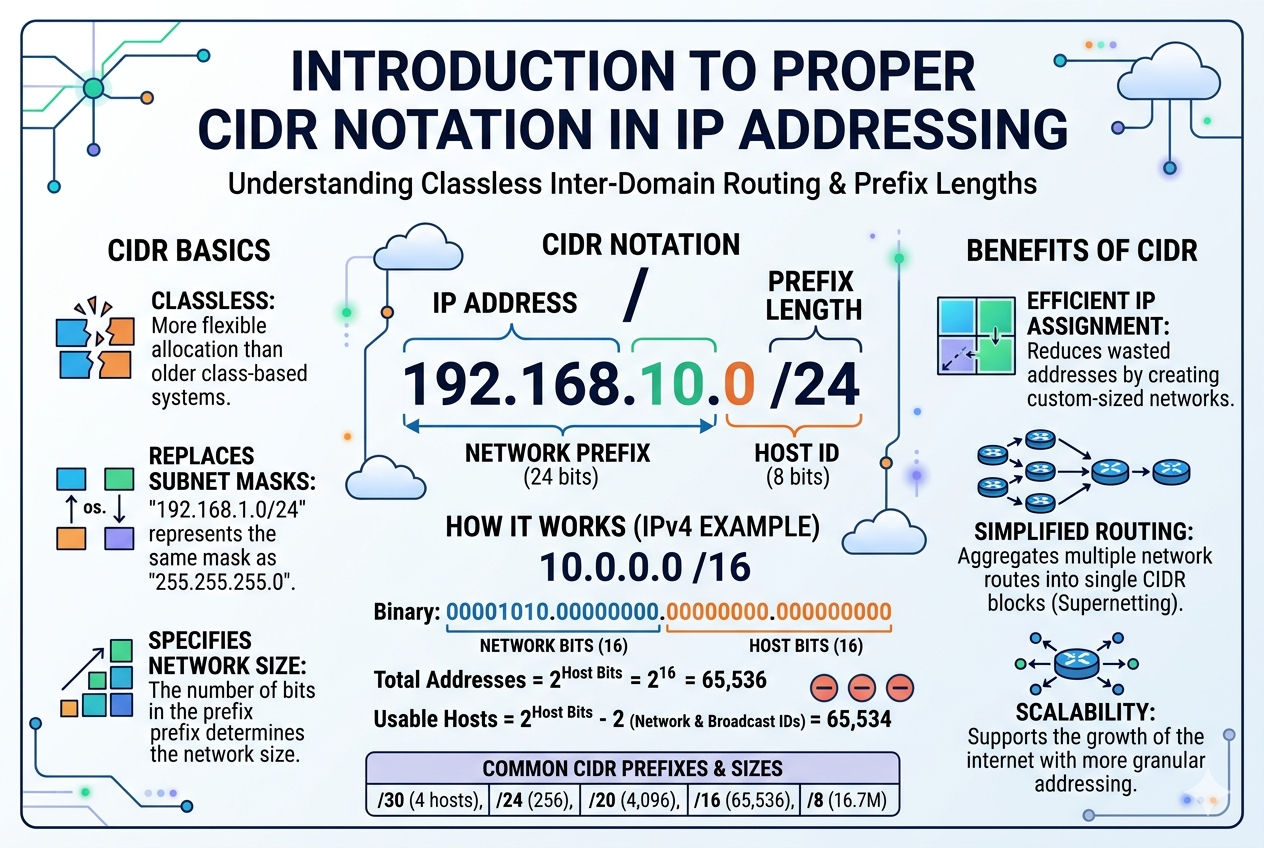
Internet Protocol addressing forms the backbone of modern digital communication, enabling devices across different networks to locate and communicate with each other. Every device connected to a network is assigned a unique IP address, which serves as its identity in the digital environment. Traditionally, IP addresses were organized using a class-based system, where addresses were divided into fixed categories with predefined network and host portions. However, this rigid structure often led to inefficient utilization of available addresses, especially as the number of connected devices grew rapidly.
To overcome these limitations, a more flexible approach was introduced, allowing network boundaries to be defined dynamically rather than being restricted to fixed classes. This shift marked a significant improvement in how networks were designed, managed, and scaled. CIDR notation emerged as a solution that brought efficiency, flexibility, and better control over IP address allocation.
Concept of CIDR Notation in Networking
CIDR notation is a method used to represent IP addresses along with their associated network prefix in a compact and meaningful format. Instead of relying on predefined classes, it uses a suffix to indicate how many bits of the address are dedicated to the network portion. This allows for precise definition of network size and structure.
An IP address written in CIDR format consists of two parts: the actual IP address and the prefix length. The prefix length indicates the number of bits used for the network segment, while the remaining bits are allocated for host addresses within that network. This flexible structure allows networks to be customized according to specific requirements, making it far more efficient than earlier methods.
Evolution from Class-Based Addressing to CIDR
The earlier class-based system divided IP addresses into fixed categories such as large, medium, and small networks. While this approach was simple, it lacked flexibility and often resulted in wasted address space. Organizations frequently received more addresses than they needed or too few to accommodate growth, leading to inefficiencies.
CIDR was introduced to eliminate these constraints by allowing networks to be defined with variable sizes. Instead of being locked into predefined classes, network administrators could now allocate IP addresses based on actual need. This transition significantly improved the scalability of the internet and helped manage the rapid expansion of connected devices.
Structure and Interpretation of CIDR Format
In CIDR notation, the structure is straightforward yet powerful. An IP address is followed by a slash and a number that represents the network prefix length. This number indicates how many bits from the left side of the address are reserved for the network portion.
For example, when an IP address is written in CIDR format, the prefix determines the size of the network and how many devices can be supported within it. A smaller prefix value indicates a larger network with more available host addresses, while a larger prefix value represents a smaller, more specific network segment.
This method allows networks to be broken down into smaller sub-networks or combined into larger ones depending on organizational needs. The flexibility offered by this structure is one of the key reasons CIDR is widely adopted in modern networking.
Role of Subnetting in CIDR
Subnetting is closely related to CIDR and plays a crucial role in dividing larger networks into smaller, manageable segments. By adjusting the prefix length, network administrators can create multiple subnets within a single IP range. This improves organization, enhances security, and optimizes network performance.
CIDR simplifies subnetting by removing the restrictions of fixed class boundaries. Instead of being limited to predefined subnet sizes, administrators can design networks with precise address allocation. This ensures that IP addresses are used efficiently without unnecessary waste.
Subnetting through CIDR also improves network traffic management. By dividing networks into smaller segments, data flow can be controlled more effectively, reducing congestion and improving overall communication speed.
Efficiency and Optimization in IP Allocation
One of the most significant advantages of CIDR notation is its ability to optimize IP address usage. In traditional systems, large blocks of addresses were often allocated even when not fully needed. This led to rapid depletion of available IPv4 addresses.
CIDR addresses this issue by enabling variable-length allocation. Networks can be sized according to actual demand, ensuring that no address space is unnecessarily wasted. This efficient allocation is essential in maintaining the sustainability of IP address resources, especially in large-scale networks.
Additionally, CIDR helps reduce the complexity of routing tables. By grouping multiple IP ranges into a single route entry, it minimizes the amount of information routers need to process, thereby improving network performance.
Route Aggregation and Simplified Routing
CIDR plays a key role in route aggregation, which is the process of combining multiple network routes into a single entry. This technique is essential for maintaining efficient routing across the internet.
Without CIDR, routing tables would become extremely large and difficult to manage, as each network would require a separate entry. With CIDR, contiguous IP ranges can be summarized into a single routing prefix, significantly reducing the size of routing tables.
This simplification not only improves the speed of routing decisions but also enhances the scalability of global networks. Routers can process information more efficiently, leading to faster data transmission and reduced network overhead.
Variable Length Subnet Masking and Flexibility
CIDR is closely associated with variable length subnet masking, which allows different subnet masks to be applied within the same network. This provides greater flexibility in designing network architectures.
Instead of using a fixed subnet mask for all networks, administrators can assign different masks based on specific requirements. This ensures that each subnet is appropriately sized for its intended use, avoiding both over-allocation and under-utilization of IP addresses.
This adaptability is especially important in complex network environments where different departments or systems require varying levels of connectivity and address space.
Real-World Application of CIDR Concepts
In practical networking environments, CIDR is used extensively in both private and public networks. Organizations use it to structure their internal networks efficiently, ensuring that different departments or systems are properly segmented.
Internet service providers rely on CIDR to allocate IP address blocks to customers in an organized manner. This allows them to manage large pools of addresses without creating unnecessary complexity.
Cloud computing environments also depend heavily on CIDR for network configuration. Virtual networks, subnets, and routing policies are all designed using CIDR notation to ensure scalability and flexibility.
Benefits of Using CIDR in Modern Networks
CIDR provides several important benefits that make it essential in modern networking. It significantly improves IP address utilization by allowing precise allocation based on actual requirements. It enhances routing efficiency by reducing the size of routing tables through aggregation.
It also supports scalable network design, enabling organizations to expand their infrastructure without major restructuring. Additionally, CIDR improves overall network performance by reducing unnecessary data processing and simplifying communication pathways.
These advantages make CIDR a fundamental concept in both theoretical and practical aspects of networking.
Challenges and Considerations in CIDR Implementation
While CIDR offers many advantages, it also requires careful planning and understanding. Incorrect assignment of prefix lengths can lead to inefficient network design or connectivity issues. Proper subnet planning is essential to ensure that networks function optimally.
Network administrators must also be familiar with binary calculations and address structures to effectively implement CIDR-based designs. Without proper knowledge, there is a risk of misconfiguration that can affect network performance.
Despite these challenges, the benefits of CIDR far outweigh its complexities, making it a standard practice in modern network engineering.
Importance of CIDR in Scalable Network Design
As networks continue to grow in size and complexity, CIDR plays a critical role in ensuring scalability. It allows networks to expand without requiring complete redesigns, as address spaces can be adjusted dynamically.
This scalability is particularly important in large organizations and global internet infrastructure, where millions of devices must be efficiently managed. CIDR provides the flexibility needed to accommodate this growth while maintaining performance and organization.
CIDR Fundamentals
CIDR notation represents a major advancement in the field of IP addressing and network design. By replacing rigid class-based systems with flexible, variable-length prefixes, it enables efficient use of IP resources, improved routing performance, and scalable network architecture.
Its role in subnetting, route aggregation, and address optimization makes it an essential concept for anyone involved in networking. Understanding CIDR is fundamental to designing modern, efficient, and scalable communication systems that support the ever-growing demands of digital connectivity.
Deepening the Role of Prefix Length in Address Planning
In CIDR-based addressing, the prefix length is not just a simple numeric indicator but a critical design element that defines the structure and capacity of a network. It directly influences how many host addresses are available and how a network is segmented. A shorter prefix length means a larger network with more possible host devices, while a longer prefix results in a smaller, more tightly controlled network.
This flexibility allows network architects to carefully plan address allocation based on operational needs. Instead of forcing networks into predefined blocks, CIDR enables precise tuning of network size, ensuring that resources are neither underused nor exhausted too quickly. This approach is especially important in large infrastructures where efficient planning directly impacts performance and scalability.
Binary Structure Behind CIDR Calculation
CIDR notation is deeply rooted in binary representation of IP addresses. Each IP address is ultimately a 32-bit binary number in IPv4 systems. The prefix length determines how many of those bits are dedicated to the network portion, starting from the left.
This binary foundation allows precise mathematical control over network segmentation. By manipulating bits, administrators can divide networks into smaller sub-networks or combine them into larger aggregates. Understanding this binary relationship is essential for accurate subnet planning and troubleshooting network configurations.
Although CIDR appears simple in notation, its underlying mechanism is highly structured and mathematically consistent, making it a powerful tool for advanced networking.
Subnet Granularity and Network Control
One of the most powerful aspects of CIDR is its ability to provide fine-grained control over subnet size. This means networks can be divided into extremely specific segments depending on organizational requirements. For example, a large enterprise can allocate different subnet sizes to departments based on their usage patterns.
This granularity improves both efficiency and security. Smaller subnets reduce broadcast traffic, which enhances performance and minimizes unnecessary data transmission. At the same time, segmentation improves isolation between different parts of a network, reducing the risk of unauthorized access or interference.
CIDR therefore plays a dual role in optimizing both performance and security within modern network environments.
Impact of CIDR on Routing Efficiency
Routing efficiency is one of the most significant improvements introduced by CIDR. In traditional addressing systems, routers had to maintain large tables containing individual routes for every network. This created scalability challenges as the internet expanded.
CIDR addresses this issue through route aggregation, where multiple contiguous networks are represented as a single routing entry. This dramatically reduces the size of routing tables and improves lookup speed.
Fewer routing entries mean faster decision-making by routers, lower memory usage, and improved overall network performance. This efficiency is essential for maintaining the stability of global internet infrastructure, where millions of routes must be processed continuously.
Hierarchical Addressing and Internet Structure
CIDR also introduces a more hierarchical approach to IP addressing. Instead of flat, unrelated address assignments, CIDR allows addresses to be organized in structured blocks that reflect real-world network relationships.
This hierarchy mirrors how networks are physically and logically distributed. Large blocks can be assigned to regional providers, which then subdivide them into smaller allocations for organizations and end users. This layered structure improves manageability and supports efficient global distribution of IP resources.
By organizing addresses hierarchically, CIDR reduces complexity and enhances coordination across different levels of the internet infrastructure.
Address Conservation and IPv4 Limitations
One of the driving forces behind CIDR adoption was the limited availability of IPv4 addresses. As the number of connected devices increased exponentially, it became clear that the existing class-based system would not be sufficient to support global demand.
CIDR significantly extends the usability of IPv4 space by eliminating rigid class boundaries. Instead of wasting large address blocks, networks can be allocated based on actual requirement. This conservation approach has helped prolong the lifespan of IPv4 addressing.
Although IPv6 was introduced to address long-term limitations, CIDR continues to play a vital role in IPv4 management and remains widely used in existing infrastructures.
Flexibility in Network Scaling
Scalability is a core requirement of modern networks, and CIDR provides the necessary flexibility to achieve it. Networks can be expanded or reduced simply by adjusting prefix lengths and reassigning address blocks.
This dynamic scalability allows organizations to adapt quickly to changing demands. Whether expanding infrastructure or optimizing existing systems, CIDR ensures that address planning remains efficient and manageable.
This adaptability is particularly valuable in cloud computing and virtualized environments, where network resources must be adjusted frequently based on workload requirements.
CIDR in Cloud and Virtual Networking
In cloud-based systems, CIDR is used extensively to define virtual networks and subnets. Each virtual network is assigned a CIDR block that determines its internal structure and address availability.
This allows cloud environments to simulate traditional networking principles while maintaining flexibility and scalability. Different virtual networks can be isolated or interconnected depending on configuration, enabling complex architectures to be built efficiently.
CIDR thus forms the foundation of modern cloud networking, supporting everything from basic virtual machines to large-scale distributed systems.
Security Implications of CIDR-Based Design
CIDR also contributes indirectly to network security by enabling better segmentation and control. Smaller subnets reduce exposure to potential threats by limiting the number of devices within a broadcast domain.
Network administrators can isolate sensitive systems within dedicated CIDR blocks, ensuring that access is controlled and monitored more effectively. This segmentation reduces the attack surface and enhances overall security posture.
In combination with firewalls and access control mechanisms, CIDR-based segmentation forms an important layer in network defense strategies.
Operational Efficiency in Large Networks
In large-scale networks, operational efficiency is critical. CIDR helps achieve this by simplifying address management and reducing administrative overhead. Instead of managing multiple fragmented address ranges, administrators can work with structured CIDR blocks.
This simplification reduces configuration errors and improves consistency across network systems. It also makes documentation and troubleshooting more straightforward, as network structures are clearly defined through prefix-based notation.
Efficient management of address space ultimately leads to more stable and reliable network operations.
Real-World Scalability Challenges Solved by CIDR
Before CIDR, scaling networks often required significant restructuring due to rigid address limitations. With CIDR, scaling becomes a gradual and controlled process.
Organizations can grow their networks incrementally without disrupting existing configurations. This reduces downtime and ensures continuity of services during expansion.
CIDR therefore solves one of the most critical challenges in network engineering: how to grow efficiently without sacrificing stability or performance.
Importance of Precision in CIDR Configuration
While CIDR offers flexibility, it also demands precision. Incorrect prefix assignments can lead to overlapping networks, routing issues, or inefficient address usage. Proper planning is essential to ensure that each CIDR block aligns with the intended network design.
Network engineers must carefully calculate address ranges and ensure consistency across systems. This level of precision is necessary to maintain reliable communication and avoid conflicts within complex infrastructures.
Accurate CIDR implementation is therefore a fundamental skill in professional networking environments.
CIDR as a Foundational Networking Concept
CIDR is not just a technical notation but a foundational concept that influences almost every aspect of modern networking. From routing and subnetting to cloud architecture and security design, it plays a central role in shaping how networks operate.
Its introduction marked a major evolution in how IP addresses are managed, replacing inefficiency with structure and scalability. Today, CIDR remains essential for building and maintaining both small and large-scale networks.
Its continued relevance demonstrates its effectiveness as a long-term solution for IP address management and network design challenges.
Scaling Internet Routing with Aggregated Networks
As global internet infrastructure expanded, managing individual network routes became increasingly inefficient. CIDR introduced the concept of aggregation, where multiple smaller networks are grouped into a single, larger routing prefix. This significantly reduces the number of entries stored in routing tables, allowing routers to operate with greater speed and stability.
In large-scale environments such as internet service provider backbones and international routing systems, this aggregation is essential. Without it, routing tables would grow uncontrollably, leading to slower convergence times and higher processing overhead. CIDR ensures that routing remains scalable even as the number of connected networks continues to increase.
Reduction of Routing Complexity Across the Internet
CIDR plays a critical role in reducing the complexity of global routing systems. Instead of maintaining detailed information about every individual subnet, routers can rely on summarized address blocks. This simplification allows for faster decision-making when forwarding data packets across networks.
By minimizing the number of routes that need to be evaluated, CIDR improves overall network responsiveness. It also reduces the likelihood of routing errors, as fewer entries mean fewer chances for misconfiguration. This streamlined approach is fundamental to maintaining the stability of modern internet communication.
Efficient Allocation of IP Address Blocks
CIDR allows internet registries and service providers to allocate IP addresses in a more structured and efficient manner. Rather than distributing large, fixed blocks that may not be fully utilized, CIDR enables precise allocation based on actual demand.
This ensures that organizations receive only the number of addresses they require, reducing wastage and improving global address utilization. It also allows providers to maintain better control over their address pools, ensuring long-term sustainability of IPv4 resources.
Efficient allocation is especially important in regions where IP address availability is limited, making CIDR a critical tool for global resource management.
Role of CIDR in Internet Service Provider Architecture
Internet service providers rely heavily on CIDR to manage their customer networks and internal infrastructure. By assigning CIDR blocks to different customers, providers can organize their address space logically and efficiently.
This structured allocation allows providers to scale their services while maintaining clear separation between different customer networks. It also simplifies network maintenance, as aggregated routes can be used to represent large groups of customers.
CIDR thus forms the backbone of ISP network organization, enabling them to support millions of users without excessive routing complexity.
Load Distribution and Network Performance Optimization
CIDR indirectly contributes to load distribution within networks by enabling better segmentation of address space. When networks are divided into appropriately sized subnets, traffic can be distributed more evenly across systems.
This reduces congestion and improves performance, especially in high-traffic environments. Smaller subnets also help isolate traffic patterns, making it easier to identify and resolve performance issues.
By enabling structured segmentation, CIDR enhances the overall efficiency of data flow across interconnected systems.
CIDR and Network Convergence Speed
Network convergence refers to the time it takes for routers to update their routing tables after a change in the network. CIDR improves convergence speed by reducing the number of routing entries that must be updated.
With aggregated routes, changes in one part of a network can be reflected more efficiently across the system. This reduces downtime and ensures that data continues to flow smoothly even during network changes or failures.
Faster convergence is especially important in large-scale networks where stability and reliability are critical.
Address Planning Strategies Using CIDR
Effective network design requires careful planning of IP address distribution. CIDR enables structured planning by allowing administrators to divide address space based on organizational needs.
For example, different departments within an organization can be assigned separate CIDR blocks based on their size and function. This ensures that each department has sufficient address space while maintaining overall network organization.
Proper planning using CIDR also helps prevent future conflicts and simplifies network expansion.
CIDR in Multi-Layer Network Hierarchies
Modern networks are often structured in multiple layers, including core, distribution, and access layers. CIDR supports this hierarchical design by allowing different levels of address aggregation.
At higher levels, large CIDR blocks represent broad network regions, while lower levels break these blocks into smaller subnets for specific use cases. This hierarchical structure improves scalability and makes network management more intuitive.
It also allows for better control over traffic flow between different layers of the network.
Minimizing Broadcast Domains Through CIDR Design
Broadcast traffic can negatively impact network performance if not properly managed. CIDR helps reduce broadcast domains by enabling smaller, well-defined subnets.
Each subnet created using CIDR has a limited broadcast scope, meaning that broadcast traffic remains contained within that segment. This reduces unnecessary network load and improves overall efficiency.
By limiting broadcast domains, CIDR contributes to more stable and predictable network behavior.
CIDR and Efficient Use of Private IP Addressing
Private IP addressing is commonly used within internal networks, and CIDR plays an important role in organizing these address spaces. Organizations often use CIDR blocks to structure their private networks into logical segments.
This allows internal systems to communicate efficiently while maintaining separation between different functional areas. It also makes it easier to implement network policies and access controls.
CIDR ensures that private networks remain organized and scalable, even as they grow in size and complexity.
Support for Modern Virtualized Environments
Virtualization technologies rely heavily on CIDR for network configuration. Virtual machines, containers, and software-defined networks all use CIDR blocks to define their network boundaries.
This enables dynamic creation and management of virtual networks without requiring physical infrastructure changes. CIDR provides the flexibility needed to allocate addresses on demand in virtual environments.
As a result, it plays a key role in enabling modern cloud computing and distributed system architectures.
CIDR in Network Troubleshooting and Diagnostics
CIDR also assists in network troubleshooting by providing clear structure to address allocation. When issues arise, administrators can quickly identify affected subnets based on CIDR ranges.
This structured approach simplifies diagnostics and reduces the time required to locate problems. It also helps in isolating faulty segments without impacting the entire network.
Clear CIDR-based organization improves operational efficiency during maintenance and troubleshooting activities.
Enhancing Scalability in Enterprise Networks
Enterprise networks must support continuous growth while maintaining performance and reliability. CIDR enables this scalability by allowing networks to expand without major redesign.
New subnets can be added within existing CIDR structures, ensuring that growth is smooth and controlled. This eliminates the need for disruptive reconfiguration and supports long-term infrastructure planning.
CIDR therefore serves as a foundation for scalable enterprise network design.
Long-Term Relevance of CIDR in Networking Evolution
Despite advancements in newer technologies such as IPv6, CIDR remains a core component of networking. Its principles continue to apply in both legacy and modern systems.
The efficiency, flexibility, and scalability offered by CIDR ensure that it remains relevant in evolving network environments. It continues to be a fundamental concept taught and used in networking disciplines worldwide.
Its enduring importance highlights its effectiveness as a solution to address management and routing challenges.
CIDR Advanced Concepts
CIDR represents a major advancement in the evolution of IP addressing and network design. Its ability to optimize routing, improve address utilization, and support scalable architectures makes it indispensable in modern networking.
From internet backbone systems to cloud environments and enterprise networks, CIDR provides the structure needed for efficient and reliable communication. Its role in simplifying complexity while enhancing performance ensures that it remains a cornerstone of networking principles.
Understanding CIDR at an advanced level is essential for designing, managing, and maintaining modern digital infrastructures that require both precision and scalability.
Integration of CIDR with Contemporary Network Models
Modern networking architectures are built on layered and highly dynamic systems where flexibility and scalability are essential. CIDR integrates seamlessly into these models by providing a structured yet adaptable way to manage IP address allocation. Whether in traditional enterprise networks or cloud-native environments, CIDR ensures that address spaces can be designed to match evolving infrastructure requirements.
This integration allows network designers to move away from rigid addressing schemes and instead adopt fluid architectures that can scale horizontally and vertically. CIDR supports this evolution by enabling precise control over how networks are segmented and interconnected.
CIDR and Software-Defined Networking
Software-defined networking relies heavily on abstraction and centralized control of network resources. CIDR plays an important role in this environment by defining address blocks that can be dynamically managed through software controllers.
In such systems, network policies can be applied to CIDR-defined segments, allowing automated provisioning and reconfiguration of network paths. This improves agility and reduces the need for manual intervention in network management.
CIDR therefore acts as a foundational structure upon which software-defined networks build their flexible and programmable behavior.
Dynamic Allocation in Virtualized Infrastructure
Virtualized environments require rapid and flexible allocation of network resources. CIDR supports this requirement by enabling dynamic assignment of IP ranges to virtual machines and containers.
Instead of statically assigning addresses, systems can allocate CIDR blocks on demand, ensuring efficient utilization of available space. This dynamic allocation is essential in environments where workloads frequently change and scale automatically.
CIDR ensures that virtual infrastructure remains organized even as resources are created and destroyed continuously.
CIDR in Multi-Tenant Network Environments
In multi-tenant systems, multiple users or organizations share the same physical infrastructure while maintaining logical separation. CIDR is essential in defining isolated address spaces for each tenant.
Each tenant is assigned a unique CIDR block, ensuring that their network traffic remains separate from others. This improves both security and performance, as it prevents address conflicts and reduces unnecessary interaction between tenants.
This structured segmentation is critical in cloud service providers and hosting environments where resource sharing is fundamental.
Traffic Isolation Through CIDR Segmentation
CIDR-based segmentation enhances traffic isolation by limiting communication boundaries within defined network blocks. Each CIDR-defined subnet operates independently, reducing the risk of cross-network interference.
This isolation is particularly important in environments handling sensitive data or critical applications. By controlling traffic flow at the subnet level, organizations can enforce strict communication rules and improve overall security posture.
CIDR thus contributes to both logical organization and operational safety within complex network systems.
CIDR and Network Policy Enforcement
Network policies such as access control, firewall rules, and routing decisions often rely on CIDR blocks for definition. Instead of applying rules to individual IP addresses, administrators can apply policies to entire address ranges.
This simplifies policy management and ensures consistency across large networks. It also reduces administrative overhead, as fewer rules are needed to manage large groups of devices.
CIDR-based policy enforcement improves both efficiency and clarity in network configuration.
Scalability in Distributed Systems
Distributed systems rely on interconnected nodes that may span multiple geographic locations. CIDR provides a structured way to manage the addressing of these distributed components.
By assigning CIDR blocks to different regions or clusters, system architects can maintain organized communication pathways. This ensures that data flows efficiently between distributed components without unnecessary complexity.
CIDR therefore supports the scalability and reliability required in modern distributed computing environments.
CIDR and Address Hierarchy Optimization
Efficient network design often depends on hierarchical organization of IP addresses. CIDR enables this by allowing address blocks to be divided into structured levels of granularity.
Large address blocks can be subdivided into smaller segments for specific functions, while still maintaining a logical relationship between them. This hierarchy improves both manageability and routing efficiency.
It also allows network administrators to visualize and control address distribution more effectively across different layers of infrastructure.
Impact on Network Performance Optimization
CIDR contributes significantly to overall network performance by reducing routing overhead and improving data flow efficiency. Smaller routing tables allow faster processing, while structured subnetting reduces unnecessary traffic.
This optimization is especially important in high-speed networks where latency and throughput are critical factors. CIDR ensures that network resources are used efficiently, resulting in smoother and more reliable communication.
Performance improvements driven by CIDR are evident across both local and global network systems.
CIDR in Internet Backbone Systems
Internet backbone systems, which form the core of global connectivity, rely heavily on CIDR for efficient operation. These systems handle massive volumes of routing information and require optimized address aggregation to function effectively.
CIDR enables backbone routers to manage large blocks of addresses without maintaining excessive routing entries. This ensures that data can be transmitted across continents with minimal delay and overhead.
Without CIDR, the scalability of global internet infrastructure would be severely limited.
Reducing Administrative Complexity in Networks
Network administration becomes significantly more manageable with CIDR due to its structured approach to address allocation. Instead of dealing with scattered address ranges, administrators work with organized CIDR blocks.
This reduces configuration complexity and minimizes the likelihood of errors during setup or maintenance. It also improves documentation clarity, making it easier to understand network structures.
Simplified administration leads to more reliable and maintainable network systems.
CIDR and Future Network Evolution
As networking continues to evolve, CIDR remains relevant due to its adaptability and efficiency. Even with the gradual transition to IPv6, CIDR principles continue to influence how address spaces are structured and managed.
Future networks are expected to become even more dynamic and automated, and CIDR provides the foundational logic required for such systems. Its flexibility ensures that it can adapt to emerging technologies and architectural changes.
CIDR will continue to play a role in shaping the evolution of network design and management.
Interoperability Across Network Systems
CIDR also supports interoperability between different network systems and technologies. By providing a standardized method of representing IP address ranges, it ensures compatibility across diverse infrastructures.
This standardization is essential in environments where multiple systems must communicate seamlessly. CIDR ensures that address interpretation remains consistent regardless of platform or implementation.
This contributes to the overall cohesion of global networking systems.
CIDR in Hybrid and Multi-Cloud Environments
Modern organizations often use hybrid or multi-cloud architectures that combine multiple cloud providers and on-premise systems. CIDR is essential in coordinating address spaces across these diverse environments.
By carefully assigning CIDR blocks, organizations can avoid overlaps and ensure smooth communication between different platforms. This structured approach enables seamless integration of distributed resources.
CIDR thus plays a critical role in enabling complex hybrid infrastructure designs.
Optimization of Resource Utilization
One of the most important benefits of CIDR is its ability to optimize resource utilization. By ensuring that IP addresses are allocated based on actual need, it prevents waste and improves overall efficiency.
This optimization extends beyond address usage to include routing efficiency, bandwidth utilization, and administrative effort. CIDR ensures that every aspect of network design is aligned with real operational requirements.
Efficient resource utilization is essential for sustainable and scalable network systems.
CIDR Modern Applications
CIDR remains a cornerstone of modern networking due to its flexibility, efficiency, and scalability. It supports a wide range of applications, from cloud computing and virtual networks to global internet infrastructure.
Its ability to simplify complex systems while improving performance makes it indispensable in contemporary network design. As networks continue to grow in size and complexity, CIDR will remain a key principle guiding their structure and operation.
Conclusion
CIDR notation represents a fundamental shift in the way IP addressing is structured and managed, replacing rigid class-based systems with a flexible, efficient, and scalable framework. By allowing networks to be defined through variable-length prefixes, it enables precise control over address allocation and eliminates the inefficiencies that once led to rapid depletion of IPv4 resources.
Across modern networking, CIDR plays a central role in simplifying routing, improving performance, and supporting large-scale infrastructure. Its ability to aggregate routes reduces the size of routing tables, while its support for subnetting allows networks to be segmented in a clean and organized manner. This combination of efficiency and structure makes it essential for both small networks and global internet systems.
In addition to improving technical performance, CIDR also enhances network design, security, and scalability. It supports hierarchical addressing, enables better traffic management, and allows seamless expansion of networks without major redesign. From enterprise environments to cloud platforms and internet backbone systems, CIDR provides the foundation for stable and optimized communication.
Even as networking continues to evolve with newer technologies and IPv6 adoption, CIDR remains deeply relevant. Its principles continue to guide how IP spaces are planned, allocated, and managed. Ultimately, CIDR is not just a notation system but a core concept that ensures modern networks remain efficient, scalable, and sustainable.