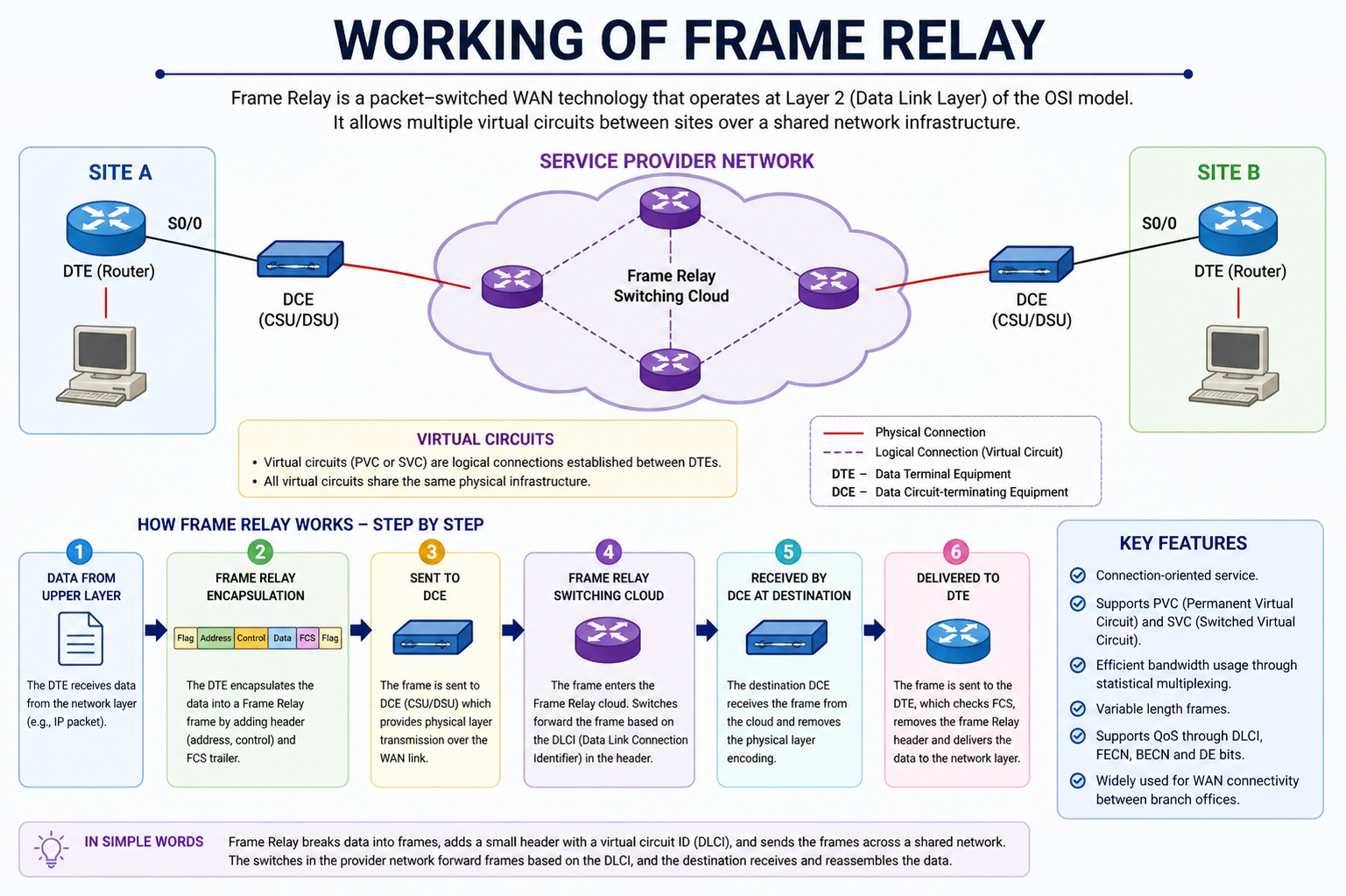
Frame Relay operates using a simplified network architecture that focuses on fast packet forwarding rather than complex error handling. It is built on the idea of sharing a single physical communication line among multiple virtual connections. This structure reduces the need for multiple dedicated lines, making communication more efficient for organizations that need to connect different locations over long distances.
At the core of its architecture are two main components: the customer equipment and the provider network. The customer equipment is responsible for generating and receiving data, while the provider network handles the switching and forwarding of frames across different locations. The separation of responsibilities ensures that the network remains lightweight and efficient.
Data Encapsulation in Frame Relay
When data is sent through a Frame Relay network, it undergoes a process called encapsulation. During encapsulation, the original data is wrapped with a Frame Relay header and trailer. This additional information includes addressing details that help the network deliver the data to the correct destination.
The encapsulated frame contains a simplified structure compared to older communication technologies. It avoids unnecessary overhead, which allows data to travel faster across the network. The reduced complexity of each frame is one of the key reasons why Frame Relay became popular for wide area networking.
Role of Frame Relay Switches
Frame Relay switches are essential devices within the network that handle the movement of data between different locations. These switches examine the incoming frame and read its addressing information to determine where it should be forwarded next.
Unlike traditional routing systems that analyze multiple layers of data, Frame Relay switches focus only on the header information. This streamlined process allows for faster decision-making and reduces delay in data transmission. Each switch acts as an intermediary point that guides frames toward their final destination.
Virtual Circuit Establishment
Communication in Frame Relay is based on virtual circuits, which are logical connections between two endpoints. These virtual circuits are established over a shared physical network, allowing multiple users to communicate simultaneously without requiring separate physical lines.
Permanent Virtual Circuits remain active at all times, making them suitable for regular and continuous communication between two locations. Switched Virtual Circuits, on the other hand, are created only when needed and are terminated after the communication session ends. This flexibility allows the network to efficiently manage resources based on demand.
Each virtual circuit is identified by a unique number that helps in directing traffic correctly. This identifier ensures that data belonging to different users does not get mixed up during transmission.
DLCI and Its Importance in Communication
The Data Link Connection Identifier plays a critical role in Frame Relay networks. It is a number assigned to each virtual circuit and is included in every frame sent across the network. The DLCI helps switches understand where the frame should be delivered.
As frames pass through different switches, the DLCI may be modified to reflect the next segment of the path. This dynamic adjustment allows seamless communication across multiple network points without confusion or data loss. The simplicity of the DLCI system contributes significantly to the efficiency of Frame Relay.
Frame Forwarding Process
The forwarding process in Frame Relay is designed to be extremely fast. When a frame enters the network, the switch immediately reads its DLCI and checks its internal mapping table to determine the next hop. Once identified, the frame is quickly forwarded without deep inspection of its contents.
This method is known as “stateless forwarding” because the network does not maintain detailed information about each packet’s history. The lack of extensive processing reduces latency and allows the network to handle a large number of frames simultaneously.
Congestion Control Mechanisms
Frame Relay includes basic congestion control techniques to manage network traffic. Since multiple users share the same infrastructure, congestion can occur when too much data is transmitted at once. To address this, Frame Relay uses specific indicators embedded within frames.
Forward Explicit Congestion Notification alerts the receiving end that congestion is occurring along the forward path. Backward Explicit Congestion Notification informs the sender to slow down data transmission. These signals help maintain a balance in network traffic and prevent data loss.
Discard Eligibility is another mechanism that allows the network to mark less important frames for removal during heavy congestion. This ensures that critical data has a higher chance of being delivered successfully.
Error Handling Approach
Unlike many other communication technologies, Frame Relay does not perform extensive error correction within the network itself. Instead, it assumes that the underlying physical connections are relatively reliable. If errors occur, they are handled by the end devices rather than the network switches.
This approach significantly reduces processing overhead within the network, allowing faster data transmission. While this means that Frame Relay is not suitable for highly error-sensitive applications, it works well in environments where speed is a higher priority than perfect accuracy.
Bandwidth Allocation and Efficiency
Frame Relay uses a flexible bandwidth allocation system that allows multiple users to share the same communication line. Each user is assigned a certain amount of guaranteed bandwidth, but they can also use additional available capacity when the network is not heavily loaded.
This burst capability makes Frame Relay highly efficient for applications that do not require constant data transmission. It ensures that network resources are not wasted and are distributed dynamically based on demand.
Encapsulation and Frame Structure Behavior
The structure of a Frame Relay frame is designed to be minimal yet effective. It contains essential routing information along with the payload data. The simplicity of the frame structure reduces processing time at each network node.
Because there is less overhead compared to older networking systems, more bandwidth is available for actual data transmission. This efficient use of resources contributes to the high performance of Frame Relay networks.
Network Transparency and Flexibility
Frame Relay provides a transparent communication environment, meaning that it does not alter the data being transmitted. It simply forwards frames based on their addressing information. This transparency ensures compatibility with a wide range of protocols and applications.
The flexibility of Frame Relay allows it to support various types of data traffic, including voice, video, and data services. Although it is not optimized for real-time applications, it can still handle mixed traffic environments effectively.
Reliability Considerations in Frame Relay
While Frame Relay is efficient, it relies heavily on the reliability of the underlying physical network. Since it does not perform error correction internally, the quality of service depends on the infrastructure provided by the network provider.
To compensate for this, higher-level protocols at the endpoints are responsible for ensuring data integrity. These protocols manage retransmissions and error checking when necessary, ensuring overall communication reliability.
Performance Advantages
Frame Relay offers several performance advantages due to its simplified design. The reduced processing requirements within the network allow for faster data transmission. The use of virtual circuits ensures efficient routing, while the ability to share bandwidth improves overall utilization.
These features make Frame Relay particularly useful for organizations that need to connect multiple branch offices over long distances without incurring high costs.
Limitations of Frame Relay
Despite its advantages, Frame Relay has certain limitations. It is not well suited for applications that require guaranteed quality of service or low latency, such as modern real-time communication systems. Its lack of built-in error correction can also be a disadvantage in less reliable network environments.
Additionally, as newer technologies have emerged, Frame Relay has gradually been replaced in many networks by more advanced solutions that offer greater flexibility and performance.
Use Cases in Network Communication
Frame Relay has historically been used in corporate networks to connect remote offices and data centers. It is also used in situations where cost-effective long-distance communication is required. Its ability to handle bursty traffic makes it suitable for applications such as file transfers, email services, and database synchronization.
Although its usage has declined with the rise of newer technologies, it still remains an important concept in understanding the evolution of wide area networking.
Statistical Multiplexing in Frame Relay
Frame Relay relies heavily on a concept known as statistical multiplexing, which allows multiple data streams to share the same transmission path dynamically. Unlike traditional systems where bandwidth is reserved for each connection regardless of usage, Frame Relay allocates bandwidth based on actual demand.
This means that when one user is not fully utilizing their allocated capacity, the unused bandwidth can be temporarily used by other users. This improves overall network efficiency and ensures that resources are not wasted. Statistical multiplexing is one of the key reasons Frame Relay was able to provide cost-effective communication services for large organizations.
By allowing dynamic sharing of bandwidth, Frame Relay supports bursty traffic patterns commonly seen in business environments, where data transmission is not constant but occurs in intervals.
Committed Information Rate and Traffic Control
Frame Relay introduces the concept of Committed Information Rate, which defines the guaranteed minimum bandwidth that a user can expect from the network. This ensures that even during periods of congestion, a certain level of performance is maintained for each connection.
In addition to the committed rate, users can also transmit data above this limit if additional bandwidth is available. This extra capacity is referred to as burst traffic allowance. However, if the network becomes congested, excess traffic may be marked or discarded based on priority levels.
This flexible approach allows Frame Relay to balance efficiency and fairness among multiple users sharing the same infrastructure.
Frame Relay Traffic Shaping Mechanism
Traffic shaping in Frame Relay helps regulate the flow of data into the network. It ensures that data is transmitted at a rate that matches the network’s capacity and prevents congestion from occurring too frequently.
When a device sends data into the network, it is controlled based on predefined parameters such as committed rate and burst limits. If the data rate exceeds allowed thresholds, the network may delay or mark frames accordingly.
This mechanism helps maintain stability in the network and ensures smoother data delivery across multiple virtual circuits.
Role of Network Interfaces in Frame Relay
The connection between user devices and the Frame Relay network is established through network interfaces. These interfaces are responsible for packaging data into frames and transmitting them into the network.
They also receive incoming frames and deliver the extracted data to the appropriate application. The interface acts as a bridge between local systems and the wide area network infrastructure.
These interfaces are designed to handle multiple virtual circuits simultaneously, allowing a single physical connection to support various communication paths.
Frame Relay Address Mapping
Address mapping is a crucial function that allows Frame Relay networks to correctly route data between endpoints. Each device connected to the network is associated with a specific Data Link Connection Identifier.
This identifier is mapped within the network switching tables, enabling efficient forwarding of frames. When a frame enters the network, the switch uses this mapping to determine the correct outgoing path.
This process eliminates the need for complex routing decisions at every node, improving speed and reducing processing overhead.
Network Congestion Behavior and Frame Prioritization
During periods of heavy traffic, Frame Relay networks implement congestion management strategies to maintain performance. One important aspect of this process is frame prioritization.
Frames can be marked with different priority levels depending on their importance. Less critical frames may be dropped or delayed during congestion, while high-priority frames are given preference in transmission.
This prioritization helps ensure that essential data, such as control signals or time-sensitive information, is delivered with minimal delay.
Forwarding Efficiency Through Minimal Processing
One of the defining characteristics of Frame Relay is its minimal processing approach within the network. Unlike more complex systems that inspect data at multiple levels, Frame Relay switches only examine the header information required for forwarding.
This reduces the computational load on network devices and allows them to handle a higher volume of traffic. As a result, the overall throughput of the network is significantly improved.
This simplicity in processing is one of the main reasons Frame Relay was widely adopted for enterprise networking.
Error Detection and Frame Integrity
Although Frame Relay does not perform error correction within the network, it still includes basic error detection mechanisms. Each frame contains a frame check sequence that allows devices to detect whether data has been corrupted during transmission.
If an error is detected, the frame is discarded rather than corrected. The responsibility for retransmission lies with higher-level protocols at the endpoints.
This design choice reduces network complexity but shifts reliability responsibilities to end systems.
Interaction Between Multiple Virtual Circuits
Frame Relay networks are capable of handling multiple virtual circuits simultaneously over a single physical connection. Each virtual circuit operates independently, with its own bandwidth allocation and routing path.
This separation ensures that traffic from one virtual circuit does not interfere with another. It also allows organizations to prioritize different types of communication based on business needs.
The ability to manage multiple logical connections efficiently is a key strength of Frame Relay systems.
Data Flow Control in Frame Relay Networks
Flow control in Frame Relay is relatively simple compared to other networking technologies. Instead of using complex feedback mechanisms, Frame Relay relies on congestion notification signals and predefined bandwidth limits.
When congestion occurs, the network informs sending devices so they can reduce transmission rates. This indirect approach helps maintain smooth data flow without introducing excessive overhead.
Flow control ensures that the network remains stable even when traffic levels fluctuate significantly.
End-to-End Communication Process
The communication process in Frame Relay begins when data is generated by a user device. The data is encapsulated into frames and sent through the network interface into the Frame Relay cloud.
Once inside the network, switches use DLCI values to forward the frames through a series of virtual circuit paths. Each switch quickly determines the next hop and forwards the frame without deep inspection.
At the destination, the frame is decapsulated and delivered to the receiving device in its original form. This entire process happens rapidly, allowing efficient long-distance communication.
Impact of Shared Infrastructure on Performance
Because Frame Relay uses shared infrastructure, its performance depends on the overall network load. When many users transmit data simultaneously, congestion may occur, affecting transmission speed.
However, statistical multiplexing helps mitigate this issue by distributing unused bandwidth dynamically. This ensures that the network remains efficient even under varying traffic conditions.
Shared infrastructure also reduces operational costs, making Frame Relay an economical choice for many organizations.
Scalability of Frame Relay Networks
Frame Relay is highly scalable due to its virtual circuit-based architecture. New connections can be added without requiring major changes to the physical infrastructure.
This scalability makes it suitable for growing organizations that need to expand their communication networks over time. Additional virtual circuits can be configured quickly, allowing new locations to be integrated into the existing system.
The ability to scale without significant hardware investment is one of the advantages of Frame Relay.
Security Considerations in Frame Relay
Frame Relay does not include built-in encryption or advanced security features. Since multiple users share the same physical network, data isolation is achieved through virtual circuits rather than encryption.
While this provides basic separation, additional security measures are typically implemented at higher network layers. Organizations often rely on external encryption protocols to ensure data confidentiality.
This reliance on external security mechanisms is a limitation of Frame Relay in modern networking environments.
Evolution and Relevance in Networking History
Frame Relay played an important role in the evolution of wide area networking. It provided a bridge between older circuit-switched technologies and modern packet-switched systems.
Its efficient use of bandwidth and simplified architecture made it a popular choice during its peak usage period. However, with the emergence of newer technologies offering higher performance and better reliability, its usage has declined.
Despite this, Frame Relay remains an important concept in understanding how modern networking systems developed.
Local Management Interface and Network Monitoring
Frame Relay networks use a mechanism called Local Management Interface (LMI) to monitor the status of virtual circuits and maintain communication between customer devices and the provider network. LMI helps in checking whether the connection between the user equipment and the Frame Relay switch is active and functioning properly.
It regularly exchanges status information, allowing devices to know which virtual circuits are operational, which are inactive, and which may be experiencing issues. This continuous feedback improves network reliability by ensuring that data is only sent through valid paths.
LMI also helps in automatically updating routing information, reducing the need for manual configuration and making network management more efficient.
Permanent Virtual Circuit Management
Permanent Virtual Circuits form the backbone of most Frame Relay networks. These circuits are pre-configured paths that remain active at all times, allowing consistent communication between two endpoints.
The management of these circuits involves mapping, monitoring, and maintaining their status within the network switching system. Each PVC is assigned a unique identifier that ensures frames are consistently delivered along the same logical path.
Even though the physical infrastructure is shared, PVCs provide the illusion of a dedicated connection, which is useful for continuous business communication.
Switched Virtual Circuit Operation
Switched Virtual Circuits are temporary connections that are established only when communication is required. These circuits are created dynamically by signaling between network devices.
When a device initiates communication, a signaling process sets up a path through the network. Once the session is complete, the circuit is terminated, freeing up resources for other users.
This dynamic behavior allows Frame Relay networks to efficiently handle intermittent traffic patterns and reduce unnecessary resource usage.
Frame Relay Signaling Process
Signaling in Frame Relay is relatively simple compared to older circuit-switched systems. It involves the exchange of control information between devices and network switches to establish, maintain, or terminate virtual circuits.
This process ensures that both ends of a communication session agree on the parameters of the connection, such as bandwidth allocation and DLCI assignments.
Because signaling is lightweight, it does not introduce significant overhead, allowing the network to remain fast and responsive.
Topology Structure in Frame Relay Networks
Frame Relay networks typically use a hub-and-spoke topology or partial mesh configuration. In a hub-and-spoke model, multiple remote sites connect to a central hub, which handles most of the routing and data exchange.
This structure simplifies management and reduces costs, but it can also create bottlenecks at the central point if traffic volume is high.
Partial mesh configurations allow some direct connections between remote sites, improving efficiency and reducing dependency on the central hub.
Traffic Flow Behavior in Shared Networks
In Frame Relay, multiple users share the same physical infrastructure, which means traffic flow must be carefully managed to avoid congestion. The network dynamically distributes available bandwidth based on demand and priority.
When traffic is light, users can often exceed their allocated bandwidth temporarily. However, during heavy usage, the network enforces limits to maintain stability.
This adaptive flow behavior ensures that the network remains functional even under varying load conditions.
Frame Relay Switching Efficiency
Switching efficiency in Frame Relay is achieved through simplified processing at each network node. Switches only analyze essential header information, allowing them to forward frames quickly without deep inspection.
This reduces latency and increases throughput, making Frame Relay suitable for high-volume data transfer environments.
The lack of complex processing also reduces hardware requirements for network devices, lowering operational costs.
Bandwidth Sharing Mechanism
Bandwidth sharing is one of the most important features of Frame Relay. Instead of assigning fixed bandwidth to each connection, the network allows users to share available capacity dynamically.
This approach maximizes utilization of network resources, especially during periods of uneven traffic distribution.
It also enables smaller organizations to access high-performance networking services without requiring dedicated infrastructure.
Error Handling at End Systems
Since Frame Relay does not perform error correction within the network, end systems play a critical role in ensuring data accuracy. If a frame is lost or corrupted, the receiving system detects the issue and requests retransmission.
This end-to-end responsibility model simplifies network design but increases the complexity of endpoint devices.
It also ensures that the network remains fast, as switches are not burdened with heavy error processing tasks.
Quality of Service Considerations
Frame Relay provides basic quality of service mechanisms through traffic prioritization and bandwidth allocation. However, it does not offer strict guarantees for latency or jitter.
Different types of traffic can be assigned different priority levels, allowing more important data to be transmitted first during congestion.
This flexible approach provides a balance between performance and efficiency, but it may not be suitable for highly sensitive real-time applications.
Network Adaptability and Dynamic Usage
One of the strengths of Frame Relay is its ability to adapt to changing network conditions. As traffic increases or decreases, the network dynamically adjusts resource allocation.
This adaptability allows organizations to handle varying workloads without needing constant manual intervention.
It also improves overall network efficiency by ensuring that unused capacity is redistributed where needed.
Interaction Between Provider and Customer Equipment
Communication in Frame Relay involves continuous interaction between customer equipment and provider infrastructure. Customer devices are responsible for generating and receiving data, while provider equipment handles routing and switching.
This separation of responsibilities simplifies network design and allows each component to focus on its core function.
The interface between these two systems is carefully managed to ensure compatibility and efficient data exchange.
Frame Relay Performance Optimization
Performance in Frame Relay networks is optimized through a combination of techniques, including statistical multiplexing, minimal processing, and dynamic bandwidth allocation.
These techniques work together to ensure that data is transmitted quickly and efficiently across long distances.
By reducing overhead and improving resource utilization, Frame Relay achieves high throughput even on shared networks.
Limitations in Modern Networking Context
While Frame Relay was highly effective in earlier networking environments, it has limitations when compared to modern technologies. It lacks advanced features such as built-in encryption, strict quality of service guarantees, and high reliability mechanisms.
These limitations have led to its replacement in many environments by newer technologies that offer better performance and security.
However, its principles still influence modern networking designs.
Transition from Traditional to Modern Networks
Frame Relay represents an important stage in the evolution of networking technology. It bridged the gap between older circuit-switched systems and modern packet-based networks.
Its introduction of virtual circuits and statistical multiplexing laid the foundation for more advanced systems used today.
Understanding Frame Relay helps in understanding how modern high-speed networks developed over time.
Interworking with Other Network Technologies
Frame Relay was often designed to work alongside other networking technologies, especially during periods of transition in enterprise communication systems. In many real-world environments, it acted as an intermediate solution between older leased-line systems and newer packet-based technologies.
Interworking allows Frame Relay networks to connect with different types of WAN infrastructures through specialized gateways. These gateways translate communication formats so that data can move smoothly between different network types without disruption.
This capability made Frame Relay a flexible option for organizations that were gradually upgrading their communication infrastructure.
Frame Relay Encapsulation at Different Layers
Frame Relay primarily operates at the data link layer, but its encapsulation process interacts closely with higher-layer protocols. When data is passed down from upper layers, it is encapsulated into frames that contain minimal routing information required for delivery.
The encapsulation process ensures that the original data remains unchanged while adding only essential headers for forwarding. This layered approach allows Frame Relay to remain independent of the type of application or protocol being used above it.
As a result, it can carry a wide range of traffic types without needing modification to its core structure.
Handling Bursty Traffic Patterns
One of the defining characteristics of Frame Relay networks is their ability to handle bursty traffic efficiently. Bursty traffic refers to data transmission that occurs in irregular intervals rather than a steady flow.
Frame Relay is well suited for this type of communication because it does not allocate fixed bandwidth at all times. Instead, it allows users to transmit data in bursts when network capacity is available.
This flexibility improves overall utilization of network resources and reduces idle bandwidth waste.
Frame Relay Switching Table Functionality
Inside a Frame Relay switch, a switching table is maintained to manage all active virtual circuits. This table contains mappings between incoming DLCI values and outgoing paths.
When a frame arrives, the switch consults this table to determine where the frame should be forwarded. The lookup process is extremely fast, allowing high-speed data transmission across the network.
The simplicity of the switching table design contributes to the overall efficiency of Frame Relay systems.
Impact of Latency in Frame Relay Networks
Latency in Frame Relay networks is generally low due to simplified processing and fast switching mechanisms. However, latency can still be affected by network congestion, distance between nodes, and traffic load.
Since Frame Relay does not perform extensive processing at each node, most delays occur due to transmission distance rather than internal computation.
This predictable latency behavior made Frame Relay suitable for business applications that required consistent performance over long distances.
Frame Relay Network Provisioning
Provisioning in Frame Relay involves configuring virtual circuits, assigning DLCIs, and defining bandwidth parameters for each connection. This process is typically handled by the service provider.
Once provisioning is complete, the network becomes ready for data transmission without requiring frequent reconfiguration.
This centralized setup simplifies network management for end users and ensures consistent performance across all connections.
Fault Detection and Isolation
Frame Relay networks include basic mechanisms for detecting faults within virtual circuits. If a connection becomes inactive or experiences issues, status messages are exchanged through management protocols.
These messages help identify whether the problem lies in the local device, the virtual circuit, or the provider network.
Although Frame Relay does not automatically correct faults, it provides enough information for administrators to quickly isolate and resolve issues.
Scalability in Large Enterprise Environments
Frame Relay is highly scalable, making it suitable for large enterprise networks with multiple branch locations. New virtual circuits can be added without major changes to the underlying infrastructure.
This scalability allows organizations to expand their network gradually as business needs grow.
The ability to scale efficiently without significant hardware upgrades was one of the reasons Frame Relay became widely adopted.
Cost Efficiency Through Shared Resources
One of the key advantages of Frame Relay is its cost efficiency. Since multiple users share the same physical infrastructure, the cost of maintaining and operating the network is distributed among all users.
This shared model significantly reduces expenses compared to dedicated line systems.
Organizations benefit from high-speed communication without the financial burden of maintaining separate physical connections for each location.
Frame Relay Traffic Monitoring Techniques
Traffic monitoring in Frame Relay is achieved through various indicators and performance metrics. These include frame loss rates, congestion notifications, and bandwidth utilization levels.
Monitoring tools help network administrators understand how efficiently the network is performing and identify potential bottlenecks.
This information is essential for optimizing network performance and ensuring smooth communication.
Interaction Between Frame Relay and Higher Protocols
Frame Relay relies on higher-layer protocols such as TCP/IP to handle tasks like error correction, sequencing, and reliability. Since Frame Relay itself is lightweight, it depends on these protocols to ensure complete and accurate data delivery.
This layered interaction allows Frame Relay to remain fast while still supporting reliable communication.
It also demonstrates how networking systems distribute responsibilities across different layers.
Evolution of Frame Relay Design Principles
The design principles of Frame Relay influenced many modern networking technologies. Concepts such as virtual circuits, statistical multiplexing, and minimal switching overhead are still used in advanced systems today.
These principles helped shift networking away from rigid circuit-based models toward more flexible packet-based communication.
Understanding these design ideas provides insight into the evolution of modern internet infrastructure.
Reliability Trade-offs in Frame Relay
Frame Relay makes a deliberate trade-off between speed and reliability. By removing complex error correction from the network layer, it achieves faster performance but relies on external systems for reliability.
This trade-off is acceptable in environments where speed and efficiency are more important than guaranteed delivery within the network itself.
It reflects a design philosophy focused on simplicity and performance optimization.
Network Resource Optimization Strategies
Frame Relay optimizes network resources through a combination of bandwidth sharing, congestion control, and dynamic traffic allocation.
These strategies ensure that available capacity is used effectively across all users.
By avoiding rigid allocation models, Frame Relay maximizes overall network efficiency.
Real-World Deployment Scenarios
In real-world environments, Frame Relay was commonly used to connect corporate offices, banking systems, and government institutions. It was especially useful in scenarios where data traffic was consistent but not constant.
Organizations relied on its ability to provide stable communication across geographically distributed locations.
Its deployment helped reduce operational costs while maintaining acceptable performance levels.
Transition Toward Modern Networking Systems
As networking technology evolved, Frame Relay gradually gave way to more advanced systems such as MPLS and high-speed broadband solutions. These newer technologies offer improved reliability, security, and performance.
However, Frame Relay played a crucial role in shaping the transition toward these modern systems.
It provided a foundation that helped engineers understand and develop more efficient networking architectures.
Conclusion
Frame Relay is a packet-switched WAN technology designed to deliver data efficiently across long distances using shared network infrastructure. Its working is based on virtual circuits, lightweight frame switching, and minimal processing within the network, which together enable faster data transmission with reduced overhead. By using identifiers like DLCI and mechanisms such as statistical multiplexing, it allows multiple users to communicate simultaneously over a single physical connection while maintaining logical separation of traffic.
The strength of Frame Relay lies in its simplicity and cost efficiency. It reduces the complexity of network operations by shifting responsibilities such as error correction and reliability handling to end systems rather than the network itself. This design choice improves speed and scalability, making it suitable for organizations that require reliable interconnection between multiple locations with variable traffic patterns.
Although modern networking technologies have largely replaced Frame Relay due to greater demands for security, quality of service, and advanced performance features, its concepts remain highly important. It played a key role in the evolution of wide area networking and introduced foundational ideas like virtual circuits and dynamic bandwidth sharing that continue to influence current network designs.