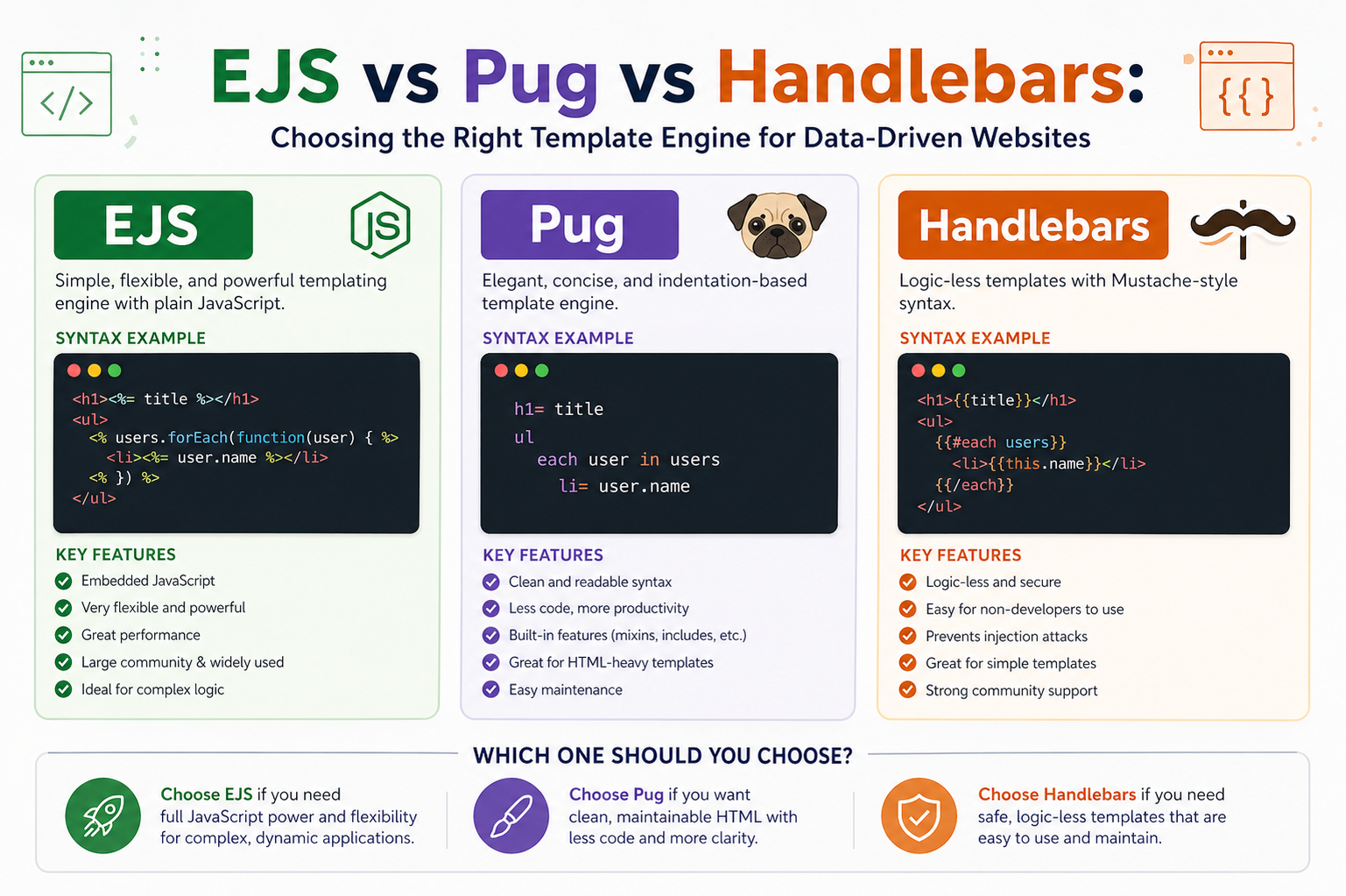
EJS is often considered the most approachable templating engine for developers who already have a strong grasp of JavaScript. Its core strength lies in its simplicity and directness. Since it allows JavaScript to be embedded directly into HTML, it feels natural for those transitioning from static pages to dynamic server-rendered applications. This familiarity reduces the initial friction when building templates and makes debugging more intuitive.
One of the key advantages of EJS is its minimal abstraction. Unlike more opinionated engines, it does not force a specific structure or syntax style beyond embedding logic within tags. This flexibility allows developers to decide how much logic they want inside the template versus the backend. It is especially useful in small to medium-sized applications where rapid development is more important than strict architectural rules.
However, this flexibility can also become a limitation. As projects grow, embedding too much logic inside EJS templates can lead to cluttered and harder-to-maintain code. When business logic starts creeping into the view layer, the separation of concerns becomes weaker. This can make long-term maintenance more challenging if discipline is not maintained.
Another notable aspect of EJS is its strong compatibility with Express-based applications. It integrates smoothly without requiring additional configuration complexity. This makes it a common default choice in many Node.js projects, particularly for developers who want a quick setup without learning a new syntax system.
Performance-wise, EJS performs adequately for most typical use cases. Since it compiles templates into JavaScript functions, rendering is generally fast enough for server-side rendering scenarios. It does not introduce heavy abstraction layers, which helps keep execution efficient.
Despite its strengths, EJS is not the most visually clean templating solution. Because it relies heavily on HTML mixed with JavaScript tags, templates can become visually noisy. This is especially noticeable in large files where logic and markup are deeply interwoven.
Pug (Formerly Jade) in Depth
Pug takes a fundamentally different approach by eliminating traditional HTML syntax in favor of a whitespace-sensitive structure. Instead of opening and closing tags, it uses indentation to define hierarchy. This results in significantly shorter templates that are often easier to scan once the syntax is understood.
One of the biggest advantages of Pug is its ability to reduce repetition. In standard HTML, repetitive tags can make templates lengthy and harder to navigate. Pug simplifies this by allowing developers to write cleaner and more compact structures. This can greatly improve productivity in large-scale applications where templates are complex and deeply nested.
Pug also supports powerful features such as mixins and template inheritance. These features allow developers to create reusable components and maintain consistent layouts across pages. This makes it especially useful in applications where design consistency is important and where multiple pages share similar structures.
However, Pug has a relatively steep learning curve. Developers familiar with HTML often need time to adjust to its indentation-based syntax. Small mistakes in spacing can lead to unexpected rendering issues, which can be frustrating during early development stages. This sensitivity to structure requires discipline and attention to formatting.
Another consideration is readability for teams. While experienced Pug developers may find the syntax clean and efficient, newcomers may struggle to interpret templates quickly. This can impact collaboration in teams where members have varying levels of familiarity with the engine.
In terms of performance, Pug compiles templates into JavaScript functions similarly to other engines. The difference in execution speed is usually negligible in real-world applications. However, the compilation step can sometimes feel slightly more complex due to its additional features and abstraction level.
Pug shines most in projects where maintainability, reuse, and compact code are priorities. It is particularly useful in large applications where reducing redundancy can significantly improve long-term development efficiency.
Handlebars in Depth
Handlebars is designed with a strong focus on simplicity and logic separation. It follows a “logic-less” philosophy, meaning that templates are intentionally restricted from containing complex JavaScript logic. Instead, it encourages handling logic in the backend or through helper functions.
This design choice makes Handlebars highly maintainable. By limiting what can be done inside templates, it ensures a clean separation between data and presentation. This makes it easier for teams to manage large applications without worrying about business logic leaking into the view layer.
Handlebars uses a straightforward and readable syntax based on double curly braces. This makes it very easy to learn and understand, even for beginners. The templates tend to be clean and expressive, focusing purely on displaying data rather than manipulating it.
One of the strongest features of Handlebars is its extensibility through helpers. Developers can define custom functions to handle repetitive tasks or formatting logic. This provides flexibility while still maintaining the core principle of logic separation.
However, the strict nature of Handlebars can also be seen as a limitation. In scenarios where dynamic logic is required directly within templates, developers may find it restrictive. This often leads to additional backend processing, which can increase complexity in certain cases.
Handlebars is particularly well-suited for applications that require predictable rendering and strict structure. It is commonly used in environments where maintainability and clarity are more important than inline flexibility.
Performance-wise, Handlebars is efficient and lightweight. Since it avoids complex runtime logic, it generally performs well in most server-side rendering situations. Its simplicity also contributes to faster development cycles once the initial structure is set up.
Comparing Developer Experience
Developer experience varies significantly between EJS, Pug, and Handlebars. EJS offers familiarity and flexibility, making it easy to adopt quickly. Pug offers a more modern and compact syntax but requires adaptation. Handlebars offers simplicity and structure but limits inline logic.
EJS tends to appeal to developers who prefer control and direct access to JavaScript within templates. Pug appeals to those who value minimal syntax and clean structure. Handlebars appeals to those who prioritize maintainability and separation of concerns.
Team dynamics also play a role in choosing the right engine. In collaborative environments, readability and consistency often matter more than personal preference. Handlebars often performs well in such scenarios due to its strict rules. Pug can be efficient but requires team-wide familiarity. EJS is easiest to onboard but can become inconsistent if not carefully managed.
Scalability Considerations
When it comes to scaling applications, template structure becomes increasingly important. EJS can scale well if developers maintain strict discipline in separating logic from views. However, without clear conventions, it can become messy over time.
Pug scales effectively in large applications due to its reusable components and clean structure. Its mixin system helps reduce repetition and improve maintainability. However, onboarding new developers can slow down scaling if they are unfamiliar with its syntax.
Handlebars scales well in structured environments where logic is already well separated. Its predictable nature makes it easier to maintain consistency across large teams and codebases. However, its restrictions may require more backend coordination.
Security and Maintainability
Security in template engines often revolves around how they handle data rendering and escaping. All three engines generally provide mechanisms to prevent injection attacks by default, but developer awareness is still important.
EJS allows more direct JavaScript execution, which can introduce risks if not carefully managed. Pug reduces some of this risk through structure but still allows logic embedding. Handlebars minimizes risk by restricting logic in templates and enforcing safer rendering patterns.
From a maintainability perspective, Handlebars is often considered the safest due to its strict rules. Pug offers a balance between structure and flexibility. EJS provides maximum flexibility but requires strong coding discipline to remain maintainable.
Choosing Based on Project Type
The best template engine often depends on the nature of the project. For small applications or prototypes, EJS is often the fastest to implement. For large, design-heavy applications, Pug can significantly improve efficiency. For enterprise-level systems where consistency and maintainability are critical, Handlebars is often preferred.
If the project involves rapid iteration and frequent changes, EJS offers the most flexibility. If the focus is on reusable UI components and clean architecture, Pug provides strong advantages. If the priority is long-term stability and team collaboration, Handlebars stands out.
Final Perspective on Selection
Each template engine reflects a different philosophy of web development. EJS emphasizes freedom and simplicity, allowing developers to work directly with JavaScript. Pug emphasizes minimalism and structure, reducing visual clutter in templates. Handlebars emphasizes discipline and clarity, enforcing a strict separation between logic and presentation.
There is no universally superior choice among them. The decision depends on balancing development speed, readability, maintainability, and team skill level. Understanding these trade-offs helps ensure that the selected template engine aligns with both immediate development needs and long-term project goals.
Advanced Use Cases and Real-World Application Patterns
As web applications grow in complexity, template engines are no longer just about rendering HTML. They become part of a larger architectural system that includes routing, data fetching, state handling, and API integration. In such environments, the way a template engine behaves under real production conditions becomes far more important than its initial ease of use.
EJS continues to be widely used in real-world projects where simplicity and rapid development are priorities. It is often found in content-heavy websites, dashboards, and small to mid-scale applications. Developers appreciate how quickly they can inject dynamic data without learning new syntax rules. However, in large-scale production systems, teams often impose strict guidelines to prevent overuse of inline logic. Without such discipline, templates can become difficult to refactor or scale.
Pug is frequently chosen in projects where UI structure is highly repetitive and component-based design is important. It is especially useful in applications that rely heavily on layouts, partials, and reusable interface blocks. Because of its compact syntax, it allows developers to build large UI systems with fewer lines of code. In enterprise environments, this can significantly reduce template maintenance overhead. However, teams must ensure consistency in indentation and formatting practices to avoid structural errors that can break rendering.
Handlebars is commonly used in systems where predictable rendering and strict data separation are essential. It is often found in CMS platforms, email template systems, and server-rendered applications where consistency is more important than flexibility. Its logic-less design ensures that templates remain purely presentational, which reduces the risk of unintended side effects. This makes it particularly valuable in environments where multiple developers contribute to the same codebase over long periods.
Learning Curve and Developer Adaptation
The learning curve of each template engine plays a major role in adoption decisions. EJS is typically the easiest to learn because it requires minimal changes to existing HTML knowledge. Developers can start using it almost immediately without adjusting their workflow significantly. This makes it a common choice for beginners and teams transitioning from static HTML.
Pug requires a more significant mental shift due to its indentation-based syntax. Instead of thinking in terms of tags, developers must think in hierarchical structure. This can initially slow down development, but once mastered, it often leads to faster template writing and cleaner code organization. Teams adopting Pug often go through a short adjustment period before becoming fully productive.
Handlebars sits somewhere in the middle in terms of learning difficulty. Its syntax is simple and intuitive, but understanding its limitations is important. Developers must learn to move logic outside the template and rely on helpers or backend processing. This shift in thinking is crucial for effective use and long-term maintainability.
Maintainability Over Time
Long-term maintainability is one of the most important factors when choosing a template engine. Applications often evolve, teams change, and requirements expand over time. A template engine that works well in early development may become a limitation if it does not scale cleanly with the project.
EJS can become harder to maintain if logic is not carefully separated. Over time, templates may start to resemble scripts rather than presentation layers. This can lead to confusion when onboarding new developers or revisiting old code. Proper architectural discipline is essential to keep EJS maintainable in large systems.
Pug generally offers better maintainability due to its structured format. Its ability to reduce repetition and enforce hierarchy helps keep templates organized. However, maintainability depends heavily on consistent formatting practices across the team. If indentation rules are not strictly followed, readability can quickly degrade.
Handlebars is often considered the most maintainable in long-term projects. Its strict separation of concerns ensures that templates remain focused only on rendering data. This reduces cognitive load when updating or debugging templates. It also makes it easier to predict how changes in data will affect the UI.
Performance in Production Environments
In most real-world scenarios, the performance differences between EJS, Pug, and Handlebars are minimal. All three engines compile templates into JavaScript functions, which are then executed on the server to generate HTML. The actual rendering speed is typically influenced more by backend logic and database performance than the template engine itself.
EJS performs efficiently due to its lightweight nature and minimal abstraction. It avoids unnecessary processing layers, which helps keep rendering fast in simple applications. However, performance can degrade if templates become overly complex with embedded logic.
Pug introduces an additional compilation step due to its unique syntax structure. While this does not significantly impact runtime performance, it can slightly increase development-time processing overhead. In large projects with many templates, this may become noticeable during build processes.
Handlebars is optimized for predictable rendering and avoids unnecessary computation inside templates. Its simplicity contributes to stable performance across different environments. Because it restricts logic, it also reduces the risk of performance bottlenecks caused by inefficient template code.
Flexibility vs Structure Trade-Off
One of the most important decisions when choosing a template engine is balancing flexibility and structure. EJS offers maximum flexibility, allowing developers to do almost anything inside a template. This can be powerful but also risky if not controlled properly.
Pug strikes a balance by enforcing a structured syntax while still allowing reusable components and dynamic rendering. It reduces clutter while still giving developers enough control over layout and logic placement.
Handlebars prioritizes structure over flexibility. It enforces a strict separation between logic and presentation, which can feel limiting in some scenarios but highly beneficial in large-scale systems where consistency matters most.
Team Collaboration and Code Consistency
In collaborative development environments, consistency becomes more important than individual preference. A template engine must support predictable patterns that multiple developers can follow easily.
EJS requires clear coding standards to ensure consistency across a team. Without guidelines, different developers may structure templates differently, leading to inconsistency.
Pug encourages consistency through its indentation rules, but it also requires strict discipline. Even small deviations can lead to rendering issues, so teams must agree on formatting conventions.
Handlebars naturally promotes consistency due to its restricted syntax. Since there are fewer ways to write logic, codebases tend to remain uniform across contributors. This makes onboarding new developers easier and reduces long-term confusion.
Integration with Modern Web Architectures
Modern web development often involves APIs, frontend frameworks, and hybrid rendering approaches. Template engines must adapt to these evolving architectures.
EJS integrates well with traditional server-rendered applications but is less commonly used in highly componentized frontend architectures. It remains effective in monolithic or server-centric systems.
Pug fits well in structured backend systems that serve dynamically generated pages. However, it is less commonly used in modern frontend frameworks that rely heavily on client-side rendering.
Handlebars is often used in hybrid environments, including email generation systems, static site generation, and backend rendering services. Its simplicity makes it adaptable across different contexts without requiring major architectural changes.
Best Practices for Using Template Engines Effectively
Regardless of which template engine is chosen, following best practices is essential to ensure clean, maintainable, and scalable code. One of the most important principles is maintaining a clear separation between logic and presentation. Even though some engines allow logic inside templates, overusing this capability often leads to messy and hard-to-maintain code structures.
In EJS, this means avoiding heavy JavaScript logic inside templates. Instead, data should be prepared in the backend before being passed to the view. This keeps templates clean and focused only on rendering content. When logic is needed, it should be minimal and strictly related to presentation.
In Pug, best practices revolve around consistent indentation and modular design. Since structure is defined through whitespace, even small formatting inconsistencies can lead to confusion. Breaking templates into reusable components helps maintain clarity and reduces duplication. This approach is especially useful in large applications with repeated UI patterns.
In Handlebars, best practices focus on using helpers effectively. Instead of trying to force logic into templates, developers should rely on helper functions defined in the backend. This keeps templates simple and ensures that they remain purely presentational. It also improves readability and reduces cognitive load when working with large codebases.
Common Mistakes Developers Make
One of the most common mistakes across all template engines is mixing too much business logic into the view layer. This often happens when developers prioritize quick implementation over clean architecture. While it may seem convenient initially, it leads to long-term maintenance challenges.
In EJS, a frequent issue is embedding loops and conditional logic directly into templates without preprocessing data. This can result in deeply nested and hard-to-read files. Over time, debugging such templates becomes difficult.
In Pug, a common mistake is inconsistent indentation. Since structure depends entirely on spacing, even a small formatting error can break the entire template. Another issue is overusing shorthand syntax without considering readability for other team members.
In Handlebars, developers sometimes struggle with its limitations and attempt to bypass them using overly complex helpers. While helpers are powerful, overusing them can shift too much logic into the backend, making the system harder to trace.
Scalability in Large Applications
Scalability is a critical factor when selecting a template engine for long-term projects. As applications grow, templates tend to become more complex, and maintaining consistency becomes increasingly difficult.
EJS can scale well if strict architectural patterns are followed. However, without clear guidelines, it can easily become cluttered. Large teams must enforce rules about logic separation and file organization to prevent degradation over time.
Pug scales effectively due to its modular nature. It naturally encourages breaking templates into smaller reusable components. This makes it easier to manage large interfaces with repeated design patterns. However, teams must ensure that everyone is comfortable with the syntax to avoid inconsistencies.
Handlebars scales very well in structured environments. Its strict separation of concerns makes it easier to maintain large codebases without introducing unintended complexity. Because templates remain simple, scaling usually happens in the backend rather than the view layer, which improves maintainability.
Debugging and Troubleshooting
Debugging template engines varies depending on their complexity and syntax style. In EJS, debugging is relatively straightforward because it closely resembles standard JavaScript. Errors are often easy to trace since logic is directly embedded in the template.
Pug debugging can be more challenging due to its indentation-based structure. Errors related to spacing or hierarchy can sometimes be difficult to identify quickly. However, once the structure is understood, debugging becomes more efficient because of the reduced clutter in the code.
Handlebars offers the simplest debugging experience in many cases. Since logic is minimal in templates, most issues are related to data rather than template structure. This separation makes it easier to isolate and fix problems quickly.
Flexibility in Design and Development
Flexibility plays an important role in how quickly developers can adapt templates to changing requirements. EJS offers the highest flexibility because it allows full JavaScript usage inside templates. This makes it easy to implement custom behavior quickly.
Pug provides moderate flexibility with a focus on structure. While it restricts HTML syntax, it still allows reusable components and dynamic rendering. This balance makes it suitable for projects that require both speed and organization.
Handlebars offers the least flexibility in terms of inline logic, but compensates with strong structure and predictable behavior. This makes it ideal for applications where consistency is more important than rapid customization.
Suitability for Different Project Types
Different projects benefit from different template engines depending on their complexity and goals.
EJS is well-suited for small to medium applications, prototypes, and projects where development speed is the top priority. It is also a good choice for developers who prefer working closely with JavaScript without learning new syntax rules.
Pug is ideal for large-scale applications with complex UI structures. It works well in environments where reusable components and clean hierarchy are important. It is often used in projects that require maintainable and scalable frontend architecture.
Handlebars is best suited for enterprise-level systems, CMS platforms, and applications where strict separation of logic and presentation is required. It is also widely used in email templating and server-rendered systems where predictability is essential.
Long-Term Evolution and Industry Trends
Over time, the role of traditional template engines has evolved due to the rise of modern frontend frameworks. Many applications now use component-based libraries that handle rendering on the client side. However, server-side template engines still remain relevant in many contexts.
EJS continues to be popular in Node.js ecosystems due to its simplicity and ease of integration. It remains a reliable choice for developers who prefer traditional server-rendered architectures.
Pug has maintained its niche in projects that value clean and minimal syntax. While not as dominant as it once was, it is still widely used in backend-driven rendering systems.
Handlebars continue to be relevant in structured environments where simplicity and separation are essential. Its predictable behavior ensures that it remains a stable choice for long-term systems.
Performance Optimization and Real-World Efficiency
When applications move into production, performance becomes less about theoretical speed differences and more about how efficiently templates integrate with the overall system. In most real-world scenarios, EJS, Pug, and Handlebars perform similarly because they all compile templates into JavaScript functions. The actual bottlenecks usually come from database queries, API calls, or server logic rather than the template engine itself.
EJS maintains steady performance due to its lightweight nature and minimal abstraction. It does not introduce additional processing layers, which keeps rendering straightforward. However, performance issues can arise if templates become overly complex with nested logic and repeated computations inside views.
Pug, while slightly more complex during compilation due to its indentation-based parsing, still performs efficiently in runtime environments. Once compiled, its output is similar to other engines. Its compact syntax can indirectly improve performance by reducing template size and improving maintainability, which helps reduce development errors that might otherwise impact performance.
Handlebars is optimized for predictable rendering and avoids unnecessary computation inside templates. Because it enforces logic separation, most processing happens outside the view layer, which helps maintain consistent performance. This makes it particularly stable in large-scale applications where predictable output is more important than micro-optimizations.
Code Organization and Project Structure
A well-structured project is essential for long-term maintainability, especially in applications that rely heavily on server-side rendering. Template engines influence how developers organize files, components, and layouts.
EJS projects often follow a traditional structure where views are separated into partials, layouts, and pages. While flexible, this structure can vary significantly between developers unless strict conventions are enforced. Without organization, templates can quickly become scattered and difficult to manage.
Pug naturally encourages modular design through mixins and includes. This makes it easier to build reusable UI components and maintain a consistent layout across multiple pages. Its structure promotes cleaner organization, especially in large applications where repetition is common.
Handlebars enforces a more rigid separation between templates and logic, which leads to a clearer project structure. Views remain focused purely on presentation, while helpers and controllers handle processing. This separation improves readability and makes large codebases easier to navigate.
Error Handling and Maintainability Challenges
Error handling is an important aspect of working with template engines, especially in production environments where debugging time is limited.
In EJS, errors are often related to JavaScript execution within templates. Because logic is embedded directly, runtime errors can sometimes originate from the view layer. This requires careful debugging and proper data validation before rendering.
In Pug, errors are frequently related to syntax and indentation. A missing space or incorrect nesting level can break the template rendering. While this can be frustrating, once corrected, it encourages cleaner and more structured code.
Handlebars typically produces fewer structural errors due to its simplicity. Most issues arise from missing data or incorrect helper usage rather than template structure. This makes it more predictable and easier to debug in large systems.
Team Workflow and Collaboration Impact
In collaborative environments, consistency and readability are more important than individual coding preferences. Template engines can significantly influence how smoothly teams work together.
EJS allows flexibility, but this can lead to inconsistent coding styles if guidelines are not enforced. Different developers may structure templates differently, which can create confusion during code reviews or maintenance.
Pug promotes consistency through its strict indentation rules and compact syntax. However, it requires all team members to be comfortable with its structure. Once adopted, it can significantly improve workflow efficiency by reducing repetitive markup.
Handlebars is often the easiest for teams to collaborate on due to its simplicity and restrictions. Since templates are limited to data rendering, there is less variation in how developers write code. This consistency reduces friction during collaboration and makes onboarding new developers easier.
Security Considerations in Template Rendering
Security is an important factor when rendering dynamic data, especially in applications that handle user-generated content.
EJS requires careful handling because it allows JavaScript execution within templates. If not properly sanitized, it can expose applications to injection risks. Developers must ensure that data is validated before rendering.
Pug reduces some risks through its structured syntax, but it still allows logic embedding. Proper backend validation remains necessary to ensure safe rendering.
Handlebars provides stronger protection by default because it escapes content automatically and limits logic execution inside templates. This makes it a safer option for applications that handle untrusted data.
When to Avoid Each Template Engine
While each engine has strengths, there are situations where they may not be ideal.
EJS may not be suitable for large enterprise systems where strict architecture and separation of concerns are required. Without discipline, it can become too flexible and lead to messy templates.
Pug may not be ideal for teams unfamiliar with indentation-based syntax. If consistency is not maintained, it can lead to confusion and debugging challenges.
Handlebars may feel too restrictive for projects that require complex logic inside templates. Developers may find themselves relying heavily on backend helpers, which can increase system complexity in other areas.
Future Relevance and Industry Direction
The web development landscape continues to evolve with the rise of frontend frameworks and component-based architectures. Many modern applications now rely on client-side rendering or hybrid rendering approaches.
Despite this shift, traditional template engines remain relevant in server-side rendering, static site generation, and backend-driven applications. They continue to play a crucial role in scenarios where simplicity, performance, and SEO-friendly rendering are important.
EJS remains widely used due to its simplicity and strong integration with Node.js ecosystems. Pug continues to serve projects that prioritize clean and compact syntax. Handlebars remains strong in structured environments where predictability and separation of concerns are essential.
Real Project Decision-Making Factors
In real development scenarios, choosing a template engine is rarely a purely technical decision. It is often influenced by team experience, project deadlines, and the overall architecture of the system. While EJS, Pug, and Handlebars all serve the same core purpose of rendering dynamic HTML, the way they integrate into workflows can differ significantly.
EJS is often chosen when teams need to move quickly and avoid steep learning curves. It fits naturally into JavaScript-heavy environments, especially those built on Node.js. Because it does not enforce strict structural rules, developers can adapt it to different coding styles. However, this flexibility requires discipline to avoid long-term inconsistency in larger projects.
Pug becomes a strong candidate when the project demands clean structure and reusable UI patterns. It is especially useful in systems where templates are complex and heavily nested. Developers who prioritize readability and compact code often prefer Pug once they are comfortable with its syntax. However, adoption should be carefully planned to ensure all team members are aligned with its formatting rules.
Handlebars are typically selected in environments where maintainability and clarity outweigh flexibility. It is widely used in applications that require predictable output, such as dashboards, reporting systems, and email rendering engines. Its strict separation of logic and presentation makes it easier to manage over time, especially in large teams.
Integration with Backend Architectures
Template engines do not exist in isolation; they are tightly connected to backend systems. Their effectiveness often depends on how well they integrate with routing, controllers, and data layers.
EJS integrates seamlessly with Express-based applications and other Node.js frameworks. It allows developers to pass data directly into templates without additional transformation layers. This makes it highly efficient for traditional server-rendered applications where simplicity is preferred.
Pug also integrates well with backend frameworks but often requires more structured planning. Since it supports layout inheritance and mixins, backend logic is usually designed to complement its component-based structure. This makes it a strong fit for applications that follow modular design principles.
Handlebars integrates effectively in systems where backend logic is clearly separated from presentation. It works well with MVC architectures, where controllers handle data preparation and views remain strictly responsible for rendering. This separation improves scalability and reduces coupling between system layers.
Maintenance Over Long Development Cycles
Over time, applications evolve, and maintenance becomes more important than initial development speed. Template engines that encourage clean structure and separation of concerns tend to perform better in long-term projects.
EJS can become harder to maintain if templates grow too large or contain excessive logic. Without strict guidelines, it is easy for code to drift into an unorganized state. Regular refactoring is often required to keep it manageable.
Pug generally maintains better structure over time due to its modular design approach. However, it still requires consistent formatting practices to ensure readability across teams. When properly managed, it can remain clean and efficient even in large codebases.
Handlebars is often the easiest to maintain in long-running projects. Its limitations actually work as an advantage by enforcing discipline. Since logic is kept outside templates, updates tend to be safer and more predictable.
Adaptability to Modern Development Practices
Modern web development increasingly relies on component-based frameworks and API-driven architectures. While traditional template engines are less dominant in frontend-heavy applications, they still play an important role in backend rendering and hybrid systems.
EJS remains relevant in applications where server-side rendering is still the primary approach. It is often used in simple content platforms and applications where quick rendering is more important than advanced frontend interactivity.
Pug fits well into systems that still rely heavily on server-rendered pages but require structured and reusable UI components. It is especially useful in applications where consistency across multiple pages is important.
Handlebars continues to be widely used in backend services that generate static or semi-dynamic content. Its predictable output makes it suitable for systems that require reliability over complexity.
Developer Productivity and Workflow Efficiency
Productivity is influenced not just by syntax, but by how quickly developers can understand, modify, and debug templates.
EJS offers high productivity for beginners due to its familiarity with HTML and JavaScript. Developers can quickly start building dynamic pages without adjusting their thinking style.
Pug improves productivity over time once developers become familiar with its structure. Its reduced syntax can significantly speed up template writing in large projects, especially when reusable components are used effectively.
Handlebars improves productivity in structured teams where clear rules are already established. Since templates are simple and predictable, developers spend less time debugging and more time focusing on backend logic.
Choosing Based on Project Complexity
The complexity of a project often determines which template engine is most suitable.
For simple applications, EJS provides enough flexibility without unnecessary overhead. It is ideal for prototypes, small websites, and projects with limited UI complexity.
For medium to large applications with repeated UI patterns, Pug offers a strong balance between structure and efficiency. It reduces redundancy and keeps templates organized.
For large enterprise systems, Handlebars is often the safest choice. Its strict rules ensure consistency across teams and reduce long-term maintenance risks.
Conclusion
Choosing between EJS, Pug, and Handlebars is ultimately a decision based on project needs, team structure, and long-term goals rather than raw technical superiority. Each template engine reflects a different development philosophy.
EJS offers simplicity and flexibility, making it ideal for quick development and small to medium projects. It allows developers to work closely with JavaScript but requires discipline to maintain clean architecture.
Pug focuses on clean, minimal, and structured syntax, making it highly efficient for large-scale UI systems. It reduces repetition and improves readability but requires adaptation and consistent formatting practices.
Handlebars emphasizes clarity, safety, and strict separation of concerns. It is best suited for large, maintainable systems where predictability and collaboration are more important than inline flexibility.
In the end, the best choice depends on balancing ease of development, scalability, maintainability, and team expertise. Understanding the strengths and limitations of each engine ensures that developers can build efficient, structured, and long-lasting web applications.