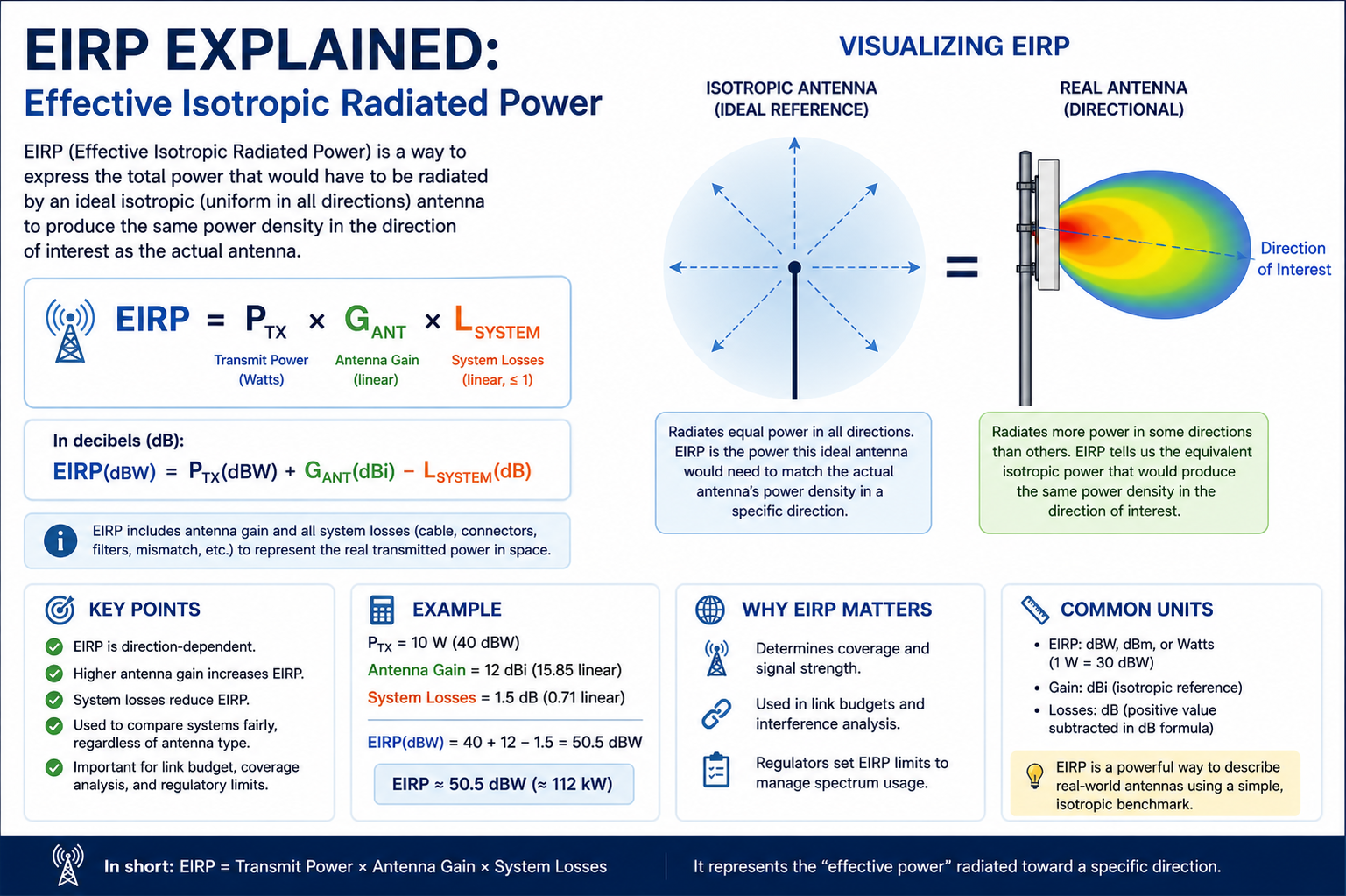
Effective Isotropic Radiated Power (EIRP) is a fundamental concept in the field of wireless communication and radio frequency engineering. It describes the amount of power that a hypothetical isotropic antenna would need to radiate in order to achieve the same signal strength in a given direction as a real antenna system. In simpler terms, it represents the effective strength of a transmitted signal after considering both the transmitter power and the directional characteristics of the antenna.
EIRP is not just a theoretical value; it plays a crucial role in designing, analyzing, and regulating modern communication systems. Whether it is mobile networks, satellite communications, Wi-Fi systems, or broadcasting stations, EIRP helps engineers understand how far and how effectively a signal can travel.
The importance of EIRP lies in its ability to standardize measurements. Since antennas come in many shapes and designs with different directional properties, simply measuring transmitter power is not enough to understand real-world performance. EIRP bridges this gap by combining transmitter output power with antenna gain, giving a more accurate representation of the radiated signal strength.
Understanding the Concept of an Isotropic Radiator
To fully understand EIRP, it is essential to first understand the idea of an isotropic radiator. An isotropic antenna is a theoretical antenna that radiates power equally in all directions. It does not exist in reality but serves as a useful reference model in electromagnetic theory.
In practice, real antennas do not radiate equally in all directions. Instead, they focus energy in certain directions to improve communication efficiency. For example, a satellite dish concentrates signals toward a specific point in space, while a Wi-Fi router may spread signals more horizontally within a room. Because of this directional behavior, real antennas can achieve higher effective signal strength in certain directions compared to an isotropic antenna with the same input power.
EIRP uses this theoretical isotropic antenna as a benchmark to measure how effectively a real antenna system radiates power in its strongest direction.
Relationship Between Transmitter Power and Antenna Gain
EIRP is determined by two main factors: transmitter power and antenna gain. Transmitter power refers to the actual electrical power fed into the antenna from the source, such as a radio transmitter or signal generator. Antenna gain, on the other hand, describes how efficiently the antenna directs that power in a specific direction.
Antenna gain is not the same as amplification in an electronic circuit. Instead, it is achieved by focusing the radiated energy rather than increasing the total energy output. When energy is concentrated in a specific direction, the signal becomes stronger in that direction while weaker in others.
The combination of these two factors determines the EIRP. A higher transmitter power increases the overall signal strength, while higher antenna gain increases the directional focus of that power. Together, they define how strong the transmitted signal appears in its most effective direction.
Mathematical Representation of EIRP
EIRP can be expressed mathematically by combining transmitter power and antenna gain. In its simplest form, it is the product of the transmitter power and the linear gain of the antenna. However, in practical engineering, it is often expressed in decibels for easier calculation and comparison.
When using decibels, EIRP is calculated by adding the transmitter power (in dBm or dBW) to the antenna gain (in dBi), and then subtracting any losses in the transmission system, such as cable or connector losses.
This representation allows engineers to easily evaluate system performance and ensure compliance with regulatory power limits. It also helps in optimizing system design by balancing power consumption, antenna design, and coverage requirements.
Role of EIRP in Wireless Communication Systems
EIRP plays a central role in determining how wireless communication systems perform in real-world environments. In mobile networks, EIRP influences how far a base station can transmit signals to mobile devices. In Wi-Fi systems, it affects the coverage area of a router inside homes or offices. In satellite communications, it determines how effectively signals can travel between Earth and space.
Higher EIRP generally means stronger signal coverage and longer communication range. However, it also increases the risk of interference with other nearby systems. For this reason, regulatory bodies impose strict limits on EIRP for different types of communication equipment.
Engineers must carefully balance EIRP to ensure reliable communication without exceeding legal or technical constraints. This balance involves selecting appropriate transmitter power levels, choosing suitable antennas, and minimizing system losses.
Antenna Gain and Its Influence on EIRP
Antenna gain is one of the most important factors influencing EIRP. It describes how effectively an antenna can concentrate energy in a particular direction compared to a reference isotropic antenna.
High-gain antennas focus energy into narrow beams, resulting in stronger signals in specific directions. This is useful in applications such as satellite communication and point-to-point microwave links. Low-gain antennas, on the other hand, distribute energy more evenly, which is suitable for applications like indoor Wi-Fi coverage.
Even if two systems have the same transmitter power, the one with higher antenna gain will have a higher EIRP in its main direction of radiation. This is why antenna selection is critical in system design.
Losses in the Transmission System
While transmitter power and antenna gain increase EIRP, system losses reduce it. These losses occur in cables, connectors, filters, and other components between the transmitter and the antenna.
For example, a long coaxial cable can absorb part of the signal power before it reaches the antenna, reducing the effective radiated power. Similarly, poor-quality connectors can introduce additional signal loss.
Engineers must account for these losses when calculating EIRP to ensure accurate system performance predictions. Ignoring losses can lead to overestimation of coverage and poor network design.
Practical Importance of EIRP in Network Planning
EIRP is widely used in network planning and optimization. In cellular networks, engineers use EIRP values to determine base station placement and coverage areas. By controlling EIRP, they can ensure consistent signal strength across different geographic regions.
In Wi-Fi networks, EIRP helps determine how far a wireless router can effectively transmit signals within a building. Adjusting antenna type, placement, and transmitter power allows optimization of coverage while minimizing interference.
In satellite systems, EIRP is critical for ensuring that signals transmitted from Earth reach satellites in orbit with sufficient strength. It also helps in maintaining communication stability over long distances.
Regulatory Control of EIRP
Because EIRP directly affects signal strength and potential interference, it is regulated by government and international communication authorities. These regulations define maximum allowable EIRP levels for different frequency bands and applications.
The purpose of these limits is to prevent interference between different communication systems and to ensure fair use of the radio spectrum. Without such controls, high-power transmitters could disrupt nearby networks and degrade communication quality.
Manufacturers of wireless equipment must design their systems to comply with these limits. This often involves adjusting transmitter power, selecting appropriate antennas, or implementing power control mechanisms.
Real-World Example of EIRP Usage
Consider a Wi-Fi router used in a home. The router transmits signals using a specific power level, and its built-in antenna has a certain gain. Together, these determine the EIRP of the device.
If the router is placed in a central location with a well-designed antenna, the EIRP ensures strong and stable coverage throughout the house. However, if obstacles like walls or interference sources are present, the effective signal strength may decrease even if EIRP remains the same.
This example shows how EIRP provides a theoretical measure, while real-world performance also depends on environmental factors.
EIRP in Decibels and Practical Calculation
In real-world engineering, EIRP is almost always expressed in decibels rather than linear power values. This is because wireless systems involve very large or very small power levels, and decibel notation simplifies calculations and comparisons.
When expressed in decibel-milliwatts (dBm), EIRP is calculated by adding the transmitter output power in dBm to the antenna gain in dBi, and then subtracting any system losses in dB. This simple additive form is one of the main reasons decibels are widely used in RF engineering.
The use of dBi for antenna gain is also important. The “i” in dBi refers to isotropic, meaning the gain is measured relative to an ideal isotropic radiator. This makes it directly compatible with the EIRP definition, which is also based on the isotropic reference model.
This logarithmic approach allows engineers to quickly estimate system performance without performing complex multiplication and division. It also makes it easier to see how changes in one part of the system affect the overall radiated power.
ERP and EIRP Difference
A commonly confused concept with EIRP is ERP, which stands for Effective Radiated Power. While both measure radiated power, they use different reference antennas.
EIRP is referenced to an isotropic antenna, which radiates equally in all directions. ERP, on the other hand, is referenced to a half-wave dipole antenna, which has its own directional gain pattern.
Because a dipole antenna has a gain of approximately 2.15 dB over an isotropic antenna, ERP and EIRP values differ by this constant factor. In simple terms, EIRP is usually about 2.15 dB higher than ERP for the same physical transmission system.
Understanding this difference is important when comparing system specifications or regulatory limits, as different regions or standards may use one or the other.
Link Budget and EIRP Role
EIRP is a key part of a broader concept called the link budget, which is used to calculate the total gain and loss in a communication link. The link budget determines whether a signal can successfully travel from transmitter to receiver with sufficient strength.
In a typical link budget, EIRP represents the starting point of the transmitted signal strength. From there, the signal travels through free space and experiences path loss, atmospheric attenuation, and other environmental effects.
At the receiving end, antenna gain and receiver sensitivity determine whether the signal is strong enough to be decoded. EIRP therefore acts as the foundation of all coverage and range calculations in wireless systems.
A well-designed system ensures that EIRP is high enough to overcome all expected losses while still staying within regulatory limits.
Free Space Path Loss and Signal Propagation
As a radio signal travels through space, it spreads out and loses strength. This phenomenon is known as free space path loss. Even if EIRP is high, the signal weakens with distance due to this natural spreading effect.
The further the signal travels, the larger the area over which its energy is distributed. This results in reduced power density at the receiver. Environmental factors such as buildings, trees, rain, and atmospheric conditions can further increase signal loss.
EIRP helps determine how much initial signal strength is available before these losses occur. A higher EIRP allows the signal to remain usable over longer distances or in more challenging environments.
EIRP in Satellite Communication
In satellite systems, EIRP is one of the most critical design parameters. Ground stations must transmit signals with enough effective power to reach satellites located thousands of kilometers above the Earth.
Because of this extreme distance, signals undergo significant attenuation. High-gain antennas, such as parabolic dishes, are used to concentrate energy into narrow beams, significantly increasing EIRP in the desired direction.
Similarly, satellites themselves use carefully designed antennas to maximize EIRP toward specific regions on Earth. This ensures that signals remain strong enough for television broadcasting, GPS navigation, and data communication.
In satellite communication, even small changes in EIRP can have a major impact on signal quality and system reliability.
EIRP in Cellular Networks
In mobile communication systems, EIRP plays a key role in determining coverage areas of base stations. Each cell tower is designed with a specific EIRP to ensure it covers its intended geographic region.
If EIRP is too low, the coverage area becomes small, leading to poor signal reception. If it is too high, signals may overlap excessively with neighboring cells, causing interference and network inefficiency.
Modern cellular networks carefully control EIRP through power management and antenna design. Sector antennas are commonly used to direct energy into specific coverage zones, improving both capacity and efficiency.
As networks evolve from 3G to 4G and 5G, EIRP optimization becomes even more important due to higher data rates and denser network deployments.
EIRP in Wi-Fi and Short-Range Systems
In Wi-Fi systems, EIRP determines how far a wireless signal can travel inside homes, offices, or public spaces. Since Wi-Fi operates in unlicensed frequency bands, regulatory bodies impose strict EIRP limits to prevent interference.
Routers typically use omnidirectional antennas that spread energy in all horizontal directions. This helps provide uniform coverage, but also means that EIRP must be carefully controlled to avoid exceeding legal limits.
Obstacles such as walls, floors, and furniture can significantly reduce effective signal strength, even if EIRP is high. This is why Wi-Fi performance often depends not just on power, but also on placement and environmental conditions.
Interference and Spectrum Efficiency
One of the main reasons EIRP is regulated is to manage interference between different wireless systems. When too much power is radiated, it can disrupt nearby devices operating on similar frequencies.
By limiting EIRP, regulators ensure that multiple systems can coexist within the same spectrum without causing harmful interference. This is especially important in densely populated areas where many wireless networks operate simultaneously.
Efficient use of EIRP also improves spectrum efficiency. Instead of increasing power, engineers often use smarter antenna designs and advanced signal processing techniques to achieve better performance within the same EIRP limits.
Measurement of EIRP in Practice
Measuring EIRP in real systems involves testing transmitter output power, antenna gain, and system losses. Specialized RF measurement equipment is used to ensure accuracy.
Engineers typically measure transmitter power at the output stage and then account for losses introduced by cables and connectors. Antenna gain is either provided by manufacturer specifications or verified through testing in controlled environments.
Once all values are known, EIRP can be calculated and compared against regulatory limits. This ensures that devices are compliant before they are deployed in real networks.
Field testing is also performed to validate theoretical calculations, as real-world environments can introduce unexpected variations.
Common Mistakes in EIRP Understanding
One common mistake is assuming that higher transmitter power automatically means better performance. In reality, increasing power without considering antenna gain and losses may not significantly improve coverage.
Another misunderstanding is confusing antenna gain with signal amplification. Antennas do not create additional power; they only redistribute existing power in a more focused direction.
Ignoring system losses is also a frequent error. Even a high-quality antenna system can perform poorly if cables and connectors introduce significant attenuation.
Correct EIRP analysis requires considering all parts of the transmission chain together rather than focusing on a single component.
EIRP in Modern Wireless Technology
With the growth of modern wireless technologies such as 5G, IoT, and advanced satellite networks, EIRP has become even more important. These systems rely on precise control of signal strength to achieve high data rates and reliable connectivity.
In 5G networks, beamforming techniques dynamically adjust antenna direction and effective radiated power to focus signals toward specific users. This allows highly efficient use of spectrum while maintaining strong signal quality.
IoT devices, on the other hand, often operate at very low EIRP levels to conserve energy and reduce interference, especially when deployed in large numbers.
As wireless systems become more complex, EIRP remains a central parameter in ensuring balanced performance.
Environmental Factors Affecting EIRP Performance
Although EIRP is a calculated value based on transmitter power and antenna gain, real-world performance is strongly influenced by the environment in which the signal propagates. Physical surroundings such as buildings, terrain, vegetation, and even weather conditions can significantly alter how effectively radiated power is received.
In urban environments, tall buildings can reflect, absorb, or scatter radio waves, creating multipath propagation. This means the signal reaches the receiver through multiple paths, sometimes causing constructive or destructive interference. Even if EIRP is high, signal quality may vary depending on how these reflected waves combine at the receiver.
In rural or open areas, signals generally travel more freely, but terrain such as hills and valleys can still block or weaken propagation. Forested regions introduce additional attenuation due to absorption by trees and moisture content in vegetation.
Weather conditions also play a role, especially at higher frequencies. Rain, fog, and humidity can absorb or scatter radio waves, reducing the effective signal strength. This is particularly important in satellite and microwave communication systems where signals must travel long distances through the atmosphere.
Because of these factors, EIRP alone does not guarantee consistent performance. It must always be considered alongside environmental conditions and propagation characteristics.
Frequency Dependence of EIRP Efficiency
The effectiveness of EIRP is also closely related to the operating frequency of the system. Different frequency bands behave differently when propagating through space and obstacles.
Lower frequency signals generally travel farther and penetrate obstacles more effectively. This means that for the same EIRP, lower frequency systems often achieve better coverage in challenging environments such as indoors or urban areas.
Higher frequency signals, on the other hand, tend to have higher path loss and are more easily blocked by obstacles. However, they allow for higher data rates and more compact antenna designs. As a result, higher EIRP values are often required to maintain reliable communication at these frequencies.
In modern communication systems, especially those using millimeter-wave technology, careful EIRP planning is essential to compensate for increased signal attenuation.
Directional Antennas and Beamforming
One of the most significant advancements in wireless technology is the use of directional antennas and beamforming techniques to optimize EIRP distribution.
Directional antennas concentrate energy into a specific direction, increasing EIRP in that direction while reducing it elsewhere. This improves communication range and reduces interference with other systems.
Beamforming takes this concept further by electronically controlling the direction of the signal without physically moving the antenna. This is achieved using multiple antenna elements that work together to form a focused beam toward the receiver.
In modern systems such as 5G networks, beamforming dynamically adjusts EIRP in real time based on user location and network conditions. This allows more efficient use of power and spectrum while improving signal quality.
These technologies demonstrate that EIRP is not static but can be actively managed to optimize performance.
EIRP in Point-to-Point Communication Links
Point-to-point communication systems, such as microwave backhaul links, rely heavily on precise EIRP calculations. These systems transmit signals between two fixed locations using highly directional antennas.
Because the signal path is known and controlled, engineers can design the system with a specific EIRP to ensure reliable communication over long distances. High-gain parabolic antennas are commonly used to achieve very focused energy transmission.
In these systems, even small misalignments in antenna direction can significantly reduce effective EIRP in the desired direction, leading to signal degradation. Therefore, accurate installation and alignment are critical.
These links are widely used in telecommunications infrastructure to connect base stations, data centers, and network hubs.
Energy Efficiency and EIRP Optimization
EIRP is not only about maximizing signal strength but also about achieving efficiency. Increasing transmitter power consumes more energy, which is not always practical or sustainable.
Modern wireless systems aim to optimize EIRP by improving antenna design rather than simply increasing power output. High-efficiency antennas can achieve strong directional gain without excessive energy consumption.
This approach is especially important in battery-powered devices such as IoT sensors, where energy efficiency directly affects device lifespan. By optimizing antenna patterns and reducing unnecessary transmission power, systems can maintain reliable communication while conserving energy.
Energy-efficient EIRP design is becoming increasingly important as wireless networks expand globally and energy consumption becomes a key concern.
Safety Considerations Related to EIRP
EIRP is also relevant in terms of human safety and electromagnetic exposure. Regulatory bodies define safe exposure limits for radio frequency energy to ensure that transmitted signals do not pose health risks.
Since EIRP represents the effective radiated power in a specific direction, it is used to estimate potential exposure levels in the vicinity of antennas. High EIRP systems, such as broadcasting towers and radar installations, are carefully designed to ensure safe operation zones.
In most everyday wireless devices like Wi-Fi routers and mobile phones, EIRP levels are kept well within safe limits. However, in industrial and broadcast applications, strict safety assessments are required to ensure compliance with exposure guidelines.
Proper antenna placement and power control help minimize unnecessary exposure while maintaining communication performance.
EIRP in Network Capacity and Efficiency
EIRP also influences network capacity, not just coverage. In dense wireless environments, such as cities or stadiums, managing EIRP properly allows multiple users to share the same spectrum efficiently.
If EIRP is too high, signals from different transmitters can overlap excessively, causing interference and reducing network capacity. If it is too low, coverage gaps may occur, leading to poor connectivity.
Modern network design uses adaptive EIRP control, where power levels are dynamically adjusted based on traffic demand and user density. This ensures optimal balance between coverage and capacity.
This dynamic control is a key feature of advanced wireless systems, enabling them to support large numbers of connected devices simultaneously.
EIRP in Emerging Technologies
As wireless technology continues to evolve, EIRP remains a critical design parameter in emerging systems such as autonomous vehicles, smart cities, and industrial automation.
In autonomous vehicles, multiple wireless systems communicate simultaneously, including radar, vehicle-to-vehicle communication, and navigation systems. Each system must carefully manage EIRP to avoid interference while maintaining reliable communication.
In smart city infrastructure, thousands of connected sensors and devices operate within limited spectrum resources. Efficient EIRP management ensures that these devices can coexist without overwhelming the communication environment.
In industrial automation, wireless networks control machinery and monitoring systems. Here, stable and predictable EIRP is essential for safety and operational reliability.
Challenges in EIRP Management
Despite its importance, managing EIRP in complex systems presents several challenges. One major challenge is maintaining consistent performance across varying environmental conditions.
Another challenge is balancing power consumption with coverage requirements, especially in battery-powered and large-scale deployments. Additionally, regulatory compliance adds constraints that must be carefully followed during system design.
Interference management also becomes increasingly difficult as the number of wireless devices continues to grow. Engineers must carefully design systems to ensure that EIRP levels do not negatively impact neighboring networks.
Advanced simulation tools and real-world testing are often used to address these challenges and optimize system performance.
EIRP in System Design and Engineering Trade-offs
In practical wireless system design, EIRP is not chosen arbitrarily but is the result of several engineering trade-offs. Designers must balance coverage, capacity, power consumption, interference control, and regulatory compliance at the same time. Because of this, EIRP becomes a central constraint around which the entire communication system is built.
If a system requires wide coverage, engineers may increase antenna gain or transmitter power to raise EIRP. However, doing so can increase interference in neighboring systems or exceed legal limits. On the other hand, reducing EIRP improves coexistence with other networks but may lead to weaker coverage and dead zones.
This balancing act is especially important in dense network environments where multiple wireless systems operate in close proximity. The goal is not simply to maximize EIRP, but to optimize it for the intended use case.
Modern engineering approaches rely heavily on simulation tools that model signal propagation, interference, and coverage based on different EIRP configurations. This allows designers to predict performance before physical deployment.
EIRP and Modulation Efficiency
EIRP does not work in isolation from other system parameters such as modulation and coding techniques. The efficiency of data transmission affects how much power is actually needed to maintain reliable communication.
Advanced modulation schemes allow more data to be transmitted within the same signal bandwidth, often requiring less increase in EIRP for improved performance. However, these schemes can also be more sensitive to noise and interference, requiring stronger signal conditions.
In low-signal environments, increasing EIRP may help maintain link quality, but in many cases improving modulation efficiency or error correction is a more effective solution than simply increasing transmitted power.
This demonstrates that EIRP is only one part of a larger communication design ecosystem, where multiple factors must work together to achieve optimal results.
Adaptive Power Control and Dynamic EIRP
Modern wireless systems increasingly use adaptive power control mechanisms that dynamically adjust EIRP based on real-time conditions. Instead of transmitting at a fixed power level, devices can increase or decrease output depending on signal quality, distance, and network demand.
In cellular networks, base stations continuously monitor user devices and adjust their transmitted power to ensure consistent connectivity while minimizing interference. This dynamic adjustment improves both energy efficiency and spectral efficiency.
Similarly, in Wi-Fi systems, devices may reduce transmission power when nearby access points are available or increase it when the signal weakens due to distance or obstacles.
This adaptive behavior ensures that EIRP is always optimized for current conditions rather than being fixed at a potentially inefficient level.
EIRP in MIMO Systems
Multiple Input Multiple Output (MIMO) technology has significantly changed how EIRP is used in modern wireless communication. MIMO systems use multiple antennas at both the transmitter and receiver to improve data throughput and reliability.
In such systems, total radiated power is distributed across multiple antenna elements. Each element contributes a portion of the overall EIRP, and together they form a combined radiation pattern that can be controlled and optimized.
MIMO allows signals to be transmitted along multiple spatial paths, increasing capacity without necessarily increasing total EIRP. This makes it possible to achieve higher performance while staying within regulatory power limits.
Advanced MIMO configurations, such as Massive MIMO used in 5G networks, rely heavily on precise EIRP control across dozens or even hundreds of antenna elements.
EIRP and Spatial Coverage Patterns
EIRP is closely related to the concept of radiation patterns, which describe how power is distributed in space. Every antenna has a unique radiation pattern that determines how EIRP varies with direction.
In omnidirectional antennas, EIRP is relatively uniform in all horizontal directions, making them suitable for general coverage areas. In contrast, directional antennas concentrate EIRP into narrow beams, creating high-intensity coverage in specific directions.
Engineers analyze these patterns to ensure that coverage areas are properly shaped for the intended application. For example, in a stadium, antennas may be positioned to focus EIRP toward seating areas while minimizing spillover outside the venue.
Understanding spatial distribution of EIRP is essential for avoiding dead zones and ensuring consistent signal quality across the entire service area.
EIRP in Interference Coordination
As wireless environments become more crowded, interference coordination has become a critical aspect of network design. EIRP plays a key role in this process because it directly influences how much a signal spreads into surrounding areas.
By carefully controlling EIRP, network operators can reduce the likelihood of overlapping signals causing interference. This is especially important in shared frequency bands where multiple operators or devices coexist.
Techniques such as power limiting, directional transmission, and frequency planning are used together to manage interference. EIRP control ensures that each system operates efficiently without negatively impacting others.
In some cases, networks are designed to intentionally reduce EIRP in certain directions to create interference-free zones.
EIRP in Regulatory Frameworks
Regulatory authorities around the world define strict rules regarding maximum allowable EIRP for different types of wireless devices. These rules vary depending on frequency band, application type, and geographic region.
The purpose of these regulations is to maintain a balanced and interference-free spectrum environment. Without EIRP limits, high-power transmissions could dominate the spectrum and disrupt other services.
Manufacturers must certify that their devices comply with these limits before they can be legally sold or deployed. This involves detailed testing and documentation of transmitter power, antenna characteristics, and system losses.
Regulatory compliance ensures that wireless communication remains reliable, fair, and safe for all users.
EIRP in Testing and Certification
Before wireless devices are released to the market, they undergo rigorous testing to verify their EIRP levels. These tests are conducted in controlled environments such as anechoic chambers, which eliminate reflections and external interference.
Engineers measure transmitter output, antenna gain, and system losses to calculate the final EIRP. The results are compared against regulatory limits to ensure compliance.
In addition to laboratory testing, field testing is also performed to evaluate real-world performance. This helps identify any discrepancies between theoretical EIRP and actual behavior in operational environments.
Certification ensures that devices will perform reliably and safely when deployed in real networks.
Future Trends in EIRP Optimization
As wireless technology continues to evolve, EIRP management is becoming more intelligent and adaptive. Future systems are expected to use artificial intelligence and machine learning to dynamically optimize transmission power and antenna direction.
These systems will be able to predict network demand, user movement, and environmental conditions, adjusting EIRP in real time for maximum efficiency.
In addition, advancements in reconfigurable antennas will allow hardware itself to change radiation patterns on demand, further improving control over EIRP distribution.
These innovations will enable more efficient use of spectrum, lower energy consumption, and improved user experience in next-generation communication systems.
Conclusion
Effective Isotropic Radiated Power (EIRP) is a core concept in wireless communication that defines how much power is effectively radiated by an antenna system in its strongest direction when compared to an ideal isotropic radiator. It combines transmitter output power, antenna gain, and system losses into a single meaningful value that represents real-world signal strength.
Across all types of communication systems—whether Wi-Fi, cellular networks, satellite links, or microwave communication—EIRP plays a critical role in determining coverage, range, and signal quality. It helps engineers design networks that are both efficient and reliable while ensuring that systems operate within regulatory power limits.
EIRP is not just about increasing transmission strength; it is about optimizing how energy is directed and used. Through antenna design, power control, and advanced techniques like beamforming and MIMO, modern systems achieve high performance without unnecessarily increasing power consumption or causing interference.
Environmental conditions, frequency bands, and system losses all influence how EIRP performs in real-world scenarios, making it an essential factor in practical engineering decisions rather than just a theoretical calculation.
Ultimately, understanding EIRP is fundamental for anyone involved in wireless technology. It provides the foundation for designing efficient communication systems that can deliver stable connectivity, support growing data demands, and operate harmoniously within shared spectrum environments.