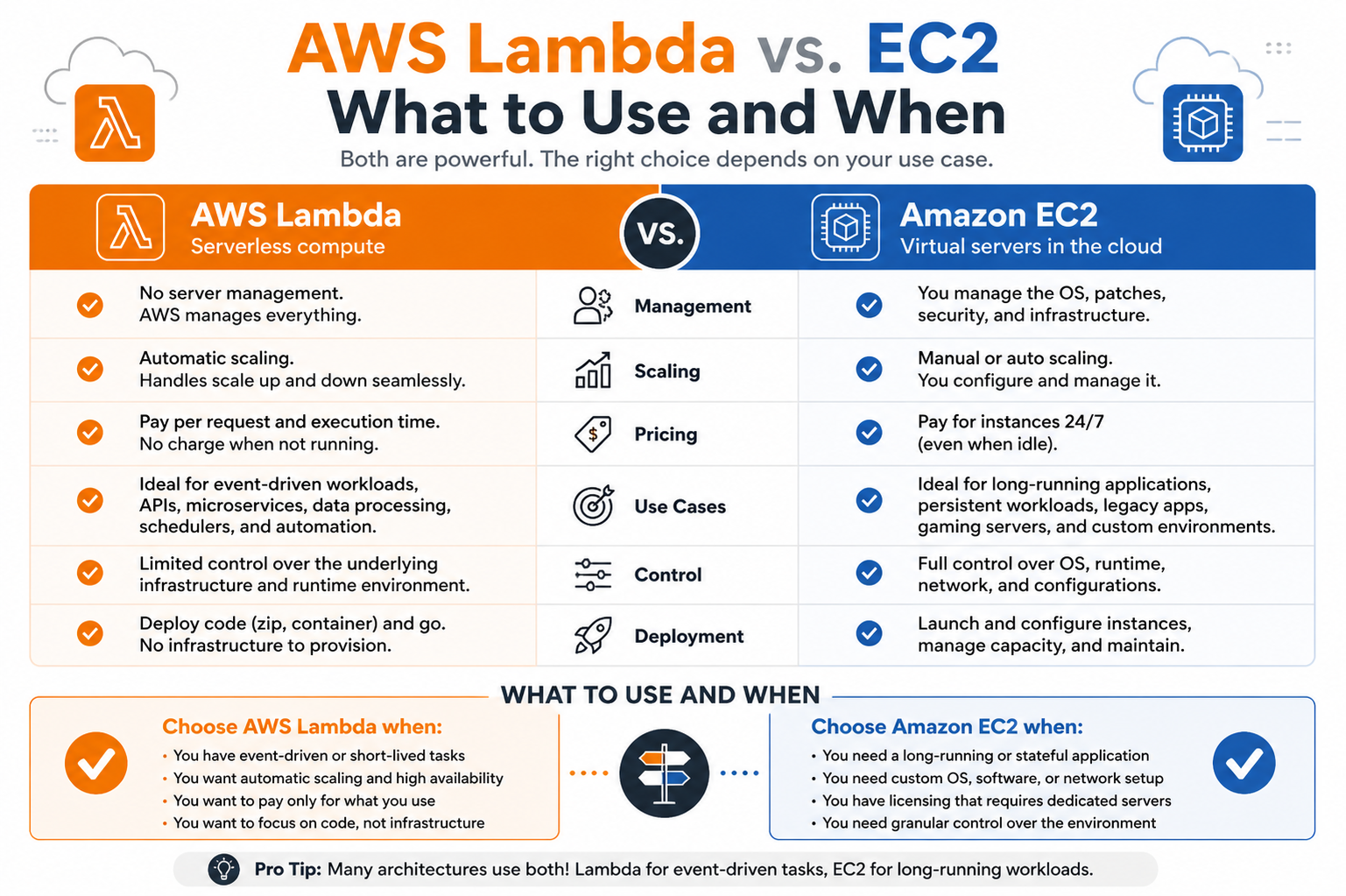
AWS Lambda and Amazon EC2 are fundamentally built on different architectural philosophies, and this difference plays a major role in how applications are designed on AWS. Lambda is centered around event-driven execution, meaning code runs only when triggered. There is no concept of a continuously running server. This design removes the need for infrastructure management and allows developers to focus entirely on business logic. EC2, on the other hand, is based on traditional virtual machine architecture where servers are provisioned and kept running as long as needed. This gives complete control over the environment but also introduces the responsibility of maintenance, scaling, and monitoring.
In Lambda, execution environments are ephemeral. Each function invocation may run in a fresh environment or a reused one, depending on system optimization. This makes it highly scalable but also introduces constraints such as execution time limits and stateless behavior requirements. EC2 instances, in contrast, are persistent and can maintain state, making them suitable for applications that require long-lived connections or memory persistence across sessions.
Execution Model and Performance Behavior
The execution model of AWS Lambda is based on short-lived compute cycles. Each function is triggered by an event, executes its logic, and then terminates. This model is highly efficient for workloads that are sporadic or unpredictable. However, it can introduce latency during cold starts when a new execution environment is initialized. While AWS has optimized this over time, it can still be a factor in latency-sensitive applications.
EC2 provides a consistent runtime environment, which eliminates cold start issues entirely. Once an instance is running, applications can execute immediately with predictable performance. This makes EC2 more suitable for applications requiring steady throughput or low-latency responses. Additionally, EC2 allows fine-tuning of CPU, memory, and storage resources, enabling performance optimization based on workload requirements.
Scalability Approach
Scalability is one of the most significant differences between Lambda and EC2. Lambda scales automatically and instantly in response to incoming events. There is no need to configure scaling policies or manage capacity planning. If thousands of requests arrive simultaneously, Lambda will spawn multiple execution environments to handle the load. This makes it extremely powerful for bursty workloads.
EC2 requires manual or policy-based scaling using tools like Auto Scaling Groups. While this provides control, it also requires careful planning to ensure sufficient capacity is available during peak demand. Scaling EC2 instances is not instantaneous and can take time depending on configuration and instance launch times. However, it provides more predictable infrastructure behavior once properly configured.
Cost Structure and Efficiency
Lambda follows a pay-per-use pricing model where you are charged based on the number of requests and execution duration. This makes it highly cost-efficient for applications with low or variable traffic. There is no cost when the function is not running, which eliminates idle resource expenses.
EC2 uses a time-based pricing model where you pay for running instances regardless of usage. Even if an instance is idle, costs continue to accumulate. While this may seem less efficient, EC2 can be more cost-effective for sustained workloads with consistent utilization. Reserved Instances and Savings Plans can also significantly reduce EC2 costs for long-term usage.
Operational Overhead and Maintenance
One of the most important distinctions between Lambda and EC2 is operational responsibility. Lambda is fully managed, meaning AWS handles server provisioning, patching, scaling, and fault tolerance. Developers do not need to worry about infrastructure management, which reduces operational overhead significantly.
EC2 requires full operational management. This includes operating system updates, security patching, load balancing configuration, and monitoring system health. While this provides flexibility, it also increases administrative burden. Organizations using EC2 often require dedicated DevOps teams to manage infrastructure effectively.
Security and Access Control
Security in Lambda is managed through execution roles and fine-grained IAM permissions. Since there is no direct server access, the attack surface is significantly reduced. This makes Lambda inherently more secure in terms of infrastructure exposure.
EC2 provides full server-level access, which introduces both flexibility and responsibility. Security groups, network access control lists, and firewall configurations must be carefully managed. While EC2 can be highly secure when properly configured, misconfigurations can lead to vulnerabilities.
Flexibility and Customization
EC2 offers maximum flexibility. You can install custom operating systems, configure networking stacks, deploy legacy software, and run virtually any type of application. This makes it suitable for complex enterprise systems and applications with specialized requirements.
Lambda is more restrictive in terms of environment customization. It supports specific runtime environments and imposes limitations on execution time and resource allocation. While this simplifies development, it may not be suitable for applications requiring deep system-level customization.
Use Case Suitability in Real-World Scenarios
Lambda is ideal for microservices architectures where applications are broken into small, independent functions. It is also widely used for automation tasks such as scheduled jobs, data processing pipelines, and real-time file processing. For example, processing uploaded images, triggering notifications, or handling API requests are common Lambda use cases.
EC2 is better suited for monolithic applications, enterprise systems, and workloads requiring persistent compute power. It is commonly used for hosting web servers, databases, gaming backends, and machine learning models that require continuous execution. Applications with steady traffic patterns often perform better on EC2 due to predictable resource allocation.
Latency Considerations
Latency is an important factor when choosing between Lambda and EC2. Lambda may introduce slight delays due to cold starts, especially when functions are not frequently invoked. Although warm execution reduces this issue, it cannot be completely eliminated in all scenarios.
EC2 provides consistent low-latency performance since instances are always running. This makes it more suitable for applications where response time is critical, such as real-time trading systems or high-frequency API services.
Development and Deployment Workflow
Lambda encourages a microservice-based development approach where each function is independently deployed and managed. This aligns well with modern CI/CD pipelines and agile development practices. Deployment is typically faster and more modular.
EC2-based deployments are often more traditional, involving full application deployment to servers. While modern tools like containers and orchestration systems have improved this process, it is still generally more complex compared to Lambda deployments.
Hybrid Architecture Approach
In many modern cloud architectures, Lambda and EC2 are used together rather than as competing choices. Lambda handles event-driven, lightweight tasks while EC2 supports core application services. This hybrid approach allows organizations to optimize both cost and performance.
For example, an application may use EC2 to host its main backend services while using Lambda for background processing, file handling, and API event triggers. This combination leverages the strengths of both services while minimizing their limitations.
Decision-Making Framework
Choosing between Lambda and EC2 depends on several key factors. If the workload is event-driven, short-lived, and unpredictable, Lambda is generally the better choice. If the workload requires persistent computing, full system control, or long-running processes, EC2 is more appropriate.
Cost considerations also play a role. Lambda is more cost-effective for intermittent workloads, while EC2 is better for consistently high usage. Operational capacity within an organization also influences the decision, as Lambda reduces infrastructure management while EC2 requires dedicated operational oversight.
Performance Optimization Strategies
For Lambda, performance optimization involves reducing package size, minimizing cold starts, and optimizing execution time. Using lightweight dependencies and efficient code structure can significantly improve performance.
For EC2, optimization focuses on selecting appropriate instance types, configuring scaling policies, and optimizing resource utilization. Load balancing and caching strategies also play a critical role in maintaining performance efficiency.
Security and Compliance Considerations
Security plays a major role when selecting between AWS Lambda and Amazon EC2, especially for enterprise-grade applications. AWS Lambda follows a highly restricted execution model where the underlying infrastructure is fully managed by AWS and not exposed to the user. This significantly reduces the attack surface because there is no direct access to operating systems, servers, or network configurations. Security is primarily handled through IAM roles, execution policies, and event-based permissions. This makes it easier to enforce least-privilege access and reduces the risk of misconfiguration at the infrastructure level.
EC2 provides much broader control, but with that comes greater responsibility. Since users have access to the operating system and network configuration, they must actively manage security updates, firewall rules, SSH access, and system hardening. Security groups, network ACLs, and key pair management become essential components of the security architecture. While EC2 can be extremely secure when properly configured, it requires consistent monitoring and maintenance to avoid vulnerabilities. This makes Lambda more appealing for teams that want a reduced operational security burden, while EC2 is better suited for organizations with strong infrastructure security expertise.
Reliability and Fault Tolerance
AWS Lambda is inherently designed for high availability. Since it runs across multiple availability zones automatically, failures in underlying infrastructure are abstracted away from the user. If a function fails due to transient issues, it can be retried automatically depending on configuration. This built-in redundancy ensures strong fault tolerance without additional configuration effort.
EC2 reliability depends on how the architecture is designed. A single EC2 instance is not inherently fault tolerant. To achieve high availability, users must deploy multiple instances across availability zones, use load balancers, and implement auto-recovery strategies. While this provides greater architectural control, it requires careful planning and design. In contrast, Lambda simplifies reliability by handling distribution and failover internally.
State Management Differences
One of the most important conceptual differences between Lambda and EC2 is how state is handled. Lambda is stateless by design. Each invocation is independent, meaning it does not retain memory or session data between executions unless external storage services are used. This encourages developers to design applications using external databases, caches, or storage systems for persistence.
EC2 supports stateful applications naturally because processes run continuously on persistent servers. Applications can store session data in memory or local storage, making it easier to handle workflows that depend on continuous state. This makes EC2 more suitable for traditional applications such as content management systems, enterprise applications, or services that require persistent user sessions.
Integration with Other AWS Services
Lambda is deeply integrated with the broader AWS ecosystem. It can be triggered by services such as API Gateway, S3, DynamoDB, SQS, and EventBridge. This tight integration makes it a powerful tool for building event-driven architectures. It enables developers to create highly modular systems where different services communicate through events rather than direct coupling.
EC2 also integrates with AWS services, but typically in a more traditional infrastructure sense. It works alongside load balancers, auto scaling groups, RDS databases, and networking services. While integration is flexible, it is less event-driven compared to Lambda. EC2-based architectures often resemble traditional server-based systems, whereas Lambda enables more distributed and reactive system designs.
Development Complexity and Learning Curve
Lambda simplifies development in many ways because it removes infrastructure management from the equation. Developers focus purely on writing functions that respond to events. However, this simplicity can introduce complexity in architecture design, especially when building large distributed systems. Debugging and tracing across multiple Lambda functions may require additional observability tools.
EC2 has a steeper operational learning curve due to the need for system administration knowledge. Developers must understand server setup, networking, scaling, and deployment processes. However, once these fundamentals are mastered, EC2 provides a highly flexible environment for building complex systems. It is often preferred by teams transitioning from traditional on-premise infrastructure to the cloud.
Deployment Speed and Iteration Cycle
Lambda supports rapid deployment cycles. Functions can be updated and deployed quickly without impacting underlying infrastructure. This makes it ideal for agile development environments where frequent updates are required. CI/CD pipelines integrate well with Lambda, enabling automated deployments with minimal downtime.
EC2 deployments are typically slower because they may involve updating entire application stacks or redeploying server images. Although containerization and orchestration tools have improved deployment speed, EC2-based systems still require more coordination compared to Lambda’s lightweight deployment model.
Monitoring and Observability
AWS Lambda integrates with monitoring tools such as CloudWatch to provide logs, metrics, and traces for function executions. Since Lambda is event-driven, monitoring often focuses on execution duration, error rates, and invocation counts. However, tracing distributed workflows across multiple functions may require additional observability frameworks.
EC2 provides deeper system-level monitoring capabilities. Users can access CPU usage, memory consumption, disk performance, and network activity. This level of visibility is useful for diagnosing performance issues and optimizing system behavior. EC2 allows more granular monitoring, but also requires more effort to configure and interpret effectively.
Networking and Connectivity
Lambda functions operate within a managed network environment. While they can access VPC resources, their networking capabilities are abstracted. This limits direct control but simplifies configuration. It is ideal for applications that do not require complex networking setups.
EC2 provides full control over networking configurations. Users can define custom VPCs, subnets, routing tables, and security policies. This makes EC2 suitable for complex network architectures, hybrid cloud setups, and enterprise-grade deployments requiring strict network segmentation.
Resource Limitations and Constraints
Lambda has predefined limits such as maximum execution time, memory allocation, and temporary storage capacity. These constraints ensure efficient resource usage but may limit its applicability for compute-intensive or long-running workloads. Developers must design within these boundaries.
EC2 does not impose such strict limitations. Users can choose instance types with varying CPU, memory, and storage configurations depending on workload requirements. This flexibility makes EC2 suitable for demanding applications such as big data processing, video rendering, or large-scale simulations.
Cost Optimization Strategies in Practice
In real-world scenarios, cost optimization differs significantly between Lambda and EC2. For Lambda, optimization involves reducing execution time, minimizing memory allocation, and designing efficient event triggers. Since billing is based on usage, even small improvements in execution efficiency can reduce costs.
For EC2, cost optimization is more infrastructure-focused. Techniques include using reserved instances, selecting right-sized instances, shutting down unused resources, and leveraging spot instances for non-critical workloads. Proper cost management in EC2 often requires continuous monitoring and adjustment.
Real-World Architectural Patterns
Modern cloud architectures frequently combine both services to maximize efficiency. A common pattern is using EC2 for core application servers while delegating asynchronous tasks to Lambda. Another pattern involves using Lambda as a front-line processing layer that triggers EC2-based systems for heavier computation.
This hybrid approach allows organizations to balance performance, scalability, and cost. It also enables gradual migration from traditional EC2-based systems to serverless architectures without requiring complete redesign.
Future Trends and Evolution
Serverless computing continues to evolve, and AWS Lambda represents a major step in that direction. As event-driven architectures become more popular, Lambda-like services are increasingly used for building scalable, low-maintenance systems. Improvements in cold start performance, execution limits, and integration capabilities are making Lambda suitable for a wider range of applications.
At the same time, EC2 remains a foundational service in cloud computing. Despite the rise of serverless technologies, there will always be workloads that require full infrastructure control. EC2 continues to evolve with better instance types, improved performance, and tighter integration with containerized workloads.
AWS Lambda and Amazon EC2 are not competing technologies in a strict sense but rather complementary solutions designed for different architectural needs. Lambda excels in simplicity, automation, and event-driven scalability, while EC2 excels in control, flexibility, and sustained computing power.
Choosing between them requires understanding workload behavior, performance expectations, cost sensitivity, and operational capacity. In many cases, the most effective cloud strategy involves combining both services to create a balanced, scalable, and efficient system architecture.
Advanced Cost Behavior and Long-Term Economics
When evaluating AWS Lambda and EC2 from a long-term financial perspective, the cost behavior of both services becomes a critical decision factor. Lambda follows a highly granular billing model where charges are tied directly to the number of requests and the exact duration of execution in milliseconds. This means costs scale precisely with usage, making it extremely efficient for workloads that are unpredictable or have long idle periods. Over time, this can lead to significant savings for applications that do not require constant processing.
However, Lambda’s cost efficiency can diminish when workloads become extremely frequent or long-running. In such cases, repeated invocations and high execution durations may accumulate costs that exceed a baseline EC2 deployment. This is where EC2 becomes economically advantageous, particularly for steady-state workloads where compute usage remains consistently high. With EC2, the cost remains fixed for running instances, which allows predictable budgeting and better cost control for sustained traffic environments.
Reserved capacity options in EC2, such as long-term commitments, further reduce costs significantly. Organizations that can forecast usage patterns benefit from reduced pricing tiers, making EC2 highly cost-effective for enterprise-scale applications. Therefore, while Lambda offers superior flexibility in cost structure, EC2 provides better economy of scale in stable environments.
Performance Consistency and Predictability
Performance consistency is another area where AWS Lambda and EC2 differ significantly. Lambda performance is influenced by factors such as cold starts, concurrency scaling, and runtime initialization. Although AWS has made improvements to reduce cold start latency, it can still introduce variability in response times, particularly in workloads that are not continuously active. This variability can be a concern for latency-sensitive applications.
EC2 provides a stable and predictable performance profile. Once an instance is running, it maintains consistent compute availability without initialization delays. This makes EC2 more suitable for applications that require deterministic performance, such as financial systems, real-time analytics, or high-frequency transaction processing. The ability to reserve dedicated compute capacity ensures that performance remains steady regardless of external demand fluctuations.
Developer Experience and Workflow Efficiency
From a developer experience standpoint, AWS Lambda significantly reduces operational complexity. Developers can deploy functions without worrying about server provisioning, patch management, or scaling configurations. This leads to faster iteration cycles and improved productivity, especially in agile development environments. The focus remains on writing modular, event-driven code rather than managing infrastructure.
EC2, while more complex, offers a familiar environment for developers who are accustomed to traditional server-based systems. It allows full control over runtime environments, which can be beneficial when working with legacy applications or custom software stacks. However, this flexibility introduces additional operational responsibilities, including deployment orchestration, system monitoring, and infrastructure maintenance.
Modern DevOps practices have reduced some of this complexity through automation tools, containerization, and infrastructure-as-code frameworks. Even so, EC2 still requires a deeper understanding of system administration compared to Lambda’s abstraction-based model.
Scalability Limitations and Real-World Constraints
Although AWS Lambda is designed for automatic scaling, it does have certain concurrency limits that can affect extremely high-throughput systems. While these limits can be increased upon request, they still represent a structural constraint that must be considered during architecture design. Additionally, rapid scaling in Lambda can sometimes lead to throttling or delayed execution under extreme load conditions.
EC2 scalability is more controlled and deliberate. Through auto scaling groups, applications can dynamically adjust capacity based on demand metrics. While this approach is not as instantaneous as Lambda, it provides more predictable scaling behavior. It also allows fine-grained control over how and when scaling occurs, which is important for systems with strict performance requirements.
Data Processing and Workflow Orchestration
Lambda is particularly effective in distributed data processing workflows. It integrates seamlessly with storage and streaming services, enabling real-time processing pipelines. For example, data ingestion, transformation, and event-triggered workflows can be efficiently handled using Lambda functions. This makes it a strong choice for modern data architectures that rely on event-driven processing.
EC2 is better suited for heavy-duty data processing tasks that require sustained compute resources. Large-scale batch processing, machine learning model training, and complex simulations often benefit from EC2’s persistent compute power. The ability to allocate high-memory or GPU-enabled instances makes EC2 more capable of handling intensive workloads that exceed Lambda’s execution constraints.
Operational Monitoring and Debugging Complexity
Monitoring Lambda-based systems requires a shift in mindset compared to traditional server monitoring. Since Lambda functions are stateless and ephemeral, debugging often relies on distributed tracing, log aggregation, and event tracking. Understanding the flow of execution across multiple functions can be challenging without proper observability tools.
EC2 provides more direct visibility into system behavior. Developers can inspect logs at the operating system level, monitor resource usage in real time, and diagnose issues using traditional debugging techniques. This level of transparency simplifies troubleshooting but requires more manual effort in system management.
In large-scale systems, Lambda monitoring becomes more abstract but scalable, while EC2 monitoring becomes more detailed but operationally heavier. The choice often depends on whether abstraction or control is prioritized.
Architectural Flexibility and Design Philosophy
AWS Lambda encourages a microservices and event-driven architecture philosophy. Applications are decomposed into small, independent functions that communicate through events. This promotes loose coupling, scalability, and modular design. However, it also introduces architectural complexity when managing large numbers of distributed components.
EC2 aligns more closely with monolithic or layered architecture models. While it can support microservices, it does so through manual configuration or container orchestration systems. EC2’s flexibility allows both modern and traditional architectures to coexist, making it suitable for organizations in transition phases.
The architectural choice between Lambda and EC2 often reflects a broader design philosophy: abstraction and automation versus control and structure.
Latency-Sensitive and Real-Time Applications
For real-time applications, EC2 generally provides a more reliable foundation due to its consistent execution environment. Applications such as gaming servers, live streaming platforms, and financial trading systems require minimal latency variation, which EC2 can deliver more effectively.
Lambda can be used in real-time systems, but it is typically better suited for event-triggered real-time processing rather than continuous real-time communication. The presence of cold starts and execution limits makes it less ideal for ultra-low-latency requirements.
Hybrid Cloud Strategy in Practice
In modern cloud architectures, it is increasingly common to combine AWS Lambda and EC2 within the same ecosystem. Lambda is used to handle asynchronous tasks, API triggers, and lightweight processing, while EC2 manages core application logic and persistent services. This hybrid approach allows organizations to balance scalability with control.
For example, a web application might run its main backend on EC2 while using Lambda to process image uploads, send notifications, or handle background analytics. This separation of responsibilities improves efficiency and reduces operational overhead.
Long-Term Maintainability and System Evolution
Over time, Lambda-based systems tend to evolve into highly modular and distributed architectures. While this improves scalability and maintainability at a functional level, it can also increase system complexity if not properly managed. Without clear design practices, Lambda-based systems can become difficult to trace and debug.
EC2-based systems evolve more slowly but maintain structural consistency. They are easier to understand at a system level but may require more effort to scale and modernize over time. Many organizations gradually transition from EC2 to serverless or hybrid models as their cloud maturity increases.
Choosing between AWS Lambda and EC2 is ultimately a strategic decision rather than a purely technical one. Lambda represents a shift toward abstraction, automation, and event-driven computing, making it ideal for modern cloud-native applications. EC2 represents stability, control, and traditional computing power, making it essential for complex, performance-intensive systems.
Neither service replaces the other. Instead, they complement each other within the broader AWS ecosystem. The most effective cloud architectures leverage both services strategically, aligning each workload with the computing model that best matches its behavior, performance needs, and cost structure.
Real-World Migration Scenarios Between EC2 and Lambda
In many organizations, the decision between AWS Lambda and EC2 is not static. Systems often evolve over time, and workloads may gradually shift from EC2-based architectures to Lambda-driven designs or the other way around. This migration is typically driven by changes in scalability needs, cost optimization goals, or modernization efforts.
When moving from EC2 to Lambda, applications are usually refactored into smaller, independent components. Monolithic services hosted on EC2 are broken down into event-driven functions. This transition improves scalability and reduces operational overhead, but it requires careful redesign of application logic, especially around state management and request handling. Not every workload is suitable for direct migration, particularly those that depend on persistent connections or long-running processes.
In contrast, migrating from Lambda to EC2 is less common but occurs when applications outgrow serverless constraints. This typically happens when execution time limits, cold start latency, or high-frequency invocation costs become limiting factors. In such cases, consolidating workloads onto EC2 provides more predictable performance and greater control over runtime behavior.
Operational Resilience and Disaster Recovery
AWS Lambda inherently benefits from AWS-managed resilience. Since execution is distributed across multiple underlying systems, failure in a single environment does not typically affect overall availability. This built-in redundancy simplifies disaster recovery planning, as there is no need to manage server-level replication or failover mechanisms.
EC2-based systems require explicit disaster recovery strategies. This includes multi-AZ deployments, automated backups, and failover configurations. While this adds complexity, it also provides more control over recovery behavior. Organizations can define exactly how systems respond to failures, which is important for critical applications with strict recovery objectives.
In practice, Lambda reduces the operational burden of resilience, while EC2 provides more customizable but complex recovery mechanisms.
Latency Trade-offs in Distributed Systems
Latency behavior differs significantly between Lambda and EC2 in distributed architectures. Lambda introduces variability due to its on-demand execution model. Even though execution is fast in most cases, initial invocation delays can impact time-sensitive workflows. This becomes more noticeable in systems that require consistent response times.
EC2 provides stable latency characteristics because services are continuously running. This eliminates startup delays and ensures that requests are processed immediately. For applications where even minor latency fluctuations are unacceptable, EC2 remains the more reliable choice.
However, in distributed event-driven systems where slight variability is acceptable, Lambda offers sufficient performance while providing superior scalability benefits.
Resource Utilization Efficiency
One of the strongest advantages of AWS Lambda is its ability to optimize resource utilization automatically. Since compute resources are only consumed during execution, there is no idle capacity. This leads to extremely efficient resource usage, especially in environments with irregular traffic patterns.
EC2, on the other hand, requires provisioning of fixed resources. Even if an instance is underutilized, costs continue to accrue. While this can be optimized through scaling strategies, there is still a baseline level of resource allocation that remains active. This makes EC2 less efficient in low-utilization scenarios but highly effective when utilization remains consistently high.
Suitability for Modern Cloud-Native Applications
Modern cloud-native applications are increasingly designed around microservices, automation, and event-driven architectures. AWS Lambda fits naturally into this paradigm by enabling fine-grained services that respond to specific events. This reduces coupling between components and improves system scalability.
EC2 continues to play a vital role in cloud-native environments, particularly as the foundation for containerized workloads. Many Kubernetes clusters and container orchestration systems run on EC2 infrastructure, making it a critical part of modern distributed systems even when serverless architectures are used.
This demonstrates that EC2 is not being replaced but rather integrated into more advanced architectures alongside serverless technologies.
Business Impact and Strategic Value
From a business perspective, the choice between Lambda and EC2 can significantly influence operational efficiency and cost structure. Lambda reduces the need for infrastructure management teams, allowing organizations to focus more on product development and innovation. This can accelerate time-to-market and reduce operational expenses.
EC2 provides strategic value in scenarios where control, customization, and performance predictability are critical. Enterprises with complex legacy systems or specialized workloads often rely on EC2 to maintain stability and continuity. It also supports hybrid cloud strategies that combine on-premise infrastructure with cloud scalability.
Ultimately, both services contribute to business agility in different ways, depending on organizational maturity and technical requirements.
Future Direction of Cloud Computing Models
The evolution of cloud computing is increasingly moving toward abstraction and automation. Serverless models like AWS Lambda represent a shift away from infrastructure-centric thinking toward event-driven execution models. This reduces operational complexity and allows developers to focus more on application logic.
At the same time, traditional virtual machine models like EC2 continue to evolve with improvements in performance, automation, and integration with container technologies. Rather than being replaced, EC2 is adapting to fit into modern hybrid and multi-cloud environments.
The future of cloud computing is likely to be hybrid, where serverless and traditional compute coexist and complement each other based on workload requirements.
Conclusion
AWS Lambda and Amazon EC2 represent two fundamentally different approaches to cloud computing. Lambda focuses on abstraction, automation, and event-driven execution, making it ideal for scalable, lightweight, and intermittent workloads. It reduces operational complexity and allows developers to build highly responsive systems with minimal infrastructure management.
EC2, in contrast, provides full control over computing environments, making it suitable for persistent, complex, and performance-intensive applications. It offers flexibility, predictability, and customization that are essential for many enterprise-grade systems.
Neither service is universally better than the other. Instead, they serve different purposes within the cloud ecosystem. Lambda excels in simplicity, scalability, and cost efficiency for dynamic workloads, while EC2 excels in control, stability, and sustained performance for traditional and complex applications.
The most effective cloud strategies do not rely on choosing one over the other but rather on combining both services intelligently. By aligning each workload with the appropriate computing model, organizations can achieve optimal performance, cost efficiency, and architectural flexibility in modern cloud environments.