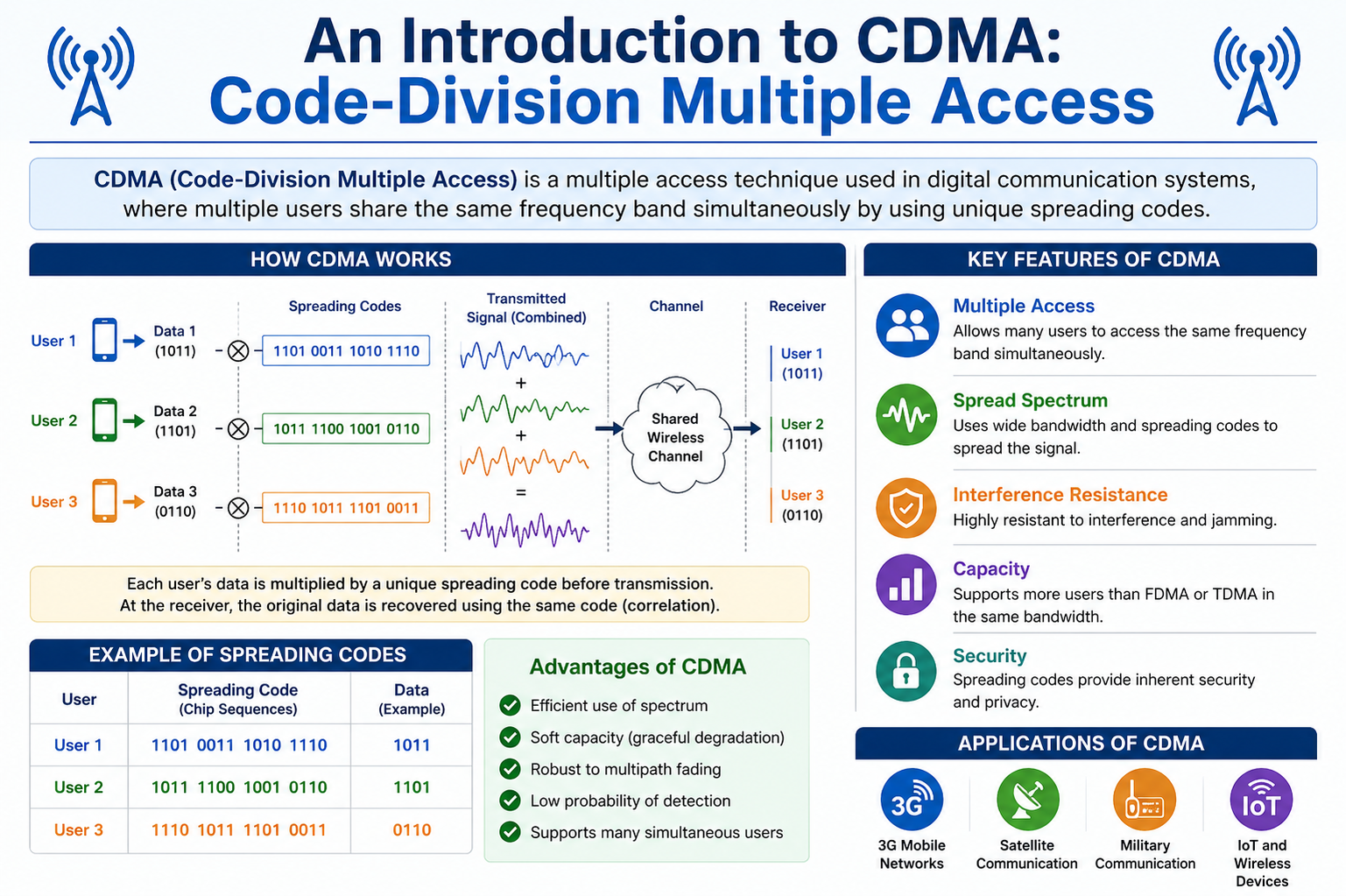
Code-Division Multiple Access is a wireless communication technique that allows many users to share the same frequency band at the same time using unique digital codes. Instead of separating users by time slots or frequency channels, CDMA separates them by assigning each user a distinct spreading code. These codes enable multiple signals to overlap in both time and frequency while still remaining distinguishable at the receiver. This method significantly improves the efficiency of spectrum usage and increases the number of users that a network can support simultaneously.
CDMA is based on the principle of spread spectrum communication, where the original signal is spread over a much wider bandwidth than the minimum required. This spreading is done using a pseudo-random code that appears random but is actually deterministic and known to both the transmitter and receiver. The receiver uses the same code to de-spread the signal and recover the original information while rejecting other signals that use different codes.
Fundamental Concept of Spread Spectrum in CDMA
The core idea behind CDMA lies in spread spectrum technology. In this approach, a narrowband signal is expanded into a wideband signal before transmission. This is achieved by mixing the data signal with a high-rate code sequence known as a chip sequence. The resulting signal occupies a much larger frequency range than the original message.
At the receiver side, the same chip sequence is used to correlate and extract the intended signal. Since each user has a unique code with low cross-correlation properties, signals from other users appear as noise and are largely ignored. This allows multiple users to transmit simultaneously over the same frequency band without significant interference.
The effectiveness of this technique depends on the properties of the spreading codes. These codes are designed to be orthogonal or nearly orthogonal so that signals can be separated easily at the receiver. The more distinct the codes, the better the system performs in separating multiple users.
Working Mechanism of CDMA Systems
In a CDMA system, communication begins when a user’s data is combined with a spreading code. This process increases the bandwidth of the signal significantly. The transmitted signal then travels through the wireless medium and mixes with signals from other users.
At the receiver, the incoming composite signal contains many overlapping transmissions. However, the receiver applies the same spreading code used by the intended transmitter. Through a process called correlation, the receiver isolates the desired signal while treating all other signals as noise. This ability to extract a specific signal from a mixture of many is what makes CDMA highly efficient.
A key factor in this process is synchronization. The receiver must align its code with the incoming signal accurately. Even slight misalignment can lead to poor signal recovery. Therefore, synchronization techniques are essential in CDMA systems to maintain communication quality.
Role of Pseudo-Random Codes
Pseudo-random noise codes, often called PN codes, are central to CDMA operation. These codes are not truly random but are generated using deterministic algorithms. They appear random to an outside observer but can be reproduced exactly when the generating algorithm and initial conditions are known.
Each user is assigned a unique PN code. These codes have specific mathematical properties, such as low cross-correlation and high auto-correlation. Low cross-correlation ensures that different users’ signals do not interfere significantly with each other, while high auto-correlation helps the receiver identify the correct alignment of the code.
The quality of these codes directly affects system performance. Poorly designed codes can lead to increased interference and reduced capacity.
Processing Gain in CDMA
Processing gain is an important concept in CDMA systems. It refers to the ratio between the spread bandwidth and the original data bandwidth. A higher processing gain means better resistance to interference and noise.
When a signal is spread over a wide frequency range, the power density of the signal becomes very low. This makes it difficult for unintended receivers to detect or jam the signal. However, at the intended receiver, the de-spreading process concentrates the signal power back into its original form, making it detectable again.
Processing gain also improves system capacity by allowing more users to share the same spectrum without causing excessive interference. It is one of the reasons CDMA systems can support a large number of simultaneous users.
Near-Far Problem in CDMA Networks
One of the major challenges in CDMA systems is the near-far problem. This occurs when a user close to the base station transmits a much stronger signal than a user farther away. The stronger signal can overwhelm the weaker one, making it difficult for the receiver to decode the distant user’s data.
To solve this issue, CDMA systems use power control mechanisms. These systems continuously adjust the transmission power of each user so that all signals arrive at the base station with approximately equal strength. This ensures fair access to the channel and prevents strong users from dominating the communication medium.
Effective power control is critical for maintaining the stability and performance of CDMA networks.
Power Control Techniques
Power control in CDMA is typically divided into two categories: open-loop and closed-loop control. Open-loop control estimates the required transmission power based on the signal strength received from the base station. It is fast but less accurate.
Closed-loop control, on the other hand, involves feedback from the base station. The base station measures the received signal quality and sends commands to the mobile device to increase or decrease its transmission power. This method is more precise and helps maintain balanced signal levels across the network.
Together, these techniques ensure that all users contribute fairly to the shared communication channel.
Rake Receiver Concept
Wireless signals often reach the receiver through multiple paths due to reflection, diffraction, and scattering. This phenomenon is known as multipath propagation. In traditional systems, multipath can cause interference and signal degradation.
CDMA systems take advantage of this effect using a special receiver called a rake receiver. The rake receiver has multiple sub-receivers, each tuned to a different delayed version of the incoming signal. These components are then combined to produce a stronger and more reliable output signal.
This technique improves signal quality and enhances resistance to fading in wireless environments.
Capacity and Efficiency of CDMA Systems
CDMA systems are known for their high capacity compared to other multiple access techniques. Since all users share the same frequency band, the system does not require strict division of time or frequency resources.
However, capacity is not unlimited. As more users join the network, the level of interference increases. Eventually, the system reaches a point where additional users degrade overall performance. This limit is called the interference-limited capacity.
Despite this limitation, CDMA still offers better spectral efficiency than traditional methods, especially in environments with many users.
Comparison with Other Multiple Access Techniques
CDMA differs significantly from Frequency-Division Multiple Access and Time-Division Multiple Access. In FDMA, each user is assigned a separate frequency band, while in TDMA, users share the same frequency but transmit at different time intervals.
CDMA, however, allows all users to transmit simultaneously over the same frequency band. This makes it more flexible and efficient in terms of spectrum usage. It also reduces the need for strict synchronization compared to TDMA.
Another advantage is that CDMA systems are less prone to interference and can handle variable traffic loads more effectively.
Security Features of CDMA
CDMA provides a higher level of security compared to other multiple access methods. Since signals are spread using pseudo-random codes, they appear as noise to unintended receivers. Without knowledge of the specific code, it is extremely difficult to intercept or decode the transmitted information.
This inherent security feature makes CDMA suitable for applications where privacy and data protection are important.
Limitations of CDMA Technology
Despite its advantages, CDMA has some limitations. The system is sensitive to interference, especially as the number of users increases. Power control must be highly accurate to prevent the near-far problem.
Complex signal processing is also required at both the transmitter and receiver, which increases system cost and design complexity. Additionally, synchronization between codes must be maintained with high precision.
These challenges require sophisticated hardware and software solutions to ensure reliable performance.
Applications of CDMA in Modern Communication
CDMA has been widely used in cellular communication systems, particularly in 3G mobile networks. It supports voice communication, mobile internet access, and multimedia services.
Beyond mobile networks, CDMA principles are also applied in satellite communication systems, military communication, and GPS technology. In these applications, its resistance to interference and ability to support multiple users make it highly valuable.
Even though newer technologies like LTE and 5G have replaced CDMA in many regions, its core concepts remain important in modern wireless communication design.
Advanced CDMA System Architecture
In a complete CDMA system, communication is not just about encoding and decoding signals but also about a well-structured architecture that manages multiple users efficiently. The system is generally divided into three main components: the mobile station, the base station, and the mobile switching center. Each part plays a specific role in ensuring smooth transmission and reception of data across the network.
The mobile station is the user device that generates and receives signals. It performs spreading and de-spreading of data using assigned codes. The base station acts as an intermediary, handling multiple mobile users within a geographical area. It manages signal reception, power control, and synchronization. The mobile switching center connects different base stations and handles routing of calls and data between users across the network.
This layered structure allows CDMA systems to scale effectively while maintaining communication quality across large networks.
Channel Structure in CDMA Communication
CDMA systems use different types of logical channels to organize communication. These channels are categorized into forward and reverse links. The forward link carries signals from the base station to the mobile devices, while the reverse link carries signals from mobile devices back to the base station.
Within these links, there are further subdivisions such as pilot channels, synchronization channels, paging channels, and traffic channels. The pilot channel helps mobile devices detect and synchronize with the base station. The synchronization channel provides timing information, while the paging channel is used to alert devices of incoming calls or messages. The traffic channel carries actual user data such as voice or internet packets.
This structured channel system ensures organized and efficient communication even in densely populated networks.
Orthogonality and Code Design in CDMA
A critical requirement in CDMA systems is the use of orthogonal or near-orthogonal codes. Orthogonality means that when two different codes are multiplied and summed over a time interval, the result is zero. This property ensures that different users’ signals do not interfere with each other.
In practical systems, perfect orthogonality is difficult to achieve due to multipath propagation and synchronization issues. Therefore, CDMA uses specially designed codes such as Walsh codes for short-range orthogonality and pseudo-random sequences for long-distance communication.
Good code design is essential for minimizing cross-user interference and improving system performance. The selection of codes directly affects capacity, reliability, and overall signal quality.
Interference Management in CDMA Networks
Unlike traditional systems where interference is avoided by separating users, CDMA allows controlled interference and manages it intelligently. Since all users share the same frequency band, interference becomes a natural part of the system.
The key to managing this interference lies in power control and code separation. Each user’s signal is adjusted so that no single signal dominates the channel. Additionally, the use of spreading codes ensures that unwanted signals appear as low-level noise.
Interference in CDMA is also influenced by cell loading, which refers to the number of active users in a cell. As the number of users increases, interference rises, reducing signal quality. Therefore, network planning is crucial to maintain optimal performance.
Soft Handover in CDMA Systems
One of the most important features of CDMA is soft handover, which improves call continuity during movement. In traditional systems, a device switches from one base station to another abruptly, which can cause brief interruptions.
In CDMA, a mobile device can communicate with multiple base stations simultaneously during a transition. This process is known as soft handover. The signals from different base stations are combined at the receiver, resulting in a smoother transition and reduced call drops.
Soft handover enhances user experience, especially in high-mobility environments such as vehicles or trains. It also improves signal reliability by taking advantage of multiple transmission paths.
Hard Handover vs Soft Handover
Hard handover occurs when a mobile device disconnects from one base station before connecting to another. This creates a short gap in communication and may result in dropped calls.
Soft handover, on the other hand, allows overlapping connections during the transition phase. The device maintains simultaneous links with multiple base stations until the strongest signal is selected. This makes CDMA networks more stable and reliable compared to systems that rely only on hard handover.
The ability to support soft handover is one of the key advantages of CDMA technology in mobile communication.
Capacity Limits and Interference Trade-Off
CDMA systems do not have a fixed number of channels. Instead, capacity is determined by the level of acceptable interference in the system. As more users join the network, interference increases gradually.
This creates a trade-off between capacity and quality. If too many users are allowed, signal quality decreases. If too few users are allowed, resources are underutilized. Therefore, CDMA networks operate near a balance point where both capacity and quality are optimized.
This dynamic nature makes CDMA flexible but also requires continuous network management.
Multipath Fading and Signal Diversity
Wireless communication often suffers from multipath fading, where signals reach the receiver through different paths with varying delays. These signals can interfere with each other, causing fluctuations in signal strength.
CDMA handles this issue using signal diversity techniques. Instead of treating multipath as a problem, CDMA uses it as an advantage. Different delayed versions of the same signal are combined at the receiver using a rake receiver.
This improves signal strength and reduces the effects of fading, making CDMA highly reliable in complex environments such as urban areas.
Rake Receiver Operation in Detail
A rake receiver works by separating the incoming signal into multiple components based on their arrival times. Each component is processed independently and then combined to produce a stronger signal.
Each sub-receiver, known as a finger, locks onto a specific multipath component. These fingers track the signal continuously and adjust to changes in propagation conditions.
By combining energy from multiple paths, the rake receiver significantly improves signal quality and reduces errors in transmission. This makes CDMA particularly effective in environments with heavy signal reflection.
Signal-to-Noise Ratio in CDMA Systems
Signal-to-noise ratio is a key performance metric in communication systems. In CDMA, the signal is spread over a wide bandwidth, which reduces its power density and makes it appear like noise to unintended receivers.
However, at the receiver, the de-spreading process increases the effective signal power while reducing noise. This improves the signal-to-noise ratio and allows reliable communication even in noisy environments.
A higher signal-to-noise ratio means better voice quality, faster data transmission, and fewer errors in communication.
Evolution of CDMA Technology
CDMA technology has evolved significantly over time. Early implementations were used in second-generation and third-generation mobile networks. These systems introduced digital voice communication, improved data services, and better spectrum utilization.
Over time, enhancements such as wideband CDMA were introduced to support higher data rates and multimedia applications. These improvements allowed CDMA to compete with other emerging technologies in mobile communication.
Although newer technologies have replaced CDMA in many regions, its concepts remain fundamental in modern wireless system design.
Wideband CDMA and Its Improvements
Wideband CDMA expanded the original CDMA concept by increasing the available bandwidth. This allowed higher data rates and better support for internet-based applications.
WCDMA also improved code structure and error correction techniques, making communication more efficient. It introduced better support for video calling, mobile internet browsing, and multimedia messaging.
These enhancements made CDMA more suitable for advanced mobile services and global communication standards.
Challenges in CDMA Deployment
Despite its advantages, CDMA deployment involves several challenges. The system requires precise power control to prevent interference issues. Synchronization between users and base stations must also be highly accurate.
Additionally, the complexity of encoding and decoding signals increases the cost of devices and infrastructure. Network planning must be carefully designed to manage capacity and maintain quality.
These challenges require advanced engineering solutions and continuous optimization.
CDMA System Overview
CDMA represents a highly efficient and sophisticated approach to wireless communication. By using unique spreading codes, it allows multiple users to share the same frequency spectrum without direct conflict.
Its advanced features such as soft handover, rake reception, and interference management make it highly reliable in real-world environments. Although newer technologies have emerged, CDMA remains an important foundation in the development of modern communication systems and continues to influence current wireless standards.
Mathematical Principles Behind CDMA
CDMA systems are built on strong mathematical foundations, especially concepts from signal processing, probability, and linear algebra. At the core of CDMA is the idea of representing digital data as sequences of binary signals that are mathematically combined with spreading codes. These codes are designed to behave like orthogonal or pseudo-orthogonal vectors in a high-dimensional space.
When a data signal is multiplied by a spreading code, the result is a sequence that spreads the energy of the original signal across a much wider bandwidth. This process can be represented mathematically as a form of vector multiplication, where each bit of data is expanded into multiple chips. The receiver performs a correlation operation, which is essentially a dot product between the received signal and the same spreading code. If the codes match, the result is a strong positive value, allowing the original signal to be recovered.
This mathematical structure ensures that even when multiple signals overlap, they can still be separated effectively using correlation techniques.
Correlation and Signal Detection in CDMA
Correlation is the key process used in CDMA to identify and extract signals. When a composite signal containing multiple users is received, the system compares it with a known spreading code. If the code matches the transmitted signal, the correlation output is high. If it does not match, the output remains low and behaves like noise.
This property allows CDMA systems to distinguish between multiple overlapping transmissions. The effectiveness of correlation depends on how well the codes are designed. Ideally, the correlation between different users’ codes should be close to zero, while the correlation of a code with itself should be maximum.
This principle is what enables CDMA to function without strict time or frequency separation between users.
Orthogonal Functions and Walsh Codes
Orthogonal functions play an important role in CDMA, especially in controlled environments such as downlink communication. Walsh codes are commonly used because they are mathematically orthogonal to each other. This means that the inner product of any two different Walsh codes is zero.
In practice, these codes are arranged in matrices where each row represents a unique code. When used in synchronized systems, they ensure that signals do not interfere with each other. However, in real-world wireless environments, perfect orthogonality is often disrupted due to delays and reflections.
Despite this limitation, Walsh codes remain useful for reducing interference in structured parts of the network.
Pseudo-Noise Sequences in CDMA
Pseudo-noise sequences are another critical element of CDMA systems. These sequences are generated using linear feedback shift registers, which produce long repeating patterns that appear random. Although they are deterministic, their randomness properties make them suitable for spreading signals.
These sequences have a wide autocorrelation peak, meaning they strongly match only when perfectly aligned with themselves. This property allows receivers to detect correct timing and synchronize signals accurately.
At the same time, their cross-correlation with other sequences remains low, reducing interference between users. This balance between randomness and structure is essential for CDMA performance.
Capacity Analysis in CDMA Networks
The capacity of a CDMA system is not fixed like in traditional systems. Instead, it depends on the level of interference that the system can tolerate. As more users join the network, each additional user contributes to the overall interference level.
Mathematically, system capacity is determined by the signal-to-interference ratio. When interference becomes too high, the quality of communication drops below acceptable levels, limiting the number of users.
This makes CDMA an interference-limited system rather than a channel-limited system. Network engineers must carefully balance user load and signal quality to maintain stable performance.
Power Control Equations and Balancing
Power control in CDMA can be described mathematically as a feedback system. Each user adjusts its transmission power based on instructions from the base station. The goal is to maintain equal received power levels for all users.
If one user’s signal is too strong, it increases interference for others. If it is too weak, it becomes difficult to decode. Therefore, the system continuously updates power levels using iterative adjustments.
This balancing process ensures fairness and stability across the network. It is one of the most important control mechanisms in CDMA systems.
Error Probability in CDMA Systems
The probability of error in CDMA depends on several factors, including noise, interference, and code properties. As interference increases, the likelihood of incorrect decoding also increases.
Mathematically, error probability is related to the signal-to-noise-plus-interference ratio. A higher ratio results in lower error rates and better communication quality.
Error correction techniques are often used alongside CDMA to further reduce the probability of incorrect data reception. These techniques help maintain reliability even in noisy environments.
Spreading Gain and Bandwidth Efficiency
Spreading gain is a measure of how much a signal is expanded in bandwidth compared to its original form. It is calculated as the ratio between the spread bandwidth and the original data rate.
A higher spreading gain improves resistance to interference and jamming. It also enhances privacy because the signal becomes difficult to detect without the correct code.
However, increasing spreading gain also requires more bandwidth, so there is a trade-off between efficiency and robustness. CDMA systems are designed to find an optimal balance between these factors.
Synchronization Techniques in CDMA
Synchronization is essential in CDMA because receivers must align perfectly with the transmitted spreading code. Even a small timing error can cause incorrect decoding.
There are two main types of synchronization: acquisition and tracking. Acquisition is the initial process of finding the correct code phase, while tracking continuously adjusts timing to maintain alignment.
These processes use correlation techniques to detect alignment peaks. Accurate synchronization ensures that signals are properly extracted from the composite transmission.
Channel Estimation in CDMA Systems
Channel estimation refers to the process of understanding how signals are affected during transmission. Wireless channels introduce fading, delay, and distortion, which must be corrected at the receiver.
In CDMA, channel estimation is often performed using pilot signals. These known reference signals help the receiver measure channel conditions and adjust decoding accordingly.
Accurate channel estimation improves signal quality and reduces errors caused by environmental factors.
Interference Distribution in CDMA Networks
In CDMA systems, interference is not localized but distributed across all users. Each user contributes a small amount of interference to others, creating a shared noise environment.
This distributed interference model is different from traditional systems where interference is caused by overlapping channels. In CDMA, the system is designed to tolerate and manage this shared interference through coding and power control.
Understanding interference distribution is key to designing efficient CDMA networks.
Soft Capacity Concept in CDMA
CDMA introduces the idea of soft capacity, meaning the number of users is not strictly fixed. Instead, capacity gradually decreases as more users are added.
This is different from hard-limited systems where exceeding capacity leads to immediate failure. In CDMA, adding more users only slightly degrades performance until a threshold is reached.
This flexibility allows better resource utilization but requires careful quality management.
Impact of Multipath Propagation on Performance
Multipath propagation can both help and harm CDMA performance. On one hand, it creates interference due to delayed signals. On the other hand, it provides multiple copies of the same signal that can be combined for stronger reception.
The rake receiver takes advantage of this by combining multipath components constructively. This improves signal strength and reduces fading effects.
Thus, multipath is treated as a resource rather than just a problem in CDMA systems.
System Scalability in CDMA Networks
CDMA systems are highly scalable due to their shared frequency structure. New users can be added without requiring additional frequency channels.
However, scalability is limited by interference levels and processing capacity. As the number of users increases, system performance gradually decreases.
This makes CDMA suitable for moderate to high-density networks but requires careful planning for large-scale deployment.
Advanced CDMA Concepts
The advanced principles of CDMA show how deeply mathematical and engineering concepts are integrated into modern communication systems. From correlation and orthogonality to power control and interference management, every aspect of CDMA is designed to maximize efficiency and reliability.
Although newer technologies have evolved, the foundational ideas of CDMA continue to influence wireless communication systems. Its blend of mathematics, signal processing, and system design makes it one of the most important milestones in the history of digital communication.
Practical Challenges in Real CDMA Networks
In real-world deployment, CDMA systems face several practical challenges that are not always visible in theoretical models. One of the most significant issues is environmental variation. Wireless signals travel through buildings, terrain, and atmospheric conditions, all of which can distort or weaken transmission. These unpredictable changes make it difficult to maintain consistent signal quality across all users.
Another challenge is user mobility. As users move between cells, signal strength fluctuates rapidly. Although soft handover helps manage transitions, high-speed movement can still introduce delays and temporary degradation in quality. Engineers must design robust tracking and synchronization systems to handle these variations effectively.
Hardware limitations also play a role. Mobile devices must perform complex signal processing in real time, which increases power consumption and design complexity. This can affect battery life and device cost, making optimization essential in practical systems.
Network Planning and Cell Design in CDMA
CDMA networks require careful planning to ensure efficient coverage and capacity. Unlike fixed-channel systems, CDMA cell size is influenced by interference levels rather than strict frequency allocation. This means that cell boundaries are more flexible but also more sensitive to load conditions.
Cell planning involves determining the optimal placement of base stations to maintain balanced coverage. Engineers must consider terrain, population density, and expected traffic load. Overlapping coverage areas are intentionally designed to support soft handover, but excessive overlap can increase interference.
Proper planning ensures that users experience consistent service quality while maintaining system efficiency.
Load Control and Network Optimization
Load control is a critical part of CDMA network management. Since capacity is interference-based, adding too many active users can degrade overall performance. Therefore, networks continuously monitor traffic levels and adjust resource allocation accordingly.
When congestion occurs, systems may reduce data rates, adjust power levels, or temporarily limit new connections. These adaptive measures help maintain stability even during peak usage periods.
Optimization techniques also include dynamic channel allocation and intelligent scheduling, which improve efficiency without compromising quality.
Quality of Service in CDMA Systems
Quality of service refers to the overall performance experienced by users, including call clarity, data speed, and connection stability. In CDMA systems, maintaining quality of service requires balancing multiple factors such as interference, power control, and user density.
Voice communication requires low delay and high stability, while data services require higher bandwidth. CDMA networks must support both simultaneously, which makes resource management more complex.
Advanced algorithms are used to prioritize traffic and ensure that critical services maintain acceptable performance levels even under heavy load.
Security and Signal Protection in CDMA
CDMA inherently provides a level of security due to its spread spectrum nature. Since signals are distributed over a wide frequency range using pseudo-random codes, they are difficult to detect or intercept without the correct code.
However, additional security layers are still required for sensitive communications. Encryption is often combined with CDMA coding to ensure data confidentiality and integrity.
This combination of physical-layer and higher-layer security makes CDMA-based systems relatively robust against unauthorized access.
Energy Efficiency Considerations
Energy consumption is an important factor in mobile communication systems. CDMA devices must continuously transmit and receive signals while performing complex signal processing tasks.
Power control helps reduce unnecessary energy usage by adjusting transmission strength based on distance and network conditions. Devices closer to the base station use lower power, while those farther away require more energy.
Efficient hardware design and optimized algorithms also contribute to reducing battery drain, making CDMA devices more practical for everyday use.
Interference Cancellation Techniques
Although CDMA is designed to handle interference, advanced systems also use interference cancellation techniques to further improve performance. These techniques attempt to estimate and remove unwanted signals from the received composite signal.
Successive interference cancellation processes signals in order of strength, removing stronger signals first to reveal weaker ones. Parallel cancellation methods process multiple signals simultaneously.
These techniques significantly improve capacity and signal quality, especially in high-load environments.
Evolution Toward Modern Technologies
CDMA has played a major role in the evolution of wireless communication, but modern systems have moved toward more advanced technologies such as LTE and 5G. These newer systems use different multiple access techniques that improve spectral efficiency and data rates.
However, many fundamental concepts from CDMA, such as code-based separation, power control, and interference management, still influence modern designs. The transition from CDMA to newer systems represents an evolution rather than a complete replacement.
Understanding CDMA is still important for grasping how modern wireless networks operate.
Comparison with OFDMA-Based Systems
Modern communication systems often use Orthogonal Frequency Division Multiple Access instead of CDMA. While CDMA separates users using codes, OFDMA divides the spectrum into small frequency subcarriers.
OFDMA provides better spectral efficiency in high-speed data environments, while CDMA offers advantages in mobility and interference handling. Each approach has its strengths depending on the application.
CDMA’s code-based structure is more flexible in some scenarios, while OFDMA is more efficient for high-capacity broadband services.
Future Relevance of CDMA Concepts
Even though CDMA is not the dominant technology in newer mobile networks, its concepts remain highly relevant. Spread spectrum techniques are still used in secure communication, satellite systems, and navigation technologies.
Ideas such as correlation detection, pseudo-random coding, and interference management continue to influence modern communication protocols. These principles form the foundation of many advanced wireless technologies.
Thus, CDMA remains an important academic and practical reference point in communication engineering.
Conclusion
Code-Division Multiple Access is a powerful and innovative wireless communication technique that revolutionized how multiple users share the same frequency spectrum. By using unique spreading codes, CDMA allows simultaneous transmission without strict time or frequency separation, making communication more flexible and efficient.
Throughout its design, CDMA integrates advanced mathematical principles, signal processing techniques, and intelligent system management. Features such as power control, soft handover, rake reception, and interference management enable it to perform reliably in complex and dynamic environments.
Despite challenges like interference control, synchronization complexity, and power management requirements, CDMA has proven to be a highly effective technology in mobile communication systems. It has played a crucial role in the development of cellular networks and laid the groundwork for modern wireless innovations.
Even in today’s advanced communication landscape, the ideas introduced by CDMA continue to influence system design and engineering approaches. Its legacy remains deeply embedded in the evolution of digital communication, making it one of the most important milestones in the history of wireless technology.