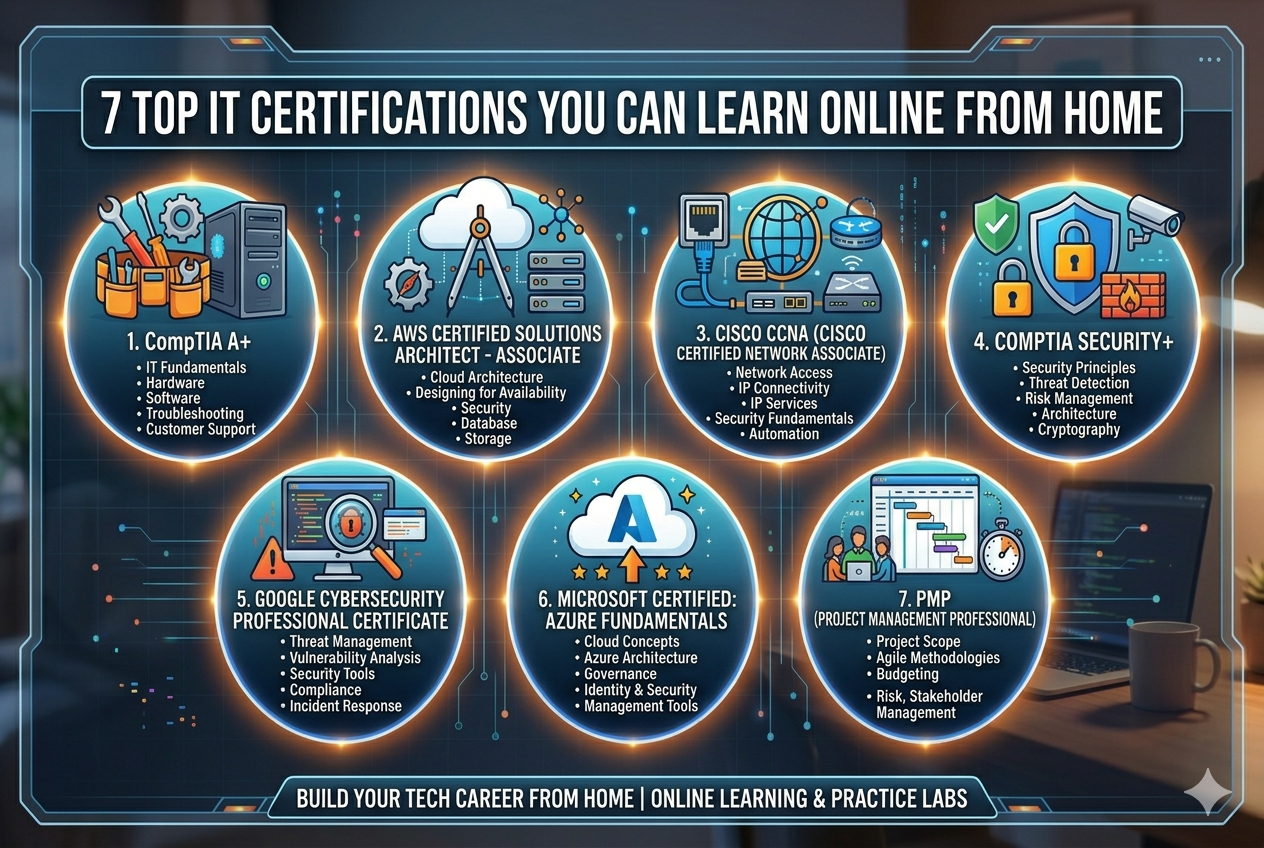
The IT industry continues to grow rapidly, creating strong demand for skilled professionals across networking, cloud computing, cybersecurity, technical support, and project management. One of the most effective ways to enter or advance in this field is through professional certifications. These certifications validate your skills, improve your career opportunities, and help you build a strong technical foundation without requiring a traditional degree path in many cases. Online learning has made it even more accessible, allowing learners to prepare for globally recognized certifications from home at their own pace. The following certifications are among the most valuable and widely recognized in the IT industry today.
Cisco Certified Network Associate (CCNA)
CCNA is one of the most respected entry-level networking certifications and is often considered a gateway into networking careers. It focuses on essential networking concepts such as IP addressing, routing protocols, switching technologies, and network security fundamentals. Understanding these areas is critical because almost every modern organization relies on stable and secure networks for daily operations.
One of the key strengths of CCNA is its balance between theory and practical knowledge. Learners are introduced to how data travels across networks, how routers and switches are configured, and how network issues are identified and resolved. This makes it highly relevant for real-world IT environments where troubleshooting and configuration tasks are part of daily responsibilities.
CCNA also helps build a strong foundation for advanced certifications in networking and cybersecurity. Many professionals use it as a starting point before moving into specialized fields such as network engineering, security analysis, or cloud networking. The skills gained through CCNA are not limited to a specific job role, making it a versatile certification for long-term career development in IT infrastructure.
CompTIA A+ Certification
CompTIA A+ is widely recognized as one of the best entry points into the IT industry, especially for those aiming to start a career in technical support or IT operations. It covers a broad range of essential IT topics, including computer hardware, operating systems, software troubleshooting, mobile devices, and basic networking concepts.
This certification is designed to build problem-solving skills for real-world technical issues. Learners gain the ability to diagnose and fix common hardware and software problems, install and configure operating systems, and support end-users in professional environments. These skills are highly valuable in help desk roles, technical support positions, and IT support technician jobs.
Another important aspect of CompTIA A+ is its vendor-neutral approach. Unlike certifications focused on a single company’s technology, A+ provides knowledge applicable across different systems and platforms. This makes it highly flexible and useful in various IT environments.
For beginners, A+ serves as a strong foundation that prepares them for more advanced certifications in networking, cybersecurity, and system administration. It is often the first step for individuals who want to transition into a long-term IT career.
Microsoft Certified: Azure Fundamentals
Microsoft Azure Fundamentals is an introductory certification designed to help learners understand cloud computing and Microsoft’s Azure platform. As cloud technology becomes a core part of modern IT infrastructure, understanding its basics is increasingly important for IT professionals across all domains.
This certification covers fundamental cloud concepts such as Infrastructure as a Service, Platform as a Service, and Software as a Service. It also introduces Azure services, cloud deployment models, security features, compliance standards, and pricing structures. These topics help learners understand how businesses use cloud platforms to store data, run applications, and manage services efficiently.
One of the key advantages of Azure Fundamentals is that it does not require advanced technical experience. It is suitable for beginners, business professionals, and IT newcomers who want to understand cloud technology at a conceptual level. It also serves as a stepping stone for more advanced Azure certifications focused on administration, development, and architecture.
In today’s job market, cloud knowledge is highly valued. Even non-cloud roles in IT often require basic understanding of cloud systems. This certification helps build that essential knowledge and improves career flexibility across multiple IT domains.
AWS Certified Cloud Practitioner
AWS Certified Cloud Practitioner is another foundational certification focused on cloud computing, specifically Amazon Web Services. AWS is one of the most widely used cloud platforms globally, making this certification highly relevant for modern IT careers.
The certification introduces core cloud concepts, AWS global infrastructure, essential services, security principles, and billing models. It also helps learners understand how organizations use AWS to deploy scalable and secure applications in the cloud.
One of the main benefits of this certification is that it provides a broad overview of cloud computing without requiring deep technical expertise. It is ideal for beginners, non-technical professionals, and individuals planning to enter cloud-related roles. It also helps professionals in sales, management, or support roles understand cloud services more effectively.
AWS Certified Cloud Practitioner is often the first step toward advanced AWS certifications, such as solutions architecture, cloud development, or DevOps engineering. It builds a strong foundation for understanding how cloud systems operate at scale and how businesses benefit from cloud adoption.
As cloud computing continues to dominate the IT industry, this certification remains one of the most valuable starting points for anyone looking to build a career in modern technology environments.
Google IT Support Professional Certificate
The Google IT Support Professional Certificate is designed to prepare learners for entry-level IT support roles through practical and job-focused training. It is especially suitable for beginners who have little or no prior experience in IT.
This certification covers key areas such as troubleshooting, system administration, networking fundamentals, operating systems, customer service, and security basics. The focus is on developing real-world skills that can be directly applied in IT support jobs.
One of the standout features of this certification is its practical approach. Learners are exposed to simulated scenarios that reflect real IT problems, helping them build confidence in solving technical issues. This includes diagnosing system errors, resolving connectivity problems, and assisting users with hardware and software issues.
It is also highly beneficial for those looking to transition into IT from non-technical backgrounds. The structured learning path helps learners gradually build knowledge from basic concepts to more advanced troubleshooting techniques.
After completing this certification, learners are often prepared for roles such as IT support specialist, help desk technician, or technical support associate. It also serves as a foundation for more advanced certifications in networking, cybersecurity, and system administration.
Certified Ethical Hacker (CEH)
Certified Ethical Hacker is a well-known cybersecurity certification that focuses on identifying vulnerabilities in computer systems and networks. It teaches how hackers think and operate, allowing professionals to strengthen security defenses by understanding potential attack methods.
This certification covers a wide range of cybersecurity topics, including penetration testing, system hacking, network scanning, malware threats, and security countermeasures. It provides both theoretical knowledge and practical techniques used in ethical hacking environments.
One of the most important aspects of CEH is its focus on defensive security. Instead of promoting malicious activities, it trains professionals to think like attackers in order to prevent cyber threats. This approach is critical in today’s digital world, where cyberattacks are becoming more frequent and sophisticated.
CEH is highly valued in cybersecurity careers and is often required for roles such as security analyst, penetration tester, and information security specialist. It helps professionals develop the skills needed to protect sensitive data and maintain secure IT systems.
As cybersecurity continues to grow in importance, CEH remains one of the most respected certifications for individuals looking to specialize in this field.
Project Management Professional (PMP)
Project Management Professional certification is one of the most recognized credentials in the field of project management. Although it is not purely technical, it plays a crucial role in IT environments where managing teams, timelines, and resources is essential for successful project delivery.
This certification focuses on project planning, execution, monitoring, and closing processes. It also covers risk management, communication strategies, budgeting, and stakeholder management. These skills are important for ensuring that projects are completed on time, within scope, and within budget.
PMP is especially valuable for experienced professionals who want to move into leadership or managerial roles. It demonstrates the ability to manage complex projects and coordinate between technical teams and business stakeholders.
In IT organizations, PMP-certified professionals often lead software development projects, infrastructure upgrades, system implementations, and digital transformation initiatives. Their role is critical in ensuring that technical work aligns with business goals.
This certification is globally recognized and respected across industries, making it a strong addition for anyone aiming to advance into senior project management positions.
Choosing the Right IT Certification for Your Career Path
Selecting the right IT certification is one of the most important steps in building a successful technology career. Many beginners make the mistake of choosing certifications randomly without understanding their long-term goals. The right approach is to first decide which area of IT interests you the most, such as networking, cybersecurity, cloud computing, or technical support.
If you enjoy working with systems, devices, and troubleshooting connectivity issues, networking certifications like CCNA can be a strong choice. If you prefer solving technical problems and helping users, entry-level certifications like CompTIA A+ or Google IT Support are more suitable. For those interested in modern infrastructure and scalable systems, cloud certifications such as AWS Certified Cloud Practitioner or Azure Fundamentals are ideal.
Cybersecurity enthusiasts should consider ethical hacking certifications like CEH, while individuals interested in leadership roles may benefit more from project management certifications like PMP. The key is to align your certification choice with both your interests and long-term career direction rather than short-term trends.
Understanding job market demand in your region or target industry also helps in making better decisions. Some certifications are more valuable in specific roles, while others are globally recognized and open doors across multiple career paths.
Effective Study Strategy for IT Certifications
Preparing for IT certifications requires a structured and consistent study plan. One of the most effective strategies is to break down the syllabus into smaller sections and focus on one topic at a time. This prevents overload and improves understanding of complex concepts.
Hands-on practice is extremely important in IT learning. Reading theory alone is not enough to pass certification exams or succeed in real-world jobs. Setting up virtual labs, practicing configurations, and simulating troubleshooting scenarios helps reinforce knowledge and build confidence.
Another effective method is active recall, where you regularly test yourself on what you have learned instead of just rereading material. This improves memory retention and helps identify weak areas that need more attention.
Consistency also plays a key role. Studying for a fixed amount of time daily is more effective than irregular long sessions. Even one to two hours of focused study each day can lead to strong progress over time.
Additionally, joining online communities and discussion groups can be helpful. Engaging with other learners allows you to exchange knowledge, clarify doubts, and stay motivated throughout your preparation journey.
Common Mistakes to Avoid During Certification Preparation
Many learners struggle with IT certifications not because the content is too difficult, but because of avoidable mistakes in their preparation approach. One common mistake is relying only on memorization instead of understanding concepts. IT exams often test practical knowledge and problem-solving skills, not just definitions.
Another mistake is skipping hands-on practice. Without practical experience, it becomes difficult to apply theoretical knowledge in real situations. This can also make exam questions harder to understand.
Some learners try to rush through the syllabus without building a strong foundation. This often leads to confusion when advanced topics are introduced. It is better to take time and fully understand each concept before moving forward.
Lack of consistency is another major issue. Studying irregularly can slow down progress and reduce retention. A steady and disciplined approach is far more effective.
Finally, many candidates ignore practice tests. Mock exams are essential because they help simulate real exam conditions, improve time management, and identify weak areas before the actual test.
Career Opportunities After IT Certifications
IT certifications open the door to a wide range of career opportunities across different domains. Entry-level certifications like CompTIA A+ and Google IT Support can lead to roles such as IT support specialist, help desk technician, and technical support associate. These positions are often the starting point for many IT professionals.
Networking certifications like CCNA can lead to careers in network administration, network engineering, and infrastructure support. These roles focus on maintaining and securing organizational networks.
Cloud certifications such as AWS Certified Cloud Practitioner and Azure Fundamentals can help you enter cloud support, cloud operations, or junior cloud engineering roles. As cloud computing continues to grow, these roles are becoming increasingly important.
Cybersecurity certifications like CEH can lead to positions such as security analyst, penetration tester, and cybersecurity consultant. These professionals are responsible for protecting systems from cyber threats and ensuring data security.
Project management certification like PMP can lead to senior roles such as project manager, IT project coordinator, and program manager. These professionals oversee technical projects and ensure successful delivery within time and budget constraints.
Each certification acts as a stepping stone, allowing professionals to move from entry-level positions to more advanced and specialized roles over time.
Salary Growth and Industry Demand
One of the major advantages of IT certifications is the potential for salary growth and career advancement. Entry-level roles in IT support and networking provide a strong starting salary, but with experience and additional certifications, professionals can significantly increase their earning potential.
Cloud computing and cybersecurity are currently among the highest-paying areas in the IT industry due to high demand and skill shortages. Professionals with certifications in AWS, Azure, or CEH often earn higher salaries compared to general IT support roles.
Networking professionals with CCNA or advanced certifications also enjoy stable and well-paying careers, especially in organizations that rely heavily on infrastructure and connectivity.
Project management roles certified by PMP are also highly valued because they combine technical understanding with leadership skills. These professionals often work on large-scale projects and are compensated accordingly.
Overall, the IT industry rewards continuous learning. The more certifications and skills you acquire, the higher your chances of career growth and salary improvement.
Building a Long-Term IT Career Roadmap
A successful IT career is built step by step rather than overnight. Most professionals start with foundational certifications and gradually move toward specialized or advanced areas based on their interests and experience.
A common roadmap begins with entry-level certifications like CompTIA A+ or Google IT Support. After gaining experience, professionals may move into networking (CCNA), cloud computing (AWS or Azure), or cybersecurity (CEH). With time and experience, they can pursue advanced certifications or leadership roles like PMP.
It is also important to continuously update skills because technology evolves rapidly. New tools, platforms, and security threats constantly change the IT landscape, making lifelong learning essential.
Practical experience gained through internships, projects, or job roles plays an equally important role in career development. Certifications provide knowledge, but real-world experience builds confidence and expertise.
Combining certifications with hands-on experience creates a strong foundation for long-term success in the IT industry.
Importance of Practical Skills Alongside Certifications
While IT certifications are highly valuable for validating knowledge, practical skills are what truly define success in the technology industry. Employers today look for professionals who can not only pass exams but also apply concepts in real-world environments. This is why hands-on experience is just as important as theoretical preparation.
Working with virtual labs, simulation tools, and real system environments helps learners understand how IT systems actually function. For example, configuring a network, troubleshooting server issues, or deploying cloud resources provides a deeper level of understanding that cannot be achieved through reading alone.
Practical learning also improves problem-solving abilities. In real IT jobs, issues rarely appear exactly as described in textbooks or exams. Professionals must analyze situations, identify root causes, and apply appropriate solutions. Hands-on practice builds this analytical mindset over time.
Combining certification study with real-world projects, even small personal ones, can significantly enhance confidence and job readiness. This balanced approach ensures that learners are not only exam-ready but also workplace-ready.
Role of IT Certifications in Remote and Freelance Careers
The rise of remote work and freelancing has created new opportunities for IT professionals worldwide. Certifications play a crucial role in helping individuals qualify for these flexible work options. Many companies now hire remote IT support specialists, cloud engineers, cybersecurity analysts, and network administrators based on certifications and skills rather than physical location.
For freelancers, certifications act as proof of credibility. Clients often prefer working with certified professionals because it reduces risk and ensures a certain level of expertise. Whether it is setting up networks, managing cloud infrastructure, or providing technical support, certifications help build trust with clients.
Cloud certifications such as AWS and Azure are especially valuable in remote work environments because cloud systems are accessible from anywhere. Similarly, cybersecurity professionals can work remotely to monitor systems, analyze threats, and improve security measures.
As digital transformation continues globally, remote IT roles are expected to increase further, making certifications even more important for independent professionals.
How Certifications Help in Career Switching
One of the biggest advantages of IT certifications is that they allow individuals to switch careers without needing a traditional computer science degree. Many professionals from non-technical backgrounds successfully transition into IT by earning entry-level certifications.
For example, someone working in customer service can move into IT support by completing certifications like CompTIA A+ or Google IT Support. Similarly, individuals from administrative roles can transition into cloud or networking fields with structured certification paths.
These certifications provide a clear learning structure that simplifies complex technical topics. Instead of spending years in formal education, learners can focus on job-relevant skills and enter the workforce faster.
Career switching through certifications also allows flexibility in choosing specializations. As learners gain experience, they can explore different IT fields such as cybersecurity, cloud computing, or networking and choose the path that best suits their strengths.
Growth of Cloud Computing and Future Demand
Cloud computing has become one of the most important technologies in modern IT infrastructure. Almost every organization, from small businesses to global enterprises, is moving its systems to the cloud. This shift has created massive demand for cloud-skilled professionals.
Certifications like AWS Certified Cloud Practitioner and Microsoft Azure Fundamentals are designed to introduce learners to this growing field. They help build an understanding of how cloud services are used to store data, run applications, and manage infrastructure efficiently.
In the future, cloud computing is expected to become even more dominant, with increased use of hybrid cloud systems, serverless computing, and cloud-based security solutions. This means professionals with cloud certifications will continue to be in high demand across industries.
Cloud skills are also highly transferable, allowing professionals to work in various roles such as cloud support, DevOps, system administration, and cloud architecture. This flexibility makes cloud certifications one of the most future-proof choices in IT.
Cybersecurity as a Critical Career Path
As digital systems expand, cybersecurity has become one of the most critical areas in IT. Organizations face constant threats from hackers, malware, and data breaches, making cybersecurity professionals essential for protecting sensitive information.
Certifications like Certified Ethical Hacker help professionals understand how cyberattacks are planned and executed. This knowledge is used to strengthen defenses and identify vulnerabilities before they can be exploited.
Cybersecurity careers are not limited to technical roles alone. They also include risk management, compliance, and security policy development. This makes the field suitable for individuals with both technical and analytical skills.
The demand for cybersecurity professionals continues to grow rapidly due to increasing cyber threats worldwide. This makes it one of the most stable and high-paying career paths in the IT industry.
Continuous Learning and Skill Upgradation
The IT industry evolves at a very fast pace, with new technologies emerging every year. Because of this, continuous learning is essential for long-term success. Certifications provide a strong foundation, but professionals must keep upgrading their skills to stay relevant.
Many IT professionals pursue multiple certifications over time to expand their expertise. For example, someone may start with networking, move into cloud computing, and later specialize in cybersecurity or DevOps.
Learning new tools, programming languages, and platforms also helps in career growth. Employers value professionals who stay updated with the latest industry trends and technologies.
Online learning platforms, practice labs, and real-world projects make it easier than ever to continue learning from home. This flexibility allows professionals to grow their skills alongside their careers.
How to Stay Motivated During Certification Journey
Preparing for IT certifications can sometimes feel long and challenging, especially when balancing study with work or personal responsibilities. Staying motivated is one of the most important factors that determines success. A clear goal helps maintain focus, whether it is landing a first IT job, switching careers, or earning a higher salary.
Breaking the learning process into small, manageable goals makes it easier to stay consistent. Instead of focusing on the entire syllabus at once, concentrating on one topic at a time creates a sense of progress. This helps reduce stress and builds confidence gradually.
Tracking progress also plays a key role. When learners see how much they have already achieved, it encourages them to keep going. Even small improvements in understanding networking, cloud systems, or cybersecurity concepts are meaningful steps forward.
Another important factor is avoiding burnout. Taking short breaks between study sessions and maintaining a balanced routine helps improve focus and long-term retention. Consistency matters more than intensity when preparing for certifications.
Building Real-World Experience Alongside Certifications
One of the most effective ways to strengthen IT knowledge is by gaining real-world experience while studying. Certifications provide theoretical understanding, but applying that knowledge in practical environments builds true expertise.
Creating small projects at home, such as setting up a virtual network, configuring a cloud instance, or practicing system troubleshooting, helps reinforce learning. These activities simulate real job tasks and prepare learners for workplace challenges.
Internships, volunteer opportunities, or freelance projects also provide valuable exposure. Even entry-level IT roles offer hands-on experience that complements certification knowledge. This combination of theory and practice is highly valued by employers.
Working on real systems helps learners understand how different IT components interact in complex environments. It also improves problem-solving skills, which are essential in any technical role.
Industry Trends Shaping IT Certification Value
The value of IT certifications continues to evolve as technology advances. One of the biggest trends shaping the industry is the rapid adoption of cloud computing. Organizations are shifting from traditional infrastructure to cloud-based systems, increasing demand for cloud-certified professionals.
Another major trend is cybersecurity. With rising cyber threats, companies are investing heavily in securing their systems and data. This has made cybersecurity certifications more valuable than ever before.
Artificial intelligence and automation are also transforming IT roles. While some tasks are being automated, new opportunities are emerging in AI system management, data analysis, and machine learning operations. Professionals who adapt to these changes through continuous learning remain competitive in the job market.
Remote work has also changed how IT services are delivered. Many organizations now hire globally, making certifications a key requirement for remote technical roles. This trend has expanded opportunities for certified professionals worldwide.
How Employers View IT Certifications
Employers generally see IT certifications as proof of foundational knowledge and commitment to learning. While experience remains important, certifications help demonstrate that a candidate understands key concepts and is capable of handling technical responsibilities.
For entry-level positions, certifications often play a major role in hiring decisions. They help employers identify candidates who have the required baseline skills, even if they lack professional experience.
For mid-level and senior roles, certifications act as a complement to experience. They show that professionals are keeping their skills updated and staying relevant in a fast-changing industry.
In competitive job markets, having multiple certifications can also provide an advantage. It shows versatility and willingness to grow, which are highly valued traits in IT professionals.
Long-Term Career Growth Through Certifications
IT certifications are not just for getting a job; they also support long-term career development. As professionals gain experience, they can pursue advanced certifications to move into specialized or leadership roles.
For example, someone starting with CompTIA A+ may later progress to networking, cloud computing, or cybersecurity certifications. Over time, this creates opportunities for higher-level positions such as system administrator, cloud engineer, or security analyst.
Project management certifications like PMP allow professionals to transition into leadership roles where they manage teams and oversee large technical projects. This combination of technical and managerial skills can significantly increase career opportunities.
Continuous certification upgrades also help professionals stay relevant in the industry. As technologies change, updated certifications ensure that skills remain aligned with current industry standards.
Advanced Pathways After Beginner IT Certifications
Once foundational certifications are completed, the next step in an IT career is moving toward more advanced and specialized pathways. This stage is where professionals begin shaping their identity in the industry, whether in networking, cloud computing, cybersecurity, or IT management. The transition from beginner to intermediate level requires deeper technical understanding and more practical exposure.
At this stage, networking professionals may progress beyond CCNA-level knowledge into more complex routing, switching, and infrastructure design concepts. Cloud learners begin exploring architecture, automation, and deployment strategies. Cybersecurity learners move into advanced threat analysis, penetration testing, and incident response techniques. Each pathway becomes more focused and aligned with specific job roles.
This phase is important because it transforms general IT knowledge into specialized expertise. Employers often look for this level of specialization when hiring for mid-level roles, as it demonstrates both commitment and capability in a specific domain.
Importance of Specialization in IT Careers
Specialization plays a major role in long-term success in the IT industry. While general certifications help beginners enter the field, specialization helps professionals grow and stand out in competitive job markets.
For example, a professional specializing in cloud computing may focus on designing scalable systems and managing infrastructure in platforms like AWS or Azure. A cybersecurity specialist may focus on ethical hacking, risk assessment, or security operations. A networking specialist may focus on large-scale enterprise systems and advanced network architecture.
Specialization not only improves technical depth but also increases earning potential. Companies are willing to pay more for professionals who have deep knowledge in a specific area because they can handle complex challenges more efficiently.
Choosing a specialization should be based on personal interest, job demand, and long-term career goals. It is important to avoid switching paths too frequently, as mastery in IT requires time and consistent effort in one direction.
The Role of Soft Skills in IT Success
While technical skills are essential in IT careers, soft skills are equally important for long-term success. Communication, teamwork, problem-solving, and time management all play a major role in workplace performance.
IT professionals often work in teams where collaboration is necessary to complete projects. Being able to clearly explain technical issues to non-technical team members is also a valuable skill. This helps bridge the gap between technical and business teams within an organization.
Problem-solving skills are particularly important in IT roles. Whether it is troubleshooting a network issue or resolving a cybersecurity threat, professionals must think logically and act efficiently under pressure.
Time management also becomes crucial, especially in roles involving multiple projects or tight deadlines. Professionals who can prioritize tasks effectively are more productive and reliable in workplace environments.
How Certification Paths Connect to Real Job Roles
Each IT certification path is closely connected to specific job roles in the industry. Understanding this connection helps learners choose the right direction and prepare for real-world responsibilities.
Entry-level certifications like CompTIA A+ and Google IT Support typically lead to roles such as IT support technician, help desk analyst, or technical support specialist. These roles focus on solving user issues and maintaining basic IT systems.
Networking certifications like CCNA often lead to roles such as network administrator or network support engineer. These professionals manage connectivity, configure devices, and ensure network stability.
Cloud certifications such as AWS Certified Cloud Practitioner or Azure Fundamentals can lead to cloud support associate or junior cloud engineer positions. These roles involve managing cloud resources and assisting in cloud deployments.
Cybersecurity certifications like CEH lead to roles such as security analyst or penetration tester. These professionals focus on identifying vulnerabilities and protecting systems from attacks.
Project management certifications like PMP lead to roles such as IT project manager or program coordinator, where professionals oversee technical projects and ensure successful delivery.
Building Confidence for IT Job Interviews
One of the final stages of preparing for an IT career is developing confidence for job interviews. Certifications help build knowledge, but interview success depends on how well candidates can communicate their skills and experience.
Understanding core concepts clearly is important because interviewers often ask scenario-based questions. Instead of memorizing answers, it is better to understand how systems work and how problems are solved in real environments.
Practicing mock interviews helps improve communication skills and reduces nervousness. It also helps candidates learn how to structure their answers in a clear and professional way.
Hands-on experience plays a major role during interviews. Candidates who can explain real projects or practical lab work often perform better because they can demonstrate applied knowledge.
Confidence comes from preparation. The more a candidate practices technical concepts and real-world scenarios, the more comfortable they become during interviews.
Conclusion
IT certifications offer a powerful pathway for building a successful and flexible career in the technology industry. They provide structured learning, practical knowledge, and globally recognized credentials that open doors to a wide range of job opportunities.
From networking and cloud computing to cybersecurity and project management, each certification plays a unique role in shaping a professional’s career path. However, success in IT is not only about passing exams. It requires consistent practice, real-world experience, and continuous learning.
The combination of certification knowledge and practical skills creates strong professionals who are ready for real industry challenges. With dedication and the right learning approach, anyone can build a rewarding IT career from home through online certifications.
As technology continues to grow and evolve, certified professionals will remain in high demand, making IT one of the most promising and future-proof career fields in the world.