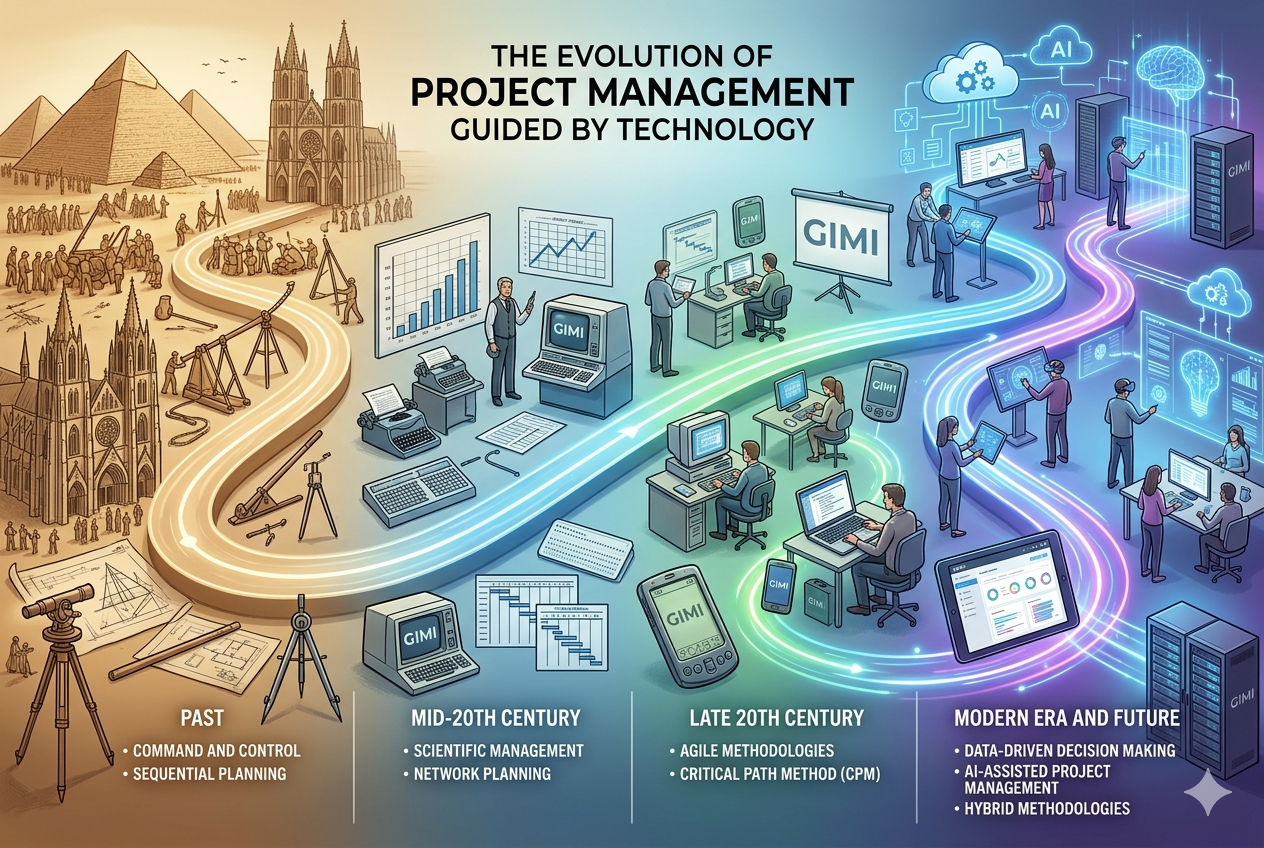
In the early stages of organized work, project management was largely dependent on manual planning methods and human coordination. Work was structured through paper-based schedules, verbal communication, and physical tracking of progress. Managers relied heavily on experience, intuition, and basic administrative tools to ensure that tasks were completed on time. There was limited visibility into real-time progress, which often led to delays, miscommunication, and inefficiencies.
Projects were typically managed in a linear and rigid manner, where changes were difficult to implement once a plan had been established. The absence of advanced systems meant that resource allocation, budgeting, and scheduling were all handled separately, often without integration. This created gaps in coordination and made large-scale projects particularly challenging to manage effectively. Despite these limitations, early project management laid the groundwork for structured planning methodologies that would later evolve with technological support.
Emergence of Early Technological Tools in Project Planning
As simple mechanical and early computing tools began to emerge, project management started to experience gradual transformation. The introduction of calculators, basic scheduling software, and spreadsheet applications significantly improved accuracy in planning and budgeting. These tools reduced the reliance on manual calculations and allowed managers to handle larger datasets with greater efficiency.
Even though these early technologies were limited in functionality compared to modern systems, they marked a turning point in how projects were controlled. For the first time, project managers could store, update, and analyze information more systematically. This shift improved decision-making and reduced human error, making project execution more reliable.
Communication also began to improve during this phase, especially with the introduction of email systems and digital documentation. Teams were no longer restricted to physical meetings or handwritten reports, allowing for faster exchange of information across different locations.
Integration of Software Systems in Project Management
With the advancement of computer technology, dedicated project management software began to emerge, transforming the entire discipline. These systems allowed for the integration of scheduling, budgeting, resource management, and reporting into a single platform. This integration significantly improved efficiency and reduced the complexity of handling multiple tools separately.
Project managers gained the ability to visualize timelines through digital charts, track dependencies between tasks, and monitor progress in real time. This led to more accurate forecasting and better risk management. The introduction of software-based planning also enabled teams to simulate different scenarios, helping organizations prepare for potential challenges before they occurred.
Furthermore, centralized data storage improved collaboration among team members. Instead of relying on fragmented communication, all stakeholders could access updated project information from a shared system. This transparency reduced misunderstandings and ensured that everyone was aligned with project goals.
Impact of the Internet on Global Project Collaboration
The widespread adoption of the internet revolutionized project management by enabling global collaboration on an unprecedented scale. Teams could now work together from different parts of the world without being physically present in the same location. This shift led to the rise of distributed teams and remote project execution.
Online communication tools allowed instant messaging, video conferencing, and real-time document sharing, making collaboration more dynamic and efficient. Project updates could be shared instantly, reducing delays caused by geographical barriers. This connectivity also made it possible for organizations to tap into global talent pools, improving the quality and diversity of project teams.
In addition, cloud-based systems began to emerge, allowing project data to be stored and accessed securely from anywhere. This eliminated the need for local storage and reduced the risk of data loss. It also ensured that all team members worked with the most updated version of project documents, improving consistency and coordination.
Rise of Automation and Intelligent Systems in Project Management
As technology continued to evolve, automation became a key component of modern project management. Routine tasks such as scheduling, reporting, and task assignment began to be automated, freeing project managers to focus on strategic decision-making. Automation reduced manual workload and minimized the chances of human error.
Intelligent systems powered by data analytics also started to play a significant role. These systems could analyze historical project data to predict potential risks, estimate completion times, and optimize resource allocation. This predictive capability improved planning accuracy and allowed organizations to make more informed decisions.
Artificial intelligence further enhanced project management by providing insights that were previously difficult to obtain. It enabled adaptive planning, where project schedules could automatically adjust based on changing conditions. This flexibility made project execution more resilient and responsive to uncertainty.
Transformation of Communication and Team Coordination
One of the most significant impacts of technology on project management has been the transformation of communication. Traditional face-to-face meetings have been supplemented and, in some cases, replaced by digital communication platforms. These tools allow instant interaction, file sharing, and collaborative editing, making teamwork more efficient.
Improved communication has reduced misunderstandings and increased accountability within teams. Project updates can be shared in real time, ensuring that all stakeholders remain informed about progress and changes. This transparency has strengthened trust and improved overall coordination.
Moreover, communication technologies have enabled asynchronous collaboration, where team members can contribute to a project at different times without disrupting workflow. This flexibility has been particularly beneficial for global teams working across multiple time zones.
Data-Driven Decision Making in Modern Project Management
The integration of advanced data analytics has transformed project management into a highly data-driven discipline. Managers now rely on real-time data to evaluate performance, identify bottlenecks, and measure productivity. This shift has reduced dependence on intuition and increased the accuracy of decision-making.
Dashboards and analytical tools provide visual representations of project metrics, making it easier to interpret complex information. These insights help organizations identify trends, forecast outcomes, and optimize processes. As a result, projects are managed with greater precision and efficiency.
Data-driven approaches also improve accountability by providing clear evidence of progress and performance. This allows organizations to continuously refine their strategies and improve future project outcomes.
Enhanced Risk Management Through Technological Support
Risk management has also evolved significantly due to technological advancements. Modern systems can identify potential risks early by analyzing patterns and historical data. This proactive approach allows project managers to address issues before they escalate into major problems.
Simulation tools enable teams to test different scenarios and evaluate their impact on project outcomes. This helps in developing contingency plans and improving preparedness. Additionally, real-time monitoring systems provide continuous updates on project performance, allowing for immediate corrective actions when necessary.
Technology has also improved documentation and tracking of risks, ensuring that lessons learned from previous projects are recorded and applied in future planning. This continuous improvement cycle has strengthened overall project resilience.
Scalability and Flexibility in Modern Project Environments
One of the most important outcomes of technological integration in project management is increased scalability. Organizations can now manage multiple large-scale projects simultaneously without a proportional increase in complexity. Digital tools allow for efficient resource allocation and workload distribution across teams.
Flexibility has also improved significantly, as project plans can now be adjusted quickly in response to changing requirements. Unlike traditional methods, where changes were difficult to implement, modern systems allow dynamic updates without disrupting overall workflow.
This adaptability has made organizations more responsive to market changes and customer demands. It has also enabled faster project delivery and improved competitiveness in various industries.
Continuous Evolution and Future Outlook
The evolution of project management is ongoing, driven by continuous advancements in technology. Emerging innovations such as artificial intelligence, machine learning, and advanced analytics are expected to further transform the field. These technologies will enhance automation, improve predictive capabilities, and enable even more efficient project execution.
Future project management systems are likely to become more intelligent, adaptive, and autonomous. They will not only assist managers but also make certain decisions independently based on predefined parameters and data analysis. This will further reduce manual intervention and increase operational efficiency.
As technology continues to evolve, project management will become increasingly integrated, data-centric, and globally connected. The ability to manage complex projects with precision and agility will continue to improve, shaping the future of how organizations plan and execute their goals.
Rise of Agile and Flexible Project Management Approaches
As technology continued to advance, traditional rigid planning methods gradually gave way to more flexible and adaptive frameworks. One of the most significant shifts was the rise of agile-based approaches, which emphasized iterative development, continuous feedback, and rapid adaptation to change. Unlike earlier linear models, agile methods allowed project teams to respond quickly to evolving requirements and shifting priorities.
This transformation was closely supported by digital tools that enabled real-time collaboration and progress tracking. Teams could now break large projects into smaller, manageable segments, making it easier to deliver value incrementally. Technology played a key role in supporting this shift by providing platforms that facilitated sprint planning, task tracking, and continuous integration of work outputs.
The adoption of flexible methodologies also improved customer involvement in the project lifecycle. Stakeholders were able to provide feedback at multiple stages, ensuring that the final output aligned more closely with expectations. This increased transparency and responsiveness marked a major improvement in how projects were managed and delivered.
Expansion of Cloud-Based Project Management Systems
The introduction of cloud computing significantly transformed the infrastructure of project management. Instead of relying on locally installed software and physical storage systems, organizations began migrating to cloud-based platforms that offered accessibility, scalability, and real-time synchronization of data.
Cloud systems enabled teams to collaborate from anywhere in the world without being limited by physical infrastructure. Project data, documents, and schedules could be accessed through secure online environments, ensuring continuity of work across different locations and devices. This flexibility became especially important as remote and hybrid work models became more common.
Another important advantage of cloud-based systems was automatic updates and backups. This reduced the risk of data loss and ensured that all team members were working with the most current version of project information. It also simplified system maintenance, as organizations no longer needed to manage complex on-site IT infrastructure.
Mobile Technology and On-the-Go Project Management
The rise of mobile technology further enhanced the accessibility of project management systems. Smartphones and tablets allowed project managers and team members to stay connected to their work at all times, regardless of location. This constant connectivity improved responsiveness and decision-making speed.
Mobile applications provided real-time notifications, task updates, and communication tools that kept teams aligned throughout the project lifecycle. Managers could approve tasks, monitor progress, and respond to issues instantly, reducing delays and improving efficiency.
This mobility also supported field-based projects, where teams working on construction sites, logistics operations, or remote environments could update project data directly from the field. As a result, the gap between on-site execution and managerial oversight was significantly reduced.
Artificial Intelligence and Predictive Project Insights
Artificial intelligence has introduced a new level of intelligence into project management systems. By analyzing large volumes of historical and real-time data, AI systems can identify patterns, predict risks, and recommend optimal strategies for project execution.
One of the most important contributions of AI is predictive analytics, which allows project managers to anticipate potential delays, budget overruns, and resource shortages before they occur. This enables proactive decision-making rather than reactive problem-solving.
AI-powered tools also assist in automating complex scheduling tasks by optimizing resource allocation based on availability, skill sets, and project priorities. This reduces inefficiencies and ensures that resources are utilized in the most effective manner possible.
In addition, machine learning algorithms continuously improve over time, learning from past projects to enhance future performance. This creates a self-improving system that becomes more accurate and efficient with continued use.
Data Security and Governance in Digital Project Environments
As project management systems became increasingly digital, the importance of data security and governance grew significantly. Sensitive project information, financial data, and organizational strategies are now stored in digital environments, making them vulnerable to cyber threats if not properly protected.
Modern project management platforms incorporate advanced security measures such as encryption, multi-factor authentication, and access control systems. These technologies ensure that only authorized individuals can access specific project data, reducing the risk of unauthorized breaches.
Data governance frameworks also play a crucial role in maintaining data integrity and compliance. Organizations are required to establish clear policies regarding data usage, storage, and sharing to ensure transparency and accountability. This has become an essential aspect of managing modern projects in a digital environment.
Collaboration Tools and the Transformation of Team Dynamics
The evolution of collaboration tools has fundamentally changed how project teams interact and work together. Digital platforms now allow seamless communication through chat systems, video conferencing, shared workspaces, and collaborative document editing.
These tools have eliminated many of the barriers associated with traditional communication methods. Teams no longer need to rely on scheduled meetings or email chains to exchange information. Instead, they can collaborate in real time, making decision-making faster and more efficient.
Collaboration tools have also improved inclusivity within teams by enabling participation from members across different time zones and geographical locations. This has expanded the talent pool available for projects and allowed organizations to build more diverse and skilled teams.
Hybrid Project Management Models in Modern Organizations
As project environments have become more complex, many organizations have adopted hybrid models that combine elements of traditional and agile methodologies. These hybrid approaches allow teams to maintain structured planning while also incorporating flexibility where needed.
Technology plays a crucial role in enabling these hybrid systems by providing integrated platforms that support multiple workflows simultaneously. Project managers can track long-term milestones while also managing short-term iterative tasks within the same system.
This adaptability allows organizations to tailor their project management approach based on the specific requirements of each project. It also improves efficiency by balancing structure with flexibility, ensuring that both planning and execution are optimized.
Impact of Automation on Workforce Roles in Project Management
Automation has significantly changed the roles and responsibilities of individuals involved in project management. Many repetitive and time-consuming tasks, such as data entry, report generation, and scheduling updates, are now handled automatically by software systems.
This shift has allowed project managers and team members to focus more on strategic thinking, problem-solving, and creative decision-making. Rather than spending time on administrative tasks, professionals can now concentrate on higher-value activities that contribute directly to project success.
However, automation has also required workers to develop new skills related to digital tools and system management. The modern project environment demands a combination of technical proficiency and analytical thinking, making continuous learning an essential part of professional growth.
Sustainability and Ethical Considerations in Modern Project Management
With the advancement of technology, there has also been an increased focus on sustainability and ethical practices in project management. Organizations are now expected to consider the environmental and social impact of their projects alongside financial and operational outcomes.
Digital tools help support sustainability by reducing paper usage, optimizing resource allocation, and enabling remote work, which reduces travel-related emissions. Project tracking systems also allow organizations to measure and report sustainability metrics more effectively.
Ethical considerations have become equally important, particularly in relation to data privacy, transparency, and responsible use of technology. Project managers are now required to ensure that digital systems are used in ways that respect user privacy and comply with regulatory standards.
Industry-Wide Transformation Through Digital Project Management
Different industries have experienced unique transformations due to advancements in project management technology. In construction, digital modeling and scheduling tools have improved accuracy and reduced delays. In information technology, agile and cloud-based systems have enabled faster product development cycles.
Manufacturing industries have benefited from automation and real-time monitoring systems that improve production efficiency. Similarly, service-based industries have enhanced customer satisfaction through improved project tracking and communication systems.
Despite these differences, a common trend across all industries is the increased reliance on data, connectivity, and automation to drive project success. This widespread transformation highlights the universal impact of technological progress on project management practices.
Future Directions of Project Management Evolution
The future of project management is expected to become even more technologically advanced, with greater integration of artificial intelligence, machine learning, and autonomous systems. These technologies will further enhance decision-making, reduce manual intervention, and improve overall efficiency.
Predictive systems will become more accurate, allowing organizations to anticipate challenges with greater precision. Virtual and augmented reality may also play a role in project planning and visualization, enabling teams to interact with digital project environments in immersive ways.
As systems become more intelligent, the role of human project managers will shift toward strategic oversight, ethical decision-making, and innovation management. Technology will handle operational complexity, while humans will focus on guiding direction and ensuring alignment with organizational goals.
Ultimately, the evolution of project management will continue to be shaped by technological progress, creating a future where projects are more connected, intelligent, and adaptable than ever before.
Digital Transformation and Intelligent Project Ecosystems
The next major phase in the evolution of project management is deeply rooted in full-scale digital transformation. At this stage, project management is no longer just supported by technology; instead, it becomes an integrated digital ecosystem where every activity, decision, and interaction is powered by interconnected systems. Organizations now rely on unified platforms that bring together planning, execution, monitoring, and reporting into a single intelligent environment.
In this ecosystem, data flows continuously across systems without manual intervention. Project updates are automatically synchronized, performance metrics are updated in real time, and decision-making is increasingly guided by live analytics. This creates a highly responsive environment where project managers can focus more on strategy rather than operational tracking.
Digital transformation also eliminates silos within organizations. Teams across departments can now work on shared platforms where communication, documentation, and task management are seamlessly integrated. This interconnected structure significantly improves efficiency and reduces delays caused by fragmented workflows.
Role of Artificial Intelligence in Advanced Decision Support
Artificial intelligence has evolved from a supportive tool into a central decision-making assistant in modern project management environments. AI systems now analyze vast datasets in real time to provide actionable insights that guide planning and execution. These systems are capable of identifying inefficiencies, suggesting improvements, and even predicting future project outcomes with high accuracy.
One of the most impactful developments is AI-driven decision support systems. These systems evaluate multiple variables such as cost, time, resource availability, and risk factors to recommend optimal project strategies. This reduces uncertainty and allows managers to make more informed decisions under complex conditions.
AI also enhances adaptability by continuously learning from ongoing project performance. As more data is collected, the system refines its predictions and recommendations, making it increasingly reliable over time. This continuous learning process ensures that project management practices evolve alongside changing business environments.
Rise of Digital Twins in Project Simulation
A significant innovation in modern project management is the concept of digital twins. A digital twin is a virtual representation of a physical project, process, or system that mirrors real-time conditions. This allows project teams to simulate, analyze, and optimize outcomes before implementing changes in the real world.
Through digital twins, project managers can test different scenarios without risking actual resources. For example, they can simulate delays, resource shortages, or design changes and observe their impact on overall project performance. This improves planning accuracy and reduces uncertainty.
Digital twins also enable continuous monitoring of ongoing projects. By reflecting real-time updates from physical systems, they provide a dynamic view of project progress. This helps managers identify potential issues early and take corrective action before problems escalate.
Blockchain and Transparency in Project Management
Blockchain technology is gradually introducing a new level of transparency and trust in project management systems. By creating immutable records of transactions and activities, blockchain ensures that all project data is secure, traceable, and tamper-proof.
This is particularly valuable in large-scale projects involving multiple stakeholders, where trust and accountability are critical. Every change, approval, or transaction can be recorded in a decentralized system, reducing the risk of fraud or data manipulation.
Blockchain also improves contract management through smart contracts, which automatically execute predefined conditions when certain criteria are met. This reduces administrative overhead and ensures that agreements are enforced without manual intervention.
As a result, blockchain enhances transparency, accountability, and efficiency across project lifecycles, particularly in industries where compliance and documentation are essential.
Human-AI Collaboration in Project Environments
Despite the increasing role of automation and artificial intelligence, human involvement remains essential in project management. However, the nature of this involvement is evolving. Instead of performing repetitive operational tasks, humans are now focusing on oversight, creativity, and strategic decision-making.
Human-AI collaboration allows machines to handle data-heavy and routine tasks, while humans interpret insights and make contextual judgments. This partnership enhances overall productivity and reduces cognitive load on project managers.
In this collaborative environment, emotional intelligence, leadership, and communication skills become even more important. While AI can process data efficiently, it cannot replace human understanding of organizational culture, stakeholder relationships, and ethical considerations.
Evolution of Risk Management with Predictive Intelligence
Risk management has become significantly more advanced due to predictive intelligence systems. Instead of reacting to problems after they occur, modern project management focuses on anticipating and preventing risks before they materialize.
Predictive models analyze historical data, market trends, and real-time project conditions to identify potential risk factors. These systems assign probability scores to different scenarios, helping managers prioritize attention where it is most needed.
This proactive approach allows organizations to allocate resources more effectively and reduce the likelihood of project failure. It also improves resilience by enabling the development of multiple contingency plans for different scenarios.
As predictive systems continue to evolve, risk management is becoming more precise, data-driven, and integrated into every stage of project execution.
Advanced Resource Optimization and Efficiency Models
Resource management has undergone a major transformation with the introduction of intelligent optimization systems. These systems analyze resource availability, skill distribution, workload capacity, and project priorities to allocate resources in the most efficient way possible.
Instead of manually assigning tasks, project managers can now rely on algorithm-based recommendations that ensure optimal utilization of human and material resources. This reduces waste and improves productivity across teams.
Dynamic resource allocation also allows systems to adjust in real time based on changing project conditions. If delays or unexpected changes occur, resources can be automatically redistributed to maintain balance and ensure continuity.
This level of optimization significantly improves cost efficiency and project performance, particularly in large and complex projects.
Virtual Collaboration and Immersive Workspaces
The development of virtual collaboration technologies has introduced new ways for teams to interact and manage projects. Virtual workspaces allow team members to collaborate in immersive digital environments that simulate physical presence.
These environments support interactive meetings, 3D project visualization, and real-time collaboration on shared digital assets. This enhances engagement and improves understanding of complex project structures.
Immersive technologies such as augmented reality and virtual reality are also being used to visualize project designs, particularly in industries like construction, engineering, and product development. This allows teams to explore and modify project components in a more intuitive way.
Virtual collaboration reduces geographical barriers even further and creates a more connected and interactive project environment.
Advanced Integration of Emerging Technologies in Project Management
The modern phase of project management is increasingly defined by the deep integration of emerging technologies that extend far beyond traditional digital tools. Systems are now evolving into interconnected environments where artificial intelligence, automation, cloud infrastructure, and advanced analytics operate together as a unified framework. This integration is not only improving efficiency but also redefining how projects are conceptualized, executed, and delivered.
One of the most significant aspects of this transformation is the seamless interaction between multiple technologies. Instead of functioning independently, tools now communicate with each other, allowing project data to flow continuously across platforms. This creates a synchronized environment where decisions are supported by real-time, multi-source insights.
This level of integration has also reduced operational fragmentation. Previously separate functions such as planning, monitoring, reporting, and risk analysis are now part of a single ecosystem. This unified structure enables faster response times and more coherent project execution.
Expansion of Intelligent Automation in Complex Projects
Intelligent automation has moved beyond simple task execution and now plays a central role in managing complex project workflows. Modern systems are capable of understanding project context, prioritizing tasks, and executing multi-step processes with minimal human intervention.
This evolution has significantly reduced the burden of repetitive administrative work. Activities such as progress updates, resource scheduling, and performance tracking are now handled automatically, allowing teams to focus on higher-level strategic responsibilities.
In complex projects involving multiple dependencies, intelligent automation ensures that tasks are executed in the correct sequence. If a delay occurs in one area, the system automatically adjusts related tasks to maintain overall project balance. This dynamic adjustment capability improves efficiency and reduces the risk of cascading delays.
Transformation of Project Monitoring Through Real-Time Intelligence
Project monitoring has shifted from periodic reporting to continuous real-time intelligence. Instead of relying on weekly or monthly updates, managers now have access to live dashboards that display ongoing project performance across multiple dimensions.
These systems collect data from various sources, including task completion rates, resource usage, budget consumption, and timeline adherence. This information is processed instantly to provide a clear and updated view of project health.
Real-time intelligence also enables early detection of deviations from planned objectives. When performance indicators fall outside expected ranges, alerts are generated automatically, allowing managers to intervene immediately. This proactive monitoring approach significantly improves control over project outcomes.
Evolution of Strategic Planning in Data-Driven Environments
Strategic planning in project management has become increasingly data-driven, shifting away from intuition-based decision-making toward evidence-based analysis. Large volumes of structured and unstructured data are now used to guide planning decisions at every stage of a project.
Advanced analytics tools help organizations evaluate historical performance, market conditions, and internal capabilities before defining project strategies. This ensures that planning is grounded in realistic assumptions rather than speculation.
Scenario modeling has also become an essential part of strategic planning. Project managers can simulate multiple potential outcomes based on different variables, allowing them to choose the most effective course of action. This improves long-term planning accuracy and reduces uncertainty.
Evolution of Leadership Roles in Digital Project Management
As technology takes over operational tasks, leadership roles in project management are also evolving. Modern project leaders are no longer focused primarily on task supervision; instead, they act as strategic facilitators who guide teams through complex digital environments.
Leaders are now required to understand data analytics, digital tools, and automation systems in order to make informed decisions. However, their primary role remains centered on vision, coordination, and stakeholder management.
Effective leadership in this environment also requires adaptability. As technologies continue to change rapidly, leaders must continuously update their knowledge and adjust their management styles accordingly.
Emotional intelligence remains a critical component of leadership, as human motivation and team dynamics cannot be fully automated.
Continuous Improvement Through Real-Time Feedback Systems
Modern project management systems place a strong emphasis on continuous improvement driven by real-time feedback. Instead of waiting until project completion to evaluate performance, organizations now analyze ongoing feedback throughout the project lifecycle.
These systems collect data from multiple sources, including team performance metrics, stakeholder feedback, and system-generated insights. This information is then used to refine processes and improve efficiency during the project itself.
Real-time feedback loops create a dynamic environment where adjustments can be made immediately, reducing the risk of long-term inefficiencies. This iterative improvement process ensures that project outcomes continuously evolve toward optimal performance.
Ethical AI and Responsible Project Governance
As artificial intelligence becomes more integrated into project management, ethical considerations have become increasingly important. Organizations must ensure that AI systems are used responsibly and do not introduce bias, discrimination, or unfair decision-making.
Ethical governance frameworks are being developed to regulate how data is collected, processed, and used within project systems. Transparency in algorithmic decision-making is also becoming a key requirement in many industries.
Responsible project governance ensures that technological advancements align with human values, legal standards, and organizational ethics. This balance is essential for maintaining trust in increasingly automated environments.
Future Outlook of Project Management Evolution
The future of project management is expected to move toward fully autonomous and intelligent systems capable of self-regulation and adaptation. These systems will integrate artificial intelligence, automation, predictive analytics, and real-time collaboration into a single unified framework.
Project managers will increasingly function as strategic overseers rather than operational controllers. Their role will focus on guiding intelligent systems, interpreting complex insights, and ensuring alignment with broader organizational goals.
As technology continues to advance, project management will become more predictive, adaptive, and efficient. However, human judgment, creativity, and ethical reasoning will remain essential components of successful project execution.
Ultimately, the evolution of project management represents a continuous journey toward greater integration between human intelligence and technological capability, shaping a future where projects are executed with unprecedented precision, speed, and intelligence.
Conclusion
The evolution of project management reflects a continuous journey shaped by technological progress and increasing digital sophistication. What once relied on manual coordination, paper-based planning, and limited communication has now transformed into a highly connected, data-driven, and intelligent discipline. Each stage of technological advancement has contributed to improving efficiency, accuracy, collaboration, and overall project success.
Modern project management is no longer defined by isolated tools or traditional methods, but by integrated systems that combine automation, analytics, artificial intelligence, and real-time communication. These developments have enabled organizations to manage complex projects with greater flexibility, faster execution, and improved control over resources and risks.
At the same time, the human role remains essential, even as technology takes over many operational tasks. Strategic thinking, leadership, creativity, and ethical decision-making continue to guide how technology is applied within projects. The balance between human insight and technological capability has become the foundation of modern project success.
Looking ahead, project management will continue to evolve alongside emerging innovations. The increasing use of intelligent systems, predictive analytics, and immersive technologies will further enhance how projects are planned and executed. However, the core objective will remain the same: delivering successful outcomes efficiently, responsibly, and in alignment with organizational goals.
Ultimately, project management has evolved from a manual coordination process into a sophisticated digital ecosystem, and its future promises even greater integration, intelligence, and adaptability.