The development of HTTP began in the early days of the World Wide Web when the primary goal was to enable simple and fast communication between browsers and servers. It was designed as a stateless protocol, meaning each request is independent and does not retain information about previous interactions. This made it efficient but not inherently secure.
As the internet grew and online transactions became common, the need for secure communication became critical. Sensitive information such as login credentials, financial details, and personal data began to be transmitted over networks that could be easily intercepted. This led to the introduction of HTTPS, which added a security layer on top of HTTP using encryption protocols.
Over time, HTTPS evolved from being optional to becoming essential. Modern web standards now prioritize HTTPS due to increasing cyber threats and the demand for privacy protection. Today, most websites automatically redirect users from HTTP to HTTPS to ensure secure communication.
Understanding How HTTP Works
HTTP operates on a simple request-response model. When a user enters a website address, the browser sends a request to the web server. The server then processes this request and returns the requested data, such as HTML pages, images, or videos.
This communication happens in plain text, which means anyone with access to the network can potentially read the data being exchanged. While this simplicity makes HTTP fast and efficient, it also makes it vulnerable to interception and manipulation.
Because there is no encryption involved, HTTP cannot verify the identity of the server or ensure that the data has not been altered during transmission. This is one of the main reasons it has largely been replaced by HTTPS in modern web environments.
How HTTPS Enhances Security
HTTPS improves upon HTTP by adding a layer of encryption using TLS, which stands for Transport Layer Security. This encryption ensures that all data exchanged between the browser and the server remains confidential and secure.
When HTTPS is used, the data is converted into an unreadable format before transmission. Only the intended recipient, who possesses the correct decryption key, can convert it back into readable form. This prevents hackers from easily accessing or modifying sensitive information.
In addition to encryption, HTTPS also provides authentication. This means it verifies that the website the user is connecting to is legitimate and not a fake or malicious version. This helps prevent phishing attacks and other forms of online fraud.
Role of SSL/TLS Certificates
SSL and TLS certificates are essential components of HTTPS security. These certificates are issued by trusted organizations known as Certificate Authorities. They act as digital proof that a website is authentic and secure.
When a user connects to an HTTPS website, the browser checks the certificate to ensure it is valid and issued by a trusted authority. If the certificate is valid, a secure connection is established. If not, the browser may display a warning indicating that the site may not be safe.
TLS is the modern and more secure version of SSL, although the term SSL is still commonly used. These certificates also help establish encrypted connections through a process known as the handshake.
The HTTPS Handshake Process
The handshake process is a critical part of establishing a secure connection between the browser and the server. It begins when the browser requests a secure connection. The server responds by sending its SSL/TLS certificate.
The browser then verifies the certificate with a trusted authority. Once verified, both the browser and server agree on encryption methods and exchange cryptographic keys. These keys are used to encrypt and decrypt all data exchanged during the session.
This entire process happens within milliseconds, ensuring that users experience secure browsing without noticeable delays. Once the handshake is complete, all communication becomes encrypted and protected.
Port 80 and Port 443 in Detail
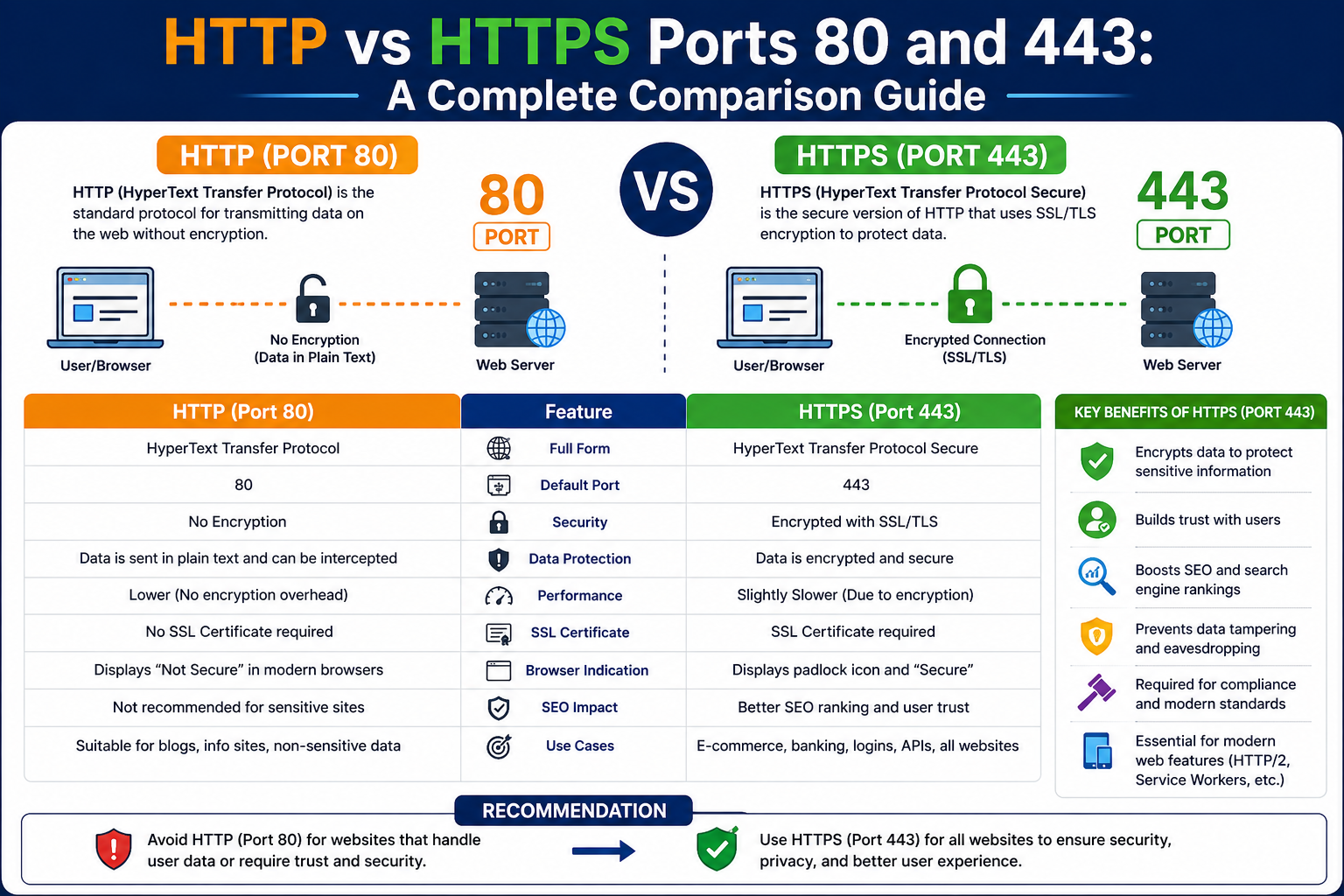
Port numbers play an important role in distinguishing between HTTP and HTTPS traffic. HTTP uses port 80 as its default communication channel. This port handles unencrypted data transmission, making it suitable for basic web browsing where security is not a concern.
HTTPS uses port 443, which is specifically designed for secure communication. This port handles encrypted data using TLS protocols. Because of encryption, data passing through port 443 is protected from interception and tampering.
These ports are essential for routing traffic correctly between browsers and servers. They ensure that requests are processed using the appropriate protocol, whether secure or non-secure.
Performance Impact of HTTPS
In the early days of HTTPS, encryption required additional processing power, which slightly slowed down website performance. However, advancements in technology have significantly reduced this impact.
Modern encryption methods are highly optimized, and protocols like HTTP/2 and HTTP/3 actually improve performance over traditional HTTP. These protocols allow multiple requests to be handled simultaneously, reducing load times.
As a result, HTTPS is no longer seen as a performance burden. In many cases, it is faster and more efficient than HTTP due to these improvements.
SEO and Browser Preferences
Search engines and web browsers now prioritize secure websites. HTTPS plays a significant role in search engine ranking because it indicates a safer browsing experience for users.
Web browsers also actively encourage the use of HTTPS by marking HTTP sites as “not secure.” This warning can discourage users from visiting non-secure websites, impacting trust and traffic.
Because of these factors, website owners are strongly encouraged to adopt HTTPS to improve visibility, credibility, and user engagement.
Common Misconceptions About HTTPS
One common misconception is that HTTPS completely protects websites from all cyber threats. While it does secure data transmission, it does not protect against vulnerabilities within the website itself, such as poor coding or malware.
Another misconception is that HTTPS is only necessary for e-commerce or banking websites. In reality, any website that collects or transmits user data benefits from HTTPS, including blogs, forums, and informational sites.
Some people also believe HTTPS slows down websites significantly, but as explained earlier, modern systems have largely eliminated this issue.
Migration from HTTP to HTTPS
Moving a website from HTTP to HTTPS involves several important steps. The process begins with obtaining an SSL/TLS certificate from a trusted authority. Once installed, the website must be configured to support HTTPS connections.
After configuration, redirects are set up so that all HTTP traffic automatically moves to HTTPS. This ensures that users always access the secure version of the site.
It is also important to update internal links, scripts, and resources to avoid mixed content issues, where secure and non-secure elements are loaded together.
Advantages of HTTPS in Modern Web Use
HTTPS provides several key advantages that make it essential in today’s digital environment. It ensures data privacy, protects against cyber attacks, and builds user trust. It also supports modern web technologies and improves overall website performance.
For businesses, HTTPS is crucial for maintaining customer confidence and complying with data protection standards. For users, it provides peace of mind knowing that their information is secure.
As the internet continues to evolve, HTTPS remains a foundational element of safe and reliable web communication.
How Browsers Enforce HTTPS Today
Modern web browsers actively enforce HTTPS to improve user safety. When a user tries to visit an HTTP website, browsers often display a warning indicating that the connection is not secure. In some cases, browsers may automatically upgrade the connection to HTTPS if the website supports it.
This enforcement is part of a broader effort to make encryption the default standard across the internet. By discouraging the use of HTTP, browsers help reduce the risk of data interception and cyberattacks. Over time, this has significantly increased global adoption of HTTPS.
Browsers also visually distinguish secure websites by displaying a padlock icon in the address bar. This simple indicator helps users quickly identify whether their connection is encrypted and trustworthy.
Role of Encryption in Data Protection
Encryption is the core technology that makes HTTPS secure. It works by converting readable data into a coded format that can only be decoded with the correct key. This ensures that even if data is intercepted, it cannot be understood by unauthorized parties.
There are two main types of encryption used in HTTPS: symmetric and asymmetric encryption. Asymmetric encryption is used during the initial handshake to securely exchange keys, while symmetric encryption is used for the actual data transfer because it is faster.
This combination allows HTTPS to maintain both strong security and efficient performance during communication between users and servers.
Threats Prevented by HTTPS
HTTPS protects against several common cyber threats. One of the most important is man-in-the-middle attacks, where an attacker intercepts communication between the user and the server. Without encryption, attackers could read or modify sensitive data.
It also helps prevent eavesdropping, where unauthorized parties monitor network traffic to steal information. Additionally, HTTPS reduces the risk of data tampering, ensuring that the content received by the user is exactly what the server intended to send.
While HTTPS does not eliminate all security risks, it significantly reduces exposure to many of the most common online threats.
Impact on User Trust and Website Credibility
User trust is a critical factor in the success of any website. HTTPS plays a major role in building that trust by ensuring that user interactions are secure. When users see the padlock icon in their browser, they are more likely to feel confident sharing personal information.
On the other hand, websites that still use HTTP may be perceived as outdated or unsafe. This can lead to higher bounce rates and lower engagement. In competitive online environments, security has become a key factor in establishing credibility.
For businesses, adopting HTTPS is not just a technical upgrade but also a strategic decision to improve reputation and customer confidence.
HTTPS and Data Integrity
Another important benefit of HTTPS is data integrity. This means that the information sent between the browser and server cannot be altered during transmission without detection.
Without HTTPS, attackers could potentially modify data in transit, such as inserting malicious code or changing content displayed to users. HTTPS prevents this by using cryptographic checks that verify whether data has been tampered with.
This ensures that users always receive accurate and unmodified information from the intended source.
Mobile Devices and HTTPS Usage
With the rise of smartphones and mobile browsing, HTTPS has become even more important. Mobile devices often connect to public or unsecured networks, which increases the risk of data interception.
HTTPS helps protect mobile users by encrypting all communication, regardless of the network being used. This is especially important when users access banking apps, social media, or e-commerce platforms on the go.
Most modern mobile browsers also enforce HTTPS by default, further strengthening security for mobile internet users.
API Communication and HTTPS
HTTPS is not only used for websites but also for APIs, which are systems that allow different software applications to communicate with each other. Many modern applications rely heavily on APIs to exchange data.
Using HTTPS for API communication ensures that data exchanged between systems remains secure and private. This is especially important for applications that handle sensitive information, such as financial services, healthcare systems, and cloud platforms.
Without HTTPS, APIs would be vulnerable to interception and unauthorized access, potentially exposing large amounts of sensitive data.
Cost and Accessibility of HTTPS
In the past, implementing HTTPS required significant cost and technical effort, which limited its adoption. However, this has changed dramatically in recent years.
Today, many organizations offer free SSL/TLS certificates, making HTTPS accessible to websites of all sizes. Hosting providers also often include automatic HTTPS setup as part of their services.
This shift has made it easier for even small websites and personal blogs to adopt secure communication without additional financial burden.
Common Technical Challenges in HTTPS Implementation
While HTTPS is widely used, implementing it can still present certain technical challenges. One common issue is mixed content, where secure pages load non-secure resources such as images or scripts. This can trigger browser warnings and reduce security effectiveness.
Another challenge is certificate management. SSL/TLS certificates must be renewed periodically, and expired certificates can cause websites to become inaccessible or flagged as unsafe.
Proper configuration and maintenance are essential to ensure that HTTPS functions correctly and consistently.
Future of Web Security Beyond HTTPS
Although HTTPS is currently the standard for secure communication, web security continues to evolve. New protocols and technologies are being developed to improve encryption efficiency, privacy, and performance.
For example, newer versions of TLS and emerging web standards aim to make encryption even faster and more secure. There is also growing interest in privacy-focused technologies that go beyond traditional encryption methods.
Despite these advancements, HTTPS will remain a foundational part of internet security for the foreseeable future.
Final Understanding of HTTP vs HTTPS
HTTP and HTTPS serve the same basic purpose of transferring data between users and websites, but they differ significantly in security. HTTP is simple and unencrypted, while HTTPS adds encryption, authentication, and data integrity protection.
Port 80 is used for HTTP traffic, while port 443 is dedicated to secure HTTPS communication. Over time, HTTPS has become the standard due to increasing concerns about privacy, security, and data protection.
In today’s digital environment, HTTPS is no longer optional but essential for safe and trustworthy internet usage.
Why Port 80 Is Becoming Less Relevant
Port 80, traditionally used for HTTP traffic, is gradually becoming less relevant in modern web systems. This is mainly due to the global shift toward secure communication. Since HTTP does not provide encryption, it exposes data to potential interception, which is no longer acceptable for most websites.
As a result, many servers are configured to automatically redirect all traffic from port 80 to port 443. This ensures that even if a user enters a non-secure URL, they are still taken to the secure HTTPS version of the website. Over time, port 80 is increasingly used only for redirection purposes rather than actual content delivery.
Despite this decline, port 80 still exists as part of the foundational structure of the internet. It remains important for compatibility with older systems and legacy applications that were built before HTTPS became standard.
Importance of Port 443 in Modern Internet Architecture
Port 443 has become the backbone of secure web communication. It is specifically designed to handle encrypted traffic using TLS protocols, making it essential for protecting sensitive data online.
Almost all modern websites, applications, and services rely on port 443 for secure data exchange. This includes online banking platforms, e-commerce websites, cloud services, and social media platforms. The widespread adoption of HTTPS has made port 443 one of the most heavily used ports on the internet.
Because of its association with secure communication, firewalls and security systems are often configured to prioritize and monitor traffic through port 443 differently from other ports.
Role of HTTPS in Online Transactions
HTTPS plays a critical role in securing online transactions. Whenever users enter credit card details, login credentials, or personal information, HTTPS ensures that this data is encrypted before being transmitted.
This encryption prevents attackers from accessing or manipulating financial information during transfer. It also ensures that users are communicating with legitimate websites, reducing the risk of fraud.
Without HTTPS, online transactions would be highly vulnerable, making secure e-commerce and digital banking nearly impossible in today’s environment.
Certificate Authorities and Trust System
The trust system behind HTTPS relies heavily on Certificate Authorities. These organizations are responsible for issuing digital certificates that verify the identity of websites.
When a certificate is issued, it confirms that the website owner has undergone validation checks. Browsers trust these certificates because they are signed by recognized authorities. If a certificate is invalid or untrusted, browsers immediately alert users.
This system creates a chain of trust that allows users to confidently interact with websites without manually verifying their authenticity.
How HTTPS Protects Against Data Theft
One of the most important functions of HTTPS is preventing data theft. Cybercriminals often attempt to intercept data traveling across networks, especially on unsecured connections.
HTTPS makes this extremely difficult by encrypting all transmitted information. Even if data is intercepted, it appears as unreadable random characters without the decryption key.
This protection is especially important on public Wi-Fi networks, where attackers often try to exploit unsecured connections to steal sensitive information.
Performance Improvements in Modern HTTPS
Earlier versions of HTTPS were sometimes criticized for being slower due to encryption overhead. However, modern advancements have significantly improved performance.
Newer protocols like HTTP/2 and HTTP/3 allow multiple requests to be processed simultaneously, reducing loading times. These improvements make HTTPS not only secure but also efficient.
In many cases, HTTPS websites load faster than HTTP websites because of optimized connection handling and reduced latency.
Search Engine Optimization Benefits of HTTPS
Search engines prioritize secure websites in their ranking algorithms. HTTPS is considered a positive ranking signal because it indicates a safer browsing experience for users.
Websites using HTTPS are more likely to appear higher in search results compared to similar HTTP websites. This makes HTTPS important not only for security but also for visibility and traffic growth.
As a result, website owners who fail to adopt HTTPS may lose competitive advantage in search rankings over time.
Mixed Content Issues in HTTPS Websites
One common technical challenge when implementing HTTPS is mixed content. This occurs when a secure webpage loads resources such as images, scripts, or stylesheets over HTTP.
Mixed content can weaken security and trigger browser warnings, reducing user trust. To resolve this, all resources must be updated to load through HTTPS.
Proper configuration ensures that the entire website, including all embedded elements, remains fully secure.
Impact of HTTPS on Privacy Protection
HTTPS also plays an important role in protecting user privacy. It prevents third parties, such as internet service providers or attackers, from monitoring the exact content of communication.
While HTTPS does not hide the fact that a user is visiting a website, it does protect the specific pages viewed and data exchanged. This adds an important layer of privacy in everyday internet use.
In an era where digital privacy is increasingly important, HTTPS helps users maintain control over their personal information.
Enterprise and Organizational Use of HTTPS
Large organizations rely heavily on HTTPS to secure internal and external communications. It is used not only for public websites but also for internal systems, APIs, and cloud-based platforms.
Enterprises often implement strict security policies requiring HTTPS for all data transfers. This helps protect sensitive corporate data and ensures compliance with industry regulations.
In many industries, using HTTPS is no longer optional but a mandatory security requirement.
Role of HTTPS in Mobile Applications
Mobile applications also depend on HTTPS for secure communication with servers. Whether it is messaging apps, banking apps, or social media platforms, HTTPS ensures that data remains encrypted during transfer.
This is especially important because mobile apps frequently exchange real-time data, including personal messages and financial transactions.
Without HTTPS, mobile applications would be highly vulnerable to interception and data breaches.
Common Misunderstandings About Ports 80 and 443
A common misunderstanding is that ports themselves provide security. In reality, ports are just communication endpoints. Security comes from the protocols used, not the ports.
Port 80 is associated with HTTP, which is unencrypted, while port 443 is associated with HTTPS, which uses encryption. However, it is the TLS protocol within HTTPS that provides actual security, not the port itself.
Understanding this distinction is important for correctly interpreting how web security works.
Global Shift Toward a Fully Encrypted Web
The internet is steadily moving toward a fully encrypted environment. Major organizations, browsers, and governments are encouraging or requiring HTTPS adoption.
This shift is driven by the need to protect user data, prevent cybercrime, and improve overall trust in digital systems. Over time, HTTP is expected to become increasingly rare or limited to non-sensitive use cases.
The goal of a fully encrypted web is to ensure that all online communication is secure by default.
Final Perspective on HTTP and HTTPS Evolution
The evolution from HTTP to HTTPS represents one of the most important transformations in internet history. It reflects the growing need for security, privacy, and trust in digital communication.
While HTTP played a crucial role in the early development of the web, HTTPS has become the modern standard for safe and reliable communication. With ports 80 and 443 serving as the underlying channels, HTTPS continues to shape the future of the internet by making it more secure for everyone.
Advanced Role of TLS in HTTPS Security
At the core of HTTPS lies TLS, or Transport Layer Security, which is responsible for creating a secure communication channel over an insecure network. TLS replaces older encryption methods and provides stronger algorithms, better performance, and improved resistance against modern cyber threats.
TLS works by combining asymmetric encryption during the handshake phase and symmetric encryption for the actual data transfer. This hybrid approach ensures both strong security and efficient communication. Each session generates unique encryption keys, meaning even if one session is compromised, others remain safe.
Over time, TLS has evolved through multiple versions, each improving security standards and removing outdated cryptographic methods. Modern web systems strongly discourage older versions due to known vulnerabilities.
Understanding Secure Sessions in HTTPS
Every HTTPS connection creates what is known as a secure session. This session is temporary and exists only for the duration of communication between the browser and the server.
During this session, all data exchanged is encrypted using session keys. These keys are unique to each connection, which prevents attackers from reusing intercepted data in future sessions.
Once the session ends, the keys are discarded. This process ensures that even if data is captured, it cannot be decrypted later without the session-specific keys.
HTTPS and Protection Against DNS Spoofing
HTTPS also helps mitigate risks associated with DNS spoofing, where attackers attempt to redirect users to fake websites by manipulating domain name resolution.
While DNS itself is not fully secure, HTTPS adds a layer of verification. When a user connects to a website, the browser checks the SSL/TLS certificate to ensure the site is legitimate.
If the certificate does not match the expected domain, the browser issues a warning, preventing users from unknowingly interacting with malicious sites.
Certificate Pinning and Enhanced Security
Some advanced systems use a technique called certificate pinning to further enhance security. This method involves associating a specific certificate or public key with a website or application.
Even if a malicious actor manages to obtain a fraudulent certificate, the connection will fail because it does not match the pinned version. This adds an extra layer of protection beyond standard certificate validation.
Certificate pinning is commonly used in high-security environments such as banking apps and enterprise systems.
HTTPS in Cloud Computing Environments
Cloud computing platforms heavily rely on HTTPS for secure data exchange between users and servers. Whether accessing storage, virtual machines, or APIs, HTTPS ensures that all communication remains encrypted.
Cloud providers often enforce HTTPS by default across their services. This helps maintain data security in distributed environments where multiple systems interact across the internet.
In such environments, HTTPS is essential for maintaining confidentiality, integrity, and trust between interconnected services.
Load Balancers and HTTPS Termination
In large-scale systems, HTTPS traffic is often managed through load balancers. These systems distribute incoming requests across multiple servers to ensure efficiency and reliability.
Sometimes, encryption is terminated at the load balancer, meaning it decrypts HTTPS traffic before forwarding it internally. This process is known as SSL termination.
While this improves performance and simplifies backend processing, it requires strong internal network security to ensure data remains protected after decryption.
Impact of HTTPS on Cybersecurity Practices
HTTPS has significantly influenced modern cybersecurity practices. It has raised the baseline for secure communication and forced attackers to develop more sophisticated methods.
Organizations now treat encryption as a fundamental requirement rather than an optional feature. Security frameworks and compliance standards often mandate HTTPS usage for all external communication.
This shift has helped reduce large-scale data breaches caused by unencrypted traffic interception.
HTTPS and Content Delivery Networks
Content Delivery Networks also rely heavily on HTTPS to securely distribute content across global servers. These networks cache website data closer to users to improve speed and performance.
When HTTPS is used, encrypted connections are maintained even when data is served from geographically distributed servers. This ensures that security is not compromised for performance.
Modern CDNs automatically support HTTPS, making it easier for websites to deliver secure content worldwide.
Common Attacks Prevented by HTTPS
HTTPS helps defend against several types of cyberattacks. One of the most important is session hijacking, where attackers attempt to take control of an active user session.
It also reduces risks from packet sniffing, where network traffic is monitored to extract sensitive data. Additionally, HTTPS prevents content injection attacks, where malicious code is inserted into unprotected traffic.
While HTTPS does not stop all forms of attack, it significantly reduces the attack surface available to cybercriminals.
User Awareness and Security Indicators
Modern browsers use visual indicators to help users understand security status. The padlock icon is the most recognizable symbol of an HTTPS connection.
Some browsers also display warnings for insecure sites or highlight extended validation certificates with additional identity information.
These visual cues help users make informed decisions about which websites to trust, even without technical knowledge.
Transition Challenges for Legacy Systems
Many older systems were built without considering encryption, making the transition to HTTPS challenging. Legacy applications may rely on outdated protocols or hardcoded HTTP links.
Migrating such systems requires careful planning to avoid breaking functionality. Developers often need to update internal logic, APIs, and third-party integrations.
Despite these challenges, most organizations eventually migrate due to security requirements and browser enforcement policies.
The Future Direction of Web Encryption
The future of web communication is moving toward universal encryption. The goal is to ensure that all data transmitted over the internet is automatically protected without user intervention.
Emerging technologies are focusing on reducing latency, improving cryptographic efficiency, and enhancing privacy protections beyond traditional HTTPS.
There is also growing interest in end-to-end encryption models that extend protection beyond transport layers.
Why HTTPS is Now a Baseline Requirement
HTTPS is no longer considered an optional enhancement but a baseline requirement for any serious website or application. It is required for compliance with many privacy laws and security standards.
Without HTTPS, websites risk losing user trust, search engine visibility, and compatibility with modern browsers. Many features of the web ecosystem also depend on secure connections to function properly.
As a result, HTTPS has become a fundamental pillar of modern internet infrastructure.
Final Understanding of Secure Web Communication
The comparison between HTTP and HTTPS highlights a major evolution in how data is transmitted across the internet. While HTTP provides basic connectivity, HTTPS ensures that communication is private, authenticated, and protected from tampering.
With ports 80 and 443 serving as the underlying channels, the shift toward HTTPS represents a global commitment to security and trust. As cyber threats continue to evolve, HTTPS remains a critical defense mechanism that supports safe and reliable digital communication.
Perspective on the Importance of HTTPS in the Modern Web
Beyond security and performance, HTTPS also plays a deeper role in shaping the overall trust ecosystem of the internet. In today’s digital world, users are constantly interacting with websites that collect personal information, track preferences, and process sensitive transactions. HTTPS acts as a foundation of digital trust in these interactions by ensuring that users are not exposed to hidden risks while browsing or sharing data online. This trust is not only technical but also psychological, as users are far more likely to engage with websites that clearly indicate secure communication through HTTPS indicators such as the padlock symbol.
Another important aspect is the growing dependency of modern technologies on secure connections. Emerging systems such as artificial intelligence platforms, Internet of Things (IoT) devices, and smart applications rely heavily on continuous data exchange. Without HTTPS, these systems would be highly exposed to interception and manipulation, which could lead to serious security breaches. HTTPS ensures that even complex networks of connected devices can communicate safely without compromising data integrity.
Additionally, HTTPS contributes significantly to regulatory compliance in many industries. Governments and international organizations have introduced strict data protection laws that require organizations to secure user data during transmission. HTTPS helps businesses meet these legal requirements while also strengthening their reputation in the market. Failure to implement HTTPS can result in penalties, loss of customer trust, and reduced competitiveness.
Conclusion
HTTP and HTTPS represent two different stages in the evolution of web communication. HTTP was designed for simple and fast data transfer, but it lacks built-in security, making it vulnerable to interception and manipulation. HTTPS, on the other hand, builds on HTTP by adding encryption, authentication, and data integrity through TLS, ensuring that communication remains private and trustworthy.
The use of port 80 for HTTP and port 443 for HTTPS helps distinguish between unencrypted and encrypted traffic, but the real security comes from the HTTPS protocol itself, not the ports. Over time, HTTPS has become the global standard due to increasing concerns about privacy, cyber threats, and data protection.
Today, HTTPS is essential for nearly all websites and applications, supporting secure browsing, online transactions, APIs, cloud systems, and mobile apps. It improves user trust, enhances search engine visibility, and ensures compliance with modern security standards.
As the internet continues to grow, the shift toward a fully encrypted web makes HTTPS not just an option but a necessity. In modern digital communication, HTTPS stands as the foundation of a safer, more reliable, and more secure online experience.
Today, HTTPS is no longer optional but a fundamental requirement for almost all websites and online platforms. Web browsers actively warn users when they attempt to access non-secure HTTP websites, and search engines give preference to HTTPS-enabled sites in their rankings. This has made HTTPS essential not only for security but also for trust, credibility, and online visibility. It is now widely used across all industries, including banking, healthcare, education, government systems, and entertainment platforms, ensuring safe communication across billions of interactions every day.
In conclusion, HTTPS represents the foundation of modern internet security. As cyber threats continue to evolve and digital communication expands further, the importance of HTTPS will only grow. It has transformed the internet into a more secure space and will remain a critical component in building a safer, more private, and more reliable digital future.