Ethernet cables used in both T568A and T568B standards are built using four twisted pairs of copper wires. These pairs are color-coded to make identification and termination easier during installation. Each pair consists of a solid-colored wire and a striped wire, and the twisting helps reduce electromagnetic interference and crosstalk between signals. Even though the internal arrangement differs between T568A and T568B, the physical construction of the cable remains identical.
The four color groups used in both standards are green, orange, blue, and brown. These colors are not random; they are part of a globally accepted system that ensures uniformity in networking installations. The only variation between the two standards lies in how these color pairs are assigned to specific pin positions inside the RJ45 connector.
Understanding this physical structure is important because it helps explain why both standards perform the same electrically even though their wiring order differs.
RJ45 Connector Pin Layout Explained
The RJ45 connector contains eight pins, and each pin corresponds to one wire in the Ethernet cable. These pins are arranged in a precise sequence to ensure proper transmission and reception of data signals.
In both T568A and T568B, all eight pins are used in modern Ethernet applications such as Fast Ethernet and Gigabit Ethernet. The difference lies in which color wire is assigned to each pin number.
In simple terms, the connector acts like a bridge between devices, and the pin arrangement determines how electrical signals flow. If the wrong arrangement is used at either end of the cable, the signal paths become mismatched, leading to communication errors.
This is why maintaining consistency in wiring standards is essential for network reliability.
T568A Wiring Sequence in Detail
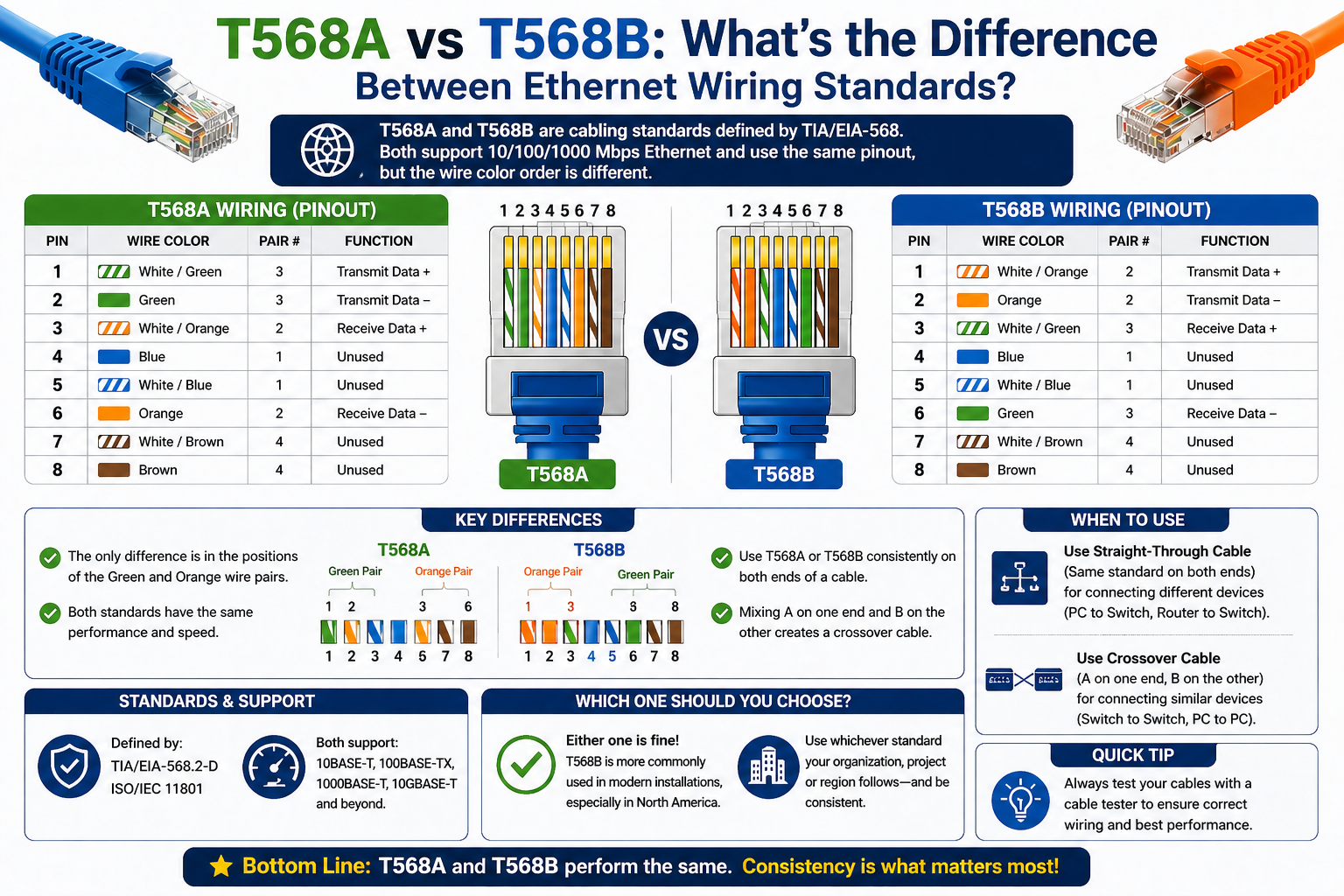
T568A follows a specific order that prioritizes backward compatibility with older telecommunications systems. The sequence of wires starting from pin 1 is green-white, green, orange-white, blue, blue-white, orange, brown-white, and brown.
This arrangement was designed with legacy systems in mind, especially those that integrated voice and data communication in the same infrastructure. Because of this, T568A has historically been favored in residential and government environments where older wiring systems were still in place.
Despite being an older standard, T568A is still fully capable of supporting modern high-speed Ethernet networks without any performance degradation.
T568B Wiring Sequence in Detail
T568B uses the same set of wires but swaps the positions of the green and orange pairs compared to T568A. The sequence begins with orange-white, orange, green-white, blue, blue-white, green, brown-white, and brown.
This small adjustment makes T568B more aligned with commercial networking practices, which is why it became the dominant standard in business environments. Over time, most commercial installations adopted T568B as the default configuration for consistency and ease of deployment.
Even though the order differs, both standards maintain the same electrical performance characteristics.
Why Two Standards Exist
The existence of two wiring standards is largely the result of historical development in the telecommunications industry. Different organizations and engineering groups developed slightly different approaches to structured cabling during the early expansion of Ethernet technology.
Instead of forcing a global replacement of one standard, both were officially accepted to avoid disrupting existing installations. This decision ensured backward compatibility and allowed networks to evolve gradually without requiring complete rewiring.
Over time, this led to a situation where both standards coexist, but one is more widely used depending on region and application type.
Straight-Through vs Crossover Cabling
One of the most important practical concepts related to T568A and T568B is cable type. A straight-through cable uses the same standard on both ends, either T568A to T568A or T568B to T568B. This type of cable is used to connect different types of devices, such as a computer to a switch or router.
A crossover cable, on the other hand, uses T568A on one end and T568B on the other. This effectively swaps the transmit and receive pairs, allowing similar devices to communicate directly, such as switch-to-switch or computer-to-computer connections in older setups.
Modern networking equipment often includes auto-sensing technology that can automatically adjust signal paths, reducing the need for dedicated crossover cables. However, understanding this concept remains important for troubleshooting and certification exams.
Impact on Network Performance
From a performance perspective, there is no difference between T568A and T568B when implemented correctly. Both standards support the same bandwidth, speed, and transmission quality. The electrical characteristics of the cable do not change based on wire order as long as proper pairing and termination are maintained.
Problems arise only when the standards are mixed incorrectly or when termination is done poorly. In such cases, signal integrity can degrade, leading to packet loss, reduced speeds, or intermittent connectivity issues.
This is why consistency and proper installation techniques are more important than the choice of standard itself.
Common Installation Mistakes
One of the most frequent mistakes in network cabling is mixing T568A and T568B within the same infrastructure without proper planning. This often happens when multiple technicians work on the same network without following a unified standard.
Another common issue is incorrect termination of twisted pairs. Even if the correct standard is chosen, untwisting too much of the cable near the connector can introduce interference and weaken the signal.
Misalignment of wires inside the RJ45 connector is also a frequent problem, especially in poorly executed installations. Even a single incorrectly placed wire can disrupt communication between devices.
Best Practices for Consistent Cabling
To ensure a reliable network, the most important rule is consistency. Once a standard is selected for a network installation, it should be followed throughout the entire system without deviation.
Labeling cables during installation can help avoid confusion later, especially in large networks. Proper testing after termination is also essential to verify that each cable is functioning correctly.
Using structured cabling practices, where cables are organized systematically and documented clearly, helps reduce long-term maintenance issues.
Role in Certification and Learning
T568A and T568B are fundamental topics in networking education and certification programs. They are often included in exams because they test a candidate’s understanding of physical network infrastructure.
Understanding how these standards work helps build a foundation for more advanced networking concepts such as routing, switching, and network troubleshooting.
In real-world scenarios, technicians frequently encounter both standards, especially when working in environments where older infrastructure still exists alongside modern systems.
Why T568B Became More Common
T568B gained popularity mainly due to early adoption in commercial environments. As businesses expanded their networks, they began standardizing on T568B for consistency across installations.
Once a large number of organizations adopted it, it naturally became the default choice for many new deployments. This widespread use reinforced its position as the preferred standard in most modern networking projects.
However, this does not make T568A obsolete. It continues to be widely used in specific environments where legacy compatibility is required.
Troubleshooting Wiring Issues
When network problems occur, incorrect cabling is one of the first things to check. Faulty or mismatched wiring can cause symptoms such as slow speeds, dropped connections, or complete communication failure.
Testing tools are often used to verify that each pin is correctly connected. These tools can quickly identify whether a cable is straight-through, crossover, or incorrectly terminated.
Understanding the differences between T568A and T568B helps technicians diagnose these issues more efficiently.
Real-World Network Consistency
In real-world network environments, consistency is far more important than the choice between the two standards. A properly installed T568A network will perform just as well as a properly installed T568B network.
The real challenge comes from maintaining uniformity over time, especially when networks are expanded or modified. If new cables are added using a different standard, it can create hidden inconsistencies that are difficult to diagnose later.
This is why many organizations enforce strict cabling guidelines for all installations.
Long-Term Reliability Considerations
Over time, network reliability depends heavily on installation quality and adherence to standards. Even small deviations in wiring can create long-term issues that are difficult to trace.
Environmental factors such as cable bending, interference, and wear can also affect performance, but these issues are unrelated to the choice of T568A or T568B.
Proper planning, consistent installation practices, and regular testing are the key factors that ensure long-term network stability.
Final Practical Understanding
Both T568A and T568B serve the same fundamental purpose: enabling reliable data communication between networked devices. The difference between them is purely in wiring order, not in capability or speed.
The most important takeaway is that networks should always maintain internal consistency. Whether using T568A or T568B, sticking to one standard ensures predictable performance and reduces the risk of connectivity issues.
In practical networking work, success depends less on which standard is chosen and more on how carefully and consistently it is applied.
Advanced Differences in Real Network Deployments
In practical networking environments, the difference between T568A and T568B becomes less about theory and more about deployment discipline. Large-scale networks rarely fail because one standard is “better” than the other; instead, failures usually happen when both standards are unintentionally mixed. In structured cabling systems found in offices, data centers, and campuses, consistency is treated as a core design rule. Once a standard is chosen during the initial build, every expansion, repair, or upgrade must follow the same pattern to maintain predictable performance.
This becomes especially important in environments where multiple technicians or vendors work on the same infrastructure. Without strict documentation, it is easy for one team to continue using T568A while another switches to T568B, creating hidden inconsistencies that are difficult to diagnose later.
Impact on Modern Ethernet Speeds
Modern Ethernet standards such as Fast Ethernet and Gigabit Ethernet are designed to operate independently of whether T568A or T568B is used. Both wiring schemes support full-duplex communication and high-speed data transmission as long as termination is correct and the cable quality meets category requirements.
For Gigabit Ethernet and above, all four twisted pairs inside the cable are used simultaneously for sending and receiving data. This makes proper pairing more important than ever. If the pairs are not correctly maintained during termination, performance degradation can occur even if the correct wiring standard is technically followed.
In essence, speed is not determined by T568A or T568B, but by cable category, termination quality, and environmental conditions.
Role in Structured Cabling Systems
Structured cabling systems are designed to provide a standardized and scalable approach to network installation. Within this framework, T568A and T568B serve as foundational wiring rules. Every cable, patch panel, wall jack, and patch cord must follow a consistent scheme to ensure uniform connectivity across the entire infrastructure.
In professional installations, documentation is just as important as physical wiring. Technicians often label both ends of every cable and maintain diagrams showing which standard is in use. This prevents confusion during maintenance and reduces downtime when troubleshooting is required.
Structured cabling also ensures that future upgrades can be performed without completely redesigning the physical network layout.
PoE (Power over Ethernet) Considerations
Power over Ethernet (PoE) technology allows electrical power to be transmitted alongside data through Ethernet cables. This is commonly used for devices such as IP cameras, wireless access points, and VoIP phones.
Both T568A and T568B fully support PoE because the power is transmitted over the same twisted pairs regardless of wiring order. However, proper pairing is critical because PoE relies on balanced signal transmission to avoid interference and heat buildup.
Incorrect termination or mixing standards can increase resistance imbalance, which may affect power delivery efficiency or device stability. While modern PoE standards are highly tolerant, best practice still requires strict adherence to one wiring scheme.
Troubleshooting Network Cabling Issues
When network problems arise, cabling is one of the first areas to inspect. Symptoms such as intermittent connectivity, slow speeds, or devices not being detected often point to physical layer issues.
A key troubleshooting step is verifying whether both ends of a cable follow the same standard. If one end uses T568A and the other uses T568B, the cable becomes a crossover connection, which may not function properly in modern networks unless specifically required.
Technicians also check for improper wire stripping, incorrect pin alignment, and excessive untwisting of pairs. Even small physical mistakes can disrupt signal integrity and lead to inconsistent network behavior.
Cable testers are commonly used to verify continuity, pin mapping, and signal quality before a network goes live.
Common Real-World Mistakes in Installation
One of the most frequent mistakes in Ethernet cabling is assuming that all cables are interchangeable without checking their wiring standard. This often leads to inconsistent infrastructure where different sections of the same building follow different conventions.
Another common issue is poor termination technique. When wires are not fully seated in the RJ45 connector or when the twists are undone too far, signal degradation can occur even if the correct standard is used.
In some cases, installers also reuse old cables without verifying their internal wiring, which can introduce hidden inconsistencies into an otherwise modern network.
Importance of Documentation and Labeling
Proper documentation is one of the most effective ways to prevent wiring inconsistencies. In professional environments, every cable run is typically documented with details such as endpoint location, cable type, and wiring standard used.
Labeling both ends of a cable helps technicians quickly identify its purpose and configuration. This becomes especially valuable in large networks where hundreds or thousands of cables may be present.
Without documentation, troubleshooting becomes significantly more time-consuming, as technicians must physically trace cables to determine their configuration.
Migration Between Standards
In some cases, organizations may decide to transition from one wiring standard to another, typically from T568A to T568B for consistency with newer infrastructure. However, this process must be carefully managed.
A complete migration requires re-terminating cables or using adapters in a controlled manner. Partial migration, where both standards coexist without clear separation, can create long-term maintenance issues.
For this reason, migrations are usually performed during scheduled upgrades or infrastructure overhauls rather than incremental changes.
Global Usage Patterns
While both standards are recognized internationally, usage patterns vary by region and industry. T568B is more commonly found in commercial and enterprise environments, particularly in North America. T568A, while less common in new deployments, remains important in government-related installations and legacy systems.
In many countries, the choice is less about regulation and more about convention. Organizations typically follow whichever standard is already established within their existing infrastructure.
Despite these regional preferences, both standards remain globally valid and functionally equivalent when implemented correctly.
Cable Testing and Certification
After installation, Ethernet cables are often tested to ensure compliance with performance standards. Testing verifies that all eight wires are correctly connected and that signal integrity meets required specifications.
Certification tools can detect issues such as crossed pairs, open circuits, or split pairs. These problems may not always be visible during installation but can significantly impact network performance.
Proper testing ensures that whether T568A or T568B is used, the cable meets the expected performance standards for its category rating.
Future of Ethernet Wiring Standards
Despite advances in wireless networking and fiber optics, copper-based Ethernet cabling remains widely used due to its reliability and cost-effectiveness. As speeds continue to increase, cabling standards are evolving in terms of shielding, materials, and performance categories, but T568A and T568B remain unchanged at the termination level.
This stability is intentional. Maintaining consistent wiring standards ensures backward compatibility and reduces the need for retraining or infrastructure redesign.
Even as network technology advances, these two standards are expected to remain relevant for many years due to their simplicity and widespread adoption.
Key Practical Takeaway
At a practical level, the debate between T568A and T568B is not about performance superiority but about consistency and planning. Both standards deliver identical network performance when installed correctly.
The real difference emerges only when they are mixed unintentionally, leading to connectivity issues that are often misdiagnosed as hardware or software failures.
Understanding both standards provides a strong foundation for anyone working with physical network infrastructure, but applying them consistently is what ensures long-term reliability.
Final Understanding of Real-World Application
In real-world networking, success depends on disciplined installation practices rather than the specific wiring standard chosen. Whether using T568A or T568B, the goal is always the same: creating a stable, predictable, and well-documented physical layer.
Once a standard is selected, maintaining it across all installations, repairs, and expansions ensures smooth communication between devices and reduces the likelihood of network disruptions.
T568A vs T568B in Large-Scale Network Architecture
In large enterprise environments, the choice between T568A and T568B is rarely treated as a technical debate. Instead, it becomes part of a broader architectural decision that defines how the entire physical network layer is standardized. Once a standard is selected during the initial design phase, it effectively becomes a rule that governs every cable drop, patch panel, and wall outlet across the organization.
This kind of discipline is especially important in environments like corporate campuses, universities, and data centers where thousands of endpoints must behave predictably. In such settings, even a small inconsistency in cabling standards can cascade into widespread troubleshooting challenges, making it difficult to isolate faults.
For this reason, network architects often prioritize uniformity over preference. The goal is not to choose the “better” standard, but to ensure that every technician, contractor, and system component follows the same rule set without deviation.
Patch Panels and Horizontal Cabling Consistency
Patch panels act as central termination points in structured cabling systems, and they play a critical role in maintaining either T568A or T568B consistency. Each cable entering a patch panel must follow the same wiring scheme to ensure predictable mapping between endpoints.
Horizontal cabling, which connects work areas to telecommunications rooms, is particularly sensitive to inconsistencies. If different standards are used within the same horizontal run, diagnosing connectivity issues becomes significantly more complex because the problem may not be visible without physical inspection.
Maintaining consistency at the patch panel level helps ensure that even if multiple technicians work on the system over time, the logical structure of the network remains intact.
Wall Jack Termination Practices
Wall jacks are another critical point where wiring standards must be strictly enforced. Each keystone jack is designed to accept wires in a specific order according to the selected standard. Whether T568A or T568B is used, the termination must match exactly at both ends of the cable.
A common issue in poorly managed installations is inconsistent wall jack termination across different rooms or floors. This creates a fragmented network where identical-looking ports behave differently depending on their internal wiring.
Professional installations avoid this by enforcing a single standard across all termination points and using color-coded labeling to reduce human error during installation and maintenance.
Crossover Evolution in Modern Networks
Historically, crossover cables were essential for directly connecting similar devices such as switches or computers. These cables intentionally used T568A on one end and T568B on the other to swap transmit and receive pairs.
However, modern networking equipment now includes Auto MDI-X functionality, which automatically detects and adjusts signal polarity. This advancement has significantly reduced the need for manual crossover cabling in most environments.
Despite this, understanding crossover behavior remains important for troubleshooting older systems and for interpreting legacy documentation where mixed standards were used intentionally.
Error Detection in Physical Layer Design
The physical layer of networking is highly sensitive to wiring accuracy. Even though Ethernet protocols include error detection at higher layers, physical wiring mistakes can still cause performance issues that appear intermittent or unpredictable.
When T568A and T568B are mixed incorrectly, the resulting misalignment can lead to partial connectivity where devices appear to link but fail to transmit data reliably. These types of issues are particularly difficult to diagnose because they often mimic software or hardware failures.
Proper use of cable testers and certification tools helps identify these issues early in the deployment process, reducing long-term maintenance overhead.
Role in Certification Exams and Skill Development
Understanding T568A and T568B is a foundational requirement in many networking certification programs. Exams such as entry-level and intermediate networking certifications often test candidates on their ability to identify wiring sequences, recognize crossover configurations, and troubleshoot physical layer issues.
This knowledge is not purely academic. It forms the basis for real-world skills required in network installation, maintenance, and troubleshooting roles. Technicians who understand these standards are better equipped to diagnose problems quickly and avoid unnecessary system downtime.
Mastery of these concepts also builds confidence when working with unfamiliar or legacy infrastructure.
Interference and Signal Integrity Considerations
Although both standards use the same electrical principles, maintaining correct twisted pair integrity is essential for minimizing interference. Each pair in the Ethernet cable is twisted at a specific rate to cancel out electromagnetic noise.
If wires are improperly separated during termination, especially near connectors, the balance of the pair can be disrupted. This can lead to increased crosstalk, signal degradation, or reduced effective transmission distance.
While T568A and T568B do not inherently affect signal quality, poor implementation of either standard can negatively impact performance.
Long-Term Maintenance Implications
From a maintenance perspective, network consistency simplifies troubleshooting and reduces operational costs. When a single wiring standard is used throughout an infrastructure, technicians can quickly identify and resolve issues without needing to verify multiple configurations.
In contrast, mixed environments require additional diagnostic steps, increasing the time required to isolate faults. Over time, this can lead to inefficiencies and higher maintenance expenses.
For this reason, many organizations enforce strict change management policies that require adherence to the original wiring standard during all upgrades and repairs.
Integration with Modern Network Technologies
Modern networks often integrate Ethernet cabling with technologies such as VoIP systems, wireless access points, and IP-based surveillance systems. In all of these cases, the underlying physical cabling remains the same regardless of application.
Both T568A and T568B support these technologies equally well, provided that the installation is consistent and properly certified. This makes them highly versatile and future-proof at the physical layer.
As network demands continue to grow, structured cabling remains a stable foundation that supports evolving digital systems without requiring constant redesign.
Environmental Factors Affecting Cable Performance
Environmental conditions such as temperature, humidity, and electromagnetic interference can affect Ethernet cable performance. While these factors are unrelated to the choice of wiring standard, they can influence overall network reliability.
For example, cables installed near power lines or heavy machinery may experience increased noise levels, which can degrade signal quality if shielding and grounding practices are not properly implemented.
Proper installation techniques, including correct cable routing and separation from power sources, are essential for maintaining stable performance regardless of whether T568A or T568B is used.
Best Practice for Future-Proof Networks
Future-proofing a network involves more than just selecting high-quality cables or devices. It requires establishing clear physical layer standards that remain consistent over time.
Choosing either T568A or T568B and applying it uniformly ensures that future expansions can be integrated without disrupting existing infrastructure. This is especially important in environments where network growth is expected over many years.
Consistency also simplifies onboarding for new technicians, as they only need to learn one wiring scheme for the entire environment.
Practical Field Observations
In real-world fieldwork, technicians often encounter networks where both standards are present due to incremental upgrades or lack of documentation. These environments are typically more difficult to maintain and troubleshoot.
Experienced professionals often begin by standardizing sections of the network during maintenance cycles, gradually bringing the entire infrastructure into alignment with a single wiring scheme.
This process improves reliability and reduces the likelihood of recurring issues caused by inconsistent wiring practices.
At the technical level, T568A and T568B are functionally identical in terms of data transmission capabilities. The distinction between them is purely structural, not performance-based.
The true engineering value lies in standardization, not preference. A well-designed network using either standard will outperform a poorly managed network that mixes both.
Ultimately, the most important principle in structured cabling is not which standard is chosen, but how consistently and accurately it is applied across the entire system.
Practical Troubleshooting Scenarios in Real Networks
In real-world networking environments, issues related to T568A and T568B rarely appear as obvious wiring problems at first glance. Instead, they often present themselves as vague symptoms such as intermittent connectivity, slow data transfer, or devices that fail to obtain an IP address. Because these symptoms can also be caused by switches, routers, or software configurations, physical cabling is sometimes overlooked during initial troubleshooting.
When technicians begin isolating the problem, one of the first physical checks is verifying cable termination standards. If a cable has been crimped with T568A on one end and T568B on the other unintentionally, it may behave like a crossover cable. While modern devices can often handle this automatically, older equipment may not, leading to communication failures that are difficult to trace without direct inspection.
This is why structured troubleshooting always starts from the physical layer before moving upward through the network stack.
Cable Certification in Professional Installations
In professional environments, simply installing cables is not enough. Each cable is usually tested and certified to ensure it meets performance standards. Certification tools verify continuity, pin-to-pin mapping, and signal quality across all eight conductors.
During this process, both T568A and T568B are treated equally in terms of performance expectations. The testing equipment does not evaluate which standard is used; it only confirms whether the selected standard has been applied correctly from end to end.
This step is critical in large deployments because it eliminates hidden wiring errors before the network becomes operational. Without certification, small mistakes can remain undetected until they cause real-world failures.
Data Centers and High-Density Cabling
In data center environments, cable management becomes significantly more complex due to the sheer number of connections. Thousands of cables may run between servers, switches, and storage systems, making consistency absolutely essential.
In these environments, T568B is more commonly used, but the key principle is not the specific standard—it is uniformity. Every patch panel, rack, and connection point must follow the same wiring convention to avoid confusion during maintenance or expansion.
Even a single inconsistency can create confusion when tracing connections in a high-density rack, potentially leading to service disruptions during upgrades or repairs.
Impact of Human Error in Cable Termination
One of the most common causes of cabling issues is human error during termination. Even experienced technicians can occasionally misplace wires inside an RJ45 connector, especially when working under time pressure or in low-visibility environments.
Mistakes such as reversing wire pairs, failing to fully insert wires, or cutting twists too early can all lead to degraded performance. These errors are often more damaging than choosing the wrong standard because they directly affect signal integrity.
This highlights an important point: T568A and T568B themselves are not problematic. The real risk lies in inconsistent or incorrect implementation.
Consistency Across Multi-Vendor Environments
In many enterprise networks, infrastructure is built using components from multiple vendors. Switches, routers, patch panels, and cabling may come from different manufacturers, but all must adhere to the same wiring standard to function correctly together.
Without strict adherence to a single standard, multi-vendor environments can quickly become difficult to manage. Even though devices are interoperable at the protocol level, physical inconsistencies can still cause communication issues that appear unrelated to cabling at first.
This is why network design documentation is considered a critical part of infrastructure planning.
Standardization as a Long-Term Strategy
Standardization is not just about initial installation—it is a long-term strategy for maintaining network health. Once a wiring standard is chosen, it becomes part of the organization’s technical identity for its physical infrastructure.
Over time, this reduces training requirements for technicians, simplifies expansion projects, and minimizes the risk of misconfiguration. It also ensures that future upgrades can be implemented without rethinking the underlying physical layout.
Organizations that enforce strict cabling standards tend to experience fewer physical layer issues and faster troubleshooting times.
Why T568B Became the Dominant Choice
T568B became widely adopted largely due to historical deployment trends in commercial environments. As businesses rapidly expanded their networks during the growth of Ethernet technology, T568B was frequently used in new installations, especially in North America.
Over time, this widespread adoption created a self-reinforcing standard. New technicians were trained on T568B by default, and manufacturers and contractors began aligning their practices accordingly.
Even though T568A remains equally valid, T568B’s dominance is primarily the result of industry momentum rather than technical superiority.
Understanding Mixed Cable Environments
In older buildings or poorly documented networks, it is not uncommon to find a mixture of both T568A and T568B cables. These mixed environments often arise from incremental upgrades over many years without strict adherence to a unified standard.
While such networks may still function, they are significantly harder to maintain. Troubleshooting becomes slower because technicians must verify wiring standards before diagnosing higher-level issues.
In many cases, organizations eventually choose to standardize the entire infrastructure during a major upgrade cycle to eliminate this complexity.
Role in Network Scalability
Scalability is a key factor in modern network design, and structured cabling plays a major role in supporting it. A consistent wiring standard ensures that new devices can be added without modifying existing infrastructure.
Whether expanding office floors, adding new server racks, or integrating additional access points, a uniform cabling system allows growth without disruption.
This makes both T568A and T568B suitable for scalable environments, as long as one standard is maintained throughout.
Maintenance Efficiency and Operational Cost
Network maintenance costs are heavily influenced by how organized and consistent the physical infrastructure is. Networks that mix wiring standards or lack documentation require more time to troubleshoot, increasing operational expenses.
On the other hand, a well-structured system using a single standard allows technicians to quickly locate and resolve issues. This reduces downtime and improves overall efficiency.
Over the long term, consistency in cabling standards contributes directly to lower maintenance costs and higher system reliability.
Final Conclusion
T568A and T568B are two fundamentally similar Ethernet wiring standards that differ only in the arrangement of the green and orange wire pairs. Despite this small variation, both standards deliver identical performance when correctly implemented.
The real importance of these standards lies not in choosing one over the other, but in maintaining strict consistency throughout a network. Mixing the two unintentionally can lead to connectivity issues, troubleshooting difficulties, and long-term maintenance challenges.
T568A is often associated with legacy systems and certain regulated environments, while T568B is more commonly used in modern commercial networks. However, neither is technically superior, and both remain fully valid in contemporary networking.
In practical terms, the success of a network depends far more on installation quality, documentation, and consistency than on the specific wiring standard selected. Once a standard is chosen, applying it uniformly across all cabling ensures stable communication, easier maintenance, and long-term reliability.
Ultimately, the most important lesson is simple: in structured cabling, consistency is far more valuable than preference, and disciplined implementation of either T568A or T568B guarantees a strong foundation for any network.