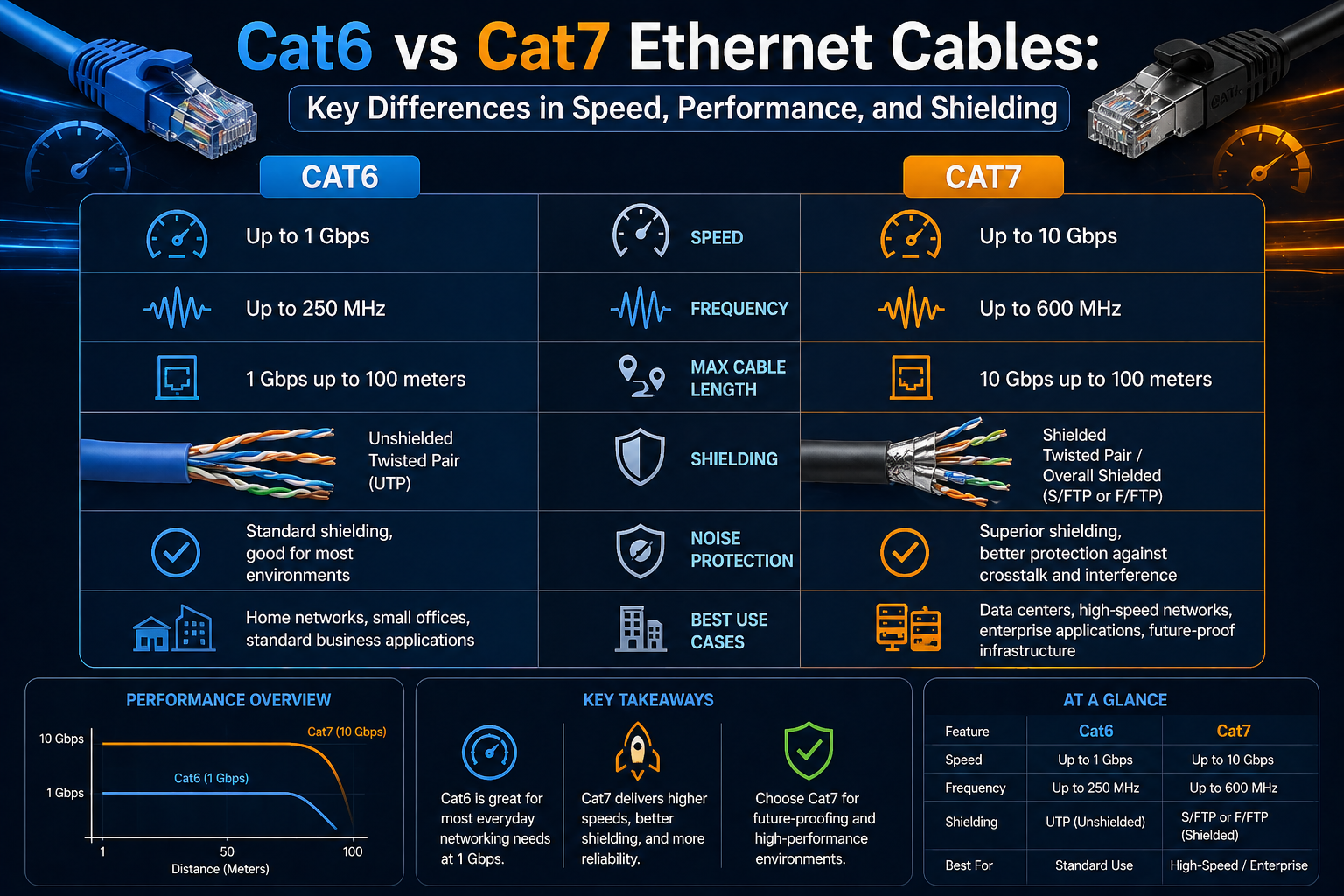
Cat6 cables are designed with a strong focus on improving signal quality while keeping manufacturing simple and cost-effective. Inside every Cat6 cable, there are four twisted pairs of copper wires, making a total of eight conductors. The key engineering principle behind Cat6 is the controlled twisting of these wire pairs. Each pair is twisted at a different rate, which helps reduce electromagnetic interference between them.
This twisting pattern is carefully calculated so that the electrical signals traveling through one wire cancel out unwanted noise generated within the cable itself. This process is known as noise cancellation through differential signaling. It allows data to travel more cleanly and efficiently, even when multiple signals are being transmitted at the same time.
A major improvement in Cat6 design compared to older standards is the tighter twist structure. These tighter twists significantly reduce crosstalk, which is the interference caused when signals from one wire pair leak into another. Crosstalk is one of the main reasons older Ethernet cables struggle with high-speed data transmission.
Many Cat6 cables also include a plastic separator, often called a spline, which runs through the center of the cable. This divider physically separates the twisted pairs and reduces internal interference even further. While not all Cat6 cables include this feature, it is commonly used in higher-quality versions.
The outer jacket of Cat6 cables is typically made from durable PVC material, which protects the internal wiring from physical damage and environmental exposure. Although standard Cat6 is unshielded, some variations include additional shielding for environments with higher interference levels.
Overall, Cat6 engineering focuses on achieving high performance through precision twisting and internal organization rather than relying on heavy shielding.
Deep Dive Into Cat7 Cable Structure and Shielding Technology
Cat7 cables represent a more advanced engineering approach that prioritizes signal protection and interference elimination over simplicity. While Cat6 relies mainly on twisted pair design, Cat7 introduces multiple layers of shielding to protect data transmission.
Each twisted pair inside a Cat7 cable is individually wrapped in a protective foil shield. This ensures that signals traveling through one pair are completely isolated from the others. This individual shielding is one of the key differences between Cat6 and Cat7.
In addition to pair-level shielding, Cat7 cables also include an overall outer shielding layer that surrounds all four pairs together. This dual-layer shielding system creates a strong barrier against both internal and external interference sources.
External interference can come from many sources such as electrical motors, power lines, fluorescent lighting, and even other nearby Ethernet cables. Cat7’s shielding is specifically designed to block these disturbances and maintain clean signal transmission.
Because of this heavy shielding, Cat7 cables are physically thicker and less flexible than Cat6 cables. This makes them more durable in harsh environments but slightly more difficult to install in tight or complex cable routes.
The advanced shielding system also improves signal stability in high-density environments where many cables are running side by side. This makes Cat7 especially useful in data centers, industrial setups, and enterprise-level networking systems.
Connector Compatibility and Real-World Usage Limitations
One important aspect of Cat7 that is often misunderstood is its connector compatibility. Originally, Cat7 was designed to use specialized connectors such as GG45 or TERA, which were created to fully support its shielding and high-frequency performance.
However, in real-world applications, most Cat7 cables use standard RJ45 connectors. This is because RJ45 is the universal standard used in almost all networking hardware, including routers, switches, and network cards.
While this makes Cat7 more compatible with existing systems, it also means that some of its original design advantages are not fully utilized. The shielding benefits still remain, but the connector system does not always match the cable’s full theoretical potential.
Despite this limitation, Cat7 still performs very effectively in most environments. It is widely used because it integrates easily into existing infrastructure without requiring specialized equipment.
This compatibility advantage makes Cat7 more practical than it might seem on paper, even though it was originally designed for a more specialized ecosystem.
Speed Capabilities and Frequency Differences
When comparing Cat6 and Cat7, one of the most discussed factors is speed. However, speed alone does not tell the full story. Both cables support high data rates, but they achieve this in different ways.
Cat6 supports frequencies up to 250 MHz. This allows it to handle gigabit Ethernet speeds very efficiently and even support 10Gbps speeds over shorter distances under ideal conditions. However, as distance increases, performance may begin to decline.
Cat7, on the other hand, supports frequencies up to 600 MHz. This higher frequency range allows it to transmit more data signals at the same time, improving overall efficiency and stability.
Although both cables are often listed as supporting 10Gbps speeds, Cat7 has more headroom for maintaining performance under stress. This means it can handle high-speed communication more consistently in demanding environments.
However, it is important to understand that actual speed depends on the entire network system, not just the cable. Routers, switches, and network interface cards must also support high-speed transmission for these benefits to be realized.
Signal Stability and Interference Control
Signal stability plays a critical role in network performance, especially in environments where multiple devices are connected and constantly exchanging data.
Cat6 achieves stability through its twisted pair design, which naturally reduces internal interference. This is sufficient for most home and office environments where electrical noise is relatively low.
However, Cat6 is more vulnerable to external interference compared to shielded cables. If installed near power lines, electrical equipment, or large bundles of other cables, performance may be slightly affected.
Cat7 solves this issue by using multiple layers of shielding that block external electromagnetic interference. Each pair is protected individually, and the entire cable is also shielded as a unit.
This makes Cat7 significantly more stable in environments where interference is unavoidable. It reduces data errors, improves consistency, and ensures smoother transmission even under heavy network loads.
Because of this, Cat7 is often preferred in environments where reliability is more important than cost or flexibility.
Distance Performance and Signal Degradation
All Ethernet cables experience signal degradation over distance, and this is an important factor when designing a network.
Cat6 performs well up to 100 meters for standard gigabit connections. However, when operating at higher speeds such as 10Gbps, the effective distance can be reduced depending on cable quality and environmental conditions.
As distance increases, signal strength weakens, which can lead to reduced performance or connection instability.
Cat7 also supports similar distance ranges, but its shielding helps maintain signal quality more effectively in challenging environments. While it does not dramatically increase maximum distance, it helps ensure more consistent performance over longer runs in noisy conditions.
In practical use, both cables are often installed within similar distance limits, but Cat7 provides better protection against signal degradation in difficult environments.
Installation Flexibility and Handling Differences
Installation is another area where Cat6 and Cat7 differ significantly.
Cat6 cables are flexible, lightweight, and easy to route through walls, ceilings, and conduits. Their simple design makes them ideal for both professional installers and home users.
Because they are easier to bend and manage, Cat6 cables are commonly used in large-scale deployments where hundreds or thousands of connections need to be installed efficiently.
Cat7 cables, however, are much thicker due to their additional shielding layers. This makes them less flexible and more difficult to install in tight spaces.
They also require more careful handling during installation to avoid damaging the shielding. In some cases, proper grounding is necessary to ensure the shielding works correctly.
Because of these factors, Cat7 is generally used in planned installations rather than casual or DIY setups.
Real-World Performance Perspective
In real-world usage, the differences between Cat6 and Cat7 are often less dramatic than technical specifications suggest.
For typical home users, Cat6 already provides more than enough performance for streaming, gaming, video calls, and everyday internet usage. It delivers stable gigabit speeds with minimal issues.
Cat7 becomes more valuable in environments where interference is high or where network stability is critical. This includes data centers, industrial systems, and enterprise networks.
In these environments, the shielding advantages of Cat7 can help maintain consistent performance under heavy load.
However, for most everyday applications, Cat6 remains the most practical and cost-effective choice.
Practical Understanding of Their Roles in Networking
Cat6 and Cat7 are not competing in the sense that one completely replaces the other. Instead, they serve different purposes based on environment and requirement.
Cat6 is designed for general-purpose networking where performance, affordability, and ease of installation are important.
Cat7 is designed for specialized environments where interference control and signal stability are the top priorities.
Understanding this distinction helps in making the right choice based on actual needs rather than just technical specifications.
Real-World Network Environments and How They Affect Cable Choice
When comparing Cat6 and Cat7 in practical usage, one of the most important factors is the environment where the cable will be installed. Network performance is not only determined by the cable itself but also by external conditions such as electrical noise, device density, and installation layout.
In a typical home environment, interference levels are usually low. Devices such as routers, laptops, smartphones, and smart TVs operate without generating significant electromagnetic noise. In such cases, Cat6 performs extremely well because its twisted pair design is already sufficient to maintain clean signal transmission. There is usually no noticeable performance difference between Cat6 and Cat7 in these settings.
In office environments, the situation becomes slightly more complex. Offices often contain multiple computers, printers, switches, and sometimes server rooms. Even then, interference levels remain moderate, and Cat6 still provides stable and reliable performance. Most business networks operate efficiently using Cat6 infrastructure without any limitations.
However, in industrial environments, the situation changes significantly. Factories, manufacturing plants, and heavy machinery setups generate high levels of electromagnetic interference. In such environments, signal disruption becomes more likely, especially when many cables are routed close together. This is where Cat7’s shielding becomes more valuable, as it helps block external noise and maintain consistent data transmission.
Data centers also benefit from Cat7 in specific scenarios. Although many modern data centers still use Cat6a or other structured cabling standards, Cat7 can be useful in high-density rack systems where cables are tightly packed together. The shielding reduces cross-interference between adjacent cables, improving stability.
Long-Term Performance and Network Stability Considerations
Long-term performance is another important aspect when choosing between Cat6 and Cat7. A network is not only evaluated based on initial speed but also on how consistently it performs over time under continuous usage.
Cat6 has a strong track record of long-term reliability in both residential and commercial installations. Because it uses a simpler design with fewer protective layers, there are fewer components that can degrade over time. As long as it is installed properly and not exposed to physical damage, Cat6 can maintain stable performance for many years.
Cat7 also offers long-term reliability, but its complexity introduces additional considerations. The shielding layers must remain intact and properly grounded to maintain effectiveness. If the shielding is compromised during installation or over time, the performance benefits may be reduced.
Despite this, Cat7 is highly durable and designed for environments where consistent performance is critical. Its shielding helps protect against gradual performance degradation caused by environmental interference, making it suitable for mission-critical systems.
In structured cabling systems where long-term stability is prioritized, Cat7 can offer a more controlled and predictable performance environment.
Heat, Power Transmission, and Electrical Efficiency
Ethernet cables not only transmit data but can also carry electrical power in certain setups through Power over Ethernet technology. This introduces additional considerations related to heat generation and electrical efficiency.
Cat6 handles PoE applications very effectively. Its copper conductors are capable of transmitting both data and power without significant heat buildup in standard usage conditions. It is commonly used in systems such as IP surveillance cameras, VoIP phones, and wireless access points.
However, when multiple PoE devices are installed in close proximity, heat can become a factor that affects cable performance over time. In most cases, Cat6 is still sufficient, but careful planning of cable bundles is recommended.
Cat7, due to its shielding, can offer improved protection in high-power or high-density PoE environments. The shielding helps reduce external interference that may affect power stability. However, shielding can also trap heat if cable management is not properly designed.
This means that while Cat7 can offer advantages in specific PoE-heavy environments, it also requires more careful installation planning to avoid heat accumulation.
Flexibility vs Protection Trade-Off
One of the most noticeable differences between Cat6 and Cat7 is the balance between flexibility and protection.
Cat6 is relatively flexible, lightweight, and easy to handle. It can be bent and routed through tight spaces without much difficulty. This makes it ideal for installations in homes, small offices, and commercial buildings where cable routing may involve corners, walls, and ceilings.
Because it is easier to work with, Cat6 also reduces installation time and labor costs. This is one of the reasons it remains the most widely used Ethernet cable in the world.
Cat7, on the other hand, prioritizes protection over flexibility. Its shielding layers make it thicker and more rigid. While this improves resistance to interference, it also makes installation more challenging.
Bending Cat7 cables too sharply can potentially damage the shielding or reduce its effectiveness. As a result, installers must take more care when planning cable routes.
This trade-off is important because it highlights the difference in design philosophy between the two categories. Cat6 focuses on simplicity and usability, while Cat7 focuses on maximum signal protection.
Network Scalability and Upgrade Potential
Scalability refers to how easily a network can grow or be upgraded over time. This includes adding more devices, increasing speeds, or expanding infrastructure.
Cat6 provides excellent scalability for most modern networks. It supports gigabit speeds and can handle short-range 10Gbps connections, making it suitable for gradual network expansion. Because it is widely compatible with existing hardware, upgrading a Cat6-based network is generally straightforward.
In many cases, organizations start with Cat6 infrastructure and later upgrade specific segments only when necessary. This allows for cost-effective scaling without replacing the entire network.
Cat7 offers additional scalability potential due to its higher frequency support and stronger shielding. It can handle more demanding network expansions in environments where interference or data load increases over time.
However, scalability with Cat7 also depends on compatible hardware. If switches and routers do not support higher performance levels, the benefits of Cat7 may not be fully realized.
In practice, Cat6 is often sufficient for scalable network growth in most environments, while Cat7 is used in specialized systems where long-term high-performance expansion is expected.
Signal Integrity in High-Density Cable Installations
Signal integrity becomes increasingly important in environments where many cables are installed close together. This is common in server rooms, data centers, and enterprise network racks.
In such environments, cables can run parallel for long distances, increasing the risk of interference between adjacent lines. This type of interference is known as alien crosstalk.
Cat6 manages this issue using its twisted pair design, which is effective in moderate-density setups. However, in extremely dense installations, performance can be affected if cables are not properly separated or organized.
Cat7 significantly reduces this issue through its shielding system. Each pair is isolated, and the overall cable is protected from external electromagnetic interference. This makes it highly effective in maintaining signal integrity in dense environments.
As a result, Cat7 is often preferred in situations where multiple high-speed cables must operate in close proximity without signal degradation.
Practical Limitations in Everyday Usage
Despite its advanced specifications, Cat7 does not always provide noticeable advantages in everyday use. Many home users and small businesses operate networks that do not require extreme shielding or high-frequency support.
Internet speeds provided by service providers are often the limiting factor in performance. Even with high-quality cables, the maximum speed is determined by the internet plan and networking hardware.
This means that in most everyday scenarios, Cat6 already exceeds actual usage requirements. Tasks such as browsing, streaming, gaming, and video conferencing do not require the additional shielding or frequency capacity of Cat7.
As a result, Cat7 is often considered over-engineered for standard use cases, even though it remains valuable in specialized environments.
Cost Efficiency and Budget Considerations in Network Planning
Cost plays a major role in network design decisions. Cat6 is widely recognized as a cost-effective solution that delivers strong performance at an affordable price.
Because it is mass-produced and widely available, Cat6 remains inexpensive even for large-scale installations. This makes it ideal for organizations that need to deploy extensive networking infrastructure without exceeding budget limits.
Cat7, however, is significantly more expensive due to its complex shielding and manufacturing requirements. The cost difference becomes even more noticeable in large installations where hundreds or thousands of meters of cable are required.
In addition to cable cost, installation costs may also increase due to the need for more careful handling and proper grounding techniques.
For this reason, Cat7 is usually reserved for environments where its advantages justify the additional expense.
Understanding the Practical Balance Between Both Cables
Ultimately, the choice between Cat6 and Cat7 is not about which cable is universally better, but about which cable is more suitable for a specific environment.
Cat6 provides a balanced solution that works well in almost all standard networking scenarios. It is efficient, affordable, and widely compatible.
Cat7 provides enhanced protection and stability in specialized environments where interference and signal integrity are major concerns.
Both cables play important roles in modern networking infrastructure, and understanding their strengths helps in making informed decisions based on real-world needs rather than theoretical specifications alone.
Future-Proofing in Networking Infrastructure
When planning a network, one of the most common concerns is future-proofing, which refers to how well a cable or system can handle future technology upgrades without needing replacement. Cat6 and Cat7 take different approaches to this idea, and understanding their long-term relevance is important for making the right decision.
Cat6 is widely considered future-ready for most current networking needs. It supports gigabit speeds effortlessly and can handle 10Gbps connections over shorter distances. For homes, offices, and most business environments, this level of performance is more than sufficient for the foreseeable future. Since internet service providers and internal networks rarely exceed these speeds in everyday use, Cat6 remains a practical long-term solution.
Cat7, on the other hand, is designed with more forward-looking capabilities. Its higher frequency rating and improved shielding give it additional headroom for future networking technologies. While today’s devices may not fully utilize its maximum potential, Cat7 is built to support more demanding systems that may emerge later.
However, future-proofing is not just about cable capability. It also depends heavily on supporting hardware such as switches, routers, and network cards. Without compatible equipment, even the most advanced cable cannot deliver improved performance. This is why simply choosing Cat7 does not guarantee a future-proof network unless the entire system is upgraded alongside it.
In practical terms, Cat6 already covers most foreseeable requirements, while Cat7 is more suitable for environments that expect continuous upgrades in high-performance infrastructure.
Industry Use Cases and Professional Deployment
Different industries adopt Ethernet cables based on their specific performance needs, environmental conditions, and budget constraints.
In residential networking, Cat6 is almost universally used. It provides stable internet access for streaming, gaming, smart home devices, and general browsing. Its affordability and ease of installation make it the preferred choice for home users.
In small and medium-sized businesses, Cat6 also dominates due to its balance between cost and performance. Offices typically rely on gigabit networks, and Cat6 is fully capable of supporting these requirements without unnecessary complexity.
In larger enterprise environments, Cat6a is often used alongside Cat6, but Cat7 is selectively deployed in areas where interference control is critical. This includes server rooms, backbone connections, and high-density network zones.
Industrial environments such as manufacturing plants, automation systems, and transportation infrastructure may benefit more from Cat7 due to its strong shielding capabilities. These environments often contain heavy machinery and electrical systems that generate significant interference, making signal protection a priority.
Data centers represent a mixed scenario. While many modern data centers use Cat6a or fiber optics for backbone connectivity, Cat7 may still be used in specific sections where copper cabling is preferred and interference reduction is essential.
This shows that Cat7 is not a universal replacement for Cat6 but rather a specialized solution for demanding environments.
Bandwidth Utilization and Network Efficiency
Bandwidth utilization refers to how efficiently a cable can handle multiple data streams at the same time without congestion or loss of performance.
Cat6 provides efficient bandwidth handling for most standard applications. It is capable of supporting simultaneous data transfers across multiple devices without noticeable slowdowns in typical environments. This makes it ideal for multitasking networks where streaming, browsing, and file transfers occur at the same time.
Cat7 improves bandwidth efficiency by reducing interference and improving signal isolation between wire pairs. This allows data to flow more smoothly in environments where network traffic is heavy and continuous.
However, it is important to understand that bandwidth efficiency also depends on network design. Poorly configured networks, outdated switches, or overloaded routers can limit performance regardless of cable quality.
In most everyday situations, Cat6 already provides sufficient bandwidth capacity. Cat7 becomes more beneficial only when networks are pushed close to their maximum capacity for extended periods.
Durability and Physical Longevity
Durability is another important factor when comparing Ethernet cables, especially in long-term installations.
Cat6 cables are durable enough for most indoor applications. Their simple construction makes them resistant to everyday wear and tear, and they can last many years when properly installed. They are also less prone to damage during installation due to their flexibility.
Cat7 cables are generally more robust in terms of shielding protection but slightly more sensitive during handling. Their thicker structure provides better resistance to external interference and physical stress, but improper bending or installation can affect shielding effectiveness.
In controlled environments such as server rooms or structured cabling systems, Cat7 can offer excellent long-term durability. However, in environments where cables may need frequent adjustment or rerouting, Cat6 is easier to manage and maintain.
Both cable types can last a long time when installed correctly, but their durability strengths apply to different usage conditions.
Electrical Noise Management and Interference Control
Electrical noise is one of the biggest challenges in network performance, especially in environments with multiple electronic devices operating simultaneously.
Cat6 manages electrical noise through its twisted pair design. The opposing twists in each wire pair help cancel out internal interference, reducing signal distortion. This method is effective in environments where external noise is limited.
However, Cat6 has limited protection against strong external interference. If placed near power cables, motors, or industrial equipment, some signal degradation may occur.
Cat7 addresses this issue more aggressively by using full shielding around each wire pair and an additional outer shield. This structure creates a physical barrier that blocks external electromagnetic fields from affecting the internal signals.
This makes Cat7 significantly more reliable in high-noise environments where electrical interference cannot be avoided. It ensures that data transmission remains stable even under challenging conditions.
Latency Stability and Data Transmission Consistency
Latency stability refers to how consistently data packets are transmitted without delay variations. While Ethernet cables do not directly cause high latency, poor signal quality can lead to retransmissions, which indirectly increases delay.
Cat6 provides stable latency performance in most environments. Its low-interference design ensures smooth data flow for gaming, video conferencing, and real-time communication.
Cat7 enhances consistency by reducing the likelihood of signal errors. With fewer retransmissions required, data flows more smoothly in high-load environments.
Although the difference in latency between Cat6 and Cat7 is usually minimal in everyday use, Cat7 can provide more consistent performance under heavy network stress.
Comparing Installation Costs and Labor Requirements
Installation cost is an important practical consideration in network planning.
Cat6 is cost-effective not only in terms of material price but also installation effort. Its flexibility allows for faster installation, reduced labor time, and easier cable management. This makes it highly suitable for large-scale deployments where efficiency is important.
Cat7 requires more careful installation due to its thickness and shielding structure. Installers must ensure proper grounding and avoid sharp bends that could damage the shielding. This increases installation time and labor costs.
In large projects, these additional costs can become significant, making Cat6 a more economical choice for most applications.
Misconceptions About “Better Cable Means Better Internet”
A common misunderstanding is that upgrading from Cat6 to Cat7 will automatically increase internet speed. In reality, cable category alone does not determine internet speed.
Internet speed is primarily controlled by the internet service provider and the networking hardware used in the system. If a router or switch supports only 1Gbps, upgrading to Cat7 will not increase that limit.
Another misconception is that shielded cables always perform better in all environments. While shielding improves protection against interference, it is unnecessary in low-noise environments and does not automatically improve speed.
Understanding these misconceptions helps avoid unnecessary spending on upgrades that may not provide real-world benefits.
Practical Decision-Making Guide Between Cat6 and Cat7
Choosing between Cat6 and Cat7 depends on balancing performance needs, environmental conditions, and budget.
Cat6 is best suited for general use, including homes, offices, and small businesses. It provides excellent performance, easy installation, and cost efficiency.
Cat7 is best suited for specialized environments where interference is a concern and signal stability is critical. This includes industrial systems, data centers, and high-density networking environments.
Both cables are capable of delivering high-speed performance, but their strengths are optimized for different scenarios.
Emerging Technologies and the Role of Ethernet Cables
Modern networking is rapidly evolving due to emerging technologies such as cloud computing, artificial intelligence systems, Internet of Things (IoT), smart cities, and edge computing. These technologies place increasing demands on network infrastructure, requiring stable, high-speed, and low-latency data transmission.
Cat6 continues to play a strong role in supporting these technologies, especially in home and office environments. IoT devices such as smart lights, sensors, cameras, and appliances do not typically require extremely high bandwidth individually. Instead, they rely on stable and consistent connectivity. Cat6 is more than capable of supporting these devices efficiently, even when multiple systems operate simultaneously within the same network.
In business environments, cloud-based applications such as video conferencing, data sharing platforms, and remote collaboration tools also rely heavily on stable Ethernet connections. Cat6 provides sufficient performance to handle these workloads without interruption, making it a reliable backbone for modern digital workflows.
Cat7, however, becomes more relevant in advanced infrastructure environments where data flow is extremely heavy and continuous. For example, edge computing systems process large amounts of real-time data close to the source, requiring highly stable and interference-free connections. In such scenarios, Cat7’s shielding helps maintain consistent performance under pressure.
Similarly, artificial intelligence and machine learning systems often involve large-scale data transfers between servers. In these environments, even small interruptions or packet losses can affect performance. Cat7 helps reduce such risks by improving signal isolation and reducing electromagnetic interference.
Despite this, it is important to recognize that fiber optic technology is increasingly replacing copper Ethernet cables in high-performance environments. This means Cat7, while advanced, is not the final step in networking evolution but rather a transitional high-performance copper standard.
Network Maintenance and Long-Term Management
Network maintenance plays an important role in determining the long-term effectiveness of Ethernet cabling systems. Even the best cables require proper management to ensure consistent performance over time.
Cat6 systems are relatively easy to maintain due to their simple structure. Because they are less sensitive to installation conditions, troubleshooting and repairs are generally straightforward. If issues arise, they are often related to external hardware or configuration rather than the cable itself.
Cable management is also simpler with Cat6. Its flexibility allows for easier rerouting, replacement, or expansion of network lines. This makes it ideal for environments where network layouts may change over time.
Cat7 systems require more careful maintenance due to their shielding structure. If grounding is not properly maintained, shielding effectiveness can be reduced, leading to performance issues. Additionally, physical damage to the cable jacket or shielding can impact signal quality more significantly than in Cat6.
However, when properly installed and maintained, Cat7 systems can provide extremely stable long-term performance with minimal signal degradation.
In structured environments such as enterprise networks or data centers, proper labeling, grounding, and cable organization are essential for both Cat6 and Cat7 systems.
Energy Efficiency and Signal Transmission Quality
Energy efficiency in Ethernet cables refers to how effectively signals are transmitted without unnecessary loss or power waste. While Ethernet cables do not consume power in the traditional sense, signal efficiency impacts overall network performance and device workload.
Cat6 provides efficient signal transmission for standard networking tasks. Its twisted pair design ensures that data signals are transmitted with minimal distortion, reducing the need for retransmissions.
Cat7 improves this efficiency by reducing interference even further through shielding. This results in cleaner signal transmission and fewer errors, especially in high-density environments.
Although the difference in energy efficiency between Cat6 and Cat7 is not directly noticeable in everyday usage, Cat7 can contribute to smoother network operation in large-scale systems where many devices communicate simultaneously.
Practical Real-World Scenarios Comparison
To better understand the differences between Cat6 and Cat7, it helps to look at real-world scenarios.
In a home setup with a single router, a few smart devices, and regular internet usage, Cat6 performs flawlessly. Streaming high-definition videos, online gaming, and video calls all run smoothly without requiring additional shielding or advanced frequency support.
In a small office environment with multiple computers, printers, and shared network resources, Cat6 again proves sufficient. It supports file sharing, cloud access, and communication tools efficiently without bottlenecks.
In contrast, Cat7 becomes more useful in environments such as broadcast studios, financial trading systems, or industrial automation setups. These environments require extremely stable and uninterrupted data flow, where even minor interference can cause noticeable issues.
In data-heavy environments like server clusters, Cat7 helps maintain consistent performance by reducing cross-cable interference. However, in many cases, fiber optics is still preferred for core backbone connections due to even higher performance capabilities.
Evolution of Ethernet Standards Beyond Cat7
Understanding Cat6 and Cat7 also requires awareness of newer Ethernet standards. Technology does not stop at Cat7; newer categories like Cat8 have already been introduced to support even higher speeds and frequencies.
Cat8 is designed for extremely high-speed data centers and supports significantly higher bandwidth over shorter distances. However, it is not commonly used in residential or standard office environments due to its cost and limited practical necessity.
This evolution shows that Cat7 is not the ultimate endpoint of Ethernet technology. Instead, it represents a high-performance stage within a broader progression toward faster and more efficient networking systems.
Despite newer standards, Cat6 and Cat7 remain highly relevant because they meet the needs of most real-world applications without requiring excessive cost or complexity.
Final Comparison of Strengths and Limitations
When comparing Cat6 and Cat7 side by side in practical terms, their strengths become clear.
Cat6 is strong in affordability, flexibility, ease of installation, and compatibility. It is suitable for almost all general networking environments and delivers reliable high-speed performance without unnecessary complexity.
Cat7 is strong in shielding, signal stability, interference resistance, and performance consistency in demanding environments. It is best suited for specialized use cases where network reliability is more important than cost or installation convenience.
Neither cable is universally superior. Instead, each is optimized for different priorities. Cat6 focuses on efficiency and practicality, while Cat7 focuses on protection and performance stability.
Conclusion
The comparison between Cat6 and Cat7 Ethernet cables highlights an important principle in networking: the best cable is not always the most advanced one, but the one that best matches the environment and requirements.
Cat6 remains the most widely used Ethernet cable because it delivers an excellent balance of speed, performance, affordability, and ease of installation. It is more than capable of handling modern internet needs, including streaming, gaming, cloud computing, and business communication systems. For most users, Cat6 provides everything needed for a stable and future-ready network without unnecessary cost or complexity.
Cat7, on the other hand, represents a more specialized solution designed for environments where interference is a serious concern and signal stability is critical. Its advanced shielding system and higher frequency support make it ideal for industrial setups, data centers, and high-density networking environments. However, its benefits are most noticeable only in conditions where network interference would otherwise impact performance.
Ultimately, the decision between Cat6 and Cat7 should be based on practical requirements rather than theoretical specifications. Factors such as installation environment, budget, network size, and hardware compatibility all play a more important role than raw cable capability alone.
In simple terms, Cat6 is the practical everyday choice for most networking needs, while Cat7 is a specialized option for demanding, high-interference environments where maximum signal protection is required.