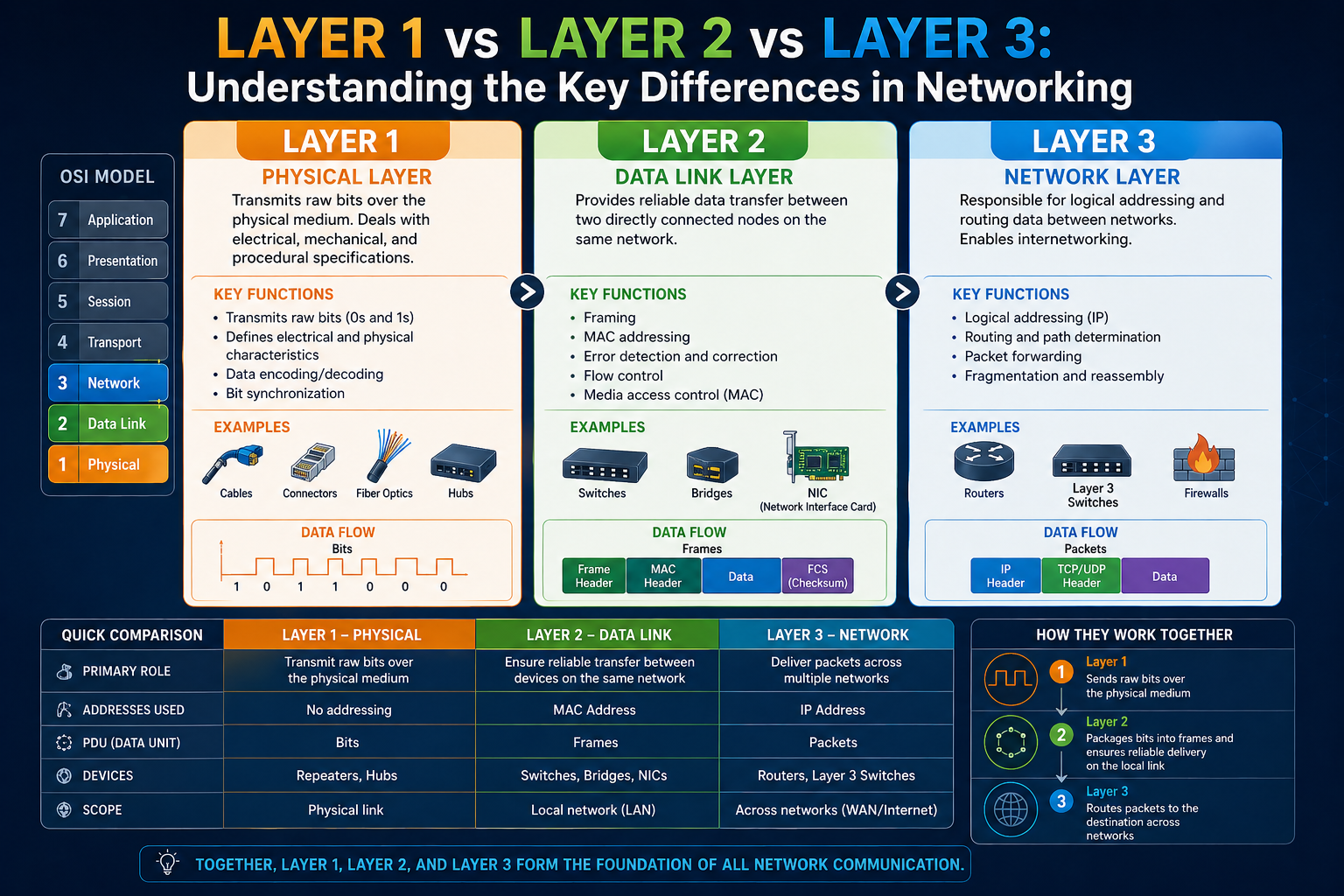
The OSI model is a structured framework that explains how data travels across a network from one device to another. It divides communication into multiple layers, each responsible for a specific function. The first two layers, known as the Physical Layer and the Data Link Layer, form the base of all networking communication. These layers are essential because they handle the actual transmission of data and the organization of that data into usable structures.
Without these two layers, no device would be able to physically send or receive information. Every online activity, whether browsing a website or sending a message, depends on these foundational processes working correctly in the background. These layers are also the most common source of real-world network problems, making them extremely important for understanding networking deeply.
Physical Layer in Networking: Foundation of Data Transmission
The Physical Layer is the first and lowest layer in the OSI model. It is responsible for transmitting raw binary data over a physical medium. At this stage, data is not meaningful or structured. It exists only as electrical signals, light pulses, or radio waves depending on the transmission method being used.
This layer does not understand what the data represents. Its only job is to ensure that bits are sent from one device and received by another. Everything is reduced to simple binary values, which are transmitted continuously across a cable or wireless channel.
The Physical Layer defines how signals are sent and received. It includes specifications such as voltage levels, signal timing, cable types, connector designs, and wireless frequency standards. These technical rules ensure that different devices can communicate properly even if they come from different manufacturers.
In simple terms, this layer is responsible for the physical movement of data. It is the foundation upon which all higher-level networking functions depend.
How Data Exists and Travels at the Physical Layer
At the Physical Layer, data is represented as a continuous stream of binary digits. These digits are transmitted through different physical media. In copper cables, electrical pulses represent bits. In fiber optics, light pulses are used. In wireless systems, radio waves carry the signals through the air.
Each bit is transmitted one after another in a timed sequence. The receiving device interprets these signals and converts them back into digital form. However, the Physical Layer itself does not check whether the data is correct or complete.
Timing is extremely important at this stage. Both sender and receiver must agree on how long each signal represents a bit. If synchronization fails, the data becomes unreadable or corrupted.
Signal degradation is also a major challenge. As signals travel through distance, they weaken and may be affected by interference or noise. The Physical Layer does not repair these issues; it only transmits whatever signal it receives from higher layers.
Physical Layer Equipment and Network Infrastructure
The equipment used in the Physical Layer is simple and does not perform any intelligent processing. Its only purpose is to transmit signals from one point to another.
Common examples include Ethernet cables, fiber optic cables, wireless antennas, hubs, and repeaters. These devices do not interpret data or make decisions. They simply carry signals across the network.
Cabling is a major part of this layer. Different cable types are designed for different distances and speeds. Proper installation is important to ensure strong and stable signal transmission.
Wireless communication also belongs to this layer. Devices like Wi-Fi routers and Bluetooth transmitters send data using radio frequencies. These signals can be affected by physical obstacles, distance, and interference from other devices.
The Physical Layer is entirely focused on connectivity. If this layer fails, no communication can happen regardless of how advanced the higher layers are.
Common Issues and Challenges in the Physical Layer
Problems at the Physical Layer are usually related to hardware. Since this layer deals with physical transmission, most issues involve cables, connectors, or signal quality.
Common problems include damaged cables, loose connections, incorrect wiring, and electromagnetic interference. In wireless networks, weak signals and environmental obstacles can also cause issues.
Because there is no data processing at this layer, troubleshooting is usually straightforward. Technicians inspect physical components, test cables, and measure signal strength to identify faults.
Even small physical issues can completely disrupt communication. This makes the Physical Layer extremely important for network stability and performance.
Data Link Layer in Networking: Structured Local Communication
The Data Link Layer sits above the Physical Layer and adds structure to raw binary data. While the Physical Layer handles transmission, the Data Link Layer organizes data into meaningful units and ensures it is delivered correctly between directly connected devices.
This layer is responsible for local communication within the same network segment. It ensures that devices can exchange information efficiently without confusion or overlap.
Data is organized into frames at this layer. These frames contain both the actual data and additional information needed for delivery and error checking.
The Data Link Layer introduces intelligence into communication by managing how devices interact within a local network.
Frame Structure and Data Organization at Layer 2
At this layer, data is divided into frames. A frame is a structured unit that contains multiple parts. It includes a header, which holds addressing information, a payload, which contains the actual data, and a trailer, which may include error-checking information.
The header allows devices to identify the sender and receiver of the data. The payload carries the information being transmitted. The trailer helps detect whether the data was corrupted during transmission.
This structure ensures that communication is organized and reliable. Devices can understand where data came from and where it needs to go.
The addressing used at this layer is based on hardware identifiers. These identifiers are unique to each device and are used to distinguish one device from another within the same network.
Media Access Control and Network Coordination
The Data Link Layer also controls how devices share access to the network medium. Since multiple devices may try to send data at the same time, coordination is necessary to prevent collisions.
This is managed through media access control mechanisms. These rules determine when a device can transmit data and how it should behave when the medium is busy.
In wired networks, devices often listen before transmitting to avoid conflicts. In wireless networks, additional techniques are used because the medium is shared and more prone to interference.
These controls ensure smooth communication and reduce the chances of data loss caused by overlapping transmissions.
Switching and Intelligent Data Forwarding
Devices operating at this layer are capable of making decisions based on frame information. They read the destination address inside a frame and forward it only to the correct device.
Switches are the most common devices at this layer. They improve network efficiency by sending data only where it is needed instead of broadcasting it everywhere.
Network interface cards also operate at this level, allowing devices to send and receive frames properly. Bridges can connect different network segments and help manage traffic flow.
This intelligent forwarding makes local networks faster and more organized.
Error Detection and Reliability in Layer 2 Communication
The Data Link Layer improves reliability by detecting errors in transmitted frames. Error-checking information is included in frames so that receiving devices can verify data integrity.
If errors are detected, the frame may be discarded or retransmitted depending on the system setup. This reduces the chances of corrupted data reaching higher layers.
Although it does not correct all errors, this layer significantly improves the quality of local communication by filtering out damaged data.
Relationship Between Physical Layer and Data Link Layer
The Physical Layer and Data Link Layer work closely together to enable communication. The Physical Layer transmits signals, while the Data Link Layer organizes those signals into structured frames.
When sending data, information moves from higher layers to the Data Link Layer, where it is formed into frames. These frames are then converted into binary signals by the Physical Layer and transmitted.
When receiving data, the Physical Layer converts signals back into bits, and the Data Link Layer reconstructs them into frames for further processing.
This continuous process ensures smooth and reliable communication between devices.
Importance of Layer 1 and Layer 2 in Networking
The Physical Layer and Data Link Layer are the foundation of all networking systems. Without them, higher layers cannot function.
Most real-world network problems originate in these two layers, making them essential for troubleshooting and understanding network behavior.
These layers ensure that devices are physically connected, data is transmitted correctly, and local communication is properly organized.
Network Layer in Modern Networking
The Network Layer is the third layer of the OSI model and plays a critical role in enabling communication between different networks. While the lower layers focus on physical transmission and local delivery, this layer is responsible for moving data beyond a single network segment.
This is the layer where logical addressing and routing come into play. It allows devices in completely different locations to communicate with each other by determining the best possible path for data to travel.
Without this layer, communication would be limited only to directly connected devices. The Network Layer expands communication globally, making the internet and large-scale networks possible.
Role of the Network Layer in Data Communication
The primary role of the Network Layer is to deliver data from a source device to a destination device across multiple networks. It does this by using logical addresses and routing decisions.
Unlike the Data Link Layer, which works within a local network, the Network Layer handles communication between distant networks. This means data may pass through many intermediate devices before reaching its final destination.
Each device along the path helps forward the data closer to its target based on routing information. This process continues until the data reaches the correct network and device.
The Network Layer does not guarantee delivery. Instead, it focuses on finding the best path for data to travel efficiently.
IP Addressing and Logical Identification of Devices
One of the most important functions of the Network Layer is logical addressing. Devices are assigned IP addresses that identify their location within a network.
Unlike hardware addresses, which are fixed, IP addresses can be configured manually or assigned automatically. This flexibility allows networks to be organized and managed efficiently.
An IP address helps determine both the network a device belongs to and the specific device within that network. This structure allows data to be routed correctly across multiple networks.
Without logical addressing, it would be impossible to send data across the internet or large enterprise systems.
Packet Structure and Data Organization at Layer 3
At the Network Layer, data is organized into packets. A packet contains both the data being transmitted and control information needed for routing.
The packet includes source and destination IP addresses, which help determine where the data is coming from and where it needs to go. It also includes additional information that assists in routing and handling the packet during transit.
Packets are independent units of data. This means each packet can take a different path to reach the same destination. This flexibility allows networks to adapt to congestion or failures.
The Network Layer does not check whether the data is received successfully. That responsibility is handled by higher layers such as the Transport Layer.
Routing and Path Selection in Networks
Routing is one of the most important functions of the Network Layer. It determines how data moves from one network to another.
Routers are the primary devices responsible for this process. They analyze the destination IP address and decide the best path for the packet to travel.
Routing decisions are based on routing tables, which contain information about network paths. These tables help routers choose the most efficient route based on distance, speed, or availability.
If one path becomes unavailable, routers can automatically choose an alternative route. This ensures that communication continues even if parts of the network fail.
Routers and Layer 3 Devices in Networking
Routers are specialized devices that operate at the Network Layer. Their main function is to forward packets between different networks.
When a router receives a packet, it examines the destination IP address and compares it with its routing table. Based on this information, it sends the packet to the next appropriate network device.
Layer 3 switches also operate at this level. They combine switching and routing capabilities to improve performance in large networks.
Firewalls can also function at this layer by filtering traffic based on IP addresses and network rules. This helps control which data is allowed to enter or leave a network.
Packet Forwarding and Hop-by-Hop Communication
Data does not travel directly from source to destination in most cases. Instead, it moves through multiple intermediate devices known as hops.
Each hop represents a router or network device that forwards the packet closer to its destination. At each hop, the device examines the packet and decides where to send it next.
This process continues until the packet reaches its final destination network. Once there, lower layers take over to deliver the data to the correct device.
This hop-by-hop method allows large networks to scale efficiently and handle massive amounts of traffic.
Connectionless Communication at the Network Layer
The Network Layer operates in a connectionless manner. This means it does not establish a dedicated path before sending data.
Each packet is treated independently and may travel through different routes. This approach increases flexibility and efficiency but does not guarantee delivery or order.
Because of this, higher layers are responsible for ensuring reliability and correct sequencing of data. The Network Layer simply focuses on delivering packets as efficiently as possible.
This design allows networks to handle dynamic conditions such as congestion, failures, and traffic changes.
Fragmentation and Packet Handling
In some cases, packets may need to be broken into smaller pieces during transmission. This process is known as fragmentation.
Different networks may have different size limits for data packets. When a packet exceeds the allowed size, it is divided into smaller fragments before being sent.
These fragments are then reassembled at the destination. This ensures that data can travel across networks with different technical limitations.
Fragmentation allows compatibility between diverse network systems but can also increase overhead and complexity.
Relationship Between Network Layer and Lower Layers
The Network Layer depends heavily on the Data Link and Physical Layers for transmission. While it determines where data should go, it relies on lower layers to physically send it.
When data is sent, it moves from higher layers into the Network Layer, where it is packaged into packets. These packets are then passed down to the Data Link Layer, which converts them into frames, and finally to the Physical Layer for transmission.
When data is received, the process is reversed. Signals are converted into frames, then into packets, and finally passed to higher layers for processing.
This layered structure ensures that each part of the network has a specific responsibility.
Importance of the Network Layer in Real-World Networking
The Network Layer is essential for modern communication systems. It enables the internet, enterprise networks, and global communication platforms.
Without this layer, devices would only be able to communicate locally. It allows data to travel across cities, countries, and continents by using routing and logical addressing.
It also provides flexibility and scalability, making it possible for networks to grow without losing efficiency.
Most internet-based services depend heavily on this layer for data delivery and connectivity.
The Network Layer is responsible for logical addressing, routing, and packet delivery across multiple networks. It enables communication beyond local systems and forms the backbone of global networking.
By combining IP addressing, routing decisions, and packet forwarding, this layer ensures that data can travel across complex and interconnected systems efficiently and reliably.
Understanding How All OSI Layers Work Together in Real Networks
In real networking systems, the OSI model does not function as separate isolated parts. Instead, all layers work together as a continuous process that allows data to move from one device to another. Every time you send or receive information over a network, multiple layers are involved at the same time, each performing a specific function.
The Physical Layer handles raw transmission, the Data Link Layer organizes local communication, and the Network Layer manages routing across different networks. These layers work in sequence, but they are also tightly connected in how they process data.
The key idea is that data does not simply “move” across a network. It is constantly being transformed, packaged, and unpackaged as it travels through different layers and devices.
Encapsulation: How Data Is Prepared for Network Transmission
Encapsulation is the process of adding control information to data as it moves down the OSI layers from the sender. This process begins when an application creates data, such as sending a message, loading a website, or transferring a file.
As the data moves downward through the layers, each layer adds its own header information. This information is necessary for communication at that specific level.
At higher levels, data exists in a simple and readable form. But as it moves down, it becomes more structured. By the time it reaches the Network Layer, it becomes a packet with logical addressing. At the Data Link Layer, it becomes a frame with physical addressing. At the Physical Layer, it becomes raw binary signals ready for transmission.
Each layer only focuses on its own responsibility and does not interfere with other layers. This separation allows networks to function in an organized and efficient way.
Encapsulation ensures that data carries all necessary instructions for delivery across different network systems.
Decapsulation: How Data Is Rebuilt at the Destination
Decapsulation is the reverse process of encapsulation. It happens when data reaches the destination device and moves upward through the OSI layers.
At the Physical Layer, signals are converted back into binary data. At the Data Link Layer, frames are reconstructed and checked for errors. At the Network Layer, packets are processed and forwarded internally to the correct destination within the device.
As data moves upward, each layer removes its own header information. This process continues until the original data created by the sender is fully restored at the application level.
Decapsulation ensures that data is delivered in its original form without losing structure or meaning during transmission.
Real-World Data Movement Across Networks
In real networking environments, data does not travel in a straight line from sender to receiver. Instead, it passes through multiple devices and networks before reaching its destination.
Each device along the path plays a role in processing the data. Local devices handle frame-level communication, while routers manage packet forwarding between networks. Physical transmission happens at every step using cables or wireless signals.
This means that data is constantly being processed and reprocessed as it moves through different environments. Each layer of the OSI model becomes active depending on the device handling the data.
This layered movement allows networks to handle complex global communication efficiently.
How OSI Layers Work in Network Devices
Different network devices interact with different OSI layers depending on their function.
End devices like computers and servers use all layers to send and receive data. Switches mainly operate at the Data Link Layer, focusing on forwarding frames within a local network. Routers operate at the Network Layer, directing packets between different networks.
Physical devices such as cables and wireless transmitters operate at the Physical Layer, handling raw signal transmission.
This division of responsibility ensures that each device performs a specific role in the communication process without unnecessary complexity.
As data moves through a network, it is processed differently at each device depending on its OSI layer functionality.
Addressing Across OSI Layers and Its Importance
Addressing is a key concept in networking and changes depending on the OSI layer being used.
At the Data Link Layer, devices use hardware-based addresses to communicate within a local network. These addresses are fixed and unique to each device. At the Network Layer, logical IP addresses are used to communicate between different networks.
Both addressing systems work together to ensure accurate data delivery. Hardware addresses manage local delivery, while IP addresses handle global routing across networks.
Without this dual addressing system, it would be impossible to distinguish between local and remote communication.
Each layer uses its own addressing method to perform its specific role efficiently.
Packet Flow and Hop-by-Hop Communication
In most networks, data does not travel directly from source to destination. Instead, it moves through multiple intermediate devices known as hops.
Each hop processes the data based on its OSI layer responsibilities. Switches forward frames within local networks, while routers forward packets between networks.
At each hop, data is temporarily unpacked, inspected, and repackaged before being sent to the next device. This ensures that every network segment can process data according to its own rules.
This hop-by-hop movement allows large-scale networks like the internet to function efficiently and handle massive amounts of traffic.
Error Handling Across Multiple OSI Layers
Error handling is distributed across different layers of the OSI model rather than being handled by a single layer.
At the Physical Layer, issues like signal loss or interference can occur. The Data Link Layer detects errors in frames and may discard corrupted data. The Network Layer focuses on forwarding packets and does not guarantee delivery.
Higher layers are often responsible for ensuring reliability and retransmission if needed. This layered approach ensures that errors are managed efficiently without overloading any single part of the system.
Each layer contributes to maintaining data integrity in its own way.
Efficiency and Scalability of Layered Networking
The OSI model is designed to make networking both scalable and efficient. By dividing communication into layers, each function can operate independently without affecting the others.
This means improvements can be made at one layer without changing the entire system. For example, new transmission technologies can be introduced at the Physical Layer without modifying routing at the Network Layer.
This modular design allows networks to grow and adapt to new technologies over time.
It also makes troubleshooting easier because problems can be isolated to specific layers.
Importance of Understanding Layer Interaction
Understanding how OSI layers interact is essential for anyone working with networks. Most real-world network problems can be traced to a specific layer.
If a cable is disconnected, the issue is at the Physical Layer. If devices cannot communicate within the same network, the problem is at the Data Link Layer. If data cannot reach another network, the issue is likely at the Network Layer.
This structured understanding allows network professionals to diagnose and fix problems more efficiently.
It also helps in designing reliable and high-performance network systems.
Simple Real-Life Example of OSI Layer Communication
A simple way to understand OSI layer interaction is to compare it with sending a package through a delivery system.
The sender creates the message, packaging systems prepare it for transport, and routing systems decide the path. Local delivery handles final distribution, and transportation systems move the package between locations.
At each stage, different handlers are responsible for specific tasks. Once the package reaches its destination, each layer of packaging is removed until the original item is delivered.
This mirrors exactly how data moves through OSI layers in networking.
Understanding of OSI Layer Integration in Networking
The OSI model works as a complete system where each layer has a specific role in communication. The Physical Layer handles transmission, the Data Link Layer ensures local delivery, and the Network Layer manages routing across networks.
Together, they enable seamless communication between devices across local and global networks. Data is constantly being encapsulated and decapsulated as it moves through these layers.
This structured process ensures that communication remains reliable, organized, and scalable across complex network environments.
Upper OSI Layers and End-to-End Communication
After understanding how the Physical Layer, Data Link Layer, and Network Layer work together, it becomes important to look at the upper layers of the OSI model. These layers are responsible for ensuring that data is delivered correctly, organized properly, and presented in a usable form for applications.
While the lower layers focus on transmission, addressing, and routing, the upper layers focus on reliability, session management, data formatting, and user interaction. Together, all layers form a complete system that enables modern digital communication.
The upper layers include the Transport Layer, Session Layer, Presentation Layer, and Application Layer. These layers are often less visible in networking hardware but are extremely important in real-world communication
Transport Layer: Reliable Data Delivery and End-to-End Communication
The Transport Layer is responsible for ensuring that data is delivered reliably between two devices. While the Network Layer focuses on sending packets across networks, the Transport Layer ensures that those packets arrive correctly and in order.
This layer breaks large data into smaller segments before transmission. These segments are then reassembled at the destination device. This process ensures that large files or messages can be transmitted efficiently across networks.
The Transport Layer also manages flow control. This means it controls how much data is sent at one time so that the receiving device is not overwhelmed. It also manages error recovery, ensuring that lost or corrupted data can be retransmitted when necessary.
There are two main types of communication at this layer. One focuses on reliable delivery with confirmation, while the other focuses on fast transmission without guarantees. This allows different applications to choose the level of reliability they need.
This layer plays a critical role in maintaining stable and accurate communication between applications running on different devices.
Session Layer: Managing Communication Between Systems
The Session Layer is responsible for establishing, maintaining, and ending communication sessions between devices. A session is a continuous exchange of data between two systems.
This layer ensures that communication remains organized. It keeps track of ongoing interactions and makes sure that data exchanges happen in the correct sequence.
If a connection is interrupted, the Session Layer can help resume communication without restarting the entire process. This is especially important in long-running tasks such as file transfers or remote connections.
It also manages multiple communication sessions at the same time. For example, a device can handle multiple applications communicating simultaneously without mixing their data.
The Session Layer acts like a coordinator, making sure that conversations between systems remain structured and uninterrupted.
Presentation Layer: Data Translation, Encryption, and Formatting
The Presentation Layer is responsible for converting data into a format that applications can understand. It acts as a translator between network data and application data.
This layer handles data encoding and decoding. Different systems may represent data differently, so this layer ensures compatibility between them.
It also manages data compression. Compression reduces the size of data, making transmission faster and more efficient. This is especially important for large files such as videos or images.
Encryption and decryption also occur at this layer. Encryption ensures that data is secure during transmission, while decryption converts it back into readable form at the destination.
The Presentation Layer ensures that data is both secure and usable when it reaches the application level.
Application Layer: User Interaction and Network Services
The Application Layer is the highest layer in the OSI model and is closest to the user. It provides network services directly to applications such as web browsers, email clients, and file transfer tools.
This layer does not represent the application itself but provides the interface that allows applications to use network services.
When a user accesses a website, sends an email, or downloads a file, the Application Layer prepares the data for transmission through lower layers.
It defines protocols that allow different applications to communicate over a network. These protocols ensure that data is formatted correctly and delivered to the right application.
The Application Layer is responsible for making networking accessible and usable for end users.
Complete Data Flow Across All OSI Layers
When all layers are combined, data flows through a structured process from one device to another.
On the sending side, data starts at the Application Layer and moves downward through the Presentation Layer, Session Layer, Transport Layer, Network Layer, Data Link Layer, and finally the Physical Layer.
At each layer, information is added to help with delivery, routing, and processing. This process is known as encapsulation.
Once data reaches the destination, it moves upward through the layers in reverse order. Each layer removes its own information until the original data is restored at the Application Layer. This process is known as decapsulation.
This complete flow ensures that data remains structured and understandable throughout its journey across networks.
Interaction Between Upper and Lower OSI Layers
The upper and lower layers of the OSI model work together to create seamless communication.
Lower layers handle physical transmission, addressing, and routing. Upper layers handle data formatting, session control, and application interaction.
Each layer depends on the others to function correctly. For example, the Application Layer depends on the Transport Layer for reliable delivery, which depends on the Network Layer for routing, which depends on the Data Link Layer for local delivery, which depends on the Physical Layer for transmission.
This dependency chain ensures that every part of the communication process is handled efficiently.
Real-World Example of OSI Layer Interaction
A real-world example can help understand how all layers work together.
When a user opens a website, the browser generates a request at the Application Layer. This request is formatted and passed down through the Presentation Layer, which may compress or encrypt the data.
The Session Layer manages the connection between the browser and the server. The Transport Layer breaks the request into segments and ensures reliable delivery.
The Network Layer determines the route across different networks. The Data Link Layer handles local delivery between devices. The Physical Layer transmits the data as electrical or wireless signals.
At the server side, the process is reversed until the request is fully reconstructed and processed.
This entire process happens in milliseconds, making internet communication fast and seamless.
Importance of OSI Model in Modern Networking
The OSI model is not just a theoretical concept. It is a practical framework used to understand and design modern networks.
It helps in troubleshooting network issues by allowing problems to be identified at specific layers. It also helps in designing scalable and efficient network systems.
Understanding how each layer works makes it easier to diagnose connectivity problems, optimize performance, and implement security measures.
The OSI model also ensures that different systems and technologies can work together without compatibility issues.
Key Benefits of Layered Networking
Layered networking provides several important benefits. It simplifies complex communication by breaking it into manageable parts. Each layer has a specific responsibility, making systems easier to understand and maintain.
It also improves flexibility. New technologies can be introduced at one layer without affecting others. This allows continuous innovation in networking.
Troubleshooting becomes easier because issues can be isolated to specific layers. This reduces downtime and improves network reliability.
Overall, layered networking provides structure, scalability, and efficiency.
Conclusion
The OSI model provides a complete framework for understanding how data moves across networks. From the Physical Layer to the Application Layer, each layer plays a unique role in ensuring communication is successful.
The lower layers handle transmission, addressing, and routing, while the upper layers manage reliability, formatting, sessions, and user interaction.
Together, all layers work as a single system that enables modern digital communication across local and global networks.
Understanding this complete structure is essential for anyone working in networking, as it provides the foundation for troubleshooting, designing, and optimizing network systems.
The OSI model remains one of the most important concepts in networking because it explains not just how data moves, but how complex communication systems function as a whole.