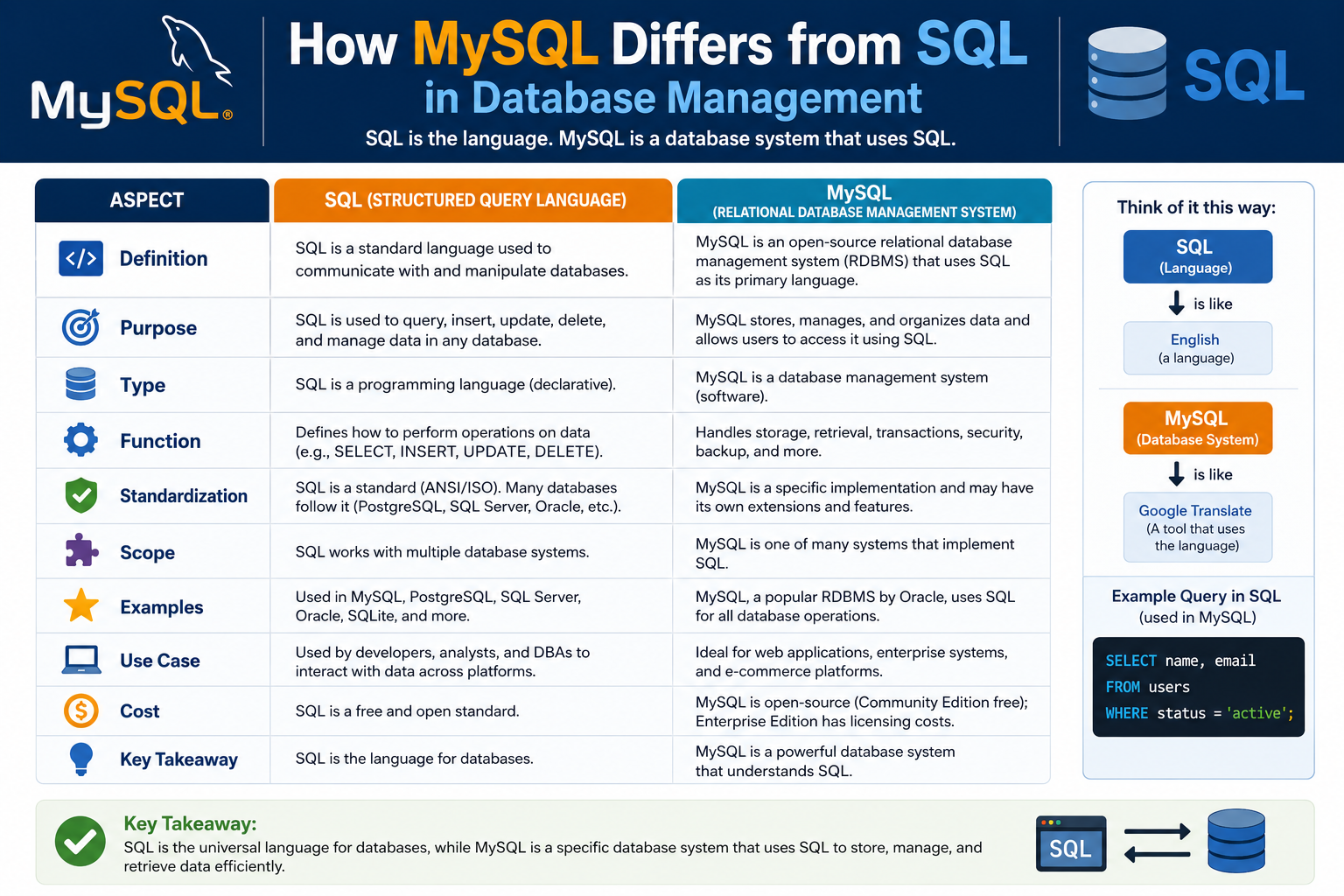
Databases have become one of the most essential components of modern technology. Every website, mobile application, online banking platform, social media network, hospital system, educational portal, and enterprise solution depends on databases to store and manage information efficiently. Without databases, organizations would struggle to organize customer records, financial data, inventory details, and operational information.
Among the most commonly discussed database technologies are SQL, MySQL, and Microsoft SQL Server. These names are frequently used together, which often causes confusion for beginners entering the field of database management and software development. Many people mistakenly believe that SQL and MySQL are identical technologies, while others assume Microsoft SQL Server is simply another version of SQL itself.
Understanding the distinctions between these technologies is extremely important for developers, database administrators, students, and organizations planning database-driven projects. Each database platform offers different features, advantages, limitations, and use cases. Choosing the correct solution can directly affect application performance, development cost, scalability, and long-term maintenance.
SQL stands for Structured Query Language, which is the standard language used to communicate with relational databases. MySQL is an open-source relational database management system that uses SQL commands to manage data. Microsoft SQL Server, often called MSSQL, is Microsoft’s enterprise-level database management platform that also uses SQL.
Although MySQL and MSSQL share many similarities because both are relational database systems, their architectures, licensing models, performance characteristics, and enterprise features differ significantly. Some organizations prioritize affordability and open-source flexibility, while others require enterprise-grade security, analytics, and advanced transaction processing.
Modern businesses generate massive amounts of information every day. Managing this data efficiently requires reliable database systems capable of handling storage, retrieval, updates, security, and scalability. This is why understanding how SQL, MySQL, and MSSQL work has become a critical skill in today’s technology-driven world.
This discussion explores the foundations of SQL, the role of relational databases, the architecture of MySQL and Microsoft SQL Server, and the key similarities and differences between these technologies. It also explains how businesses and developers decide which database management system best fits their specific requirements.
Understanding Relational Databases
To understand SQL, MySQL, and Microsoft SQL Server properly, it is important first to understand what relational databases are and why they matter.
A relational database stores information in tables made up of rows and columns. Each table represents a specific type of information. For example, one table may contain customer information, while another table may contain product details or sales transactions.
Rows represent individual records, while columns define the characteristics of those records. A customer table may include columns such as:
- Customer ID
- Name
- Email address
- Phone number
- Address
Each customer stored in the database occupies a single row.
The word relational refers to the ability to connect tables together using relationships. These relationships are usually established through primary keys and foreign keys.
A primary key uniquely identifies each row in a table. A foreign key connects one table to another. This structure allows databases to organize data efficiently without unnecessary duplication.
For example, an online shopping platform may store customer data in one table and orders in another table. The customer ID links both tables together so the system knows which orders belong to which customer.
Relational databases became popular because they provide:
- Structured organization
- Data consistency
- Efficient querying
- Reduced redundancy
- Improved scalability
- Better data integrity
Today, relational databases remain widely used in enterprise systems, banking platforms, healthcare systems, retail operations, logistics applications, and government databases.
What Is SQL?
SQL stands for Structured Query Language. It is the standard language used to interact with relational database management systems.
SQL allows users to:
- Create databases
- Design tables
- Insert records
- Retrieve information
- Modify existing data
- Delete records
- Manage permissions
- Control transactions
SQL acts as the communication bridge between users and databases. Instead of manually searching through files, developers use SQL commands to request specific information quickly and efficiently.
Some of the most common SQL commands include:
- SELECT
- INSERT
- UPDATE
- DELETE
- CREATE
- DROP
- ALTER
The SELECT command retrieves information from a database table. INSERT adds new records. UPDATE modifies existing data, while DELETE removes unwanted records.
SQL also supports filtering and sorting operations. Developers can retrieve only the information they need instead of scanning entire databases manually.
One reason SQL became so successful is its simplicity and readability. Even complex database operations can often be written using relatively straightforward syntax.
For example, retrieving all customer names from a customer table may require only a short SQL query.
SQL is not tied to a single database platform. Many relational database systems use SQL as their primary language, including:
- MySQL
- Microsoft SQL Server
- PostgreSQL
- Oracle Database
- SQLite
Although these platforms use SQL, each system may introduce unique features and extensions that slightly modify the syntax or functionality.
The History and Evolution of SQL
SQL originated during the 1970s when researchers began exploring efficient ways to manage relational data. The language was designed to simplify database interactions and reduce the complexity of handling large volumes of structured information.
Over time, SQL became the industry standard for relational database communication because of its flexibility and power.
As businesses increasingly relied on digital systems, SQL evolved to support:
- Enterprise transactions
- Security controls
- Complex reporting
- Data analytics
- Scalability
- Multi-user environments
Today, SQL remains one of the most important programming and database skills in the technology industry.
Nearly every major organization depends on SQL-based systems for daily operations.
What Is MySQL?
MySQL is an open-source relational database management system that uses SQL to manage data.
Originally developed as a lightweight and efficient database solution, MySQL quickly became one of the most widely used database platforms in the world. It gained enormous popularity because it was free, reliable, and easy to integrate with web applications.
Today, MySQL is owned by Oracle Corporation, but its community edition remains open source and freely available.
MySQL is especially popular in web development environments because it works extremely well with technologies such as PHP.
Many websites and applications use MySQL because it offers:
- Fast performance
- Simplicity
- Flexibility
- Low cost
- Broad community support
- Easy installation
Developers commonly use MySQL in:
- E-commerce websites
- Content management systems
- Blogging platforms
- Online forums
- Educational applications
- Small business software
MySQL supports multiple operating systems, including:
- Windows
- Linux
- macOS
It also supports many programming languages such as:
- PHP
- Java
- Python
- JavaScript
- Perl
- Ruby
- C++
This flexibility makes MySQL suitable for a wide variety of development environments.
MySQL and Open-Source Development
One major reason behind MySQL’s success is its open-source nature.
Open-source software allows developers to access and modify source code freely. This encourages collaboration, innovation, and community-driven improvements.
Because MySQL is available without expensive licensing costs, startups and small businesses often choose it when building applications on limited budgets.
The open-source ecosystem surrounding MySQL also provides:
- Community forums
- Tutorials
- Documentation
- Third-party tools
- Plugins
- Development frameworks
This extensive support network makes learning and troubleshooting easier for developers.
MySQL became especially dominant in web hosting environments because hosting providers could offer it to customers without significant licensing expenses.
What Is Microsoft SQL Server?
Microsoft SQL Server is a relational database management system developed by Microsoft.
Unlike MySQL, Microsoft SQL Server is primarily designed for enterprise environments that require advanced database management capabilities, security features, and large-scale transaction processing.
SQL Server integrates closely with Microsoft technologies and business ecosystems.
Organizations commonly use MSSQL for:
- Enterprise applications
- Banking systems
- Financial platforms
- Business intelligence solutions
- Government systems
- Healthcare applications
Microsoft SQL Server supports multiple editions designed for different organizational needs. These editions range from lightweight developer environments to enterprise-level deployments capable of handling massive workloads.
SQL Server includes advanced tools for:
- Reporting
- Analytics
- Backup management
- Disaster recovery
- Data warehousing
- Security administration
- Performance monitoring
It also integrates effectively with:
- Windows Server
- Microsoft Azure
- Active Directory
- .NET applications
This integration makes SQL Server highly attractive to organizations already invested in Microsoft infrastructure.
Enterprise Focus of Microsoft SQL Server
Microsoft SQL Server is widely recognized for its enterprise-grade capabilities.
Large organizations often require advanced tools to ensure:
- Data consistency
- Transaction reliability
- Security compliance
- Business continuity
- High availability
SQL Server includes many built-in enterprise services that simplify database administration and operational management.
These features help organizations reduce downtime and improve system reliability.
Microsoft also provides professional support services, which many businesses consider valuable for mission-critical environments.
While SQL Server usually involves licensing costs, many organizations accept the expense because of the platform’s enterprise-level functionality and support ecosystem.
Understanding the Difference Between SQL and MySQL
A common misunderstanding among beginners is assuming SQL and MySQL are the same technology.
In reality, SQL is a language, while MySQL is a database management system.
SQL provides the commands used to communicate with databases. MySQL is software that stores and manages data using SQL instructions.
An easy comparison is thinking of SQL as a language and MySQL as a system capable of understanding that language.
Developers write SQL commands inside MySQL to:
- Retrieve records
- Add data
- Update information
- Delete entries
- Manage permissions
This distinction is extremely important because many different database platforms use SQL, not just MySQL.
Other SQL-based database systems include:
- Microsoft SQL Server
- PostgreSQL
- Oracle Database
- SQLite
Each database platform interprets SQL commands while also adding its own specialized features.
Similarities Between MySQL and MSSQL
Although MySQL and Microsoft SQL Server differ in many ways, they also share several core similarities because both are relational database management systems.
One major similarity is their use of SQL syntax for database interactions.
Developers familiar with one system can often understand the basics of the other system relatively quickly.
Both platforms also organize information into relational tables connected through keys and relationships.
Additional similarities include:
- Transaction support
- Data indexing
- User authentication
- Backup features
- Query optimization
- Stored procedures
- Data integrity controls
Both systems can scale to support large applications and enterprise environments.
They also offer graphical tools that simplify database administration tasks such as:
- Monitoring performance
- Running queries
- Managing users
- Creating backups
- Configuring permissions
Another important similarity is multi-user support. Both MySQL and MSSQL allow multiple users to access databases simultaneously while maintaining consistency and reliability.
Database Performance and Speed
Performance is one of the most important considerations when selecting a database system.
Applications depend on databases to retrieve and store information quickly. Slow databases can negatively affect user experience and business operations.
MySQL is widely known for its fast read performance and efficient handling of lightweight web applications.
This makes it highly suitable for:
- Blogs
- Content platforms
- E-commerce websites
- Online communities
- Small business applications
Its lightweight design contributes to strong performance in web environments.
Microsoft SQL Server also provides excellent performance, especially for enterprise-level transactional systems.
SQL Server performs particularly well in environments requiring:
- Complex queries
- Large transactions
- Advanced analytics
- High concurrency
- Massive data processing
SQL Server includes sophisticated optimization tools that improve query execution and workload management.
The best-performing database often depends on:
- Application type
- Hardware resources
- Query design
- Indexing strategy
- Concurrent users
- Database size
There is no single database system that performs best in every situation.
Scalability and Growth
Modern applications often begin small but eventually grow into much larger systems.
Scalability refers to a database’s ability to handle increasing workloads without major performance degradation.
Both MySQL and MSSQL offer scalability, but they approach it differently.
MySQL is frequently used in scalable web architectures because it supports replication and distributed environments efficiently.
Large web platforms often use multiple MySQL servers to distribute workloads across systems.
Microsoft SQL Server also provides powerful scalability tools designed for enterprise environments.
These tools support:
- High availability
- Load balancing
- Clustering
- Advanced replication
- Distributed transactions
Large corporations handling millions of daily transactions often prefer SQL Server because of its advanced scalability features and enterprise management capabilities.
Programming Language Compatibility
Database systems must integrate smoothly with programming languages and development frameworks.
MySQL supports a broad range of languages, including:
- PHP
- Java
- Python
- Perl
- Ruby
- C++
This flexibility contributes to its popularity among web developers.
Microsoft SQL Server also supports multiple languages but is especially powerful in Microsoft development ecosystems.
It works particularly well with:
- C#
- Visual Basic
- ASP.NET
- .NET applications
Organizations already using Microsoft technologies often choose SQL Server because of this seamless integration.
Compatibility affects:
- Development speed
- Application stability
- Deployment efficiency
- Maintenance complexity
Choosing a database that integrates naturally with existing technologies can significantly simplify development processes.
Features, Architecture, Security, and Enterprise Capabilities
Modern organizations depend heavily on data to support daily operations, customer interactions, analytics, reporting, and strategic planning. Whether a company manages an online store, financial transactions, educational systems, healthcare records, or cloud-based applications, the efficiency of its database system directly affects performance and reliability.
Among the most widely discussed database technologies are MySQL and Microsoft SQL Server. Both systems use SQL as their core query language, yet they differ significantly in terms of architecture, administration, enterprise functionality, scalability, security, and operational behavior.
As businesses continue to expand digitally, database management systems must handle increasing volumes of information while maintaining speed, consistency, and protection against data loss or unauthorized access. Database administrators and developers therefore need a deep understanding of how different database platforms operate internally and how those differences affect real-world performance.
MySQL has earned a strong reputation as a lightweight, open-source, and highly flexible relational database system commonly used in web applications and online platforms. Microsoft SQL Server, meanwhile, is known for enterprise-level tools, advanced analytics, business intelligence services, and strong integration with Microsoft ecosystems.
Although both systems are powerful, they were designed with different priorities in mind. MySQL emphasizes simplicity, speed, affordability, and web compatibility, while Microsoft SQL Server focuses on enterprise-grade reliability, advanced administration, security management, and large-scale transactional environments.
Understanding these differences helps organizations choose the right platform based on business requirements, technical expertise, growth expectations, and financial considerations.
This section explores the deeper technical and operational distinctions between MySQL and Microsoft SQL Server, including architecture, storage handling, security systems, backup procedures, scalability, disaster recovery, concurrency management, and enterprise functionality.
Database Architecture and System Design
Database architecture refers to the internal structure and operational design of a database management system. Architecture affects how data is stored, processed, retrieved, secured, and managed.
Although both MySQL and Microsoft SQL Server are relational database systems, their architectural designs differ considerably.
MySQL was originally developed with a strong focus on speed, simplicity, and lightweight deployment. It became especially popular in web hosting environments because it could efficiently support dynamic websites and web applications without requiring extensive hardware resources.
Microsoft SQL Server was designed primarily for enterprise environments that require advanced transaction handling, business intelligence features, extensive reporting tools, and sophisticated administration capabilities.
One major architectural difference is MySQL’s support for multiple storage engines.
A storage engine determines how data is stored and managed inside the database. MySQL allows administrators to choose from different storage engines depending on workload requirements.
Some commonly used MySQL storage engines include:
- InnoDB
- MyISAM
- Memory
- Archive
InnoDB is widely used because it supports transactions, foreign keys, and crash recovery. MyISAM, while faster in some read-heavy scenarios, lacks transaction support.
Microsoft SQL Server uses a more unified architecture rather than multiple interchangeable storage engines. This centralized approach helps maintain consistency across enterprise deployments.
SQL Server’s architecture includes tightly integrated services for:
- Transaction management
- Security
- Analytics
- Reporting
- Replication
- Data warehousing
This integration simplifies administration in large organizations where centralized management is essential.
Storage and Data Management
Efficient storage management is essential for maintaining application speed and reliability.
MySQL generally requires less storage overhead compared to Microsoft SQL Server. This lightweight nature makes MySQL attractive for web applications and smaller deployments.
MySQL’s flexible storage engines allow developers to optimize databases for specific workloads. For example, applications prioritizing fast reads may use one storage engine, while systems requiring strong transaction consistency may use another.
Microsoft SQL Server often consumes more storage space because it includes extensive enterprise features and additional metadata management systems.
However, SQL Server compensates for this increased storage usage with advanced tools for:
- Compression
- Data optimization
- Index tuning
- Performance monitoring
SQL Server also provides advanced partitioning capabilities that help large organizations manage enormous datasets more effectively.
These features become extremely valuable for enterprise systems processing millions of transactions daily.
Transaction Management
Transactions are critical for maintaining data consistency in database systems.
A transaction is a sequence of operations treated as a single unit of work. If any part of the transaction fails, the entire operation can be rolled back to preserve data integrity.
For example, in a banking system, transferring money from one account to another involves multiple database operations. If one operation fails while the other succeeds, account balances may become inconsistent.
Database systems therefore use transaction management to ensure reliability.
Microsoft SQL Server includes highly advanced transaction management capabilities designed for enterprise workloads.
SQL Server supports:
- Atomicity
- Consistency
- Isolation
- Durability
These principles are commonly referred to as ACID compliance.
MySQL also supports ACID transactions when using storage engines such as InnoDB.
However, transaction behavior in MySQL can vary depending on the selected storage engine.
This flexibility provides customization advantages but may require more careful configuration by administrators.
SQL Server’s centralized transaction engine often makes enterprise transaction management more consistent and predictable.
Concurrency and Multi-User Access
Modern databases frequently support thousands of simultaneous users and applications.
Concurrency management refers to the ability of a database system to handle multiple operations at the same time without conflicts or corruption.
Both MySQL and Microsoft SQL Server support concurrent access, but their approaches differ.
MySQL uses locking and transaction isolation mechanisms to manage concurrent operations. Depending on the storage engine and configuration, different levels of locking may occur.
In older MySQL storage engines such as MyISAM, table-level locking could reduce performance during high concurrency workloads.
InnoDB improved concurrency significantly by supporting row-level locking.
Microsoft SQL Server includes advanced concurrency management systems optimized for enterprise transaction environments.
SQL Server supports sophisticated isolation levels that reduce conflicts while maintaining consistency.
This becomes particularly important in:
- Banking systems
- Financial applications
- Airline reservation systems
- Enterprise inventory management
Applications requiring extremely high transaction consistency often benefit from SQL Server’s advanced concurrency controls.
Security Features and Protection
Database security is one of the most important concerns in modern computing.
Organizations store sensitive information such as:
- Customer records
- Financial transactions
- Medical histories
- Employee information
- Intellectual property
Protecting this data from unauthorized access is critical.
Microsoft SQL Server is widely recognized for its strong enterprise-level security features.
SQL Server includes advanced capabilities such as:
- Transparent data encryption
- Row-level security
- Dynamic data masking
- Authentication integration
- Role-based access control
- Auditing tools
It also integrates closely with Microsoft Active Directory, simplifying centralized user management in enterprise environments.
This integration allows organizations to manage permissions more efficiently across large networks.
MySQL also provides robust security features, including:
- SSL encryption
- Password authentication
- User privilege systems
- Role management
- Secure connections
Modern versions of MySQL continue improving security capabilities to meet enterprise demands.
However, SQL Server often provides more built-in enterprise governance tools out of the box.
Organizations operating in heavily regulated industries may prefer SQL Server because of its advanced compliance and auditing capabilities.
Authentication and Access Control
Controlling who can access a database is essential for preventing unauthorized activity.
Both MySQL and Microsoft SQL Server support user authentication and access control systems.
Administrators can create user accounts with varying permission levels.
For example, some users may only be allowed to read information, while others can modify or delete data.
MySQL typically uses account-based authentication systems managed internally by the database.
SQL Server supports both SQL authentication and Windows authentication.
Windows authentication integrates directly with enterprise directory services, reducing administrative overhead in corporate environments.
Role-based access control allows organizations to assign permissions based on job responsibilities.
This improves security by ensuring users only access the information necessary for their work.
Backup and Recovery Systems
Data loss can have devastating consequences for organizations.
Hardware failures, software corruption, cyberattacks, and human errors can all threaten database integrity.
Reliable backup and recovery systems therefore play a crucial role in database administration.
MySQL and Microsoft SQL Server both support database backups, but their approaches differ.
MySQL often relies on exporting data as SQL statements or using backup utilities to create database copies.
During certain backup operations, databases may become partially blocked depending on configuration and workload.
Restoring large MySQL backups can sometimes be time-consuming because the database must execute many SQL statements during restoration.
Microsoft SQL Server provides advanced backup systems designed for enterprise continuity.
SQL Server supports:
- Full backups
- Differential backups
- Transaction log backups
- Point-in-time recovery
One major advantage of SQL Server is its ability to perform backups without significantly interrupting active database operations.
This minimizes downtime for businesses requiring continuous availability.
SQL Server also includes automated maintenance plans that simplify backup scheduling and recovery management.
Disaster Recovery and High Availability
Disaster recovery refers to the ability to restore operations after catastrophic failures.
Enterprise organizations require systems capable of maintaining availability even during server crashes or hardware failures.
MySQL supports replication and clustering technologies that improve availability and redundancy.
Replication allows data to be copied across multiple servers.
If one server fails, another server may continue handling requests.
Microsoft SQL Server includes advanced high-availability solutions such as:
- Failover clustering
- Always On Availability Groups
- Database mirroring
- Log shipping
These technologies help organizations maintain uptime during failures or maintenance activities.
For mission-critical enterprise applications, SQL Server often provides more comprehensive disaster recovery capabilities.
Query Processing and Optimization
Efficient query processing directly affects application speed and responsiveness.
Both MySQL and SQL Server include query optimizers that determine the best way to execute SQL commands.
Indexes play a major role in improving query performance.
Indexes allow databases to locate information more quickly without scanning entire tables.
MySQL performs extremely well in lightweight read-heavy environments such as websites and online applications.
Its simplicity contributes to fast response times for many common web queries.
Microsoft SQL Server includes advanced optimization engines capable of handling highly complex enterprise queries.
SQL Server also provides detailed performance analysis tools that help administrators identify bottlenecks and optimize workloads.
These tools include:
- Execution plans
- Performance monitoring dashboards
- Index tuning recommendations
- Query profiling systems
Large enterprise systems with complicated reporting requirements often benefit from SQL Server’s advanced optimization features.
Programming Language Integration
Database systems must integrate smoothly with development environments and programming languages.
MySQL supports many languages commonly used in web development, including:
- PHP
- Python
- Java
- JavaScript
- Ruby
- Perl
Its compatibility with PHP contributed heavily to its widespread adoption in web hosting environments.
Many popular content management systems rely on MySQL because of this strong integration.
Microsoft SQL Server integrates particularly well with Microsoft technologies such as:
- C#
- ASP.NET
- Visual Basic
- .NET Framework
Organizations building applications within Microsoft ecosystems often prefer SQL Server because of this seamless compatibility.
Strong integration reduces development complexity and improves deployment efficiency.
Cross-Platform Compatibility
Operating system compatibility is another important consideration.
MySQL supports multiple platforms, including:
- Linux
- Windows
- macOS
Its flexibility makes it attractive for diverse development environments.
Historically, Microsoft SQL Server was available only on Windows systems.
However, modern versions of SQL Server also support Linux environments.
Despite this expansion, some advanced SQL Server features may still function best within Windows-based infrastructures.
Organizations already invested heavily in Linux environments often prefer MySQL because of its longstanding cross-platform support.
Cost and Licensing Differences
Cost remains one of the most important factors when selecting a database system.
MySQL’s open-source licensing model makes it highly attractive for organizations with limited budgets.
The community edition can be downloaded and used without licensing fees.
This affordability benefits:
- Startups
- Students
- Independent developers
- Educational institutions
- Small businesses
Commercial support options are also available for organizations requiring professional assistance.
Microsoft SQL Server typically requires commercial licensing.
Licensing costs vary depending on:
- Number of users
- Server cores
- Deployment scale
- Enterprise features
Although SQL Server involves higher costs, many organizations justify the investment because of its enterprise tools, support services, and integrated ecosystem.
For mission-critical business operations, the additional expense may provide long-term operational advantages.
Enterprise Analytics and Business Intelligence
One area where Microsoft SQL Server strongly differentiates itself is enterprise analytics.
SQL Server includes integrated business intelligence services such as:
- Reporting Services
- Integration Services
- Analysis Services
These tools help organizations perform advanced analytics, generate reports, and process large datasets.
Businesses often rely on these features for:
- Financial analysis
- Sales forecasting
- Operational reporting
- Data warehousing
- Executive dashboards
MySQL supports analytics as well but generally requires additional third-party tools for enterprise-level business intelligence functionality.
Organizations focused heavily on reporting and analytics may therefore favor SQL Server.
Administrative Tools and User Experience
Database administration becomes increasingly important as systems grow larger and more complex.
Microsoft SQL Server includes graphical management environments that simplify administrative tasks.
These tools allow administrators to:
- Monitor performance
- Configure security
- Manage backups
- Optimize queries
- Track server health
MySQL also offers administrative interfaces and third-party management tools.
However, SQL Server’s integrated enterprise management ecosystem is often considered more comprehensive for large organizations.
Ease of administration can significantly reduce maintenance costs and improve operational efficiency over time.
Scalability, Real-World Applications, Advantages, Limitations, and Final Considerations
Databases are the foundation of nearly every modern digital system. Businesses, governments, educational institutions, healthcare providers, financial organizations, and technology companies all depend on reliable database management systems to store, organize, retrieve, and protect information. As organizations continue generating larger volumes of data, the importance of selecting the right database technology becomes even greater.
Among the most recognized database technologies are MySQL and Microsoft SQL Server. Both systems rely on SQL for interacting with data, yet they differ significantly in design philosophy, enterprise capabilities, scalability, licensing, performance optimization, and operational management.
Organizations choosing between MySQL and Microsoft SQL Server must evaluate several factors carefully. A startup building a lightweight web application may prioritize affordability and simplicity, while a multinational enterprise processing millions of financial transactions may require advanced security, analytics, and high-availability features.
There is no universal database solution that works perfectly for every scenario. The ideal platform depends on technical requirements, project goals, development environments, business budgets, scalability expectations, and long-term maintenance considerations.
Understanding how these database systems perform in real-world environments helps organizations avoid costly mistakes and infrastructure limitations later in development. Developers and database administrators must also understand how scalability, integration, maintenance, replication, and cloud compatibility affect operational success.
This section explores practical applications of MySQL and Microsoft SQL Server, examines their strengths and limitations in different industries, analyzes scalability and cloud integration, and explains how businesses choose between these database technologies based on operational requirements.
Real-World Applications of MySQL
MySQL became extremely popular because of its simplicity, flexibility, and affordability. It is widely used in web-based environments and online applications where speed and cost-efficiency are critical.
Many organizations use MySQL for:
- E-commerce platforms
- Content management systems
- Online forums
- Social networking sites
- Blogging platforms
- Educational portals
- Startup applications
The database gained massive popularity alongside the growth of internet technologies and open-source development communities.
One of the biggest reasons for MySQL’s success is its strong compatibility with web technologies such as PHP. This combination became a standard foundation for many websites and hosting environments.
MySQL is frequently chosen for projects that require:
- Fast deployment
- Lightweight infrastructure
- Low operating costs
- Easy maintenance
- Flexible development environments
Small and medium-sized businesses often prefer MySQL because they can launch applications without investing heavily in commercial database licenses.
Web hosting providers also widely support MySQL because it allows them to offer affordable database services to customers.
Large-scale online platforms can also benefit from MySQL when properly configured. Through replication and distributed architectures, MySQL can support millions of users and extensive web traffic.
Real-World Applications of Microsoft SQL Server
Microsoft SQL Server is commonly used in enterprise environments where reliability, advanced management features, and transactional consistency are essential.
Industries that frequently rely on SQL Server include:
- Banking
- Healthcare
- Government
- Insurance
- Manufacturing
- Retail
- Enterprise resource planning
Organizations often choose SQL Server because of its advanced tools for administration, security, analytics, and business intelligence.
SQL Server performs especially well in applications requiring:
- Complex transactions
- Advanced reporting
- Large-scale analytics
- Centralized management
- Enterprise compliance
- High availability
Many companies using Microsoft technologies naturally adopt SQL Server because of its seamless integration with:
- Windows Server
- Microsoft Azure
- Active Directory
- .NET Framework
- Power BI
This integration simplifies development and infrastructure management across enterprise environments.
SQL Server is also widely used in data warehousing projects where organizations analyze large datasets to support business decisions.
Its reporting and analytics services help businesses generate detailed operational insights and performance reports.
Scalability in Database Systems
Scalability refers to a database’s ability to grow and handle increasing workloads efficiently.
As organizations expand, their databases must support:
- More users
- More transactions
- Larger datasets
- Higher traffic volumes
- Greater application complexity
Both MySQL and Microsoft SQL Server support scalability, but they approach it differently.
MySQL became highly successful in scalable web environments because it supports replication and distributed deployment strategies effectively.
Many large internet companies historically used MySQL clusters to distribute workloads across multiple servers.
Replication allows one server to copy data from another server, improving:
- Fault tolerance
- Load balancing
- Read performance
- Availability
MySQL scaling strategies often involve horizontal scaling, which means adding more servers to distribute traffic.
This approach works particularly well for web applications with heavy read operations.
Microsoft SQL Server also supports scalability but places stronger emphasis on enterprise management and centralized control.
SQL Server includes advanced technologies such as:
- Clustering
- Failover systems
- Availability groups
- Distributed transactions
These tools help enterprises maintain high performance even during hardware failures or traffic spikes.
SQL Server environments frequently scale vertically by increasing hardware resources such as CPU power, memory, and storage.
Large enterprises processing mission-critical transactions often prefer SQL Server because of its sophisticated high-availability architecture.
Cloud Computing and Database Integration
Cloud computing has transformed how organizations deploy and manage databases.
Modern businesses increasingly rely on cloud platforms for:
- Scalability
- Remote accessibility
- Disaster recovery
- Cost optimization
- Infrastructure flexibility
Both MySQL and Microsoft SQL Server support cloud deployments.
MySQL is widely available on major cloud platforms and works effectively in containerized and distributed environments.
Cloud providers often offer managed MySQL services that reduce administrative overhead.
These services handle tasks such as:
- Backups
- Scaling
- Monitoring
- Maintenance
- Security updates
MySQL’s lightweight architecture makes it highly suitable for cloud-native applications and microservices environments.
Microsoft SQL Server also integrates strongly with cloud platforms, particularly Microsoft Azure.
Azure provides advanced SQL Server cloud services that support:
- Automatic scaling
- Managed backups
- Advanced analytics
- Security monitoring
- Disaster recovery
Organizations already invested in Microsoft ecosystems often prefer Azure SQL solutions because of simplified migration and centralized management.
Cloud integration has become a major consideration when choosing database technologies for modern applications.
Performance in High-Traffic Environments
Performance remains one of the most critical aspects of database management.
Applications experiencing high traffic require databases capable of handling thousands or millions of simultaneous operations without significant slowdowns.
MySQL is often praised for excellent read performance and lightweight operation.
This makes it highly effective for:
- Blogs
- News websites
- E-commerce stores
- Social platforms
- Content-heavy applications
Its efficiency in handling read-heavy workloads contributed significantly to its widespread adoption.
However, extremely complex transactional systems may require careful optimization in MySQL environments.
Microsoft SQL Server excels in enterprise transactional performance.
Its advanced optimization systems help manage:
- Large concurrent workloads
- Complex queries
- Extensive reporting
- Financial transactions
- Analytical operations
SQL Server includes sophisticated tools for identifying performance bottlenecks and optimizing database operations.
Enterprise administrators often value these tools because they simplify long-term performance management.
Ultimately, performance depends heavily on:
- Database design
- Indexing strategy
- Hardware resources
- Query efficiency
- Application architecture
No database system automatically guarantees optimal performance without proper administration and optimization.
Ease of Use and Administration
Ease of administration can significantly affect operational efficiency and maintenance costs.
MySQL is often considered easier for beginners to learn and deploy.
Its installation process is relatively straightforward, and its lightweight nature simplifies development for smaller projects.
Open-source communities provide extensive tutorials, forums, and documentation that help developers troubleshoot issues quickly.
This accessibility makes MySQL especially attractive for:
- Students
- Independent developers
- Startups
- Small businesses
Microsoft SQL Server provides more advanced administrative tools designed for enterprise management.
SQL Server Management Studio offers graphical interfaces that simplify:
- Query execution
- Performance monitoring
- Security configuration
- Backup management
- Database maintenance
Although SQL Server may involve a steeper learning curve for beginners, enterprise administrators often appreciate its integrated management ecosystem.
Large organizations managing multiple databases can benefit significantly from SQL Server’s centralized administration capabilities.
Replication and Data Distribution
Replication is the process of copying data between multiple database servers.
Replication improves:
- Availability
- Performance
- Fault tolerance
- Disaster recovery
MySQL replication has historically been one of its strongest features.
Administrators can configure multiple MySQL servers to distribute workloads across environments efficiently.
This architecture became especially important for large web platforms serving millions of users worldwide.
Read replicas help reduce pressure on primary servers by distributing read operations across multiple systems.
Microsoft SQL Server also supports advanced replication technologies, including:
- Transactional replication
- Snapshot replication
- Merge replication
SQL Server’s replication systems integrate closely with enterprise administration tools, simplifying management in large infrastructures.
Both platforms provide effective replication capabilities, though implementation strategies may differ depending on organizational requirements.
Data Integrity and Reliability
Maintaining data integrity is essential for preventing corruption and inconsistencies.
Both MySQL and SQL Server include mechanisms that help preserve data accuracy during operations.
MySQL using the InnoDB storage engine supports transactional consistency and crash recovery.
However, older storage engines such as MyISAM lack some advanced reliability features.
Microsoft SQL Server emphasizes enterprise-grade consistency and reliability through advanced transaction engines and recovery systems.
Financial institutions and enterprise organizations often favor SQL Server because of its strong consistency guarantees during high-volume transaction processing.
Reliability becomes especially important in systems handling:
- Financial records
- Medical information
- Government databases
- Inventory systems
- Reservation platforms
Data corruption or transaction failures in these environments can have severe consequences.
Cost Considerations and Budget Planning
Budget limitations often influence database selection decisions.
MySQL’s open-source nature makes it one of the most affordable relational database systems available.
Organizations can deploy the community edition without paying licensing fees.
This significantly reduces startup and infrastructure costs.
Small businesses and independent developers frequently choose MySQL because it allows them to build applications without large financial investments.
Commercial support options are available for organizations needing professional assistance.
Microsoft SQL Server typically requires licensing fees that vary based on:
- User counts
- Processor cores
- Enterprise features
- Deployment scale
Although SQL Server is more expensive, many enterprises justify the investment because of its advanced features and vendor support.
Businesses must evaluate long-term operational costs rather than focusing only on initial licensing expenses.
In some cases, SQL Server’s management tools and enterprise support may reduce administrative overhead enough to offset licensing costs.
Security and Compliance Requirements
Modern organizations face increasing pressure to protect sensitive information and comply with regulations.
Industries such as banking, healthcare, and government must meet strict compliance requirements regarding:
- Data protection
- User access
- Encryption
- Auditing
- Privacy
Microsoft SQL Server includes extensive enterprise security features designed for regulatory compliance.
Its built-in auditing and encryption capabilities help organizations satisfy industry standards more easily.
MySQL also offers strong security features, particularly in modern versions, but some advanced enterprise governance tools may require additional configuration or third-party solutions.
Organizations handling highly sensitive information often prioritize security and compliance capabilities when selecting a database platform.
Community Support and Vendor Ecosystems
Community and vendor support can strongly influence long-term success with a database system.
MySQL benefits from a massive global open-source community.
Developers can access:
- Documentation
- Tutorials
- Discussion forums
- Plugins
- Third-party tools
This large ecosystem simplifies troubleshooting and learning.
Microsoft SQL Server benefits from official Microsoft support services and enterprise documentation.
Organizations requiring guaranteed technical assistance often value vendor-backed support contracts.
The strength of an ecosystem affects:
- Developer productivity
- Problem resolution
- Training availability
- Integration opportunities
Both platforms provide strong support ecosystems, though they serve somewhat different audiences.
Advantages of MySQL
MySQL offers several important advantages, including:
- Open-source licensing
- Low operational costs
- Lightweight architecture
- Strong web compatibility
- Easy deployment
- Broad community support
- Excellent read performance
- Flexible scalability
Its simplicity and affordability make it ideal for many startups and online applications.
Developers building web-based systems often appreciate MySQL’s speed and accessibility.
Advantages of Microsoft SQL Server
Microsoft SQL Server provides powerful enterprise features such as:
- Advanced security systems
- Sophisticated analytics
- Enterprise reporting tools
- High-availability technologies
- Transaction consistency
- Centralized administration
- Business intelligence integration
- Professional vendor support
Large organizations frequently choose SQL Server because of its enterprise management capabilities and reliability.
Limitations of MySQL
Despite its strengths, MySQL also has some limitations.
Complex enterprise analytics may require additional tools beyond the core platform.
Some advanced administrative features available in SQL Server may require more manual configuration in MySQL environments.
High-end enterprise governance and auditing tools may not be as comprehensive as those provided by SQL Server.
Organizations with extremely demanding transactional workloads may require careful optimization.
Limitations of Microsoft SQL Server
SQL Server’s biggest disadvantage is cost.
Licensing fees can become expensive for large deployments.
The platform may also require more hardware resources because of its enterprise-oriented architecture.
Smaller organizations with limited budgets may find SQL Server financially challenging compared to open-source alternatives.
Additionally, organizations outside Microsoft ecosystems may not benefit fully from SQL Server’s integration advantages.
Choosing the Right Database System
Selecting the right database depends on several factors, including:
- Project size
- Budget
- Technical expertise
- Scalability requirements
- Security needs
- Development environment
- Enterprise integration
- Maintenance expectations
MySQL is often ideal for:
- Web applications
- Startups
- Content platforms
- Lightweight deployments
- Budget-conscious organizations
Microsoft SQL Server is often better suited for:
- Enterprise applications
- Financial systems
- Business analytics
- Government infrastructure
- Large transactional workloads
There is no universal solution suitable for every project.
Organizations must carefully evaluate both immediate and long-term operational requirements before making decisions.
Conclusion
MySQL and Microsoft SQL Server are two of the most widely used relational database management systems in the technology industry. Both platforms rely on SQL for database communication, yet they serve somewhat different purposes and operational environments.
MySQL became popular because of its open-source accessibility, affordability, lightweight performance, and strong compatibility with web applications. It remains one of the most widely used database systems for websites, startups, online services, and scalable web architectures.
Microsoft SQL Server, on the other hand, focuses heavily on enterprise functionality, advanced security, business intelligence, transaction consistency, and centralized administration. Large organizations often choose SQL Server because of its sophisticated management tools and integration with Microsoft ecosystems.
Understanding the differences between SQL, MySQL, and Microsoft SQL Server is essential for developers, administrators, and organizations planning database-driven projects. Database selection directly influences scalability, maintenance complexity, performance, reliability, operational costs, and long-term business success.
Neither platform is universally superior in every scenario. The best choice depends entirely on organizational requirements, infrastructure goals, technical expertise, compliance obligations, and financial considerations.
As digital systems continue evolving, databases will remain one of the most important foundations of modern computing. Organizations that carefully evaluate their database strategies will be better prepared to manage growth, protect information, and deliver reliable applications in increasingly data-driven environments.