Learning is far more than memorizing information for an exam and forgetting it afterward. True learning happens when knowledge becomes meaningful, useful, and applicable in real situations. Many students spend countless hours studying but still struggle to retain information because they focus only on repetition instead of understanding how the learning process actually works. Bloom’s Hierarchy offers a structured framework that helps learners move from simple memorization to deep mastery.
Bloom’s Hierarchy, often called Bloom’s Taxonomy, was created in 1956 by educational psychologist Benjamin Bloom and a team of researchers. The goal of the framework was to classify the different ways people think and learn. Over time, it became one of the most influential educational models in the world and is still widely used in schools, universities, professional training programs, and certification courses.
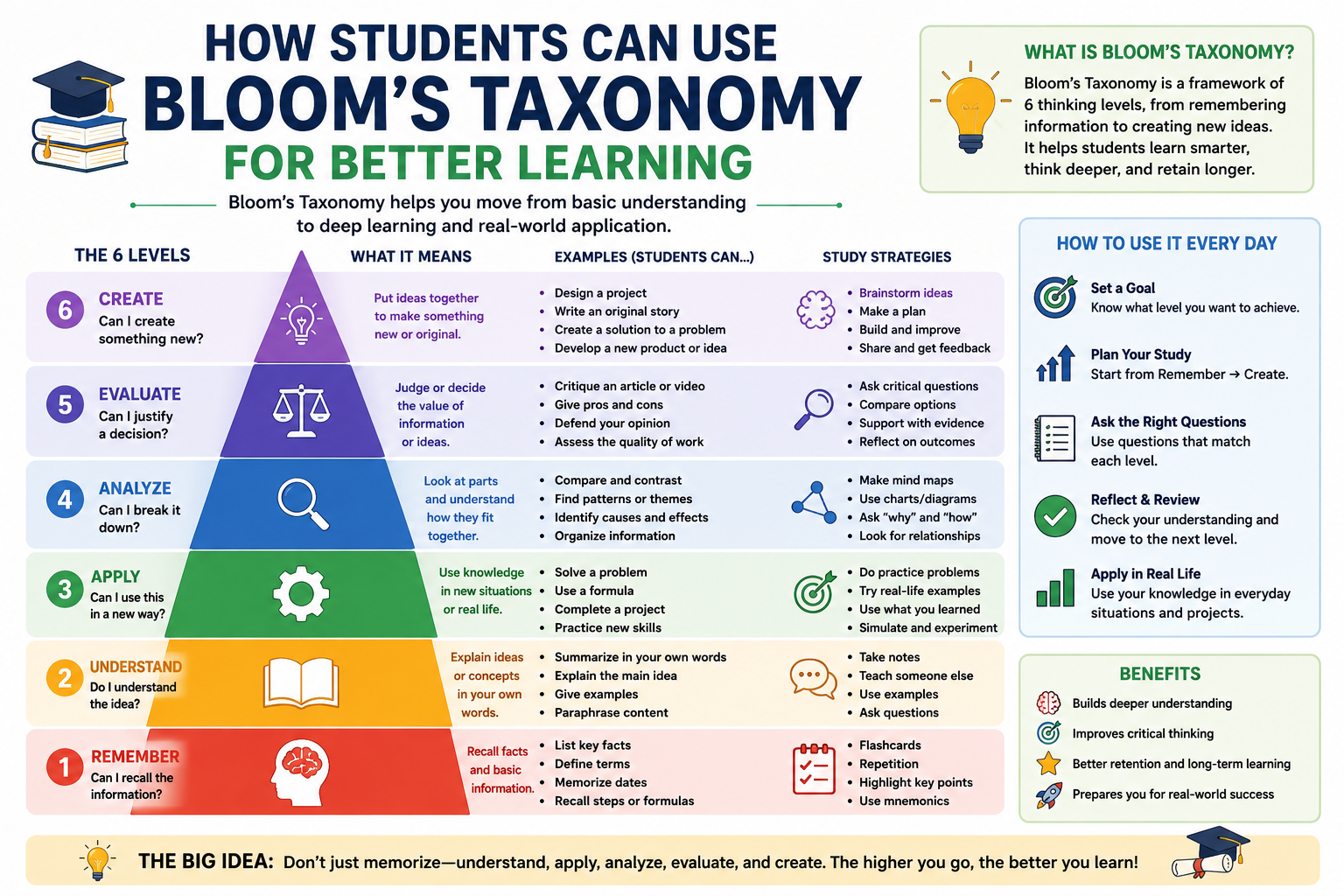
The hierarchy organizes learning into six cognitive levels. These levels represent increasingly advanced forms of thinking, beginning with simple recall and progressing toward creativity and innovation. Instead of treating learning as a single action, Bloom’s model explains that effective learning develops gradually through stages.
The six stages are Remember, Understand, Apply, Analyze, Evaluate, and Create. Each stage builds on the previous one, meaning learners must develop a solid foundation before progressing to more advanced thinking skills.
Bloom’s Hierarchy is valuable because it transforms studying into a purposeful process. Rather than randomly rereading notes or highlighting textbooks, students can identify which cognitive skills they need to strengthen. This approach improves comprehension, retention, confidence, and long-term mastery.
The framework is especially useful for students preparing for technical certifications, university exams, and professional training programs. Complex subjects such as cybersecurity, networking, programming, engineering, and medicine require more than memorization. They demand practical application, analysis, problem-solving, and critical thinking.
Understanding Bloom’s Hierarchy helps learners study smarter instead of simply studying longer.
Why Bloom’s Hierarchy Matters in Modern Learning
Modern education has changed dramatically over the last few decades. In the past, many educational systems emphasized memorization above all else. Students were expected to recall definitions, formulas, and historical facts accurately during examinations.
While memorization remains important, today’s world requires much more advanced cognitive abilities. Employers want individuals who can solve problems, evaluate information critically, communicate effectively, and create innovative solutions.
Technology has accelerated the need for higher-level thinking skills. Information is now available instantly through the internet, meaning the ability to memorize facts is less valuable than the ability to interpret, analyze, and apply information effectively.
Bloom’s Hierarchy aligns perfectly with these modern educational demands because it emphasizes the progression from basic knowledge to advanced thinking.
For example, a cybersecurity professional cannot rely solely on memorizing security concepts. They must understand how threats operate, apply security principles in practical situations, analyze system vulnerabilities, evaluate risks, and develop creative defense strategies.
Similarly, a software developer needs more than knowledge of programming syntax. They must solve problems logically, debug errors, analyze system performance, and design applications that meet real-world requirements.
Bloom’s framework helps learners develop these abilities systematically.
Another reason the hierarchy matters is because it encourages intentional learning. Many students become frustrated because they confuse familiarity with mastery. Reading notes repeatedly may create a feeling of recognition, but recognition alone does not guarantee understanding.
A learner may recognize a networking term during study sessions but still struggle to explain the concept or apply it in practice. Bloom’s model highlights these differences by separating cognitive stages clearly.
This awareness helps students identify weaknesses in their learning process and improve their study strategies accordingly.
The Foundation of Learning Begins with Remembering
The first level of Bloom’s Hierarchy is Remember. This stage involves recalling information from memory. It includes recognizing facts, definitions, formulas, concepts, terminology, and procedures.
Remembering forms the foundation of all higher learning. Without basic knowledge, advanced thinking becomes impossible. Learners must first acquire information before they can understand or apply it.
Examples of remembering include:
Listing key terms
Memorizing formulas
Identifying definitions
Recalling facts
Recognizing concepts
Naming components
For students preparing for certification exams, remembering often involves memorizing commands, protocols, technical standards, or hardware specifications.
In networking, for instance, students may memorize TCP/IP ports, networking devices, or OSI model layers. In cybersecurity, learners might memorize encryption standards, attack types, or security frameworks.
Although memorization sometimes receives criticism, it remains essential. Every complex skill depends on foundational knowledge.
Imagine trying to solve advanced mathematical equations without first memorizing multiplication tables. Similarly, a programmer cannot write code effectively without remembering syntax and commands.
The problem occurs when learners stop at memorization without progressing further.
Many ineffective study habits focus almost entirely on the Remember stage. Students reread notes repeatedly or highlight textbooks without engaging with the material more deeply. This creates short-term familiarity but weak long-term retention.
To strengthen remembering, learners should use active recall techniques instead of passive review. Active recall forces the brain to retrieve information from memory, improving retention significantly.
Effective strategies include:
Flashcards
Practice quizzes
Self-testing
Reciting information aloud
Writing summaries from memory
Teaching concepts to someone else
Spaced repetition is another powerful technique. Instead of cramming information into a single study session, learners review material repeatedly over increasing intervals of time.
This method strengthens long-term memory and reduces forgetting.
Remembering may seem like the simplest stage in Bloom’s Hierarchy, but it plays a critical role in supporting all later stages of learning.
Understanding Information Beyond Memorization
The second level of Bloom’s Hierarchy is Understand. At this stage, learners move beyond recalling facts and begin grasping meaning.
Understanding involves interpreting, summarizing, explaining, comparing, and describing information in meaningful ways.
A student who understands a concept can explain it in their own words rather than repeating memorized definitions.
For example, a learner studying cloud computing may memorize the definition of virtualization during the Remember stage. However, understanding occurs when they can explain how virtualization improves resource efficiency and supports cloud infrastructure.
Understanding creates connections between pieces of information. Instead of isolated facts, learners begin building organized mental frameworks.
This stage is essential because memorized information without understanding is fragile. Students may remember facts temporarily but struggle to apply them in unfamiliar situations.
True understanding improves flexibility and adaptability.
To strengthen understanding, learners should actively engage with material through explanation and interpretation.
Effective strategies include:
Summarizing concepts
Paraphrasing information
Explaining ideas aloud
Comparing related topics
Creating diagrams or concept maps
Discussing material with others
Asking “why” questions
For example, instead of memorizing that firewalls filter network traffic, a learner should ask why filtering matters, how firewalls operate, and what problems they solve.
This deeper engagement improves comprehension dramatically.
One of the best ways to test understanding is through teaching. If learners can explain a topic clearly to another person without relying heavily on notes, they likely understand it well.
Misunderstandings often become obvious during explanation because gaps in knowledge are easier to recognize when trying to communicate ideas clearly.
Another useful method is connecting new information to existing knowledge. The brain learns more effectively when new concepts relate to familiar experiences or previously learned material.
For example, understanding computer networking becomes easier when learners compare networks to transportation systems where data moves like vehicles traveling on roads.
Analogies and real-world examples make abstract concepts easier to grasp.
The Transition from Passive Learning to Active Learning
One of the most important ideas connected to Bloom’s Hierarchy is the difference between passive and active learning.
Passive learning occurs when students receive information without significant interaction. Examples include:
Listening to lectures
Watching videos
Reading textbooks
Reviewing slides
Highlighting notes
Passive learning can introduce information effectively, especially for beginners. However, passive methods alone rarely produce deep mastery.
Active learning, on the other hand, requires learners to engage directly with educational content.
Examples of active learning include:
Solving problems
Participating in discussions
Completing practice exercises
Teaching concepts
Writing summaries
Applying knowledge practically
Answering questions
Research consistently shows that active learning improves retention, comprehension, and performance more effectively than passive review alone.
Bloom’s Hierarchy naturally encourages active learning because higher levels require interaction and engagement.
For example, someone studying programming may begin passively by watching tutorial videos. However, real learning occurs when they start writing code, fixing errors, building applications, and solving programming challenges independently.
Similarly, cybersecurity students gain deeper understanding by configuring security tools, analyzing vulnerabilities, and practicing incident response instead of merely reading about attacks.
The transition from passive to active learning is often what separates struggling students from successful learners.
Many learners mistakenly believe studying longer automatically produces better results. In reality, the quality of engagement matters far more than the number of hours spent reviewing material.
A focused one-hour active study session may produce greater retention than several hours of passive rereading.
Bloom’s Hierarchy helps learners recognize when they need more active engagement to progress.
Different Types of Knowledge in Bloom’s Framework
The revised version of Bloom’s Taxonomy introduced another important concept: different categories of knowledge.
Knowledge is not limited to memorized facts. Different types of learning require different forms of understanding.
The four major categories are factual knowledge, conceptual knowledge, procedural knowledge, and metacognitive knowledge.
Factual knowledge includes basic details learners must know to become familiar with a subject.
Examples include:
Definitions
Terminology
Dates
Names
Formulas
Technical specifications
Conceptual knowledge involves understanding relationships among ideas.
Examples include:
Theories
Principles
Models
Classifications
Frameworks
Conceptual understanding helps learners recognize patterns and connections.
Procedural knowledge focuses on how to perform tasks and processes.
Examples include:
Operating equipment
Configuring software
Solving equations
Writing code
Following troubleshooting procedures
Many technical careers rely heavily on procedural knowledge because practical skills are essential.
Metacognitive knowledge involves awareness of one’s own learning process.
This includes understanding:
How you learn best
Which study methods work effectively
What weaknesses need improvement
How to monitor progress
How to adapt strategies
Metacognition is especially powerful because it helps learners become independent and self-directed.
A student with strong metacognitive skills can recognize ineffective habits and adjust accordingly.
For example, if rereading notes fails to improve exam performance, a metacognitively aware learner may switch to practice testing or hands-on exercises.
This adaptability leads to more efficient learning over time.
Identifying Your Personal Learning Style
Every learner processes information differently. Understanding personal learning preferences can improve study efficiency and retention.
Although individuals often use multiple learning methods, many people naturally prefer certain approaches.
Auditory learners process information effectively through listening.
These learners may benefit from:
Lectures
Discussions
Podcasts
Reading aloud
Audio recordings
Visual learners prefer information presented through images and visual organization.
Helpful methods include:
Diagrams
Charts
Videos
Color-coded notes
Mind maps
Graphs
Tactile or kinesthetic learners understand information best through hands-on interaction.
These learners benefit from:
Labs
Practice exercises
Simulations
Building projects
Physical interaction
Real-world application
Understanding learning preferences helps students choose study methods aligned with how they process information naturally.
For example, an auditory learner studying cybersecurity may benefit from discussing concepts aloud or listening to recorded lectures.
A visual learner might prefer diagrams showing network structures or attack flows.
A tactile learner may understand best by configuring systems directly in virtual labs.
However, learners should avoid limiting themselves to a single style. Combining multiple learning methods often produces the strongest results because it engages the brain in different ways.
For example, watching instructional videos, taking notes, practicing exercises, and discussing concepts together create stronger retention than relying on only one method.
The Importance of Self-Paced Learning
One major advantage of modern education is the rise of self-paced learning.
Online learning platforms allow students to study at their own speed, revisit difficult topics, and adjust schedules according to personal needs.
Self-paced learning provides flexibility, but it also requires discipline and planning.
Without structure, learners may procrastinate or spend excessive time on passive review instead of active practice.
Bloom’s Hierarchy helps organize self-paced learning effectively.
Students can intentionally move through each cognitive stage while studying.
For example:
First, memorize foundational information.
Then, work toward understanding.
Next, apply knowledge through exercises.
Afterward, analyze relationships and patterns.
Later, evaluate ideas critically.
Finally, create original solutions or projects.
This structured progression prevents learners from becoming stuck at lower cognitive levels.
Effective self-paced learning also requires realistic scheduling.
Many students underestimate the time needed for deep understanding. Complex topics require repetition, reflection, and practical application over extended periods.
Short, focused study sessions spread across weeks or months usually produce better results than intense cramming sessions before exams.
Long-term learning strengthens retention and improves mastery.
This is particularly important for certification exams and technical skills where understanding must remain useful beyond test day.
Building Stronger Study Habits Through Bloom’s Hierarchy
Bloom’s Hierarchy provides more than a theory of learning. It offers a practical roadmap for improving study habits.
Instead of studying aimlessly, learners can organize study sessions intentionally.
Before studying, students should ask themselves:
What level of understanding am I trying to achieve?
Do I need memorization, comprehension, application, or deeper analysis?
This awareness improves focus and efficiency.
For example, early study sessions may emphasize remembering and understanding foundational concepts.
Later sessions can shift toward application, analysis, and evaluation through labs, practice questions, case studies, and projects.
This progression creates balanced learning rather than shallow memorization.
Strong study habits also require consistency.
Learning is cumulative, meaning small daily improvements produce substantial long-term growth.
Students who study regularly often outperform those who rely on last-minute cramming because repeated exposure strengthens memory and understanding gradually.
Breaks and rest are equally important.
The brain requires time to process and consolidate information. Overloading study sessions without rest can reduce concentration and retention.
Balanced schedules with focused sessions, review periods, and adequate sleep support more effective learning overall.
Bloom’s Hierarchy encourages patience during this process.
Mastery rarely happens instantly. Learners progress through stages gradually as understanding deepens over time.
Recognizing this progression reduces frustration and builds confidence.
Rather than viewing mistakes as failure, learners can see them as natural steps toward higher understanding.
This mindset supports long-term academic and professional growth.
Applying Knowledge to Real-World Situations
The third level of Bloom’s Hierarchy is Apply, and this is where learning begins to move from theory into action. Many students spend too much time memorizing concepts and reading explanations without practicing how to use the information in realistic situations. Application changes that. It requires learners to use knowledge actively instead of simply recognizing it.
At the application stage, learners solve problems, complete exercises, follow procedures, and demonstrate skills. Instead of asking whether they remember a concept, they ask whether they can actually use it correctly.
This stage is especially important in technical and professional fields. In information technology, cybersecurity, engineering, medicine, and business, practical ability matters just as much as theoretical understanding. Employers and certification exams expect learners to apply knowledge under pressure and in unfamiliar scenarios.
For example, someone studying networking may memorize IP addressing rules and understand how subnetting works conceptually. However, application occurs when they calculate subnets, configure devices, and troubleshoot connectivity problems independently.
Similarly, a cybersecurity learner may memorize attack types and understand security principles, but true application happens when they configure firewalls, analyze threats, or secure systems in practice.
Application strengthens memory because the brain learns more effectively through use. Repeatedly applying information reinforces neural connections and improves retention far more than passive review alone.
One reason many students struggle with exams is because they remain stuck in the remembering and understanding stages. They recognize information while reading notes but cannot apply it independently during tests.
Practical exercises reveal whether understanding is genuine. If learners cannot solve problems without assistance, they may need additional practice or stronger conceptual understanding.
Effective application-based learning includes:
Practice questions
Hands-on labs
Real-world case studies
Simulations
Projects
Role-playing scenarios
Interactive exercises
Step-by-step problem solving
The more learners interact actively with material, the stronger their understanding becomes.
Application also builds confidence. Repeated success using knowledge practically helps learners trust their abilities. This confidence becomes extremely valuable during high-pressure situations such as certification exams, presentations, or workplace responsibilities.
Another advantage of application is that it exposes weaknesses quickly. Learners often believe they understand concepts until they attempt to use them independently. Practical work identifies gaps that passive studying may hide.
For example, a programming student may understand syntax while reading examples but struggle to write functioning code alone. That difficulty reveals areas needing improvement.
Application transforms learning from observation into participation. Instead of watching others solve problems, learners begin solving them personally.
The Importance of Hands-On Learning
Hands-on learning is one of the most effective ways to strengthen application skills. People retain information better when they interact physically or actively with concepts instead of simply observing them.
This is especially true in technical fields where practical experience is essential.
For example, IT students often learn more effectively by building virtual networks, configuring servers, or practicing cybersecurity exercises than by reading textbooks alone.
Hands-on learning engages multiple cognitive processes simultaneously. Learners think critically, make decisions, troubleshoot mistakes, and adapt strategies in real time.
Mistakes themselves become valuable learning opportunities. When students encounter errors and solve them independently, understanding deepens significantly.
For example, a learner configuring a network may accidentally create incorrect settings that disrupt communication. Troubleshooting the issue teaches lessons that are far more memorable than reading theoretical explanations.
This active struggle strengthens problem-solving skills and builds resilience.
Hands-on learning also improves long-term retention because the brain associates concepts with experiences. Experiences are easier to remember than isolated facts.
Many successful learners create personal projects to strengthen practical skills.
Examples include:
Building websites
Creating small applications
Setting up home labs
Designing databases
Configuring virtual machines
Writing scripts
Creating study guides
Developing presentations
Projects encourage creativity and reinforce multiple Bloom’s Hierarchy levels simultaneously.
A cybersecurity student building a virtual lab, for instance, remembers commands, understands concepts, applies techniques, analyzes vulnerabilities, evaluates risks, and creates solutions during the same activity.
This integrated learning process accelerates mastery.
Moving Beyond Practice into Analysis
The fourth level of Bloom’s Hierarchy is Analyze. This stage introduces deeper critical thinking and intellectual exploration.
Analysis involves breaking information into smaller parts and examining relationships among ideas, systems, structures, or processes.
Instead of simply applying knowledge mechanically, learners begin asking deeper questions:
Why does this happen?
How do these components connect?
What patterns exist?
What causes certain outcomes?
What assumptions are involved?
Analysis transforms learners from followers into thinkers.
At this stage, students recognize relationships between concepts rather than viewing information as isolated facts.
For example, a networking professional analyzing system failures might investigate traffic patterns, device configurations, bandwidth usage, and protocol behavior to determine the root cause of performance problems.
Similarly, a cybersecurity analyst examining a security breach may analyze system logs, attack vectors, vulnerabilities, and user behavior to identify how the incident occurred.
Analysis requires learners to organize information logically and identify connections.
Common analytical activities include:
Comparing ideas
Classifying information
Investigating relationships
Identifying patterns
Breaking systems into components
Recognizing assumptions
Distinguishing causes from effects
Examining structures
Detecting inconsistencies
Analytical thinking is extremely valuable because modern problems are often complex and interconnected. Simple memorization rarely solves real-world challenges.
For example, troubleshooting a server outage may involve networking issues, operating system problems, software conflicts, hardware failures, and security concerns simultaneously.
Analytical skills help learners approach these situations systematically rather than emotionally.
Students can strengthen analytical thinking through activities such as:
Case study analysis
Scenario-based learning
Comparative essays
Troubleshooting exercises
Data interpretation
Research projects
Mind mapping
Root-cause analysis
Discussion and debate
One powerful analytical strategy involves asking “why” repeatedly.
For example:
Why did the system fail?
Why did this vulnerability exist?
Why did users experience delays?
Why did security controls fail?
This questioning process reveals deeper understanding and encourages curiosity.
Analysis also improves decision-making because learners become more aware of relationships and consequences.
Instead of reacting impulsively, analytical thinkers evaluate situations carefully before acting.
How Critical Thinking Improves Learning
Critical thinking is closely connected to the Analyze and Evaluate stages of Bloom’s Hierarchy.
Critical thinking involves examining information carefully, questioning assumptions, evaluating evidence, and forming logical conclusions.
In today’s information-rich environment, critical thinking has become more important than ever. Learners constantly encounter enormous amounts of data, opinions, tutorials, videos, articles, and advice online.
Without critical thinking skills, it becomes difficult to distinguish reliable information from inaccurate or misleading content.
Critical thinkers ask important questions:
Is this information accurate?
What evidence supports this claim?
Are there alternative explanations?
What biases may exist?
Does the reasoning make sense?
Can the information be verified?
Critical thinking improves learning because it encourages active engagement rather than passive acceptance.
Students who think critically tend to understand concepts more deeply because they challenge ideas instead of memorizing them blindly.
For example, someone studying cybersecurity might critically evaluate the strengths and weaknesses of different security models rather than assuming one approach works universally.
This deeper engagement strengthens long-term understanding.
Critical thinking also improves adaptability. Learners who understand underlying principles can apply knowledge flexibly in unfamiliar situations.
This flexibility becomes essential in rapidly changing industries such as technology, where tools and systems evolve constantly.
Developing critical thinking requires practice and reflection.
Helpful methods include:
Debates
Research assignments
Comparative analysis
Evaluating arguments
Examining multiple perspectives
Reflective journaling
Question-driven learning
Problem-solving discussions
Over time, critical thinking becomes a habit rather than a specific exercise.
Learners begin naturally questioning, analyzing, and evaluating information in everyday situations.
The Role of Evaluation in Bloom’s Hierarchy
The fifth level of Bloom’s Hierarchy is Evaluate. At this stage, learners make judgments based on evidence, reasoning, standards, and criteria.
Evaluation goes beyond analysis because it requires forming conclusions and defending decisions logically.
Evaluative thinking includes:
Judging effectiveness
Assessing quality
Defending opinions
Critiquing methods
Comparing alternatives
Supporting arguments with evidence
Making recommendations
Evaluating risks and benefits
This stage is extremely important in professional environments because real-world decisions rarely involve perfect certainty.
Professionals must weigh evidence carefully before making conclusions.
For example, an IT manager evaluating cloud service providers may compare security, reliability, cost, scalability, performance, and customer support before selecting the best option.
Similarly, a cybersecurity professional may evaluate different defense strategies based on organizational needs and threat levels.
Evaluation requires both knowledge and reasoning. Learners must understand information deeply enough to assess it critically.
This stage also encourages independent thinking. Instead of accepting information automatically, learners form their own informed conclusions.
One of the best ways to strengthen evaluative skills is through argument-based learning.
For example, learners can practice defending positions such as:
Which programming language is best for a certain project?
Which cybersecurity strategy offers the strongest protection?
Which cloud model best fits a business?
Which troubleshooting method is most effective?
Defending conclusions with evidence improves both reasoning and communication skills.
Evaluation also develops leadership abilities because leaders constantly make decisions involving uncertainty, trade-offs, and consequences.
Strong evaluative thinking improves confidence because learners learn to trust logical reasoning instead of relying solely on memorization.
Creating Original Ideas and Solutions
The highest level of Bloom’s Hierarchy is Create.
Creation represents true mastery because learners use all previous cognitive skills together to produce something original.
At this stage, learners generate new ideas, build systems, design solutions, develop projects, and innovate creatively.
Creation may involve:
Designing applications
Building systems
Writing research papers
Developing strategies
Producing presentations
Creating content
Inventing processes
Solving unique problems
Creating requires deep understanding because learners must combine knowledge from multiple areas.
For example, a software developer creating a new application must remember programming concepts, understand system requirements, apply coding techniques, analyze architecture, and evaluate design decisions simultaneously.
Creation is one of the most rewarding stages of learning because it transforms students into innovators rather than consumers of information.
This stage encourages independence and confidence.
Many learners mistakenly believe creativity belongs only to artists or designers. In reality, creativity exists in every field.
Engineers create solutions.
Cybersecurity professionals create defense strategies.
Managers create organizational systems.
Programmers create software.
Teachers create educational experiences.
Scientists create research methods.
Creativity often emerges naturally after learners develop strong foundational knowledge.
The more deeply someone understands a subject, the easier it becomes to generate original ideas within that field.
Project-based learning is one of the best ways to strengthen creativity.
Projects encourage learners to combine multiple skills and think independently.
Examples include:
Building applications
Designing networks
Creating business plans
Producing educational content
Developing automation scripts
Conducting research
Building portfolios
Creating presentations
Creative projects also improve motivation because learners feel ownership over their work.
Instead of studying only for exams, they build meaningful outcomes that demonstrate real ability.
Why Long-Term Learning Matters More Than Short-Term Memorization
One major lesson from Bloom’s Hierarchy is that deep learning takes time.
Many students attempt to cram information quickly before exams. While cramming may produce temporary recall, it rarely creates lasting understanding.
Long-term learning requires gradual progression through multiple cognitive stages.
For example, someone studying cybersecurity cannot realistically achieve mastery overnight. They must repeatedly review concepts, practice skills, analyze scenarios, evaluate strategies, and create solutions over time.
This extended process strengthens both understanding and retention.
Spacing study sessions over longer periods improves memory dramatically.
This method, known as spaced repetition, allows the brain to consolidate information gradually instead of becoming overloaded.
Long-term learning also improves flexibility.
Students who truly understand concepts can apply knowledge months or years later because their understanding extends beyond temporary memorization.
This becomes especially important in professional environments where knowledge must remain useful after exams are finished.
For example, passing a certification test means little if the learner cannot perform effectively on the job afterward.
Bloom’s Hierarchy emphasizes mastery rather than short-term performance.
Learners who move intentionally through each cognitive stage develop stronger, more adaptable knowledge.
Balancing Active and Passive Learning Methods
Although active learning is extremely important, passive learning still has value.
Watching instructional videos, attending lectures, and reading books provide foundational exposure to new information.
The key is balance.
Passive learning introduces concepts efficiently, while active learning strengthens mastery.
For example, an effective study session might involve:
Watching a lesson
Taking notes
Answering questions
Practicing exercises
Discussing concepts
Completing labs
Reviewing mistakes
This combination engages multiple cognitive levels simultaneously.
Video-based learning can become highly interactive when paired with active engagement.
Students can pause videos to summarize concepts, predict outcomes, answer questions, or practice demonstrations independently.
Discussion boards and study groups also improve engagement because explaining ideas to others strengthens understanding.
The most successful learners rarely rely on only one study method.
Instead, they combine reading, listening, practicing, analyzing, discussing, and creating.
This balanced approach aligns naturally with Bloom’s Hierarchy because different activities strengthen different cognitive levels.
Developing Discipline and Consistency in Learning
One of the biggest challenges in self-paced learning is maintaining consistency.
Motivation naturally rises and falls over time. Discipline helps learners continue progressing even when motivation decreases.
Strong study habits are often more important than natural intelligence.
Consistent learners gradually build mastery through repeated effort.
Effective habits include:
Creating study schedules
Setting realistic goals
Tracking progress
Reviewing regularly
Avoiding procrastination
Taking purposeful breaks
Practicing consistently
Reflecting on improvement
Small daily progress often produces greater long-term success than occasional intense study sessions.
Bloom’s Hierarchy supports discipline because it provides clear learning goals.
Instead of studying aimlessly, learners can focus on progressing through specific cognitive stages.
This structure creates direction and purpose.
Over time, disciplined learning habits become automatic, making long-term educational growth much more manageable and sustainable.
Using Bloom’s Hierarchy for Certification Exam Preparation
Certification exams can be intimidating because they often test far more than simple memorization. Many professional certifications, especially in technical fields, evaluate whether learners can apply concepts, analyze situations, and solve realistic problems under pressure. Bloom’s Hierarchy provides an ideal framework for preparing effectively because it encourages gradual mastery instead of shallow memorization.
One common mistake learners make while studying for certification exams is focusing entirely on reading materials repeatedly. While reading helps introduce concepts, relying only on passive review often creates false confidence. Students may recognize information during study sessions but struggle to recall or apply it independently during the actual exam.
Bloom’s Hierarchy helps solve this issue by guiding learners through multiple cognitive levels.
At the Remember stage, learners begin memorizing terminology, commands, formulas, definitions, protocols, and foundational concepts. This stage creates the base of knowledge needed for future learning.
Once basic knowledge is established, learners progress to Understand. Here, they focus on explaining concepts in their own words and identifying how systems or processes function. Instead of memorizing isolated facts, they begin connecting ideas logically.
The Apply stage becomes especially important for certification preparation. Learners use practice labs, simulations, troubleshooting exercises, and scenario-based questions to apply concepts actively.
For example, someone studying networking certifications should practice configuring routers, creating subnets, and troubleshooting connectivity issues rather than merely reading about them.
At the Analyze stage, learners compare solutions, identify patterns, examine system behaviors, and investigate why certain outcomes occur.
Evaluation involves judging the effectiveness of solutions, comparing alternatives, and defending decisions logically.
Finally, the Create stage may involve designing systems, building projects, or developing original approaches using the accumulated knowledge.
This progression mirrors how many certification exams are structured. Modern exams frequently use scenario-based questions that test application and analysis rather than simple recall.
Learners who move intentionally through Bloom’s stages tend to perform better because their understanding is deeper and more flexible.
Another major advantage of Bloom’s Hierarchy is that it reduces panic during difficult exam questions. Learners who truly understand concepts can reason through unfamiliar situations even if they do not remember every detail perfectly.
Instead of relying entirely on memorized answers, they use critical thinking to identify the best solution logically.
This flexibility becomes especially valuable during adaptive or performance-based exams where questions require problem-solving under pressure.
How Online Learning Fits into Bloom’s Hierarchy
Online education has become one of the most important learning methods in the modern world. Learners now have access to instructional videos, virtual labs, discussion communities, interactive quizzes, digital textbooks, and practice simulations from virtually anywhere.
Bloom’s Hierarchy works extremely well within online learning environments because digital platforms can support multiple cognitive levels simultaneously.
For example, instructional videos often support the Remember and Understand stages by introducing concepts and explaining ideas visually or verbally.
Interactive quizzes reinforce remembering through active recall.
Hands-on virtual labs support application by allowing learners to practice skills directly.
Discussion boards and collaborative activities strengthen analysis and evaluation through conversation and comparison of ideas.
Projects and portfolios encourage creation by allowing learners to build original work.
Online learning also supports self-paced progression, which aligns naturally with Bloom’s framework. Learners can spend extra time strengthening foundational knowledge before advancing to more complex tasks.
One major benefit of online education is flexibility. Students can review lessons repeatedly, pause videos, revisit difficult topics, and adapt study schedules according to personal needs.
However, online learning also creates challenges. Without structure and discipline, learners may become passive consumers of information instead of active participants.
Watching hours of educational videos without engagement often produces weak retention. Bloom’s Hierarchy helps prevent this problem by encouraging learners to interact actively with content.
For example, after watching a lesson, students can:
Summarize the material
Explain concepts aloud
Answer practice questions
Apply ideas in exercises
Analyze case studies
Evaluate different approaches
Create projects related to the topic
This transforms online learning into an active cognitive process instead of passive observation.
Another important advantage of online learning is accessibility. Learners from different backgrounds and locations can access high-quality educational resources that were previously unavailable.
This accessibility supports lifelong learning, which has become increasingly important in rapidly changing industries.
Technology continues evolving, meaning professionals must continuously update their knowledge and skills throughout their careers.
Bloom’s Hierarchy helps structure this ongoing learning process effectively.
The Role of Reflection in Effective Learning
Reflection is one of the most overlooked aspects of successful learning. Many students move rapidly from one topic to another without taking time to evaluate their understanding or learning strategies.
Bloom’s Hierarchy becomes far more powerful when combined with reflection because learners gain awareness of how they think and study.
Reflection involves examining experiences, identifying strengths and weaknesses, and considering how improvements can be made.
For example, after completing a study session, learners might ask themselves:
What concepts do I understand clearly?
What areas still confuse me?
Can I apply this information practically?
What mistakes did I make?
Which study methods worked best?
What should I change next time?
These reflective questions strengthen metacognitive awareness, which refers to understanding one’s own learning process.
Metacognition is extremely important because it helps learners become independent and adaptable.
Instead of relying entirely on instructors, reflective learners monitor their own progress and adjust strategies when necessary.
For example, a learner may realize that passive rereading is not improving retention. Through reflection, they might switch to practice testing, active recall, or hands-on exercises.
Reflection also improves confidence because learners recognize progress over time.
Many students focus only on what they still do not know, which creates frustration and discouragement. Reflective practice helps learners notice improvement, reinforcing motivation.
Journaling can be a useful reflection tool. Learners can record:
Concepts studied
Questions encountered
Challenges experienced
Mistakes corrected
Goals achieved
Strategies that worked effectively
Over time, this creates a valuable record of growth and learning patterns.
Reflection also improves long-term retention because reviewing experiences reinforces memory.
Instead of rushing endlessly through material, learners pause to consolidate understanding and strengthen connections between ideas.
Why Mistakes Are Essential for Learning
Many learners fear mistakes because they associate errors with failure. In reality, mistakes are one of the most valuable parts of the learning process.
Bloom’s Hierarchy supports growth through gradual progression, and mistakes often reveal exactly what needs improvement.
For example, a programming student may write code that produces errors repeatedly. Although frustrating initially, debugging those errors strengthens understanding far more effectively than merely reading correct examples.
Similarly, a cybersecurity learner who misconfigures a security setting in a practice lab gains valuable troubleshooting experience by correcting the mistake independently.
Mistakes provide feedback.
They reveal gaps in understanding that passive review might hide.
One reason hands-on learning is so effective is because it creates opportunities for experimentation and correction.
Learners who never challenge themselves beyond memorization often avoid mistakes but also avoid deeper understanding.
Growth requires discomfort and effort.
This principle applies across all Bloom’s levels.
At the Remember stage, mistakes may involve forgetting information.
At the Understand stage, learners may misinterpret concepts.
At the Apply stage, they may use procedures incorrectly.
At the Analyze stage, they may overlook relationships or patterns.
At the Evaluate stage, they may reach weak conclusions.
At the Create stage, projects may fail initially.
Each mistake becomes an opportunity for refinement and improvement.
Successful learners develop resilience by viewing mistakes as normal parts of mastery rather than evidence of inability.
This mindset reduces fear and encourages experimentation.
Educational environments that support learning from mistakes often produce stronger critical thinkers because students become more willing to explore challenging ideas.
One powerful strategy involves reviewing mistakes intentionally.
For example, after completing practice exams, learners should analyze incorrect answers carefully instead of merely checking scores.
Questions to consider include:
Why was this answer wrong?
What misunderstanding caused the mistake?
What concept needs further review?
How can I avoid this error in the future?
This process transforms mistakes into learning tools.
The Importance of Curiosity in Long-Term Learning
Curiosity plays a major role in effective learning because it motivates deeper engagement.
Learners who are genuinely curious about subjects tend to explore beyond minimum requirements. They ask questions, investigate ideas independently, and seek understanding rather than merely chasing grades.
Bloom’s Hierarchy supports curiosity naturally because each stage encourages deeper exploration.
Memorization alone rarely satisfies curiosity. As learners progress toward understanding and analysis, they begin asking increasingly meaningful questions.
For example:
How does this system work?
Why does this process exist?
What happens if conditions change?
How do different ideas connect?
What alternative solutions exist?
Curiosity transforms learning from obligation into discovery.
This mindset improves retention because emotionally engaging experiences are easier to remember.
Curious learners also tend to develop stronger analytical and creative thinking skills because they explore ideas actively rather than accepting information passively.
One way to strengthen curiosity is through question-driven learning.
Instead of focusing only on answers, learners should develop the habit of generating thoughtful questions about topics they study.
Discussion-based learning also encourages curiosity because exposure to different perspectives introduces new ways of thinking.
Curiosity becomes especially important in rapidly evolving fields such as technology, science, and business.
Professionals who remain curious adapt more effectively because they continue learning throughout their careers.
Lifelong learning depends heavily on maintaining intellectual curiosity.
Balancing Speed and Depth in Learning
Modern learners often feel pressure to learn quickly. Online courses, fast-paced tutorials, and productivity culture sometimes create the impression that speed matters more than understanding.
However, Bloom’s Hierarchy demonstrates that deep learning requires time.
Rushing through topics without progressing through cognitive stages often produces fragile understanding.
For example, someone may complete dozens of instructional videos quickly but still struggle to solve practical problems independently.
True mastery involves depth rather than speed alone.
This does not mean learners should progress slowly unnecessarily. Instead, they should balance efficiency with comprehension.
Strong learners focus on understanding concepts thoroughly enough to apply them flexibly later.
One useful strategy involves deliberate practice.
Deliberate practice focuses intensely on weaknesses rather than endlessly repeating familiar tasks.
For example, a networking student struggling with subnetting should practice subnet calculations repeatedly instead of reviewing easier material already mastered.
This targeted approach improves progress more effectively.
Another important principle is avoiding cognitive overload.
The brain processes information more effectively in manageable segments. Long, exhausting study sessions often reduce retention and concentration.
Short, focused sessions with breaks generally produce better results.
Sleep also plays a critical role in learning. During sleep, the brain consolidates information and strengthens memory.
Learners who sacrifice sleep for excessive studying often experience reduced performance despite spending more time reviewing material.
Balanced learning requires:
Focused practice
Adequate rest
Regular review
Purposeful repetition
Reflection
Consistent progress
Bloom’s Hierarchy supports this balanced approach by emphasizing gradual mastery instead of rushed memorization.
Using Collaboration to Improve Understanding
Learning does not always need to happen alone. Collaboration can significantly improve understanding because discussing concepts with others exposes learners to different perspectives and explanations.
Study groups, online communities, peer discussions, and collaborative projects all support Bloom’s Hierarchy.
For example, explaining concepts to others strengthens understanding because teaching requires organization and clarity of thought.
Group discussions encourage analysis and evaluation because learners compare ideas and defend viewpoints logically.
Collaborative projects support creation by combining skills and perspectives.
Working with others also improves communication skills, which are essential in professional environments.
One major advantage of collaboration is exposure to alternative problem-solving approaches.
Different learners often think differently. Observing how others analyze or solve problems can expand understanding significantly.
However, effective collaboration requires active participation.
Passive group study where learners merely sit together without engagement is often ineffective.
Strong collaborative learning includes:
Asking questions
Explaining concepts
Debating ideas
Solving problems together
Reviewing mistakes
Sharing strategies
Providing feedback
Online learning communities can be especially valuable because they connect learners globally.
Discussion boards, forums, and study groups allow learners to exchange ideas and support one another during challenging topics.
Collaboration also reduces isolation and frustration, helping learners stay motivated during long-term educational goals.
How Confidence Develops Through Mastery
Confidence in learning does not appear instantly. It develops gradually through repeated practice, understanding, and successful application.
Bloom’s Hierarchy naturally supports confidence because each stage strengthens competence progressively.
At first, beginners often feel overwhelmed because unfamiliar information creates uncertainty.
As learners remember foundational concepts and begin understanding relationships, confidence slowly increases.
Application strengthens confidence further because learners prove they can use knowledge practically.
Analysis and evaluation build intellectual confidence by improving reasoning and critical thinking.
Creation represents the highest level of confidence because learners produce original work independently.
True confidence differs from overconfidence.
Overconfidence often comes from shallow familiarity without deep understanding.
Real confidence comes from demonstrated ability.
For example, someone who has repeatedly practiced troubleshooting networks in realistic scenarios develops genuine confidence because experience supports their skills.
This confidence reduces anxiety during exams, interviews, and workplace challenges.
One important aspect of confidence is recognizing progress.
Many learners focus excessively on remaining weaknesses instead of acknowledging improvement.
Tracking progress through practice scores, completed projects, or mastered skills helps reinforce motivation.
Confidence also improves persistence.
Learners who believe improvement is possible are more likely to continue through difficult challenges instead of giving up.
Bloom’s Hierarchy encourages this mindset because it frames mastery as a gradual process rather than an instant achievement.
Conclusion
Bloom’s Hierarchy remains one of the most effective frameworks for understanding how learning truly works. Instead of viewing education as simple memorization, the hierarchy demonstrates that mastery develops through progressive stages of cognitive growth.
Learners begin by remembering information, but true understanding emerges when they apply concepts, analyze relationships, evaluate ideas critically, and create original solutions.
This framework is valuable because it transforms studying into a purposeful process. Rather than relying solely on passive review, learners can intentionally engage with information at deeper levels.
Bloom’s Hierarchy also supports practical skill development, critical thinking, creativity, adaptability, and long-term retention. These abilities are essential not only for academic success but also for professional growth in today’s rapidly changing world.
Whether someone is preparing for certification exams, learning technical skills, pursuing higher education, or exploring personal interests, Bloom’s model provides a clear roadmap for more effective learning.
By combining active learning, reflection, curiosity, hands-on practice, collaboration, and consistent effort, learners can move beyond surface-level memorization and achieve genuine mastery.
Ultimately, studying effectively is not about spending endless hours reviewing information. It is about engaging with knowledge meaningfully, progressing through deeper levels of understanding, and continuously developing the ability to think, apply, analyze, evaluate, and create.