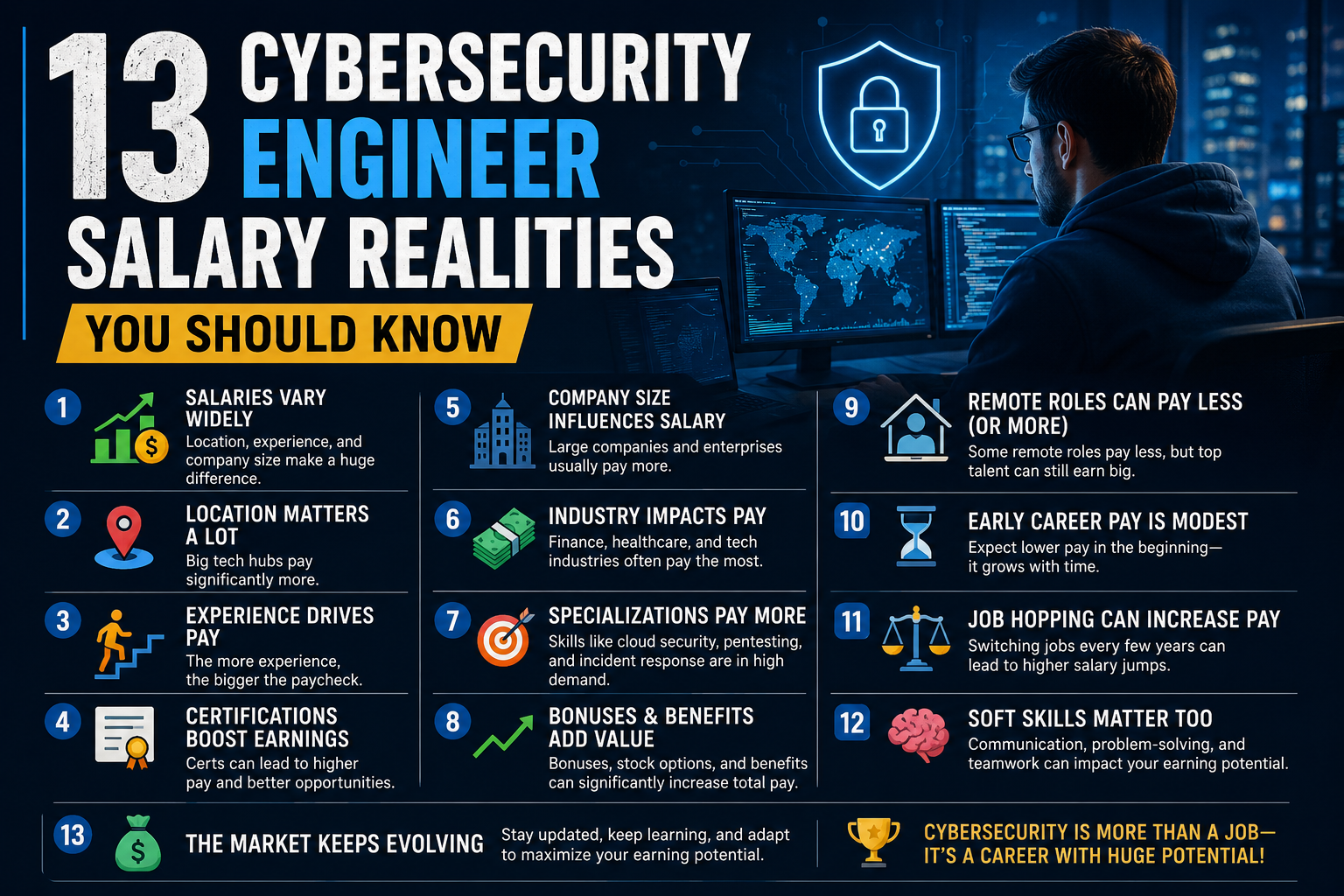
Cybersecurity engineering has become one of the fastest-growing career paths in modern technology. As businesses continue moving their operations online and storing larger amounts of digital information, organizations are investing heavily in security professionals who can protect systems from attacks, breaches, and vulnerabilities. Because of this growing demand, cybersecurity engineers are now among the highest-paid professionals in the IT industry.
When people search online for cybersecurity engineer salaries, they often find wildly different numbers. One website may suggest a salary below six figures, while another claims cybersecurity engineers earn extremely high executive-level incomes. These conflicting figures make it difficult for newcomers to understand what the career truly offers financially.
The reality is much more nuanced. Salaries depend on many variables, including location, experience, certifications, technical specialization, industry demand, and company size. Someone working in a smaller city may earn far less than an engineer with the same title in a major technology hub. Likewise, a cybersecurity engineer working for a global enterprise may earn significantly more than someone supporting a small local business.
Despite those differences, cybersecurity engineering remains one of the most financially rewarding technical careers available today. Many professionals reach six-figure salaries after developing strong technical expertise and gaining real-world experience. Companies continue competing aggressively for qualified security professionals because cyber threats have become increasingly sophisticated and damaging.
The role itself has evolved far beyond traditional antivirus management or password enforcement. Modern cybersecurity engineers design complex security infrastructures, secure cloud environments, automate defensive systems, investigate incidents, and protect organizations from constantly changing attack methods. These responsibilities require specialized skills that are difficult to master, which is one reason salaries continue to rise.
At the same time, there are misconceptions about what cybersecurity engineering actually involves. Some people assume the field is easy money or believe certifications alone guarantee high salaries. Others underestimate the amount of continuous learning required to stay relevant in the industry. Understanding the true nature of the role is important for anyone considering this career path.
This guide explores realistic cybersecurity engineer salaries, the factors influencing compensation, the skills employers value most, and the career paths available within the cybersecurity industry. Instead of relying on inflated salary claims or unrealistic marketing promises, this discussion focuses on practical expectations and the real opportunities available to motivated IT professionals.
What a Cybersecurity Engineer Actually Does
A cybersecurity engineer is responsible for designing, implementing, and maintaining systems that protect organizations from digital threats. Unlike general IT support staff, these professionals focus specifically on security architecture, risk mitigation, and defense strategies.
Their daily responsibilities can vary depending on the organization, but most cybersecurity engineers work with technologies such as firewalls, intrusion detection systems, endpoint protection platforms, cloud security tools, identity management systems, and encryption technologies. They help ensure that sensitive information remains protected from unauthorized access or malicious activity.
Cybersecurity engineers are often involved in planning secure network architectures. They evaluate systems for weaknesses and recommend changes that reduce security risks. In some cases, they also participate in incident response efforts when attacks occur.
The position requires both technical depth and strategic thinking. Security engineers must understand how attackers operate while simultaneously developing defensive controls that minimize vulnerabilities. This balance between offensive awareness and defensive implementation makes the role highly specialized.
In many organizations, cybersecurity engineers also collaborate with software developers to improve application security. They may review code, test systems for vulnerabilities, or help implement secure development practices throughout the organization.
Cloud computing has significantly expanded the responsibilities of cybersecurity engineers in recent years. Many companies now rely on cloud platforms for critical operations, meaning engineers must understand how to secure virtual environments, cloud storage systems, and remote access technologies.
Automation has also become increasingly important. Modern security environments generate massive amounts of data, making manual monitoring inefficient. Engineers who can automate security tasks using scripting languages and security orchestration tools are especially valuable.
Beyond technical work, cybersecurity engineers often help create policies and procedures governing security operations. They may establish password requirements, define access control policies, or assist with compliance efforts related to industry regulations.
Why Cybersecurity Salaries Differ So Much
One of the biggest reasons cybersecurity salary estimates appear inconsistent is because the field itself includes many different specialties and experience levels. Two professionals with the same job title may perform entirely different tasks and receive very different compensation.
Location remains one of the most significant factors affecting salary. Engineers working in large metropolitan areas generally earn more because companies must compete within expensive labor markets. However, higher salaries often come with increased living costs.
Technology hubs such as San Jose, Seattle, and New York typically offer some of the highest cybersecurity salaries in the country. These cities host large technology companies, financial institutions, and enterprise organizations that require advanced security expertise.
Government-focused regions also tend to pay well. Areas surrounding federal agencies and defense contractors often offer strong compensation packages due to the sensitivity of the work involved.
Meanwhile, smaller cities may offer lower salaries but provide better overall affordability. Some professionals prefer these locations because lower housing costs and reduced expenses create a more balanced lifestyle.
Industry type also influences compensation heavily. Financial institutions, healthcare organizations, cloud service providers, and defense contractors frequently pay more than smaller businesses because they face greater security risks and regulatory pressures.
Experience level is equally important. Entry-level professionals typically earn less while they develop practical skills and industry knowledge. Over time, engineers who demonstrate technical competence and leadership ability can progress into significantly higher-paying roles.
Specialized skills create additional salary differences. Engineers with expertise in cloud security, penetration testing, incident response, or security architecture often earn more because those skills are in especially high demand.
The Growing Demand for Cybersecurity Professionals
Cybersecurity has become essential to nearly every industry. Businesses depend on digital infrastructure for communication, operations, customer transactions, and data storage. As a result, cyberattacks can disrupt services, damage reputations, and create massive financial losses.
This increasing reliance on technology has fueled an enormous demand for cybersecurity professionals. Organizations of all sizes are expanding their security teams to address evolving threats and protect sensitive information.
Ransomware attacks, phishing campaigns, and data breaches continue affecting companies worldwide. Attackers constantly develop new techniques to exploit vulnerabilities, forcing organizations to strengthen their defensive capabilities.
At the same time, there are not enough experienced cybersecurity professionals to fill available positions. The workforce shortage has become one of the defining characteristics of the industry.
Because qualified candidates are limited, employers compete aggressively for skilled professionals. This competition contributes directly to rising salaries, signing bonuses, and expanded benefits packages.
The demand extends beyond private companies. Government agencies, educational institutions, hospitals, and nonprofit organizations also require cybersecurity expertise. Even smaller businesses increasingly recognize that they cannot ignore security risks.
Remote work has expanded opportunities even further. Many cybersecurity engineers can now work remotely or in hybrid environments, allowing organizations to recruit talent from broader geographic regions.
The shortage of qualified professionals is expected to continue for years. As technology adoption increases and cyber threats evolve, organizations will likely maintain strong hiring demand for experienced security engineers.
Understanding Realistic Salary Expectations
While cybersecurity engineering can provide excellent financial opportunities, it is important to maintain realistic expectations. Not every cybersecurity professional immediately earns a massive salary after completing a certification course or bootcamp.
Entry-level positions may start with moderate salaries, especially for individuals transitioning from unrelated industries. However, compensation often increases rapidly as professionals gain practical experience and develop specialized expertise.
Many engineers begin their careers in roles such as help desk support, systems administration, network administration, or security analysis before advancing into engineering positions. These foundational experiences help build the technical understanding necessary for higher-level security responsibilities.
Professionals with several years of experience commonly move into six-figure salary ranges, particularly if they work in large organizations or high-demand regions.
Senior cybersecurity engineers, cloud security specialists, security architects, and incident response leaders can earn substantially more. Compensation may also include bonuses, stock options, retirement contributions, and other benefits depending on the employer.
Freelance consulting and contract work can further increase income for experienced professionals with strong reputations and specialized expertise.
Still, achieving high compensation usually requires consistent effort, continuous learning, and adaptability. Cybersecurity is not a field where skills remain static for long periods. Professionals must stay informed about emerging threats, new technologies, and evolving security practices.
The Difference Between Security Analysts and Security Engineers
Many people entering the cybersecurity field initially confuse analysts and engineers because the roles overlap in some areas. However, there are important distinctions between the two positions.
Security analysts typically focus on monitoring and investigation. They review security alerts, analyze suspicious activity, investigate incidents, and respond to threats identified within the environment.
Cybersecurity engineers, on the other hand, are generally more involved in designing and implementing security systems. They create the infrastructure and policies that analysts rely on during monitoring activities.
An analyst may identify a recurring vulnerability, while an engineer develops and deploys the technical solution that addresses the issue permanently.
Engineers also tend to work more extensively with architecture, automation, infrastructure design, and systems integration. Their responsibilities often involve larger-scale technical planning rather than continuous operational monitoring.
Because engineering positions usually require broader technical expertise and more advanced implementation skills, they often command higher salaries than analyst roles.
However, many professionals begin as analysts before transitioning into engineering positions later in their careers. This pathway allows individuals to gain exposure to security operations while building technical experience.
The Importance of Technical Foundations
Cybersecurity engineering requires a strong technical foundation. Unlike some professions where theoretical knowledge alone may be sufficient, security engineering demands practical understanding of how systems operate.
Networking knowledge is especially important. Engineers must understand protocols, routing, switching, firewalls, and segmentation techniques to secure enterprise environments effectively.
Operating systems expertise is equally critical. Security engineers often work extensively with Windows, Linux, and cloud-based systems. Understanding system administration concepts helps engineers identify vulnerabilities and implement defensive controls properly.
Cloud computing has become another foundational area. Organizations increasingly rely on cloud services for infrastructure and applications, making cloud security expertise highly valuable.
Programming and scripting skills also improve career prospects significantly. Engineers who can automate tasks using languages such as Python or PowerShell are often more efficient and valuable to employers.
Knowledge of identity and access management systems has become increasingly important as organizations adopt zero-trust security models and remote work environments.
Database security, endpoint protection, encryption technologies, and vulnerability management all contribute to the broad technical skill set expected from cybersecurity engineers.
Because the field covers so many areas, professionals often spend years developing expertise across multiple domains. This complexity is one reason cybersecurity engineering salaries remain competitive.
Why Continuous Learning Matters
One of the defining characteristics of cybersecurity is constant change. Attack methods evolve continuously, and technologies that were considered secure a few years ago may no longer provide adequate protection today.
As a result, cybersecurity engineers must commit to ongoing education throughout their careers. Employers highly value professionals who stay current with industry trends and emerging technologies.
Continuous learning may involve earning certifications, attending conferences, participating in training programs, reading security research, or practicing new techniques in lab environments.
Engineers who fail to update their skills risk becoming outdated in a rapidly changing industry. Conversely, professionals who continuously expand their expertise often enjoy faster career advancement and higher salaries.
Learning is not limited to technical subjects alone. Leadership, communication, and project management skills become increasingly important as engineers move into senior or managerial roles.
The most successful cybersecurity professionals combine technical depth with adaptability and curiosity. They recognize that cybersecurity is a long-term learning journey rather than a static career path.
Because threats continue evolving, organizations prefer hiring professionals who demonstrate both current expertise and a willingness to continue growing professionally.
Cybersecurity Engineer Salaries Across Major Cities and Industries
Cybersecurity engineering salaries are influenced by far more than a simple job title. While many people searching for career information want a single average number, the reality is that compensation changes dramatically depending on geography, industry, company size, and technical specialization. A cybersecurity engineer working for a financial institution in New York may earn far more than someone with the same title at a smaller regional business in another state. Likewise, engineers supporting cloud infrastructure for global enterprises may command salaries significantly higher than professionals handling basic network security responsibilities.
The growing complexity of cyber threats has forced organizations to invest heavily in security infrastructure and skilled professionals. Businesses now recognize that cybersecurity failures can result in operational downtime, legal consequences, financial losses, and long-term damage to customer trust. Because of this, organizations are increasingly willing to pay premium salaries for experienced engineers capable of protecting critical systems.
However, salary growth in cybersecurity is not automatic. Professionals who reach the highest earning levels usually combine technical expertise, hands-on experience, certifications, communication skills, and strategic thinking. Understanding how these elements interact provides a much clearer picture of what cybersecurity engineers can realistically expect throughout their careers.
This section explores how salaries vary by region and industry, why some locations pay more than others, how company structure influences compensation, and what technical skills contribute most strongly to long-term earning potential.
How Geography Shapes Cybersecurity Salaries
Location remains one of the strongest influences on cybersecurity compensation. Employers set salary ranges partly based on regional living costs and local competition for talent. Areas with strong technology sectors or concentrations of large enterprises tend to offer significantly higher salaries than smaller markets.
Cities with major government operations, financial institutions, or cloud technology companies often pay cybersecurity professionals especially well because the stakes of security failures are extremely high. These organizations cannot afford weak security programs, so they compete aggressively for skilled engineers.
Northern Virginia has emerged as one of the strongest cybersecurity job markets in the United States. The region hosts numerous defense contractors, intelligence agencies, and federal organizations that require advanced security expertise. Engineers working in this environment often earn strong salaries because many positions involve protecting highly sensitive systems and complying with strict regulatory standards.
California also remains a major center for cybersecurity employment. Technology companies throughout Silicon Valley depend heavily on security engineers to protect cloud platforms, applications, customer data, and global infrastructure. Competition among major technology firms contributes to some of the highest salary ranges in the country.
Seattle continues growing as another major technology hub due to the concentration of enterprise cloud providers and software companies. Organizations operating massive cloud environments require specialized security professionals who understand large-scale infrastructure protection and identity management.
New York provides strong cybersecurity opportunities as well, particularly within finance and insurance. Financial institutions manage enormous amounts of sensitive information and face constant targeting from cybercriminals. As a result, they often invest heavily in experienced cybersecurity professionals.
Meanwhile, cities such as Dallas, Charlotte, Phoenix, and Atlanta have become increasingly attractive for cybersecurity careers. Although salaries may not always match those found in Silicon Valley or Manhattan, lower living expenses often create better overall affordability.
Remote work opportunities have also changed salary dynamics in recent years. Some organizations now hire cybersecurity engineers regardless of location, while others adjust salaries based on regional cost-of-living differences. This shift has allowed professionals to pursue high-paying opportunities without necessarily relocating to expensive metropolitan regions.
The Relationship Between Cost of Living and Compensation
High salaries do not always translate into greater financial comfort. Cost of living plays a major role in determining how far income actually stretches in different regions.
For example, a cybersecurity engineer earning a very large salary in California may still face extremely high housing costs, transportation expenses, and taxes. In contrast, someone earning less in a more affordable city may enjoy a similar or even better quality of life.
This is why many professionals evaluate compensation packages holistically rather than focusing only on salary figures. Benefits such as healthcare coverage, retirement contributions, bonuses, stock options, remote flexibility, and professional development support can significantly impact total compensation.
Some cybersecurity engineers intentionally choose mid-sized cities where the balance between salary and living expenses is more favorable. These regions often provide growing technology sectors without the extreme competition and high expenses associated with larger markets.
Remote work has expanded these options even further. Professionals who can work from lower-cost regions while earning salaries tied to larger markets may achieve substantial financial advantages.
Still, some engineers prefer large technology hubs because those environments offer access to cutting-edge projects, larger security teams, and faster career growth opportunities. The right choice often depends on individual career goals, lifestyle preferences, and long-term priorities.
Industries That Pay Cybersecurity Engineers the Most
Not every industry values cybersecurity expertise equally. Some sectors face much greater security risks and regulatory pressures than others, leading to significantly higher salaries for experienced professionals.
Financial services consistently rank among the highest-paying industries for cybersecurity engineers. Banks, investment firms, and payment processors manage highly sensitive financial data while facing constant attacks from cybercriminals. Regulatory requirements further increase the need for sophisticated security programs.
Healthcare organizations also invest heavily in cybersecurity due to the sensitive nature of medical records and patient information. Hospitals and healthcare networks have become frequent ransomware targets, making strong security teams essential for operational continuity.
Cloud computing companies represent another major source of high-paying cybersecurity roles. Organizations operating cloud infrastructure platforms must secure enormous amounts of customer data and maintain reliable global services. Engineers with expertise in cloud security architecture are especially valuable in this environment.
Defense contractors and government agencies often offer strong salaries as well, particularly for professionals with security clearances. Protecting national infrastructure and classified information requires highly specialized expertise and strict compliance standards.
Technology companies developing enterprise software, artificial intelligence platforms, or large-scale digital services also invest heavily in cybersecurity talent. These organizations rely on secure systems to maintain customer trust and business continuity.
Manufacturing and energy industries increasingly require cybersecurity professionals too. Industrial control systems and critical infrastructure networks have become attractive targets for attackers, creating demand for engineers capable of securing operational technologies.
Retail companies, educational institutions, and logistics organizations have also expanded cybersecurity hiring in response to growing threats and digital transformation efforts.
How Company Size Affects Salary Potential
Large enterprises generally offer higher cybersecurity salaries than smaller businesses because they manage more complex environments and face greater exposure to security risks.
Major corporations often maintain dedicated security teams covering multiple specialties, including cloud security, threat intelligence, incident response, identity management, and compliance. Engineers working in these organizations may specialize deeply within a particular domain and receive higher compensation for advanced expertise.
Smaller companies may not have the same budget flexibility, but they sometimes provide broader technical exposure. A cybersecurity engineer at a smaller organization may handle many different responsibilities, gaining diverse experience more quickly.
Startups present another unique situation. Early-stage companies may offer lower base salaries but compensate employees with stock options or equity opportunities. In successful startups, these benefits can become extremely valuable over time.
Large enterprises often provide additional benefits beyond salary, including tuition reimbursement, certification funding, performance bonuses, and retirement matching programs. These advantages can substantially increase total compensation.
However, smaller organizations may offer greater flexibility, reduced bureaucracy, and faster advancement opportunities. Some professionals prefer environments where they can influence security strategy directly rather than operating within highly specialized corporate structures.
Why Cloud Security Skills Command Premium Salaries
Cloud computing has transformed the cybersecurity industry. As organizations migrate infrastructure and applications to cloud environments, the need for engineers with cloud security expertise has grown dramatically.
Securing cloud environments involves much more than traditional network protection. Engineers must understand identity and access management, cloud-native monitoring tools, secure architecture design, encryption practices, and compliance frameworks.
Misconfigured cloud environments have caused many major data breaches in recent years. Organizations recognize the financial and reputational damage these incidents can create, making cloud security expertise especially valuable.
Engineers who understand platforms such as Amazon Web Services, Microsoft Azure, and Google Cloud frequently earn higher salaries because these skills remain in extremely high demand.
Cloud security also requires continuous adaptation because providers regularly introduce new services and features. Professionals who stay current with evolving cloud technologies position themselves strongly for career growth.
Organizations increasingly seek engineers capable of integrating security into automated deployment pipelines and infrastructure-as-code environments. This combination of cloud and automation expertise often commands premium compensation.
The Growing Importance of Security Automation
Modern cybersecurity operations generate enormous amounts of data. Security teams receive alerts from firewalls, endpoint detection systems, cloud monitoring tools, vulnerability scanners, and many other technologies.
Manually reviewing every event is no longer practical in large environments. Because of this, automation has become one of the most valuable skills within cybersecurity engineering.
Engineers who can automate repetitive tasks help organizations improve efficiency, reduce response times, and minimize human error. Automation also allows security teams to focus more attention on strategic analysis and complex threats.
Programming and scripting knowledge play a major role in automation efforts. Languages such as Python and PowerShell are widely used for creating custom tools, automating workflows, and integrating security platforms.
Security orchestration and automation technologies have become increasingly important as organizations attempt to manage growing threat volumes with limited personnel.
Professionals who combine strong security knowledge with automation skills often advance quickly because they help organizations operate more effectively at scale.
Incident Response and Crisis Management Skills
Cybersecurity engineering involves more than prevention alone. Even strong security programs occasionally experience incidents, making response capabilities critically important.
Organizations highly value engineers who can respond calmly and effectively during security crises. Incident response professionals investigate attacks, contain threats, preserve evidence, and help restore normal operations.
The financial impact of security incidents can be enormous. Downtime, regulatory penalties, customer notification requirements, and reputational harm all create significant pressure during breaches.
Because of this, engineers with strong incident response skills often earn higher compensation. Employers want professionals capable of making sound decisions under stressful conditions.
Incident response work also requires strong communication abilities. Engineers must coordinate with executives, legal teams, public relations staff, and external investigators during major events.
Professionals who can combine technical expertise with leadership during crises often move into senior roles more quickly.
Specializations That Increase Earning Potential
Cybersecurity engineering includes many specialized career paths, and some specialties consistently command higher salaries than others.
Application security specialists focus on protecting software from vulnerabilities and exploitation. As organizations rely increasingly on digital applications and APIs, demand for these professionals continues rising.
Penetration testers simulate attacks against systems to identify weaknesses before malicious actors can exploit them. Ethical hacking expertise remains highly respected within the industry.
Identity and access management specialists help organizations control user permissions and authentication systems. As remote work expands, secure identity management has become increasingly important.
Threat intelligence professionals analyze attacker behavior and emerging threats to improve organizational defenses. Their insights help companies prepare proactively for evolving risks.
Security architects design enterprise-wide security frameworks and long-term defense strategies. These senior roles typically require extensive experience and broad technical knowledge.
Digital forensics specialists investigate breaches and recover evidence from compromised systems. Their work is particularly valuable during legal investigations and compliance matters.
Each specialization requires different technical strengths, but all contribute to the diverse career opportunities available within cybersecurity engineering.
The Long-Term Financial Outlook for Cybersecurity Engineers
Cybersecurity remains one of the strongest long-term career fields within technology. Demand continues increasing across industries, and organizations show no signs of reducing security investments.
As technology adoption expands, businesses face growing exposure to cyber threats. Artificial intelligence, cloud computing, remote work, connected devices, and digital transformation initiatives all create new security challenges requiring skilled professionals.
This ongoing demand supports strong salary growth and career stability for experienced cybersecurity engineers. Professionals who continue learning and adapting will likely find abundant opportunities throughout their careers.
Leadership roles provide even greater earning potential. Engineers who develop management, strategy, and communication skills often progress into positions such as security architect, security director, or chief information security officer.
Independent consulting can also become highly lucrative for experienced professionals with strong reputations and specialized expertise.
Although cybersecurity engineering requires significant effort and continuous education, the financial rewards and career opportunities remain extremely attractive for motivated individuals willing to invest in long-term professional growth.
Building a Successful and High-Paying Cybersecurity Engineering Career
Cybersecurity engineering is more than just a well-paying technology career. It is a profession built around protecting organizations, systems, and people from constantly evolving digital threats. As cyberattacks become more advanced and businesses depend increasingly on connected technologies, the role of the cybersecurity engineer continues to expand in both importance and complexity.
The strong salaries associated with cybersecurity engineering reflect this growing responsibility. Organizations are no longer treating security as an optional department or secondary concern. Instead, security has become central to business continuity, customer trust, and long-term organizational survival. Companies now recognize that even a single successful attack can lead to massive financial damage, operational disruption, and reputational harm.
Because of this, cybersecurity engineers have become some of the most valuable professionals in the technology industry. However, high salaries are usually earned through experience, technical expertise, adaptability, and continuous learning rather than quick shortcuts. Professionals who thrive in cybersecurity often dedicate years to building practical skills and understanding how modern systems operate.
This section explores the certifications, career paths, workplace expectations, technical growth opportunities, and long-term strategies that help cybersecurity engineers maximize both career success and earning potential. It also examines how professionals can remain competitive in an industry defined by constant change.
Why Certifications Matter in Cybersecurity
Certifications have become one of the most recognized ways to demonstrate cybersecurity knowledge and commitment to professional growth. Employers frequently use certifications to evaluate technical competence, especially when candidates have limited professional experience.
Unlike some industries where certifications are optional, cybersecurity places significant value on structured training and validated expertise. Because security threats evolve rapidly, organizations want professionals who actively update their knowledge and remain current with modern technologies and defense strategies.
Entry-level certifications help newcomers establish foundational skills. They introduce topics such as network security, risk management, access control, encryption, and threat analysis. These certifications also help candidates develop the vocabulary and conceptual understanding necessary to communicate effectively within technical environments.
As professionals gain experience, more advanced certifications become increasingly valuable. Mid-level and senior certifications often focus on security engineering, cloud security, penetration testing, governance, architecture, and enterprise defense strategies.
Certifications can also influence salary growth. Employers frequently associate advanced certifications with stronger technical capabilities and a greater ability to manage complex environments. In some organizations, specific certifications are tied directly to promotion requirements or salary increases.
Government agencies and defense contractors often require certifications for compliance purposes as well. Professionals pursuing careers in regulated industries may find certifications especially important for accessing higher-paying roles.
However, certifications alone are not enough to guarantee success. Practical experience remains essential. Employers generally prefer candidates who combine certifications with hands-on problem-solving abilities and real-world technical knowledge.
Starting a Career in Cybersecurity Engineering
Very few professionals begin their careers directly as cybersecurity engineers. Most people enter the field through related technology roles that help build foundational skills.
Help desk positions are a common starting point. Although these roles may seem unrelated to cybersecurity at first, they teach critical troubleshooting, communication, and systems support skills. Professionals learn how users interact with technology and gain exposure to common technical problems.
Systems administration is another popular entry path. Managing servers, operating systems, and enterprise infrastructure helps future security engineers understand how systems function internally. This knowledge becomes extremely valuable when identifying vulnerabilities and designing defensive controls.
Network administration provides equally important experience. Cybersecurity engineers must understand how data moves across networks, how firewalls operate, and how attackers exploit networking weaknesses. Professionals with networking backgrounds often transition successfully into security roles.
Security operations center positions also serve as common entry points. Analysts working in these environments monitor alerts, investigate suspicious activity, and respond to incidents. Over time, many analysts move into engineering positions focused on building and improving security systems.
Career progression in cybersecurity is often nonlinear. Some professionals specialize deeply in one area, while others develop broad expertise across multiple domains before moving into leadership positions.
The most successful professionals usually focus on developing strong technical fundamentals before chasing advanced titles or salaries. Understanding systems deeply creates a much stronger long-term foundation than pursuing shortcuts.
The Value of Hands-On Experience
Cybersecurity is an intensely practical field. Employers value real-world experience because security challenges rarely follow predictable patterns. Engineers must solve problems under pressure, adapt to changing threats, and make decisions with incomplete information.
Hands-on experience teaches lessons that cannot be fully learned through textbooks or certification exams alone. Building labs, configuring systems, troubleshooting failures, and responding to incidents all contribute to professional growth.
Many aspiring cybersecurity engineers create home lab environments to practice technical skills. Virtual machines, cloud accounts, networking tools, and open-source security platforms allow individuals to experiment safely and develop practical understanding.
Capture-the-flag competitions and ethical hacking exercises also help professionals sharpen their skills. These activities simulate real-world attack scenarios and improve analytical thinking.
Internships provide another valuable source of experience. Working within actual security teams exposes newcomers to enterprise environments, professional workflows, and collaborative problem-solving.
The ability to discuss practical experiences during interviews often distinguishes strong candidates from those relying solely on theoretical knowledge.
Organizations increasingly prioritize demonstrated capability over academic credentials alone. Professionals who can explain how they solved technical challenges or improved security processes often stand out during hiring evaluations.
Cloud Security and the Future of Cybersecurity Careers
Cloud computing has fundamentally transformed the cybersecurity industry. Organizations now operate increasingly complex environments spread across public clouds, private clouds, hybrid systems, and remote work infrastructures.
As a result, cloud security expertise has become one of the most valuable skill sets within cybersecurity engineering.
Traditional security approaches focused heavily on securing on-premises infrastructure. Modern environments require engineers to protect distributed systems, cloud storage platforms, containerized applications, and identity-based access models.
Cloud security engineers must understand shared responsibility models, cloud-native monitoring tools, secure architecture design, encryption strategies, and compliance frameworks.
Identity and access management has become especially critical in cloud environments. Engineers responsible for securing authentication systems and access permissions often play central roles in enterprise security strategies.
Automation skills have become increasingly important as well. Cloud environments operate at enormous scale, making manual security management inefficient. Engineers who can automate deployments, monitoring, and policy enforcement are highly sought after.
As organizations continue migrating operations to the cloud, professionals with strong cloud security expertise will likely remain among the highest-paid specialists in cybersecurity.
Communication Skills and Leadership Development
Many people assume cybersecurity engineering is purely technical, but communication skills are equally important for long-term success.
Security engineers regularly explain technical risks to executives, project managers, developers, and non-technical employees. The ability to translate complex ideas into clear business language is highly valuable.
Strong communication improves collaboration across departments. Security teams often work closely with software developers, compliance officers, legal teams, and executive leadership during projects and incident response efforts.
Presentation skills also matter. Engineers may deliver security awareness training, explain vulnerabilities during audits, or present recommendations for infrastructure improvements.
Leadership abilities become increasingly important as professionals advance into senior roles. Experienced engineers frequently mentor junior staff, coordinate projects, and help shape organizational security strategies.
Professionals who combine technical depth with strong interpersonal skills often progress into management positions more quickly than purely technical specialists.
Leadership roles typically involve larger compensation packages as well. Security managers, architects, directors, and executives influence enterprise-wide security decisions and often oversee major budgets and strategic initiatives.
The Mental Challenges of Cybersecurity Work
Cybersecurity engineering can be intellectually rewarding, but it can also be mentally demanding. Engineers operate in environments where mistakes may have serious consequences.
Security professionals often manage high-pressure situations involving active threats, system outages, or sensitive investigations. Incident response efforts may require long hours and rapid decision-making.
The field also changes constantly. Engineers must continuously learn new technologies, attack methods, and defensive techniques to remain effective.
This pace can create stress and burnout if professionals fail to maintain balance. Organizations increasingly recognize the importance of supporting employee well-being within security teams.
Successful cybersecurity professionals often develop strong time management, prioritization, and stress management habits. They understand that continuous learning is necessary but also recognize the importance of sustainable work practices.
Despite these challenges, many professionals find cybersecurity deeply fulfilling because the work is meaningful and intellectually engaging. Solving complex problems and protecting organizations from threats can provide a strong sense of accomplishment.
Remote Work and Global Opportunities
Cybersecurity has become one of the most flexible technology careers regarding remote work opportunities. Many security tasks can be performed effectively from remote environments, allowing organizations to recruit talent globally.
Remote work has expanded career possibilities for cybersecurity engineers significantly. Professionals no longer need to live near major technology hubs to access strong opportunities.
This flexibility has also increased competition in some areas while creating opportunities in others. Engineers capable of working independently and communicating effectively in distributed environments often perform especially well.
Global hiring trends continue expanding as organizations struggle to fill cybersecurity positions locally. Some companies now build internationally distributed security teams to access broader talent pools.
Remote work also allows professionals to pursue specialized consulting opportunities, freelance projects, and contract roles across multiple industries.
However, remote security work still requires discipline, strong communication, and effective collaboration. Engineers must remain engaged with teams despite physical distance.
Hybrid work models have become increasingly common as organizations balance flexibility with collaboration needs.
The Importance of Ethical Responsibility
Cybersecurity engineers operate in positions of significant trust. They often have access to sensitive systems, confidential information, and critical infrastructure.
Because of this, ethical behavior is essential within the profession. Organizations rely on security professionals to act responsibly and protect systems rather than exploit them.
Engineers must balance security objectives with privacy considerations, regulatory requirements, and organizational policies. Ethical decision-making becomes especially important during investigations, monitoring activities, and incident response efforts.
The cybersecurity industry places strong emphasis on professional integrity. Violations of trust can destroy careers and damage organizational reputations.
Many certifications and professional organizations include ethical standards that members are expected to follow.
Professionals who consistently demonstrate reliability, discretion, and ethical judgment often gain access to more advanced opportunities and leadership roles.
Career Paths Beyond Cybersecurity Engineering
Cybersecurity engineering can lead to many different long-term career paths. Some professionals remain deeply technical throughout their careers, while others move toward leadership, consulting, or strategic planning roles.
Security architects design enterprise-wide defense strategies and oversee large-scale infrastructure planning. These roles often involve evaluating technologies, establishing standards, and guiding organizational security direction.
Incident response leaders manage investigations and coordinate organizational responses during major security events.
Penetration testing specialists focus on identifying vulnerabilities through simulated attacks and adversarial testing.
Cloud security consultants help organizations secure modern cloud environments and migrate infrastructure safely.
Compliance and governance professionals ensure organizations meet regulatory requirements and industry standards.
Security managers and directors oversee teams, budgets, hiring, and long-term security operations.
Chief information security officers represent the highest executive security positions within organizations. These leaders shape enterprise security strategy, manage risk programs, and communicate directly with executive leadership and boards of directors.
The diversity of available career paths is one reason cybersecurity remains attractive to professionals with different interests and strengths.
Conclusion
Cybersecurity engineering has evolved into one of the most important and financially rewarding careers in the technology industry. As businesses become increasingly dependent on digital systems and online operations, the demand for skilled security professionals continues growing at an extraordinary pace.
While salary figures vary depending on experience, location, industry, and specialization, cybersecurity engineers consistently earn strong compensation compared to many other IT roles. Organizations recognize that effective security programs are essential for protecting customer trust, operational stability, and long-term business success.
However, the field requires far more than technical curiosity alone. Successful cybersecurity engineers commit themselves to continuous learning, practical skill development, adaptability, and ethical responsibility. The profession evolves constantly, and staying relevant demands ongoing education and hands-on experience.
Certifications, cloud expertise, automation skills, communication abilities, and leadership development all contribute to long-term career advancement. Professionals who combine technical depth with strategic thinking often progress into highly influential and well-compensated roles.
Despite the challenges associated with cybersecurity work, including high-pressure situations and continuous change, the career offers strong job stability, intellectual stimulation, and meaningful opportunities to protect organizations from real-world threats.
For motivated individuals willing to invest in learning and professional growth, cybersecurity engineering offers not only impressive earning potential but also a dynamic and future-focused career path with opportunities across virtually every industry in the modern economy.