Modern organizations face constant cyber threats that target networks, applications, cloud environments, and remote users. Businesses rely on secure communication systems to protect sensitive information, maintain operations, and comply with industry regulations. As digital transformation continues, traditional firewalls are no longer enough to defend against sophisticated attacks. Companies now require next-generation security platforms capable of identifying malicious behavior, inspecting encrypted traffic, and adapting to evolving threats in real time.
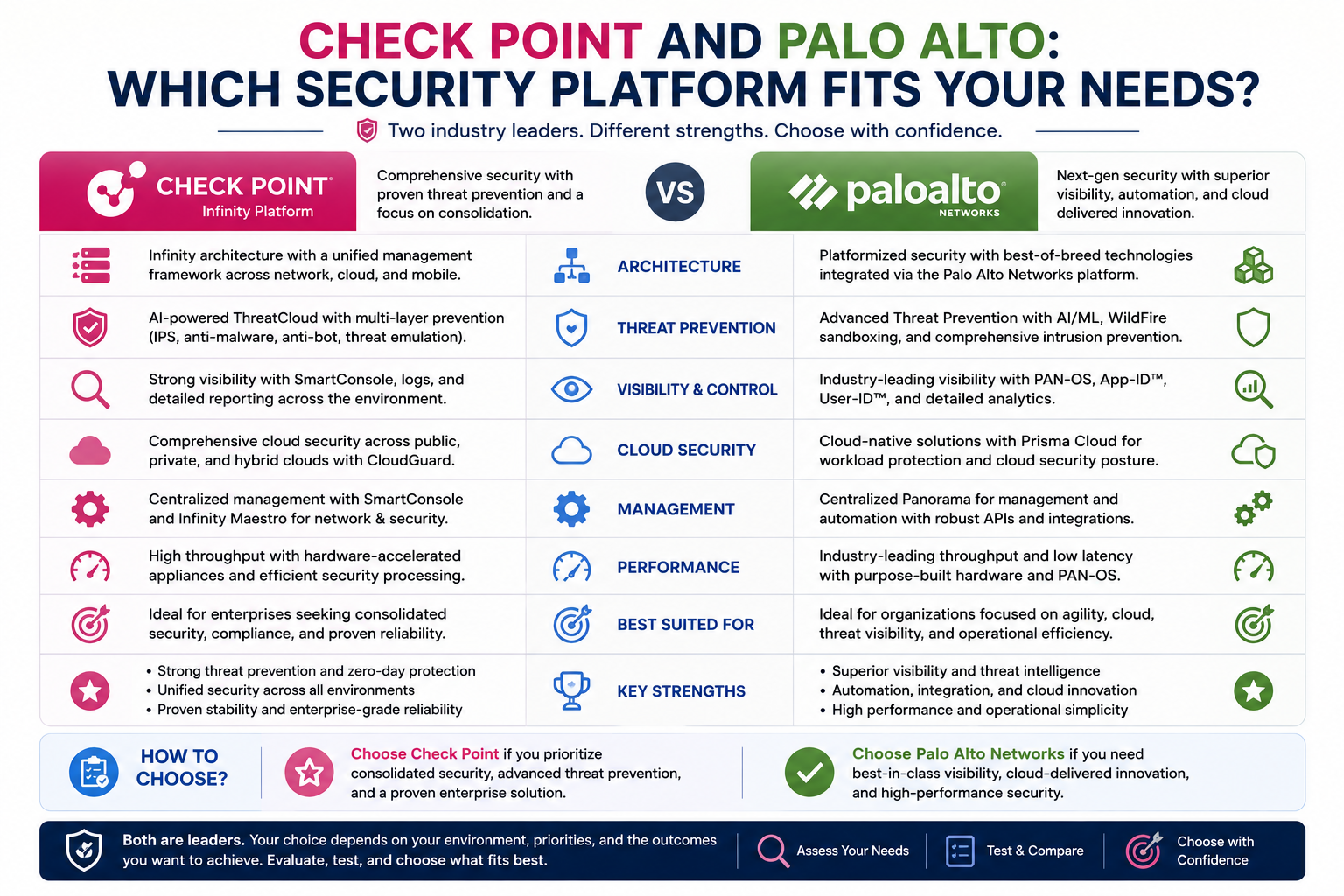
Two of the most respected names in network security are Check Point and Palo Alto Networks. Both companies provide advanced firewall solutions designed to secure enterprise environments, but they approach cybersecurity differently. Their products include next-generation firewall technologies, intrusion prevention systems, application visibility tools, VPN capabilities, cloud security integration, and threat intelligence services. Even though their feature sets appear similar at first glance, their design philosophies and operational methods differ significantly.
Organizations choosing between these platforms must consider several factors, including infrastructure size, cloud adoption, staffing expertise, scalability requirements, management preferences, and long-term operational goals. Understanding the differences between these security vendors helps businesses make informed decisions that support both security and performance.
The Evolution of Network Security
Network security has changed dramatically over the last two decades. Earlier firewall systems focused primarily on controlling traffic based on IP addresses, ports, and protocols. While this approach worked reasonably well in traditional environments, it became less effective as cyber threats evolved.
Modern attackers hide malicious traffic inside trusted applications and encrypted communications. Cloud computing, remote work, mobile devices, and software-as-a-service platforms have expanded the attack surface significantly. Organizations can no longer rely solely on perimeter-based protection.
This shift created demand for next-generation firewalls capable of inspecting traffic at a deeper level. Modern firewalls identify applications, analyze user behavior, inspect encrypted sessions, and integrate threat intelligence feeds that detect emerging attacks.
Check Point and Palo Alto both emerged as major players in this environment, but they chose different strategies for addressing modern security challenges.
Check Point’s Approach to Cybersecurity
Check Point focuses on unified security architecture. The company designs its products around centralized management and layered protection. Instead of deploying separate systems for every security function, organizations can manage multiple capabilities through a single integrated platform.
At the center of Check Point’s architecture is the security gateway. This gateway acts as the core enforcement point for multiple security services, including firewall protection, intrusion prevention, antivirus inspection, application control, VPN services, anti-bot technology, and advanced threat prevention.
Check Point uses modular components known as Security Blades. Organizations can activate specific blades depending on their requirements. This allows businesses to customize protection without deploying entirely separate products.
The modular design supports operational consistency. Administrators can apply policies across data centers, branch offices, remote users, and cloud workloads using centralized controls. Security events from different services are correlated within the same platform, improving visibility and response coordination.
Check Point’s philosophy prioritizes stability, reliability, and granular administrative control. Many large enterprises choose the platform because it supports highly structured security operations and predictable performance.
Palo Alto’s Approach to Cybersecurity
Palo Alto Networks built its reputation by introducing application-aware firewall technology. Instead of relying mainly on ports and protocols, the company developed systems capable of identifying applications regardless of how traffic is routed across the network.
This application-centric model allows organizations to build security policies based on application behavior rather than only network addresses or protocols. The firewall analyzes traffic patterns and determines whether activity aligns with legitimate application behavior.
Palo Alto also emphasizes automation, machine learning, and real-time threat analysis. Its systems continuously evaluate traffic for suspicious behavior and adapt to changing threat conditions automatically.
The platform’s architecture is designed to support modern cloud environments and hybrid infrastructures. Organizations operating dynamic cloud workloads often benefit from Palo Alto’s scalability and integration capabilities.
Palo Alto’s philosophy focuses heavily on visibility, behavioral analysis, and intelligent threat detection. Businesses seeking flexible cloud security and adaptive protection frequently consider Palo Alto a strong option.
Why Architecture Matters in Security Platforms
Firewall architecture influences every aspect of network protection, including traffic inspection, scalability, performance, management complexity, and policy enforcement.
Check Point’s unified architecture centralizes multiple security services into one coordinated system. Security components share information internally, allowing the platform to correlate threats and apply consistent protection policies across environments.
This approach simplifies governance because administrators manage security from a centralized interface. Policy consistency becomes easier to maintain across large infrastructures.
Palo Alto’s architecture prioritizes application intelligence and contextual analysis. Instead of focusing only on packet-level filtering, the platform evaluates application behavior, user activity, and traffic context continuously.
This behavioral focus enables more adaptive security policies and improved visibility into modern application traffic.
The architectural differences between the platforms shape how organizations deploy, manage, and scale their security operations.
Unified Security Management with Check Point
One of Check Point’s strongest advantages is centralized management. Administrators use unified tools to configure policies, monitor events, and enforce security standards across distributed infrastructures.
Organizations operating multiple branch offices, cloud environments, and remote access systems often benefit from centralized governance. Policies can be created once and deployed consistently across all gateways and protected systems.
Centralized management reduces configuration inconsistencies and simplifies compliance auditing. Security teams gain visibility into the entire network through one management environment instead of juggling separate tools.
Check Point’s SmartConsole interface allows administrators to manage firewall rules, VPN configurations, intrusion prevention policies, application controls, and monitoring functions from a single platform.
This integrated structure appeals particularly to enterprises requiring strict policy enforcement and operational consistency.
Application Awareness in Palo Alto
Palo Alto transformed firewall technology by focusing heavily on application identification. Traditional firewalls often struggle when applications use nonstandard ports or encrypted traffic. Palo Alto’s App-ID technology addresses this challenge by identifying applications regardless of port, protocol, or encryption method.
This capability allows administrators to build highly granular policies. Instead of allowing or blocking traffic solely based on ports, organizations can define rules tied directly to application behavior.
For example, companies can allow employees to use collaboration tools while restricting risky features within those applications. Administrators can monitor bandwidth consumption, identify shadow IT usage, and detect abnormal behavior inside trusted applications.
Application awareness improves visibility into network activity and supports zero-trust security models where decisions are based on context rather than static network rules.
Organizations operating cloud-first environments often value this level of application intelligence because modern workloads generate highly dynamic traffic patterns.
Deep Packet Inspection and Threat Prevention
Both Check Point and Palo Alto provide deep packet inspection capabilities, but their methods differ.
Check Point relies on layered inspection engines that analyze traffic against multiple security services simultaneously. Traffic passes through coordinated inspection layers that evaluate signatures, behavior patterns, malware indicators, and policy compliance.
Threat intelligence collected from different components feeds into the broader platform, improving detection accuracy and response coordination.
Check Point’s ThreatCloud service distributes global threat intelligence across customer environments, allowing gateways to block known threats quickly.
Palo Alto focuses more heavily on contextual and behavioral analysis. The platform evaluates how applications and users behave over time, identifying anomalies that could indicate malicious activity.
Machine learning algorithms help distinguish legitimate traffic from suspicious behavior, even when attackers attempt to hide inside trusted communications.
This behavioral approach improves detection of advanced threats that may bypass traditional signature-based systems.
The Importance of Threat Intelligence
Modern cybersecurity depends heavily on threat intelligence. Security platforms must recognize emerging threats quickly and update defenses continuously.
Check Point’s threat intelligence ecosystem shares attack data across gateways and protected environments. When one customer environment identifies malicious behavior, the intelligence can help protect others using the same ecosystem.
The platform integrates threat intelligence directly into inspection processes, allowing administrators to block threats before they spread throughout the network.
Palo Alto also invests heavily in threat intelligence and automation. Its systems continuously analyze threat behavior and distribute updates globally.
Because Palo Alto emphasizes real-time analysis and machine learning, its threat detection capabilities often adapt quickly to evolving attack techniques.
Both vendors recognize that static protection models are no longer sufficient against modern cyber threats.
Cloud Security and Hybrid Infrastructure
Cloud computing has fundamentally changed enterprise networking. Businesses now operate workloads across private data centers, public cloud platforms, and hybrid infrastructures that combine both environments.
Check Point extends its unified security model into cloud environments. Organizations can apply centralized policies to cloud workloads while maintaining consistent governance across local infrastructure.
This approach simplifies administration for businesses transitioning gradually into cloud adoption.
Palo Alto was designed with cloud integration as a major focus. Its systems scale dynamically in response to changing workloads and integrate closely with cloud-native platforms.
Organizations operating large-scale cloud infrastructures often appreciate Palo Alto’s flexibility and automation capabilities.
Cloud security requirements continue to grow as remote work and distributed applications become standard across industries.
Remote Work and Secure Access
Remote work environments create additional security challenges. Employees connect from home networks, mobile devices, and public internet connections that may not provide enterprise-level protection.
Check Point provides integrated VPN services and centralized policy enforcement that help secure remote access environments. Administrators can extend security controls to remote users while maintaining consistent standards across the organization.
Palo Alto supports remote access through cloud-integrated security frameworks and adaptive policy enforcement. The platform evaluates user activity, device behavior, and application context continuously.
Both platforms recognize that modern security must extend beyond traditional office boundaries.
Operational Stability and Reliability
Large enterprises often prioritize operational stability as much as advanced security features. Security systems must function consistently without introducing unnecessary complexity or downtime.
Check Point has built a strong reputation for predictable performance and long-term reliability. Many organizations trust the platform because of its mature architecture and stable operation under demanding workloads.
Palo Alto also delivers strong performance but focuses more on adaptive security behavior and dynamic analysis. This creates greater flexibility but may require teams comfortable managing continuously evolving environments.
The importance of stability varies depending on organizational priorities and infrastructure complexity.
Security Team Skill Requirements
Security platforms differ not only in technical capabilities but also in operational complexity.
Check Point often appeals to organizations with experienced security teams that want detailed control over policies and configurations. The platform provides extensive customization options and granular management capabilities.
However, this level of control may require administrators with deeper technical expertise.
Palo Alto emphasizes streamlined management and user-friendly interfaces. Many organizations find the platform easier to learn and operate, especially in cloud-centric environments.
Smaller teams with limited security staffing may appreciate Palo Alto’s simplified workflows and automation capabilities.
The skill level of the internal security team should influence platform selection decisions.
Performance Under Heavy Workloads
Enterprise networks process enormous amounts of traffic, including encrypted communications, cloud application data, video conferencing traffic, and remote access sessions.
Check Point distributes traffic loads across multiple gateways, maintaining steady performance under heavy demand. Its architecture is particularly effective in large enterprise and data center environments where consistent throughput is critical.
Palo Alto dynamically allocates resources according to changing traffic patterns. This elasticity supports environments where traffic spikes occur unpredictably.
Organizations handling variable cloud workloads may benefit from Palo Alto’s adaptive scaling capabilities.
Performance testing remains an important part of evaluating either platform.
Long-Term Security Strategy Considerations
Choosing a firewall platform is a long-term strategic decision. Organizations typically maintain security infrastructure for many years, making scalability and future compatibility important considerations.
Check Point’s centralized governance model supports businesses seeking structured long-term security operations. The platform scales effectively in large enterprise environments and supports extensive policy standardization.
Palo Alto aligns closely with organizations prioritizing cloud transformation, automation, and adaptive security frameworks.
Businesses should evaluate not only current requirements but also future infrastructure plans, staffing models, and digital transformation goals before selecting a platform.
Understanding Modern Threat Prevention
Cyber threats have become far more advanced than they were just a few years ago. Attackers no longer rely only on simple malware or direct network attacks. Today’s cybercriminals use encrypted traffic, phishing campaigns, ransomware, supply chain compromises, and stealth techniques designed to bypass traditional security controls. Organizations need intelligent systems capable of identifying threats before damage occurs.
Both Check Point and Palo Alto provide advanced threat prevention capabilities, but they use different methods to detect and respond to malicious activity. Their approaches reflect their broader security philosophies and influence how organizations manage protection across networks, cloud services, applications, and remote environments.
Threat prevention is one of the most important areas to examine when comparing these two platforms because it directly affects an organization’s ability to stop attacks, reduce risk, and maintain business continuity.
Check Point’s Layered Security Model
Check Point approaches threat prevention through a layered security architecture. Every packet moving through the network passes through multiple inspection engines designed to evaluate traffic from different perspectives.
This layered model creates coordinated protection across firewall filtering, intrusion prevention, anti-malware analysis, anti-bot detection, URL filtering, application control, sandboxing, and threat intelligence systems. Instead of relying on a single security engine, Check Point combines several defensive technologies into one unified process.
The platform’s Security Blades allow organizations to enable specific protections according to their operational needs. Businesses can customize security policies while maintaining centralized visibility and control.
Because all security functions operate within the same ecosystem, the platform correlates information from different inspection layers. If suspicious behavior appears in one area of the network, other security services immediately receive that intelligence.
This coordinated approach helps organizations identify attacks earlier and reduces the likelihood of isolated security gaps.
ThreatCloud and Global Threat Intelligence
One of Check Point’s most important capabilities is its ThreatCloud intelligence platform. ThreatCloud gathers security data from global sources and distributes threat intelligence updates across customer environments.
When new malware, ransomware, phishing domains, or attack patterns appear, ThreatCloud updates protection systems rapidly. Security gateways receive new intelligence automatically, helping organizations defend against emerging threats without waiting for manual updates.
ThreatCloud also improves visibility into attack trends. Administrators gain insight into threat origins, attack techniques, and targeted vulnerabilities through centralized reporting tools.
This global intelligence-sharing model allows organizations to benefit from collective threat analysis. If one network encounters a previously unseen attack, other networks using the platform can receive protection against similar threats quickly.
Threat intelligence has become essential because cyber threats evolve continuously. Security systems that fail to adapt rapidly leave organizations vulnerable to emerging attacks.
Palo Alto’s Behavioral Threat Detection
Palo Alto takes a more behavior-focused approach to threat detection. Instead of relying primarily on signatures or static inspection methods, the platform evaluates how applications, users, and traffic behave over time.
The firewall analyzes communication patterns, user activity, application behavior, and data flows to determine whether activity appears legitimate or suspicious. This allows the system to identify threats hidden inside encrypted or trusted traffic.
Machine learning and artificial intelligence play major roles in Palo Alto’s detection strategy. The platform continuously evaluates traffic against behavioral baselines and identifies anomalies automatically.
For example, if an application suddenly begins transmitting unusual amounts of data or communicating with suspicious destinations, the system may flag the behavior even if no known malware signature exists.
This adaptive detection model improves visibility into sophisticated attacks that attempt to evade traditional security tools.
Application Visibility and Traffic Awareness
Application visibility is one of Palo Alto’s defining strengths. Traditional firewalls often struggle to identify applications using dynamic ports, encryption, or tunneling techniques. Palo Alto’s App-ID technology solves this problem by identifying applications regardless of how traffic is structured.
This capability provides administrators with detailed insight into network activity. Security teams can monitor which applications users access, how much bandwidth applications consume, and whether applications behave unexpectedly.
Granular application visibility allows organizations to create highly specific security policies. Businesses can allow certain application functions while blocking others, reducing unnecessary exposure.
For example, organizations may allow employees to use collaboration software while restricting risky file-sharing functions. Administrators can also detect unauthorized applications that employees install without approval.
Application awareness improves both security and operational visibility, especially in environments where cloud applications dominate daily workflows.
Zero-Day Threat Protection
Zero-day attacks target vulnerabilities that security vendors have not yet patched or fully documented. These attacks are particularly dangerous because traditional signature-based systems may fail to recognize them.
Check Point addresses zero-day threats through advanced sandboxing and threat emulation technologies. Suspicious files and behaviors are analyzed in isolated environments before they reach production systems.
Threat emulation allows the platform to observe how files behave during execution. If malware attempts to modify systems, communicate externally, or encrypt files, the platform blocks the activity before it spreads.
Palo Alto also uses sandboxing and behavioral analysis to identify unknown threats. The platform’s machine learning systems evaluate suspicious activity patterns and compare them against known attack behaviors.
Because Palo Alto emphasizes behavioral analysis heavily, it can sometimes detect previously unknown threats based on abnormal activity rather than relying solely on signatures.
Zero-day protection is critical for organizations handling sensitive data or operating in industries frequently targeted by cybercriminals.
Encrypted Traffic Inspection
Encrypted traffic presents a major challenge for modern cybersecurity systems. Many attackers hide malicious content inside encrypted communications to avoid detection.
Both Check Point and Palo Alto support encrypted traffic inspection, but their approaches differ slightly.
Check Point emphasizes stable and consistent encrypted traffic inspection across large enterprise environments. The platform can decrypt traffic, inspect its contents, apply policies, and then re-encrypt sessions before forwarding traffic to users.
This process allows organizations to maintain visibility into encrypted communications while enforcing security standards consistently.
Palo Alto integrates encrypted traffic analysis closely with its application-awareness framework. The platform evaluates application behavior within encrypted sessions and identifies anomalies based on contextual analysis.
Encrypted traffic inspection has become increasingly important as more applications and websites use HTTPS and other encryption protocols by default.
Organizations that fail to inspect encrypted traffic risk allowing hidden threats to bypass perimeter defenses.
Intrusion Prevention Systems
Intrusion prevention systems detect and block attempts to exploit vulnerabilities or compromise systems.
Check Point integrates intrusion prevention directly into its layered security architecture. The IPS engine evaluates traffic against known attack signatures and suspicious behavior patterns.
Administrators can customize inspection sensitivity, prioritize specific protections, and apply policies across distributed environments centrally.
The unified management structure simplifies policy deployment and reduces administrative fragmentation.
Palo Alto integrates intrusion prevention into its broader behavioral analysis framework. Instead of treating IPS as a separate component, the platform combines intrusion detection with application analysis and threat intelligence.
This integrated approach improves visibility into complex attack chains that involve multiple stages or application-level exploitation techniques.
Both vendors provide strong intrusion prevention capabilities, but their operational workflows differ depending on management preferences.
Managing Security Across Large Networks
Enterprise security environments often span multiple locations, cloud platforms, branch offices, and remote users. Managing policies consistently across such environments can become extremely challenging.
Check Point addresses this challenge through centralized management tools designed for enterprise-scale operations. Administrators can deploy policies across thousands of systems while maintaining consistent enforcement standards.
The SmartConsole interface allows security teams to manage firewall rules, VPNs, intrusion prevention policies, application controls, and monitoring functions from one location.
Centralized management reduces operational complexity and improves compliance auditing.
Palo Alto uses its Panorama management platform to centralize administration across distributed infrastructures. Panorama emphasizes visual management, streamlined workflows, and operational simplicity.
The platform provides interactive dashboards, traffic visualization tools, and centralized reporting functions that help administrators monitor activity efficiently.
Organizations should evaluate which management style aligns better with their operational culture and staffing capabilities.
User Experience and Administrative Simplicity
Administrative usability plays a major role in day-to-day security operations. Complex systems can increase training requirements and slow incident response.
Check Point offers extensive configuration flexibility and deep customization options. Experienced security teams often appreciate the platform’s granular control.
However, this level of detail can create a steeper learning curve for administrators unfamiliar with enterprise security systems.
Palo Alto generally emphasizes simplicity and intuitive management. Many administrators find its interfaces easier to navigate and its workflows more streamlined.
The platform often appeals to organizations seeking operational efficiency without sacrificing advanced security capabilities.
User experience becomes especially important for organizations with smaller security teams or limited specialized expertise.
Incident Response and Security Visibility
Rapid incident response is essential during cyberattacks. Security teams need accurate information, clear alerts, and centralized visibility to contain threats quickly.
Check Point provides detailed reporting and event correlation tools that help administrators understand attack timelines and affected systems.
Because security services operate within a unified ecosystem, administrators can investigate incidents through centralized interfaces instead of piecing together information from disconnected systems.
Palo Alto emphasizes real-time visibility and contextual analysis. Its dashboards display application activity, user behavior, and threat indicators visually, helping analysts identify suspicious patterns quickly.
Behavioral analysis also improves visibility into advanced attacks that evolve gradually over time.
Both platforms support automated responses and centralized logging, but their reporting styles differ.
Remote Access Security
Remote work environments have expanded dramatically in recent years. Employees now access corporate systems from home networks, mobile devices, hotels, and public internet connections.
Check Point integrates VPN functionality directly into its unified security framework. Organizations can enforce consistent policies across remote and on-premises users alike.
Centralized policy management simplifies remote access governance and improves compliance enforcement.
Palo Alto approaches remote access through adaptive security principles. The platform evaluates user identity, application context, device posture, and behavioral indicators continuously.
This adaptive model aligns closely with zero-trust security strategies where access decisions depend on ongoing verification rather than static trust assumptions.
Remote access security remains a critical consideration for modern enterprises operating distributed workforces.
Cloud-Native Security Integration
Cloud adoption continues reshaping enterprise infrastructure. Security platforms must integrate effectively with cloud providers and support dynamic workloads.
Check Point extends centralized governance into cloud environments while maintaining consistent policies across hybrid infrastructures.
Organizations transitioning gradually to cloud services often appreciate this unified management approach.
Palo Alto focuses heavily on cloud-native integration and dynamic scalability. Its systems adapt automatically to changing cloud workloads and traffic patterns.
The platform integrates deeply with modern cloud architectures, making it attractive for businesses operating heavily in public cloud environments.
Cloud security capabilities should align with an organization’s broader digital transformation strategy.
Automation and Artificial Intelligence
Automation plays an increasingly important role in cybersecurity operations. Security teams face growing workloads and must respond quickly to evolving threats.
Check Point supports automation through centralized policy deployment, coordinated threat intelligence, and integrated management tools.
Palo Alto places stronger emphasis on machine learning and automated behavioral analysis. The platform continuously evaluates traffic patterns and adjusts threat detection models automatically.
Automation reduces manual workloads and improves response speed during attacks.
Organizations should evaluate how much operational automation they require and how comfortable their teams are managing AI-driven security systems.
Compliance and Regulatory Considerations
Many industries must comply with strict security regulations governing data protection, access control, and monitoring practices.
Check Point’s centralized governance model supports detailed policy enforcement and audit visibility. Organizations can demonstrate consistent security controls across distributed infrastructures.
Palo Alto also supports compliance reporting and monitoring, particularly in cloud-centric environments where dynamic workloads create additional complexity.
Compliance requirements often influence firewall selection decisions, especially in regulated industries such as healthcare, finance, and government.
Scalability and Long-Term Operations
Security infrastructure must scale alongside business growth. Organizations need platforms capable of supporting increased traffic, additional users, cloud expansion, and evolving security requirements.
Check Point scales effectively in large enterprise environments through gateway clustering and centralized policy management.
Palo Alto scales dynamically according to workload demands, particularly in cloud-heavy infrastructures.
Businesses should evaluate future growth plans when selecting a security platform because replacing firewall infrastructure later can be expensive and disruptive.
Choosing the Best Operational Fit
Both Check Point and Palo Alto provide advanced threat prevention, centralized management, and enterprise-grade security capabilities.
However, operational fit depends on organizational priorities.
Check Point appeals strongly to enterprises seeking stability, centralized governance, layered protection, and detailed administrative control.
Palo Alto appeals to organizations prioritizing application visibility, behavioral analysis, cloud-native flexibility, and operational simplicity.
The best platform depends not only on technical capabilities but also on staffing models, management preferences, cloud strategies, and long-term business objectives.
The Importance of Performance in Enterprise Security
Performance is one of the most critical factors when evaluating a next-generation firewall platform. Security systems sit directly in the path of network traffic, meaning their speed and efficiency affect every user, application, cloud service, and business process connected to the network. A poorly performing firewall can create latency, slow applications, disrupt remote access, and reduce productivity across the organization.
Modern enterprises generate enormous volumes of traffic every second. Video conferencing platforms, cloud applications, file transfers, virtual private networks, streaming services, and encrypted communications all place heavy demands on network infrastructure. Security platforms must inspect this traffic thoroughly without becoming bottlenecks.
Check Point and Palo Alto both deliver enterprise-grade performance, but they approach traffic processing and scalability differently. Their architectural philosophies influence how they manage encrypted traffic, cloud workloads, application visibility, and high-volume network operations.
Organizations selecting between the two platforms should understand not only their raw throughput capabilities but also how they behave under real-world workloads.
Check Point’s Performance Philosophy
Check Point focuses heavily on stability and consistent performance. The platform is designed to maintain predictable throughput even when security services are heavily utilized. This approach appeals to enterprises that require reliability under demanding operational conditions.
Large organizations often process massive amounts of encrypted traffic while simultaneously running intrusion prevention, malware inspection, application control, VPN services, and threat intelligence updates. Check Point’s architecture is optimized to distribute workloads efficiently across multiple gateways.
Instead of relying primarily on dynamic scaling mechanisms, Check Point emphasizes structured load balancing and coordinated gateway clustering. This design helps organizations maintain steady performance during periods of heavy traffic.
Data centers, financial institutions, healthcare systems, and government networks frequently value this predictable operational behavior because performance fluctuations can affect critical business services.
Check Point also prioritizes deep inspection efficiency. The platform inspects encrypted traffic, analyzes application activity, and applies layered security controls while maintaining consistent network responsiveness.
For enterprises operating complex hybrid environments with thousands of users, stable inspection performance becomes extremely important.
Palo Alto’s Performance Philosophy
Palo Alto approaches performance with greater emphasis on flexibility and adaptive scaling. Its architecture is designed to support highly dynamic environments where traffic patterns change rapidly throughout the day.
Cloud workloads, remote access systems, and application-heavy infrastructures often generate unpredictable traffic spikes. Palo Alto’s systems dynamically allocate resources according to demand, helping organizations maintain performance during sudden usage increases.
The platform’s application-aware architecture also affects performance optimization. Because Palo Alto identifies applications directly instead of relying solely on ports and protocols, it can prioritize and manage traffic more intelligently.
For example, organizations may choose to prioritize critical business applications while limiting bandwidth for lower-priority traffic. This improves operational efficiency and user experience.
Palo Alto’s cloud-native integration capabilities also support scalability across distributed environments. Organizations operating large cloud infrastructures often benefit from the platform’s elasticity and automated resource management.
Businesses adopting modern cloud architectures frequently prioritize flexibility over rigid infrastructure consistency, making Palo Alto an attractive option.
Handling Encrypted Traffic at Scale
Encrypted traffic continues to grow across enterprise networks. Most modern applications, websites, APIs, and cloud services use HTTPS or other encryption protocols by default. While encryption improves privacy and security, it also creates challenges for inspection systems.
Firewalls must decrypt traffic, inspect its contents, apply security policies, and re-encrypt communications before forwarding them to users. This process consumes significant processing power.
Check Point addresses this challenge through hardware optimization and distributed inspection models. The platform spreads workloads across gateways to maintain inspection performance during heavy encrypted traffic loads.
Organizations processing high volumes of secure communications often appreciate this consistency because inspection bottlenecks can slow application performance dramatically.
Palo Alto integrates encrypted traffic inspection with its application-awareness engine. The system evaluates application behavior and contextual indicators alongside decryption processes.
This contextual inspection improves visibility into modern threats hiding within encrypted traffic, especially attacks disguised as legitimate application activity.
As encryption usage continues growing, inspection performance will remain a major factor in firewall selection decisions.
Scalability in Growing Enterprises
Enterprise infrastructures rarely remain static. Organizations expand into new markets, add employees, adopt cloud platforms, deploy remote work systems, and integrate additional applications over time.
Security infrastructure must scale alongside business growth without forcing organizations to redesign their entire networks.
Check Point supports scalability through gateway clustering and centralized policy management. Organizations can distribute workloads across multiple gateways while maintaining unified policy enforcement.
This approach allows businesses to expand security capacity gradually while preserving operational consistency.
Large enterprises often appreciate the ability to scale infrastructure predictably because major architectural changes can introduce operational risks.
Palo Alto supports scalability through dynamic resource allocation and cloud integration. The platform can adjust resources automatically according to changing workloads and traffic demands.
This elasticity benefits organizations experiencing rapid cloud adoption or fluctuating traffic patterns.
Businesses operating seasonal services, large remote workforces, or cloud-heavy infrastructures may find dynamic scaling particularly valuable.
Performance in Hybrid Cloud Environments
Hybrid cloud environments combine on-premises infrastructure with public and private cloud platforms. These environments create unique performance and security challenges because traffic flows constantly between multiple locations.
Check Point extends centralized policy management into hybrid infrastructures, allowing organizations to maintain consistent security controls across local and cloud systems.
The platform’s structured architecture supports stable connectivity between environments and simplifies governance across distributed workloads.
Palo Alto was designed with cloud integration as a central priority. Its systems adapt dynamically to changing traffic flows between cloud services and local infrastructure.
Cloud-native scalability and application visibility help organizations maintain performance across highly distributed environments.
The increasing popularity of hybrid cloud models makes this area particularly important for long-term infrastructure planning.
Remote Work and Network Performance
Remote work has transformed enterprise networking. Employees now access corporate systems from homes, hotels, airports, and mobile devices across the world.
Remote access security systems must handle encrypted VPN traffic, cloud application access, collaboration tools, and video conferencing platforms simultaneously.
Check Point integrates VPN functionality directly into its unified security architecture. Organizations can enforce centralized policies across remote and local users while maintaining consistent performance standards.
Gateway clustering and traffic distribution help support large remote workforces without sacrificing stability.
Palo Alto supports remote work through adaptive cloud-integrated security frameworks. The platform evaluates user identity, application activity, and traffic behavior continuously while dynamically adjusting resources as needed.
Organizations with highly distributed workforces may value Palo Alto’s flexible scaling capabilities.
Remote work environments continue evolving, making secure and reliable remote access performance increasingly important.
Traffic Visibility and Monitoring
Visibility into network traffic helps organizations optimize performance and identify operational issues quickly.
Check Point provides centralized monitoring tools that display traffic activity, security events, and policy enforcement across distributed infrastructures.
Administrators can analyze bandwidth usage, application activity, threat detection events, and user behavior through unified dashboards.
Palo Alto emphasizes visual analytics and application-level visibility. Its interfaces provide detailed insight into how applications consume bandwidth and interact across the network.
This application-focused visibility helps organizations troubleshoot performance issues and optimize resource allocation more effectively.
Performance monitoring plays a major role in maintaining efficient network operations over time.
Operational Simplicity and Administrative Efficiency
Security teams must balance advanced protection with manageable operational complexity. A platform offering powerful features but difficult management may increase administrative workloads unnecessarily.
Check Point provides extensive customization and detailed policy controls. Large enterprises with experienced security teams often value this level of granularity because it supports precise governance.
However, highly detailed configuration environments can require additional training and administrative effort.
Palo Alto generally focuses more heavily on simplified workflows and intuitive management experiences. Many organizations find the platform easier to deploy and operate.
Automation and visual management tools reduce manual workloads and improve operational efficiency.
Organizations should evaluate how much customization they require compared to how much simplicity they prefer.
High Availability and Business Continuity
Downtime can create severe financial and operational consequences for modern businesses. Security systems must support continuous availability even during hardware failures or traffic surges.
Check Point supports high availability through clustered gateway architectures that distribute workloads and provide failover protection.
If one gateway experiences issues, traffic automatically shifts to other available gateways, minimizing service interruptions.
Palo Alto also provides high availability features and dynamic workload balancing. The platform supports automated failover and elastic scaling across cloud environments.
Business continuity planning should include evaluating how each platform handles failures, maintenance events, and unexpected traffic spikes.
Reliable failover systems help organizations maintain operations during emergencies.
Licensing Models and Cost Structure
Cost is always a major consideration when selecting enterprise security infrastructure. However, evaluating firewall costs requires looking beyond initial purchase prices.
Organizations must consider licensing models, subscription costs, maintenance expenses, operational efficiency, staffing requirements, and scalability costs over time.
Check Point often appeals to large enterprises because its centralized architecture can reduce operational fragmentation and support long-term scalability.
Organizations may pay higher initial deployment costs but benefit from predictable scaling models and integrated management.
Check Point’s modular Security Blade approach also allows businesses to activate only the services they require.
Palo Alto generally positions itself as a premium platform focused on advanced capabilities and cloud-native features.
Subscription-based licensing often includes continuous updates, advanced threat intelligence services, and cloud integration capabilities.
Organizations prioritizing cutting-edge threat detection and automation may consider the additional investment worthwhile.
The total cost of ownership depends heavily on organizational size, infrastructure complexity, staffing levels, and operational priorities.
Staffing and Skill Requirements
Security infrastructure affects staffing requirements significantly. Complex systems may require highly specialized administrators, while simpler platforms can reduce training burdens.
Check Point often appeals to organizations with experienced security teams capable of managing detailed configurations and large-scale policy environments.
The platform provides extensive control, but administrators may need deeper technical expertise to maximize its capabilities fully.
Palo Alto emphasizes streamlined workflows and user-friendly management. Smaller teams or organizations with limited specialized expertise may find the platform easier to manage efficiently.
Automation and simplified interfaces can reduce operational overhead and improve deployment speed.
Staffing capabilities should influence platform selection decisions because operational complexity affects long-term efficiency.
Security for Large Enterprises
Large enterprises face unique security challenges involving massive user populations, distributed infrastructures, compliance requirements, and extensive cloud adoption.
Check Point has built a strong reputation in large enterprise environments because of its centralized governance and operational consistency.
Organizations managing thousands of devices and multiple global locations often appreciate the platform’s unified policy management capabilities.
Palo Alto also supports large enterprises effectively, particularly organizations emphasizing cloud transformation and application visibility.
The platform’s adaptive architecture and automation capabilities align well with modern digital transformation strategies.
Enterprise-scale deployments require careful evaluation of scalability, management efficiency, and long-term operational flexibility.
Security for Cloud-First Organizations
Cloud-first organizations prioritize agility, scalability, and dynamic infrastructure management.
Palo Alto’s cloud-native design makes it especially attractive for businesses heavily invested in public cloud services and distributed workloads.
The platform integrates deeply with cloud providers and supports automated scaling according to workload demand.
Check Point also supports cloud environments effectively but often appeals more strongly to organizations seeking centralized governance across hybrid infrastructures.
Cloud strategy should strongly influence firewall selection decisions because infrastructure direction affects long-term operational requirements.
Balancing Innovation and Stability
Every organization must balance innovation with operational reliability.
Check Point prioritizes stable, predictable operations and mature enterprise management capabilities. Organizations valuing consistency and long-term reliability often appreciate this approach.
Palo Alto emphasizes innovation, automation, machine learning, and adaptive security models. Businesses prioritizing advanced threat detection and cloud-native flexibility may prefer this strategy.
Neither philosophy is universally better. The right choice depends on organizational culture, infrastructure goals, and operational priorities.
Evaluating Long-Term Security Strategy
Selecting a firewall platform is not simply a technical decision. It is a long-term strategic investment that affects operational workflows, staffing, scalability, compliance, and infrastructure planning.
Organizations should evaluate how each platform aligns with future business growth, cloud adoption plans, remote work strategies, and cybersecurity objectives.
Testing both platforms in real-world environments provides valuable insight beyond specifications and marketing materials.
Hands-on evaluation helps organizations understand management complexity, visibility, scalability, and operational fit more accurately.
Conclusion
Check Point and Palo Alto both represent powerful and highly respected cybersecurity platforms capable of protecting modern enterprise environments against sophisticated threats.
Check Point stands out for its unified security architecture, centralized management, operational stability, and enterprise-scale consistency. Organizations seeking structured governance, predictable performance, and granular administrative control often find Check Point highly effective.
Palo Alto distinguishes itself through application awareness, behavioral analysis, cloud-native flexibility, automation, and adaptive threat detection. Businesses prioritizing modern cloud integration, application visibility, and streamlined management frequently view Palo Alto as an excellent choice.
The decision between the two platforms depends on organizational priorities rather than simple feature comparisons. Infrastructure design, cloud adoption strategy, staffing expertise, operational preferences, scalability needs, and long-term business goals all influence which platform fits best.
No single platform is ideal for every organization. The most successful deployments occur when businesses carefully evaluate their technical requirements, operational workflows, security objectives, and future growth plans before making a final decision.
Ultimately, the strongest cybersecurity strategy comes not only from selecting advanced technology but also from implementing that technology effectively within the organization’s broader operational and security framework.